Knife Steel Types for Under-$30 Knives: The steel grade and hardness rating (HRC) determine everything a budget knife delivers — edge retention, sharpening frequency, and rust resistance.
Three steel types define this price range:
- X50CrMoV15 — a German stainless steel used by brands like Victorinox and Wüsthof in entry-level lines, hardened to 55–56 HRC, balancing corrosion resistance with reliable edge stability
- 420HC — a higher-carbon variant of the 420 family, favored by Buck Knives in their Made-in-USA EDC line, offering better edge retention than standard 420J2 while staying rust-resistant
- 420J2 — the most common steel in budget imports sold through retailers like Walmart and Amazon Basics kitchen sets, softer HRC means the blade dulls faster but resharpens quickly at home
X50CrMoV15 holds its edge longer than 420J2. Buck Knives uses 420HC because it sharpens fast and resists corrosion in humid climates, making it a practical choice for local outdoor supply stores like Bass Pro Shops. A listing showing only “German steel” without a grade or HRC number signals a marketing claim. Avoid those knives.
Interesting Fact: Buck Knives developed their proprietary 420HC heat treatment process in-house, pushing the steel beyond its standard hardness ceiling and outperforming many knives sold at twice the price.
Key Points
- Under-$30 knives usually use X50CrMoV15 (~420MoV) for balanced rust resistance, toughness, and practical edge life.
- Compare steels by HRC: aim roughly 54–58 HRC; higher hardness holds edges longer but increases chipping risk.
- 420J2 is softer (~52–54 HRC) with faster dulling; 420HC is harder (~55–58 HRC) and generally retains edges better.
- 1095 and other high-carbon steels sharpen well and keep an edge, but rust quickly and need more maintenance.
- For listings, prioritize explicit steel names and HRC; vague “German steel” or “ultra-hard” claims are unreliable without heat-treatment details.
The 4 Steel Types You’ll See at the Under-$30 Tier
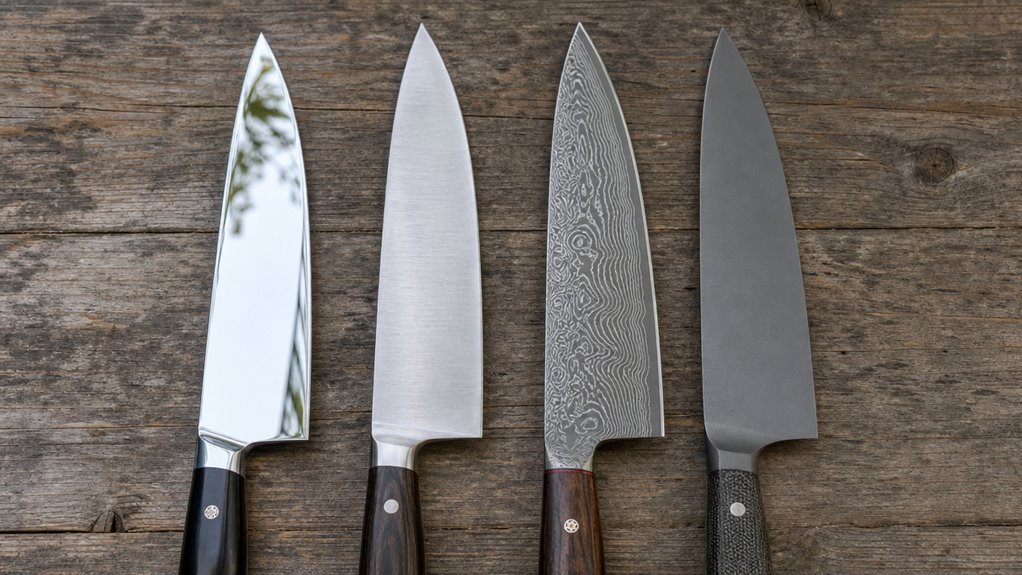
When you shop under $30, you’ll mostly run into four steel families: X50CrMoV15 (the Victorinox/Wüsthof-ish standard), 420HC/420J2 (big-box staples), simple carbon steels like 1095, and the occasional “near-$30” stainless (think AUS-8 or 14C28N).
X50CrMoV15 is the balanced daily-driver—good rust resistance and edge life—while the trade-off is you’ll still need normal care like hand-drying to avoid spots. 14C28N is essentially AEB-L with improved corrosion resistance and similar hardness potential.
Wear resistance is one reason these steels can feel like they have different “edge life,” since higher wear resistance generally makes sharpening harder due to greater abrasion resistance.
420J2 sharpens easily but tends to dull fast, 1095 holds an edge better yet rusts unless you oil and dry it, and stainless “mystery” listings usually hide one of these basics.
X50CrMoV15 (The Victorinox and Wusthof Standard)
X50CrMoV15 is the boring-but-useful stainless steel that shows up in a lot of the under-$30 “reliable” knives you actually see used day to day, especially Victorinox and Wusthof.
X50CrMoV15,stainless steel gives you solid edge retention: about 55–56 HRC, tempered martensite, and ~15% chromium for rust resistance. X50CrMoV15 is a high-hardness martensitic stainless steel used predominantly in strip form for knife blades. It’s a German martensitic stainless steel DIN 1.4116, known in shorthand as ~AISI 420MoV.
It’s easy to sharpen, but MoV still won’t match high-end vanadium steels.
Dishwasher use shortens life.
420HC and 420J2 (The Big-Box Tier and Why It’s Different)
So, what do you usually get when a $15–$30 “stainless” knife doesn’t list the grade? Often, 420HC or 420J2, and their hardness tells the story.
- 420HC runs ~55–58 HRC
- 420J2 often hits ~50–54 HRC
- 420HC keeps an edge longer, resists wear better
- 420J2 sharpens faster, but dulls quicker
- Both resist rust fairly well
Both 420HC and 420J2 are chromium-bearing steels, but 420HC is the high-carbon version that’s typically easier to harden higher. 420HC’s ~13–14% chromium is the reason it’s commonly marketed as a rust-resistant budget stainless, even though it won’t match the performance of premium stainless alloys. For under-$30, grade disclosure matters most.
1095 and Other High-Carbon Steels (Worth Knowing About)
If you’ve learned to distrust vague “stainless” labels, you can use the same habit to catch the opposite problem: knives that brag about being “high carbon” but skip the maintenance reality. 1095 is a plain high-carbon steel (~1% carbon) that gives strong edge retention at 55–65 HRC, but it rusts fast. It’s also easier to chip with abuse than alloyed steels. Keep up care.
1095’s carbon content is roughly 0.95–1.0%, which is why it’s classified as a high-carbon steel in the first place.
What Hardness Actually Tells You (HRC Explained)
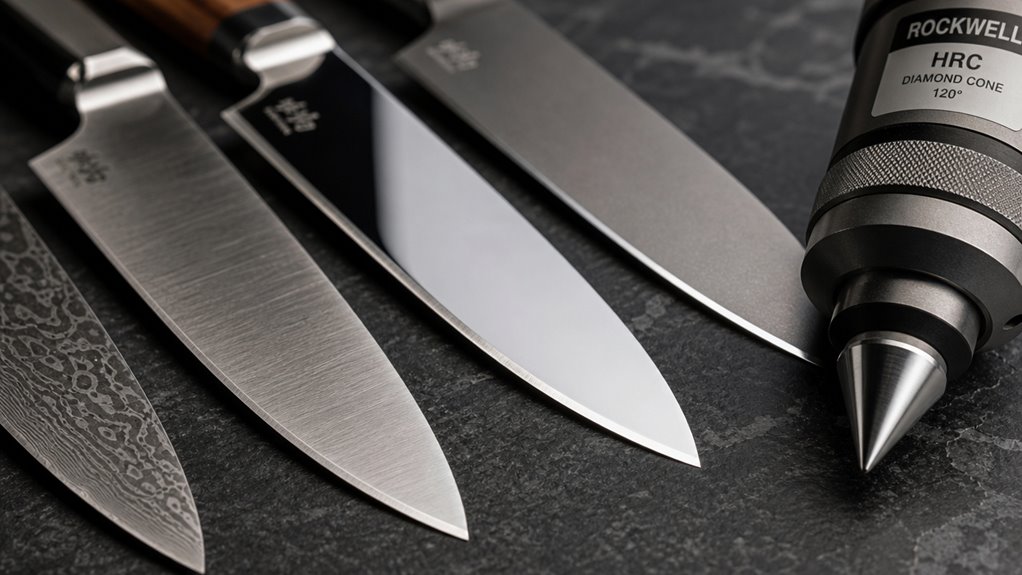
When you see 54–58 HRC, you’re basically looking at the Western kitchen sweet spot: hard enough to resist wear and stay sharp, but not so brittle that every minor twist turns into chipping. If a knife is 60+ HRC, it’ll often keep an edge longer, yet it’s also more likely to chip or tip-bang under side load or impact, which is common in real kitchens. HRC is a Rockwell C hardness reading that uses a Brale indenter with a 150-kilogram load, where a shallower indentation corresponds to a higher number. With a higher carbon content blade, you usually get a tougher “forgiving” edge that handles abuse premium steels can’t, but don’t expect it to out-last harder Japanese setups.
54-58 HRC as the Western Kitchen Sweet Spot
What does 54–58 HRC actually mean for a Western kitchen knife, and why do so many good sub-$30 options land right there? In this HRC 54–58 window, Western knives hardness signals moderate hardness: enough edge life without brittle chips, and sharpening stays manageable for budget knife steel. You’ll notice performance shifts with just 2–4 points. In practical terms, Hardness measures steel’s resistance to permanent deformation on the Rockwell C scale (HRC). Blade hardness reflects resistance to impact and wear which is why this range tends to balance daily durability with a cutting edge that won’t feel fragile.
- Moderate edge retention
- Easier sharpening
- High toughness
- Forgiving angles
- Better side-stress tolerance
Why 60+ HRC Steels Stay Sharper But Chip More
HRC is basically a “how hard is the blade” number, and once you see 60+ HRC on a kitchen knife, you should expect two things at the same time: better edge wear resistance and a higher chance of micro-chipping.
Harder steel boosts edge retention by tightening microstructure and supporting carbide formation. But it also drops toughness, so thin edges fail more easily under twist or side-load impacts. 60-62 HRC steels are known for long-edge retention, but they can be harder to sharpen and may show brittleness if production quality and expectations aren’t aligned.
Harder steel boosts edge retention by tightening microstructure and supporting carbide formation. But it also drops toughness, so thin edges fail more easily under twist or side-load impacts.
Why 56 HRC Tolerates Real Kitchen Abuse Premium Steels Can’t
56 HRC means your blade sits in that practical middle where it doesn’t just look sharp on day one—it actually survives the stuff real kitchen use throws at it. With 56 HRC, a budget knife steel holds an edge through knocks better than 60+—without being too brittle. Harder steels resist deformation generally correlates with improved edge retention because harder steels resist deformation and wear. Higher hardness generally correlates with improved edge retention because harder steels resist deformation and wear. – fewer chips from mis-hits – easier honing often – forgiving for twisting – usable edge retention – less sensitivity to abuse
Why X50CrMoV15 Dominates the Under-$30 Tier
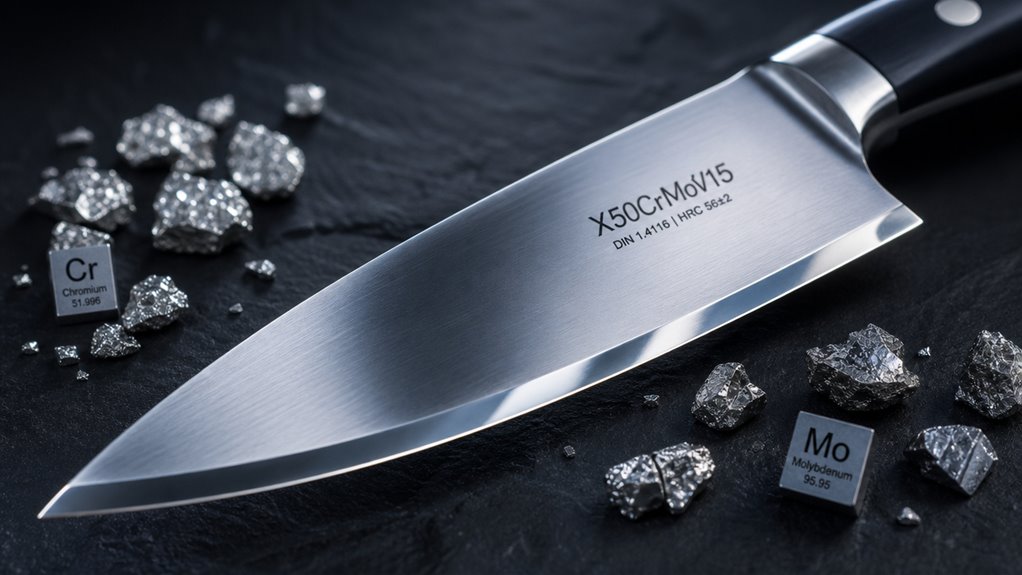
When you see X50CrMoV15 in under-$30 knives, you’re basically getting the 0.5% carbon + ~15% chromium combo that forms a decent passive layer against rust, plus molybdenum and vanadium to keep the edge stable without making the blade too brittle. German and Swiss brands stuck with this mix because it’s repeatable at the factory—heat treat it to about 54–57 HRC and you get reliable daily performance even in rough home conditions. CHROMIUM And yeah, the same steel can show up in a Wusthof for about 4x the price because the cost shifts to forging, grind, and build quality, not because the alloy magically changes. corrosion resistance The high chromium content is why X50CrMoV15 is routinely described as offering corrosion resistance that holds up well for everyday kitchen use.
The Chromium-Molybdenum-Vanadium Balance That Resists Rust
Ever wondered why a lot of under-$30 “stainless” knives actually survive a real kitchen instead of turning spotty in a week? With X50CrMoV15, you get about 15% chromium, built passive protection, and help from molybdenum. Vanadium steadies the edge. You should still hand-wash and dry.
- ~15% chromium passive layer
- ~0.7% molybdenum fights pitting
- ~0.15% vanadium supports wear stability
- ~0.5% carbon balances toughness
- Typical 54–57 HRC for easy sharpening
- Limitation: more upkeep than true 17% “rust-proof” stainless steel
Why German and Swiss Brands Both Settled on This Composition
Why did German and Swiss brands land on X50CrMoV15 as their mainstream “works in a real kitchen” steel, including for the under-$30 range?
You get 4116, mass-market stainless with ~0.5% carbon and 14–15% chromium: enough rust resistance, enough edge life, and forgiving heat-treat. That X50CrMoV15 composition is often described as the “Volkswagen” of knife steels—good, dependable, and easy to live with. It’s built around a classic recipe: roughly 0.5% carbon paired with about 15% chromium for corrosion resistance and hardness balance. It’s consistent across Solingen and Swiss OEMs, so factories don’t fight scrap.
Limitation: it’s not best for ultra-sharp, long-cycle edges.
How the Same Steel in Wusthof Costs 4x More Than in Victorinox
You can see the same steel show up in two very different price worlds: Wüsthof Classic and Victorinox Fibrox both commonly use X50CrMoV15, yet one might cost you around $150–$170 and the other often lands closer to $50–$60.
- forged vs stamped differences
- price/production costs in labor, fit, finishing
- X50CrMoV15 chromium corrosion resistance stays similar
- hardness ~58 vs ~55–56 changes sharpening frequency
- Wüsthof trade-off: pricier; Victorinox limitation: softer edge
The 420 Family (And Why Big-Box Block Sets Use It)
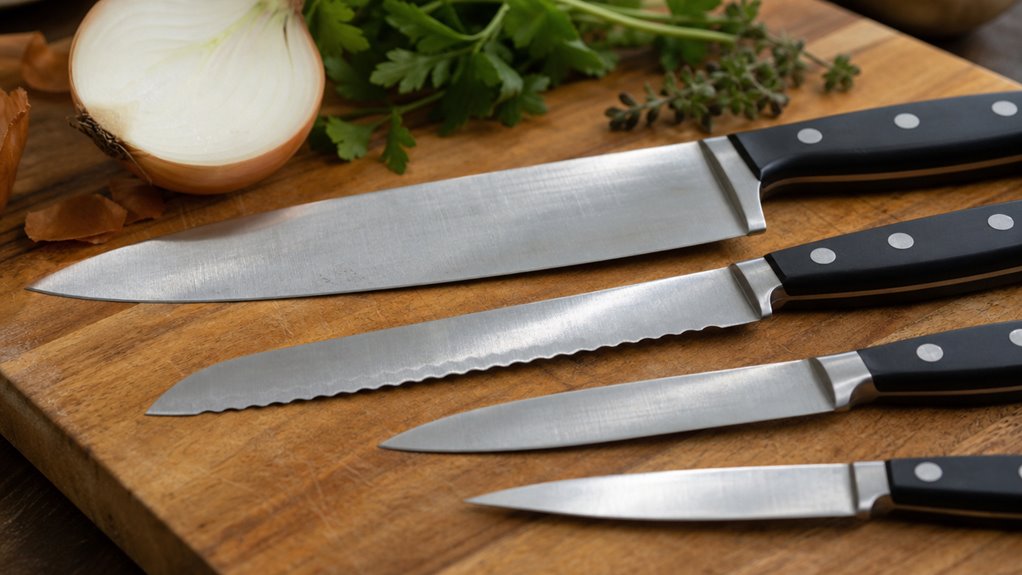
When you see “420” on a $15–$25 block-set knife, you’re usually looking at 420J2 (or similar) instead of 420HC, and that extra ~0.1% carbon can mean noticeably better edge holding and typically higher hardness.
Big-box makers pick the lower-hardness end on purpose: it resists chipping in rough kitchens and stays easy to touch up, but it dulls faster if you actually use the knife hard.
420HC is genuinely good enough for daily prep if you keep expectations realistic, but it still won’t match the edge life you get from X50CrMoV15 at ~56–58 HRC.
420HC vs 420J2: The 0.1% Carbon Difference That Matters
That tiny jump in carbon—about 0.1% to 0.2%—is the whole story behind 420J2 vs 420HC, and it’s why they feel different even when both get sold as “stainless.” If a knife uses 420J2, you’re usually looking at ~0.15–0.36% carbon and ~12–14% chromium, so it tends to come out softer after heat treat (often around 52–54 HRC) and holds an edge for fewer cutting sessions.
- 420J2 vs 420HC carbon content shifts hardness
- 420J2 edge retention is poor to very poor
- 420HC lands ~55–59 HRC more often
- 420J2 resists rust better under wet use
- 420HC is tougher for everyday slicing
Why $15 Knives Use Lower-Hardness Steel by Design
Why do so many $15 knives land in the ~52–56 HRC range instead of the ~58–62 HRC you see on mid-range Japanese or premium Western blades? You’re usually getting 420 steel, designed to be tougher under twisting and board impacts.
Lower hardness HRC means cheaper grinding and forgiving heat-treat. The trade-off is weaker budget knife edge retention, plus dents and rolled edges.
When 420HC Is Genuinely Good Enough (And When It Isn’t)
420HC can be a perfectly workable choice under $30, as long as you don’t treat it like a “set-and-forget” knife. You get decent edge retention at ~56–58 HRC, plus forgiving toughness. It’s great for light food prep, boxes, and occasional touch-ups, especially in budget knives. Use 420HC when you can accept more frequent sharpening on abrasive stuff like carpet.
- ~0.45–0.55% carbon
- ~13% chromium
- ~56–58 HRC when done right
- easy grinding/sharpening
- rolls before chips, when not abused
What to Look for on a Listing (And What to Ignore)
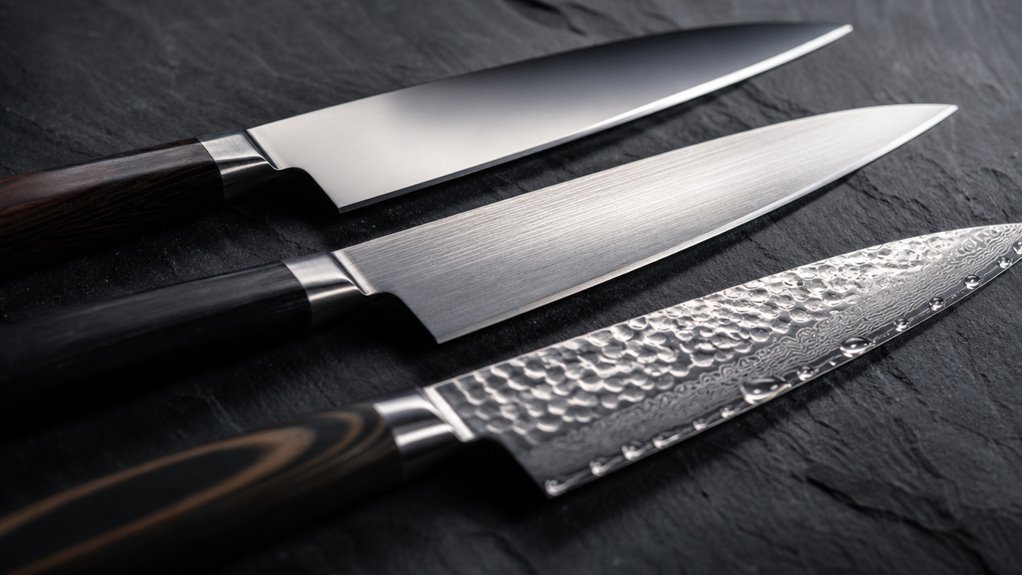
When a listing says “German steel,” you should treat it as a vibe check, not a spec, because you want to see the actual grade like 14C28N, 8Cr13MoV, AUS-8, or 420HC, not “high-grade stainless.”
Your single most useful spec is HRC hardness—missing HRC usually means the grade and heat treat aren’t getting fully disclosed, and that’s where vague 420J2 or worse tends to hide.
If the listing dodges both the steel name and the hardness range (or tosses around “ultra-hard” without numbers), assume it’s marketing first and buy accordingly.
“German Steel” Marketing vs Actual Composition Disclosure
Next to “sharp” and “stainless,” “German steel” shows up a lot on sub-$30 listings, but it usually doesn’t tell you much about the actual metal. That’s classic german steel marketing: you get vibes, not composition. Check steel designation disclosure and hunt real names, not country hints.
- Grade code (e.g., X50CrMoV15)
- EN/1.4116 numbers
- Approx C/Cr
- “Made in Germany” vs alloy
- Avoid vague “surgical” claims, budget knife alloys.
Why Hardness (HRC) Is the Single Most Useful Spec
Hardness (HRC) is the single most useful spec you can find on a sub-$30 knife because it tells you how the edge resists getting deformed and dulled. HRC predicts edge retention and deformation, but the real reason is heat treatment. Look for an explicit 56–60 HRC range with a tight spread. Ignore vague “premium steel” claims; they don’t control HRC.
How to Spot a Listing That Hides the Steel Grade
If a listing can’t name the actual steel grade, treat that like a warning light, not a mystery to solve. Look for hidden steel in specs photos, technical details, or blade stamps. Low-information listings often say “stainless” only, which usually means 420J2-type steel and weaker edge life.
- No alloy name (just “premium”)
- Missing HRC hardness
- Contradicting specs
- Stock photos, blurred logos
- Steel only in Q&A
Frequently Asked Questions
Is “German Stainless” a Steel Grade or Just Marketing?
“German stainless” is a marketing term, not a recognized steel grade. It has no standardized composition or hardness rating. The actual steel is typically 1.4116 (X50CrMoV15).
Do Lower-Hrc Knives Stay Sharp Longer Than Higher-Hrc Ones?
No. Higher-HRC knives stay sharp longer. Harder steel resists wear and edge deformation. Lower-HRC blades dull faster but are easier to resharpen.
Will Dishwasher Use Ruin 420J2 Versus X50crmov15?
Dishwasher use accelerates dulling and staining in both steels. 420J2 resists rust better in dishwasher conditions. X50CrMoV15 risks surface rust and slight softening from heat and moisture. Hand-washing and prompt drying is recommended for both.
How Can I Tell 420HC From 420J2 Without Lab Tests?
How Can I Tell 420HC From 420J2 Without Lab Tests?
420HC typically has a disclosed hardness rating of 56–58 HRC, while 420J2 usually falls around 52–54 HRC. 420HC holds an edge noticeably longer under use. 420J2 dulls faster and requires more frequent sharpening. Reputable brands like Buck label their steel as 420HC explicitly. Budget knives rarely specify grade and default to 420J2. 420J2 shows surface rust faster in humid or wet conditions. 420HC feels more resistant when sharpening on a stone. Checking the manufacturer’s listed specifications is the most reliable non-lab method.
Are Carbon Steel Knives Better Than 0.5% Carbon Stainless Ones?
Carbon steel knives hold sharper edges longer and reach higher HRC hardness ratings. However, 0.5% carbon stainless steel resists rust and requires less maintenance for everyday use.
Conclusion
If the listing just says “stainless” and skips the steel name and HRC, assume you’re not getting the edge life you want. You can still shop smart under $30, but verify details like X50CrMoV15 and look for roughly 56–58 HRC. An anticipated objection is “it still cuts fine,” and yeah, it might at first. The limitation is you’ll usually feel dulling sooner on mystery steel.