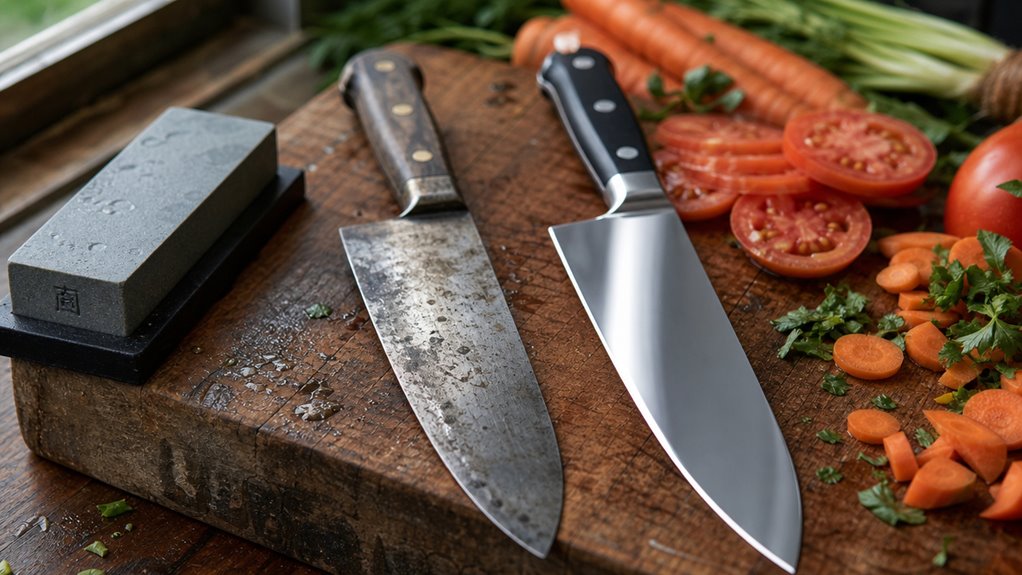
Kitchen knives: a well-maintained blade lasts anywhere from several years to multiple decades.
- Whetstone sharpening preserves the cutting edge and extends usable blade life significantly
- Edge geometry determines cutting performance more reliably than simple dullness
- Blade-height loss at the heel signals when replacement becomes necessary
Regular honing on a Victorinox honing rod keeps the edge aligned between sharpening sessions. Whetstone sharpening on a King KW-65 removes metal deliberately and restores the primary bevel. Both practices together give a quality knife from Global or Wüsthof a lifespan measured in decades rather than years.
The shoulder behind the edge thickens with each sharpening session. Thickening shoulders increase wedging. Wedging increases cutting drag. Drag reduces performance even on a technically sharp edge. A local knife sharpening shop like Korin in New York City or a regional cutlery specialist can thin the blade geometry before drag becomes permanent.
Steel fatigue produces chips that migrate past the microbevel into the primary bevel. Chips reaching the primary bevel indicate the steel has degraded beyond routine sharpening. Shun and Miyabi high-carbon blades show this pattern earlier than softer German steel knives.
Replace a knife when heel width loss reaches 20–30 percent, leaving roughly 70–75 percent of original blade height remaining. Past that threshold, the blade geometry serves no cook well.
Interesting Fact: Japanese bladesmiths in Sakai, Osaka have produced kitchen knives continuously for over 600 years, with some single-bevel knives lasting a professional chef’s entire career through progressive thinning alone.
Key Points
- A kitchen knife can last years if you maintain edge geometry with regular honing and avoid aggressive metal removal between sharpenings.
- Replace when wear reaches about 20–30% blade-height/width loss or the heel shows ~70–75% of original height.
- If edge chipping continues past the microbevel into the primary bevel, the steel may be fatigued—not just dull.
- Fixed-edge wedging, increased drag, and thickening shoulders indicate thickness-behind-the-edge growth from sharpening.
- Choose repair vs replacement: cracked tangs or loose handles are often fixable, but deep structural damage may require replacement.
The Real Lifespan of a Properly Maintained Kitchen Knife
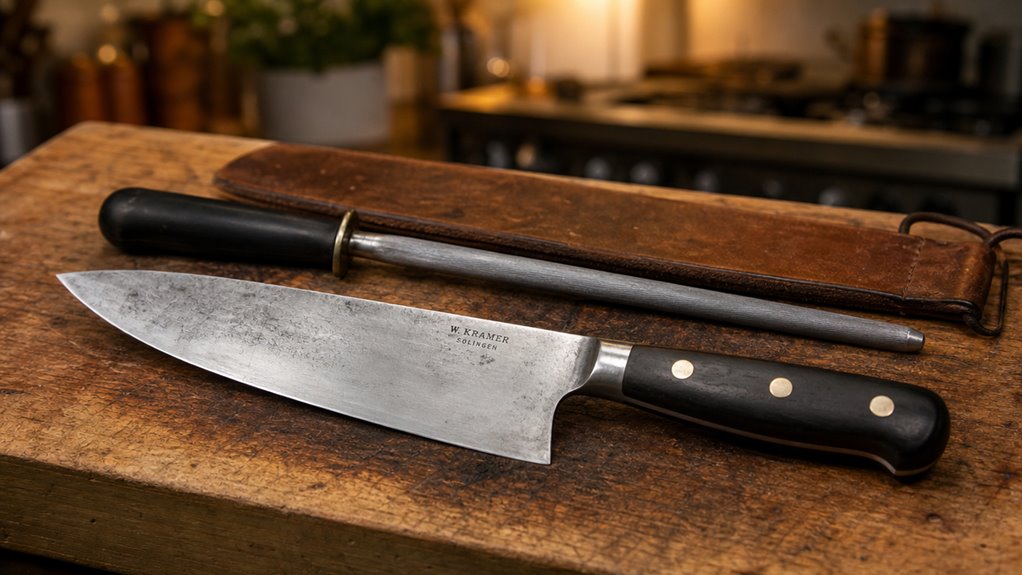
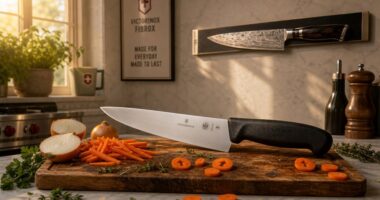
If you maintain a Victorinox Fibrox with real whetstone sharpening about 1–2 times per year, you can expect it to stay practical for roughly 15–25 years. In general, the quality of the blade type and material is a major factor in longevity, along with how you use it day to day. But if you rely on a pull-through, you’ll burn through usable thickness way faster because it removes far more steel per session, so a knife can feel “fine” until it gets too thin by around year 5. And the kicker is honing discipline: if you keep the edge aligned instead of grinding it down, whetstones and maintenance tools last about three times longer than the quick-fix approach you’d usually take. Proper maintenance extends usefulness over decades with edge-focused touch-ups rather than frequent full regrinds.
The 15-25 Year Lifespan of a Victorinox Fibrox with Whetstone Care
With the right care, a Victorinox Fibrox can genuinely hang around for 15–25 years, not because the steel “never wears out,” but because you slow down the two real killers: dulling that forces heavy sharpening, and damage like chips from bad boards or dishwasher heat. Victorinox Fibrox longevity hinges on whetstone maintenance and consistent knife lifespan habits. X50CrMoV15 holds an edge exceptionally well when you keep up with regular honing. With proper whetstone maintenance, you can help prevent overheating and preserve edge performance during sharpening. Hone before you dull. Sharpen lightly on a whetstone. Hand-wash and dry fast. Avoid glass, stone, and dishwashers.
Why Pull-Through-Maintained Knives Don’t Reach Year 5
Why do pull-through knives seem to hit year 5 right on schedule, even when you’re “not abusing” them?
You’re actually grinding away too much steel each touch.
Pull-through sharpeners thin the blade, causing uneven bevels and fast blade wear that turns normal dulness into a geometry problem.
That shortens knife lifespan because you reach the “too thin” to work well stage far earlier than with whetstones.
Proper maintenance helps knives last longer because different steels wear differently depending on how they’re sharpened and cared for.
How Honing Discipline Outlasts Sharpening Tools Three to One
A kitchen knife lives or dies by what you do between sharpenings, not by the day you bought it. If you hone, you realign the edge and delay steel loss. Sharpening rebuilds the edge, but it removes metal. Keep a steady rhythm:
- Hone every few uses
- Sharpen once or twice yearly
- Stop at ~30% blade-width loss
- Replace if tang/handle fails
Between sharpening sessions, honing is what keeps the edge aligned for efficient cutting honing].
What Actually Wears Out on a Kitchen Knife
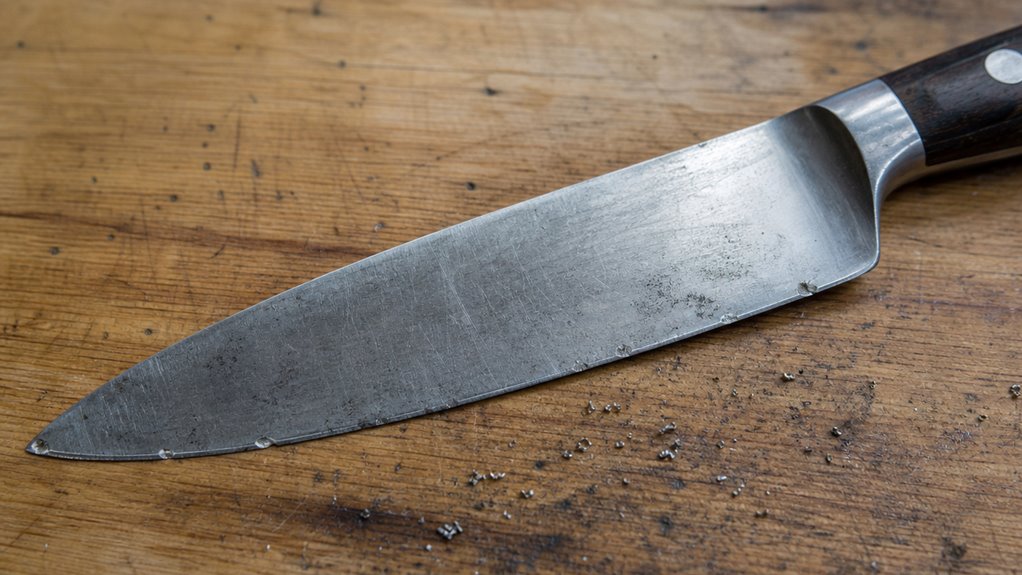
You usually wear out a kitchen knife in three places: the edge geometry from repeated sharpening (rolling and dulling first), the handle and tang joints loosening or cracking over time, and the slow steel loss that eventually makes the blade too thin or too short.
If your handle feels wobbly, you can often fix it by re-pinning or re-epoxying, and if the edge is just dull, sharpening restores the cutting surface without replacing the whole knife. A dull blade can be more dangerous than a sharp one because it increases hand and wrist fatigue.
The honest line for replacement shows up when steel loss hits about a 30% blade-width reduction near the heel (roughly under 25 mm on a typical chef knife), because at that point balance and safety start to suffer even if the knife still “looks fine.”
Edge Geometry Loss From Repeated Sharpening
As you sharpen a kitchen knife over time, the edge geometry doesn’t stay put, and that’s usually what “wears out” the knife, not the handle or the steel rusting in your drawer. You get edge geometry loss from sharpening wear: – shoulders thicken – edge rides higher into the blade – blade height loss shifts belly and reach – drifting angles broaden micro-bevels. Even if the edge feels sharp, it cuts harder and glides worse.
Because repeated touch-ups can gradually introduce a micro-bevel at the apex, the edge may look “sharpened” while it’s actually losing its crisp apex geometry. This effect is closely tied to how you hold and move the blade during sharpening, since angle control determines how consistently the edge is formed along its curve.
Tang and Handle Failures (And Why They’re Often Repairable)
Edge wear is usually what makes a knife feel “old,” but tang and handle problems are the other common reason people throw a perfectly good blade in the trash. If you spot loose pins, cracked scales, or a weak fit at the Tang,handle failure is often repairable. With rehandling, you remove the old handle, clean corrosion, and re-seat the tang snugly usually with glue or rivets. Uneven bolsters from the maker—like height differences or misalignment around the tang—can create a poor fit that worsens over time. Only total blade-tang separation ends it.
When Steel Loss Crosses the Threshold to Replace
Steel doesn’t “wear out” all at once, it quietly gets removed and compressed toward the edge every time you sharpen. When your knife edge thinning becomes blade height loss, you hit the replace knife threshold: about 20–30% height loss, or ~30% blade-width reduction at the heel. Dullness after a few uses indicates steel wear and edge angle loss. Cutting gets harsher. Rolling/chipping rises. Sharpening stops restoring. Geometry turns uneven. If you notice chips, cracks, or nicks, deep damage can compromise blade integrity even after sharpening, making replacement the safer move.
The Signs Your Knife Is Genuinely at End of Life
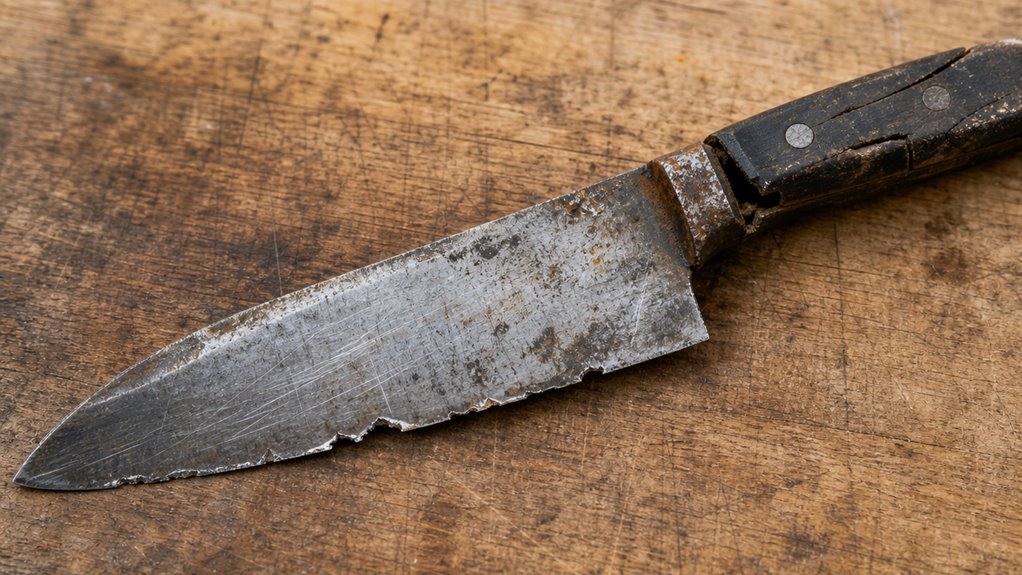
Check your blade width at the heel: if it’s dropped by about 30% from new (roughly under 25 mm on a typical chef knife), you’re done with “one more sharpening” and you’re into replacement territory. Meanwhile, if you see a cracked tang or a loose handle, you’re usually still in repair land—tighten, re-pin, or re-set is often cheaper than buying a new knife. If the edge keeps chipping past your microbevel and the knife flexes/rolls more easily, that’s usually steel fatigue, not just dullness, and it’s a genuine end-of-life signal.
The Blade-Width Test (And the 30% Loss Threshold)
If you want one practical way to tell whether your chef knife is past its “just sharpen it” stage, measure blade width and height against where the knife started. Use the blade-width loss 30% threshold: if heel height is ~70–75% of new, you’re near end-of-life, especially once thickness behind the edge builds wedge-like drag. thickness behind the edge is the key metric for wear, since a worn knife may still look sharp but no longer slices smoothly even after sharpening. thinning each time you sharpen can eventually make the knife harder to correct, because excessive material removal changes the geometry in ways that lead to wedging and increased cutting resistance. Compare width/height to original. Watch for wedging resistance. Estimate thickness behind the edge. Stop when thinning isn’t economical.
Why Cracked Tangs and Loose Handles Are Almost Always Repairable
Cracked tangs and loose handles usually don’t mean your knife’s done. You’re often seeing handle failure, not blade steel failure. With knife repairability, tang cracks commonly get ground out and rewelded, then rehandled. Thinning and sharpening can also restore cutting performance after damage to the edge, especially if the blade was chipped. Loose scales can be re-peened or re-epoxied. Only deep, structural tang-to-heel cracks beyond repair mean end-of-life.
A careful forge weld approach may be needed when a tang crack has to be truly rewelded, and it’s especially important to protect and then restore the knife’s heat treatment afterward.
How Edge Chipping Past the Microbevel Signals Steel Fatigue
When your edge chips, the detail that matters isn’t the first little nick—it’s whether it keeps spreading past the microbevel. If edge chipping goes beyond that sacrificial apex into the primary bevel, you’re likely seeing low-cycle fatigue, not just bad technique. Specifically, chipping is a form of fracture; toughness controls resistance to chipping, so repeated cracking under cyclic stress can progressively drive damage deeper. Chips relocate behind the microbevel. Cracks link through carbides. Damage repeats after gentle sharpening. Chips deepen at moderate cutting load.
How Sharpening Method Determines When You Replace
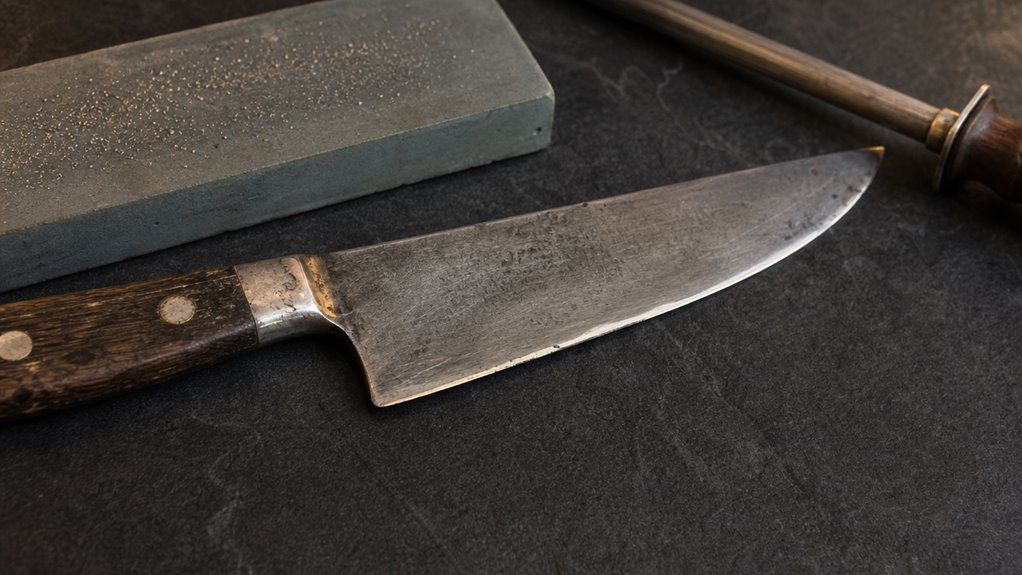
When you sharpen with a whetstone and don’t turn every dull moment into a full grind, you can stretch a good knife to a year-20 standard because each session removes only a little steel. If you rely on a pull-through, you’ll often compress about 10 years of wear into around 3, since each pass strips metal faster and keeps reshaping your edge geometry until the blade gets too thin. This is why sharpening discipline outlasts the knife you started with, but here’s the trade-off: whetstones take practice and you can’t rush your way to consistent angles.
Whetstone-Maintained Knives Reach Year 20 Standard
If you keep your knife in play with a whetstone, you can usually push it toward a true “year 20 standard” because each sharpening pass removes very little metal and lets you keep the edge geometry close to what the factory started with. With proper whetstone sharpening, edge maintenance, and controlled angles, your blade lifespan stays stable.
- Light pressure, consistent 12–20° per side
- Stop at burr; remove it
- Water cooling avoids heat damage
- Micro-bevel reduces chipping
Pull-Through Sharpeners Compress 10 Years Into 3
How much faster does a pull-through sharpener “use up” a knife compared to a whetstone? Pull-through sharpeners can remove several times more metal per session, so blade wear ramps up fast. Their fixed angle forces edge geometry distortion, flattening thin edges into a thicker V. You also tear the apex, creating burrs and micro-chips, then grind more away. That’s why “until sharp” compresses 10 years into 3.
Why Whetstone Discipline Outlasts the Knife It Maintains
Whetstone discipline is what keeps your knife from “ageing” faster than it should. You remove less steel per sharpening, manage honing between full sessions, and avoid reshaping every time. That lowers blade wear and keeps geometry closer to original. Use proper grit progression too.
- Only full whetstone sessions 1–2/year
- Hone often, remove little
- Flatten stones for even bevels
- Start coarse, finish fine
Replacement Decisions by Knife Tier
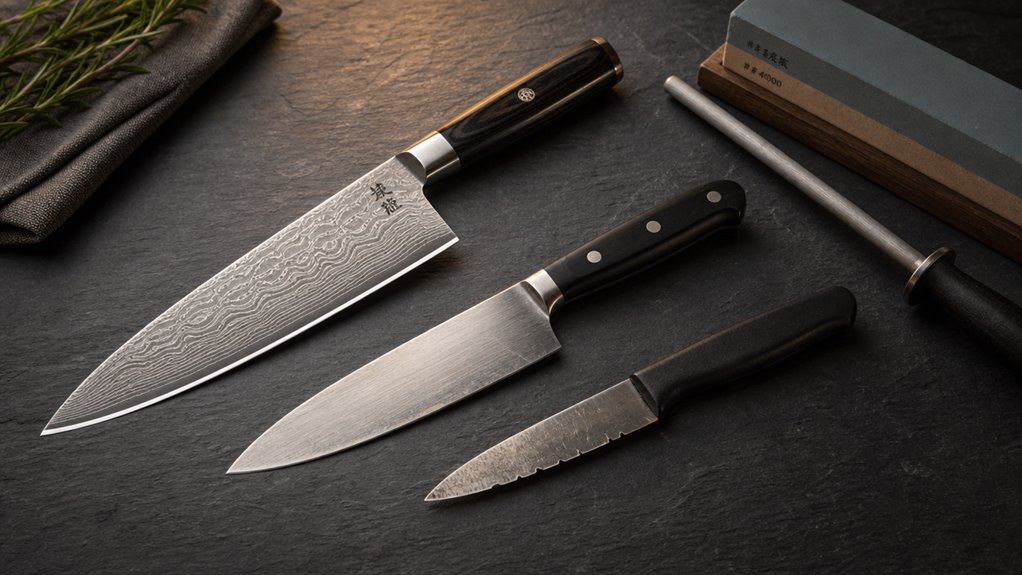
If your $35 Victorinox Fibrox is genuinely at end-of-life (you’ve lost roughly 30% of blade width near the heel), don’t sink money into it—replace it, because re-handling won’t save the thinning edge.
For a $130 Wusthof Classic, you usually replace by re-handling first: when the handle loosens but the edge can still be sharpened back to a safe height, a professional re-handle can buy you 15+ more years, though the limitation is the labor cost can approach a big chunk of what the knife cost new.
With Japanese heritage knives, you go pro when chips, rolling, or old edge geometry has changed enough that you can’t restore the edge shape cheaply; professional refurbishment makes sense, but carbon/edge care still comes with real upkeep even after the work is done.
The $35 Victorinox Fibrox at End of Life (Just Buy a New One)
By the time your $35 Victorinox Fibrox Pro chef’s knife hits “end of life,” you usually won’t be dealing with a busted blade so much as a geometry problem from repeated sharpening—its edge and blade height keep getting smaller until it won’t hold a straight working edge without taking off a lot of steel.
- chef knife lifespan hits 15–25 years with whetstone care
- Victorinox Fibrox wear out at the blade-height threshold (~30% at heel)
- warped recurve, stubborn edge straightness
- swap instead of replace dull knife
Limitation: dishwasher use accelerates cosmetic grime at the handle seam.
The $130 Wusthof Classic Worth Re-Handling Instead of Replacing
When your $35 Victorinox Fibrox hits its end-of-life, the steel geometry usually can’t “earn” one more year, so you swap it.
For a $130 Wüsthof Classic, re-handling can make sense if the blade still has height and the POM handle is loose or damaged.
Expect replacement cost to compete: pro re-handling often runs ~$80–$200, sometimes near new price.
Your limitation: costly thinning can outweigh gains.
When a Japanese Heritage Knife Deserves Professional Refurbishment
You don’t have to baby a Japanese heritage knife, but you also shouldn’t treat it like a replaceable tool once it starts losing its “clean push-cut” feel.
Choose professional refurbishment by tier:
- Repeated edge chips resist recovery after correct technique
- Edge retention drops fast despite good boards
- Thickened shoulders from over-grinding
- Loose handle or patina/pitting won’t clean out
Entry repairs save blade durability; higher tiers protect grind identity.
Frequently Asked Questions
Can an “Old-Looking” Knife Still Cut Well After Years of Use?
Can an old-looking knife still cut well?
Yes, if the edge geometry is intact.
Does patina affect cutting performance?
No, patina is purely cosmetic.
How do you restore a dull old knife?
Re-sharpen it using a whetstone.
When should an old knife be replaced?
When the blade is ~30% thinner than original or has an unrepairable tang or handle crack.
Do scuffs and scratches ruin a knife?
No, surface scuffs do not impact cutting ability.
What’s a Measurable Blade-Width Loss That Means “Replace, Not Sharpen”?
A 30% loss in blade width at the heel signals replacement. For example, a blade starting at 30–40mm that has worn down to under 25mm has reached geometric failure and should be replaced rather than sharpened.
Which Handle or Tang Failures Are Repairable at Low Cost?
Loose scales and pins can be repaired with epoxy or re-peening. Minor handle cracks and chips can be fixed with CA glue or epoxy filler. Loosened rivets can be reset. Only a catastrophic blade-tang separation requires full replacement.
How Many Times per Year Should I Sharpen a Home-Use Chef Knife?
Sharpen a home-use chef knife 1–2 times per year. Hone weekly and you need only 1 sharpening per year. Skip honing and sharpen every 4–6 months.
Does Whetstone Maintenance Extend Lifespan More Than Buying a Pricier Knife?
Whetstone maintenance extends a knife’s lifespan significantly. Regular sharpening 1–2 times per year removes minimal steel. Proper angle control preserves blade geometry for decades. A well-maintained budget knife outlasts a neglected premium knife.
Conclusion
You don’t really “wear out” a kitchen knife the same way you replace one. You track loss: edge geometry, handle stability, and steel-loss from sharpening. If you’ve thinned the blade by around 30% of its original width, you should replace it, even if it still cuts. Electric grinders and aggressive pull-throughs can speed that up fast. Loose handles and cracked scales are usually repairable; a badly thinned, flexy blade isn’t.