Immersion Blender vs Vitamix vs Ninja vs NutriBullet: Each tool serves a distinct kitchen role based on batch size, motor power, and task type.
- Immersion Blender – blends directly in the pot, eliminating hot-liquid transfers
- Vitamix – delivers ultra-smooth results through a 2 hp motor and metal drive system
- NutriBullet – produces single-serve smoothies in a personal cup format
The Immersion Blender handles in-pot soups and sauces with precision. It eliminates hot-liquid transfers by operating directly inside the cooking vessel. Its core limitation is batch size — it cannot process a full-size jug volume.
The NutriBullet produces single-serve smoothies fast. It fills one personal cup per cycle. Thick blends cause the motor to overheat, and volume beyond one cup exceeds its capacity.
The Ninja crushes ice and processes mid-size batches efficiently. Its blades dull after two to three years of regular use. It cannot reach true nut-butter consistency regardless of blend time.
The Vitamix — sold at Williams Sonoma, Sur La Table, and Costco locations nationwide — produces ultra-smooth drinks, hot soups, and nut butter through its 2 hp motor and metal drive coupling. Its price exceeds $400. That investment justifies itself only for households blending heavy loads daily.
Interesting Fact: The Vitamix motor generates enough friction heat to bring cold soup ingredients to steaming temperature in approximately six minutes, eliminating the need for a stovetop entirely.
Key Points
- Immersion blenders excel at in‑pot soups, sauces, and small batches (1‑2 cups) without transferring hot liquids.
- NutriBullet is ideal for single‑serve, on‑the‑go smoothies, but struggles with volumes larger than a cup.
- Ninja handles mid‑size batches (2‑4 cups) and offers versatile attachments, though blades may dull after years of use.
- Vitamix dominates heavy‑duty tasks: large‑volume smoothies, hot soups, nut butters, and dense blends, thanks to its 2 HP motor and metal‑drive system.
- Counter‑space considerations: immersion blenders store in drawers; NutriBullet fits a small corner; Ninja and Vitamix occupy similar base footprints but require extra shelf space for jars and accessories.
The Four-Blender Decision Reddit Has Been Arguing for Years
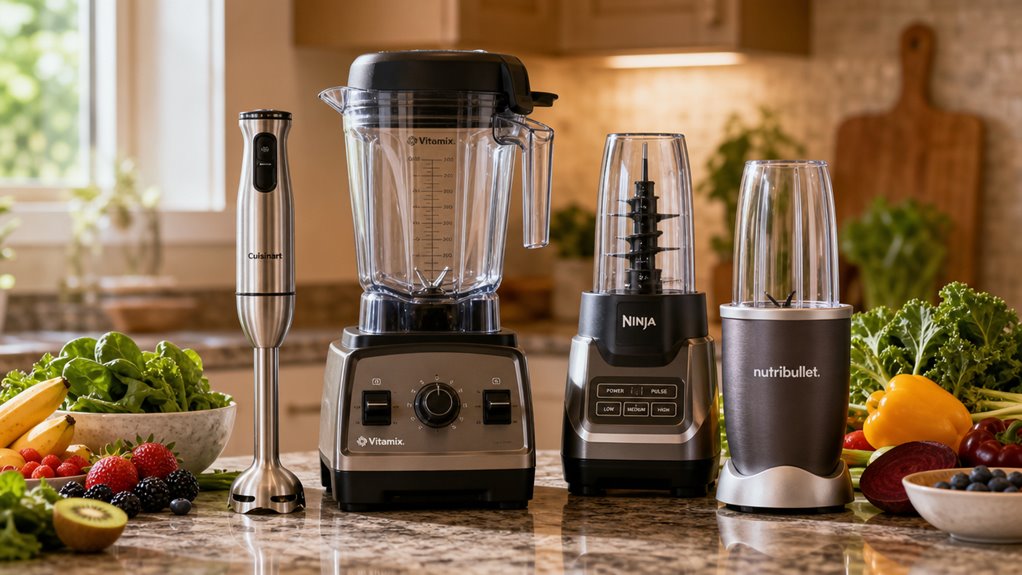
You’ll see why each blender sticks around even though their duties overlap: the immersion handles in‑pot soups and sauces without a transfer, the NutriBullet gives you a single‑serve smoothie on the go, the Ninja covers mid‑size batches and occasional ice, and the Vitamix tackles heavy‑duty tasks like nut butter and hot‑soup friction. The specific tasks each wins are clear—immersion for small, hot blends, NutriBullet for personal smoothies, Ninja for versatile everyday blending, Vitamix for premium, high‑volume work. But trying to keep all four on the counter means paying a $400‑plus price for the Vitamix, sacrificing cabinet space, and often ending up with two or three idle appliances. The Vitamix’s 1471‑watt motor delivers superior power for crushing ice and making smooth nut butter.
Why Each Tool Survives Despite Overlapping Use Cases
Because each blender sits in a different price band and solves a distinct kitchen workflow, they all keep a foothold even when their tasks overlap. You’ll find immersion blender vs Vitamix debates hinge on cost and use‑case: an under‑$30 immersion handles in‑pot soups and small sauces, takes up a cabinet, and never clutters the counter.
Vitamix worth it only if you blend heavy smoothies, hot soups, or nut‑butters daily; its 7‑year warranty and $0.16 per use math break even at that frequency. Ninja offers mid‑range volume with a larger pitcher, but its blades dull after a few years.
NutriBullet delivers single‑serve smoothies, yet its motor often fails before the warranty expires. When you ask which blender to buy, match your cooking pattern to the tool’s price tier and lifespan, not just its headline specs. The fixed blade design of Vitamix eliminates the need for extra cleaning and storage steps that removable‑blade competitors require.
The Specific Blending Tasks Each Tool Wins
If you blend soups directly in the pot, the immersion wand wins because it lets you puree without transferring hot liquid to a sealed jar, which cuts the risk of steam‑pressure bursts. You’ll find it’s the most budget‑friendly option for quick sauces, small‑batch emulsions, and on‑the‑stove finishing. It’s a true small kitchen blender that fits in a cabinet, so your counter stays clear. The NutriBullet shines on single‑serve smoothies, but it can’t handle a pot‑full of soup. The Ninja bridges the gap, offering mid‑size batches and a steadier motor, yet it still needs a pitcher. The Vitamix dominates heavy‑duty tasks—ultra‑smooth smoothies, hot‑soup heating, nut butter—but its price and size limit casual use.
| Tool | Best Task |
|---|---|
| Immersion blender | In‑pot soups, sauces |
| Ninja | Mid‑size smoothies, multi‑mode |
| NutriBullet | Personal‑size smoothies |
| Vitamix | Heavy‑duty blends, hot soup |
The Counter-Space and Cost Reality of Owning All Four
When you line up a Vitamix, a Ninja, a NutriBullet and an immersion blender, the counter quickly turns into a storage battlefield. The Vitamix alone claims an 8″×11″ footprint and often sits on the counter because it won’t fit under an 18″ cabinet.
A ninja blender review notes a similar base size but adds a wider jar and extra attachments, pushing you to allocate two shelves. The BN801’s 1,400‑watt motor delivers performance on par with premium models. A nutribullet review highlights a compact 6″ circular base that can tuck into a corner, yet you still need a small shelf for extra cups.
The immersion blender slides into a drawer, freeing vertical space but demanding a dedicated drawer.
- Vitamix: $350‑$700, 7‑10‑year warranty, permanent counter resident
- Ninja: $150‑$250, one‑year warranty, occupies two shelves
- NutriBullet: $60‑$120, short warranty, fits on a small shelf
- Immersion: $25‑$30 entry, drawer storage, minimal counter‑space impact
Where the Immersion Blender Genuinely Wins
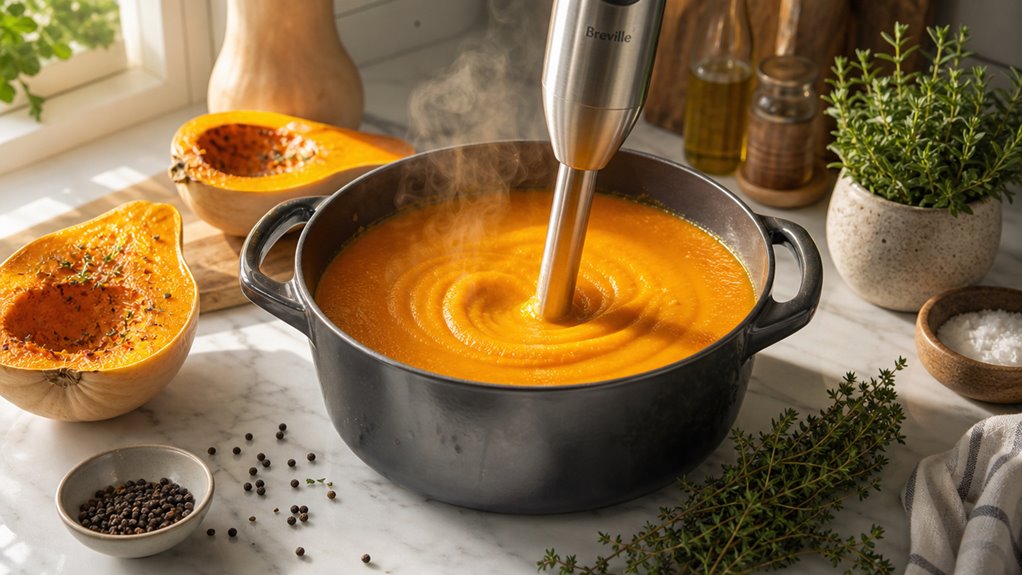
You’ll notice the immersion blender lets you blend soup right in the pot, so you skip the awkward transfer to a pitcher and avoid spills.
It also shines with one‑ or two‑cup batches, perfect for quick sauces, single‑serve smoothies, or baby food without wasting space.
At $25‑30 it fits in a cabinet drawer, freeing counter space that a bulkier Vitamix or Ninja would claim.
Immersion blenders are designed to process hot ingredients directly in a pot or pan, making them ideal for hot soup preparation.
In-Pot Soup Blending (No Transfer Required)
Because the blades sit right in the pot, you can pureé a whole batch of soup without ever lifting a ladle.
You skip the heavy jar, the steam‑filled lid, and the risk of spills when you move near‑boiling liquid.
The immersion blender stays low, so pressure never builds, and you stay safe.
You also keep texture control, pulsing only the sections that need smoothing while leaving beans intact.
This workflow matches the blender cooking pattern many Reddit users discuss, and it beats a single serving blender for any batch larger than a cup.
- No transfer steps, so less mess.
- Safe with hot liquids, no lid blow‑off.
- Unlimited batch size, limited only by pot.
- Precise partial blending for rustic textures.
Small Batch (Single Serving Smoothies, Quick Sauces)
Blending a single‑serving smoothie or a quick vinaigrette in a mug is where the immersion blender shines. You can drop a handful of thawed fruit, yogurt, and a splash of juice straight into a cup, dip the shaft, and watch the mixture whirl without a pitcher or lid.
The narrow head concentrates the blades, so you avoid the “minimum fill” issue that trips a under 30 blender in a Vitamix. Cleanup is a wipe‑down, not a dishwasher load, which beats the nut vs vitamix assembly.
When you compare nutribullet vs vitamix, the NutriBullet handles frozen chunks better, but for a single‑serve, soft‑ingredient drink the immersion tool is faster and takes up no counter space.
Likewise, ninja vs vitamix shows the Ninja needs a dedicated cup, while the immersion blender stays in the jar and finishes in seconds.
Why the $25-30 Immersion Blender Earns Counter Space Most
When you’re juggling a pot of simmering soup and a deadline for dinner, the immersion blender’s tiny footprint lets you stay in the same pan and finish the job without a second vessel. At $25‑30 it slides into a drawer, not a countertop, and you never have to juggle a bulky pitcher.
You blend hot soups, sauces, or a quick pesto right where you cook, cutting transfer steps and dishwashing. The wand’s low profile reaches the pot’s corners, and detachable shafts rinse in seconds.
It’s the only tool that stays out of sight yet ready for everyday small‑batch tasks.
- Fits any deep, heat‑safe pot, no proprietary jar needed
- Includes whisk and mini‑chopper attachments for eggs, herbs, or crumbs
- Weighs under 3 lb, so you can grab it and store it vertically
- Requires only the wand and pot to clean, saving time and water
Where the Vitamix Genuinely Wins
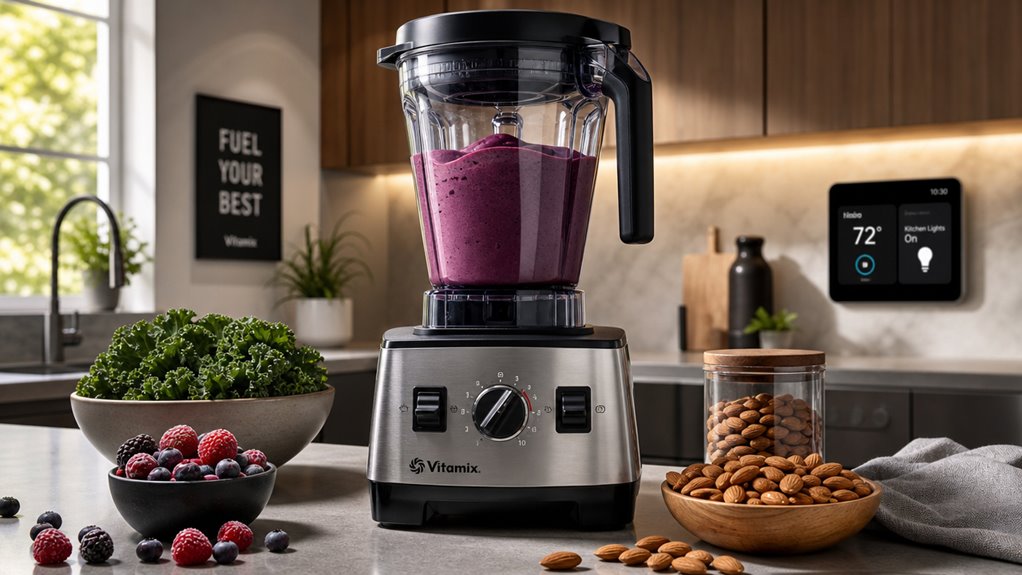
You’ll get ultra‑smooth smoothies and hot soups without stopping the motor because the Vitamix’s 2 HP motor keeps blade tip speed high even under load.
It also handles multi‑hour jobs like nut butter or bread‑flour doughs, thanks to its metal drive and variable‑speed control.
The $400‑plus price only makes sense if you blend heavy‑duty recipes daily; otherwise the cost per use climbs quickly.
Heavy-Duty Smoothies and Hot Soup Cooking
If you regularly make thick, frozen‑fruit smoothies for a family or want to turn a pot of simmering vegetables into a velvety soup without a stovetop, the Vitamix’s high‑power motor and metal‑drive system give you a real advantage.
Its 1,500‑W motor keeps blade tip speed steady under heavy loads, so frozen berries and kale turn into a uniform drink without green flecks.
The 64‑oz jug lets you blend several servings at once, and the vortex pulls ingredients down without you having to stop and stir.
You can also heat soup by friction, reaching 180 °F in minutes, which most immersion blenders can’t do safely.
- Ultra‑smooth texture for fibrous greens
- Handles full‑size frozen batches without bogging down
- Friction‑heats soups directly in the container
- Metal‑drive system resists wear compared to plastic‑drive rivals
Multi-Hour Tasks (Nut Butter, Bread Flour)
Smoothies and hot soups are great for a Vitamix, but the real test comes when you ask it to grind nuts into butter or turn whole grains into flour. Its 2‑hp motor spins the blades up to seven times faster than a typical food‑processor attachment, so almond or cashew butter reaches a spreadable texture in about a minute without oil.
The tamper lets you press the nuts into the blades, eliminating the stop‑and‑scrape routine that stalls lower‑power blenders.
For flour, the same high‑speed blades mill wheat berries or chickpeas in 45‑60 seconds, and a dedicated dry‑grain container keeps the mixture from clouding.
Immersion blenders can’t hold enough nuts to generate torque, and personal blenders like NutriBullet overheat after a few seconds, making the Vitamix the only practical choice for these multi‑hour, high‑friction tasks.
Why the $400+ Vitamix Earns Place Only for Daily Heavy Users
When you blend day after day, the Vitamix’s 2‑hp motor and metal drive socket stop feeling like a luxury and become a workhorse. Its 1,400‑watt motor runs hot without tripping, so you can crush frozen fruit, kale stems, or nut‑butter in one go. The metal drive tolerates back‑to‑back batches, and the container’s vortex pulls ingredients in, meaning you rarely need to stop and stir.
That durability translates into a 10‑year lifespan that outlasts most $100 blenders, making the per‑use cost drop to pennies when you blend daily.
- 2‑hp motor handles dense, fibrous loads without overheating.
- Metal drive socket resists stripping under frequent heavy use.
- Consistent vortex creates ultra‑smooth textures, eliminating grit.
- 7‑year warranty supports a 15‑plus‑year life, amortizing the $400 price for daily users.
Where the Ninja and NutriBullet Win
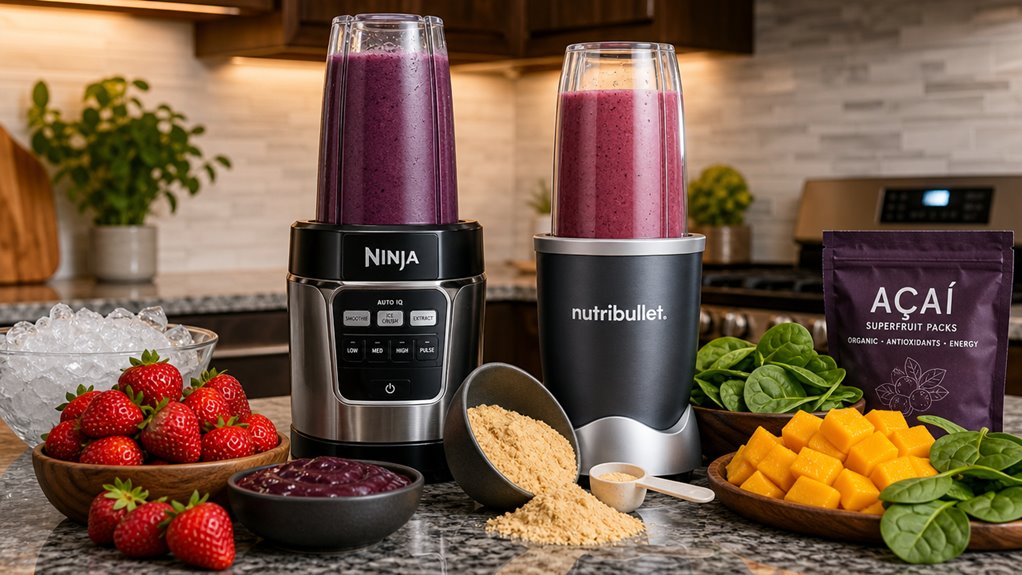
You’ll find the NutriBullet shines when you need a single‑serve smoothie that blends straight in the cup, so you skip a pitcher and a wash‑up. The Ninja adds a mid‑range versatility with its multi‑mode presets and larger jar, letting you crush ice or make a batch of drinks without the $300‑plus price tag of a Vitamix.
Both sit between the cheap immersion blender and the premium Vitamix on the cost‑capability curve, though the NutriBullet’s limited power can struggle with very thick blends.
Personal-Size Smoothies (NutriBullet Single Serving)
A typical morning routine can start with a 24‑oz NutriBullet cup that fits right in your hand, so you pour, press, and drink without ever moving the blender. You’ll appreciate the narrow, tall cup that creates a vortex, pulling fruit and leafy greens into the blades for a smooth texture in under a minute.
The push‑down start is simple, and cleanup is just a quick rinse of the cup and blade. However, the 600 W motor may struggle with dense frozen fruit or thick “bowl” blends, where a Ninja’s higher wattage and multi‑fin blades give a cleaner result.
- 24‑oz cup fits single‑serve portion control
- Direct‑in‑cup blending reduces transfer and dishwashing
- Push‑down start keeps operation straightforward
- 600 W motor handles typical smoothies but can choke on heavy ice
Mid-Range Versatility (Ninja Multi-Mode)
Why does the Ninja multi‑mode cooker feel like a kitchen Swiss‑army knife? It packs pressure cooking, air‑fry, grill, steam, slow‑cook, and dehydrate into a single 12‑ to‑15‑liter unit, so you replace a dozen gadgets with one countertop appliance.
The SmartLid slider lets you flip between pressure‑cook, air‑fry, and combi‑steam without hunting for separate controls, cutting mode complexity.
For busy families, the large capacity means you can braise beans, crisp chicken wings, and proof dough in one pot, then blend a soup with the built‑in immersion blade if you need a smooth finish.
The downside is the learning curve; mastering each function takes time, and the unit takes up roughly three square feet of counter space.
Still, if you want heat‑based cooking plus occasional blending without paying Vitamix‑level prices, Ninja’s mid‑range versatility bridges that gap.
Why Both Sit Between Immersion and Vitamix on Cost-Capability Curve
When you compare the price‑performance curve, the NutriBullet and Ninja land squarely in the middle—cheaper than a Vitamix but more capable than an immersion stick.
Their sealed‑blade cup designs give smoother smoothies than an open‑air wand, and the Ninja’s higher wattage and larger pitcher handle ice and frozen fruit better than most personal blenders.
Both stop automatically after a cycle, so you don’t have to watch the timer.
Yet each still falls short of Vitamix’s multi‑hour, heavy‑duty stamina and the immersion blender’s in‑pot convenience.
- NutriBullet: $40‑80, single‑serve smoothness, limited to light blends
- Ninja: $80‑150, larger capacity, stronger motor, struggles with nut butter
- Immersion: $25‑30, in‑pot work, low power, not for frozen fruit
- Vitamix: $300‑500, premium consistency, high cost, only justified for daily heavy use
The Cooking-Pattern Diagnostic That Decides
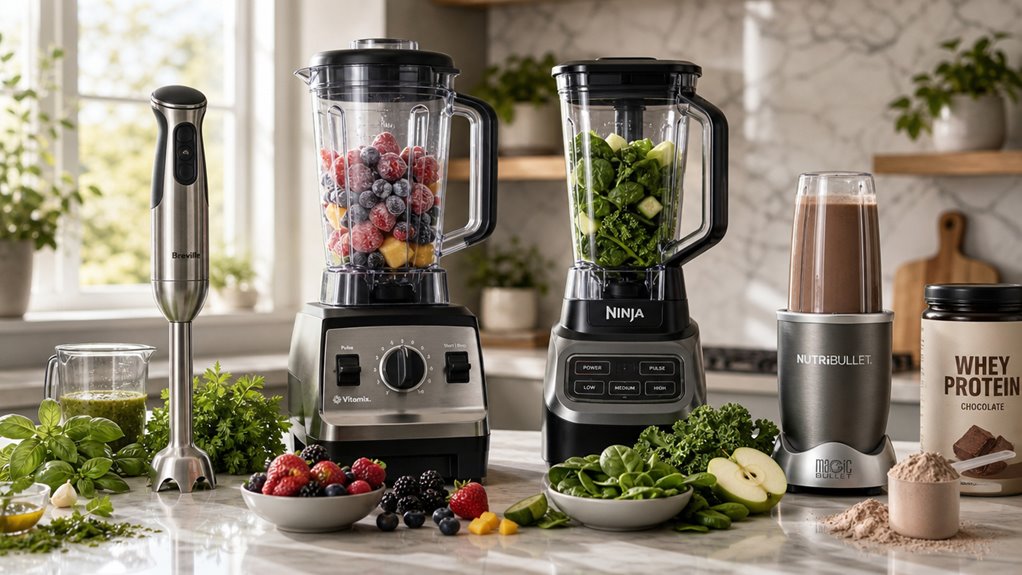
You’ll notice that if you blend soups right in the pot every day, the immersion blender wins because it avoids transfer and fits a cabinet.
If your routine is a single‑serve smoothie each morning, a NutriBullet or a Ninja fits better, though the NutriBullet can’t handle frozen fruit well and the Ninja takes longer to reach a silky texture.
Heavy‑duty daily tasks like nut butter or thick dough push you toward a Vitamix, but most households only hit one of those patterns, so a single, under‑$30 immersion unit usually covers the rest.
Daily Soup Cook With Pot Blending: Immersion Wins
If you spend most evenings whisking vegetables, searing aromatics, then turning the whole pot into a velvety soup, an immersion blender is the tool that actually fits that workflow.
You can keep the pot on the stove, submerge the shaft, and blend without lifting heavy jars or risking burns.
The compact handle fits in a cabinet, so the counter stays clear, and the $25‑$30 price keeps the budget low.
Variable speed gives you texture control, from chunky to silk‑smooth, while the submerged blade reduces splatter.
- Direct in‑pot blending eliminates transfer steps.
- Small batch capacity matches typical 4‑8‑serving soups.
- Submerged operation cuts splashing and cleanup time.
- Affordable entry price avoids a costly countertop purchase.
Daily Smoothie Person: NutriBullet or Ninja
After the soup‑pot immersion blender, the next most common kitchen pattern is the daily smoothie routine, and that’s where the choice between NutriBullet and Ninja really matters.
If you usually make one‑person, 16‑ to‑32‑oz drinks, NutriBullet’s cup‑size fits perfectly and its 25 000 RPM blades give a smoother texture, especially with kale or seeds. It’s quick to twist, clean, and store, but the base can wobble on uneven counters.
If you often blend for two‑to‑four people or need ice‑crushing power, Ninja’s larger pitcher and 1 200 W motor handle bigger batches and frozen cubes with less strain, though its multiple containers take more cabinet space.
Choose the tool that matches your batch size and texture priority.
Heavy-Duty Daily Use: Vitamix
A handful of households blend more than just a quick smoothie; they crush ice, grind dry beans, and whip up hot soups multiple times a day. If you’re the kind who makes a batch of hot soup, a nut‑butter, and a frozen‑fruit smoothie each morning, the Vitamix’s 2 HP motor and 48‑oz container become a workhorse that doesn’t overheat.
Its variable‑speed control lets you grind oats into flour or emulsify mayonnaise without stalling, and the cooling system handles back‑to‑back blends. The downside is the price—$400‑plus—so you need daily, heavy‑duty use to justify it.
- 2 HP motor pulverizes ice, nuts, fibrous greens
- Variable speed creates smooth emulsions and hot soups
- Large 48‑64 oz jar fits family‑size recipes
- High upfront cost limits value for casual users
Why Most Households Need One, Not Four
The Vitamix shines when you blend dozens of times a day, but most kitchens don’t run that marathon. You likely blend a soup or a smoothie a few times a week, and that frequency makes a $400‑plus machine hard to justify.
An immersion blender costs $25‑30, fits in a cabinet, and handles hot‑pot purees, sauces, and small batches without moving the pot.
A NutriBullet or Ninja adds a personal‑size cup or a mid‑range pitcher, but they occupy extra counter space and duplicate tasks you already cover with the immersion tool.
Most households fall into the “one‑tool” zone: a single, low‑cost immersion blender meets 50 % of blending needs, and the remaining 50 % can be managed with a simple whisk or food processor.
The cooking‑pattern diagnostic shows that unless you blend daily, heavy‑duty smoothies, or large freezer meals, adding more blenders just taxes your storage and budget.
Frequently Asked Questions
Can Immersion Blenders Crush Ice for Frozen Drinks?
Yes, immersion blenders can crush ice, but only in small amounts with plenty of liquid added. A high-wattage, heavy-duty model works best. Results may be uneven, and overuse can strain or damage the motor.
Do Nutribullets Handle Hot Soup Without Damage?
Do Nutribullets Handle Hot Soup Without Damage?
Only full-size NutriBullet models with vented lids can safely blend hot soup. Personal-cup versions cannot handle hot liquids due to pressure buildup risk. Always use a vented pitcher and avoid overfilling.
Is the Ninja’s Motor Warranty Longer Than Vitamix’s?
No, Vitamix offers a longer motor warranty, typically seven or more years, compared to Ninja’s three-to-five years.
How Much Countertop Space Does a Full-Size Vitamix Occupy?
A full-size Vitamix occupies approximately 9 inches wide by 8+ inches deep, requiring roughly 0.5 square feet of countertop space.
Can an Immersion Blender Make Nut Butter Efficiently?
Yes, an immersion blender can make nut butter, but it takes several minutes of pulsing, frequent scraping, and added oil to achieve a smooth result.
Conclusion
You’ll find the immersion blender covers most everyday tasks—soups, sauces, small batches—without crowding the counter, but it can’t crush ice or make hot‑cooked smoothies. The Vitamix handles high‑volume, high‑temperature jobs and nut‑butter emulsions, yet its price only pays off if you blend daily for years. Ninja and NutriBullet excel at personal‑size smoothies, though they’re limited to smaller containers and slower motor speeds. Pick the tool that matches your cooking pattern, and you won’t overpay for unused power.