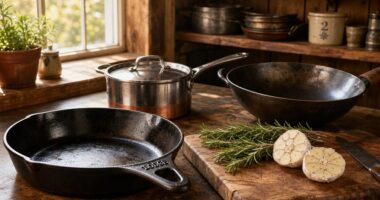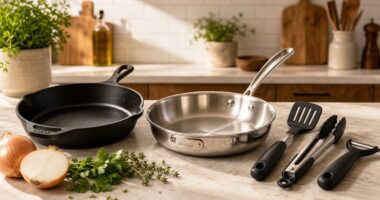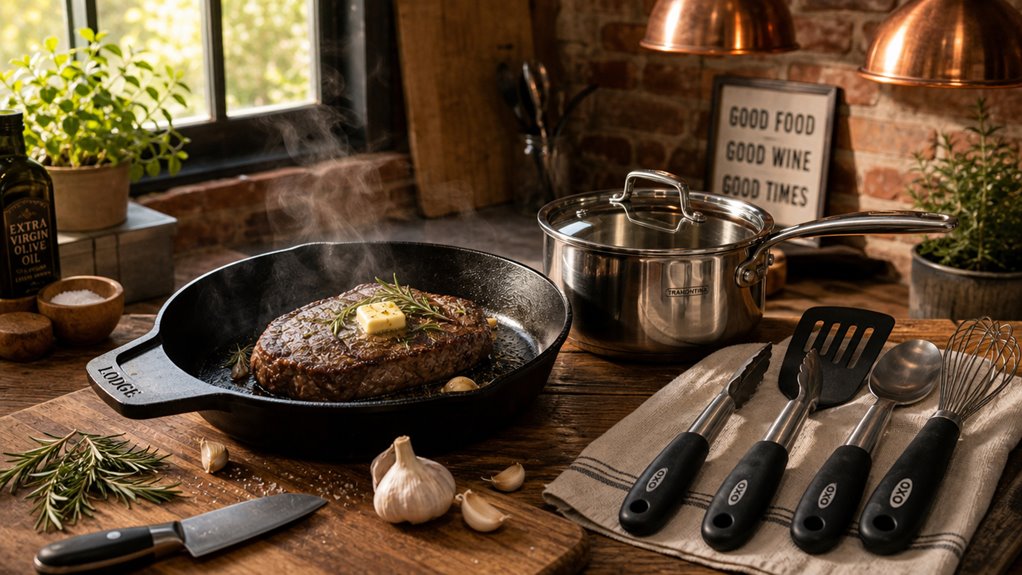
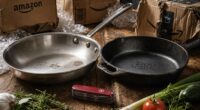
Buy-it-for-life kitchen brands: Lodge, Tramontina, and OXO Good Grips lead Reddit’s BIFL community recommendations by delivering durability, heat performance, and everyday control.
- Lodge Cast Iron — forged in South Pittsburg, Tennessee since 1896
- Tramontina Tri-Ply Stainless — engineered in Brazil, sold widely across North American retailers
- OXO Good Grips — designed in New York City for accessible, ergonomic kitchen use
Lodge Cast Iron produces its skillets using ASTM A48 Class 30 iron through sand-mold casting at its South Pittsburg, Tennessee foundry. Lodge skillets retain high heat consistently, making them reliable for searing meat and baking cornbread. The trade-off is weight — Lodge cast iron runs heavy, which challenges users with limited grip strength.
Tramontina tri-ply stainless steel cookware bonds an aluminum core between two stainless layers, spreading heat evenly across gas, electric, and induction burners. Tramontina pans require approximately 4–5 minutes of preheating before reaching cooking temperature. Tramontina sells its tri-ply line at Walmart, Costco, and Amazon, keeping it accessible to most households.
OXO Good Grips tools give everyday cooks better control over cutting, peeling, and measuring tasks. OXO designs its handles with non-slip, soft-grip material intended for users with arthritis or reduced hand strength. Smaller hands may find OXO handles feel bulky during extended use.
Interesting Fact: Lodge Cast Iron has operated continuously from the same South Pittsburg, Tennessee location for over 125 years, making it one of the oldest surviving cookware manufacturers in the United States still producing goods domestically.
Key Points
- Lodge Cast Iron traces to Blacklock Foundry (1896) in South Pittsburg, supporting long-term process consistency and seasoning know-how.
- Tramontina Tri‑Ply uses an aluminum core with full stainless cladding for even heating and warp resistance.
- OXO Good Grips emphasizes universal, leverage-focused handles for consistent usability across tools, backed by a limited lifetime warranty.
- These brands’ “BIFL” reputation relies on durable materials and community-validated longevity through daily cooking and maintenance.
- Warranty support varies by product type, with faster claims turnaround for defects and limited coverage for nonstick coatings.
The Three Brands the BIFL Community Returns to Year After Year
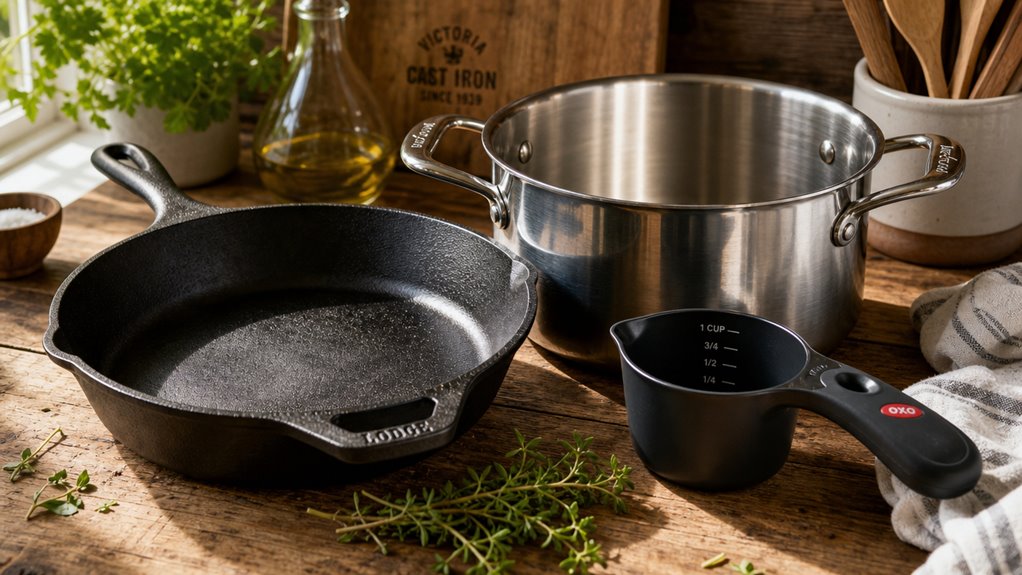
You keep coming back to Lodge, Tramontina, and OXO because they earn it with boring, repeatable stuff: Lodge’s cast iron comes from the same Tennessee foundry lineage since 1896, Tramontina’s tri-ply stainless gives even heating and warp resistance at mid-range prices, and OXO’s soft-grip, tool-first design actually stays comfortable and usable longer than fancier aesthetics. You can see the pattern in how each brand’s material choices hold up decade after decade, not just in marketing claims. The trade-off is real though: Lodge cast iron is heavy and needs seasoning/care, Tramontina stainless takes learning on temperature to avoid sticking, and OXO’s peeler and gadgets can lose cutting edge faster than all-metal shop tools.
Lodge Cast Iron (And Why Foundry Continuity Beats Marketing)
Why does Lodge cast iron keep showing up in r/BuyItForLife threads year after year, even when other “lifetime” brands quietly drift? It’s foundry continuity: sand-molding since 1896 in Tennessee, modernized but same core casting process. You get thick, heavy heat stability, plus factory seasoning you can re-season. That’s sand-molding since 1896 lodge cast iron, backed by BIFL reputation. It began as Joseph Lodge’s Blacklock Foundry in South Pittsburg, producing everything from stoves to kitchen sinks. Limitation: it’s heavy, so lighter meals don’t feel lighter.
Tramontina Stainless (And Why It Outperforms Brands 4x Its Price)
Tramontina Tri‑Ply stainless keeps showing up in r/BuyItForLife threads because it’s basically the sensible middle step between cheap stainless and the “pay the premium tax” brands—especially for people who want even heating without babysitting their cookware.
With Tri‑Ply,BIFL,cookware value, you get fewer hot spots and 304/18-10 clad fully to the rim, fewer hot spots, and solid durability. In practice, aluminum core helps drive balanced, evenly distributed heating across the base and walls.
Limitation: heat-up takes ~4–5 minutes, slower than heavier lines.
OXO Good Grips (And Why Universal Design Outlasts Aesthetic Design)
OXO Good Grips earned its spot in r/BuyItForLife not because it chases pretty kitchen trends, but because it starts with one practical problem: people struggling to grip and control standard tools. Universal Design, BIFL, Ergonomic cookware. You’ll notice:
- oversized soft TPR/TPR-like handles
- tactile “fins” for feedback
- leverage-focused openers and peelers
- consistent usability across tools
Limitation: bulkier handles feel awkward for small hands.
OXO’s original breakthrough came from difficulty using a vegetable peeler, turning a frustrating, personal prototype into a system that many people can use comfortably. Specifically, Sam Farber founded OXO after seeing Betsey Farber struggle with arthritis, which motivated the promise to create a better peeler for her.
What These Three Brands Share (And Why It Matters)
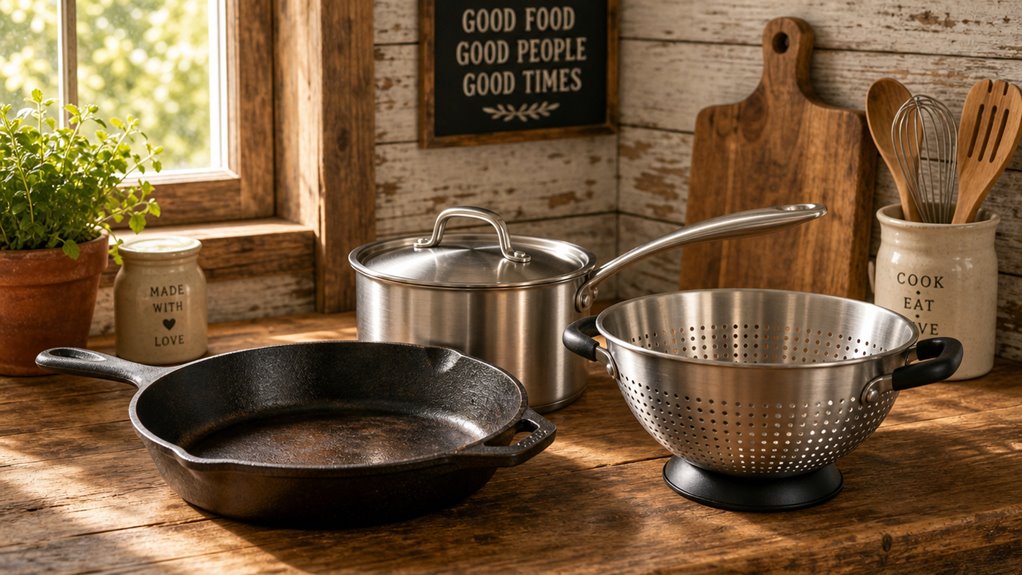
You’re seeing the same pattern with Lodge, Tramontina, and OXO: their material specs stay consistent for years, and the products don’t quietly “fix” problems by cutting corners. You also get a warranty culture where lifetime claims actually get honored, and you’re not betting your money on a brand after private-equity style ownership changes. induction compatible hard-anodized aluminum is a major example of how OXO keeps its performance-focused build approach steady over time, using an induction-ready, three-layer nonstick system rather than chasing shortcuts. The trade-off is real though: Lodge cast iron is heavy, Tramontina nonstick needs normal non-scratch care, and OXO’s soft-grip parts can wear out on the handles over time.
Material Specs That Don’t Quietly Downgrade Over Decades
How do you tell whether a cookware brand keeps its promises, even after a decade of messy real-life use? You look at materials that hold heat and structure. Lodge cast iron, Tramontina tri-ply stainless, and OXO hard-anodized aluminum all spread heat and resist warping. Construction quality also helps prevent uneven heating and hot spots, since better bonding distributes heat more reliably from rim to rim.
- Thick cast iron you can re-season
- Aluminum core tri-ply stainless for fewer hot spots
- Riveted/solid structure over flimsy welds
- Hard-anodized bases that resist wear
Limit: OXO nonstick still eventually loses release.
Warranty Cultures That Honor Lifetime Claims
After you’ve checked that the materials won’t “quietly downgrade” under real heat cycles, you still need the backstop: warranty culture. Lodge’s Made Right limited lifetime warranty coverage is clear: defects in material and workmanship, with easy customer-service review. Lodge’s normal household use requirement means coverage is tied to following the instructions that come with the cookware. Tramontina lays out tiered coverage and common exclusions like overheating. OXO’s “Better Guarantee” keeps claims low-friction. Limitation: all require normal household use and proof.
Why Family or Employee Ownership Outlasts Private-Equity Brand Acquisitions
Ownership structure isn’t trivia in the BIFL world; it changes the incentives behind what gets made, how often specs shift, and how willing a company stays when a problem claim shows up. You’ll notice ownership continuity in Lodge, Tramontina, and OXO. In contrast, specialty brands built around a craft-first mindset tend to preserve standards because the people making the decisions are more invested in longevity than churn. family/employee control protects “product memory”—sustained manufacturing philosophy helps prevent spec whiplash and keeps materials consistent over time. – family/employee control protects “product memory”
- PE hunts near-term EBITDA, pushes cost-down
- fewer reorganizations mean stable materials
- durable kitchen tools keep serving, not rebranding
Limitations: OXO is Helen of Troy.
Lodge Cast Iron — The 128-Year Foundry Standard
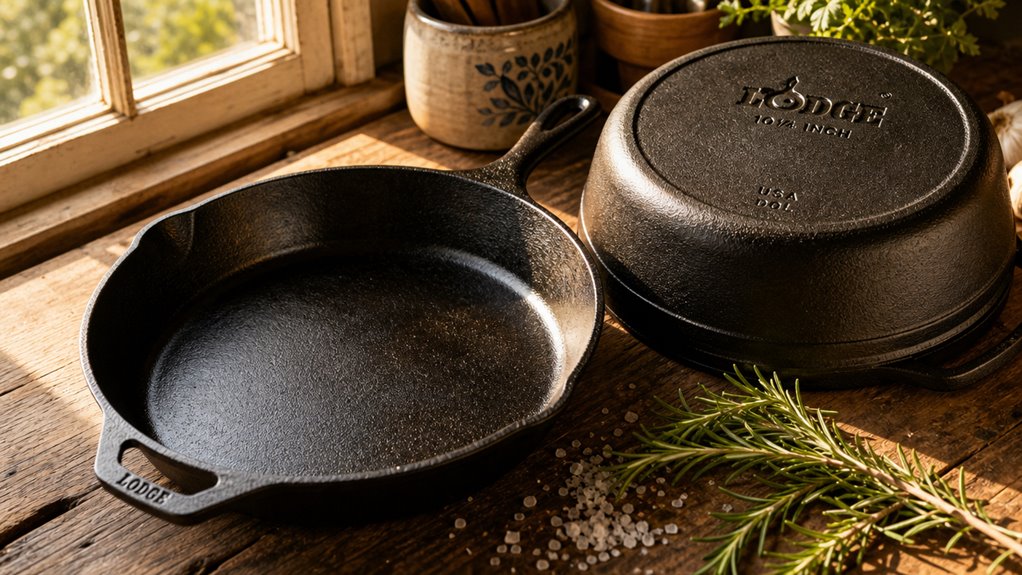
You’re looking at Lodge’s 128-year foundry continuity in South Pittsburg, where they’ve kept turning out cast iron since 1896 and backed it with real manufacturing changes like induction melting in 1992. In 1877 Joseph Lodge relocated to South Pittsburg, and that move established the family’s long-running foundry base. Across the core bare-skillet lineup, you’re also basically buying consistent material—ASTM A48 Class 30 grey iron—so the heat retention and searing behavior don’t feel like a lottery from SKU to SKU. If you can stomach the one real limitation, Lodge’s entry-level pre-seasoning still needs your own seasoning routine to get truly nonstick, and that’s exactly why a $25 L8SK3 can beat a $200 premium alternative that rarely fixes the underlying maintenance work.
The South Pittsburg Continuity Story
How did Lodge keep cast iron cooking on the same patch of Tennessee ground for so long? You can trace Lodge Cast Iron back to South Pittsburg in 1896, with production never relocating core operations. Family leadership stuck. The town employed generations. Blacklock Foundry established in 1896 by Joseph Lodge, focused on a wide range of cast iron products including cookware. continuous foundry work helped the company build deep, uninterrupted know-how in the casting and finishing process—especially the seasoning that makes Lodge pieces approachable for everyday cooks. – intergenerational employees – J.P. Morgan-linked expansions – the Lodge Museum preserves the story
ASTM A48 Class 30 Grey Iron Across Every Lodge SKU
If you’ve ever wondered why Lodge pans feel “dead” on the counter and hold heat like they were built for the long haul, it starts with the iron they spec: ASTM A48 Class 30 gray cast iron.
The graphite flake network damps vibration and supports seasoning. graphite flakes fracture along the surface and contribute to gray cast iron’s characteristic finish and behavior under load. Class 30’s ≥30,000 psi tensile target underpins cookware durability. gray cast iron has long been used in rugged cast components like manhole covers and other heavy-duty parts, which is the kind of “built to last” lineage BIFL shoppers are looking for.
Limitation: thicker sections mean these are heavy to lug.
Why a $25 Lodge L8SK3 Beats $200 Premium Alternatives Every Time
A $25 Lodge L8SK3 10.25-inch skillet often cooks like its $200-and-up cousins because it starts with heavy ASTM A48 Class 30 grey cast iron from a foundry that’s been turning out the same core material for generations. You get better price-to-performance and BIFL cookware value, plus factory seasoning and high-heat oven use. cast iron rewards the consistent, time-invested care of proper seasoning and maintenance, which helps it deliver long-term results that nonstick pans typically can’t match.
- dual pour spouts
- opposite helper handle
- sears after preheat
- rough interior needs seasoning patience
Tramontina — The Brazilian Stainless That Outperforms Its Price
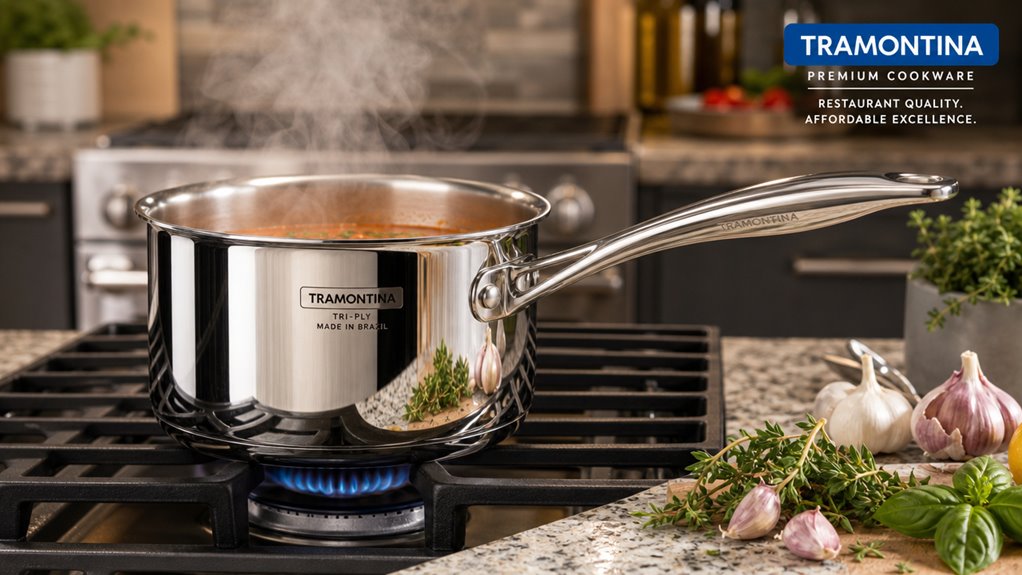
You’ll get real 18/10 stainless guts on Tramontina’s Tri-Ply Clad, with an aluminum core that spreads heat more evenly than the cheaper single-ply styles you see elsewhere under $80.
If you’ve used Cuisinart’s clad before, note how Tramontina’s tri-ply base keeps the aluminum mostly where the heat starts, so you avoid some of that “disc-only” temperature mismatch while still cooking solidly.
Just don’t expect heavyweight-level heat retention—cold loads can drop the pan temp and make browning feel more finicky if you don’t preheat and manage your oil.
18/10 Stainless Construction in the Under-$80 Range
Why does “18/10 stainless” matter when you’re shopping under $80? Because it’s built around 18% chromium and 10% nickel, so you resist rust and deal better with acids. You get non-reactive food-contact behavior and fewer discoloration surprises, even in budget cookware, including Tramontina.
- Passive oxide layer
- Better salt/tomato tolerance
- Easy cleaning, shine
- Induction compatibility
Limitation: under-$80 Tramontina may use thinner gauge.
Tri-Ply Bottom on Tramontina vs Single-Ply on Cuisinart
If you’re comparing Tramontina tri‑ply to a budget Cuisinart single‑ply, start with the construction difference: Tramontina spreads an aluminum core across the whole pan (and up the sides) between stainless layers, while many Cuisinart lines rely on a stainless “skin” with heat spreading mainly from a disc at the bottom.
That means steadier sears and better simmer control, plus induction compatibility via a magnetic 18/0 outer layer.
Limit: tri‑ply can still lose heat faster than thick multi‑ply.
Why Tramontina ProLine Earns Its Reddit BIFL Recommendation
How does Tramontina ProLine earn that Reddit BIFL rep without the luxury-brand markup? You get durability from heavy-gauge 18/10 stainless, riveted handles, and steady heat for searing, sautéing, and acidic sauces—plus easy cleaning.
- Budget-to-midrange stainless
- Even heat distribution
- Nonreactive fond-friendly cooking
- Repair-free daily use
One limitation: edges and finish feel simpler than premium tri-ply.
OXO Good Grips — The Universal-Design Champion
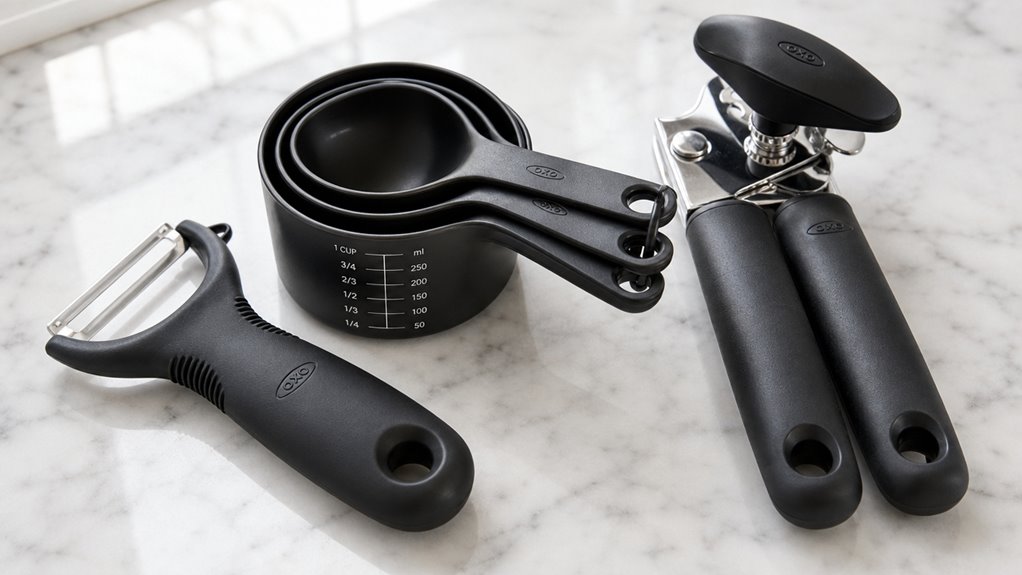
If you’ve ever watched a Santoprene handle turn gooey after a bunch of dishwasher cycles, you’ll care that OXO Good Grips was built around universal, arthritic-friendly grip design plus handle materials meant to handle real kitchen abuse.
OXO also earns its BIFL reputation because owners report the lifetime warranty getting honored fast, and replacements can show up quickly when failures pop within about 4–6 weeks.
One limitation: OXO tools with softer Santoprene overmolds won’t outlast careful washing habits forever if you consistently use harsh heat or long soak cycles.
Why Santoprene Handles Survive Decades of Dishwasher Cycles
Santoprene handles last through years of dishwasher cycles because the rubber-like layer in OXO Good Grips isn’t just “soft plastic.” It’s a thermoplastic vulcanizate (TPV), which means the material acts elastic like rubber but melts/processes like a thermoplastic, so it resists the wear mechanisms that make many grips go tacky, brittle, or peel.
- dishwasher durability stays stable via crosslinked rubber domains
- TPR overmold bonds to the core, resisting peeling
- heat, water, and detergent won’t easily hydrolyze it
- stress spreads over the oval cross-section
Limitation: you’ll still see whitening if scratched.
The Lifetime Warranty That Owners Actually Use
What you’ll notice with OXO Good Grips cookware is that their “limited lifetime” warranty actually reads like a process, not a marketing slogan. You get lifetime warranty coverage for defects in materials and workmanship, but non-stick coating is only 2 years. You must show dated proof, then submit claims for repair or replacement. OXO also excludes misuse, accidents, overheating, and commercial use.
Why OXO Good Grips Replaces Tools Within 4-6 Weeks of Failure
How does OXO Good Grips end up replacing a failed tool in about 4–6 weeks instead of dragging it out? You submit photos and details, then costumer service processes the claim fast. OXO warranty language says replace or refund, so they don’t stall. The replacement cycle usually finishes when shipping and stock lines up.
- Online warranty form
- Fast verification
- Warehouse processing in days
- Back-and-forth variance
You’re covered, but you must provide proof.
Frequently Asked Questions
Which Lodge, Tramontina, OXO Items Are Most Commonly Replaced Under Warranty?
Lodge warranty replacements most commonly involve enameled cast iron with chips or cracks, and seasoned skillets that have warped. Tramontina replacements typically cover tri-ply pans with warping or delamination, and nonstick pans with failed coatings. OXO replacements most often involve degraded Santoprene handles and broken buttons or springs on peelers and can openers.
Do These Brands Use Any Nonstandard Alloys or Coatings That Change Over Time?
Lodge uses only standard bare cast iron seasoned with polymerized oil — no PTFE, PFAS, or proprietary coatings. Tramontina and OXO use standard 18/10 stainless steel with aluminum cores. Their nonstick lines use conventional PTFE or ceramic coatings, both of which degrade with use over time.
How Can I Confirm a Product Matches the BIFL Material Specs Before Buying?
Look for exact material names (cast iron, 18/10 stainless steel, enamel, Santoprene) directly on the product page or listing.
Cross-reference the manufacturer’s spec sheet to confirm the listed materials match official documentation.
Check construction type — clad, enameled, or one-piece builds indicate higher durability standards.
Review care instructions — BIFL materials typically require specific maintenance (e.g., hand-wash only, seasoning required) that confirms authentic construction.
What Ownership or Acquisition Changes Signal Quality Risk on R/Buyitforlife?
Acquisitions by private equity firms or large conglomerates are the top red flags. Loss of founder or family control frequently precedes quality drops. Factory relocations, especially overseas, signal manufacturing changes. Thinner metals, weaker coatings, and cheaper materials appear post-acquisition. Lifetime warranties get quietly shortened or eliminated. Warranty claims become paperwork-heavy and difficult to process. Unrelated brand expansions under new ownership indicate profit-driven priorities. Rushed product line growth after acquisition suggests cost-cutting. R/BIFL members flag these changes as reliable predictors of declining product quality.
Are There Cheaper Alternatives, or Do These Brands Offer the Best Cost-Per-Decade?
Cheaper cookware exists, but often lacks verified material specs and reliable warranties. Lodge cast iron and Tramontina tri-ply deliver the strongest cost-per-decade value. OXO tools rank as the lowest long-term cost option among quality brands.
Conclusion
If you’re testing the “BIFL” theory, these three brands at least give you workable evidence: Lodge stays consistent in cast iron, Tramontina’s stainless recipes hold up, and OXO’s lifetime coverage usually matches the parts you actually wear out. Still, each has a trade-off. Lodge skillets are heavy. Tramontina handles can feel slick if you’re damp. OXO tools aren’t the best for high-heat use. If you pick based on that, you’ll waste less time.