
Common Knife Mistakes That Ruin a Good Blade (Even an Expensive One): Three habits destroy most knives before their time.
- Dishwasher exposure
- Improper storage
- Wrong sharpening tools
A good knife suffers damage quickly. Heat and alkaline detergents inside a Bosch or Miele dishwasher soften the steel edge. Tiny impacts during a cycle micro-dull even a Wüsthof Classic or Shun Premier blade. Hand-washing at a sink preserves the bevel.
A loose drawer destroys a knife slowly. Metal-on-metal contact chips the edge of a Global G-2 or Victorinox Fibrox over weeks. Moisture trapped between blades accelerates oxidation. A magnetic wall strip from Crate & Barrel or a wooden knife block from Williams Sonoma protects the edge and the steel.
A pull-through sharpener ruins a blade fast. Devices like the Chef’sChoice 4643 remove excess steel and compress the bevel at a wrong angle. A whetstone from King or Norton sharpens correctly. Local kitchen supply shops such as Sur La Table carry both and offer sharpening instruction.
Cutting technique matters. Twisting a knife or side-loading the blade on a glass or stone board chips the edge. A wooden end-grain board from Boos Blocks or a plastic board from OXO absorbs force without damage.
Interesting Fact: High-carbon steel knives, such as those made by Bob Kramer, hold an edge up to three times longer than standard stainless steel but corrode in under sixty seconds of dishwasher exposure.
Key Points
- Don’t run knives through dishwashers; heat cycling and detergent abrasion quietly soften edges and increase corrosion risk.
- Avoid hard, non-forgiving cutting boards like glass or stone; they scrape and chip steel edges faster than soft boards.
- Store knives loose in drawers or near metal utensils; daily edge knocks create micro-chips and dulling.
- Skip proper edge maintenance by overusing pull-through sharpeners; they remove steel aggressively and shorten blade life.
- Cut with torque or sideways prying instead of smooth push-cuts; lateral shock and stress cause micro-edge damage and chips.
The 5 Mistakes That Ruin Knives Fast (Regardless of Price)
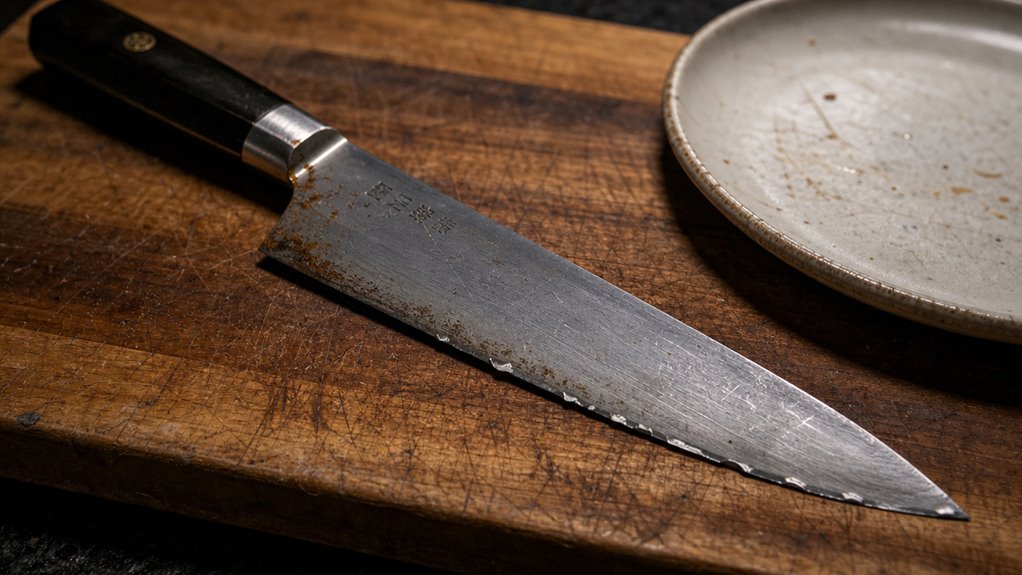
If you run a $200 knife through the dishwasher, you’re basically trading away edge performance faster than you’d lose it sharpening at home, because heat, detergent, and collisions all work together to soften and nick the cutting edge. Dishwashers Micro-corrosion from leftover moisture can also cause tiny chips or missing pieces at the edge. Next, you’ll see the cutting-board mistake show up fast: glass and other hard surfaces chip edges within months, even if the steel starts out “premium.” And once you understand how glass and ceramic keep stripping steel at the microscale, you’ll stop treating it like a harmless choice of plate and start treating it like an everyday wear setting.
Why a $200 Knife in a Dishwasher Is Worse Than a $35 Knife on a Whetstone
You don’t ruin a good knife because it’s “expensive,” you ruin it because you run it through a dishwasher when the blade is built to be treated gently.
That’s dishwasher damage: extremely hot water and detergent attack steel, speeding corrosion and edge deterioration. Even high carbon steel blades are more prone to rust after dishwasher exposure. Never Put Your Knives In The Dishwasher. A $35 whetstone session can restore sharpness; a $200 edge that gets micro-dented and softened keeps losing bite sooner.
The Cutting Board Mistake That Chips Edges Within Months
The real “knife-killer” in a home kitchen usually isn’t steel or price. It’s using a hard board.
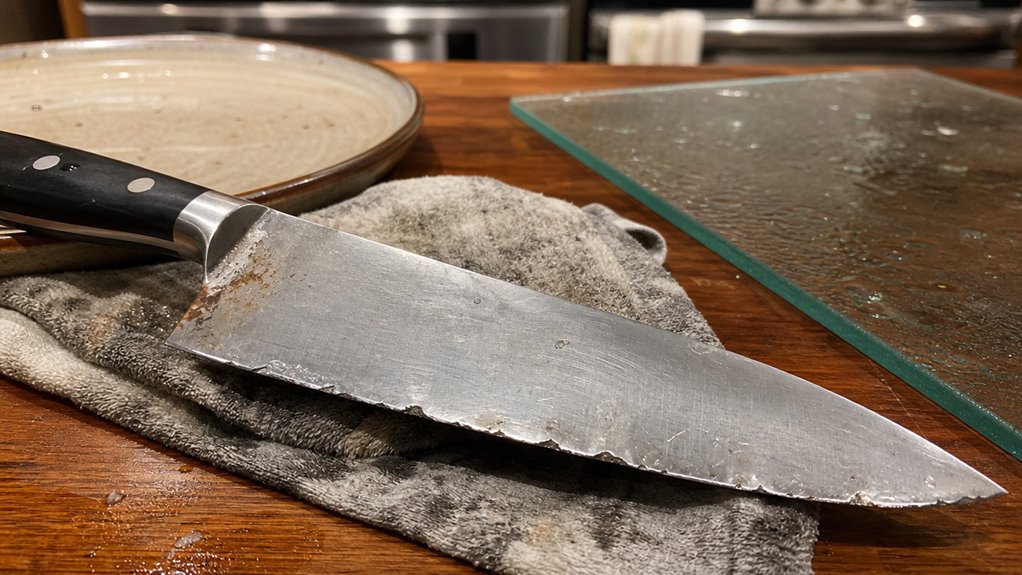
If you chop on glass, stone, or even some tough bamboo, you create knife edge damage fast: each cut chips microscopically, then edge chips show up in months. chipped blades reduce cutting efficiency, similar to dulling the edge.
Pick softer end-grain wood instead, and you’ll reduce cutting board damage knife wear. soft materials help keep the edge more responsive and precise.
This mistake beats knife dishwasher damage by sheer frequency.
Why Glass and Ceramic Cutting Boards Strip Steel From Premium Knives
Why glass and ceramic boards seem to “strip” steel from even premium knives? Glass cutting boards are harder than your steel, so you get micro-edge scraping, edge chipping, and rolling from skids. No give means you press harder, turning tiny fractures into chips faster. Glass is much harder than steel, so it offers virtually no give to absorb the cutting edge’s impact. Hard surfaces dull knife blades when drawn across them. Table:|What happens|Result|;|—|—|;|Skidding|Scraped steel|;|Hard impact|Microchips|;|Scraped bevel|Duller geometry|. That’s why premium knife care means wood or HDPE.
Dishwasher Damage (Why Even Dishwasher-Rated Knives Suffer)
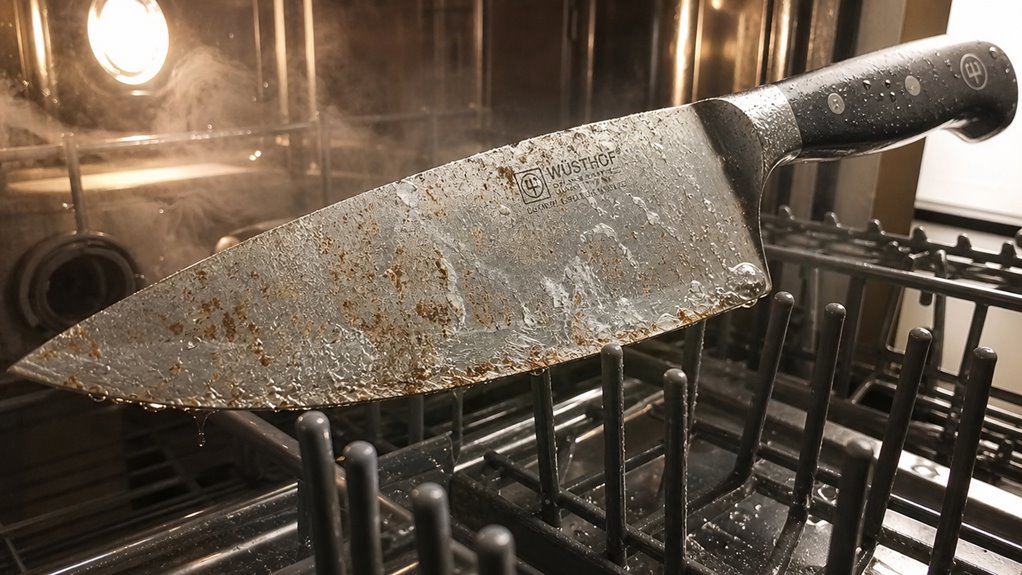
You might think a “dishwasher-safe” knife survives because the handle is what gets marketed, but the wash still hits the edge with hot water (often around 140–170°F) and harsh, high‑pH detergent that strips protective films.
That chemical exposure plus heat cycling nudges the steel at the microscale, so fine edges dull faster and can develop hidden pitting along the cutting surface.
Even if you don’t see damage right away, the combination of detergent, heat, and rack collisions keeps undoing the precision your whetstone would normally maintain. harsh detergents are abrasive and chemically harsh, designed for plates and pans but harmful to knives.
Heat, Detergent Chemistry, and Edge Microscale Damage
Even if your knife is labeled “dishwasher safe,” the dishwasher still attacks the edge in quiet, cumulative ways. Heat cycling and detergent chemistry strip protective oils, leaving spots for moisture to sit. Alkaline cleaners can etch and discolor, while residues keep working near the bolster. Meanwhile, dishwasher movement and metal contact cause edge microscale damage, dulling you long before chips show.
Because of heat cycling, high heat cycles can cause metal to expand and contract, leading to warping and micro-fractures over time.
The 140°F Wash Cycle and Steel Tempering Loss
That “140°F wash cycle” on your dishwasher label sounds harmless, but the edge still takes a beating over repeated runs. In a dishwasher, time-at-temperature around 120–140°F can slowly relax edge stresses, causing steel tempering loss without classic overtempering. Tempering heat colors (gold, bronze, purple, blue, gray) are the visual clues smiths watch for when steel is actually being pushed out of its intended temper range. The big threat isn’t hardness collapse; it’s gradual softening plus corrosion harm that stacks cycle after cycle. Toughness decreases as hardness increases, which means any tempering loss can quietly make the edge less resistant to damage over time. You just notice it later.
Why “Dishwasher Safe” Marketing Doesn’t Mean Whetstone-Maintained Edge Survives
Dishwasher-safe doesn’t mean your edge survives like it was just freshly whetted and babied. You still get edge degradation from tumbling racks, plus detergent abrasion that rounds the apex. Hot, pressurized water adds mechanical stress. For stainless steel, harsh cycles can disrupt the chromium passivation layer, speeding stainless steel corrosion and pitting near the edge. detergent abrasion also contributes to micro-serration blunting, which dulls finely honed edges faster than you’d expect. harsh chemicals and salts can also strip or degrade protective handle coatings over time, even if the blade itself is rated for dishwashers. Handle claims are about survival, not whetstone-maintained performance.
Storage Mistakes That Cause Daily Edge Damage
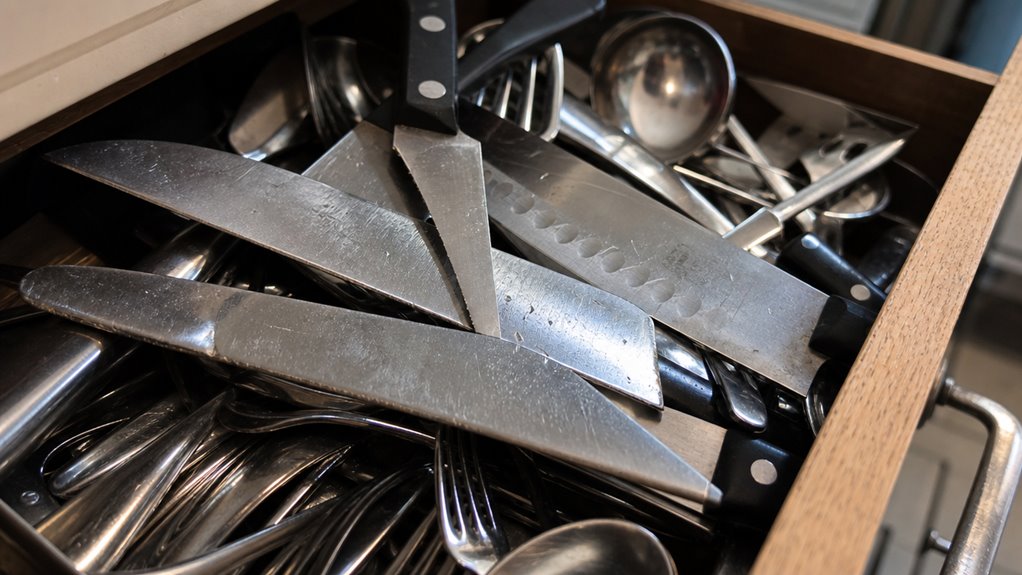
If you toss your chef’s knife loose in a drawer, you’re basically inviting daily edge knock: every scrape and bump against other utensils rolls the edge a little and can micro-chip it faster than you’ll notice. For support, a magnetic strip can help, but only if you keep it clean and ensure the blade never slaps onto the magnet (cheap magnets with rough surfaces do more harm than good). Adding drawer storage without protection can cause the blade to contact other utensils, leading to dull edges and nicks over time. The $10–$15 sleeve or a slotted organizer is the boring fix that actually works, because it stops metal-on-metal contact with one clear limitation: it takes up a little space and adds one extra step when you grab the knife. For example, humidity control is crucial because even stainless blades can still rust when moisture and oxygen are trapped in the wrong storage setup.
Drawer Storage Without a Sleeve and the Edge-Knock Problem
You probably don’t think of the drawer as part of knife maintenance, but loose storage turns it into a daily edge-knock machine. With drawer storage, your knife collides with metal tools, vibrations scrape the bevel, and micro-nicks grow after 12–15 grabs. Even if you’re careful, a cluttered junk-drawer setup creates immediate safety hazards every time you reach in for the handle. With drawer storage, your knife collides with metal tools, vibrations scrape the bevel, and micro-nicks grow after 12–15 grabs. Drawer storage drawer slams create abrasive particulates and can form microbial biofilms (Salmonella, S. aureus) after 14 days.
| Scenario | Edge effect | Fix |
|---|---|---|
| Unsleeved knives | flat spots | sleeve |
| Clutter hits | micro-chips | tray |
| Drawer slams | rolled edge | slot |
Even a keyboard-cleaner-style habit can’t undo edge-knock.
Magnetic Strips That Help (And the Cheap Versions That Hurt)
Magnetic knife strips can help you stop the daily edge-knock you get from unsleeved drawer storage, but only if you choose the right kind and mount it in the right spot. Quality magnetic strips keep knives stable, gripping the flat side for edge protection and air-drying blades to reduce storage damage. Cheap bars with weak magnets slip, causing micro-impacts. Avoid hard, un-cushioned metal. Also, mount away from sinks and steam.
Why a $10 Knife Sleeve Outlasts the Knife It Protects
Why does a $10 knife sleeve sometimes outlast the knife it’s supposed to save?
You stop storage damage at the source: loose drawers let blades knock, scrape grit, and roll the edge. Knife sleeves keep metal-on-metal contact from shaving off microscopic steel, giving real edge protection.
Limitation: if your sleeve traps moisture, you’ll still get rust pitting, so dry the blade first.
Sharpening Mistakes That Compress 10 Years Into Three
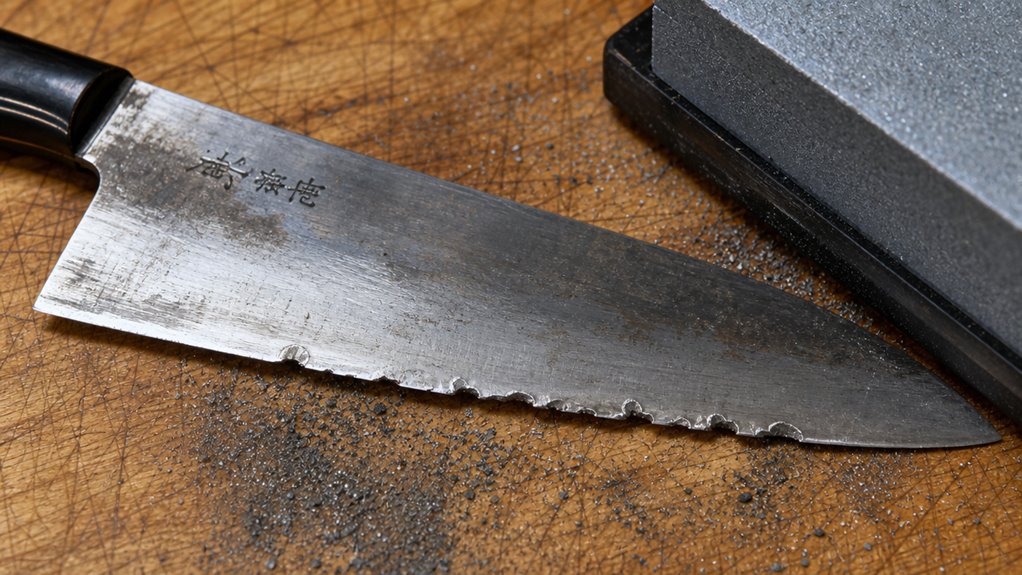
If you’re still using a pull-through sharpener, you’re basically paying in steel loss every time you sharpen, and the “maintenance” can add up fast—enough to feel like 10 years just got compressed into a few.
Next, watch your angle: wrong settings reshape the edge geometry (steep can chip micro-bits, shallow can roll it), and premium steels just show the problem more clearly.
And when you skip honing between sharpenings, you end up forcing a full re-sharpen sooner, because the edge finally falls apart instead of staying nicely in shape.
Pull-Through Sharpeners and the Steel-Loss Math
Pull-through sharpeners quietly turn “maintenance” into steel removal, and that matters because you can’t put the metal back. Each pass creates steel loss, gradually shrinking width and thinning the edge until it feels dull sooner, chips sooner, and needs rework again.
- Carbide V-grooves remove fast
- Uneven contact thins spots
- Service life compresses fast
- Better: whetstone, sparingly
Wrong Angle Settings That Reshape Premium Knife Geometry
How did your “quick touch-up” turn into a geometry problem? Wrong angles let you remove way more steel than intended, thickening the edge and reshaping blade geometry. If you drift from 15° per side toward 20–25°, frequent re-profiling on coarse stones compresses years into months. Off-center apexes from mismatched sides steer cuts and dull one side faster.
When Skipping Honing Forces Premature Full Sharpening
Skipping honing turns “my knife feels dull” into a steel-thinning habit. You ignore edge deformation, mistake a rolled apex for wear, and jump to premature sharpening. That removes steel along the whole edge, compressing years of thinning into months. Keep honing between full sessions.
- Honing fixes rolls fast
- Cuts stay predictable
- Geometry stays closer to OEM
- Less heat and scratch buildup
Cutting Pattern Mistakes That Chip Edges
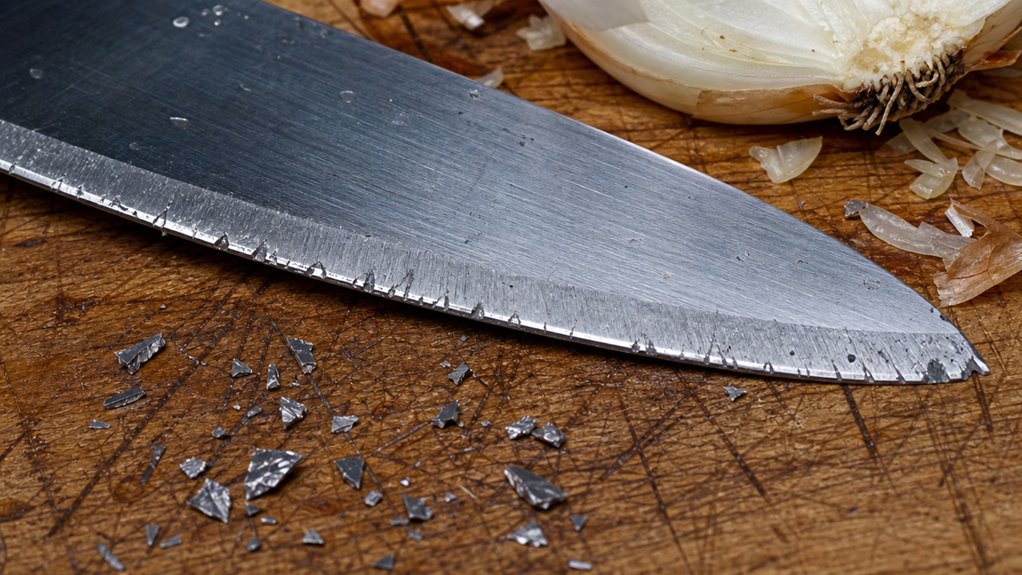
If you side-load your premium knife—especially with straight-down chopping, twisting, or prying—you concentrate stress at the edge and turn micro-chips into visible chips fast, because 60+ HRC steel is great at staying sharp but not as forgiving to lateral shock as tougher, softer blades.
When you force cuts through frozen foods or hit anything hard like bones (or crusty rinds you’re trying to “muscle through”), you’re basically testing an edge designed for slicing against impact it wasn’t built to take, and the damage shows up at the apex.
Treat your fancy knife like carbon steel in practice: make smooth push-cuts, avoid torque, and switch to a thicker beater when the job includes bone, ice, or other hard stuff.
Side-Loaded Chopping and the Premium-Knife Vulnerability
Side-loaded chopping is what happens when you hit the food with a bit of lateral force or a twist instead of a clean, vertical push, and that’s exactly how you chip a premium edge. Side load creates micro-fractures on thin, acute grinds, so edge chipping shows near heel and tip.
- Rocking
- Twisting stuck food
- Steering mid-cut
- Scraping sideways into hard boards
Frozen Foods, Bone Contact, and the Hard-Steel Chip Risk
When you cut through frozen food, you’re not just dealing with cold—you’re hitting a brittle, rigid surface that can shove extra stress back into the edge.
frozen foods and bone contact both create localized impacts that thin, high-hardness edges struggle to absorb.
That’s how you get edge chipping: micro-fractures from stress concentration, especially on acute, fine grinds.
Thaw, and keep bone out of the board zone.
Why Western Cooks Get Better Outcomes Treating Premium Knives Like Carbon Steel
You’ll chip premium edges faster than you expect if you treat them like typical Western workhorses and keep using a big rock-chop, twisting motion, and sideways dragging while the blade’s still loaded on the food.
Premium edge geometry is harder, thinner, and less forgiving. Prefer controlled push-cuts and vertical strokes. Reduce board contact mistakes.
- Rock-chop technique with side loads
- Dragging sideways on food
- Edge-first strikes into boards
- Canting or twisting on contact
Frequently Asked Questions
Can I Fix Chipped Edges, or Is Replacement Ever Necessary?
Small chips can be repaired by grinding past the damage on a coarse stone, then refining the edge. Replacement becomes necessary when cracks, deep fractures, or severe chips are present that would require an unsafe regrind to remove.
How Often Does Dishwashing Measurably Dull a High-Hardness Chef Knife?
Measurable dulling can occur after just 1 dishwasher cycle. Clear performance loss typically appears within 10–20 cycles. Significant edge softening develops within months of repeated use.
What Drawer Setup Best Prevents Metal-On-Metal Edge Knocking?
Individual-slot drawer organizers keep each blade fully separated. Grooved inserts or edge guards cushion and protect cutting edges. Fabric-lined knife rolls provide soft, isolated pockets. Avoid loose stacking, as direct metal-to-metal contact dulls and chips blades.
Do Pull-Through Sharpeners Ruin Blades Faster Than Leaving Them Dull?
Pull-through sharpeners remove more metal per use than whetstones. They grind aggressively, roughen the blade apex, and risk chipping harder steel. A dull blade loses sharpness; a pull-through-sharpened blade loses material repeatedly. Honing realigns rolled edges without metal removal. Whetstones sharpen with more control and less structural damage.
Which Cutting Pattern Causes Edge Chips Even on Wood Boards?
Cross-grain chopping causes edge chips on wood boards. Short “punch” cuts and twisting motions concentrate shock directly at the edge, while rocking or scraping sideways adds lateral stress, creating brittle micro-fractures that result in chipping.
Conclusion
If you treat your knife like a disposable tool, it’ll behave that way. Stop the big offenders: hot dishwasher cycles, glass and stone boards, and drawer chaos. When it’s time to sharpen, pick the right angle and tool, or you’ll grind away years instead of just refreshing the edge. The good news is you don’t need hype. You just need boring consistency, and your blade stays aligned longer.