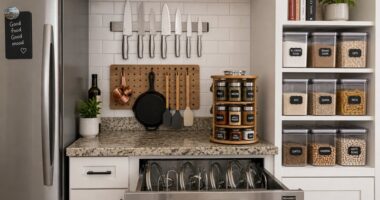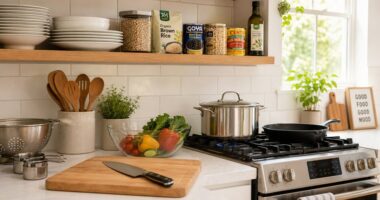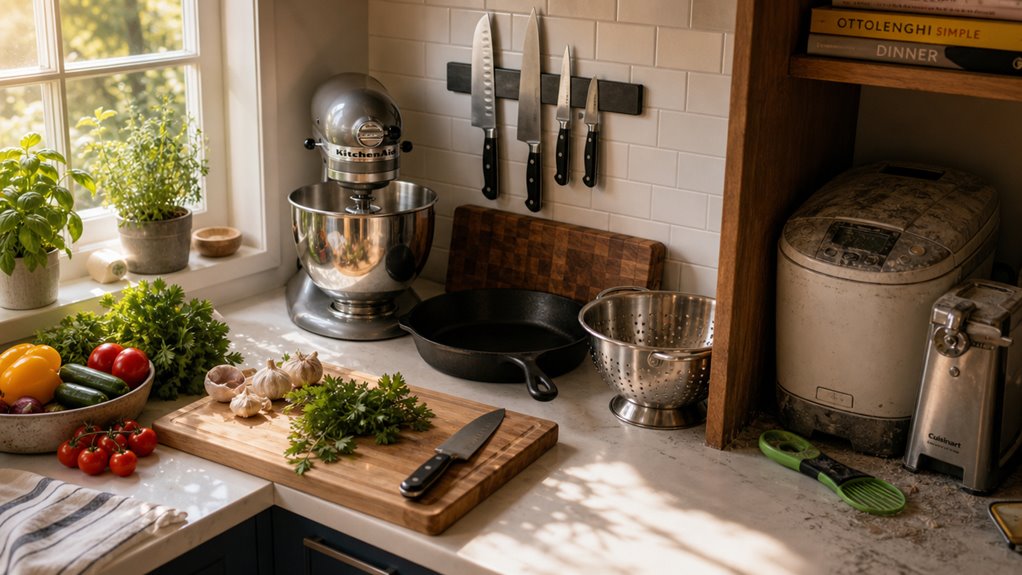

Kitchen organization requires choosing which tools earn permanent counter space and which ones belong in a drawer, a donation box, or the trash. A well-organized kitchen depends on a short list of multitasking workhorses that replace several single-purpose gadgets each.
The 10 tools that earn permanent counter space, because each is used most days and covers jobs a single-purpose gadget cannot:
- Chef’s knife: slices, dices, minces, and cores across nearly every meal.
- Cutting board: the safe landing zone every ingredient needs, impractical to store in a drawer.
- Box grater: shreds, zests, and slices in one vertical footprint, replacing a micro-plane, vegetable slicer, and chocolate shaver.
- Kitchen scale: weighs ingredients precisely and retires a shelf of measuring cups.
- High-performance blender: smoothies, purees, sauces, nut butters, and batters from one base.
- Food processor: chops, slices, shreds, and makes dough or sauce for family batches.
- Stand mixer: mixes and, with attachments, rolls pasta, grinds, and spiralizes.
- Toaster-oven range combo: bakes, air-fries, broils, and dehydrates in one footprint.
- Coffeemaker: daily use earns its spot in most households.
- Utensil crock: keeps spatulas and spoons within reach without a drawer dig.
The 10 that do not earn their spot, because a knife or a multitasker already does the job:
- Avocado slicer: pits and slices one fruit a chef’s knife handles in seconds.
- Egg slicer: wires stretch and break where a knife gives any thickness.
- Banana slicer: a plastic frame that leaves uneven cuts and traps food.
- Apple corer/slicer wheel: forces a fixed wedge and takes up bulky round space.
- Strawberry huller: a paring knife removes stems with less waste.
- Tomato corer: another stem remover a paring knife already covers.
- Melon baller: decorative spheres a knife can carve without a dedicated scoop.
- Garlic press: one job a chef’s knife does, and its chamber is hard to clean.
- Micro-plane: zesting the box grater already covers.
- Chocolate shaver: shaving the box grater already handles.
Cheap or expensive is the wrong question. Cost per use is the honest one. Check out our new Calculator.
Cost-Per-Use Calculator →Counter space functions as a limited resource, and every item placed on it competes with tools used daily. Single-purpose fruit gadgets—banana slicers, egg slicers, melon ballers, and corer wheels—each occupy that space for one task a chef’s knife already handles with equal or greater control.
A food processor, stand mixer, and range-toaster oven combo each consolidate several functions into one footprint. Storing these larger tools on the counter makes sense when they see regular use. A magnetic knife strip keeps blades accessible and off the cutting board without consuming horizontal surface area. Fix the strip into wall studs rather than plasterboard alone, and mount it high enough that children cannot reach the blades.
In a small kitchen, zoning drawers and pull-out shelves for seasonal items keeps the counter clear for the tools that earn their place. The keep-or-cull pass works by asking one question for each object: how many distinct tasks does it perform, and how often.
Studies on household kitchens suggest that the average home cook owns roughly 15 to 20 gadgets used fewer than once per month, contributing to counter clutter without meaningfully expanding cooking capability.
Key Points
- Multitask tools that see daily use, such as a chef’s knife, cutting board, and high-performance blender, earn a permanent spot on the counter.
- A practical limit is three visible countertop items, judged by a “single move to use” rule, with anything else in drawers or on wall strips.
- Each gadget scores on frequency, footprint, and overlap, and single-use items such as an avocado slicer that duplicate knife functions get demoted.
- A 30-day trial with usage tracking shows whether a borderline tool deserves counter space or belongs in storage.
- Drawers and cabinets work best organized by task zones, with the counter reserved for high-frequency multitask tools and seasonal or low-use items stored out of sight.
| 5-Piece Kitchen Chef Knife Set with Scissors and Peeler |  | Complete Set | Blade Length: 7 in (cleaver), 7 in (Santoku), 4.5 in (utility) | Blade Material: Stainless steel | Edge Type: Plain | VIEW LATEST PRICE | Read Our Analysis |
| 3-Pc Ultra Sharp Kitchen Knife Set (8″ 5″ 3.5″) |  | Versatile Trio | Blade Length: 8 in | Blade Material: High-carbon German steel (3CR13MOV) | Edge Type: Plain | VIEW LATEST PRICE | Read Our Analysis |
| 3-Piece Ultra Sharp Carbon Steel Chef Knife Set |  | Carbon Steel | Blade Length: 8 in | Blade Material: High-carbon German steel (3Cr13MoV) | Edge Type: Plain | VIEW LATEST PRICE | Read Our Analysis |
Links to Amazon are affiliate links. Buying through one costs you nothing extra and helps fund the research.
The Kitchen Organization Rule That Decides What Stays
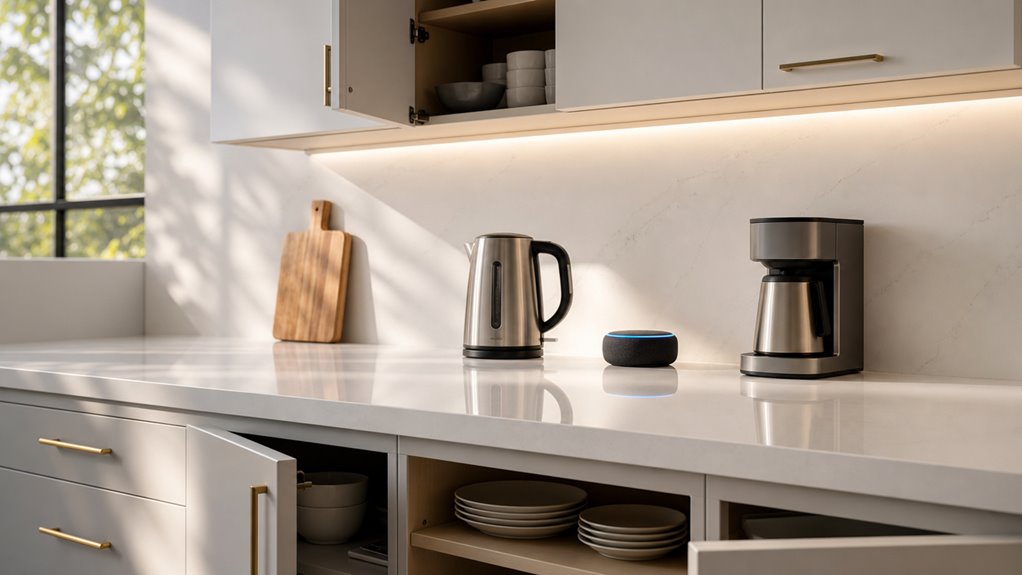
Kitchen organization comes down to one practical rule: a tool earns permanent counter space only when it gets used most days of the week, while anything reached for less frequently belongs in a drawer or leaves the kitchen entirely. Multitaskers like a chef’s knife or a box grater justify their footprint because they handle several distinct jobs without a reasonable substitute. Single-task gadgets, such as an avocado slicer or a garlic press, rarely meet that standard and typically end up in a drawer or the donation pile. The distinction between daily-use tools and occasional-use gadgets shapes how much counter space stays clear and how functional a kitchen actually feels. What follows covers the decisions behind that line in more detail. The triangle rule ensures that essential appliances stay within easy reach, supporting efficient workflow.
Why Daily Use Is the Only Fair Counter-Space Rule
The most useful kitchen items usually sit right on the counter, and that is no accident. The daily‑use rule treats the counter as prime real estate, reserving space only for tools you reach for at least once a day—coffee makers, toasters, a chef’s knife, a box grater.
Anything you grab weekly or seasonally belongs in a drawer or on a high shelf. Keeping just these multitaskers cuts visual clutter, so wiping down the surface takes seconds instead of minutes.
It also trims the steps between prep and cooking, because each item sits at waist‑to‑eye height, reducing bending and stretching. When you follow this filter, you’ll notice fewer crumbs around appliances, less cross‑contamination, and a kitchen that feels larger and easier to maintain. Frequent‑use items should be stored in decorative containers to keep the counter clear and aesthetically pleasing.
The Multitaskers That Earn Their Spot Without Argument
Start by looking at the footprint and the tasks a tool can cover. A high‑performance blender that handles smoothies, milkshakes, purees, nut butters, and batters replaces three separate gadgets, so its single base earns counter space.
The food processor’s chopping, slicing, shredding, dough, and sauce functions make it a multitasking kitchen tool; its 64‑oz bowl handles family batches, and its nesting discs keep the footprint small.
A modern range that bakes, air‑fries, broils, and dehydrates combines a toaster oven, air fryer, and pizza oven, so you can keep it under the cabinet and still have daily versatility.
A stand mixer with pasta roller, grinder, and spiralizer attachments turns one base into a baker’s hub, but the large footprint means you need a dedicated spot.
Each of these multitaskers proves its worth by covering many jobs without a drawer substitute, while any single‑task gadget that duplicates a knife or board should move elsewhere.
Compact gadgets maximize countertop efficiency and are essential for small kitchens.
| Cuisinart 8″ Stainless Steel Chef's Knife Guard | 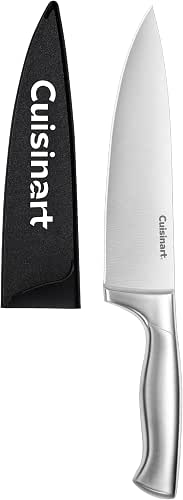 | Best Value | Blade Length: 8 in | Blade Material: Stainless steel | Edge Type: Plain | VIEW LATEST PRICE | Read Our Analysis |
| Kiwi Brand Stainless Steel 8 inch Thai Chef's Knife No. 21 |  | Classic Thai | Blade Length: 8 in | Blade Material: Stainless steel (forged) | Edge Type: Plain | VIEW LATEST PRICE | Read Our Analysis |
| 8″ Chef Knife Safety Notch 5CR15MOV Steel | 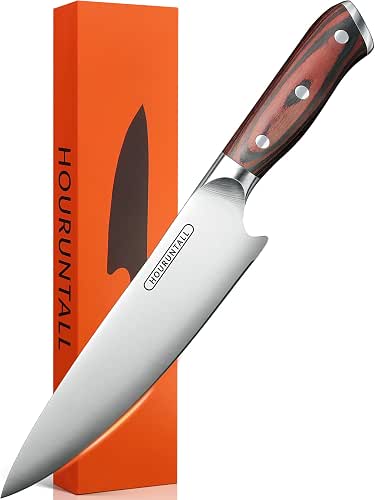 | Safety First | Blade Length: 8 in | Blade Material: 5CR15MOV high-carbon stainless steel | Edge Type: Plain | VIEW LATEST PRICE | Read Our Analysis |
Links to Amazon are affiliate links. Buying through one costs you nothing extra and helps fund the research.
The 10 Tools That Earn Their Counter Space
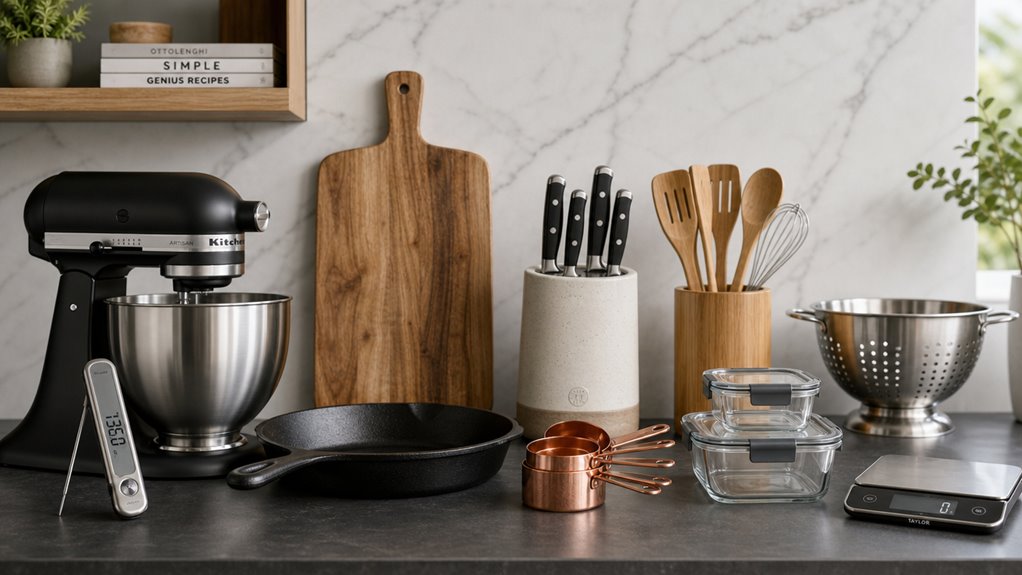
Counter tools earn their place through a combination of daily use frequency, minimal footprint, and the absence of a practical drawer alternative. These criteria filter out novelty gadgets and keep only genuine workhorses within reach.
A chef’s knife handles slicing, dicing, and mincing across nearly every meal, which means it sees consistent use without a single‑purpose substitute capable of replacing it.
A cutting board follows the same logic: its surface area and material make it irreplaceable at counter scale, where a drawer version would be impractical.
The box grater consolidates several prep tasks such as shredding cheese, zesting citrus, and breaking down vegetables into one compact footprint. A garlic press, built for a single job a knife already performs, cannot match that range.
Adjustable pegboards serve as both backsplash and storage, offering moisture‑resistant stainless steel surfaces that are easy to clean and customize for utensils and small tools.
Knife, Board, Box Grater, and the Daily Workhorses
Grab the chef’s knife, a cutting board, and a box grater, and you already have three of the ten tools that truly belong on the counter.
Your chef’s knife handles chopping, slicing, mincing, and dicing, replacing a drawer of specialty blades.
A sturdy cutting board gives you a safe landing zone for every ingredient and can double as a serving platter when space is tight.
The box grater consolidates shredding, zesting, and slicing into one vertical footprint, saving you the hassle of swapping gadgets.
Add a kitchen scale for precise portioning, a coffeemaker for daily caffeine, a utensil crock for constant spatula access, and a small herb planter for fresh flavor.
Each multitasker earns its spot by being used daily, occupying minimal space, and avoiding overlap.
Choosing a colorful blender adds visual interest and quick access to smoothies.
Why a Box Grater Earns the Counter Space That a Garlic Press Cannot Justify
Shift the box grater to the front of your counter routine; it shreds cheese, zests citrus, and slices vegetables all from one vertical footprint, so you never have to swap gadgets mid‑prep. You’ll find it replaces a micro‑plane, a vegetable slicer, and a chocolate shaver, keeping your workspace tidy while handling three daily tasks.
Its compact shape fits a drawer when not in use, yet it stays handy because you reach for it several times a day. A garlic press, by contrast, does one job that a chef’s knife already handles, and its tiny chamber traps bits that are hard to clean. The press adds a separate cleaning step without saving space, so it belongs in a drawer or the donate pile.
How Kitchen Organization Changes in a Small Space
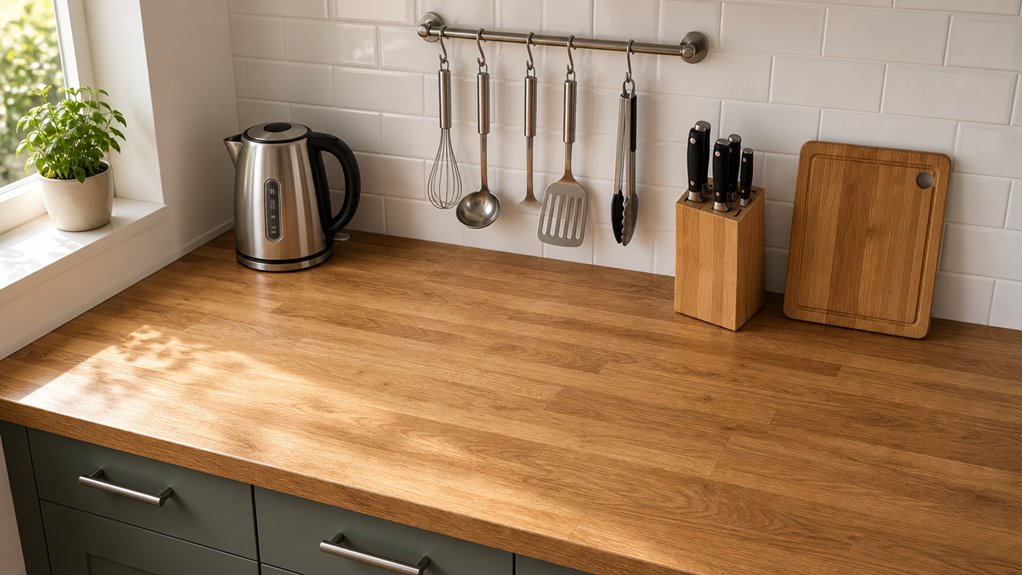
Kitchen organization shifts fundamentally in a small space because counter space becomes a constrained working surface where only daily-use, multi-function tools earn a permanent spot. Every item left on the counter competes directly with food prep area, so the threshold for what stays visible is higher than in a larger kitchen.
Drawers and cabinets absorb the remainder, organized by frequency of use, physical footprint, and functional overlap to reduce redundancy and prevent clutter from migrating back to the surface. Single-task gadgets that would otherwise crowd the counter can remain accessible without occupying workspace when cabinet storage follows a deliberate structure. The choices that shape this system run deeper than simple tidying.
Why Counter Space Is Prime Real Estate Worth Defending
Usually you’ll find that a tiny kitchen’s countertops become the most valuable real estate in the room.
In kitchen organization, every square inch serves as a work surface for prep, plating, cooling, and staging, so losing just a couple of feet feels like losing a whole room. Clear counters also make the space look bigger; cluttered tops shrink the visual field and hamper movement. Because you can’t rely on hidden drawer or cabinet space, only daily‑use, multitask tools earn a permanent spot. Bulky single‑purpose gadgets belong in a drawer or on a wall rack. Mobile islands or rolling carts can temporarily add surface, but they’re a stopgap, not a substitute for protecting your prime real estate.
The Drawer-and-Cabinet Logic for Everything Else
If you’ve already decided which multitask tools stay on the counter, the next step is to make every drawer and cabinet earn its keep. Use drawer storage that matches depth to function: shallow tops for utensils, medium for prep bowls, deep bottoms for pots. Organize each drawer into a task zone—spices, dish towels, gadgets—so you never dig through a mixed pile.
Pull‑out shelves next to the range keep cooking tools within arm’s reach, while prep items sit in a drawer under the prep counter. Base cabinets under the sink become the cleaning zone, freeing lower cabinets for daily use. Vertical pull‑out inserts and narrow corner pull‑outs squeeze extra items into otherwise dead space, keeping the workflow tight and the countertop clear.
The 10 Tools That Don’t Earn Their Spot
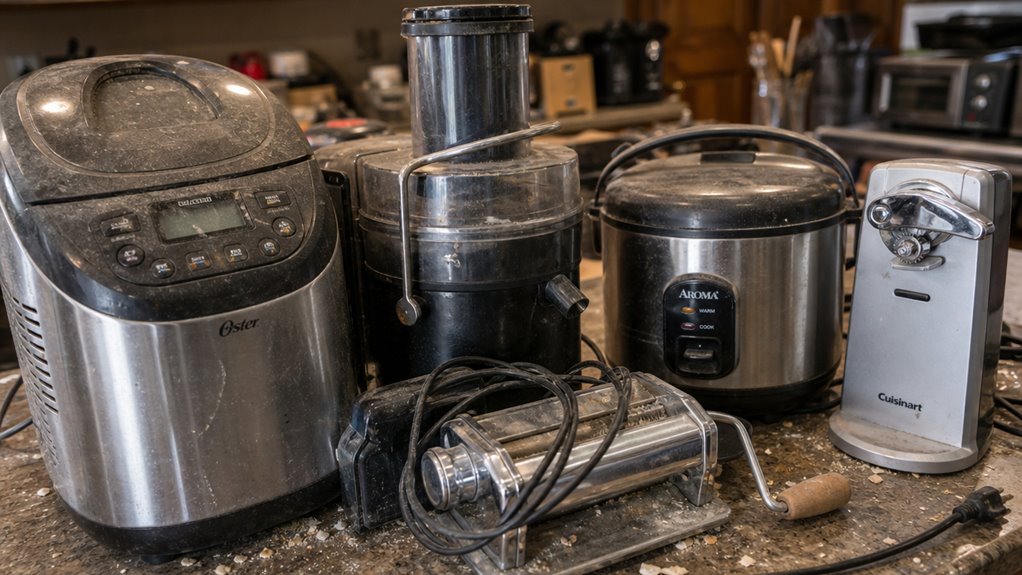
Single-task kitchen gadgets earn their place only when they handle a job that no general tool can replicate. Most do not clear that bar.
An avocado slicer, for example, cuts one fruit, while a chef’s knife covers the same task alongside tomatoes, onions, and dozens of other ingredients.
When a basic knife already handles the cutting, slicing, and prep work, a dedicated gadget adds counter clutter without adding capability.
The result is a drawer full of tools that see little use and eventually end up donated or discarded.
Understanding which gadgets fall into this pattern helps narrow down where kitchen space and budget are genuinely well spent.
Single-Task Gadgets a Knife Already Handles
You probably have a stack of single‑task gadgets cluttering your counter, each promising a shortcut that a kitchen knife already provides.
An egg slicer, for example, cuts hard‑boiled eggs with wires that stretch and break, while a knife gives you variable thickness and a simple wipe clean.
The apple corer/slicer wheel removes cores but forces a fixed wedge size and takes up a bulky circular space; a knife quarters and v‑cuts any apple in seconds.
A banana slicer makes uniform slices, yet its plastic frame leaves uneven cuts and traps food.
A strawberry huller or tomato corer removes stems, but a paring knife does the same with less waste.
A melon baller creates decorative spheres, but a knife can carve similar shapes without a dedicated scoop.
These single‑task gadgets duplicate what a good knife already does, so you can keep the knife and discard the rest.
Why a Chef’s Knife Earns Its Spot While an Avocado Slicer Wastes It
Start by looking at the kitchen counter as a workspace, not a storage shelf. Your chef’s knife earns its spot because it covers chopping, slicing, dicing and even butchering in one hand‑held tool.
One 8‑inch blade plus a magnetic strip occupies far less inches than a plastic avocado slicer, which only pits a single fruit and adds a bulky handle. The knife’s high‑frequency use means you reach for it daily, while the slicer sits idle after two seasonal uses.
A sharp chef’s knife cuts more predictably than a blunt one, though that is a reason to keep your knife sharp rather than a reason to give up a guarded tool. Where a gadget such as an egg slicer or an apple corer keeps fingers away from the blade, the case against it is counter space, not safety. A knife also sharpens in minutes, where a slicer means cleaning crevices. In short, the knife’s multitask power, low footprint and longevity outweigh the avocado slicer’s single‑use, space‑hungry design.
How to Run the Keep-or-Cull Pass Without Regret
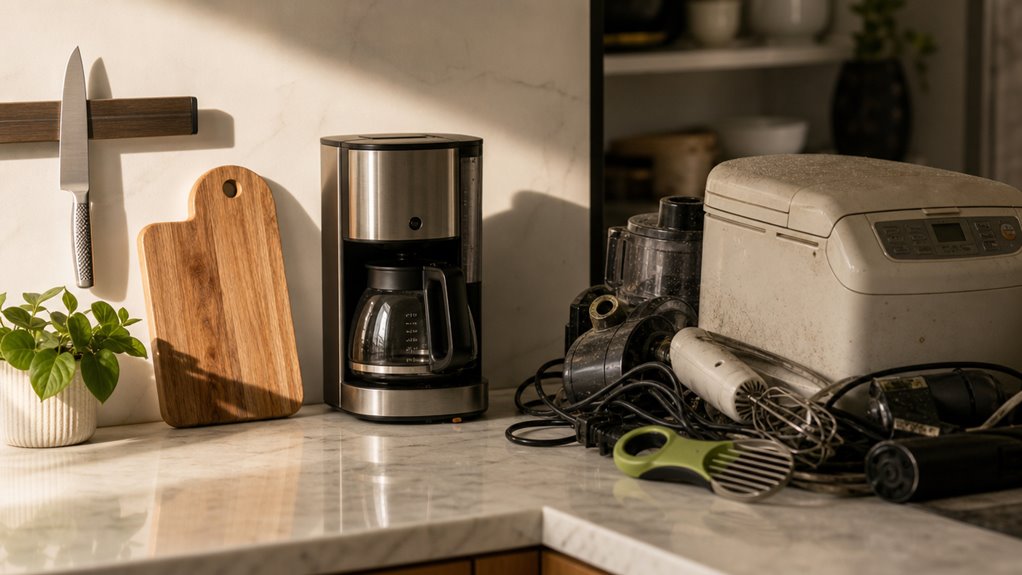
The keep-or-cull pass is a deliberate audit of every kitchen tool you own, scored against three practical filters: how often you reach for it, how much counter or drawer space it claims, and whether another tool already covers the same task.
Frequency of use separates daily workhorses from occasional-use items that quietly consume storage space.
Footprint matters because a tool that occupies significant counter real estate must justify that cost through consistent, multi-task utility.
When two tools perform the same function, the one with a narrower use case is the natural candidate for donation or removal.
Understanding how these filters interact shapes a more deliberate decision for each item you assess.
Sorting by Frequency, Footprint, and Overlap
Often the easiest way to decide what stays on the counter is to line up each tool by three simple metrics: how often you reach for it, how much space it hogs, and whether it duplicates a broader-purpose item.
Start with frequency of use: daily staples like measuring cups, spatulas, and a chef’s knife earn a spot; gadgets you pull out once a month, like a garlic press, fall to the drawer. Next, check the counter footprint. A bulky mandoline or a stand‑alone blender claims valuable real‑estate, while nesting measuring cups sit barely on the edge.
Finally, assess overlap. If a single‑purpose slicer does what a knife and spoon already handle, it’s redundant. Rank each tool, keep only the multitaskers, and move the rest to a drawer or donation pile.
Building a Counter That Works for How You Actually Cook
Mapping your actual work zones before you decide what stays on the counter is the first step toward a functional kitchen.
Identify prep, cook, clean, coffee and bake zones, then assign each counter section a dominant function.
Keep only zone‑critical tools—cutting board and chef’s knife in prep, oil and salt near the stove.
Limit visible appliances to three and require a “single move to use” rule; anything else belongs in a drawer or on a wall‑mounted strip, fixed into studs and kept out of children’s reach if it holds knives.
In a small kitchen, test borderline items in a 30‑day trial, marking each use on a piece of tape. If you don’t reach it, move it.
The method lets daily multitaskers earn space while single‑task gadgets get demoted, so the counter clears without regret.
Frequently Asked Questions
Can I Keep a Bulky Appliance if I Use It Daily?
Yes, you can keep a bulky appliance if you use it daily, but only if it handles multiple tasks, fits your prep zone, doesn’t block workflow, and isn’t duplicated by a smaller multitasker.
Do Premium Brands Count as Multitaskers Under $30?
Yes, a premium brand can count as a multitasker under $30 when it packs several genuine functions into one well-built tool, keeping counters clear without adding a single-use gadget.
How Do I Measure a Tool’s Footprint Accurately?
You measure a tool’s footprint by laying a rigid tape or ruler along its longest edge, noting length, width at the widest point, and height including handles, then record L × W × H in consistent units.
What if a Single‑Task Gadget Also Looks Nice?
If it looks nice, still let frequency and multitasking decide. Keep it only if you use it daily and it replaces a tool you already have; otherwise store it or donate it.
Should I Prioritize Frequency Over Overlap When Deciding?
Think of your kitchen as a garden: daily tools are sturdy trees, single‑task gadgets are weeds. Prioritize frequency; keep the trees thriving, then prune overlapping weeds to free space for growth.
Conclusion
You’ve now got a simple rule: keep tools that you reach for daily, that fit the countertop, and that cover multiple tasks. A chef’s knife, a sturdy cutting board, and a box grater survive; a single‑use avocado slicer doesn’t. Apply the rule in any kitchen, big or small, and you’ll free up space without sacrificing function. The result is a work surface that feels organized, not cluttered, and lets you cook with confidence.
| Sunhouse 7.5″ Chef Knife – Ultra Sharp Ergonomic Handle | 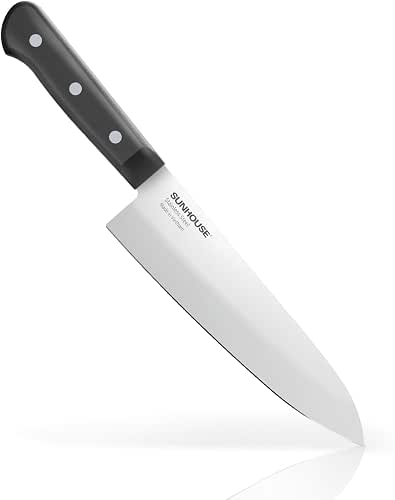 | Compact Sharp | Blade Length: 7.5 in | Blade Material: High-carbon stainless steel | Edge Type: Plain | VIEW LATEST PRICE | Read Our Analysis |
| OLULU 8″ Chef Knife with Ergonomic Handle |  | Lightweight Performer | Blade Length: 8 in | Blade Material: German stainless steel | Edge Type: Plain | VIEW LATEST PRICE | Read Our Analysis |
| Astercook 8″ Professional Kitchen Chef Knife (Gift Box) | 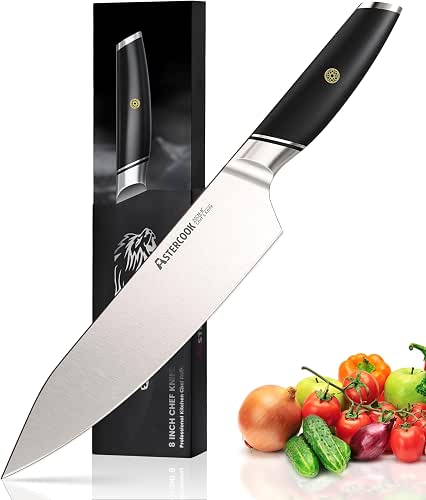 | Gift-Ready | Blade Length: 8 in | Blade Material: German high-carbon stainless steel | Edge Type: Plain | VIEW LATEST PRICE | Read Our Analysis |
Links to Amazon are affiliate links. Buying through one costs you nothing extra and helps fund the research.

Michael Haralson worked in professional kitchens from 1979 to 1992: San Diego restaurants, six years with a catering company beside an Austrian chef, and two summers as a cook on the Finland to Sweden cruise route. He then built a fifteen-year career at Nokia. It began in product marketing and product management, where technical specifications and supplier evaluation were part of the work, and grew from a few countries to a region to global roles, then into sales and corporate strategy. That took him to Beijing for three years, where he spent many weekends in a different province trying the local food and took cooking classes. He has eaten in more than 40 countries and has been shown the kitchens of restaurants in Southern Europe. At home in Finland he cooks Cantonese, Sichuan and Mediterranean food, and still uses the cast iron skillet he bought in 1992. He is the author of Buy It Once, Book One of The Researched Kitchen, and writes here about the balance between kitchen tools that cost too much and those that fail too soon.