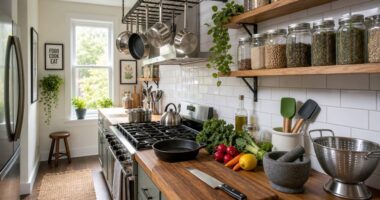

Small kitchen design requires choosing tools that reduce the total number of stored items, not simply tools that take up less individual space. Multitask tools and space-saving storage strategies work together to make a compact kitchen function more efficiently.
- Chef’s knife replaces the need for separate paring, utility, and serrated knives, cutting the number of stored blades to one.
- Immersion blender handles purees, sauces, and whipped toppings, eliminating the need for several single-purpose appliances.
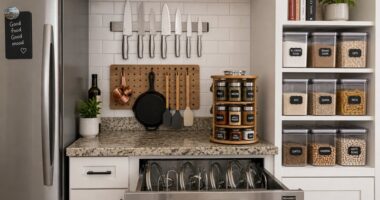
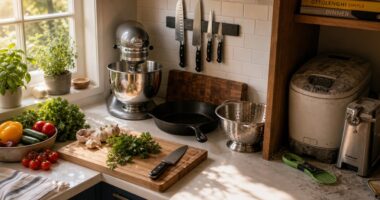
- Magnetic knife strips keep blades off counters and out of drawers, freeing horizontal surface area for food preparation.
Nesting bowls consolidate storage by stacking inside one another, so a full set occupies the footprint of a single bowl. Wall-mounted pot racks move cookware off counters entirely, returning that surface area to active use. A loaded pot rack has to be fixed into wall studs, never into plasterboard alone, and kept well under its stated load rating.
Single-purpose gadgets accumulate quickly in small kitchens and fill drawer and cabinet space faster than larger items do. Replacing them with multitask tools reduces the item count, which directly reduces the storage demand placed on the kitchen.
Storage fixtures mounted to walls and vertical surfaces shift the organizational load away from counters and drawers. Magnetic strips, wall hooks, and overhead racks use vertical space that small kitchens often leave unused.
Counter clutter is a measurable drag on a small kitchen: every item left out permanently reduces the prep surface available for actual cooking, which is why storage strategy matters as much as the tools themselves.
Cheap or expensive is the wrong question. Cost per use is the honest one. Check out our new Calculator.
Cost-Per-Use Calculator →Key Points
- Multitasking tools replace several single‑purpose gadgets, freeing counter and drawer space.
- Vertical storage (magnetic strips, pegboards, wall racks) utilizes unused wall area, expanding usable workspace.
- Nesting and collapsible items reduce footprint when stored, keeping cabinets organized and accessible.
- Consolidating appliances (e.g., immersion blender, multicooker) cuts the number of separate units needing power outlets and countertop room.
- Layout adjustments like a single‑counter workflow and pull‑out pantry maximize efficiency without needing larger tools.
| Modern Innovations 16″ Magnetic Knife Bar Organizer |  | Extended Capacity | Mounting Method: Screw mounting (included hardware) | Primary Material: Stainless steel (satin finish) | Load Capacity (Approx.): Holds multiple knives (≈ 5-10 lb total) | VIEW LATEST PRICE | Read Our Analysis |
| 17″ Magnetic Knife Holder with Hooks and Adhesive Tape |  | Integrated Hooks | Mounting Method: Screw or strong adhesive tape | Primary Material: 304 stainless steel | Load Capacity (Approx.): Holds 5-8 knives (≈ 5-10 lb) | VIEW LATEST PRICE | Read Our Analysis |
| Magnetic Spice Rack Wall-Mounted Shelf (Black) |  | Budget Magnetic Pick | Mounting Method: Magnetic (tool-free) | Primary Material: Carbon steel | Load Capacity (Approx.): Holds assorted items (≈ 5-10 lb) | VIEW LATEST PRICE | Read Our Analysis |
Links to Amazon are affiliate links. Buying through one costs you nothing extra and helps fund the research.
The Small Kitchen Ideas That Actually Free Up Space
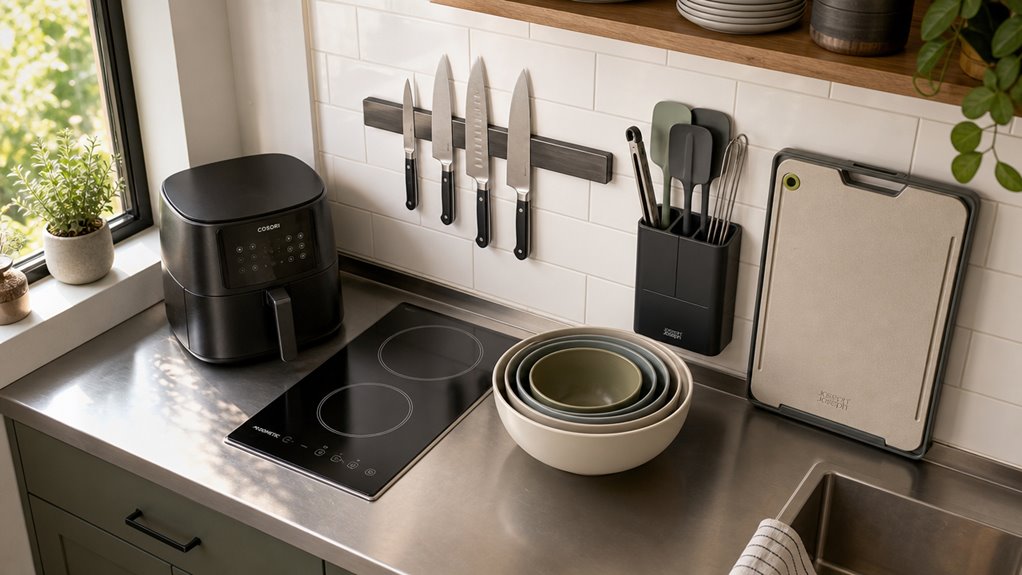
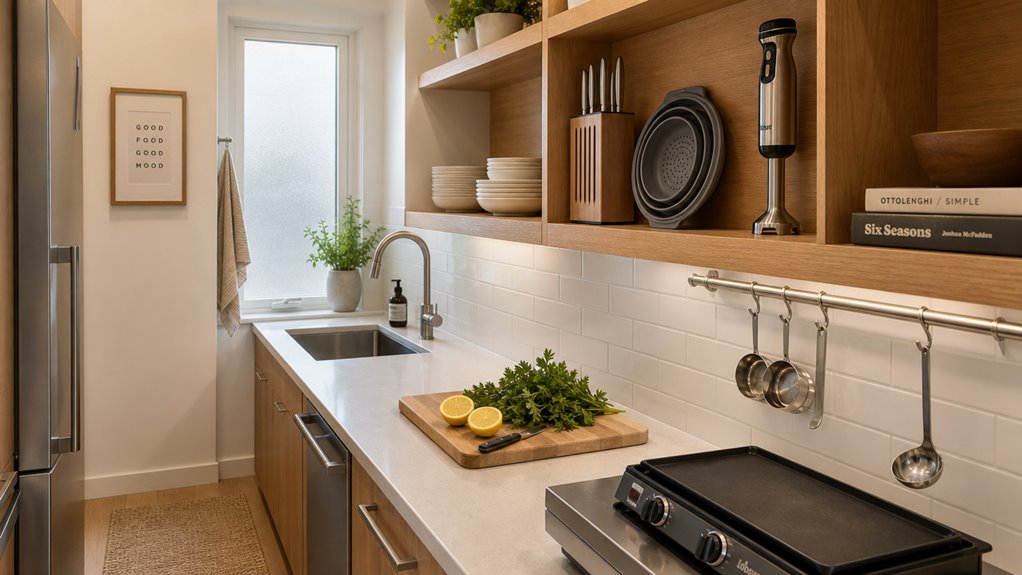
Freeing up space in a small kitchen comes down to replacing single-use gadgets with tools that handle multiple tasks and storing them off the counter and out of overcrowded drawers. A chef’s knife, for example, covers slicing, chopping, and mincing, while an immersion blender handles pureeing, whipping, and blending. Together those two tools replace several narrower ones. Vertical storage methods, such as a magnetic knife strip or wall-mounted rack, move frequently used tools onto unused wall space rather than letting them consume cabinet or counter room. The layout of a small kitchen rewards this kind of consolidation because every surface and drawer has a fixed capacity that single-use gadgets erode quickly. The sections that follow go deeper into how these choices work in practice. Adding a pot rail along the backsplash provides easy access to cookware while freeing up drawer space.
Why Buying Miniature Versions Solves Nothing
Because the real bottleneck in a tiny kitchen is the lack of counter and storage space, not the size of the gadgets you own, buying a miniature version of every tool rarely frees up room.
A tiny whisk may look cute, but its counter footprint is still a piece of surface you must clear whenever you whisk. When you replace a full‑size blender with a mini one and leave it on the counter, you’ve swapped one occupied inch for another, and the workflow stays cramped.
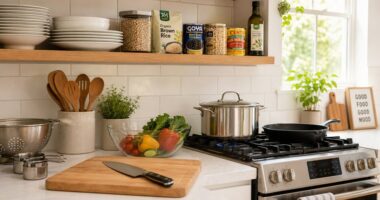
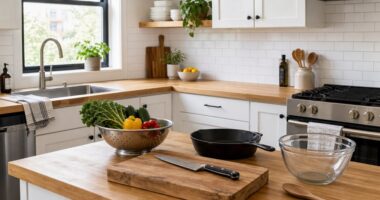
Instead, choose multitasking kitchen tools that combine chopping, blending, and whisking in one unit, then store them in a drawer or on a wall strip when not in use. This cuts the number of items you need to keep visible and actually frees the counter for prep. Adding wall-mounted shelves creates extra storage without sacrificing floor space.
The Multitasker-First Principle Behind Every Good Idea
You’ll notice that a single multitasking tool can replace three or four single‑purpose gadgets, and that alone frees a surprising amount of cabinet and counter space.
A good multitasker follows a space‑saving design: one high‑power motor base with a whisk, grinder, and immersion blender attachment lets you puree, whip, and chop without a separate blender, processor, or hand‑mixer. The chef’s knife handles slicing, dicing, and mincing, eliminating a slicer and a paring knife. Choose nesting bowls that collapse into each other, so you store a set in the footprint of one. Mount a magnetic strip for the knife and a pegboard for a fold‑flat colander; the walls become storage, not the drawers. The result is fewer pieces, clearer counters, and a kitchen that works for daily tasks without extra clutter. Incorporating high‑gloss finishes further amplifies light, making the space feel larger.
| Magnetic Fridge Shelf with Wood Lid (White) |  | Multi-Surface Mount | Mounting Method: Magnetic (no tools) | Primary Material: Magnetic steel + wood lid | Load Capacity (Approx.): Up to 50 lb | VIEW LATEST PRICE | Read Our Analysis |
| Metal Magnetic Refrigerator Spice Rack (4 Pack) |  | High-Weight Capacity | Mounting Method: Magnetic (refrigerator) | Primary Material: Iron (black finish) | Load Capacity (Approx.): 50 lb per shelf | VIEW LATEST PRICE | Read Our Analysis |
| Magnetic Foldable Spice Rack with Towel Hooks |  | Foldable Convenience | Mounting Method: Magnetic board or screws | Primary Material: Iron (anti-rust) | Load Capacity (Approx.): Holds multiple spice containers (≈ 5-8 lb) | VIEW LATEST PRICE | Read Our Analysis |
Links to Amazon are affiliate links. Buying through one costs you nothing extra and helps fund the research.
Why Different Tools Beat Smaller Tools
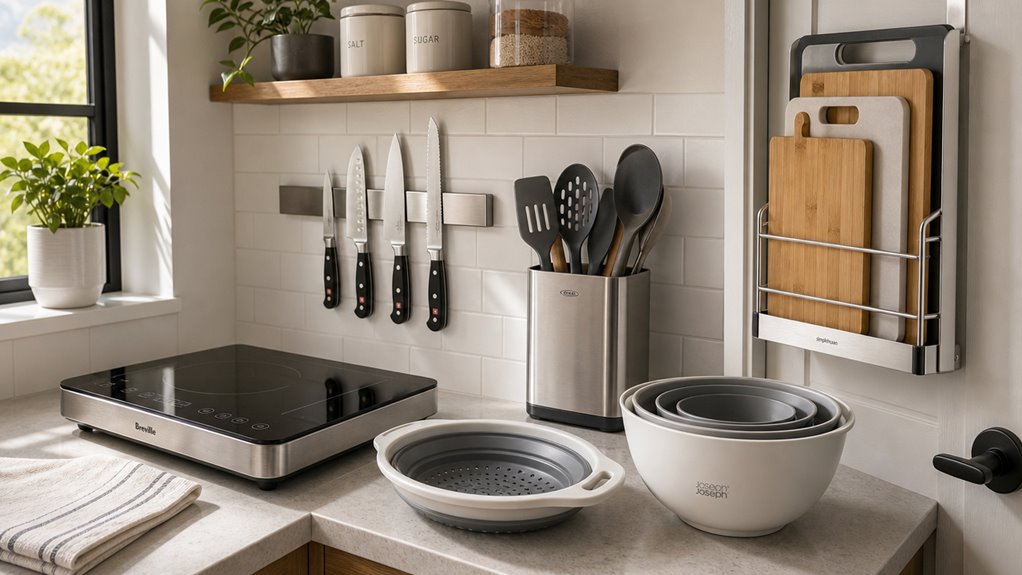
Different tools beat smaller tools because a single versatile implement can handle multiple prep tasks without multiplying the clutter of specialized gadgets, keeping both counter space and storage drawers manageable.
An immersion blender, for example, covers the functions of a whisk, a compact food processor, and a countertop blender in one unit, while a full-size chef’s knife manages chopping, slicing, and mincing without the drawer bulk that a collection of miniature slicers creates.
Motor capacity is a practical constraint worth noting. An immersion blender’s motor can overheat during extended use, so understanding the limits of each tool shapes how reliably it replaces its smaller counterparts.
Storage solutions such as magnetic strips also factor into the equation, since how a tool is stored affects whether consolidation actually reduces clutter or simply shifts it.
The sections that follow examine these trade-offs in greater detail. Adjustable organizers allow cookware to be stored vertically, freeing up cabinet space and improving accessibility.
Tools That Replace Three Gadgets Instead of Shrinking One
Swap out three single‑purpose gadgets for one multitasker and you’ll actually free up space. A pressure multi‑cooker handles pressure cooking, slow cooking, rice cooking, steaming, yogurt making, and warming, all in the same footprint as a separate slow cooker, rice cooker, and steamer.
Pair it with nesting bowls that collapse into each other, letting you store a colander, sieve, and mixing bowl in a single stack. A countertop air‑fryer toaster oven replaces a toaster, convection oven, air fryer, broiler, and reheater, so you ditch several appliances and a bulky rack.
The trade‑off? Multi‑cookers need a power outlet and a few minutes to build pressure, and nesting bowls can be cumbersome to lift when fully stacked. This approach cuts drawer clutter and keeps counters clearer.
A magnetic knife strip holds metal utensils and protects blades better than a knife block or a crowded drawer. Mount it into wall framing rather than into plasterboard alone, and place it where children cannot reach it.
Why an Immersion Blender Suits the Small Kitchen That a Countertop Blender Crowds
Even a narrow galley can stay clear when you swap a bulky countertop blender for a wand‑style immersion model. An immersion blender’s footprint is just a wand and a small jar, so you tuck it into a drawer or a slim utensil crock, freeing the counter space a traditional countertop blender occupies.
You can blend a cup of sauce right in the pot, a single smoothie in a mug, or a vinaigrette in a measuring cup without transferring to a 48‑ounce jar that forces you to make oversized batches. The wand moves to the pot, cutting down on extra containers and cleanup.
Cordless versions let you work near any outlet, but the motor isn’t as strong for crushing ice, so you may still need a separate ice‑crusher for frozen drinks.
Which Small Kitchen Ideas Matter Most for Daily Cooking
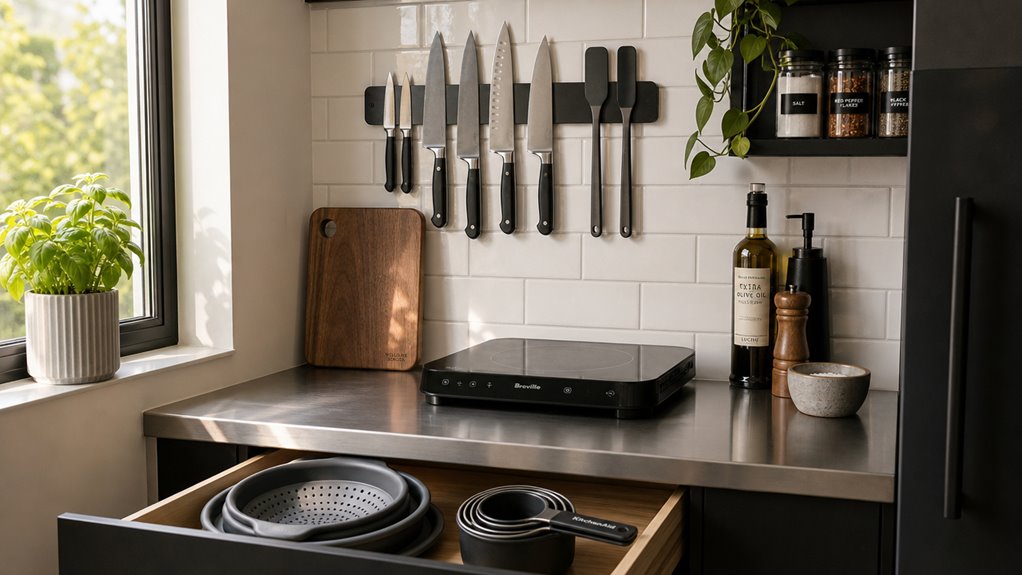
Small kitchen cooking becomes more manageable when a limited set of versatile tools replaces the habit of accumulating single-use gadgets that compete for drawer and counter space.
A full-size chef’s knife handles chopping, slicing, and mincing across most daily prep tasks, removing the need for a crowded collection of smaller blades.
An immersion blender consolidates whisking, pureeing, and frothing into one handheld unit, which directly reduces the number of items requiring storage.
Choosing tools that serve multiple functions keeps surfaces clear and keeps spending within a budget-friendly range without sacrificing capability.
The sections ahead examine how these principles apply across the specific decisions small kitchen cooking demands.
The Few Tools That Carry an Entire Small Kitchen
Start with a multitasking pan that does the work of a sauté pan, skillet, and small braiser all in one. It replaces three pots, so you keep only one large‑bottomed, lidded pan on the stove. Pair it with a half‑sheet pan for roasting, a nesting bowl set, a digital scale, and a compact box grater. Those five items are the core set that let you sauté, bake, prep, weigh, and grate without crowding drawers. The list stays under $30 each, yet each tool handles multiple daily jobs. You’ll notice more counter space and fewer gadgets to chase.
| Tool | Primary Uses |
|---|---|
| Multitasking pan | Sauté, shallow fry, braise, simmer |
| Half‑sheet pan | Roast, bake, sheet‑pan meals |
| Nesting bowls | Mix, toss, serve, store |
| Digital scale | Weigh, portion, replace cups |
| Box grater | Grate, zest, shred |
Why One Full-Size Chef’s Knife Beats a Compact Set in a Small Kitchen
Grab the only knife you really need, an 8‑inch chef’s knife, and you’ll cover almost every chopping, slicing, and dicing task you face in a small kitchen.
One full‑size chef’s knife handles 90‑95 % of daily prep, so you skip the overlap of a compact knife set that forces you to pick a short utility blade, then a paring blade, then a serrated piece.
The longer blade lets you rock across a tiny board, cutting more per stroke and keeping the countertop clearer.
It also gives a balanced grip, which reduces finger‑cramping and accidental slips when space is tight.
Storing a single knife on a magnetic strip saves drawer volume, and sharpening one edge is far quicker than maintaining several mediocre ones.
The Layout and Storage Ideas That Multiply Space
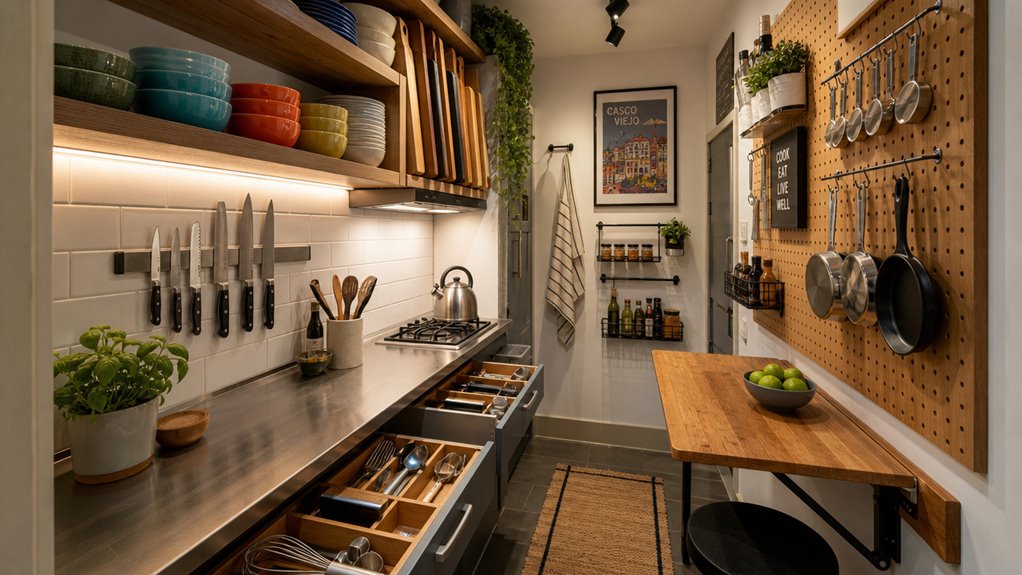
Layout and storage ideas that multiply space work by converting underused surfaces and gaps into functional zones, so a kitchen or room can handle more activity without expanding its footprint.
Ceiling-mounted racks move cookware off the floor and counter, freeing prep space that would otherwise stay cluttered with stacked pots. They only work safely when they are fixed into ceiling joists rather than into plasterboard, so locate the framing before drilling.
A pull-out pantry fitted into a narrow wall gap recovers hidden depth that standard shelving ignores, making that dead space actively useful.
Nesting bowls and consolidating prep to a single counter reduce the scattered-station problem that makes small rooms feel cramped even when square footage is adequate.
The techniques and design features covered here apply across a range of room sizes and storage needs.
Vertical Storage, Nesting, and Clear-the-Counter Habits
You can start by freeing up the walls, ceilings, and doors that usually sit idle, turning them into storage zones that keep everyday tools out of the way of your counters. Install a pegboard or rail system on the wall near the stove; magnetic strips hold knives, while hooks suspend pots and hanging baskets. Mount a knife strip into wall framing rather than into plasterboard alone, and site it where children cannot reach it.
Ceiling‑mounted pot racks lift bulky pans off the floor, and high shelves stash seasonal dishes. Fix any loaded rack into ceiling joists or wall studs, never into plasterboard alone and never with plastic anchors. Locate the framing before you drill, check the rack’s stated load rating, and stay well under it. Cast iron reaches that limit far faster than the number of pans suggests. Inside cabinet doors, add slim racks for lids and spices.
Use nesting bowls and stackable clear bins to collapse cookware into a single footprint, and place tiered organizers in deep cabinets for easy access. Keep a few labeled containers on the countertop for staples, then store the rest vertically or in nesting sets to maintain clear work surfaces.
Working One Counter Instead of Fighting for Three
Free up the walls, ceilings, and doors, then let that extra space guide you to a single, well‑planned work zone. A single‑counter workflow shrinks the classic work triangle into a tight 4‑foot stretch, so sink, stove, and fridge sit side‑by‑side. You’ll see a clear 18‑inch prep strip between sink and stove, and a landing zone next to the fridge for unloading groceries.
Swap deep 24‑inch cabinets for 18‑inch reduced‑depth units; the narrower run keeps circulation open while still holding pull‑out shelves and deep drawers for pots and knives. An under‑counter appliance garage hides the microwave, and a pull‑out trash bin stays near the sink. Pair these layout moves with multitasking tools like a full-size chef’s knife and an immersion blender that replace three gadgets each, keeping the counter free for food, not clutter.
How to Apply These Ideas Without Overspending
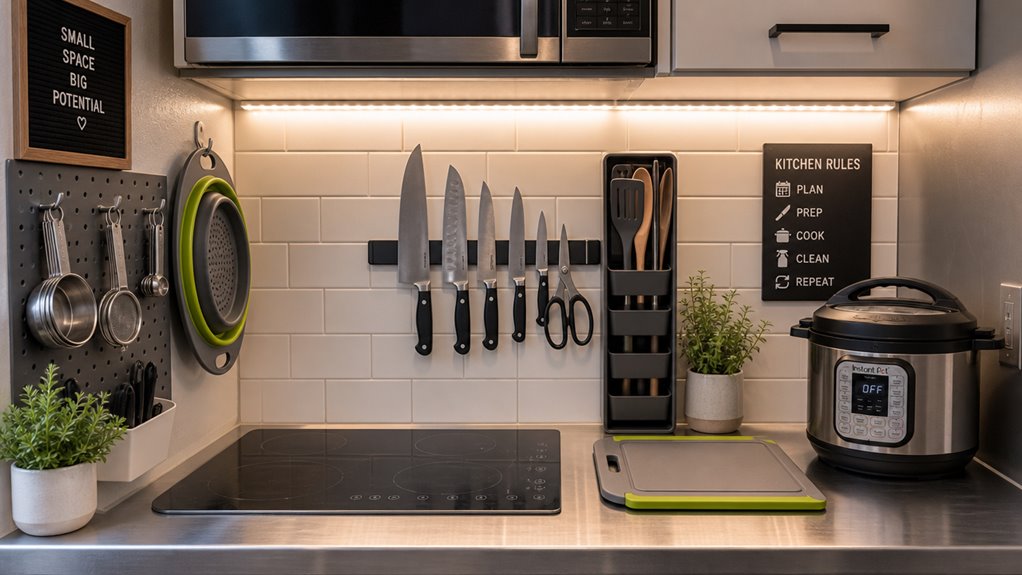
Applying these ideas without overspending means replacing clusters of single-purpose gadgets with a smaller number of multitasking tools, each handling three or four jobs, while keeping individual purchases within a budget price tier.
A full-size chef’s knife, for example, can take over the roles of several narrower slicers, reducing both drawer clutter and total cost.
A compact immersion blender covers purees, sauces, and whipped toppings in one unit, while a nesting bowl set collapses into a single tier when not in use.
The trade-off worth noting is that consolidating around larger, multi-use tools can feel bulkier in a tight drawer, so the layout and storage design of the space shape how well this approach works in practice.
The sections ahead examine specific tool categories and drawer configurations in greater detail.
Prioritizing Multitaskers Over Single-Use Gadgets
Start by swapping out the tiny, single‑purpose gadgets that crowd your drawers for a handful of true multitaskers.
A chef’s knife replaces three specialty knives, letting you chop, slice, and mince with one blade. Pair it with a cast iron skillet that can fry, grill, bake, and roast, so you ditch separate pans and a roasting tin. Heat‑proof silicone spatulas combine scraping, stirring, and shallow deglazing, cutting out wooden spoons and scrapers. Kitchen shears take over herb scissors, pizza cutters, and some knife work, freeing a drawer. An immersion blender handles purees, frothing, and small‑batch blending, sparing you a stand‑blender.
Choose tools that cover at least three daily tasks; the trade‑off is a slightly larger footprint, but the space you reclaim outweighs it.
Matching Small Kitchen Choices to the Under-$30 Ceiling
If you keep the budget under $30, you can still replace a handful of single‑use gadgets with multitaskers that actually free space. A high‑carbon stainless steel chef’s knife handles chopping, slicing, and mincing, so you ditch a tiny paring knife and a slicer.
Pair it with a collapsible colander that folds flat when not in use, cutting drawer depth by half. Add a magnetic spice strip to the wall; it holds tins without stealing counter inches.
A stackable silicone container set replaces separate bowls, lids, and a plastic freezer box, keeping pantry rows tight. Each piece saves a specific spot, and together they stay under the $30 ceiling.
Frequently Asked Questions
How Do I Prioritize Tools for Limited Countertop Space?
You prioritize by measuring each tool’s footprint, then ranking those that replace multiple gadgets, fit vertically, and see daily use. Choose multitaskers first, discard single‑use miniatures, and store the rest off the counter.
Can I Replace Multiple Appliances With a Single Multitasker Under $30?
Yes, you can swap three gadgets for one under‑$30 multitasker. Grab an immersion blender for soups, smoothies, and dressings, plus a steamer insert for veggies, and a sturdy skillet that sears, bakes, and fries.
What Vertical Storage Solutions Work Best for a One‑Person Kitchen?
Install floating shelves, tall narrow wall units, magnetic knife strips, and under‑cabinet rails. Fix anything that carries weight into wall studs rather than into plasterboard alone, locate the framing before you drill, and keep the load well under the fixture’s stated rating. Renters should check what their tenancy allows before drilling. Use tiered spice racks and pull‑out pantry towers to maximize height, freeing floor space.
How to Choose a Full‑Size Knife That Fits a Tiny Drawer?
Measure your drawer’s depth and height, then pick a 6‑8‑inch chef’s knife with a low‑profile handle. Choose straight‑edge or Santoku blades, and match it to a slim bamboo dock that fits within 2‑3 in clearance.
Are There Budget‑Friendly Multitaskers That Also Look Sleek?
A silicone collapsible colander, a nesting bowl set, and a flat-fold drying rack all sit comfortably under the $30 ceiling. Each multitasks, saves space, and keeps a clean, minimalist look.
Conclusion
You’ve learned that swapping tiny, single‑purpose gadgets for a few sturdy multitaskers can actually free up more room than shrinking everything. A chef’s knife that dices, slices, and trims replaces three separate blades; an immersion blender that purees, whips, and emulsifies cuts a bulky processor. Vertical racks and nesting towers turn walls and cabinets into usable shelves. Keep each purchase under $30, accept one limitation per item, and watch your cramped kitchen become a lean, efficient workspace.
| Magnetic Paper Towel Holder for Fridge and Kitchen |  | Renter-Friendly | Mounting Method: Magnetic backing with optional screws | Primary Material: Carbon steel (powder-coated) | Load Capacity (Approx.): Up to 6 lb | VIEW LATEST PRICE | Read Our Analysis |
| Magnetic Aluminum Foil and Plastic Wrap Organizer (2-Pack) | 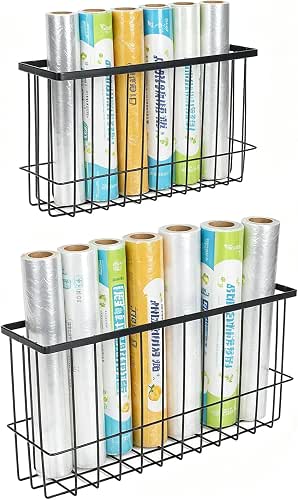 | Kitchen Organizer | Mounting Method: Magnetic back (no tools) | Primary Material: Steel (matte coating) | Load Capacity (Approx.): Holds rolls of wrap (≈ 2-3 lb) | VIEW LATEST PRICE | Read Our Analysis |
| Wall-Mount Metal Spice Rack, Screw-In (4 Pack) | 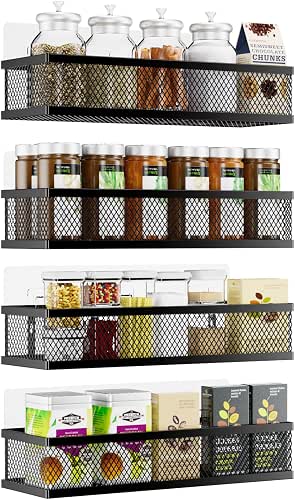 | Heavy-Duty Build | Mounting Method: Adhesive stickers or wall-mount brackets | Primary Material: Thickened carbon steel | Load Capacity (Approx.): Holds larger items (≈ 2-3 lb per rack) | VIEW LATEST PRICE | Read Our Analysis |
Links to Amazon are affiliate links. Buying through one costs you nothing extra and helps fund the research.

Michael Haralson worked in professional kitchens from 1979 to 1992: San Diego restaurants, six years with a catering company beside an Austrian chef, and two summers as a cook on the Finland to Sweden cruise route. He then built a fifteen-year career at Nokia. It began in product marketing and product management, where technical specifications and supplier evaluation were part of the work, and grew from a few countries to a region to global roles, then into sales and corporate strategy. That took him to Beijing for three years, where he spent many weekends in a different province trying the local food and took cooking classes. He has eaten in more than 40 countries and has been shown the kitchens of restaurants in Southern Europe. At home in Finland he cooks Cantonese, Sichuan and Mediterranean food, and still uses the cast iron skillet he bought in 1992. He is the author of Buy It Once, Book One of The Researched Kitchen, and writes here about the balance between kitchen tools that cost too much and those that fail too soon.