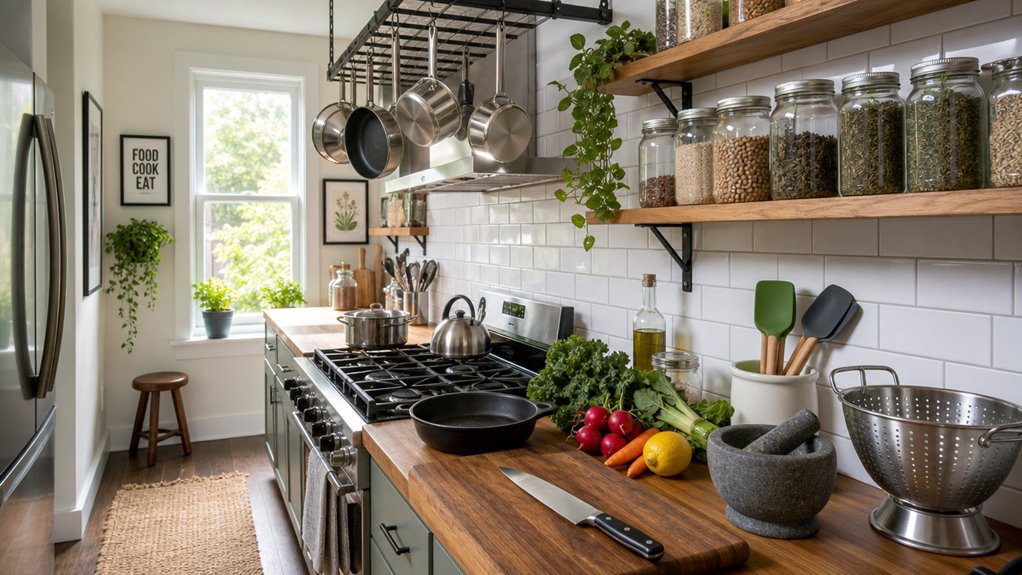
A galley kitchen requires deliberate tool selection because limited counter and storage space makes every item compete for a place. Equipping one on a budget means choosing tools that nest, stack, or mount rather than sprawl.
- Magnetic strip mounting keeps chef’s knives and paring knives accessible on a wall surface without consuming drawer or counter space.
- Nesting and collapsible tools reduce the footprint of mixing bowls, strainers, and silicone bowls to a fraction of their working size when stored.
- Cast-iron skillets deliver durable, even heat across a long lifespan, making them a reliable budget choice despite their weight during retrieval.
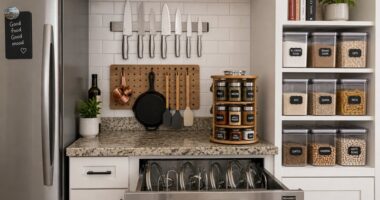
A galley kitchen typically measures narrow and long, so storage solutions run vertically rather than horizontally. A magnetic strip holds knives flat against a wall. An S-hook rail keeps tongs off the counter. A low cabinet or stacked arrangement handles the sheet pan and skillet together.
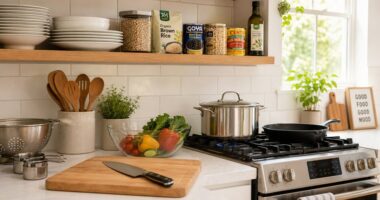
Collapsible and rollable tools address the storage gaps that rigid tools cannot. A silicone baking mat rolls into a cylinder. A collapsible strainer folds flat. A collapsible silicone bowl compresses to roughly an inch of depth, freeing shelf space for other items.
A slim microplane grater slots into a narrow drawer edge, and a multi-purpose spatula occupies a single utensil drawer slot. Choosing stackable cutting boards over multiple loose boards keeps the prep surface organized without adding bulk.
Cast iron cookware can last several generations with basic maintenance, and some pieces produced in the early twentieth century remain in regular use today, making them among the longer-lasting items typically found in a budget kitchen toolkit.
Cheap or expensive is the wrong question. Cost per use is the honest one. Check out our new Calculator.
Cost-Per-Use Calculator →The twelve budget, buy-it-for-life tools that equip a galley kitchen, each chosen to nest, stack, or wall-mount rather than sprawl:
- Chef’s knife: handles roughly 90% of chopping, slicing, and dicing, and stores flat on a magnetic strip.
- Paring knife: takes on the peeling and trimming the chef’s knife is too big for.
- Cast-iron skillet: sears, sautés, roasts, and bakes in one pan, replacing three.
- Cutting board: stackable, protects the blade edge and keeps raw meat separate from other prep.
- Microplane grater: slim enough to slot into a narrow drawer edge for zesting and shredding.
- Wooden spoon: stirs, folds, and scrapes without scratching the skillet.
- Tongs: hang from an S-hook rail to stay off the counter.
- Nesting mixing bowls: collapse to the footprint of the largest bowl.
- Saucepan: stacks with the skillet and shares a common lid.
- Sheet pan: slides into a file-style organizer for roasting and reheating.
- Instant-read thermometer: reads doneness and stows flat in the utility drawer.
- Multi-purpose spatula: one-piece build occupies a single drawer slot.
Key Points
- Prioritize a magnetic strip for the chef’s and paring knives, freeing drawer space and keeping blades protected.
- Choose a single 8‑inch cast‑iron skillet, wall‑mounted or stacked, to replace multiple specialty pans. If it hangs, the mount goes into wall studs, not into plasterboard.
- Use nesting bowl and pot sets with shared lids. A nested stack occupies only the footprint of its largest piece, which is the most efficient use of a shallow cabinet.
- Select multifunction tools like an immersion blender with whisk/mini‑chopper and a collapsible silicone bowl to eliminate single‑use gadgets.
- Install wall‑mounted S‑hook rails and under‑cabinet magnetic strips for tongs, spatulas, lids, and small strainers, maximizing vertical storage.
| Modern Innovations 16″ Magnetic Knife Bar Organizer |  | Extended Capacity | Mounting Method: Screw mounting (included hardware) | Primary Material: Stainless steel (satin finish) | Load Capacity (Approx.): Holds multiple knives (≈ 5-10 lb total) | VIEW LATEST PRICE | Read Our Analysis |
| 17″ Magnetic Knife Holder with Hooks and Adhesive Tape |  | Integrated Hooks | Mounting Method: Screw or strong adhesive tape | Primary Material: 304 stainless steel | Load Capacity (Approx.): Holds 5-8 knives (≈ 5-10 lb) | VIEW LATEST PRICE | Read Our Analysis |
| Magnetic Stainless Steel Wall-Mounted Trash Bag Holder |  | Dual-Mount Flexibility | Mounting Method: Magnetic or screw-mounted | Primary Material: Epoxy-coated carbon steel + PP plastic | Load Capacity (Approx.): Holds 1× regular organizer capacity (≈ 5-8 lb) | VIEW LATEST PRICE | Read Our Analysis |
Links to Amazon are affiliate links. Buying through one costs you nothing extra and helps fund the research.
Why Small Kitchen Storage Decides Which Tools Make the Cut
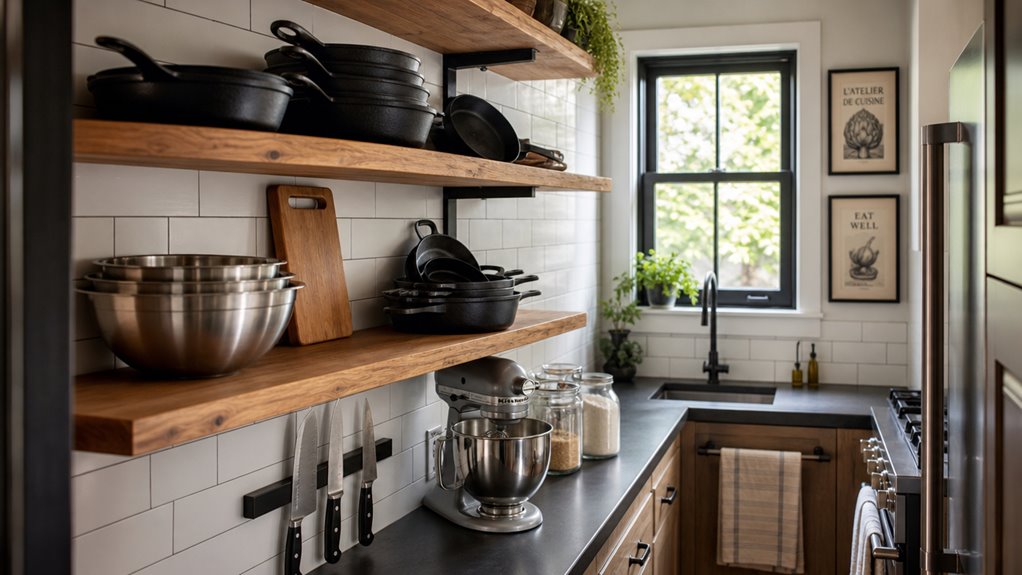
Small kitchen storage determines which tools earn a permanent place because cabinet footprint, drawer depth, and available wall space set hard limits on what can physically stay.
A single narrow drawer holds only a modest number of items, so tools that nest, stack, or mount to a wall carry more practical value than those designed for one task only.
When storage space is limited, multifunctional tools reduce clutter without reducing capability, and durable construction means fewer replacements over time.
Shelf space and wall-mount options work together to extend a small kitchen’s effective storage beyond what drawer count alone suggests.
The choices that follow reflect how these constraints shape a lean, functional kit. Adding a pot rail along the backsplash can free up drawer space by hanging frequently used cookware.
Choosing Tools by Footprint Before Function
When you measure a galley kitchen, the first thing you notice is how little linear space the cabinets and countertops actually give you, so the tools you keep must earn every square inch. Keep only the tools that nest, stack, or mount to a wall.
A magnetic knife strip, for example, tucks blades onto the backsplash, freeing a drawer and keeping edges out of the way. Choose a cast‑iron skillet that fits snugly in a lower cabinet and can double as a serving pan, rather than a bulky non‑stick set that hogs shelf space.
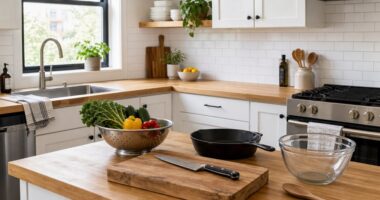
Opt for collapsible silicone bowls that flatten for storage, and a single, sturdy grater that slides into a narrow slot. Each piece should occupy a defined footprint, then multitask to cover prep, cooking, and cleanup without crowding the galley. Adding a narrow island can provide extra storage without sacrificing the tight layout.
Why Twelve Chosen Tools Outwork a Drawer Full of Gadgets
Because a galley kitchen’s cabinets are barely wider than a broom, every drawer becomes a battleground for space. You’ll find that a minimalist galley kit of twelve well-chosen tools beats a drawer full of single‑use gadgets. Each piece multitasks, nests, or wall‑mounts, reclaiming cabinet volume. The alternatives waste space, add cleaning steps, and increase decision fatigue. Durability settles most of it: cast iron, steel, and untreated wood. None of them peel, and all of them can be repaired rather than replaced. The result is faster prep, cleaner counters, and a kitchen that feels organized rather than cramped.
A well-sharpened chef’s knife can be faster than a food processor for many prep tasks.
| Tool | Storage Method |
|---|---|
| Chef’s knife | Magnetic strip |
| Paring knife | Magnetic strip |
| Cast‑iron skillet | Wall‑mounted |
| Cutting board | Stackable |
| Grater | Nesting |
| Spoon | Nesting |
| Tongs | Nesting |
| Mixing bowls | Nesting |
| Pot | Stacking |
| Sheet pan | Stacking |
| Thermometer | Drawer |
| Multi‑purpose spatula | Drawer |
| Wall-Mount Metal Spice Rack, Screw-In (4 Pack) | 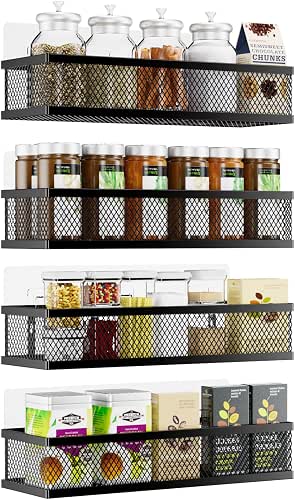 | Heavy-Duty Build | Mounting Method: Adhesive stickers or wall-mount brackets | Primary Material: Thickened carbon steel | Load Capacity (Approx.): Holds larger items (≈ 2-3 lb per rack) | VIEW LATEST PRICE | Read Our Analysis |
| Magnetic Foldable Spice Rack with Towel Hooks |  | Foldable Convenience | Mounting Method: Magnetic board or screws | Primary Material: Iron (anti-rust) | Load Capacity (Approx.): Holds multiple spice containers (≈ 5-8 lb) | VIEW LATEST PRICE | Read Our Analysis |
| Wider Magnetic Shelf Basket with Bamboo Top (XXL) | ![[WIDER SHELF] 1 SET Strong Magnetic Shelf Basket for Fridge](https://m.media-amazon.com/images/I/81E+PU5Bb8L._AC_SL500_QL70_ML2_.jpg) | XXL Storage | Mounting Method: Magnetic panels or screw-mount (bamboo top) | Primary Material: Steel with bamboo top | Load Capacity (Approx.): Up to 60 lb total | VIEW LATEST PRICE | Read Our Analysis |
Links to Amazon are affiliate links. Buying through one costs you nothing extra and helps fund the research.
The 12 Budget BIFL Tools a Galley Actually Needs
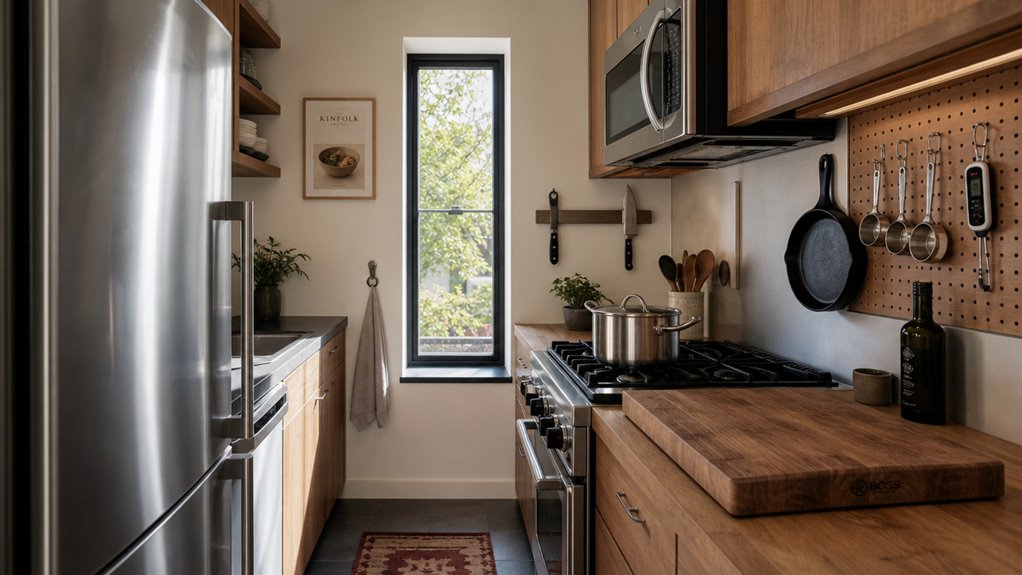
Budget galley tools earn their keep by handling multiple tasks with durable, low-maintenance materials rather than filling limited space with single-use gadgets. A solid chef’s knife in high-carbon steel, a seasoned cast-iron skillet, and a set of stainless-steel nesting bowls together cover cutting, cooking, and prep without redundancy. These materials are chosen because they hold up under regular use and stay within a budget price tier, making them practical for small-space cooking over the long term. Cast iron does require periodic seasoning to maintain its non-stick surface, and nesting bowls work best when storage accessories are chosen with compatibility in mind. The details of how each tool performs, what to look for, and where trade-offs appear are covered further below. Clear glass jars can accelerate rancidity, so opting for opaque containers helps preserve food quality longer.
The Cutting, Cooking, and Prep Core
Start with a solid 8‑inch chef’s knife and you’ve covered most of the cutting you’ll ever need in a galley. Pair it with a cast iron skillet, and you’ve got the backbone of cooking and prep.
The chef’s knife handles 90 % of chopping, slicing, and dicing; keep it sharp with a slim stone to avoid costly sharpening trips. A small paring knife tackles peeling and trimming without fatiguing your grip.
A heavy‑bottom cast iron skillet distributes heat evenly, perfect for sautéing, searing, and finishing a sauce in one pan. It’s durable, but the handle can get hot, so use a mitt.
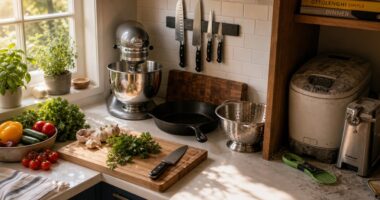
Store the knife on a magnetic strip and hang the skillet from a wall‑mounted pot rack to reclaim cabinet space. Fix both into wall studs, never into plasterboard alone and never with plastic anchors. Locate the framing before you drill, check the rack’s stated load rating, and stay well under it, because cast iron reaches that limit far faster than the number of pans suggests. Use a dual‑purpose cutting board to protect the knife edge and separate raw meat from other foods.
Multitaskers That Each Replace Several Single-Use Gadgets
Your chef’s knife and cast‑iron skillet already cover chopping and searing, but a galley’s tight cabinet forces you to replace whole rows of single‑purpose gadgets with a handful of multitaskers.
An 8‑inch cast‑iron skillet doubles as grill pan, roasting pan, and stovetop broiler, cutting out three separate pans. A nesting pot set with shared lids stacks under nine inches, replacing stockpots, saucepans, and baking dishes while staying easy to stack.
The immersion blender with whisk and mini‑chopper handles soups, smoothies, and herb chopping, so you skip a stand mixer and a food processor.
A collapsible silicone bowl works as a mixing bowl, proofing container, and serving dish, then folds flat. Each multitasker saves space, but the silicone bowl can tear if over‑filled.
How Twelve Tools Fit Real Small Kitchen Storage
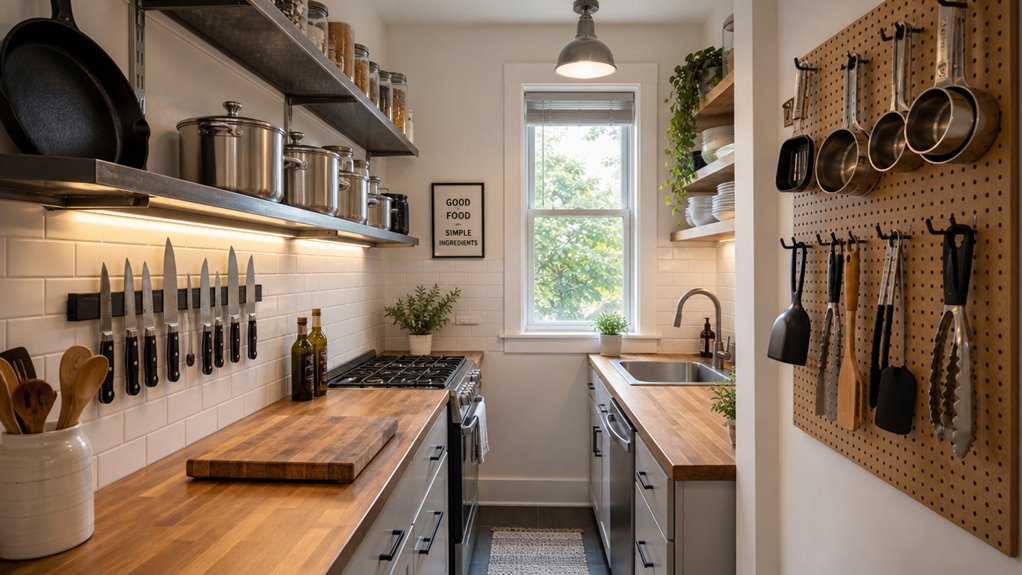
Twelve tools fit a small kitchen when nesting, stacking, and wall-mounted storage each handle a different category of cookware and utensils.
Bowls and prep containers nest inside one another, recovering cabinet space that appeared fully occupied.
Cookware such as skillets, pots, and sheet pans stack vertically on a single shelf, so height is used rather than wasted.
A magnetic strip mounted on the wall holds knives, tongs, and spatulas off the counter while keeping them accessible during cooking.
The sections that follow examine each of these storage approaches in closer detail.
Nesting, Stacking, and Wall-Mounting the Whole Kit
When you line the galley walls with a magnetic knife strip and a S‑hook rail, the countertop instantly gains a few inches of breathing room.
You’ll notice vertical storage takes the pressure off the cramped drawer, holding five to eight knives in a 15‑inch span. Pair that with nesting bowls that stack down to the footprint of the largest one, and you free a whole cabinet bay for a pan stack. The skillet and the pot stack together, while a sheet pan slides into a narrow file‑style organizer.
A wall‑mounted pot rack suspends four pans, and under‑cabinet magnetic strips hold metal lids and small strainers. That rack has to be fixed into wall studs rather than into plasterboard alone, and loaded well inside its stated rating.
The result is a twelve‑tool kit that lives on walls, in a single stack, and in one hidden drawer, keeping the galley clear and functional.
Why Nesting Storage Reclaims the Cabinet Space That Rigid Containers Lose
Nesting your bowls and containers lets a single stack take up the space of the biggest piece, so you’re reclaiming the shelf depth that a hodgepodge of rigid jars leaves empty. A nesting container set collapses four to six vessels into one footprint, eliminating the air gaps that a rigid container collection leaves behind.
Those gaps add up, often wasting 10–30 % of shelf space with orphan lids and mismatched shapes. When the lids share a common size, you file them vertically at the cabinet edge, freeing the central depth for the stack itself.
The uniform height lets you place taller stacks in lower cabinets and shorter ones on upper shelves, matching the galley’s shallow depth. The result is a predictable, space‑saving layout that a single cabinet can actually hold.
Why Budget BIFL Tools Suit a Galley Best
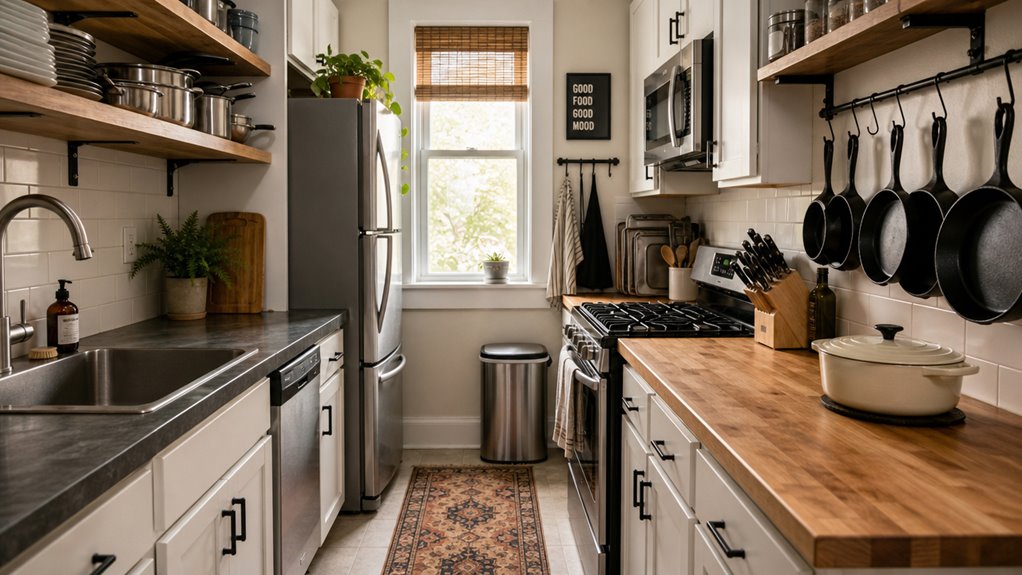
Budget tools built from cast iron or solid steel suit a galley kitchen because their durability eliminates the repeated replacement cycle that cramped storage makes especially costly. Without a non-stick coating to degrade, these materials hold up through the constant shuffling between a narrow stovetop and a compact sink that galley layouts demand.
The absence of a fragile surface layer means the cookware retains its functional shape over years of regular use, reducing both the space occupied by backup equipment and the effort spent sourcing replacements. Weight is a real trade-off, since a heavy skillet can be awkward to lift from a low cabinet, but that drawback sits within a manageable range for most cooks once storage is organized around it.
The considerations that follow cover the practical factors worth weighing before committing to this approach.
Durable Materials That Survive Daily Use in Tight Quarters
Start with materials that won’t crack or wear out under the constant bumping of a galley’s tight circulation. A seasoned cast-iron skillet and heavy-gauge stainless tools take knocks, heat, and daily washing without degrading, so they stay in service for years rather than seasons.
Your tool set should lean on heavy‑gauge stainless mixing bowls and stackable tri‑ply pans; they double as prep, double‑boiler, and roast trays, reducing drawer clutter.
Both hold their shape and their finish for years, which is what keeps a small kitchen stocked without a replacement cycle. The only drawback is the weight of cast‑iron pieces, which can strain a single cabinet shelf.
No Coatings to Peel and Nothing to Replace Every Year
The durable tool materials covered above hold up to galley use, but the real staying power comes from the tools themselves. Nothing peels, nothing chips, and nothing needs replacing every season.
You’ll find that no‑peel construction means uncoated metal surfaces stay clean and safe, so you never worry about flaking nonstick that could contaminate food.
A cast iron skillet, seasoned once, will handle searing, baking, and frying for decades without a new pan in sight.
Riveted handles on pots and welded tongs survive constant washing without loosening.
One‑piece spatulas avoid weak joints that crack.
The trade‑off? Cast iron needs occasional seasoning, but that’s a tiny effort compared to buying a fresh coated pan every few years.
How to Assemble the Kit Without Overspending
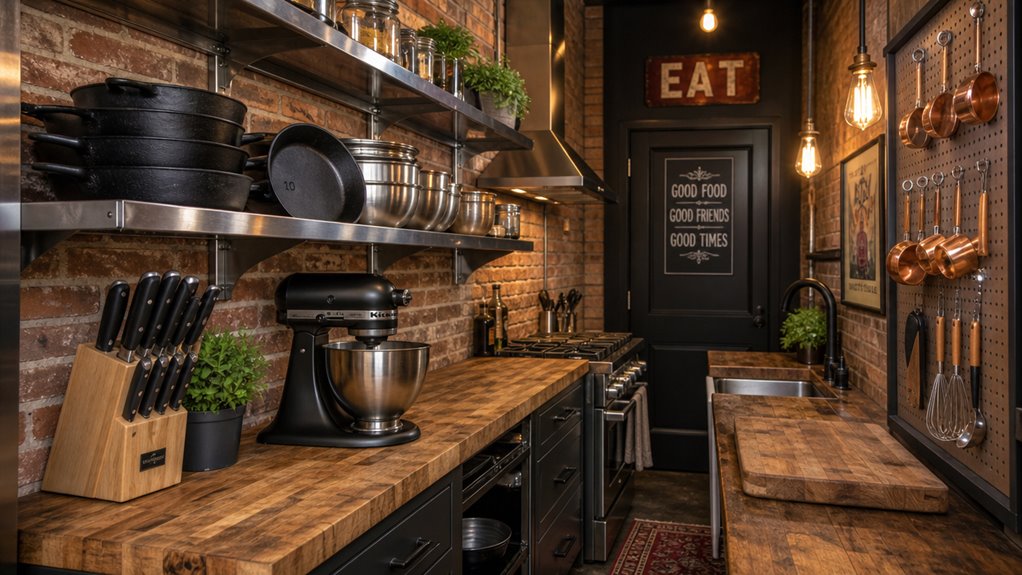
Assembling a functional galley kit without overspending means prioritizing a small set of versatile pieces, starting with a chef’s knife and a cast-iron skillet, then adding supporting items like a nesting bowl set and a magnetic knife strip only as budget allows.
Keeping each purchase in a budget tier means costs accumulate gradually rather than arriving as a single large expense.
Space constraints in a galley kitchen shape every decision, so each new piece should earn its place by fitting the available storage without creating clutter.
Matching tools to both budget and physical space prevents the common mistake of buying items that work well individually but can’t coexist in a compact cooking environment.
The choices and trade-offs involved in building this kind of kit reward closer examination.
Building the Twelve Over Time, Not All at Once
When you’re limited to a single galley cabinet, the smartest way to grow a twelve‑piece kitchen kit is to treat it like a phased construction project rather than a one‑off splurge. Start with the backbone: a chef’s knife, cutting board, 8‑inch skillet, and saucepan. Those four cover most daily cooking and keep small kitchen storage manageable. Buy them in a first tier, then add stacking bowls, a magnetic knife strip, and a sheet pan in the next quarter. Each phase should stay in the budget tier, letting you spread cost without committing to a single large outlay. Track how often you use each item; only move to the next tier when a tool proves it can handle at least three weekly tasks.
| Phase | Core Item | Reason |
|---|---|---|
| 1 | Chef’s knife | High‑utility BIFL, replaces many smaller knives |
| 2 | Cast‑iron skillet | Multitasker, replaces three separate pans |
| 3 | Magnetic knife strip | Frees cabinet, supports wall storage |
Matching the Whole Galley Kit to the Under-$30 Ceiling
Because space is your real budget, you’ll want every tool to earn its footprint by doing more than one job and lasting years without a replacement. Stay under the $30 ceiling by picking multitaskers that nest or collapse, then stack the rest on a magnetic knife strip.
A solid chef’s knife in the budget tier does the work of a slicer, a santoku, and a utility knife; pair it with an inexpensive microplane grater for zesting and shredding. Add a collapsible strainer that doubles as a pasta colander, a silicone baking mat that eliminates parchment, and a kitchen shear that cuts, opens packages, and trims herbs.
Choose a used 8‑inch cast‑iron skillet for searing, and a reusable wrap set for storage. Check any second-hand pan for cracks, warping, or a base that wobbles on a flat surface, and re-season it from bare metal, since whatever coating the previous owner applied is unknown. Each of these stays under the $30 ceiling while covering cutting, cooking, and prep.
Frequently Asked Questions
How Do I Clean Cast‑Iron Without Stripping Seasoning?
You clean it by rinsing with warm water, scrubbing gently using a nylon sponge or kosher‑salt paste, drying on low heat, then wiping a thin oil layer while still warm, avoiding steel wool or soaking.
Can I Replace a Magnetic Knife Strip With a DIY Wood Board?
You can, but a home-made board carries no stated holding capacity, and a knife that slips off it falls point down from head height. Unless you can verify that the magnets and the board will hold a full chef’s knife, use a commercial holder with a published load rating instead. Whichever you choose, fix it into wall studs rather than into plasterboard alone, and site it where children cannot reach it.
What’s the Best Way to Organize Nesting Bowls for Quick Access?
Stack the largest bowl at the bottom, then nest progressively smaller ones inside, placing the most‑used size at the front. Use a drawer divider or low bin to keep the stack stable and visible.
Do Any of These Tools Double as Serving Dishes for Guests?
Your tools double as serving dishes. Nesting steel bowls become minimalist platters, a cast‑iron skillet transforms into a rustic table centerpiece, and a hardwood board flips into a cheese or charcuterie board for guests.
How Can I Protect Wooden Handles From Kitchen Humidity?
You protect wooden handles by applying thin coats of food‑grade mineral oil or a beeswax‑oil blend, wiping excess, re‑oil every few weeks, and storing tools away from steam and direct moisture.
Conclusion
You’ve trimmed the clutter, kept the essentials, and saved cash, all without sacrificing function. The cast‑iron skillet handles sear, sauté, and bake, while the magnetic knife strip frees drawer space. Stackable containers nest neatly, and the paring knife handles the peeling and trimming the chef’s knife is too big for. The only hitch is the skillet’s weight, which can strain a flimsy shelf. Still, these twelve pieces give a galley a professional feel without the gadget overload.
| Chengu Magnetic Spice Rack Stainless Steel Wall Mount |  | Space Saver | Mounting Method: Self-adhesive stickers or magnetic surface | Primary Material: Stainless steel | Load Capacity (Approx.): Holds standard spice tins (≈ 1 lb per rack) | VIEW LATEST PRICE | Read Our Analysis |
| LUCYCAZ Wall Mounted Spice Rack (2 Pack) |  | Compact Versatility | Mounting Method: Adhesive stickers or screws | Primary Material: Powder-coated metal | Load Capacity (Approx.): Holds spice jars (≈ 1-2 lb per shelf) | VIEW LATEST PRICE | Read Our Analysis |
| Fun Memories 30″ Magnetic Stove Top Shelf |  | Stove-Top Companion | Mounting Method: Magnetic bottom or screws for wall mounting | Primary Material: Pine wood (magnetic base) | Load Capacity (Approx.): Holds bottles/spices (≈ 5-10 lb) | VIEW LATEST PRICE | Read Our Analysis |
Links to Amazon are affiliate links. Buying through one costs you nothing extra and helps fund the research.

Michael Haralson worked in professional kitchens from 1979 to 1992: San Diego restaurants, six years with a catering company beside an Austrian chef, and two summers as a cook on the Finland to Sweden cruise route. He then built a fifteen-year career at Nokia. It began in product marketing and product management, where technical specifications and supplier evaluation were part of the work, and grew from a few countries to a region to global roles, then into sales and corporate strategy. That took him to Beijing for three years, where he spent many weekends in a different province trying the local food and took cooking classes. He has eaten in more than 40 countries and has been shown the kitchens of restaurants in Southern Europe. At home in Finland he cooks Cantonese, Sichuan and Mediterranean food, and still uses the cast iron skillet he bought in 1992. He is the author of Buy It Once, Book One of The Researched Kitchen, and writes here about the balance between kitchen tools that cost too much and those that fail too soon.