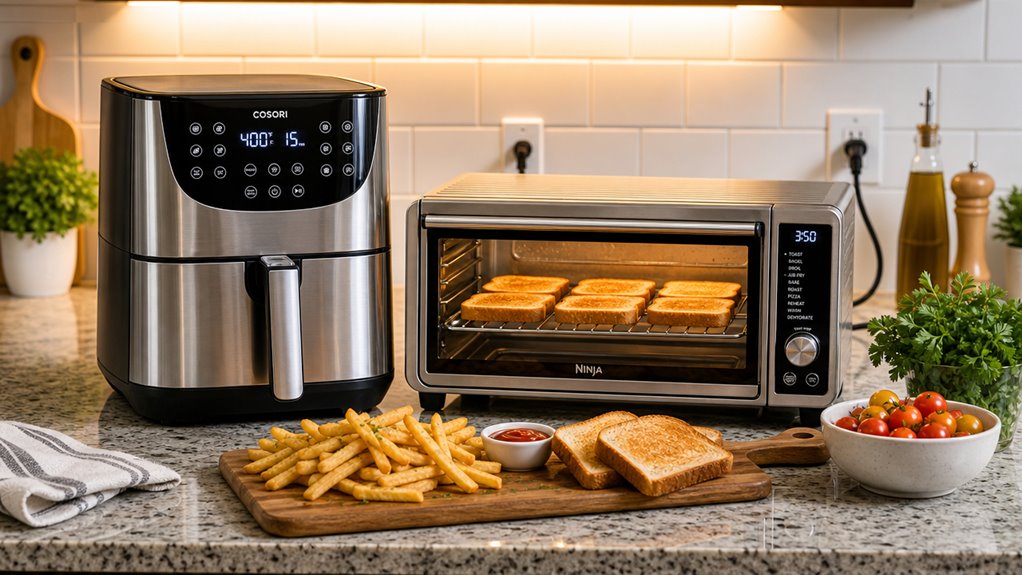

Both of these appliances sit above the $30 ceiling this site is built around, so treat what follows as honest buyer education rather than a budget pick. For a lot of everyday cooking an under-$30 tool already covers the job: a sheet pan in your existing oven crisps and roasts, and a basic toaster handles toast. Those stay the budget-tier default, and most kitchens never need more. The useful question is narrower. When an under-$30 tool stops being enough, is stepping up to an air fryer or a toaster oven worth the counter space and the spend? The comparison below is framed around that decision, not around busting the budget.
Choosing between an air fryer and a toaster oven depends on batch size, counter space, and the range of cooking tasks a kitchen requires. Both appliances use convection heat, but they differ in capacity, preheat speed, and surface durability.
- Air fryer uses a high-speed fan to circulate heat around small batches, producing a crisp exterior on foods like fries and wings without frequent flipping.
- Convection toaster oven accommodates multiple racks and larger pans, supporting a broader range of tasks including baking, toasting, and broiling.
- Non-stick basket coating degrades over repeated high-heat cycles, reducing the air fryer’s long-term performance and increasing the need for replacement.
An air fryer typically reaches around 400 °F quickly, making it well suited for single or double servings that need fast, basket-style crisping. The compact footprint fits smaller kitchens, but the limited capacity restricts how much food a cook can prepare in a single run.
A convection toaster oven preheats more slowly and occupies more counter space. In exchange, it handles larger volumes and a wider menu of dishes, making it a practical choice for households that cook varied meals regularly.
The non-stick basket and the bulkier chassis represent the primary trade-offs each appliance asks a cook to accept. Batch size and available counter space often determine which trade-off is easier to absorb.
Cheap or expensive is the wrong question. Cost per use is the honest one. Check out our new Calculator.
Cost-Per-Use Calculator →Key Points
- The primary task decides the pick: an air fryer suits fast, daily crisping of small batches, while a toaster oven suits versatile baking, roasting, and larger sheet‑pan meals.
- Air fryers preheat in 2‑5 minutes and cook 20‑30 % faster, delivering uniform crunch without flipping; toaster ovens need 5‑10 minutes preheat and are slower to crisp.
- Capacity differs: air fryer baskets hold 1‑3 servings (2‑6 qt); convection toaster ovens accommodate 12‑inch pizzas, multiple racks, and full‑pan casseroles.
- Counter space matters: vertical air fryers have a smaller footprint but require overhead clearance; toaster ovens are wider/deeper and need more uninterrupted countertop length.
- Durability and cleanup: air‑fryer non‑stick baskets wear faster and may warp; toaster ovens have sturdier trays and crumb trays that last longer with regular cleaning.
What an Air Fryer Toaster Oven Comparison Really Comes Down To
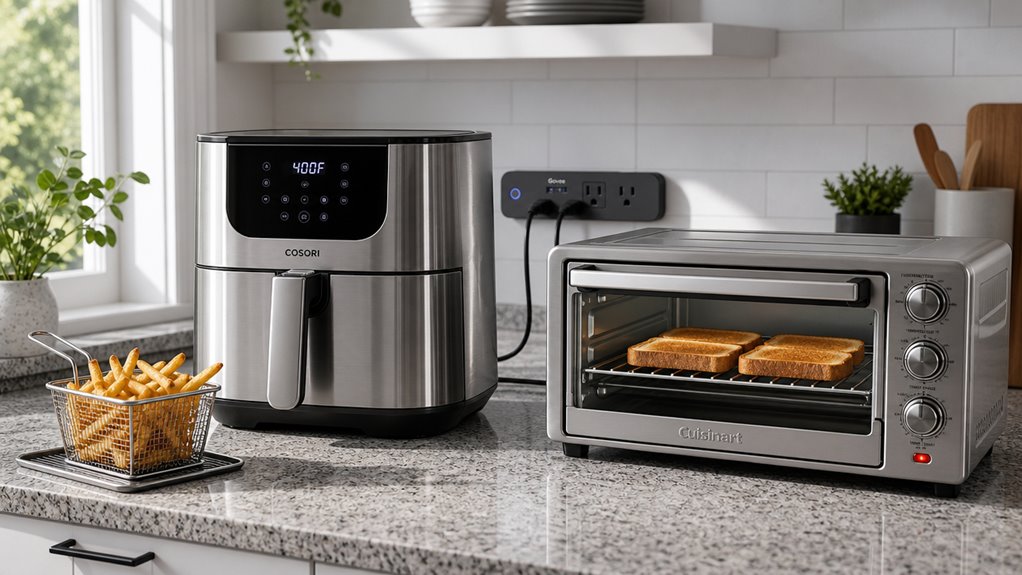
Choosing between an air fryer and a toaster oven comes down to matching cooking function to counter space, because each appliance handles heat circulation, capacity, and task range differently enough that the wrong choice creates a daily friction point.
An air fryer uses a compact basket and concentrated hot-air circulation to crisp small portions quickly, making it a strong fit for reheating or cooking foods where a dry, textured exterior matters.
A toaster oven offers a wider tray, multiple rack positions, and broader function coverage: baking, toasting, and broiling, without requiring a separate device for each task.
Counter footprint is the constraint that shapes the decision most directly, since both appliances occupy meaningful space and neither collapses into the other’s role without compromise.
The details that follow break down exactly where each design holds up and where it falls short. Adding a top‑performing combo can cost noticeably less than buying the two appliances separately.
Speed and Crisping Versus Capacity and Versatility
Start by weighing how quickly you want a snack crisped against how much you need to cook at once. The choice between the two comes down to speed versus bulk.
Air fryers preheat in 2–5 minutes and finish fries 20–30 % faster because their high‑velocity fan forces hot air around a small basket. The crunch is uniform, and you rarely have to flip. The downside is limited capacity: usually one or two portions per batch.
A toaster oven takes 5–10 minutes to warm up and cooks slower, but its larger tray fits a half‑sheet pan, multiple racks, or a pizza, letting you handle family‑size meals in one go. If you mainly crave daily crisping, an air fryer is worth it; for versatile, larger cooking, the oven wins. Rapid air circulation makes the air fryer excel at crisping.
The Counter-Space Question Behind Both Boxes
On a cramped countertop the shape of the appliance matters more than the brand. You’ll notice the vertical “pod” air fryer takes up a smaller footprint but reaches higher, so it fits a narrow strip but can block cabinet doors.
A convection toaster oven spreads wider and deeper, often matching a microwave’s rectangle, demanding a longer uninterrupted counter run. Heat clearance also differs: the oven needs inches of space behind and above its door, while the air fryer vents upward, needing overhead room to avoid cabinet warping.
- Footprint vs. capacity – the oven gives more internal volume per square inch.
- Heat clearance – oven radiates laterally; fryer vents upward.
- Mobility – fryer is lighter and can be stored; oven stays fixed.
Air fryers typically have a smaller capacity than convection toaster ovens, limiting the amount of food you can cook at once.
How Each One Actually Cooks
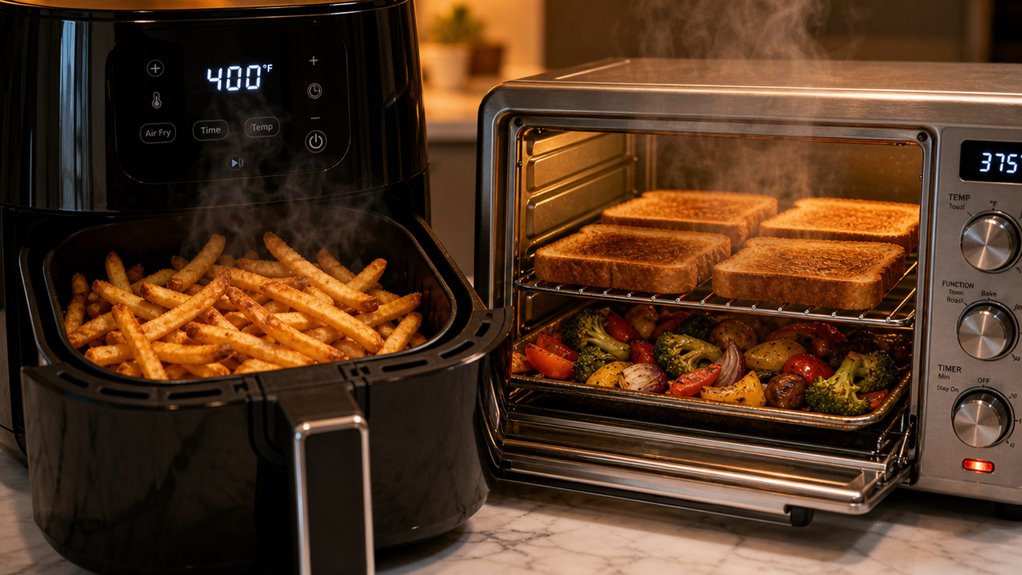
Air fryers and toaster ovens cook through different mechanisms, and those differences shape the texture and timing of every meal.
An air fryer circulates hot air rapidly around food held in a small basket, forming a crisp crust quickly while keeping the interior moist.
A toaster oven uses heating elements above and below a tray, delivering steady, even heat that suits baking, toasting, and broiling but requires more time to achieve the same surface crispness.
The basket’s non-stick coating can wear down with repeated use, while the toaster oven’s larger cavity demands a longer preheat before cooking begins.
Understanding how each design handles heat helps explain the tradeoffs that matter most in daily use. The rapid convection in an air fryer enhances the Maillard reaction for faster browning.
Convection Crisping in an Air Fryer Basket
Cooking in an air‑fryer basket relies on a compact chamber that forces hot air to race around the food, so the surface heats up quickly and a crust forms fast. The basket’s perforated mesh lets air hit every side, while the high‑speed fan boosts convective heat transfer.
That rapid airflow evaporates moisture, so even a light oil coat dries out and browns faster than a larger oven cavity. You’ll notice the crust sets at a lower internal temperature, which means shorter cook times for small, low‑moisture pieces. The downside is that a crowded basket chokes the flow, giving uneven crispness.
- Air‑flow velocity – basket > oven cavity.
- Heat source – forced hot air + radiant heating.
- Moisture removal – fast evaporation, drier exterior.
Convection ovens can also achieve crispness when using a dedicated air‑fry setting.
Baking, Toasting, and Broiling in a Toaster Oven
Start with the heat, and you’ll see the toaster oven split into three distinct cooking styles.
Baking uses both top and bottom elements, cycling to keep a steady ambient temperature that surrounds the food. You get through‑cooking of batter, dough, or casserole, but the smaller cavity means you should drop the recipe temperature about 25 °F and watch for faster top browning.
Toasting leans on direct radiant heat from both elements at higher intensity, drying the surface and triggering Maillard browning quickly; the horizontal rack lets you add cheese or sauce that a pop‑up toaster can’t handle.
Broiling fires only the top element at very high heat, concentrating intense radiation for rapid charring or gratin finishes.
When you enable convection cooking, a fan circulates the hot air, evening out temperature and shaving minutes off bake and broil times, though the limited space can cause uneven results if you overload the tray.
Where an Air Fryer Toaster Oven Choice Depends on Your Kitchen
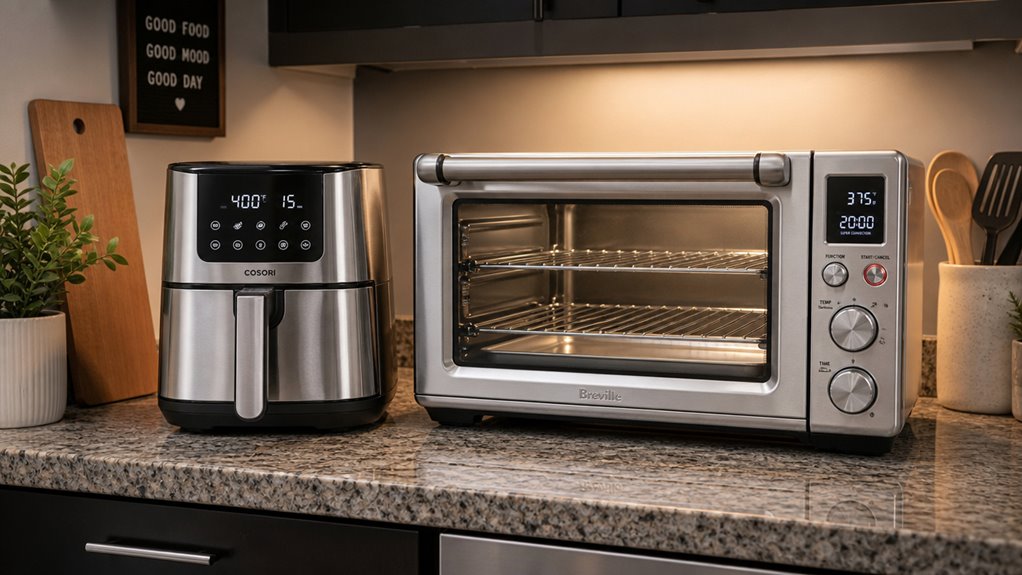
Choosing between an air fryer and a toaster oven depends on counter space, cooking capacity, and how varied your meals tend to be.
An air fryer circulates hot air through a compact basket, which crisps food quickly but limits how much you can cook at one time.
A convection toaster oven takes longer to achieve similar results yet handles a wider range of tasks, including baking, toasting, and broiling on a larger tray.
Households cooking for one or two people with limited counter clearance may find the air fryer’s small footprint practical, while cooks who move between quick snacks and full casseroles typically benefit from the extra capacity a toaster oven provides.
The details below help clarify which setup suits a given kitchen.
Batch Size, Counter Room, and What You Cook Most
A basket‑style air fryer caps out at about 2‑6 quarts, so you’ll usually fit only one to three servings of fries or wings per run. That limits batch size and forces you into multiple cycles for a family dinner.
A convection toaster oven gives you a flatter chamber, letting you spread a 12‑inch pizza or a sheet‑pan meal in one go, but its counter footprint is larger and you need clearance for ventilation. If most of your cooking is frozen snacks, the air fryer’s compact shape wins; if you bake, toast, or reheat trays, the toaster oven’s capacity saves you time and space.
- Batch size – air fryer: 1‑3 servings; toaster oven: full‑pan meals.
- Counter footprint – air fryer: narrow base; toaster oven: microwave‑size width.
- What you cook most – snacks vs. tray‑style dishes.
Why an Air Fryer Crisps Faster but a Toaster Oven Does More
When hot air whizzes past food at 400 °F in a tight, basket‑style chamber, the Maillard reaction spikes and the crust forms in minutes, so an air fryer crisps faster than a typical convection toaster oven.
The strong, focused fan and the perforated basket give every side of a fry or wing rapid exposure, cutting preheat and cook time.
A toaster oven spreads heat through a larger cavity, so it takes longer to crisp, but its flat racks and multiple rack positions let you bake a pizza, roast a chicken, or toast bagels, all in one box.
This is why the air fryer tilts toward speed, while the toaster oven wins on versatility and capacity.
You’ll notice the basket coating wears faster than a crumb tray, and the oven’s door hinges can loosen over years.
Choose the combo if you need both crisping and broader cooking tasks.
The Durability and Cleanup Differences
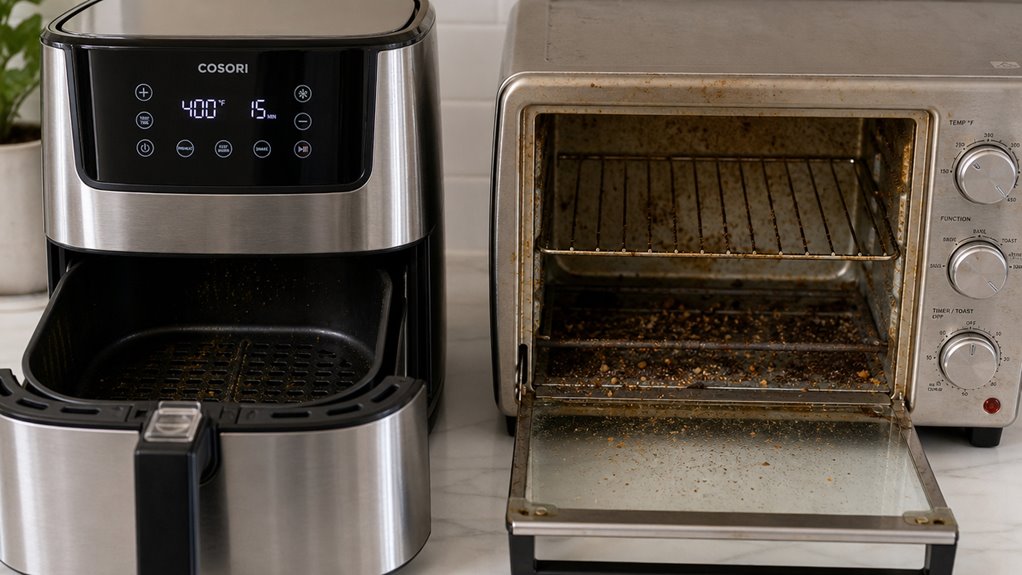
Air fryers and toaster ovens differ meaningfully in how long their components last and how much effort cleanup requires, with the nonstick coating on an air fryer basket typically thinning after repeated high-heat cycles while a toaster oven‘s crumb tray can remain functional for years with consistent clearing.
The concentrated airflow inside an air fryer basket puts direct, repeated stress on its nonstick surface, accelerating wear in a way that the larger cavity of a toaster oven avoids by distributing heat more evenly across its racks and trays.
Routine wiping is necessary for both appliances, but the smaller contact area of an air fryer basket generally makes that process faster and less messy than cleaning a toaster oven’s broader interior surfaces.
The material and design differences that drive these outcomes are worth understanding in more detail.
Baskets, Coatings, and Crumb Trays Over Time
If you’re juggling a thin‑gauge steel basket with a nonstick coating and a heavier stainless‑steel tray, the difference shows up quickly. The thin basket warps sooner, especially when you push it to max heat, while the sturdy tray stays flat for years.
Grease drips through mesh, coating the crumb tray below, which you can wipe clean in seconds. A solid tray catches most splatter, but it can still get a stubborn film if you leave it too long.
Over time, the nonstick coating on the basket chips, and the mesh corners trap carbonized bits that need a brush.
- Thin‑gauge basket → warps, coating wears.
- Heavy tray → resists warping, easier wipe.
- Crumb tray → collects drip, simple cleanup.
Where a Nonstick Basket Coating Wears and What Survives
The coating on an air‑fryer basket starts to wear at the edges and corners because those spots rub against the metal drawer and the basket’s rim each time you pull it out. You’ll notice the PTFE coating flaking first where the rim meets the drawer, and the same happens at the corners that scrape the rack.
Contact points for skewers or grill plates scar the coating, and the area nearest the heating element can turn matte or micro‑crack after repeated 400°F cycles.
In a toaster oven, the coated tray wears fastest at the center where you scrape food, while uncoated wire racks only discolor.
Abrasive sponges and metal utensils accelerate scratches, so gentle silicone tools and warm soapy water extend the life of both PTFE and ceramic‑based surfaces.
Retire the basket once the coating is flaking, rather than cooking on it. A flaking PTFE surface is no longer a nonstick surface, and an air fryer routinely runs at 400 °F, close to the range where PTFE begins to break down and give off fumes. Overheated PTFE fumes are the recognised hazard with this material, and they are dangerous to pet birds at concentrations people barely notice. So once you can see flaking, matte patches or micro-cracking, replace the basket or the whole unit, never run the appliance empty at high heat, keep the kitchen ventilated, and stop using metal utensils and abrasive sponges on the coating in the first place.
Which One Earns the Counter (Or Whether You Need Both)
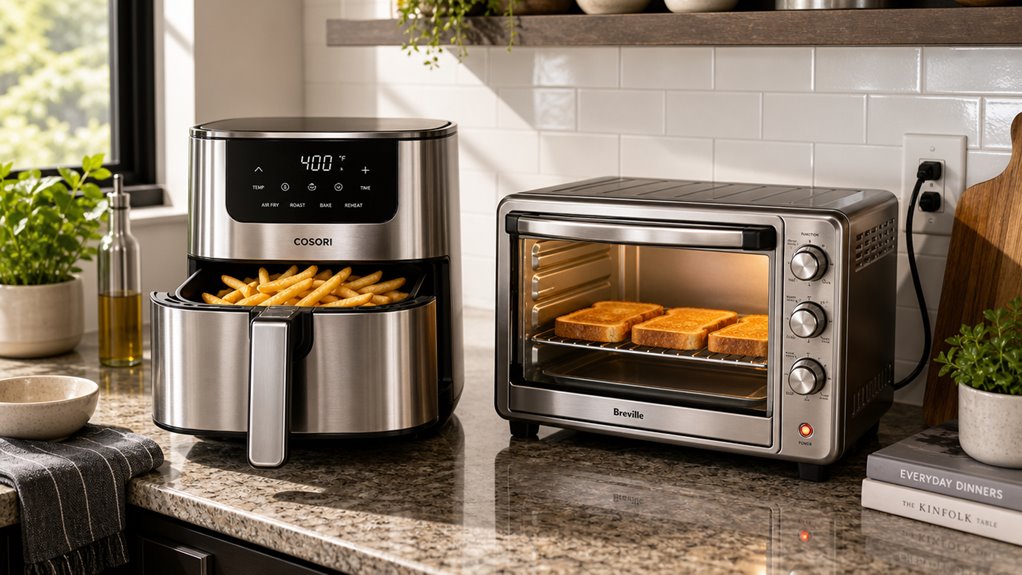
Once an under-$30 tool no longer covers the cooking you do, a convection toaster oven with an air-fry mode can replace a standalone air fryer entirely, earning its place on the counter by handling crisping, baking, toast, and pizza within a single appliance footprint.
A dedicated air fryer produces rapid, small-batch crunch efficiently, but the nonstick basket coating wears down over time, and the limited capacity often requires cooking in multiple rounds for larger meals.
Counter space becomes the deciding factor when kitchen room is tight, since a combo unit consolidates both functions without giving up the core tasks each appliance would otherwise cover separately.
The right choice depends on how frequently batch size, cooking variety, and appliance longevity factor into everyday use.
The sections below work through each consideration in closer detail.
Matching the Appliance to How You Cook
Because you’re juggling a tiny countertop and a mix of breakfast toast, frozen snacks, and occasional sheet‑pan meals, the appliance that earns the space has to match the bulk of your cooking habits. If you mostly toast, bake, and reheat larger portions, a toaster oven wins on capacity and tray flexibility. If your daily routine leans toward quick, single‑serve crisping of frozen bites, the air fryer’s rapid convection is more efficient.
When you need both crispness and versatility, a convection toaster oven with an air‑fry mode can replace two boxes, but the basket coating will wear faster than a crumb tray.
- Batch size – toaster oven handles trays; air fryer fits a basket.
- Counter footprint – both claim space, yet a combo saves one box.
- Primary task – crisp daily snacks with air fryer; bake, toast, and sheet‑pan meals with toaster oven.
Why a Convection Toaster Oven With Air-Fry Mode Replaces Both Boxes
A convection toaster oven with an air‑fry mode packs the crisp‑making speed of a basket fryer and the tray‑based versatility of a mini‑oven into one box, so you can replace both the pop‑up toaster and the standalone air fryer without sacrificing countertop real estate. You get 0.6–1.0 cu ft of space, enough for a 12‑inch pizza or a sheet of cookies, while the fan‑boosted air‑fry mode reaches a comparable texture, taking longer than a dedicated fryer mainly because the larger cavity needs 5–10 minutes to preheat against the fryer’s 2–5.
The same chassis lets you toast, bake, broil, roast, and dehydrate, so you never need a separate basket or a second appliance. The only drawback is the higher price point compared to a basic air fryer, and to an under-$30 sheet pan or toaster, so the step up is worth it only when you regularly need both crisping and full toaster-oven range; for occasional use, the budget-tier tools you already own still win on cost per use.
Frequently Asked Questions
Do Air Fryers Affect the Taste of Delicate Vegetables?
Yes, they’ll intensify flavor and crispness, but the high‑velocity heat can dry out delicate veggies and burn low‑smoke oils, so you must lower temperature, avoid overcrowding, and toss midway.
Can a Toaster Oven With Air‑Fry Mode Replace a Deep‑Fryer Completely?
A toaster‑oven air‑fry mode can’t fully replace a deep‑fryer. It handles everyday crisping, but it lacks the intense heat and oil immersion needed for true deep‑fried texture.
How Does the Noise Level Compare During Operation?
You’ll notice the air fryer’s fan whirs louder—about 55‑65 dB—while a toaster oven runs quieter, typically 40‑55 dB, so the fryer can be heard across the kitchen, the oven stays more subtle.
What’s the Typical Lifespan of the Non‑Stick Basket Coating?
You’ll find the non‑stick basket coating generally lasts between six months and three years, depending on heat, utensils, and cleaning habits, so treat it as a temporary convenience rather than a permanent feature.
Do Either Models Require Special Power Outlets or Circuits?
Both use a standard wall receptacle rather than a special outlet, but treat either one as a dedicated-circuit appliance. A full-size air fryer or toaster oven typically draws 1500-1800 W, which is 12.5-15 A, and a 15 A branch circuit is only rated for a 12 A continuous load. Running one near the top of that range while the same circuit also feeds a kettle, microwave or second countertop appliance is a sustained overload rather than a merely busy circuit. Plug it straight into a wall receptacle, ideally on a circuit nothing else heavy is using, and never run either appliance from an extension cord, a power strip or a multi-way adapter: that is the specific behaviour that starts kitchen fires. The 120 V figure applies to North American wiring; elsewhere, check the rating plate on the appliance and your own circuit rating.
When Is an Under-$30 Tool Enough, and When Is Stepping Up Worth It?
For everyday toasting, reheating, and the occasional tray of roasted vegetables, an under-$30 sheet pan in your existing oven plus a basic toaster stays the budget-tier default and is hard to beat on cost per use. Stepping up to an air fryer or a toaster oven earns its place when you crisp small batches several times a week, cook mostly for one or two people, or want toasting, baking, and broiling from one countertop unit instead of heating a full oven. If none of those patterns fit your kitchen, the under-$30 tools you already own are the researched call.
Conclusion
If you have decided an under-$30 tool no longer covers your cooking, you’ll find the convection toaster oven with an air‑fry mode fits most kitchens better than a standalone air fryer. It handles toast, bake, and broil while still giving you that crisp finish, and its larger interior lets you cook a full pan instead of a single basket. The downside is a slightly longer pre‑heat time compared to a dedicated fryer. Think of it as a Swiss‑army knife versus a single‑purpose screwdriver: more versatile, though not as specialized.

Michael Haralson worked in professional kitchens from 1979 to 1992: San Diego restaurants, six years with a catering company beside an Austrian chef, and two summers as a cook on the Finland to Sweden cruise route. He then built a fifteen-year career at Nokia. It began in product marketing and product management, where technical specifications and supplier evaluation were part of the work, and grew from a few countries to a region to global roles, then into sales and corporate strategy. That took him to Beijing for three years, where he spent many weekends in a different province trying the local food and took cooking classes. He has eaten in more than 40 countries and has been shown the kitchens of restaurants in Southern Europe. At home in Finland he cooks Cantonese, Sichuan and Mediterranean food, and still uses the cast iron skillet he bought in 1992. He is the author of Buy It Once, Book One of The Researched Kitchen, and writes here about the balance between kitchen tools that cost too much and those that fail too soon.