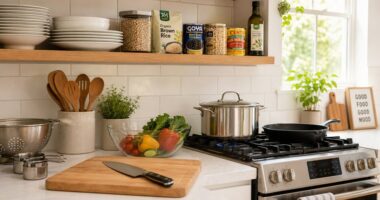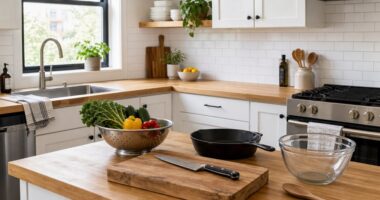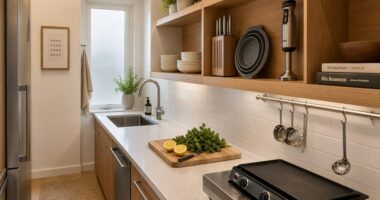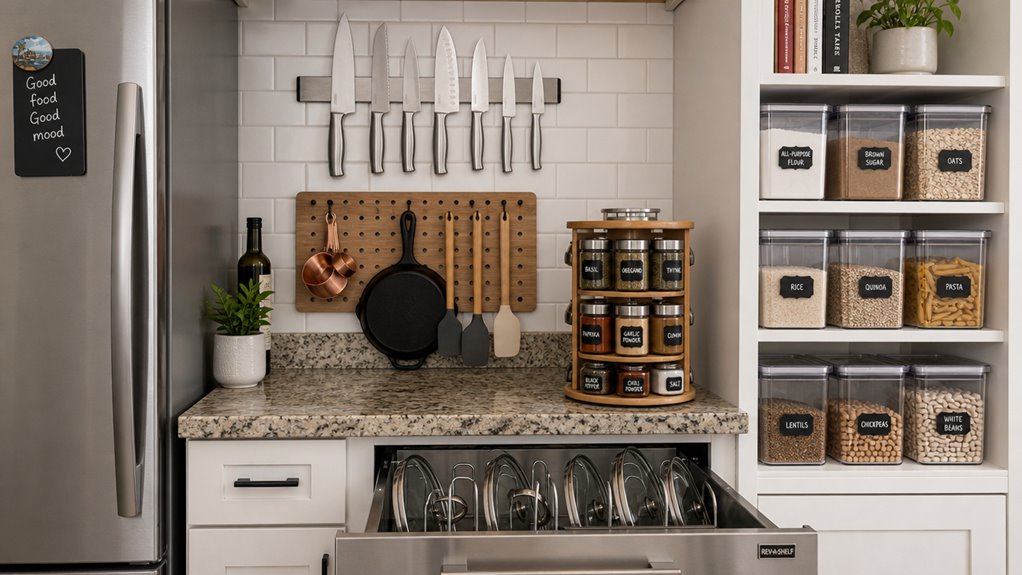

Kitchen organization for apartments refers to a set of no-drill storage methods that expand usable space without permanent wall damage. These methods rely on removable hardware and vertical surfaces to recover square footage that most apartment kitchens leave unused.
- Tension-rod shelves split a tall cabinet gap into two separate tiers, effectively doubling the usable capacity of a single shelf space.
- Removable adhesive hooks attach to smooth surfaces and hold lightweight items such as mugs or small baskets without leaving holes.
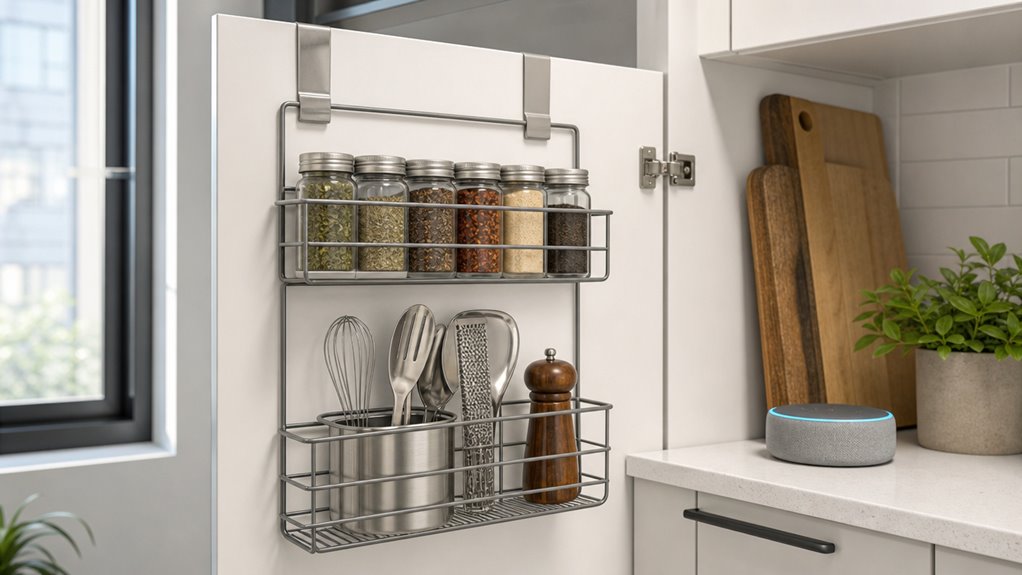
- Over-the-door racks mount on a pantry door and add a shallow storage tier that would otherwise go unused.
Each of these solutions uses a different attachment method. Tension rods grip surfaces through compression and rubber caps. Adhesive hooks bond through Command-style strips and release cleanly when removed. Magnetic rails offer a third option for metal surfaces.
Weight limits shape how each solution gets used. Adhesive hooks typically support around one pound, while tension rods often hold a few pounds. Lightweight items such as spice packets, foil rolls, and small tools work well within these limits.
Combining these three methods across vertical surfaces allows an apartment kitchen to gain meaningful storage capacity without a single tool or a single hole in the wall.
Studies on small-space living suggest that vertical storage methods can roughly double the accessible storage area in kitchens under 100 square feet when applied consistently across cabinet interiors and door panels.
Cheap or expensive is the wrong question. Cost per use is the honest one. Check out our new Calculator.
Cost-Per-Use Calculator →Key Points
- Use removable adhesive hooks or magnetic strips to hang lightweight items, keeping walls damage‑free and preserving security deposits.
- Install tension‑rod shelves or under‑shelf baskets to create double tiers without drilling, effectively doubling vertical storage space.
- Add over‑door racks or hanging organizers that lift off easily, providing pantry‑style storage while maintaining door swing clearance.
- Deploy stackable risers and rack systems on existing shelves to split a single shelf into multiple functional zones, increasing capacity by up to 100 %.
- Choose rolling spice racks or pot rails with rubber feet for repositionable, non‑permanent storage that fits narrow gaps and uneven surfaces.
| Magnetic Paper Towel Holder for Fridge and Kitchen |  | Renter-Friendly | Mounting Method: Magnetic backing with optional screws | Primary Material: Carbon steel (powder-coated) | Load Capacity (Approx.): Up to 6 lb | VIEW LATEST PRICE | Read Our Analysis |
| Magnetic Fridge Shelf with Wood Lid (White) |  | Multi-Surface Mount | Mounting Method: Magnetic (no tools) | Primary Material: Magnetic steel + wood lid | Load Capacity (Approx.): Up to 50 lb | VIEW LATEST PRICE | Read Our Analysis |
| Metal Magnetic Refrigerator Spice Rack (4 Pack) |  | High-Weight Capacity | Mounting Method: Magnetic (refrigerator) | Primary Material: Iron (black finish) | Load Capacity (Approx.): 50 lb per shelf | VIEW LATEST PRICE | Read Our Analysis |
Links to Amazon are affiliate links. Buying through one costs you nothing extra and helps fund the research.
Why an Apartment Kitchen Needs Renter-Friendly Storage
Apartment kitchens need renter-friendly storage because most units offer limited cabinet space and lease terms that prohibit permanent modifications, which means every organizational solution must be fully removable without damaging walls or surfaces.
Landlords commonly withhold security deposits when tenants leave behind drill holes or adhesive residue, so the storage approach has to account for reversibility from the start. Tension rods, adhesive hooks, and over-door racks address this constraint directly by anchoring without fasteners, allowing renters to organize dishes, spices, and countertop clutter without violating lease conditions.
The type of solution that works depends on cabinet depth, door clearance, and how much weight a given adhesive or tension mount can reliably hold. The sections below cover the specific options and how to apply them across a small kitchen layout. Using Command strips you can hang lightweight shelves without drilling.
Working Within Limited Cabinets and a Deposit on the Line
When you’re squeezed into a galley kitchen with a handful of shallow cabinets, every inch counts, and a drilling mistake can cost you a month’s rent in lost deposit. You need no‑drill kitchen storage that’s deposit‑safe, so the landlord can’t claim damage. The answer is to work vertically, using removable pieces that fit inside existing spaces.
- Shelf risers split a single shelf into two levels, doubling plate capacity.
- Tension rods create a hidden divider under the sink for cleaning supplies.
- Over‑door organizers attach with adhesive strips, freeing cabinet doors for spices.
- Stackable bins with uniform footprints fill dead space and stay put when you move.
These options boost usable volume without holes, patches, or permanent marks. Adding a rolling spice rack between the fridge and window provides extra storage that can be repositioned as needed.
The No-Drill Rule That Keeps Solutions Reversible
Because most leases label any drilled hole as damage, you can’t afford to gamble on permanent hardware without risking your security deposit. The no‑drill kitchen storage rule means you stick to tension rods, adhesive strips, and over‑door racks that leave no marks. Removable kitchen organizers attach by pressure or gentle adhesive, so when you move out you simply peel them off and the paint stays intact. A tension rod under the sink can hold a spray‑bottle tray without a screw, while a Command‑style hook on a cabinet door supports a small basket for spices. Over‑door racks transfer weight to the door, not the wall, so the wall surface stays untouched. All these options are reversible, deposit‑safe, and install in minutes. Using over‑the‑door organizers adds extra storage without any wall damage.
| Magnetic Aluminum Foil and Plastic Wrap Organizer (2-Pack) | 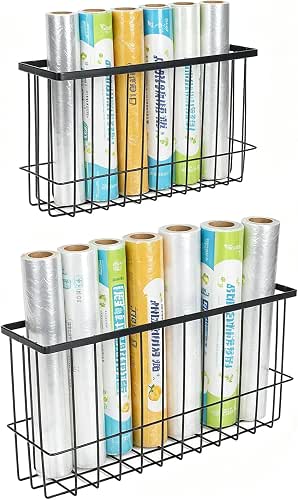 | Kitchen Organizer | Mounting Method: Magnetic back (no tools) | Primary Material: Steel (matte coating) | Load Capacity (Approx.): Holds rolls of wrap (≈ 2-3 lb) | VIEW LATEST PRICE | Read Our Analysis |
| Magnetic Spice Rack Wall-Mounted Shelf (Black) |  | Budget Magnetic Pick | Mounting Method: Magnetic (tool-free) | Primary Material: Carbon steel | Load Capacity (Approx.): Holds assorted items (≈ 5-10 lb) | VIEW LATEST PRICE | Read Our Analysis |
| Wider Magnetic Shelf Basket with Bamboo Top (XXL) | ![[WIDER SHELF] 1 SET Strong Magnetic Shelf Basket for Fridge](https://m.media-amazon.com/images/I/81E+PU5Bb8L._AC_SL500_QL70_ML2_.jpg) | XXL Storage | Mounting Method: Magnetic panels or screw-mount (bamboo top) | Primary Material: Steel with bamboo top | Load Capacity (Approx.): Up to 60 lb total | VIEW LATEST PRICE | Read Our Analysis |
Links to Amazon are affiliate links. Buying through one costs you nothing extra and helps fund the research.
The Storage Solutions That Add Space Without Tools
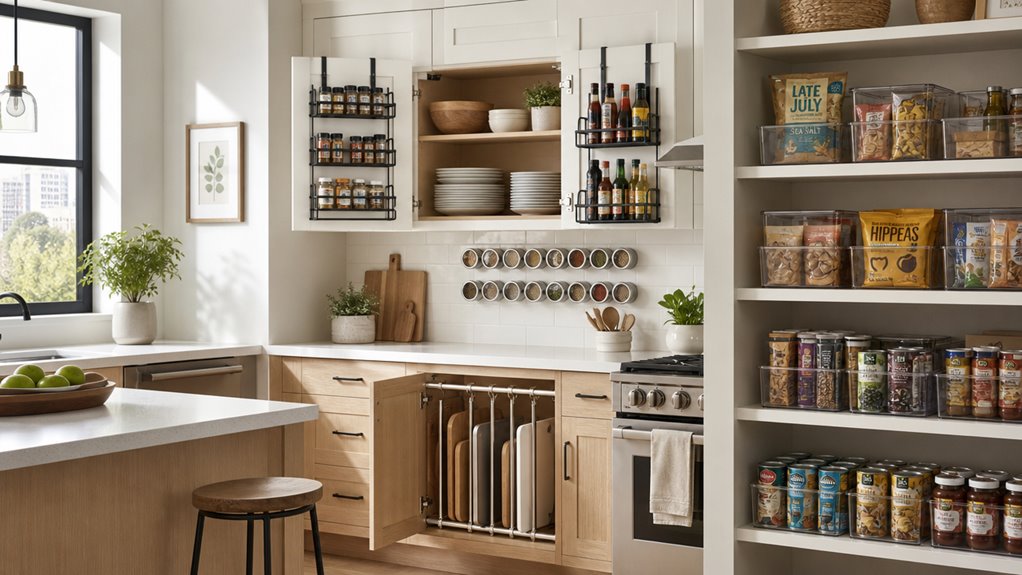
Storage solutions that add space without tools rely on hardware-free mechanisms: tension rods, adhesive hooks, and over-door organizers. Each one mounts, holds, and removes without drilling into walls or cabinets.
A tension rod placed under a sink or between cabinet shelves creates a removable divider that keeps trays and cutting boards upright and separated.
Adhesive hooks attach to doors and walls to hold mugs, utensils, or spice jars, and they peel off cleanly without leaving damage behind.
Over-door organizers extend pantry capacity by adding shallow shelves to otherwise unused vertical space, though loading them too heavily can restrict the door’s swing.
The choices available cover a wider range of configurations and load capacities than most people expect. Adding a pot rail along the backsplash provides a convenient place to hang frequently used cookware without any permanent installation.
Tension Rods, Adhesive Hooks, and Over-Door Organizers
If you can’t drill, tension rods, adhesive hooks, and over‑door organizers become your go‑to trio for squeezing extra room out of a cramped apartment kitchen.
A tension rod slides into a lower cabinet and lets you hang spray bottles by their triggers, freeing the shelf for bulk cleaners.
An adhesive hook on a pantry door holds a lightweight basket for spices, while a metal over‑door rack adds shallow shelves for canned goods.
You can mix and match: a rod inside a deep cabinet corrals lids, a hook under a cabinet suspends a mug, and an organizer on the pantry door stores tea bags in clear pockets.
- Tension rod under sink – hang bottles.
- Adhesive hook on door – hold baskets.
- Over‑door rack on pantry – add shelves.
- Combine rod + hook – create tiered spice storage.
A tension rod can also be used to conceal visual clutter by covering electronics and cords in an open TV console.
Why Tension Rods Suit a Rental Where Drilled Shelves Risk Your Deposit
When you can’t drill, a tension rod becomes a simple, reversible divider that slides into a cabinet and holds items by tension alone. Its spring tension and rubber end caps hold firmly while leaving no marks on the cabinet. You can adjust the length to fit narrow gaps, set it horizontally for a shelf, or vertically to split a deep cabinet. The rod supports lightweight trays, spray bottles, or a thin plywood shelf, adding a few extra inches of usable space without a single hole.
| Feature | Benefit |
|---|---|
| Adjustable length | Fits odd alcoves and narrow cabinets |
| Rubber caps | Distributes pressure, prevents dents |
| No tools | Install in minutes, remove cleanly |
Because the rod leaves no marks, you protect your deposit and keep the kitchen organized.
How to Add Storage to an Apartment Kitchen Without Renovating
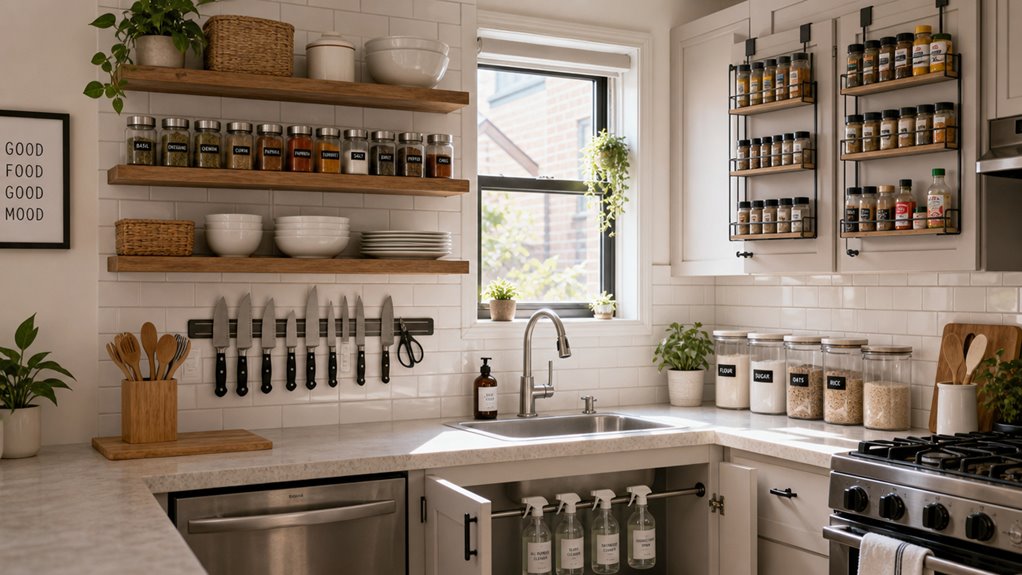
Adding storage to an apartment kitchen without renovating means using removable, hardware-free solutions that reclaim wasted vertical space and underused cabinet zones without damaging walls or voiding a lease.
Cabinet doors, for example, accept slim adhesive racks that hold spices and wraps against an otherwise blank surface. Inside deep cabinets, pull-out baskets slide on their own base and reach items pushed to the back, while tension-rod shelves divide a single shelf gap into two usable levels for stacking plates.
The layout of the kitchen itself shapes which solutions work. Dead zones near corners or above eye level often hold the most untapped capacity.
The approaches that follow address each of these opportunities in practical detail.
Cabinet-Door, Under-Shelf, and Inside-Cabinet Wins
At the back of a cramped kitchen cabinet, a tension‑rod shelf can split a single level into two, instantly giving you a second tier for plates or canned goods without a drill.
A cabinet‑door organizer slides onto the door and adds 3‑4 inches of shallow storage for sprays, sponges, or cutting‑board holders, while an under‑shelf basket hooks onto an existing shelf and creates a lower tier for snacks or small dishes.
Inside the cabinet, a stackable riser doubles the usable height for plates, and a pull‑out basket brings items from the back to the front without bending.
- Tension‑rod shelf – no tools, splits a shelf.
- Cabinet‑door organizer – holds cleaning supplies, lightweight.
- Under‑shelf basket – adds a level, fits 5/8‑inch shelves.
- Pull‑out basket – converts deep base cabinet, limited to 12‑inch depth.
Reading a Layout for Wasted Vertical Space
Above the fridge and the upper cabinets you’ll often see a 2‑3 foot band of empty wall that most renters ignore.
Scan that space from floor to ceiling; you’ll find 2–3 ft of vertical storage potential above the refrigerator, pantry, or freestanding shelves.
Use removable adhesive hooks or a slim magnetic rail to hang lightweight bins, spice jars, or a small basket.
A tension‑rod shelf can split the band into two tiers, turning a single shelf into a double‑stacked pantry without drilling.
In the corner where two walls meet, a narrow ladder shelf or etagère slides in, using the height you normally leave blank.
These no‑drill solutions add real, rental‑safe vertical storage to your apartment kitchen.
The Vertical Moves That Double Your Cabinet Space
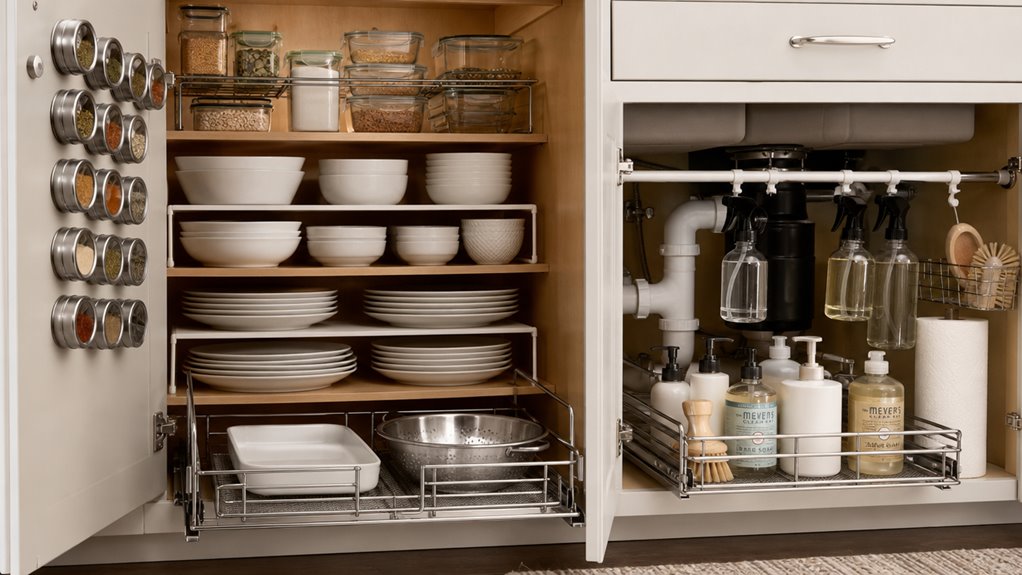
Vertical moves in cabinet organization work by stacking usable layers within the same fixed footprint, turning a single shelf into multiple functional zones without permanent modifications.
Shelf risers are a practical starting point, typically adding around 100% more usable surface area by creating a second tier above the original surface.
Stackable racks extend that logic across the full depth of the cabinet, while hanging baskets recover the overhead space that canned goods and dry goods rarely reach on their own.
The material and frame design of each riser matters, since metal edges can catch thin plates during everyday use.
The sections ahead cover how to apply these techniques across different cabinet types and storage needs.
Shelf Risers, Stacking Racks, and Hanging Baskets
Lift the shelves with a simple riser and you instantly turn one flat surface into two usable levels. A shelf riser slides into the existing shelf groove, creating a lower tier for plates while the top tier holds bowls.
Pair it with a stacking rack that runs the full height of the cabinet, giving each dish its own slot and cutting stacking height by up to 40 %. Hanging baskets cling to the shelf edge, turning the air gap into a spot for napkins or snacks, and they stay visible for quick grabs. Together they let you store more without drilling or permanent hardware.
- Shelf riser – adds a lower level.
- Stacking rack – separates items vertically.
- Hanging basket – utilizes under‑shelf space.
- Combination – multiplies usable volume.
Why Shelf Risers Double the Cabinet Space That a Single Stack Wastes
Shelf risers turn a single, flat shelf into two distinct levels, instantly doubling the usable surface area without any drilling or permanent hardware. You’ll see that a typical cabinet leaves 30‑50 % of its height empty; a shelf riser splits that gap, letting plates sit low and bowls rest above, so you never waste space. The extra tier also keeps heavy stacks from toppling, cuts breakage, and makes the items you use most reachable. Because the riser is removable, you protect your deposit and can re‑arrange whenever you move.
| Feature | Benefit | Trade‑off |
|---|---|---|
| Dual tier | Doubles surface area | Slightly reduces depth per tier |
| Open design | Improves visibility | May need occasional cleaning |
| Non‑slip feet | Stabilizes dishes | Limited to standard shelf width |
How to Set It Up and Take It Down Cleanly
Setting up and taking down a rental-friendly kitchen organization system cleanly means choosing no-drill hardware, staging the installation carefully, and reversing every step without leaving damage behind.
Removable options in the budget tier, such as Command strips for lightweight shelves or tension rods for under-sink dividers, hold organizers securely while allowing clean removal when needed.
Proper staging matters because lining up components on a clear counter surface before mounting keeps traffic paths open and reduces the chance of misalignment that can stress adhesive bonds.
When the system comes down, peeling strips slowly and wiping surfaces immediately prevents residue buildup that could threaten a security deposit.
The sections ahead cover each phase of this process in detail.
Removable Solutions That Leave No Marks
You can turn a cramped kitchen into a functional space without ever touching a drill, because removable solutions rely on tension, adhesive, or magnetic forces that leave no marks. Start with damage‑free adhesive hooks on the backsplash to hang mugs; they peel off cleanly.
Use tension rods under the sink to create a hanging zone for spray bottles, and slide under‑shelf baskets onto existing shelves for a second tier. Magnetic strips on the fridge side hold knives without scratching.
Over‑the‑door organizers add pantry space while only compressing the door edge.
- Command‑style hooks – easy peel‑off, limited to 1 lb.
- Tension rods – no tools, watch for wobble with heavy loads.
- Magnetic strips – strong hold, but they need a ferrous surface.
- Over‑door racks – quick install, may leave faint marks that fade.
Matching Renter-Friendly Storage to the Under-$30 Ceiling
After covering the no‑drill hooks and tension rods that keep walls pristine, let’s look at the cheap, removable pieces that actually sit inside doors and cabinets.
An over‑door organizer hooks over the door top, giving you a 20‑30 % pantry boost without drilling; you lift it off when you move, and a damp cloth wipes any edge marks.
Under‑shelf wire baskets slide onto a shelf edge, creating a second tier that can add up to 50 % more vertical space; they rely on tension, so you just pull them off and dust the shelf.
Both stay under $30, need no tools, and leave nothing but light dust lines.
The only drawback is that the baskets can wobble if the shelf isn’t perfectly level.
Frequently Asked Questions
Can I Use Adhesive Hooks on Painted Cabinet Doors Without Damage?
You can, but only if you pick paint‑friendly, low‑weight hooks, clean the surface with alcohol, test discreetly, and remove them slowly parallel to the door; otherwise you risk peeling paint.
How Many Shelf Risers Fit in a Standard 12‑Inch Cabinet?
You’ll find one low‑profile riser fits a typical 12‑inch cabinet, and a second can squeeze in only if the cabinet’s taller and you measure the interior height carefully.
Do Tension Rods Hold Heavy Pots or Just Lightweight Items?
You’ll find tension rods best for lightweight items: spoons, mugs, small pans. Heavy pots exceed what tension rods reliably hold, typically only a few pounds, so they’ll slip or bow; stick to light cookware or sturdier racks.
What’s the Best Way to Prevent Sliding on Over‑Door Racks?
To keep an over-door rack from sliding, add rubber‑lined hooks, felt pads, and a thin Velcro strip behind it. This grip combo stops sliding, protects paint, and stays fully removable.
Can I Combine Multiple No‑Drill Solutions in One Cabinet?
Yes, you can mix tension rods, adhesive hooks, and shelf risers in the same cabinet. Just assign each to a different surface, clean it first, and test weight limits before stacking.
Conclusion
You’ve seen how tension rods, adhesive hooks, and over‑door racks can reclaim height without a drill. It works because the weight limits rule out heavy cookware but comfortably cover spice jars and small baskets. The only downside is that adhesive hooks may lose grip in humid kitchens, so keep a spare on hand. If you stay under $30 per piece and remove everything cleanly, you’ll keep your deposit safe while finally having space to breathe.
| Chengu Magnetic Spice Rack Stainless Steel Wall Mount |  | Space Saver | Mounting Method: Self-adhesive stickers or magnetic surface | Primary Material: Stainless steel | Load Capacity (Approx.): Holds standard spice tins (≈ 1 lb per rack) | VIEW LATEST PRICE | Read Our Analysis |
| LUCYCAZ Wall Mounted Spice Rack (2 Pack) |  | Compact Versatility | Mounting Method: Adhesive stickers or screws | Primary Material: Powder-coated metal | Load Capacity (Approx.): Holds spice jars (≈ 1-2 lb per shelf) | VIEW LATEST PRICE | Read Our Analysis |
| Fun Memories 30″ Magnetic Stove Top Shelf |  | Stove-Top Companion | Mounting Method: Magnetic bottom or screws for wall mounting | Primary Material: Pine wood (magnetic base) | Load Capacity (Approx.): Holds bottles/spices (≈ 5-10 lb) | VIEW LATEST PRICE | Read Our Analysis |
Links to Amazon are affiliate links. Buying through one costs you nothing extra and helps fund the research.

Michael Haralson worked in professional kitchens from 1979 to 1992: San Diego restaurants, six years with a catering company beside an Austrian chef, and two summers as a cook on the Finland to Sweden cruise route. He then built a fifteen-year career at Nokia. It began in product marketing and product management, where technical specifications and supplier evaluation were part of the work, and grew from a few countries to a region to global roles, then into sales and corporate strategy. That took him to Beijing for three years, where he spent many weekends in a different province trying the local food and took cooking classes. He has eaten in more than 40 countries and has been shown the kitchens of restaurants in Southern Europe. At home in Finland he cooks Cantonese, Sichuan and Mediterranean food, and still uses the cast iron skillet he bought in 1992. He is the author of Buy It Once, Book One of The Researched Kitchen, and writes here about the balance between kitchen tools that cost too much and those that fail too soon.