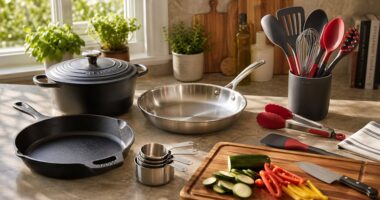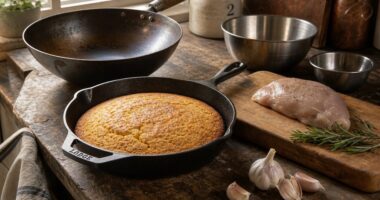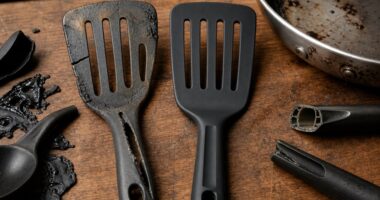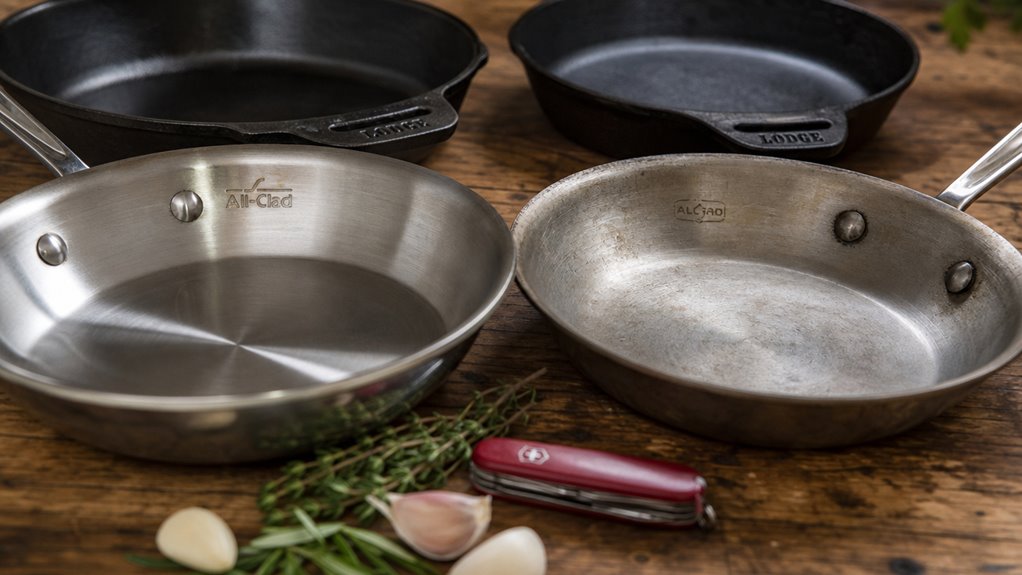
Spotting counterfeit cookware requires knowing which physical and packaging details separate a genuine piece from a replica. Fake versions of well-known cookware brands often mimic the shape and finish but fail on weight, construction quality, and labeling accuracy.
Five red flags separate a genuine All-Clad, Lodge, or Victorinox piece from a counterfeit:
- Weight and balance: genuine multi-ply or cast-iron cookware carries a dense, even heft that cheap counterfeit materials cannot replicate.
- Rivet and handle construction: uneven edges, rough seams, or wobbling handles reveal shortcuts that legitimate factory production does not allow.
- Country-of-origin stamp: a blurry, crooked, or absent “Made in USA” mark is a reliable indicator of a counterfeit piece.
- Packaging and documentation: authentic items ship with clean printing, aligned seals, and warranty paperwork that matches the product, while fuzzy text or generic inserts point to an unauthorized source.
- Price and seller credibility: listings priced well below the market range for bonded stainless or seasoned cast iron, or sold by unknown third-party sellers, signal counterfeit sourcing.
Counterfeit cookware typically enters the market through third-party marketplace listings that copy authentic product photos and descriptions. The physical item arrives with differences in weight distribution, surface finish, and structural consistency that a genuine piece does not have.
Cheap or expensive is the wrong question. Cost per use is the honest one. Check out our new Calculator.
Cost-Per-Use Calculator →Packaging and paperwork provide a second layer of verification. Authentic cookware ships with clean printing, correctly aligned seals, and documentation that matches the product inside the box. Fuzzy text, mismatched inserts, or generic warranty cards suggest the item did not come from an authorized source.
Price serves as an additional signal. Genuine multi-ply stainless or seasoned cast-iron cookware sits in a mid-range to premium price tier, and listings priced well below that range often indicate a replica rather than an authorized sale.
The scale of the problem is large enough to be worth stating carefully. The OECD and the EU Intellectual Property Office estimate in Mapping Global Trade in Fakes 2025, using 2021 customs seizure data, that counterfeit and pirated goods accounted for up to 2.3 percent of global trade, and up to 4.7 percent of EU imports. That is a whole-economy figure covering every product category, not a kitchenware-specific one.
Key Points
- Weight & heft: Authentic All‑Clad, Lodge, and Victorinox pans feel dense and heavy; fakes are noticeably light, flimsy, and may flex under pressure.
- Rivet & handle finish: Genuine pieces have solid stainless rivets, flush spacing, and smooth, uniformly textured handles; uneven or wobbling rivets signal a counterfeit.
- Brand markings: Genuine pieces carry crisp, centered “Made in USA” stamps and sharp laser‑etched logos; fuzzy, crooked, or missing stamps indicate fraud.
- Packaging integrity: Authentic items arrive in sealed, high‑quality boxes with clear barcodes, regulatory text, and tamper‑evident seals; mismatched tape or blurry printing suggests repackaging.
- Price & seller credibility: Listings far below typical market prices (e.g., under $50 for a D3 pan) or sold by unknown third‑party sellers are strong red flags for counterfeit goods.
| Dexter-Russell 6″x3″ Dough Cutter High-Carbon Steel NSF Certified USA Made |  | Professional Grade | Material: High-carbon stainless steel blade, polypropylene handle | Made in USA: USA-made (Dexter-Russell) | Hand-wash Only: Hand-wash recommended (cleanable handle) | VIEW LATEST PRICE | Read Our Analysis |
| American Made Natural Hard Maple Wood Angled Spatulas Set of 2 |  | Eco-Friendly Choice | Material: Hard maple wood, linseed oil finish | Made in USA: USA-made, locally sourced maple | Hand-wash Only: Hand wash only | VIEW LATEST PRICE | Read Our Analysis |
| American Made Natural Hard Maple Wood Large Turner Spatula 15-inch |  | Heavy-Duty Performer | Material: Hard maple wood, linseed oil finish | Made in USA: USA-made, locally sourced maple | Hand-wash Only: Hand wash only | VIEW LATEST PRICE | Read Our Analysis |
Links to Amazon are affiliate links. Buying through one costs you nothing extra and helps fund the research.
Five Red Flags That Reveal a Fake All Clad Pan
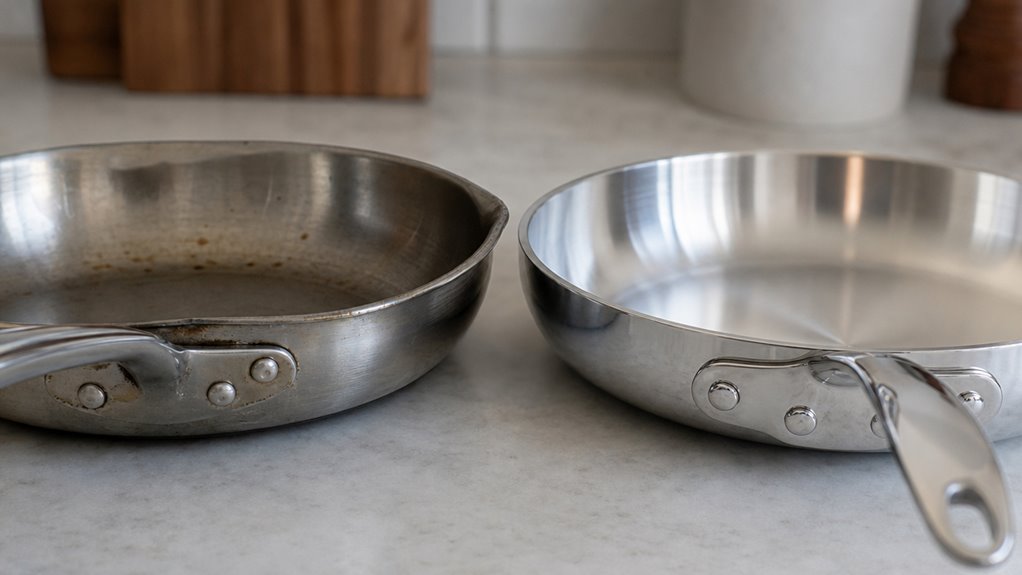
Fake All‑Clad pans give themselves away across five red flags: uneven rivets, a missing or poorly stamped “Made‑in‑USA” mark on the base, weight that feels noticeably lighter than a genuine pan, suspiciously low pricing, and packaging that fails close inspection.
Authentic All‑Clad construction relies on consistent bonding across layers of stainless steel and aluminum, which produces a heft that counterfeit versions rarely replicate.
Rivet spacing and stamp clarity are manufacturing outcomes, not decorative choices, so irregularities in either reveal shortcuts in production quality.
Prices dramatically below the standard market range for bonded cookware often signal counterfeit sourcing, since sellers depend on discount appeal to move units that can’t pass a close inspection.
Understanding each of these red flags in detail makes it possible to evaluate any pan before purchase.
Weight, Rivets, and the Made-in-USA Stamp
Grab the pan and give it a heft test; a genuine All‑Clad feels dense, like a solid block of metal, while a fake is surprisingly light and flimsy.
The weight & thickness of a real tri‑ply pan runs around three millimetres total, so it settles heavily in your hand and stays balanced when you swing it.
Next, inspect the rivets. Authentic All‑Clad rivets are solid stainless, evenly spaced, and sit flush without gaps or burrs; any wobble or mismatched size signals a counterfeit.
Finally, turn the pan over and look for the “Made in USA” stamp. It should be crisp, correctly placed near the logo, and match the branding on the box. A crooked, fuzzy, or missing stamp is a clear red flag.
Most All‑Clad pans are manufactured in the USA and feature a multi‑layer construction that contributes to their characteristic heft.
Why a Price That Looks Too Good Is the First Warning
After checking the weight, rivets, and Made‑in‑USA stamp, the next thing to watch is the price tag.
An All-Clad listing under $50 is a red flag because genuine D3/D5 pans usually sit between $130 and $200.
Look for unrealistic discount levels—70 % off or more—especially when the seller isn’t an authorized retailer.
If a Copper Core or D5 set is priced like a single entry‑level skillet, the price doesn’t match the claimed features.
Deep‑discount offers that beat All‑Clad’s own site by half often signal counterfeit stock.
Warranty coverage also applies to accessories and spare parts, so a deal that includes “extra” components at a rock‑bottom price should be scrutinized closely.
How Counterfeit All Clad Slips Onto Amazon Listings
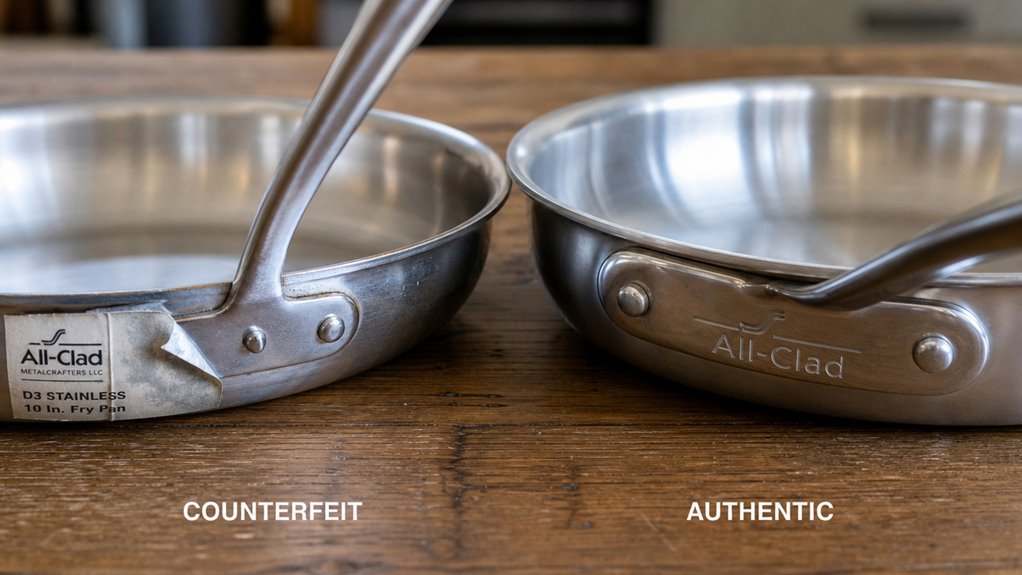
Counterfeit All-Clad reaches Amazon shoppers through a structural gap in third-party marketplace listings, where an unauthorized seller can attach a fraudulent offer directly to a genuine product page without creating a separate listing. Amazon’s commingled fulfillment model compounds the problem, because inventory from multiple sellers — including counterfeit stock — is stored together in shared warehouse pools, making it difficult to trace which physical unit ships to a buyer. That commingling also makes the Buy Box easier for a low-priced, unauthorized seller to win, even when the listing displays authentic product images and brand copy. When All-Clad sells directly through its own storefront, the inventory remains in a brand-controlled pool, separating it from third-party stock entirely. Understanding how these fulfillment and listing structures interact reveals why the source of a seller matters as much as the product page itself. Scam links can also be used to lure shoppers to fake Amazon pages that mimic the brand’s official site.
Third-Party Sellers and the Commingled Inventory Problem
Because Amazon’s “stickerless” FBA system pools every unit under the same ASIN, a counterfeit All‑Clad pan can end up in the same bin as a genuine one and be shipped to you even when the listing says “sold by Amazon.” The commingling process erases the link between a specific item and the seller who originally sent it, so you can’t tell whether the pan came from the brand’s own inventory, an Amazon‑retail source, or a third‑party vendor who slipped a fake into the pool.
In practice, the commingled-inventory counterfeit risk spikes when a third‑party seller opts into stickerless FBA. Their cheap, gray‑market units mix with authentic stock, and Amazon’s fulfillment algorithm pulls any pan from the pool without checking provenance. Because the system tracks only the ASIN, the real source stays hidden, leaving you with a fake that looks legit on the page.
The liability gap means you’ll face a tangled claim process, and the only reliable defense is buying directly from the brand or an Amazon‑sold listing that opts out of commingling. This structural flaw makes third‑party sellers the most common entry point for counterfeit kitchenware.
Why a Third-Party Listing Raises the Counterfeit Risk That a Brand-Sold One Removes
When a third‑party seller lists an All‑Clad pan, the brand name on the page looks legit, but the seller’s identity is a hidden variable. You can’t see the difference between a brand‑sold listing and a third‑party offer until you dig into the seller profile, and that gap is where counterfeit risk spikes. A third‑party seller can attach a fake pan to a genuine product page, letting the brand’s reputation mask the fraud. Brand‑sold listings keep the seller fixed to the manufacturer, so Amazon’s anti-counterfeit tools, including Registry, Transparency, and Project Zero, apply directly. This reduces the chance you receive a light, poorly stamped knock‑off.
| Seller type | Risk level |
|---|---|
| Brand‑sold listings | Low |
| Third‑party seller | High |
| Amazon‑sold (direct) | Medium |
How to Spot a Fake Lodge or Victorinox the Same Way
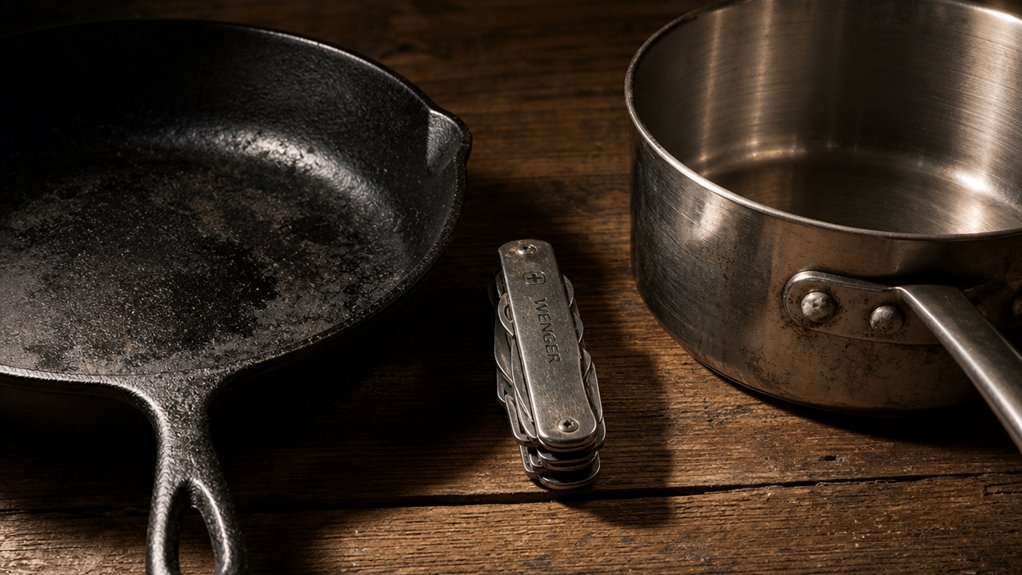
Spotting a fake Lodge skillet or Victorinox knife comes down to examining three reliable indicators: the cast-in or stamped logo, the handle construction, and the packaging.
On genuine Lodge and Victorinox products, logos appear crisp and centered, while counterfeits often show fuzzy edges or misaligned imprints.
Handle texture and tang stamping reveal further differences, since authentic pieces feel solid and carry consistent, legible markings, whereas fakes tend to be lighter and carry incomplete or sloppy stamps.
Packaging also matters. Real products arrive in boxes that match the brand’s official color scheme and include intact barcodes and warranty documentation, while counterfeit versions typically use plain or low-resolution materials.
The details covered ahead make each of these checkpoints easier to apply in practice.
Cast-In Logos, Handle Texture, and Stamping Quality
If you’re holding a Lodge skillet or a Victorinox knife, the first thing to check is how the branding was made into the metal. Look at the cast‑in logo on a Lodge pan: it should be raised or recessed, clean‑edged, and centered on the bottom or handle underside. Any smeared, uneven, or off‑center mark signals a cheap mold.
Run your fingers along the handle texture; authentic sand‑cast surfaces feel uniformly pebbled with smooth transitions, while abrupt ridges or jagged parting lines betray a recast.
For Victorinox blades, examine the stamping and engraving quality. The laser‑etched letters must be sharp, evenly spaced, and consistent in depth. Fuzzy or uneven characters mean a counterfeit.
These details let you spot fakes before you click “buy.”
The Packaging and Documentation Genuine Brands Include
Because the box is often the first thing you see, its construction tells you a lot before you even lift the pan or knife.
Genuine brand packaging arrives sealed, with crisp logos, aligned barcodes, and the proper recycling symbols. Look for tamper‑evident folds, shrink‑wrap, or heat seals; mismatched tape or re‑gluing signals a repackaged fake.
Victorinox cards and blister packs show high‑clarity thermoformed plastic, die‑cut windows, and multilingual safety text.
Lodge cookware boxes feature the cast‑in logo printed cleanly, and All‑Clad boxes include a serial stamping that matches the interior stamp.
Missing regulatory text or fuzzy printing is a red flag.
Keep the documentation handy; it’s a quick way to verify authenticity.
The Physical Tells That Separate Real From Replica
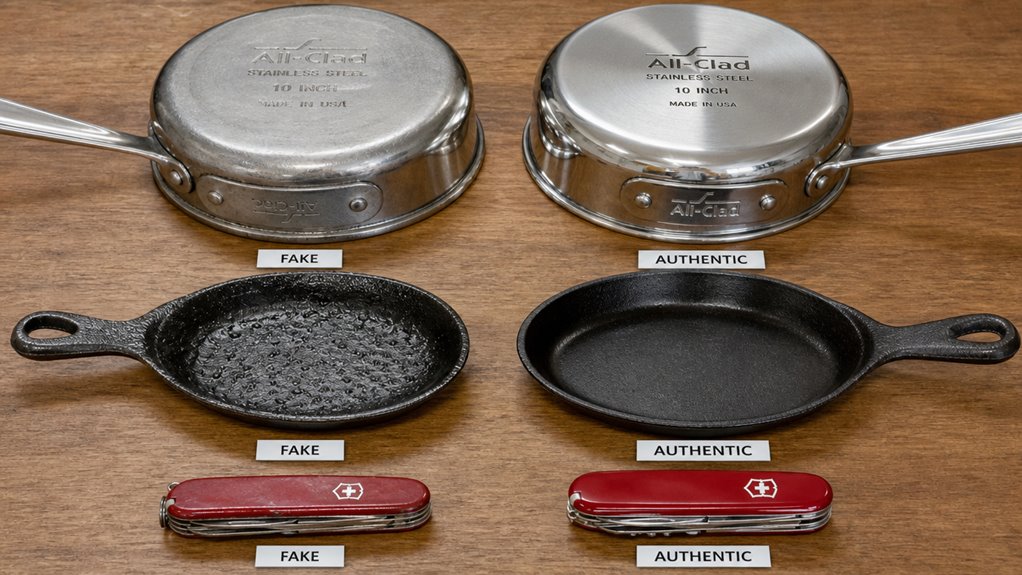
Physical tells reliably separate a genuine All‑Clad pan from a replica, and the most immediate signal is weight — a real pan feels solid because its bonded tri‑ply construction layers stainless steel around an aluminum core, adding meaningful mass that counterfeit versions typically skip.
That missing internal structure is why a fake often feels flimsy when lifted or flexed. Manufacturing stamps, particularly the “Made in USA” mark, serve as a secondary checkpoint, since replicas frequently omit or misprint this detail.
Together, weight, material construction, and stamping accuracy give buyers a reliable physical checklist before any cooking test is needed. The remaining indicators go deeper into what these differences reveal about long‑term performance and durability.
A Genuine All-Clad’s Heft Versus a Light Counterfeit
Feel the weight before you buy; a genuine All‑Clad pan carries a solid heft that a light counterfeit simply can’t mimic. When you lift it, the tri‑ply core feels dense, the handle balances, and the rim doesn’t give under gentle pressure.
A fake will feel thin, almost toy‑like, and you’ll hear a higher‑pitched clack when you tap it. Check the wall thickness: authentic D3 models have about 1.7 mm aluminum, so the pan stays rigid and the base barely flexes under a firm press. If it flexes or “oil‑cans,” it’s probably a counterfeit.
Use the ring test—real pans emit a muted, heavy tone, while fakes sound tinny. These tactile clues are the fastest way to judge whether an All-Clad pan is genuine before you commit to buying.
Why a Fake All-Clad Feels Lighter and Skips the Made-in-USA Stamp
The heft you felt in the real All‑Clad pan won’t show up in a fake because the counterfeit skips the full tri‑ply core and uses thinner, lower‑grade aluminum or even a single‑disk bottom.
You’ll notice the weight is off; a genuine 10‑inch fry pan should feel dense, while a replica feels surprisingly light for its diameter.
The base will be centered‑heavy, not evenly weighted across the footprint, and the sidewalls will give a little when you squeeze them.
Look for the “Made in USA” stamp on the underside—real All‑Clad has a crisp, deep impression.
Counterfeits often omit it or use a shallow, blurry mark.
These physical clues are the quickest way to tell a real All-Clad from a knock‑off.
What to Do If You Suspect You Bought a Fake
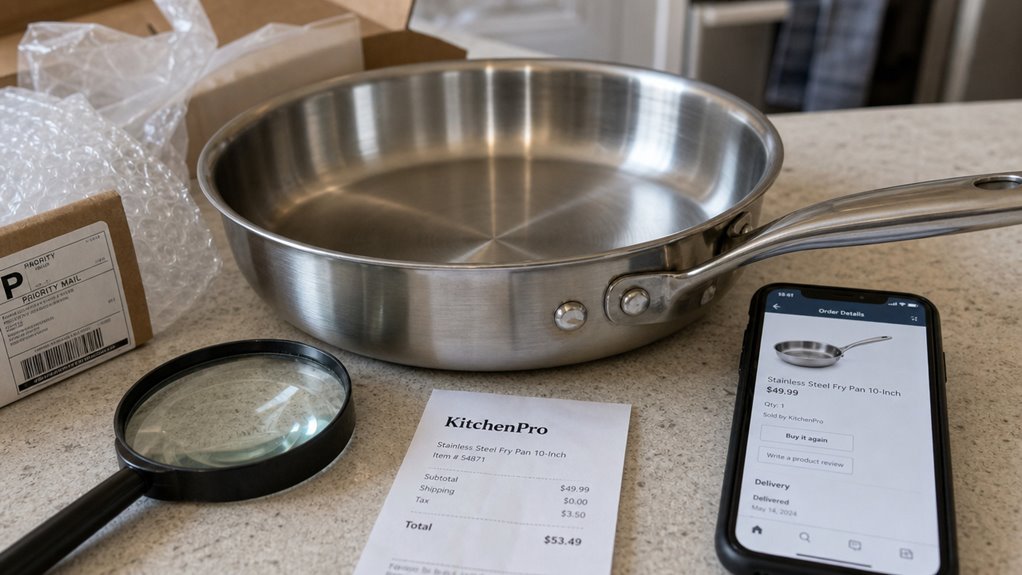
Suspecting a counterfeit purchase requires acting quickly across several fronts — checking the seller’s identity, reviewing recent buyer feedback for mentions of fakes, and initiating a return through your Amazon order page before the return window closes.
Third-party listings with thin or suspicious feedback are a common signal that a product may not be authentic. Packaging quality matters too: misspellings, sloppy stamps, or inconsistent labeling are physical evidence worth photographing before anything is discarded.
Filing an A-to-z claim gives Amazon a formal basis to investigate and protect the purchase, and if that process stalls, the brand’s anti-counterfeit team can often advance the case when given the same documentation. The steps involved, and how each one affects the outcome, are worth understanding in detail.
Checking the Seller, Reviews, and Return Window
When you spot a listing that seems too good to be true, start by confirming who actually sells it. Look for “ships from and sold by Amazon” or “ships from Amazon.com / sold by [brand]” in the buy box; anything else, even “Fulfilled by Amazon,” means a third‑party is involved.
Check the seller’s storefront for a focused brand line. Mixed inventory of random items is a red flag. Compare the seller rating to the product rating; a high product star count won’t rescue a low seller score.
Scan recent, verified‑purchase reviews for complaints about weight, stamping, or packaging that differ from genuine All‑Clad, Lodge, or Victorinox.
Finally, check the return window for that specific item in Your Orders as soon as it arrives. Return periods vary by category, by seller and over time, so do not work from a figure quoted in an article. Whatever the window turns out to be, do the weight and rivet checks inside it rather than after it.
How an Amazon A-to-z Claim Protects a Mistaken Purchase
After you’ve checked the seller’s identity and scanned the reviews, the next step is to protect yourself if the pan turns out to be a fake.
First, gather your order number, tracking details, and any photos that show the counterfeit stamp or missing Made‑in‑USA label. Contact the seller through Amazon’s messaging system and ask for a return label, and keep every message in the thread.
If they ignore you or refuse, open an A-to-z Guarantee claim. Read that page before filing rather than working from day counts quoted in an article: the waiting period before a claim becomes eligible, the window for filing, and the window for appealing a decision all vary by situation and Amazon changes them. Filing before you are eligible wastes the attempt. When you do file, upload your evidence and include a short description of the counterfeit tell.
Frequently Asked Questions
Can I Trust Amazon’s “Fulfilled by Amazon” Badge for Brand Integrity?
You can’t rely on the “fulfilled by Amazon” badge for brand integrity; it only guarantees shipping logistics, not that the seller sourced authentic goods or kept the inventory free of counterfeits.
Do Seller Ratings Replace the Need for Physical Product Inspection?
You might think ratings suffice, but they’re just a polite nod. You still need to weigh the pan, check stamps, and verify rivets, since those tactile clues reveal fakes that star scores can’t catch.
How Does Amazon’s “Buy Box” Affect Counterfeit Risk?
You’re exposed to more counterfeits when the Buy Box lands on a third‑party seller, because Amazon rotates it based on price and fulfillment, not authenticity, and FBA can mix genuine and fake stock.
Are Third‑Party Warranties Reliable for Premium Cookware?
Think of third‑party warranties as a shaky bridge: they often stall on claims, demand endless paperwork, and cost extra, so you’ll usually trust the brand’s own warranty over them.
What’s the Best Way to Verify a Pan’s Weight at Home?
You should tare a digital kitchen scale, place the pan (and any lid) on it, record the weight to the nearest gram, repeat twice, average the readings, then compare that figure to the manufacturer’s spec.
Conclusion
Think of your Amazon cart like a treasure chest. You’ve learned to check the lock, weigh the gold, and read the seal before you claim the prize. If the seller’s name, the pan’s heft, the logo’s crispness, the price, and the packaging all line up, you’ve likely found the real deal. If something feels off, trust the clues and use Amazon’s A‑to‑Z claim—your safety net against counterfeit loot.
| Handmade Pennsylvania Black Cherry Wooden Spatula 12” Paddle |  | Handcrafted Classic | Material: Pennsylvania black cherry wood | Made in USA: USA-made, handcrafted in Pennsylvania | Hand-wash Only: Hand wash with soap and water | VIEW LATEST PRICE | Read Our Analysis |
| 10″ Wood Cooking Utensils – Scraper Turner Spatula (USA) |  | Versatile Workhorse | Material: Sustainable natural wood (various types) | Made in USA: USA-made, handcrafted in Montana | Hand-wash Only: Hand wash recommended | VIEW LATEST PRICE | Read Our Analysis |
| Microplane Premium Zester Grater – Dark Gray Stainless Steel |  | Precision Zester | Material: Surgical-grade stainless steel | Made in USA: USA-made (Microplane) | Hand-wash Only: Dishwasher safe (but rinse recommended) – note: not hand-wash only | VIEW LATEST PRICE | Read Our Analysis |
Links to Amazon are affiliate links. Buying through one costs you nothing extra and helps fund the research.

Michael Haralson worked in professional kitchens from 1979 to 1992: San Diego restaurants, six years with a catering company beside an Austrian chef, and two summers as a cook on the Finland to Sweden cruise route. He then built a fifteen-year career at Nokia. It began in product marketing and product management, where technical specifications and supplier evaluation were part of the work, and grew from a few countries to a region to global roles, then into sales and corporate strategy. That took him to Beijing for three years, where he spent many weekends in a different province trying the local food and took cooking classes. He has eaten in more than 40 countries and has been shown the kitchens of restaurants in Southern Europe. At home in Finland he cooks Cantonese, Sichuan and Mediterranean food, and still uses the cast iron skillet he bought in 1992. He is the author of Buy It Once, Book One of The Researched Kitchen, and writes here about the balance between kitchen tools that cost too much and those that fail too soon.