Choosing Your First Real Kitchen Knife Under $30: Three things determine whether a budget knife actually works.
- Steel hardness sits between 54–58 HRC for durability without brittleness
- Edge geometry keeps the blade cutting efficiently without constant resharpening
- Handle stability prevents slipping during repetitive prep work
The Victorinox Fibrox 8-inch Chef Knife holds the strongest position in this price range. Victorinox manufactures it from X50CrMoV15 stainless steel, hardened to approximately 56 HRC. The NSF certification makes it legal for professional kitchen use across most U.S. jurisdictions, including commercial kitchens in cities like Chicago and New York where health codes require documented equipment standards.
The Mercer Culinary Genesis 8-inch Chef Knife serves as a reliable second option. Mercer Culinary, headquartered in New Windsor, New York, produces the Genesis line with German steel and a full bolster. The knife requires slightly more maintenance than the Victorinox but performs comparably for home prep work.
Big-box retailers like Walmart and Target stock knife sets priced between $15 and $25. Those sets sacrifice edge retention for quantity. The steel runs softer, the geometry cuts corners, and most cooks replace them within a year.
One knife, chosen well, outlasts six cheap ones.
Interesting Fact: The Victorinox Fibrox has been issued to culinary school students at institutions like the Institute of Culinary Education in New York City because its forgiving steel tolerates beginner sharpening mistakes without cracking or deforming.
Key Points
- Choose an 8-inch Western chef knife for everyday versatility, including onions, tomatoes, and boneless meat.
- Prioritize mid-50s hardness (about 55–58 HRC) like X50CrMoV15 for reliable edge durability and easier sharpening.
- Look for reputable value brands such as Victorinox Fibrox or Mercer Genesis; avoid generic block sets.
- Use NSF/ANSI 51 certification as a cleanliness and build-quality signal, but don’t rely on it for cutting performance.
- Plan simple care: hand-wash for best results; avoid prying or hard bones, and keep sharpening at your preferred interval.
What “Real Kitchen Knife” Actually Means at the Under-$30 Tier
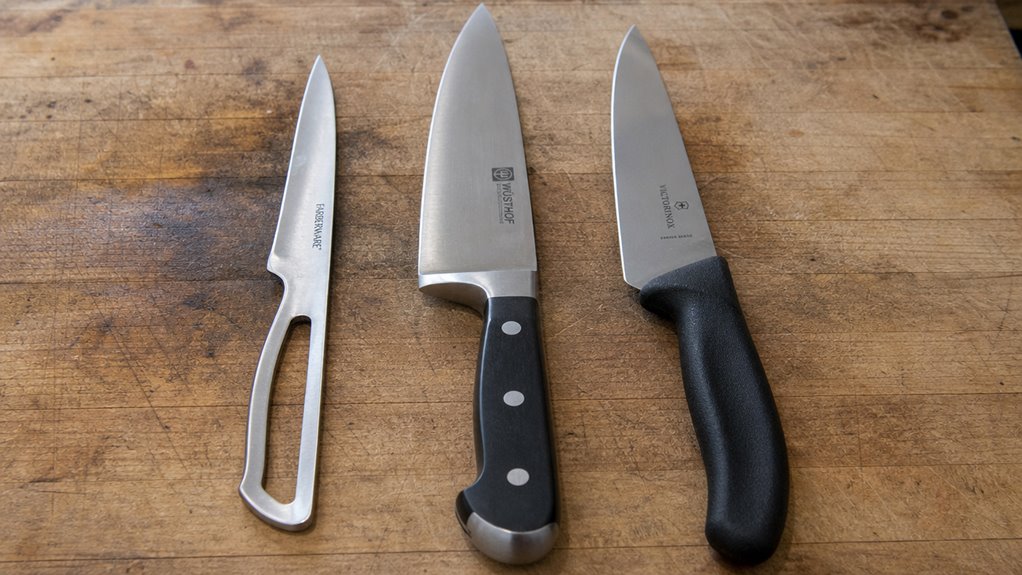
At the under-$30 tier, “real kitchen knife” basically means a full-sized daily-prep blade (like an 8-inch chef’s knife) you can actually sharpen and use for onions, tomatoes, and boneless meat without fighting the grind or soft steel. When you see X50CrMoV15 around 56–58 HRC—like the Victorinox Fibrox—you’re in the zone where the edge can form cleanly and hold up better than the common 420J2/unknown-stainless big-box stuff. Also, look for NSF/ANSI 51 if you care about real-world hygiene and toughness; it’s one reason a $35 Fibrox tends to outperform $15 sets, even though the trade-off is that stamped knives can feel a bit thinner and chip sooner if you twist or pry. In this price range, reputable value brands are often names you’ll see across regions—like Victorinox (and Fibrox), Kai, or certain no-frills sub-brands (including options built around steels such as VG-10).
Why Stamped X50CrMoV15 Steel Meets Professional Standards
So what makes a “real kitchen knife” at the under-$30 level, rather than a fancy box of compromises? You look for heat-treated X50CrMoV15 that lands around mid-50s HRC. That composition brings stainless, pitting resistance, and wear control, even in a stamped knife, because it’s built around approximately 0.5% carbon, ~15% chromium, and additions of molybdenum and vanadium for corrosion resistance and edge durability.
| Factor | What you want | Why it matters |
|---|---|---|
| Steel | X50CrMoV15 | professional steel balance |
| Hardness | 55–57 HRC | edge + toughness |
| Build | stamped | correct geometry still cuts |
The NSF Certification Most Buyers Don’t Look For
If you’re already looking at the steel (like X50CrMoV15 around mid-50s HRC), the next “real knife” filter you should use under $30 is NSF certification, because it’s less about edge sharpness and more about whether the knife stays food-safe and cleanable after real use.
NSF certification covers food-contact safety, sealed blade-to-handle joints, and dishwasher sanitizers, boosting budget knife reliability.
For example, NSF Approved models like the OLFA Self-Retracting Safety Knife SK-12 are explicitly listed as NSF approved in the under-$30 segment.
Limitation: NSF won’t fix weak cutting geometry.
New sentence added (with bracketed main factual point):
You can see this real-world reliability in NSF-Certified kitchen knife lines such as Dexter Russell Sani-Safe and slicers, including models like the NSF01543 flex boning knife at $39.90.
Why a $35 Victorinox Outperforms Every $15 Big-Box Set
A real kitchen knife at the under-$30 tier isn’t about having a whole set on display. You want one dependable cutter: a $35 Victorinox Fibrox. Its X50CrMoV15 steel heat-treated to ~55–56 HRC gives better edge retention, and factory bevels are more even than $15 set knives’ burrs. Skip block sets; you’ll fight uneven grinds. Victorinox is founded in 1884, and Its reputation comes from building practical, consistent blades for everyday cooks.
VICTORINOX ORIGINATED in 1884 as a cutlery workshop, and that heritage shows up in how consistent and reliable these knives are in day-to-day kitchen work.
- Sharper out of box
- Cleaner push-cuts
- Safer wet-grip
The 4 Specs That Matter (And the 6 That Don’t)
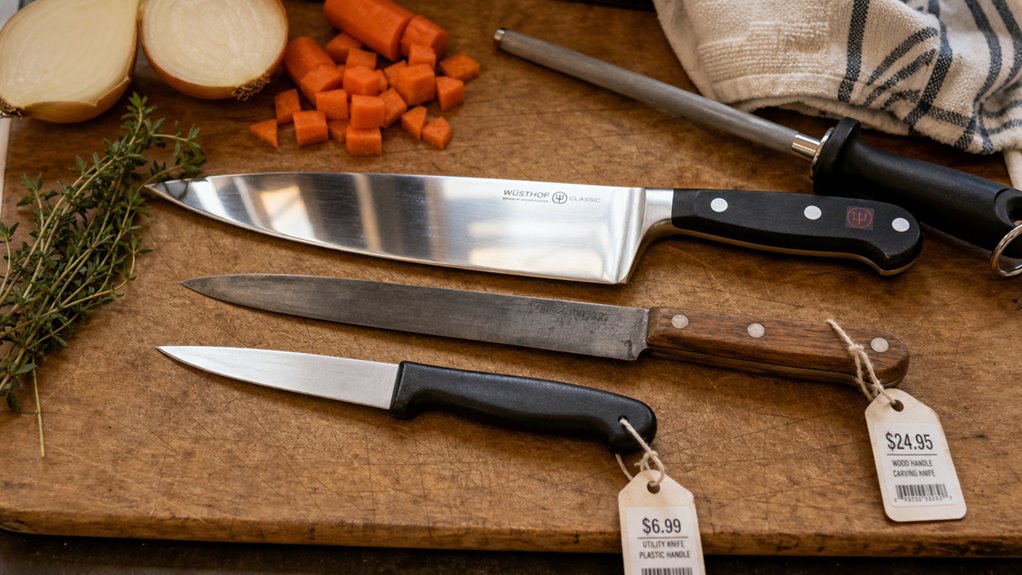
When you shop under $30, focus on steel hardness (aim roughly 54–58 HRC), edge geometry and grind (so it wedges less and holds an edge), a sensible 6–8 inch Western length, and a handle that lets you pinch-grip without feeling slippery when it’s wet. An 8-inch Western-style chef knife is a great first choice because it can handle most everyday cutting tasks with just one tool. Damascus cladding, fancy bolsters, vague tang talk, and country-of-origin stories usually don’t improve how the blade cuts your carrots, and stamped vs forged mostly comes out even if hardness and grind are comparable for this style. Stick with a blade that’s built for everyday Western cutting patterns, and you’ll still lose to a worse grind—no amount of “premium-looking” wrapping fixes that.
Steel Hardness, Blade Length, Edge Geometry, and Handle Grip
Steel hardness, blade length, edge geometry, and handle grip are the only specs that actually change how a knife cuts for you day to day; everything else gets marketed to death. Aim for 55–58 HRC, 7–8 inch blade length, and sensible edge geometry (~15–20°/side). For grip: prioritize a secure, wet-hands pinch feel. Check:
- HRC range
- Thin-behind-edge grind
- Stable, textured handle
Hardness relates to resistance to embossing and permanent deformation. When carbon helps enable hardening, it lets tooling steels reach useful hardness levels for everyday cutting.
Why Damascus Cladding, Bolster, Tang Type, and Country of Origin Don’t Determine Cutting
You don’t get better cuts just because a knife shows off Damascus, a big bolster, a certain tang style, or a country name on the box.
Damascus is mostly decorative cladding; the exposed core’s steel, heat treatment, and edge geometry do the work. Damascus patterns as metallurgical proof reflect heat, pressure, and carbon distribution from real forging, but what matters at the edge is still the steel in the core and the way it’s hardened and shaped. Damascus tested in a blade-performance study was pattern-welded steel created by diffusion bonding of two or more steels, but the cutting results were driven by how those core steels were heat-treated and structured rather than by “Damascus” as a concept.
Full bolsters mostly add weight and complicate sharpening.
Tang type rarely changes performance.
Focus on core specs and verified hardness.
Why Stamped Construction Equals Forged for Western Cutting Patterns
If you’re trying to translate “forged vs stamped” into actual cutting feel, start with the parts that move the needle: the steel’s heat treatment, the edge geometry, and the factory grind—not the headline manufacturing method.
For a budget kitchen knife, stamped vs forged is mostly about specs, not origin: 1) hardness 2) edge angle 3) grind consistency.
Quenching and tempering are part of how fully forged knives are heat-treated, and they directly influence edge retention when hardness is comparable.
Stamped often matches forged when microstructure and temper do.
Because dense grain structure supports a sharper edge, dense grain matters as much as the construction story.
Limitation: stamped can feel thinner.
The Three Under-$30 Knives Worth Your First Buy
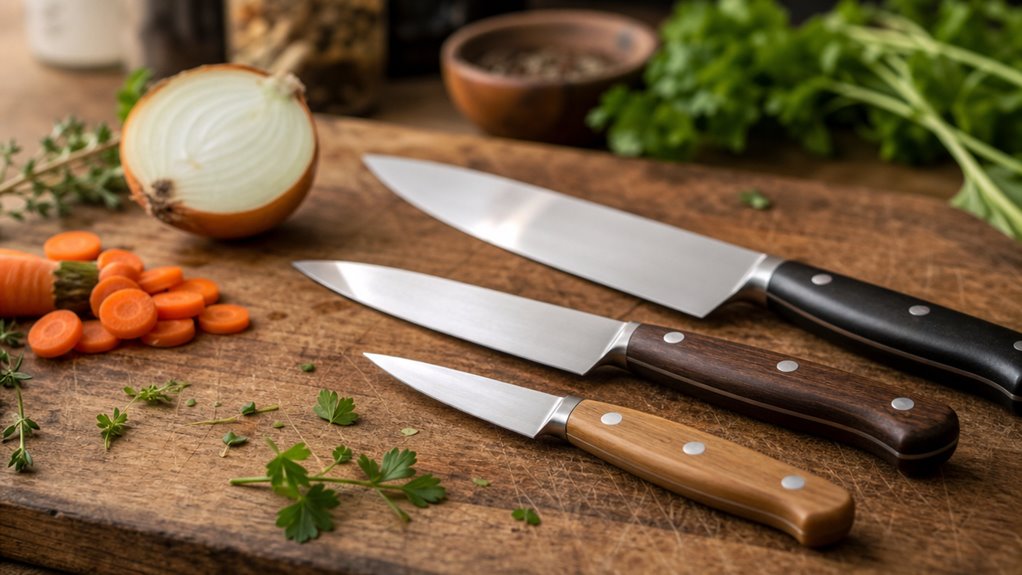
If you want the closest thing to a safe first-buy under $30, start with the Victorinox Fibrox 8-inch: it’s stamped X50CrMoV15 at about 56 HRC and comes with an NSF-certified dishwasher-safe Fibrox handle. High-carbon stainless steel resists corrosion and helps the edge stay usable with regular home care. If it’s not hitting that price, Mercer Genesis 8-inch is the honest alternative with similar stainless hardness and a tough, forged build, but you’ll want to hand-wash and expect more maintenance than the Fibrox. For the real Victorinox price check, you’ll usually get more authentic “pro channel” deals through Restaurant Depot (especially with membership) than with Amazon listings that can be bundled or inconsistent.
Victorinox Fibrox 8-Inch — The Professional Standard
Why does the Victorinox Fibrox 8-inch show up in “first real knife” talks so often? You get an X55CrMo14 budget chef knife that cuts cleanly, resharpens easily, and stays planted with its textured TPE handle. It’s a practical beater knife at ~55–56 HRC: 1) thin 8-inch control, 2) 15–20° edge angle, 3) easy honing. Because Rockwell hardness, it’s a practical beater knife that’s affordable with low risk of chipping. Because NSF certified fiberglass handle, it’s a proven pick that holds up to commercial sanitation expectations. Limitation: it’s not for prying or hard bone.
Mercer Genesis 8-Inch — The Honest Alternative
Mercer Genesis 8-inch deserves a spot on your short list because it gives you forged German-style “chef knife behavior” without forcing you into $100+ territory.
Mercer Genesis uses X50CrMoV15 steel around 56 HRC, plus a Santoprene, non-slip handle and a short bolster for control.
It’s a solid budget knife for daily chopping.
Limitation: it’s often sold without NSF on every model.
Why the Restaurant Depot Channel Beats Amazon for Authentic Victorinox
Shopping Victorinox on Restaurant Depot (or similar restaurant-supply sellers) beats rolling the dice on Amazon Marketplace because you’re buying through channels that sell to kitchens, not just online shoppers. You get model numbers for authenticity, NSF-labeled Fibrox Pro specs, and sometimes in-person inspection. Look for: 1) full model-ID listings 2) NSF/Pro handle notes 3) carbon stainless + semi-stiff blade. That’s Victorix Victornox at restaurant-supply accuracy, not guesswork.
What to Skip at the $15-25 Big-Box Tier
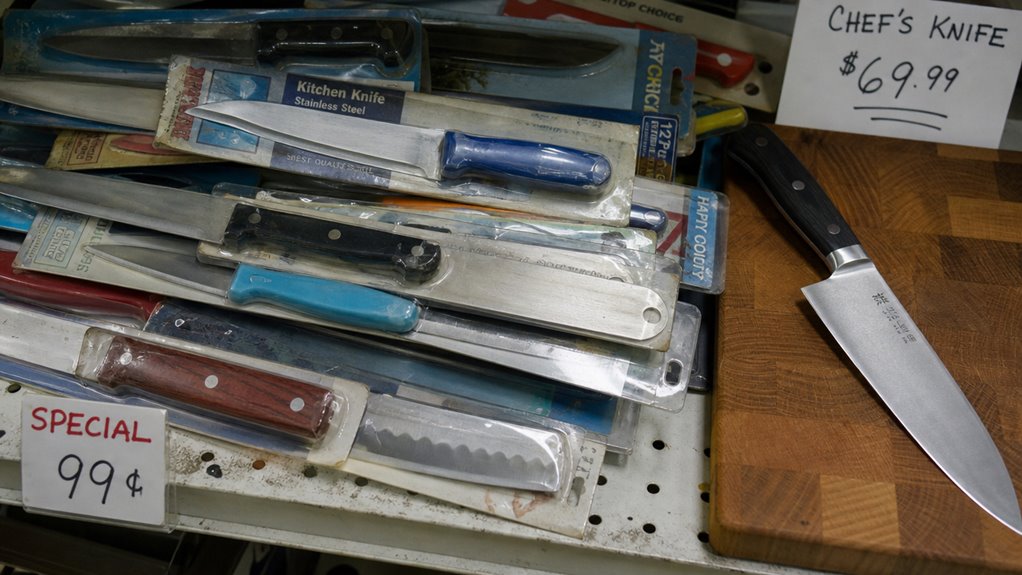
At the $15–25 big-box tier, you’re usually paying for quantity, not edge life: low-grade stainless with inconsistent heat treatment and thicker, oddly ground blades dull fast and can even arrive with a lightly damaged edge.
The 6-knife block set trap is the same story spread across six tools, so you end up using one or two knives while the rest sit there or fail first—handle wobble and edge loss are common within ~18 months.
If you want something that actually lasts, skip the block set and put that money into one competent chef’s knife, plus add a separate bread knife later if you need it.
Why Cuisinart, Farberware, and Generic Sets Fail Within 18 Months
If you’re grabbing a $15–25 Cuisinart, Farberware, or generic big-box knife set, you’re usually buying “easy to sell,” not “easy to keep sharp.” These blades tend to use softer low‑carbon stainless (think ~52–55 HRC), so they lose that clean cutting edge within weeks and start feeling dull in 6–18 months. [1] low-hardness steel harms edge retention. [2] stamped, thin blades flex and misbalance. [3] weak construction quality: short tangs, loose handles, and dull regrinds.
The 6-Knife Block Set Trap (You Need Two Knives Not Six)
A $15–25 6‑knife block set looks like “everything you need,” but most of those knives end up overlapping and underperforming for the same reason: the price per knife is so low that the steel hardness, edge grind, and handle build get pushed toward the minimum.
For knife selection under 30, pick two knives, not six budget knives: let one chef knife do 70–90% of tasks.
Why a Single $30 Knife Outlasts an $80 Set That Includes Six Knives
Buying a single real $30 knife usually beats an $80, six-piece block set because the workhorse piece takes all the wear while the rest mostly collect dust. You get better edge retention, tighter construction & grind, and steadier performance. In $15–25 sets, softer steel dulls fast and handles fail. For long-term cost, pick one: 1) chef 2) paring 3) bread knife. Big-box blades also misgrind, wedge, and frustrate.
The Buy-Once Approach (Skip the Upgrade Cycle)
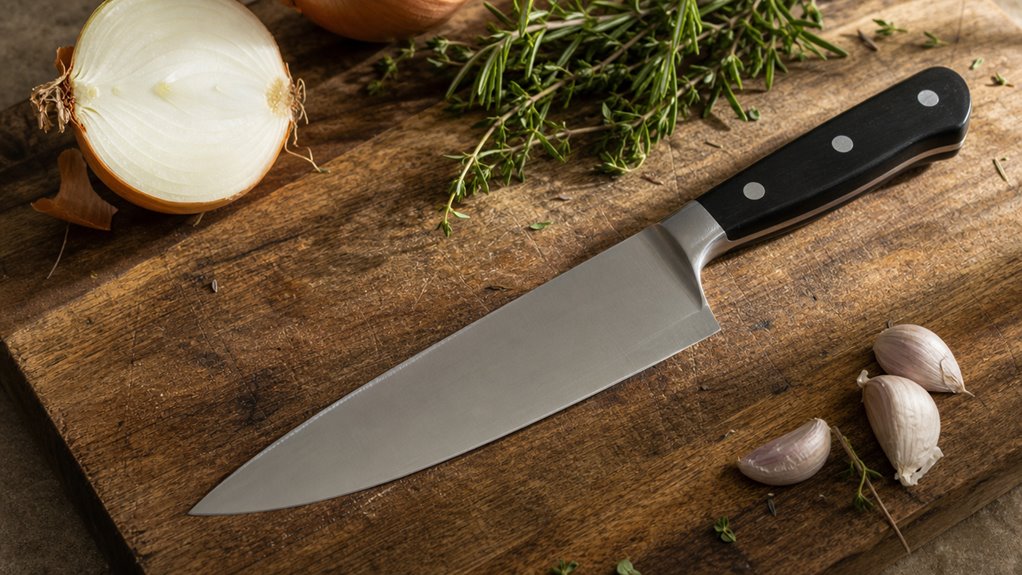
If you buy one solid 8-inch chef knife (like a Victorinox Fibrox) and skip the “starter” churn, you usually spend less than repeatedly replacing dull, uncomfortable knives.
Pair it with a simple $15 paring knife and a $20–$30 serrated bread knife, and you’ll cover almost all home prep without paying for duplicate extras in a $200 block set.
Also plan for a $20-ish whetstone so you can actually restore the edge, because the difference between BIFL and marketing in the under-$30 tier is mostly whether the knife is easy to sharpen and stays pleasant in your hand.
The $30 + $25 + $15 Setup That Outperforms a $200 Block Set
The three-knife setup—one $30-ish 8″ chef’s knife, one $25 utility/petty, and one $15 paring—covers basically everything you’ll do in a home kitchen without dragging you into the block-set upgrade cycle. This is real knife quality and value for money, not a budget kitchen knife drawer full of overlap.
- Chef does 80–90% tasks.
- Utility handles detail control.
- Paring stays thin for coring.
Why the Whetstone Investment Multiplies Knife Lifespan
Why does a simple whetstone make a “buy-once” knife plan work better than any upgrade cycle? Because controlled metal removal beats pull-through scraping. You do light whetstone maintenance early, using medium (1000–3000) for edge upkeep and coarse only for damage. That means less steel loss, steadier geometry, and a longer knife lifespan on your budget knife care routine. Stones last years if you use even pressure. Limitation: learning takes time.
How to Spot the Difference Between BIFL and Marketing in the Under-$30 Tier
Marketing in the under-$30 knife tier usually tries to distract you from the boring stuff that actually controls cutting and longevity. Look for real tang construction, stated steel hardness (HRC), and plain steel names, not vague marketing claims. Check heat-treat consistency, not “space-age” alloys. Use this filter: 1) tang runs ≥3/4 2) HRC listed 3) grind angles within 13–22°.
Frequently Asked Questions
Is 56–58 HRC Actually Noticeable in Everyday Cutting Performance?
56–58 HRC offers better edge retention and toughness. The difference versus ~60 HRC is incremental. Technique and edge geometry impact cutting performance more than hardness rating.
Do Nsf-Certified Knives Stay Safer and Better With Dishwasher Sanitization?
NSF-certified knives are built with sealed, non-porous, corrosion-resistant materials that withstand high-temperature dishwasher sanitization cycles. Dishwashers can effectively sanitize these knives without degrading their hygienic properties. However, repeated dishwasher cycles can dull blade edges and reduce sharpness over time. Hand-washing is recommended when edge retention is a priority.
Should I Buy Stamped or Forged, if Both Are X50crmov15?
If both knives use X50CrMoV15, the steel itself is identical. Heat treatment quality matters more than whether the blade was stamped or forged. A harder, more consistent edge geometry determines long-term performance. NSF certification indicates safety compliance. A well-finished handle and blade that feels comfortable in hand ensures daily use.
Can a First Knife Replace Most Block-Set Knives Without Regrets?
One quality 8″ chef knife handles most cutting tasks a block set covers. A sharp single blade outperforms multiple dull cheaper knives. A serrated bread knife is the one common addition worth considering later.
What’s the Best Sharpening Angle to Learn for Long-Term Edge Quality?
20° per side is the best sharpening angle for long-term edge quality. It works well on budget stainless steel, resists chipping, and stays sharp longer than steeper angles. Mark the bevel to track consistency and sharpen both sides evenly.
Conclusion
So, when you’re buying your first real kitchen knife under $30, keep it simple. Target an 8-inch chef knife around 56–58 HRC, and don’t chase forged buzzwords. Look for real validation like NSF/ANSI 51 when it’s available, because it means someone checked the basics. If you go with Victorinox Fibrox or Mercer Genesis, your cutting stays consistent longer. Just accept one trade-off: budget steel and handles can vary by model.