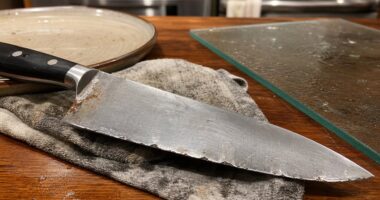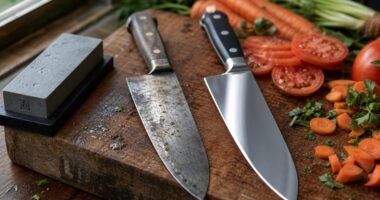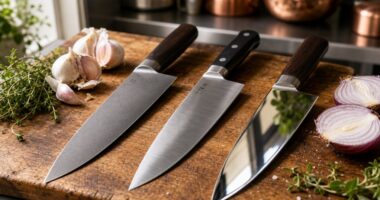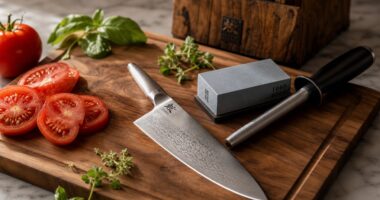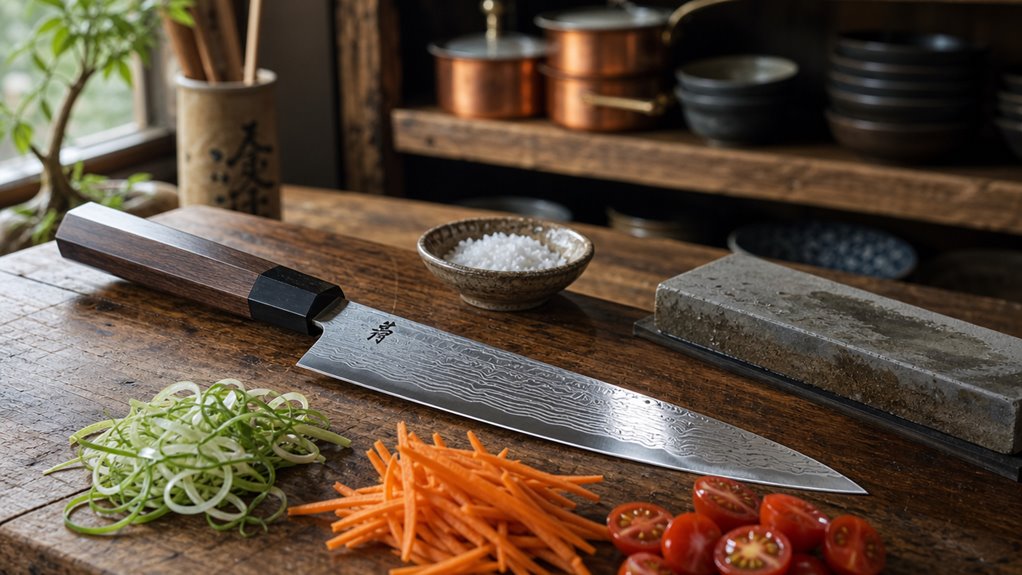
Japanese chef knives over $200: They earn their price through geometry, fit, and edge retention—not marketing.
Three properties separate premium Japanese knives from budget options:
- Single-bevel grind — delivers cleaner cuts on raw fish and protein
- Steel composition — determines edge sharpness, retention, and corrosion resistance
- Handle ergonomics — affects fatigue, control, and long-term precision
Knives like the Shun Classic and Global G-2 use steels such as VG-MAX and CROMOVA 18 that hold a finer edge longer than German alternatives. Aogami Super carbon steel, used by makers like Yoshihiro Cutlery, stays sharper through high-volume sashimi and whole-fish breakdown. A double-bevel gyuto from MAC Knife’s Professional Series handles daily prep work at a lower price point without sacrificing core performance.
Shops like Japanese Knife Imports in Los Angeles and Korin in New York City stock knives across every price tier and let buyers test balance before purchasing.
The maintenance commitment is real. Every knife above this price point requires hand-washing, immediate drying, and whetstone sharpening on stones like the King KW-65 1000/6000.
Interesting Fact: Aogami Super steel, developed by Hitachi Metals, contains vanadium and tungsten additives that push its hardness to 67 HRC—harder than most surgical steel used in operating rooms.
Key Points
- Much of the $200+ premium buys tighter geometry, finish, and heat-treatment consistency, not universally better cutting.
- Premium Japanese knives are mainly worth it for specialized edges like single-bevel yanagiba/deba at ~15°.
- Higher hardness sharpens more but increases chipping risk and demands careful cutting, especially on bones or frozen foods.
- Stainless VG-MAX types resist rust and sharpen predictably, while carbon steels like Aogami Super stain if not cleaned/dried.
- Hand-wash and frequent whetstone sharpening are part of the trade-off; dishwasher use accelerates dulling and rust.
What Japanese Chef Knives Actually Offer (And What’s Marketing)
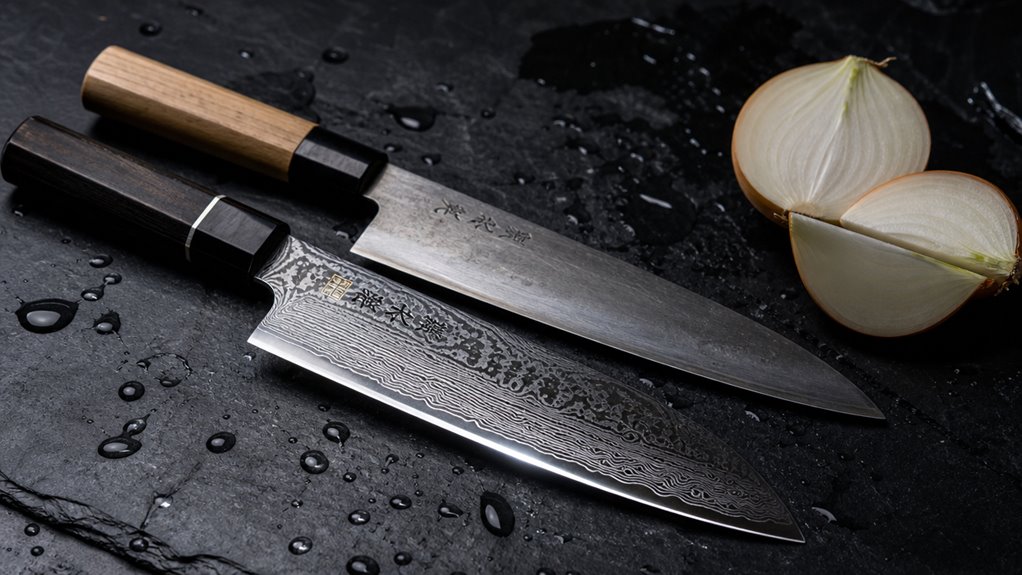
You’ll hear “VG-MAX” and “Aogami Super” used like magic words, but what you’re really paying for is how those steels hold a sharp edge at ~60–64 HRC and how they behave on a stone—VG-MAX tends to be more forgiving, while Aogami Super stays very sharp but chips easier if you hit bones or frozen stuff. Then you look at the geometry: single-bevel (15° one-sided) is the real Japanese advantage for draw-cut tasks like sashimi and proper whole-fish breakdown with a deba, while double-bevel gyuto work is closer to what most Western knives can do day-to-day. High-carbon steels are prized in this range because they’re capable of extremely sharp edges and strong edge retention, assuming you’re willing to maintain them. So if a $200+ Japanese chef knife isn’t a single-bevel specialist in practice, the “laser” marketing is mostly about grind and polish, not a reason you’ll get better cutting outcomes—plus you’ll still own the trade-off that high-hardness steels demand hand-wash and careful handling.
For a concrete example of that “sweet spot,” a Yoshihiro Aogami Super Gyuto 210mm built by Yamawaki Hamono is often cited as a top pick around the $200 level.
The VG-MAX and Aogami Super Steel Grades and Why They Sharpen Differently
Here’s the part of the “premium Japanese steel” story that actually changes your sharpening sessions: VG-MAX and Aogami Super don’t just sound different on a label, they behave differently on stones. You’ll notice:
- VG-MAX (stainless, VG-10-derived) sharpens more predictably and resists rust. It’s exceptional hardness and durability help the edge feel consistent for longer between sharpenings. about 0.5% carbon
- Aogami Super (carbon) forms a tougher edge but takes longer to abrade off.
- Aogami Super stains if you don’t wipe and dry.
Single-Bevel vs Double-Bevel Geometry (And Which Tasks Each Actually Wins)
When you’re comparing Japanese chef knives, the big difference isn’t the logo or the steel grade first. You’ll feel it in geometry. A single-bevel edge (yanagiba, deba) gives clean draw cuts and precise steering, but it’s more fragile and chips sooner with twisting. A double-bevel gyuto tracks straighter for daily prep and handles board contact better. Bevel is the angled surface that leads into the knife’s edge. Urasuki is a slightly concave backside on many single-bevel knives that can reduce food sticking and be resharpened more quickly than more complex profiles.
Why $200 Japanese Knives Earn Premium Only for Single-Bevel Specialist Work
Most $200+ Japanese chef knives don’t earn that price from “better cutting” across your whole weekly menu—they earn it from being built for a narrower job, especially single-bevel work. You pay for geometry precision and consistent edges, not magic. That shows up when you:
1) slice fish cleanly with a single-bevel knife
2) debone with a deba’s heavy chop
3) maintain by hand-wash and whetstone.
With many popular under-$200 options, steel and geometry still deliver real everyday performance, which is why a good Japanese gyuto/chef knife can feel plenty premium for home use even when you’re not paying for specialty single-bevel manufacturing. For many cooks, a well-made Japanese knife under $200 can still deliver excellent sharpness and control for everyday slicing and chopping— which is why price Japanese chef knives often land in the “sweet spot” where performance per dollar stays strong.
The Cooking Patterns Where a $200 Knife Cuts Differently
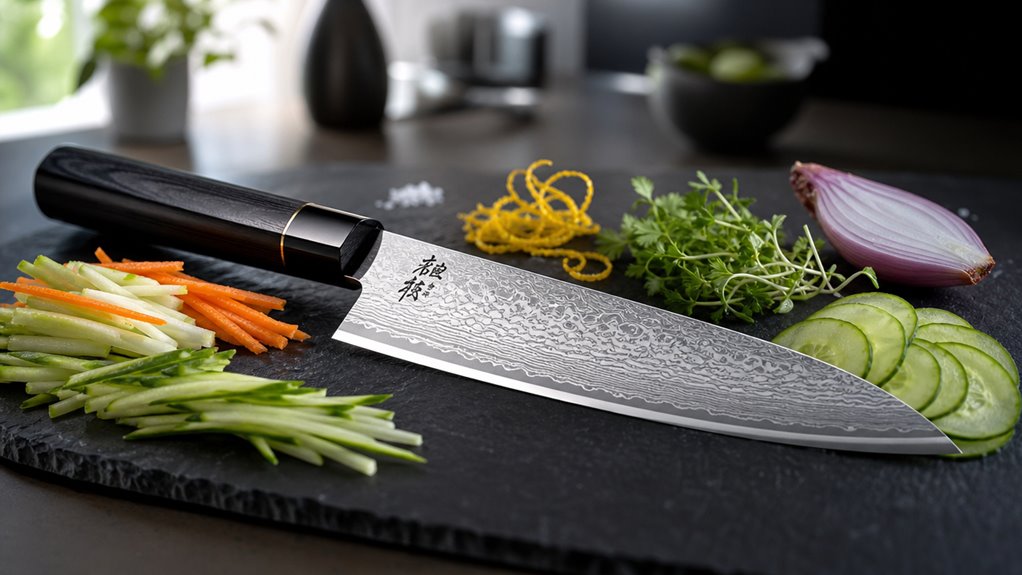
When you’re doing sushi or sashimi prep, you’ll quickly see why a yanagiba’s single-bevel 15° “pull” cut matters: it slices fish flesh cleanly instead of dragging and tearing. For whole-fish work, a deba’s heavy single-bevel chops through bone with less steering than most Western knives, so you get fewer awkward stops and reroutes. And for everything else, a double-bevel santoku often ends up feeling like marketing repackaging compared to a simpler, sharper workhorse—its limitation is it can’t replace the single-bevel geometry when you need that draw cut.
In particular, single-bevel knives are often preferred for right-handed precision and that kind of refined “shaving” action.
In addition, shaving-like edge action can make clean slice work feel more controlled and less fatiguing over repeated cuts.
Why Sashimi and Sushi Prep Demand a Yanagiba
If you’re prepping sashimi or nigiri, you’ll notice the knife’s job isn’t “cut stuff,” it’s “make the slice look and eat the same every time.” A yanagiba (often 240–330 mm) gives you long, uninterrupted strokes through raw fish after you’ve broken the fillet down, so you portion with consistent thickness instead of stacking multiple smaller cuts. With single-bevel blades, you can achieve an extremely sharp, smooth cut surface that helps keep the fish’s texture intact. (1) Single-stroke pull cut for less tearing (2) Flat, mirror-like surfaces for presentation (3) Cleaner release for fat-rich tuna and salmon
How a Deba Breaks Down Whole Fish Cleaner Than Any Western Knife
You can’t treat a deba like a general chef’s knife and expect the same results, because it’s built around whole-fish butchery. With a deba knife, the thick spine and heel give controlled force at the head and collar. The 15° single-bevel tracks bone instead of steering away. Urasuki reduces drag when separating skin-on flesh. A deba is designed for fish butchery, which is why its cutting geometry and weight distribution feel different from Western all-purpose blades. Limitation: don’t hack thick frozen bones.
When the Double-Bevel Santoku Is Just a Marketing Repackaging
Most of the time, a double-bevel santoku above $200 just repackages what a good Western chef’s knife already does, especially for everyday chopping. You get similar geometry, and branding leans on “Japanese-style” names. Most of these knives are grounded with double bevel angles on both sides, which helps maintain versatility for routine kitchen tasks.
- Push-cut dense veg
- Slice boneless proteins
- Fast dicing transfer
Pay more mainly for harder steel and finer edge retention, and double-edge variation can offer flexibility for both left- and right-handed use. Limitation: it won’t fix dull habits or cutting bone.
What You’re Actually Paying for at the $200+ Tier
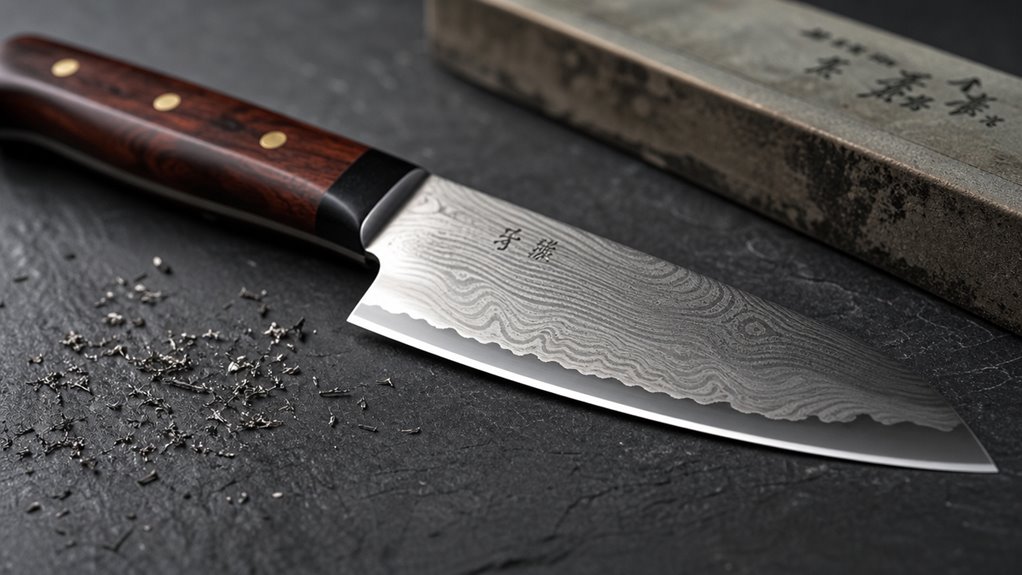
At the $200+ tier, you’re mostly paying for the parts that don’t show up in a glossy review: the hand-finished grind, tighter heat treatment, and the labor around fit, like spine/choil rounding and more consistent bevels that stay true.
For example, the Kasumi 240mm is built with VG10 and a carefully layered Damascus pattern over the core, and that kind of Damascus cladding tends to be priced as much for the “wow” presentation as for any edge performance boost.
Damascus cladding is the big “wow” add-on, and the catch is it’s usually just a patterned cladding over the same hard core steel, so it doesn’t make the edge cut better while it can cost you $100+ and add more care.
If you go for a mirror-polished, Solingen-priced look, you also accept that you’ll likely baby it more, because a pristine finish and high-hardness cores don’t love abuse the way a tough 56 HRC daily driver does.
The Hand-Forging Premium and the Solingen-Versus-Seki Pricing Split
Why does the $200+ tier feel so slippery in Japanese-chef-knife shopping? Because hand-forged pricing often bundles labor, small-batch overhead, and tighter QC, not just steel. You also pay for fit-and-finish, forging/thinning, and inspection time; fewer units means higher per-knife cost. Meanwhile Seki skews export-scale efficiency, and Solingen leans on heritage and finishing. One concrete example is that many premium makers offer multiple handle lengths and blade types—like petty (150mm) versus gyutou (180mm/210mm)—with different steel/geometry tradeoffs, reflected across lines such as Kazan and Sakai Takayuki (steel grade variety). You also see these differences show up in the listed collections and sizes, where the same “tier” may include everything from petty to sujihiki and santoku depending on what’s being made. Petty knife SKUs commonly land above $200 in this assortment—for instance, the Miki Hamono Hakuun VG-10 Damascus Petty Knife 150mm / 5.9 is listed at $229, while other Sakai Takayuki petty options vary by layer count, steel, and handle style.
- Labor time
- Small runs
- Brand/controls
Damascus Cladding, Mirror Polish, and the Aesthetics Tax
Damascus cladding and mirror-polished faces rarely make your knife cut better in a meaningful way, and that’s the whole point of the “aesthetics tax” at the $200+ tier.
You’re paying for visual differentiation: layered patterns over the same core steel. Mirror polishing mostly adds labor time, not glide. Damascus steel is largely valued for its patterned look—created by forging and folding multiple layers—and for aesthetics as much as performance. Your trade-off is glare plus showpiece behavior, not extra performance.
Why Damascus Cladding Costs $100 and Adds Nothing to the Cut
Those pretty wave-and-stripe patterns on a $200+ Japanese chef knife mostly come from the cladding, not the edge steel that actually does the cutting. Damascus cladding protects and beautifies the core, while the core’s heat treatment controls retention. You’re paying for extra welding and finishing:
- more steps
- more labor
- visual differentiation
The Maintenance Reality Most Home Cooks Don’t Want
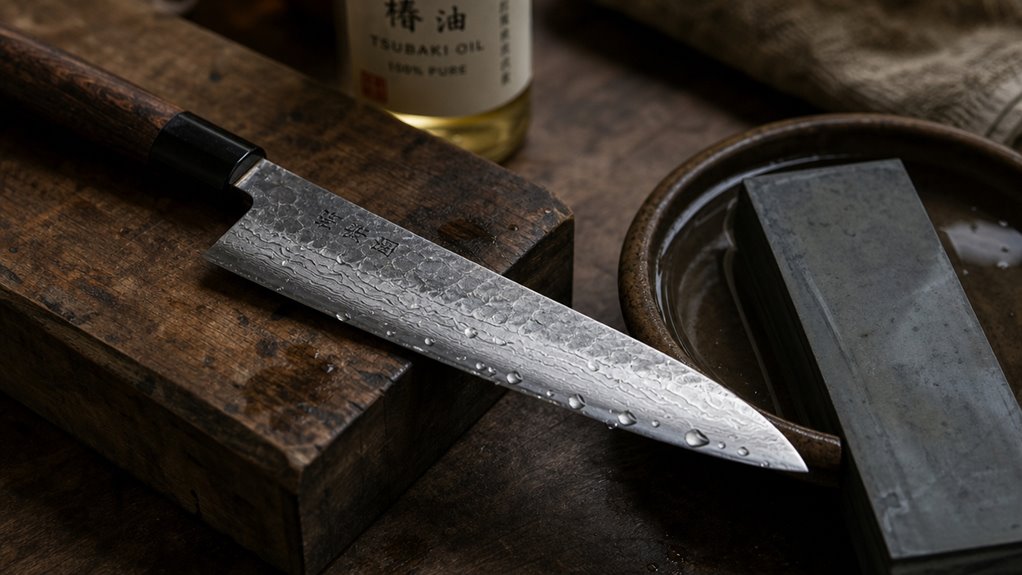
If you buy a Japanese knife in the 60+ HRC range, you’re trading easier edge retention for a higher chip risk, especially with frozen food, bone, or side-loaded chopping. You also can’t treat sharpening like “let it ride,” because a whetstone routine is mandatory for most Japanese edges to stay truly sharp.
And if you keep tossing it in the dishwasher, expect faster dulling and rust spots, because you’ll need hand-wash right after use, then fully dry and store it dry.
The 60+ HRC Steel Hardness Trade-Off (Sharper but Chippy)
So you want the sharper feel that shows up when a Japanese knife sits at 60+ HRC, but here’s the catch: higher hardness usually means less toughness, which makes chipping more likely when you hit something hard or apply a side load. With VG-Max steel, you get long edge life, but you must cut clean.
- Harder edge resists wear
- Less toughness invites micro-chips
- Avoid bones, frozen, lateral torque
Why Whetstone Sharpening Is Mandatory for Japanese Knives
Whetstone sharpening isn’t a style choice for Japanese chef knives—it’s the maintenance method they’re actually designed around. You reset bevels with controlled steel removal on whetstones, recreate the edge geometry, and build a burr, then refine it in steps. One workhorse 1000-grit plus a finer stone keeps performance. Skip the stone and you’ll never restore a true hard-steel edge.
The Dishwasher and Hand-Wash Restrictions That Affect Daily Use
Why do people baby Japanese chef knives right after dinner instead of tossing them in the dishwasher with everything else? You get edge rolling and micro-chips from rack knocks, plus thermal shock and rust risk. Your handle can swell or split. Soap and heat dull fine edges. So if you buy japanese knives worth it, do this:
1) hand-wash
2) dry immediately
3) avoid leaving wet in the sink.
The Honest Recommendation by Cooking Pattern
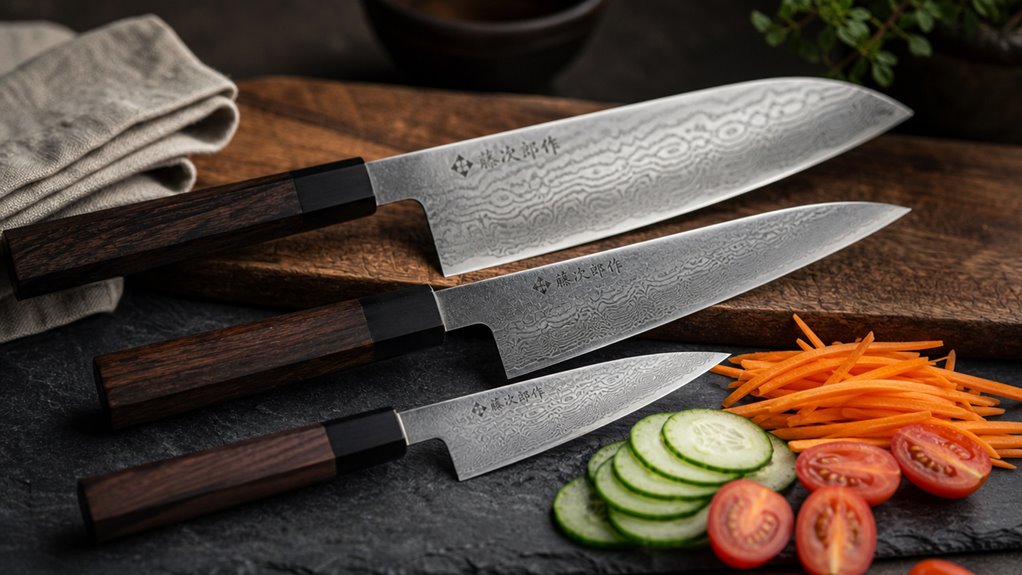
If you’re doing daily Western cooking and you actually want less fuss, you’ll usually get better value with a $30-ish Victorinox Fibrox than with a $200+ Japanese gyuto, because it tolerates real kitchen abuse and still stays sharp with basic care. You should only pay $200+ when your use matches the specialty geometry—single-bevel work like a yanagiba for sashimi or a deba for whole-fish prep. Keep in mind the Victorinox’s specific limitation is that it won’t hold an edge as long as harder Japanese steels, so you’ll hone more often.
For Daily Western Cooking, the Under-$30 Victorinox Wins Every Time
For daily Western cooking, a sub-$30 Victorinox Fibrox Pro 8″ chef’s knife tends to make the most sense because it already nails the stuff you actually do most nights: onions, carrots, potatoes, boneless meats, and herbs. You get 15–20° per-side performance, solid edge life, and easy care.
- Low-cost sharpening
- Wet-grip handle
- Dishwasher-tolerant stance
Limitation: it won’t match premium Japanese edge longevity.
When a $200+ Japanese Knife Earns Its Premium for Single-Bevel Specialists
Once you stop using the knife as a nightly all-purpose workhorse, the $200+ Japanese question gets much simpler: premium money only shows up when you actually use single-bevel geometry. With single-bevel knives, yanagiba and deba keep thin edges stable for long pull cuts and bone work.
Outside sashimi or whole-fish prep, a $35 Victorinox Fibrox cuts plenty well. Trade-off: you must hand-wash and hone carefully.
Frequently Asked Questions
Will a $200 Japanese Knife Chip More Than a $35 Victorinox?
Yes, harder steel (60–63 HRC) chips more easily. The Victorinox rolls rather than chips under stress from bone or frozen food.
Do Japanese VG-10 or VG-MAX Knives Rust After Tomatoes or Citrus?
Japanese VG-10 and VG-MAX stainless steels can develop small rust spots when exposed to acidic foods like tomatoes or citrus. Rinse and dry the blade immediately after cutting acidic foods to prevent spotting.
Is Damascus Different Steel, or Just an Etched Aesthetic Layer?
Damascus steel is typically layered cladding around a hard core, not a different edge steel. The pattern is mainly aesthetic, produced through etching. It offers corrosion protection but no special performance advantage. True pattern-welded Damascus is the exception, where the entire blade is forged steel layers.
Why Does Single-Bevel Geometry Matter, and What Tasks Benefit?
Single-bevel geometry creates a single flat cutting edge that steers the blade along one consistent path, producing cleaner cuts with minimal tearing. It excels at sashimi draw cuts, deba fish-bone breakdown, and precise skinning and trimming tasks.
What Sharpening Setup and Frequency Should I Expect Beyond $200 Pricing?
Water stones are recommended, starting at 1,000–1,200 grit and finishing at 3,000–6,000 grit. Touch-ups are needed every 1–2 weeks with heavy use. Full sharpening sessions occur every 4–8 weeks. Occasional stropping is also required.
Conclusion
If you mostly prep mixed veg, chicken, and occasional meat, a $200+ Japanese knife usually won’t change your results much. The real difference shows up with whole-fish work, where geometry matters, like yanagiba or deba making clean single-bevel cuts. At the $200+ tier, you’re paying for grind and edge behavior, plus sharper steel that still needs care. Maintenance isn’t optional. Honestly, it’s not “magic,” but it can feel like cheating.