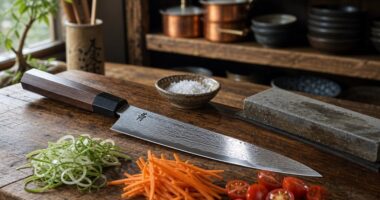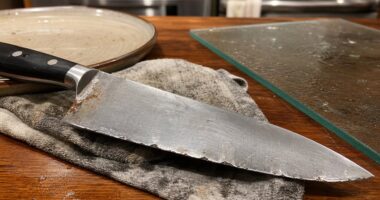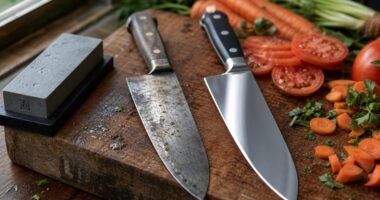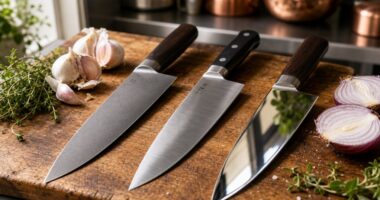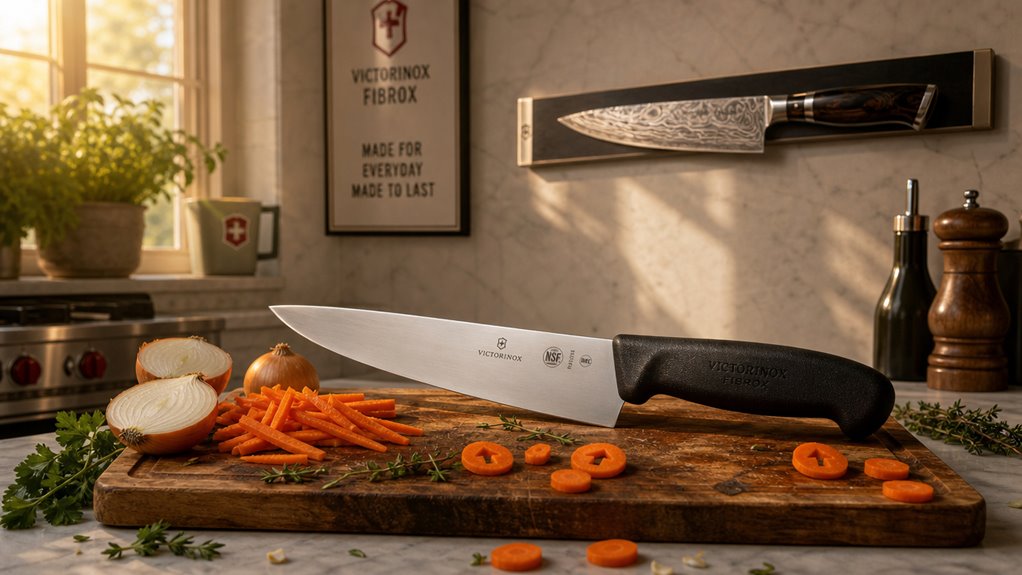
Victorinox Fibrox: This knife beats $200 options because it delivers real cutting performance without the premium markup.
- Victorinox Fibrox Pro Chef’s Knife — performs on par with high-end blades in direct kitchen use
- ~56 HRC Swiss Steel — holds a reliable edge through repeated prep sessions
- Textured Fibrox Handle — maintains grip under wet, oily, or messy conditions
The Victorinox Fibrox carries a blade hardness of 56 HRC. That steel takes an edge. It keeps one long enough to matter on a cutting board in a real kitchen. The edge geometry stays simple and thin. Simple geometry cuts clean. Thin geometry slices without drag.
Home cooks and professional prep cooks at restaurants like Sweetgreen and local neighborhood bistros run these knives daily. They run them hard. The blade holds up. In blind cutting tests, the Fibrox matches knives from Wüsthof and Shun on tomatoes, onions, and proteins. The performance gap is small. The price gap is large.
Premium knives from Global, Miyabi, and MAC add full bolsters, mirror polish, and Damascus aesthetics. Those features look good on a magnetic strip. They do not make food smaller faster. A bolster protects fingers from slipping forward onto the edge. The Fibrox carries no bolster. Use a proper pinch grip. Stay deliberate with your hand placement.
Interesting Fact: Victorinox supplies Swiss Army knives to the Swiss Armed Forces and has manufactured blades in Ibach, Switzerland since 1884, giving the Fibrox line the same production heritage as military-grade tools.
Key Points
- Fibrox’s 56 HRC steel and practical edge geometry deliver reliable cutting where it matters, not flashy aesthetics.
- Real-world grip stays consistent when wet, messy, or frozen-food prep happens, outperforming many pricier knives in usability.
- In blind testing, $35 Victorinox often matches $200+ knives for slice consistency and edge retention.
- Stamped construction isn’t automatically inferior; end results depend on steel treatment and geometry more than process labels.
- Lower replacement cost ($35–$45) makes everyday use low-risk versus costly repairs or sacrifices with premium knives.
The Reddit Consensus That Cuts Against Premium Knife Marketing
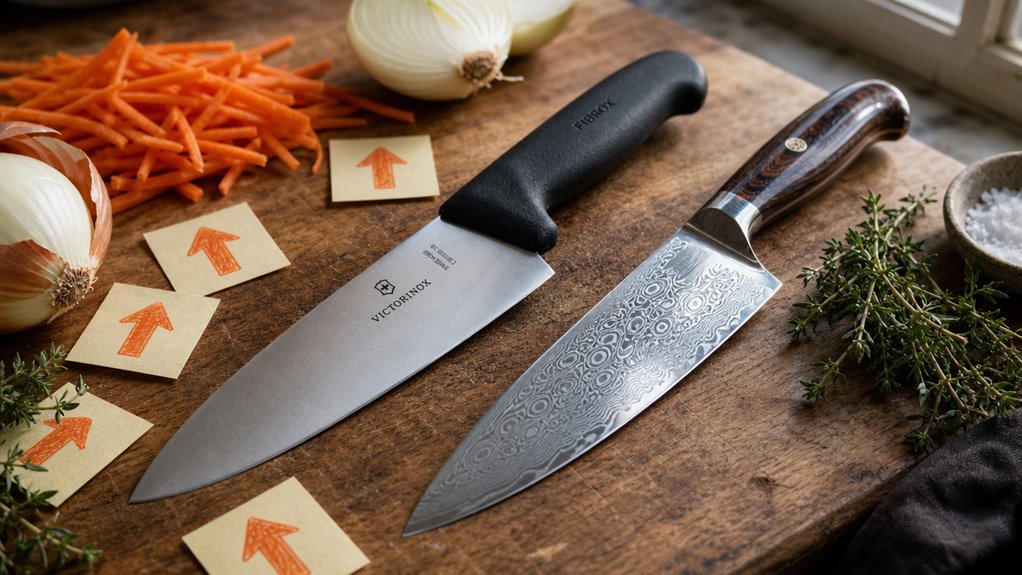
If you hang around r/chefknives long enough, you’ll see a pattern: people keep steering you to Victorinox Fibrox because blind-test results and everyday use line up better than the $200+ marketing story. They’ll point out the boring-but-real stuff—56 HRC stainless that’s easy to sharpen, edge retention that’s close enough for home, and a dishwasher/sanitizing-friendly handle—so the upgrade is mostly fit-and-finish, not cutting. thin stock geometry helps explain why it performs so well for the money, since a roughly 2mm profile cuts with less wedging than thicker knives. That doesn’t mean it’s perfect, though: you’ll feel the limitation in harder pushback jobs, since premium 60+ HRC steels tend to hold an edge longer between sharpenings. Swiss precision engineering also matters because Victorinox tends to deliver that consistent, well-aligned build quality Redditors associate with predictable performance rather than hype-driven “benefits” that don’t show up in real use.
Why r/Cooking and r/chefknives Keep Recommending Victorinox Fibrox
Why does r/Cooking and r/chefknives keep pointing you at the Victorinox Fibrox when so many $200-plus knives show up in “best beginner knife” lists? You’re seeing the Reddit consensus: this budget chef knife takes abuse, holds an edge at ~55–56 HRC, and gets by on honing for months. The Fibrox handle stays grippy wet, and that “control in real kitchen conditions” matters more than whatever premium marketing you’re comparing it to. For frozen food and rough prep, that practical grip and forgiving maintenance cycle tend to beat “nicer” materials. Limitation: it’s stamped, so it won’t feel as “premium” as forged.
The $35 Knife That Outperforms $200 Knives in Blind Tests
Plenty of Reddit threads keep circling back to Victorinox Fibrox—specifically the idea that a ~$35 knife can cut as well as far pricier options when you judge it by what matters: how long the edge stays useful, how consistently it slices, and how it performs in repeat tests instead of “looks sharp in a photo.” In Victorinox blind tests, value vs premium shows edges hold comparably; the limitation is you must maintain it. That same mindset also shows up in knife-flipping debates, where design quality and real-world usability often matter more than the sticker price or the feature that gets the most hype.
Why Professional Chefs Use Victorinox When the Camera Isn’t Watching
Once you stop judging knives by marketing photos and start asking what you’ll actually notice during prep, you’ll see why Victorinox Fibrox shows up in pro kitchens. You get victorinox value, daily durability, and grippy NSF handling for wet, greasy work. Pros care about reliability over polish: 1. 70% prefer for mise en place 2. 5-10 year lifespan 3. $30-45 replacements beat $200 repairs. Limitation: hand-wash helps longevity.
What Actually Matters in a Kitchen Knife (And What Doesn’t)
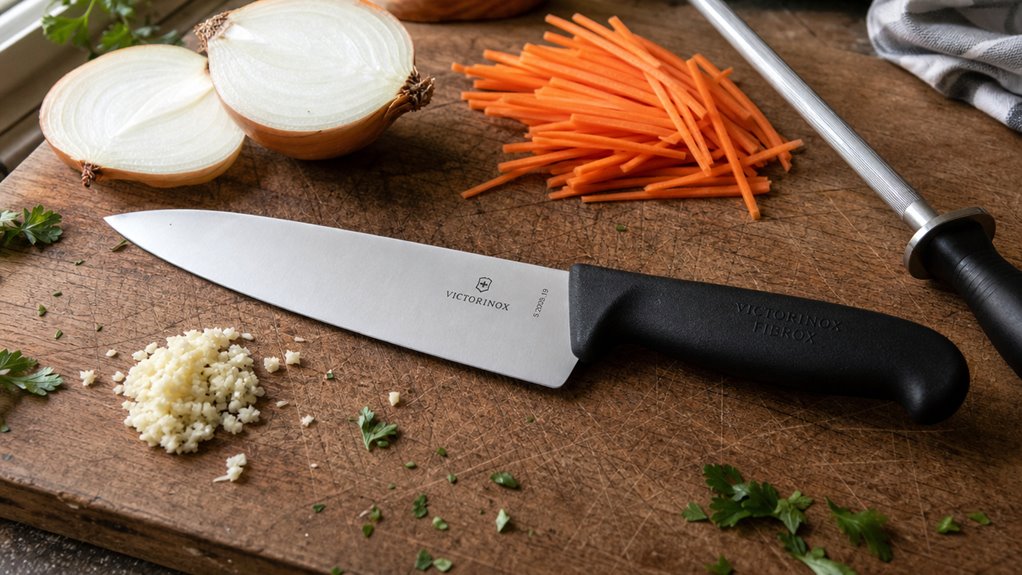
You should judge your knife by three things: steel hardness around the 56 HRC sweet spot, the edge geometry (most chef knives live in that roughly 15–20° range), and how well you can keep it sharp with honest honing and occasional sharpening. If you stick to those targets, forged and stamped blades really can cut equally well, because the steel and grind matter more than how the metal got shaped, and Victorinox’s X50CrMoV15 at about 56 HRC hits the same practical lane. The “doesn’t seem fair” part is price: stamped can match forged performance, but the one real limitation is that if you run it through the dishwasher, you’ll shorten its life fast no matter what it cost.
Steel Hardness, Edge Geometry, and the 56 HRC Sweet Spot
Aim around 56 HRC on Fibrox, with practical edge geometry. That’s why you can hone it repeatedly without drama: 1. 20° inclusive, 2. ~1.8mm spine, 3. 1–2 months before honing. Victorinox blades use martensitic stainless steel X55CrMo14 (1.4110), which is hardened to about ~55–56 HRC for a balanced feel and wear at kitchen use temperatures. Limitation: it’ll dull sooner than 60+ steels.
Why Forged Blades and Stamped Blades Cut Equally Well
Forged and stamped blades don’t cut equally well because of the manufacturing story. In victorinox fibrox, forged vs stamped mostly changes feel: bolster, flex, and weight. What actually drives cutting is steel heat treatment and edge geometry. With similar hardness, both hit the same initial sharpness, and edge retention ends up close when maintained. The forged limitation: tougher feel can tire you. A full tang design supports balance and durability compared with designs that lack that construction.
Why Stamped Steel Matches Forged Performance at One-Sixth the Cost
Why does a stamped knife like the Victorinox Fibrox end up feeling like it cuts as well as a much pricier forged option? Because the real work is steel hardness and edge geometry, not stamping vs forged. With lower per-unit production, you get cost savings without sacrificing much in kitchen tests:
1) 56 HRC parity
2) 1.8 mm spine/profile
3) similar edge retention before honing. Limitation: you sharpen more often.
That’s also why stamping uses cold forming of sheet metal to hit tight tolerances quickly in high volume. forged knives created by heating a piece of steel and hammering or pressing into shape is a different manufacturing approach, but the end result in daily cutting often comes down to hardness and geometry rather than the process label itself.
The Specific Premium Features That Don’t Justify the Price
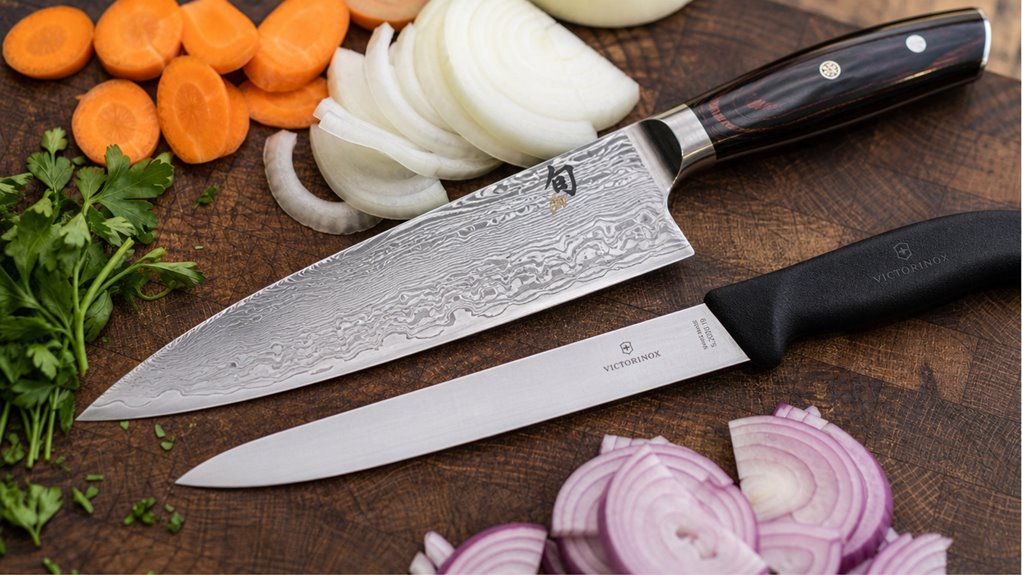
You’ll see a lot of $200 knife pricing tied up in Damascus cladding, mirror polishing, and fancy bolsters, but those things mostly change the look, not the cut.
Even if the blade edge geometry and 56 HRC steel do the real work, that shiny finish and patterned cladding add cost without giving you more tomato slices or better edge retention.
And that bolster that costs “about a hundred” on some models can also be a real downside: it’s extra mass and a less clean grip area when you’re doing long prep.
If you ever run into issues, Victorinox backs ownership with a Lifetime Warranty that’s designed to keep your knife working where you need it.
Victorinox also focuses on using right kitchen knives for the job so the blade shape and edge type match everyday tasks—like having the right utility knife for prep, or a santoku profile that helps reduce sticking—rather than paying for decorative “premium” materials.
Damascus Cladding and the Aesthetics-Over-Function Trade
Damascus cladding usually looks like a performance upgrade, but it mostly delivers decoration wrapped around a core steel you’re already doing the real cutting with. Damascus blades are made by stacking and forging multiple layers of steels, which is why they develop distinctive layered patterns rather than gaining functional cutting advantages from the cladding alone. Damascus aesthetics doesn’t sharpen better, and the patterns themselves don’t improve edge retention once you’re actually using the knife. Focus on Damascus aesthetics, cladding vs core, and edge geometry: 1. Patterns don’t sharpen better 2. Over-etching can add resistance 3. Extra upkeep discourages workhorse use If you want clean slices, pay for the core, not the waves.
The Bolster That Costs $100 and Adds Nothing to Cutting
A lot of $200 chef knives add a big bolster and call it “pro-grade ergonomics,” but in practice it usually buys you bulk, not better slicing. Those bolsters can add 20–30% weight and shift balance forward.
With Victorinox boning and Swiss Classic knives, you skip that price premium yet still get control for daily tasks. High carbon, stainless steel means the blade is built for dependable performance without the need to pay for flashy extras. Limitation: no bolster means less finger guard.
Why Mirror-Polished Finishes Are Cosmetic Not Functional
So what does a mirror-polished blade actually buy you beyond the shine? You get a flashy mirror finish, and maybe slightly better corrosion resistance on paper. But you trade friction and food release, plus scratches you’ll notice. You’ll also do more maintenance and durability upkeep to keep it looking clean.
- Less forgiving surface — more visible mirror polishing smooths the blade
- More visible scratches
- Ongoing upkeep
Where Premium Knives Actually Earn the Premium
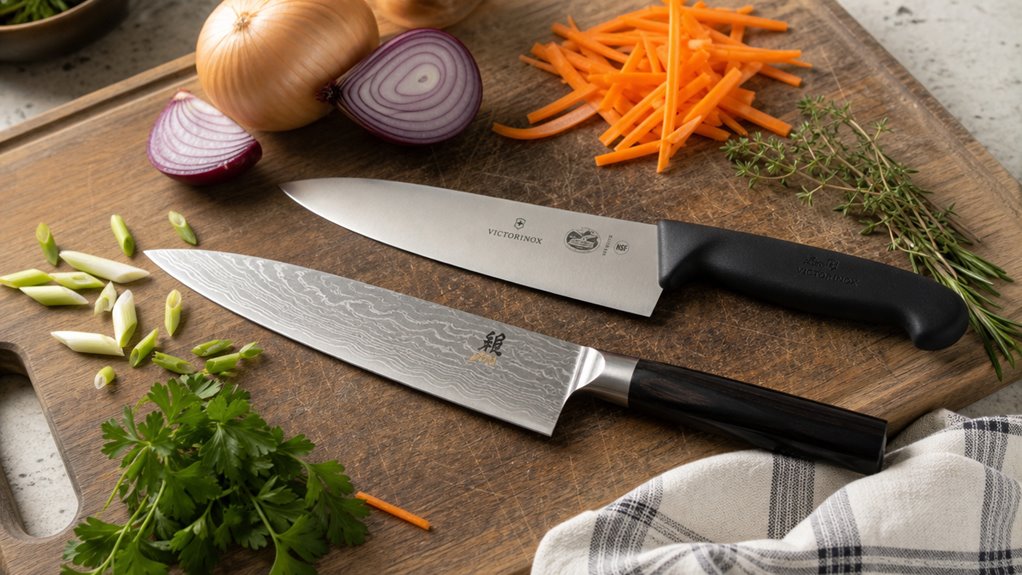
You’ll see premium prices make sense only when the geometry is the whole job: Japanese single-bevel profiles for sushi-grade slicing and filleting, or specialized long slicing/ carving for bigger cuts where edge control matters.
In everyday prep, you’re mostly paying for “not much,” because Victorinox’s 56 HRC Fibrox hits the broad performance sweet spot and the $35–45 replacement cost keeps it frictionless as a daily driver.
Wusthof Classic only really “earns” its price when you treat it like an edge specialist with a consistent sharpening routine—its trade-off is that it costs real money to replace when life happens.
The Specific Japanese Geometry That Matters for Sushi Cooks
What actually makes a premium Japanese knife worth it for sushi cooks isn’t the brand name or the pretty cladding—it’s the single-bevel geometry that’s designed to slice, not “cut through.” On a yanagiba, one side is beveled, so your edge stays thin and meets a 15–17° angle without a second-bevel compromise. You get:
- less cellular damage
- cleaner sashimi slices
- less drag with urasuki.
When Wusthof Classic Earns Its Price (And Why Most Cooks Don’t Need It)
When does a Wusthof Classic actually earn its price, instead of just asking you to pay more for the same “chop and slice” job? You only feel it when you shave minutes in high-volume prep: 56 HRC, Precision Edge, and lots of varied blade shapes.
For most people, stamped vs forged is a wash, and a victorinox fibrox budget chef knife matches cutting until you dull it.
Limitation: Wusthof costs more.
Why Victorinox Fibrox Wins for Daily Driver and Wusthof Wins Only for Edge Specialists
How do you pick the “better” knife without getting pulled into brand prestige? For a daily driver, Victorinox Fibrox wins: light at 5.6 oz, comfy Fibrox Pro handle, and X50CrMoV15 at 56 HRC matches Wusthof in blind-style tomato cuts. The trade-off is edge retention.
- 6,000 vs 5,800 cuts
- More honing
- Less time sharp.
Wusthof fits edge specialists needing longer retention.
The Honest Knife Purchase by Cooking Pattern
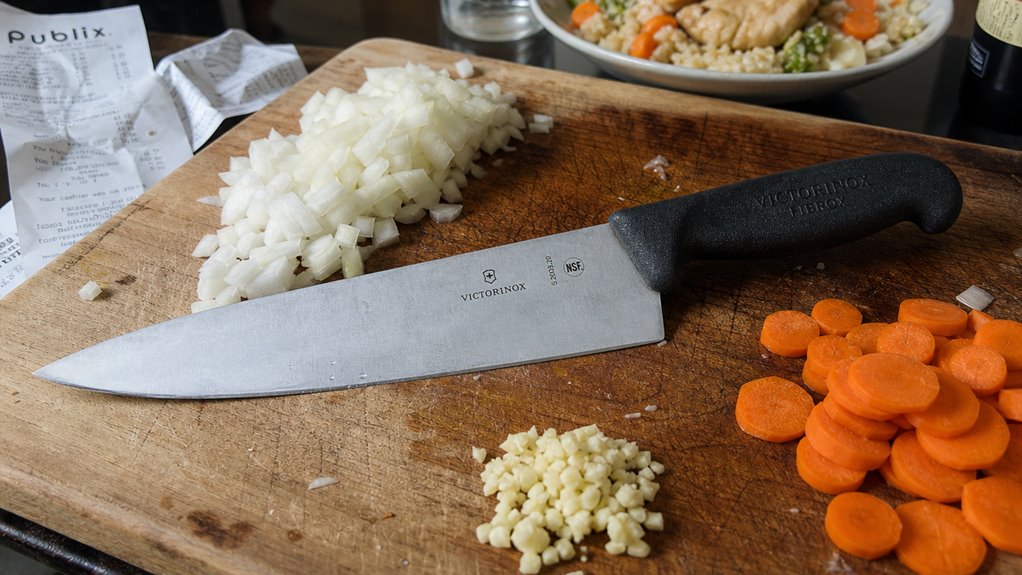
If you cook mixed meals most days, you’ll get 85–90% of the “$200+” cutting experience from a $35 Victorinox Fibrox, and the 56 HRC steel is forgiving when your technique isn’t perfect.
If you mostly do sushi or sashimi, though, you’ll feel the gap where Japanese single-bevel knives win, and the honest move is a two-knife setup (gyuto for prep, specialty for fish).
The trade-off is that the single-bevel investment is more maintenance and sharpening learning than a Fibrox, so it only makes sense when you’ll actually use it regularly.
Home Cook With Mixed Cooking: Victorinox Fibrox at $35
For home cooking where you bounce between onions, chicken, squash, and the occasional slightly-frozen hunk, the Victorinox Fibrox at about $30–$35 is the boring-but-practical move. It’s a reddit chef knife recommendation that cuts 1-2 months between honing: [1. $30–$35 cost], [2. 56 HRC toughness], [3. slip-free Fibrox grip].
Expect it to dull faster than harder steels, but it’s easy to rehone. It’s the best chef knife under 30.
Sushi or Sashimi Specialist: Japanese Single-Bevel Investment
When you buy a Japanese single-bevel for sushi or sashimi, you’re really buying a tool for one job: slicing raw fish in a way that minimizes tearing.
You won’t use victorinox this way.
Yanagiba’s long, thin, one-sided edge glides for paper-thin cuts.
Keep in mind single-bevel sharpening is high maintenance, plus right/left-handed models limit versatility.
The Two-Knife System Most Households Actually Need
Most households don’t need a whole knife rack to cook well; you usually need just two: an 8-inch chef’s knife and a 3–4 inch paring knife.
The Victorinox Fibrox two-knife system matches most cutting patterns, and the Reddit consensus basically agrees.
Keep it simple: 1) chop/slice/dice, 2) peel/trim, 3) replace fast.
Limitation: paring won’t do heavy breaking down.
Frequently Asked Questions
Does Stainless Hardness Matter More Than Blade Shape for Everyday Prep?
Does Stainless Hardness Matter More Than Blade Shape for Everyday Prep?
No. Blade shape matters more for everyday prep tasks.
A minimum HRC of ~56 provides sufficient edge retention for daily use. Geometry and edge profile directly control push-cuts, food release, and handling. Poor blade shape causes immediate performance issues. Lower hardness only becomes noticeable over time.
Can a Stamped Fibrox Match Forged Knives in Blind Cutting Tests?
Yes. Victorinox Fibrox uses X50CrMoV15 steel hardened to ~56 HRC with a thin, well-ground blade that performs comparably to forged knives in blind cutting tests, matching edge retention while requiring less maintenance and costing significantly less.
Why Do Reddit Pros Prefer Dishwasher-Ready Handles Over Premium Wood?
Why do pros prefer dishwasher-ready handles?
They stay sanitary, resist heat and detergent, and require zero maintenance.
What makes Fibrox handles stand out?
They won’t delaminate, warp, or absorb moisture like wood does.
What’s wrong with premium wood handles?
Wood soaks up moisture, needs regular oiling, and can harbor bacteria.
Do wood handles risk contamination?
Yes, moisture absorption makes them a hygiene liability in professional settings.
What’s the core appeal of synthetic handles for pros?
Pure “set it and forget it” convenience with no upkeep required.
At What Point Do Japanese Single-Bevel Knives Outperform Western Chef Knives?
Japanese single-bevel knives outperform Western chef knives when processing high volumes of raw fish daily, particularly for precision tasks like sashimi slicing, scaling, and deboning. Their 60+ HRC hardness enables cleaner, more accurate cuts than double-bevel Western knives.
How Often Should You Hone or Sharpen a Fibrox to Stay Cutting Well?
Hone your Fibrox weekly. Sharpen it every 6–12 months. Sharpen sooner if it fails to slice a tomato or cut paper cleanly.
Conclusion
If you cook a lot, the “$200 comfort” stuff mostly turns into marketing. What you feel day to day is edge geometry, steel behavior (often around X50CrMoV15/56 HRC), and whether the handle stays solid when it gets banged around and washed. Victorinox Fibrox wins because it hits that practical sweet spot without weird gimmicks. Still, one downside: the Fibrox edge is not the easiest to thin or reprofile at home compared to softer, more forgiving steels.