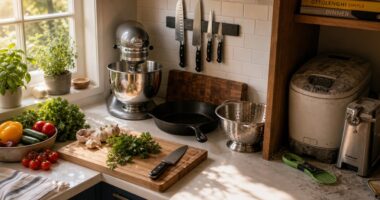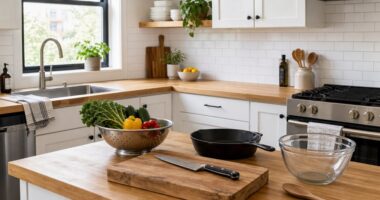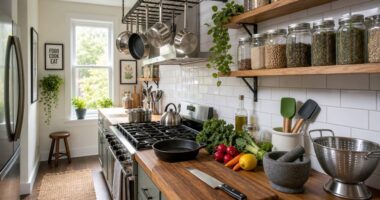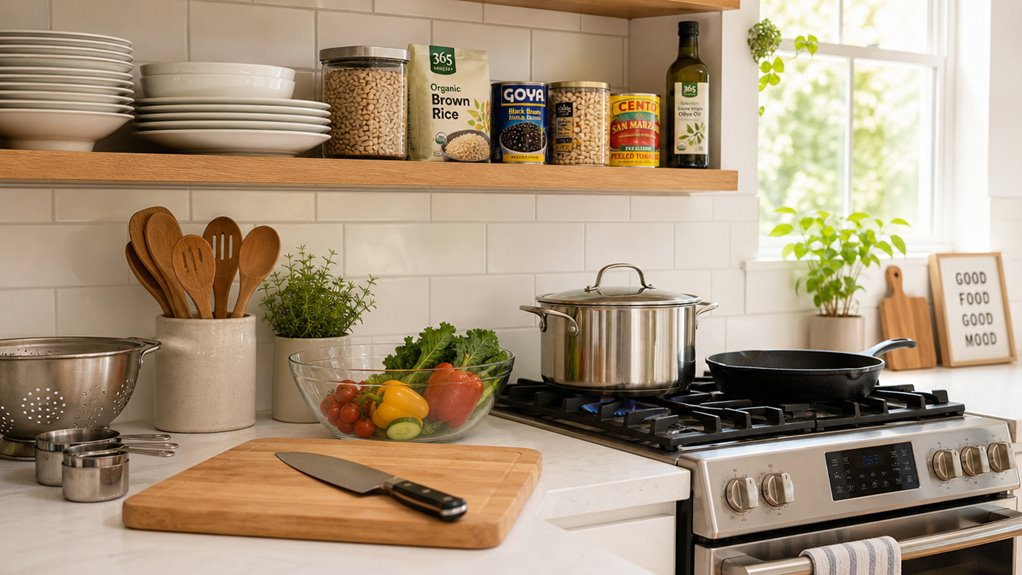

Kitchen essentials for a first apartment require four core tools that handle daily cooking without crowding a small space. A nonstick skillet, a saucepan, a chef’s knife, and a cutting board cover the majority of everyday tasks at a budget-friendly cost.
- Nonstick skillet performs well for eggs, stir-fries, and pancakes but scratches when metal utensils contact the cooking surface.
- Full-tang chef’s knife handles most chopping tasks and maintains its edge longer when paired with a honing steel for regular maintenance.
- Cutting board protects the knife edge during use and is available in plastic or bamboo materials suited to light daily wear.
A 10-inch nonstick skillet gives a first-time cook enough surface area for single-serving and small-batch meals. The nonstick coating depends on plastic or silicone utensils to stay intact, and overheating shortens its usable life significantly.
A 3-quart saucepan with a tight-fitting lid handles sauces, grains, and small batches of liquid-based dishes. The lid can warp under sustained high heat, so moderate temperature control extends the cookware’s lifespan.
An 8-inch chef’s knife with a full-tang construction distributes weight evenly across the handle, reducing hand fatigue during extended prep work. A honing steel realigns the blade edge between uses and reduces how often the knife needs professional sharpening.
Studies on household cooking behavior suggest that home cooks rely on roughly three to five core tools for around 80 percent of their daily meal preparation.
Cheap or expensive is the wrong question. Cost per use is the honest one. Check out our new Calculator.
Cost-Per-Use Calculator →Key Points
- Prioritize versatile, durable pieces: a 10‑inch nonstick skillet, a 3‑quart saucepan, and an 8‑inch chef’s knife replace many single‑purpose tools.
- Choose cookware that works on both stovetop and oven to maximize utility and save cabinet space.
- Stick to a per‑item budget ceiling (≈ $30) by selecting core items first and delaying specialty gadgets until truly needed.
- Use a “30‑day rule”: if a new gadget isn’t used within a month, postpone its purchase to avoid clutter and waste.
- Avoid boxed starter sets; instead, buy high‑use, high‑quality items that fit your small‑space kitchen and resist warping or breakage.
| Nordic Ware Naturals Quarter Sheet 2-Pack Natural |  | Best Overall | Material: Pure aluminum | Made in USA: Made in America | Hand-Wash Recommended: Hand wash | VIEW LATEST PRICE | Read Our Analysis |
| Nordic Ware Half Sheet Set Nonstick Grid 2-Piece |  | Most Versatile | Material: Natural aluminum (pan) and nonstick steel (grid) | Made in USA: Made in America | Hand-Wash Recommended: Hand wash | VIEW LATEST PRICE | Read Our Analysis |
| Nordic Ware Naturals Eighth Sheet 2-Pack |  | Budget-Friendly Sheet | Material: Pure aluminum (uncoated) | Made in USA: Made in America | Hand-Wash Recommended: Hand wash | VIEW LATEST PRICE | Read Our Analysis |
Links to Amazon are affiliate links. Buying through one costs you nothing extra and helps fund the research.
The Kitchen Essentials a First Apartment Truly Needs
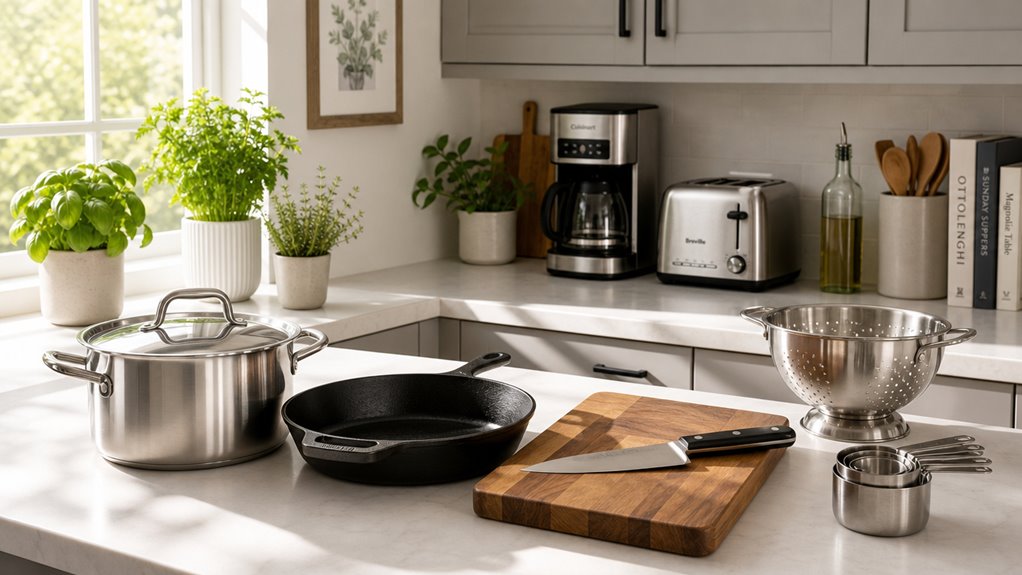
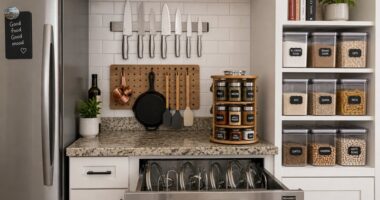
A first apartment kitchen needs a compact, functional core, a chef’s knife, a versatile 10‑inch pan, and a small set of prep tools, that covers nearly every everyday meal without overwhelming limited cabinet space. Choosing durable, multitasking pieces from the start means each item earns its place rather than sitting idle between uses. Boxed starter sets often bundle single‑use gadgets that crowd drawers and rarely justify the cost, while a curated approach keeps spending in check and storage manageable. Building around a reliable core first, then adding specialty cookware or tools as specific cooking needs arise, prevents the wasted space and unnecessary expense that come from stocking a kitchen all at once. One‑Pan Rule ensures that a single 10‑inch non‑stick skillet can handle sautéing, searing, and even oven‑finishing, reducing the need for multiple specialty pans. What follows covers the essential categories and practical considerations that shape those early decisions.
The Compact Core That Covers Almost Every Meal
When you strip your kitchen down to the essentials, a handful of multitasking pieces can handle almost every home‑cooked meal.
Your first apartment kitchen essentials should revolve around a core kit that scores on durability, versatility, and price.
Pick items that replace a dozen single‑purpose tools, and buy them in a sensible order so nothing sits idle.
- 10‑inch nonstick skillet – eggs, stir‑fries, pancakes; light, but the coating can scratch if metal utensils are used.
- 3‑quart saucepan with lid – pasta, rice, soups; limited capacity for larger batches.
- 5‑quart stockpot or Dutch oven – soups, stews, bulk pasta; heavy, may dominate a small burner.
- 8‑inch chef’s knife – chopping, slicing, dicing; needs regular honing to stay sharp.
- Two cutting boards – separate produce and meat; board can warp if soaked too long.
These pieces cover most meals, keep your cabinets tidy, and stay under the budget ceiling. Adding a durable aluminum sheet pan expands baking and roasting options without sacrificing space.
Why a Curated Kit Beats a Boxed Starter Set Every Time
Because a boxed starter set piles on low‑grade tools you’ll never use, a curated kit lets you spend on a few multitasking pieces that actually see daily action.
You’ll get a solid chef’s knife, a heavy‑bottomed skillet, and a sturdy cutting board, each handling chopping, sautéing, and boiling without crowding your cabinets.
A budget kitchen setup built this way avoids duplicate pans and novelty gadgets that sit idle, so you save space and money.
Over time you can add a sheet pan or second pot only when recipes demand them, keeping expenses under the $30 ceiling per core item.
This sequenced approach maximizes use per dollar, reduces waste, and leaves room for the occasional specialty tool later.
| Nordic Ware Naturals Aluminum NonStick 9x13-Inches Cake Pan,Silver |  | Best Nonstick | Material: Aluminum with reinforced steel rim, nonstick interior | Made in USA: Made in USA | Hand-Wash Recommended: Hand wash | VIEW LATEST PRICE | Read Our Analysis |
| Nordic Ware 8″x8″ Square Aluminum Cake Pan |  | Compact Classic | Material: Pure aluminum with reinforced steel rim | Made in USA: Made in USA | Hand-Wash Recommended: Hand wash | VIEW LATEST PRICE | Read Our Analysis |
| Nordic Ware Naturals Loaf Pan 1.5 Pound |  | Professional Grade | Material: Pure aluminum | Made in USA: Made in USA | Hand-Wash Recommended: Hand wash | VIEW LATEST PRICE | Read Our Analysis |
Links to Amazon are affiliate links. Buying through one costs you nothing extra and helps fund the research.
How to Build the Setup Without Wasting Money
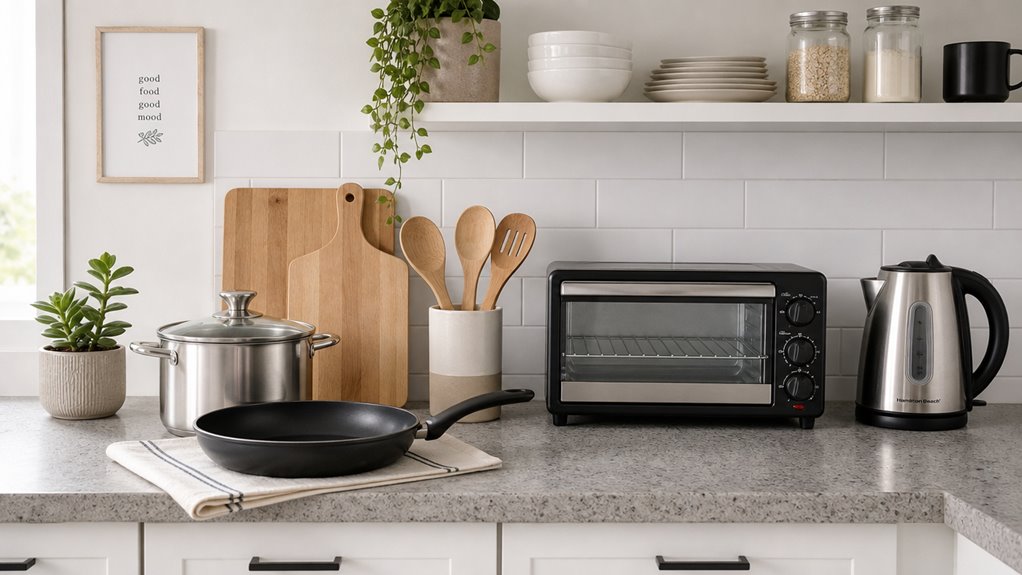
Building a kitchen setup without wasting money starts with prioritizing multitasking cookware over single-use gadgets, since a chef’s knife and a 10-inch skillet together cover the core techniques of chopping, sautéing, and oven roasting without accumulating idle clutter.
A chef’s knife handles the full range of prep work that specialty blades rarely justify on their own, while a versatile skillet moves from stovetop to oven without requiring a separate piece of equipment.
Buying a lid-equipped pan or a small stockpot only when specific recipes demand them keeps spending tied to actual cooking needs rather than anticipated ones.
The order of acquisition matters as much as the items themselves, because adding equipment before the need arises typically leads to redundant tools that occupy space without earning use.
What follows breaks down how to evaluate each decision as your setup grows.
Spending on Multitaskers Before Specialty Pieces
Starting with the multitaskers that actually see daily use lets you lock down the core of your kitchen without wasting space or cash. A cheap kitchen starter setup should focus on items that replace several single‑use gadgets.
Pick a nonstick skillet, a 3‑quart saucepan, a sheet pan, a basic utensil set, and a few stackable storage containers. Those five multitaskers cover frying, simmering, baking, prep, and leftovers, so you avoid buying a specialty appliance you’ll barely use.
- Nonstick skillet: handles sauté, fry, and sear; limited to stovetop only.
- 3‑quart saucepan: boils, simmers, and sauces; not ideal for deep‑frying.
- Sheet pan: roasts and bakes; flat surface, no sides for liquids.
- Utensil set (spatula, spoon, tongs, ladle, measuring tools): versatile; metal tools can scratch nonstick.
- Stackable containers: keep leftovers fresh; lids may warp over time.
- Choose stainless steel pots for durability and compatibility with all stove types.
Why a Knife and One Pan Come Before Any Specialty Appliance
Grab a solid chef’s knife and a 10‑inch cast‑iron skillet before you think about an air fryer or a fancy coffee maker. A chef’s knife replaces a dozen single‑purpose cutters, letting you chop onions, slice carrots, and trim chicken with one sharp edge. It costs less than a bundle of gadgets and lasts decades if you sharpen it occasionally.
Pair it with a versatile pan that sears, sautés, bakes, and even goes from stovetop to oven. One 10‑inch skillet covers most meals, so you avoid buying a grill pan, a pizza stone, and a separate sauté pan. Both items fit a tiny cabinet, need no electricity, and keep your budget under control while you learn what else you truly need.
How to Buy First-Apartment Kitchen Essentials Without Overspending
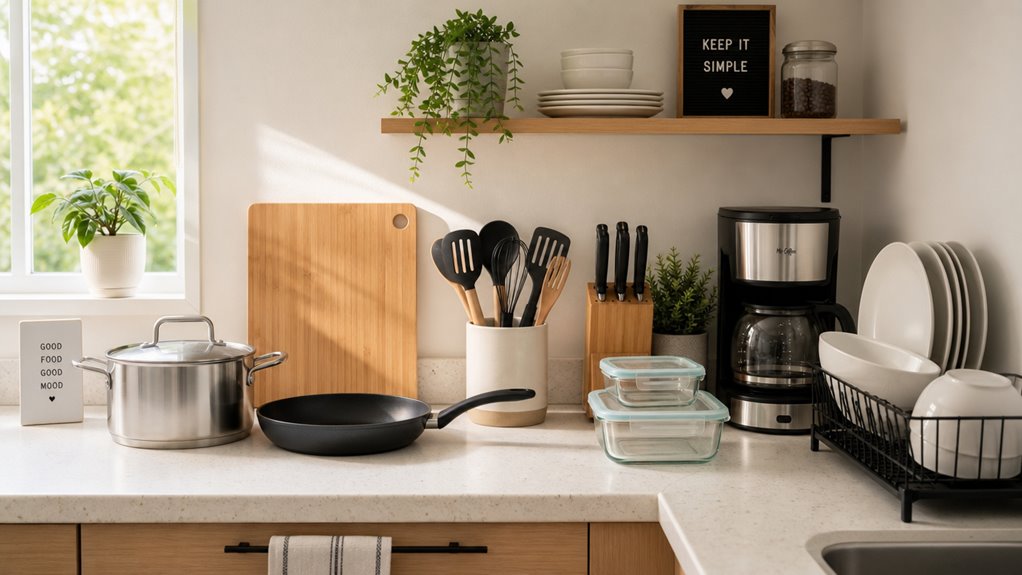
Stocking a first apartment kitchen without overspending means buying only the tools that earn their place immediately, such as a sharp chef’s knife, a non-stick skillet, and a cutting board cover the majority of everyday cooking tasks without duplicating function or wasting counter space.
Starting with multitaskers rather than single-use gadgets keeps early spending focused, since an unused tool costs money twice: once at purchase and again in the space it occupies.
Material choices and pan size affect how versatile each piece actually is in a small kitchen, which is why a 10-inch skillet tends to handle more meals than a larger or smaller alternative.
Adding secondary items like a sheet pan or saucepan only after regular cooking habits are established prevents the budget from expanding faster than the skill set does.
What follows covers each stage of that process in detail.
Sequencing the List So Nothing Sits Idle
Because you’ll be cooking the same handful of meals over and over, the first thing to do is map those recipes to the tools they actually require. Start with a 10‑inch nonstick skillet, a 3‑quart saucepan, and a sheet pan. These three cover eggs, pasta, stir‑fries, roasted veggies, and a quick bake.
Pair them with a chef’s knife, a cutting board, and a colander, and you’ve got the core of kitchen essentials on a budget. Buy in phases: week 1‑2 get the skillet, saucepan, and knife; weeks 3‑4 add the colander and mixing bowls; month 2 brings a toaster or coffee maker if you use them regularly. Keep a “30‑day rule” for any extra gadget; if it stays unused, it belongs on the later list.
- Skillet (10‑inch, nonstick) – versatile, but can warp if overheated.
- Saucepan (3‑qt) – good for sauces, yet limited for deep‑frying.
- Sheet pan – doubles for roasting and reheating, but lacks high sides.
- Chef’s knife – sharp for most cuts, but needs regular honing.
- Cutting board – safe surface, but can scar with heavy use.
Choosing Durable Pieces That Will Not Need Replacing
If you focus on a few multitasking pieces instead of a boxed set, you’ll keep the budget low and the kitchen functional. Choose a cast‑iron skillet because it handles searing, baking, and stovetop cooking without warping, but it’s heavy and needs seasoning. Pair it with a solid cutting board, since high‑grade plastic or bamboo resists deep scoring, yet plastic can melt if you place hot pans directly on it. Prioritize items that survive daily wear; a stainless‑steel saucepan with a tight‑fitting lid replaces a whole set, though the lid may be a bit pricey. A versatile 8‑inch chef’s knife outlasts a block, but you’ll need to sharpen it regularly.
| Item | Material | Why it lasts |
|---|---|---|
| Skillet | Cast iron | Heat‑resistant, non‑stick with seasoning |
| Cutting board | Bamboo or high‑grade plastic | Dishwasher safe, resists scoring |
| Saucepan | Stainless steel | No warping, tight lid |
| Chef’s knife | Full‑tang steel | Holds edge, easy to sharpen |
The Pieces People Overbuy and Regret
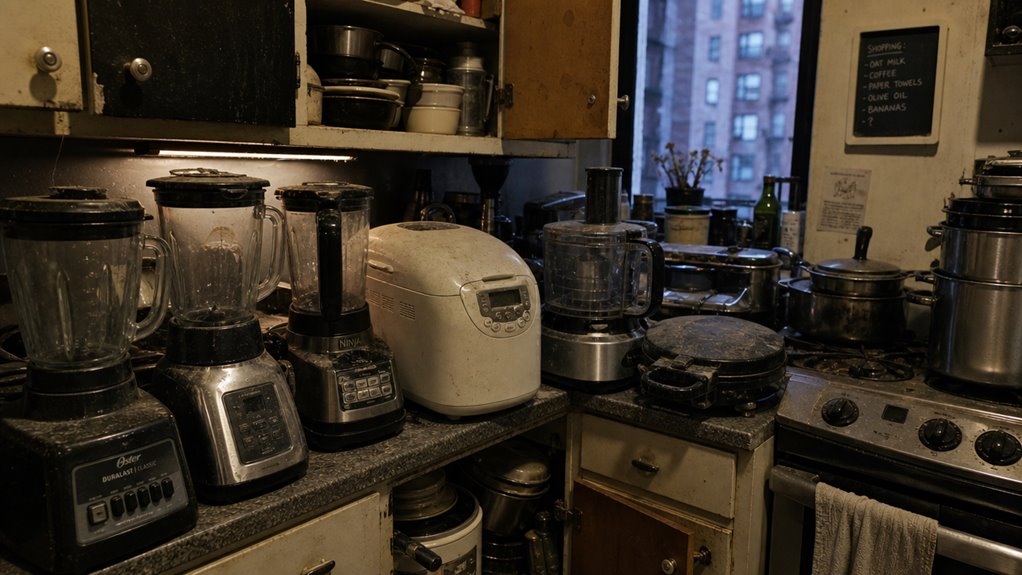
The pieces people overbuy and regret most often fall into three categories: bundled starter sets, single-use gadgets, and aspirational appliances that rarely match actual cooking habits.
Boxed cookware sets typically include a dozen thin pans that warp after repeated washing and flimsy utensils that break under normal use, leaving most of the cabinet space filled with pieces that don’t perform.
Single-use gadgets like avocado slicers or corn strippers occupy drawer space for tools that a basic chef’s knife can often replace at comparable or lower cost and with greater durability.
Aspirational appliances such as stand mixers and air fryers tend to sit idle when a standard pot, skillet, and hand mixer already handle the meals most home cooks prepare regularly.
What drives these purchasing patterns, and how to avoid them, takes more than a quick list to explain.
Boxed Sets, Single-Use Gadgets, and Aspirational Appliances
You’ll soon discover that boxed kitchen sets, single‑use gadgets, and aspirational appliances are the usual culprits behind cluttered cabinets and wasted cash. A boxed starter set often packs 15‑21 pieces, many of which are duplicate sizes or flimsy lids that warp quickly. A single‑use gadget like an avocado slicer sits idle after a few months, taking up drawer space and collecting residue. Aspirational appliances, like mini bread makers or fancy juicers, consume counter space and electricity, yet you’ll use them once a week at best. Focus on multitaskers that truly earn a spot.
- One versatile skillet replaces a specialty pan
- A sharp chef’s knife covers most cutting tasks
- A sturdy cutting board doubles as a serving platter
- A basic saucepan handles boiling and simmering
- A compact multi‑function tool (microplane) replaces several novelty gadgets
Where Thin Cookware Warps and Cheap Gadgets Break
Boxed sets may have gotten you a handful of useful tools, but they also left you with thin pans that warp the moment you crank up the heat and gadgets that snap after a few uses.
You’ll quickly learn that thin cookware lacks the mass to handle rapid temperature swings; a sudden splash of cold water can bend the base, creating hot spots and uneven searing.
A cheap sheet pan suffers the same fate: large flat surfaces flex when the oven heats unevenly, and the pan never returns flat. Burners that are too small exacerbate the problem, heating only the center and pulling the edges into a bowl shape.
Stick with at least 3 mm‑thick, multi‑ply stainless steel and skip the flimsy extras until you truly need them. This saves space, money, and the frustration of warped, unusable pieces.
How to Finish the Setup as Your Cooking Grows
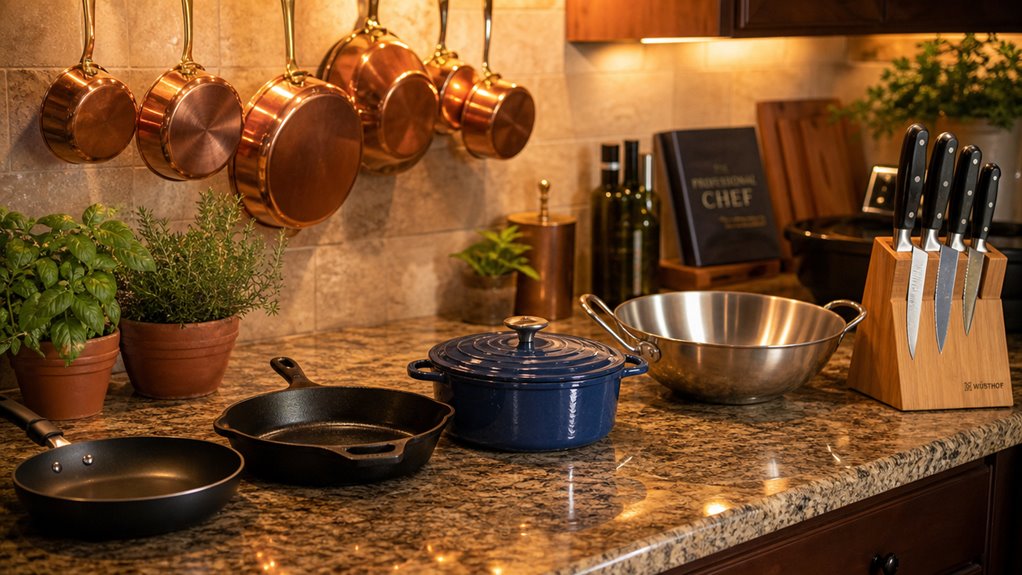
Finishing a kitchen setup as cooking grows means adding equipment only when a clear gap appears, keeping purchases within a budget ceiling, typically under $30, and favoring multitasking tools that replace several single-use gadgets at once.
A pan or utensil bought before a real need exists tends to sit unused, which wastes both money and cabinet space. Multitaskers earn their place because they consolidate function without multiplying clutter, so each addition pulls more weight than a specialized item would. Staying within a consistent price tier also keeps the overall investment proportional to actual cooking habits rather than aspirational ones.
The sections ahead cover what to look for, what to skip, and how to decide when a gap is real enough to fill.
Adding Pieces Only When a Real Gap Appears
When you start noticing the same work‑arounds, like using a plate as a lid or a makeshift colander, it’s a sign a real gap has opened in your kitchen. You’ve already got a complete kitchen essentials list that covers the basics, but a minimalist kitchen setup thrives on adding pieces only when they truly matter. Track each improv that forces you to improvise; if it fails twice, that tool becomes a candidate. Then buy what solves the repeated problem, not every gadget that looks nice.
- Stockpot or Dutch oven for batch soups and pasta
- Oven‑safe skillet that doubles as a baking pan
- Colander for safe draining of pasta and veggies
- Measuring cups when baking accuracy matters
- Extra cutting board for raw meat safety
Each addition should close a genuine gap, not just a convenience wish.
Matching the Complete Budget Setup to the Under-$30 Ceiling
You’ve already swapped out makeshift lids and improvised colanders, so the next step is to lock down a core kit that stays under the $30 ceiling while still giving you room to grow. Focus on kitchen essentials that multitask: a solid 8‑inch chef’s knife, a nonstick skillet, a sturdy cutting board, a silicone spatula, and a basic measuring set.
These five items cover chopping, frying, boiling, and portion control, and each can be found for $5‑$7 at discount stores. Skip boxed sets and single‑use gadgets; they waste space and money.
When you need more, add a half‑sheet pan or a digital scale, but only after you’ve used the basics consistently. This sequenced approach keeps the budget tight and the functionality expanding.
Frequently Asked Questions
Can I Use a Single Pan for Baking and Stovetop Cooking?
Yes, you can. Choose a cast‑iron skillet or heavy‑bottom stainless pan with a metal handle and oven‑safe lid; it handles searing, simmering, and stovetop “baking” without warping.
Do I Need a Separate Cutting Board for Meat and Veggies?
Yes, you should keep separate boards, one for meat and one for veggies, so you avoid cross‑contamination; a quick color‑code or material split lets you stay safe without extra hassle or cost.
How Often Should I Sharpen My Chef’s Knife?
You should sharpen your chef’s knife about two to three times a year, but hone it weekly to keep the edge alive; if it can’t slice tomato skin cleanly, it’s time for a full grind.
Is a Silicone Spatula Essential for a Starter Kitchen?
Yes, you need a silicone spatula. It scrapes, folds, and stirs without scratching nonsticks, tolerates ordinary stovetop heat, stays hygienic, and replaces multiple cheap tools, making it a solid pick for a budget starter kitchen. Consumer food-grade silicone utensils are commonly rated somewhere in the 400°F to 500°F range rather than higher, so check the manufacturer’s stated rating on your specific spatula rather than assuming.
What’s the Best Way to Store a Small Sheet Pan?
Store your small sheet pan vertically in a cabinet using a simple divider or bakeware rack; keep it upright on the edge, front‑most, and separate it with a rubber protector to avoid scratches and easy access.
Conclusion
You’ve got the basics, so you can actually cook instead of just stare at empty cabinets. A sharp chef’s knife slices, a sturdy pan sears, and a solid board protects your countertops. Add a pot when you need to boil, a sheet pan for roasts, and you’ll stay within budget while expanding your menu. Invest in quality now, and you’ll avoid replacing cheap gear later. Your kitchen will grow with you, not the other way around.
| Nordic Ware Treat Rectangular Cake Pan 9x13 |  | Heavy-Duty Rectangular | Material: Carbon steel with PFOA-free nonstick coating | Made in USA: Made in USA | Hand-Wash Recommended: Hand wash | VIEW LATEST PRICE | Read Our Analysis |
| Harvest Bounty Loaf Pan |  | Premium Loaf | Material: Cast aluminum with silicone nonstick coating | Made in USA: Made in USA | Hand-Wash Recommended: Hand wash | VIEW LATEST PRICE | Read Our Analysis |
| Nordic Ware Classic Fluted Loaf Pan 6 Cup Gold |  | Classic Fluted | Material: Cast aluminum with silicone nonstick coating | Made in USA: Made in USA | Hand-Wash Recommended: Hand wash | VIEW LATEST PRICE | Read Our Analysis |
Links to Amazon are affiliate links. Buying through one costs you nothing extra and helps fund the research.

Michael Haralson worked in professional kitchens from 1979 to 1992: San Diego restaurants, six years with a catering company beside an Austrian chef, and two summers as a cook on the Finland to Sweden cruise route. He then built a fifteen-year career at Nokia. It began in product marketing and product management, where technical specifications and supplier evaluation were part of the work, and grew from a few countries to a region to global roles, then into sales and corporate strategy. That took him to Beijing for three years, where he spent many weekends in a different province trying the local food and took cooking classes. He has eaten in more than 40 countries and has been shown the kitchens of restaurants in Southern Europe. At home in Finland he cooks Cantonese, Sichuan and Mediterranean food, and still uses the cast iron skillet he bought in 1992. He is the author of Buy It Once, Book One of The Researched Kitchen, and writes here about the balance between kitchen tools that cost too much and those that fail too soon.