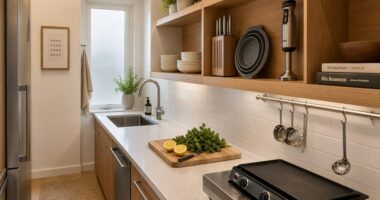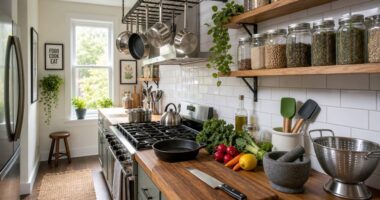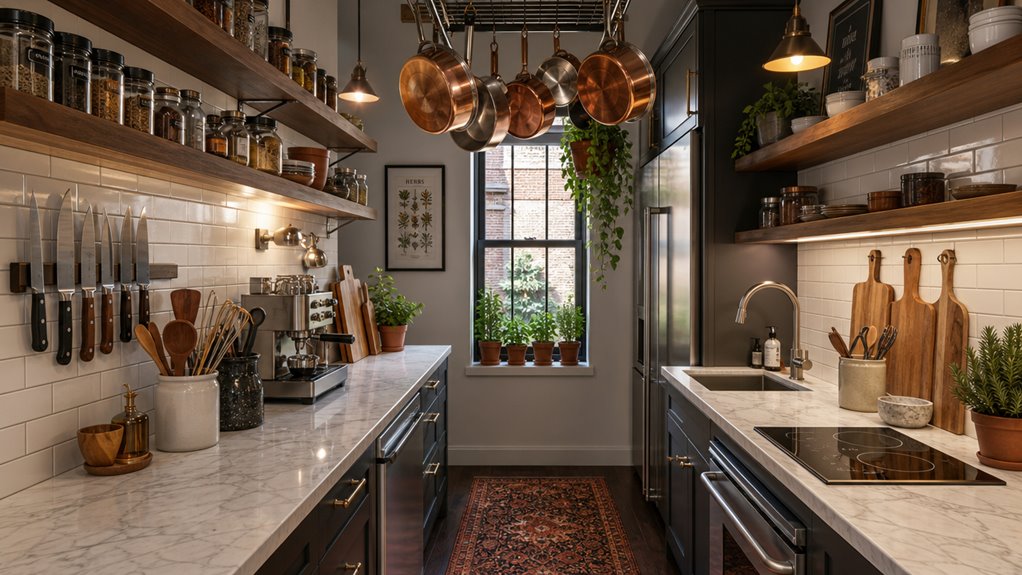
A galley kitchen setup requires careful equipment choices to keep a roughly 100-square-foot space functional and uncluttered. The sink-stove-fridge line depends on clear aisle access, typically between 4 and 6 feet wide, and on tools that store compactly without sacrificing cooking capacity.
- Nesting cookware reduces cabinet volume by stacking pots inside the largest vessel, with a 12-inch lidded skillet replacing several smaller pans.
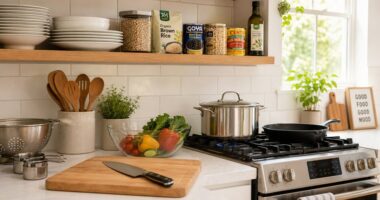
- Collapsible storage tools fold flat when not in use, allowing a colander or cutting board to slide into a drawer or cover the sink.
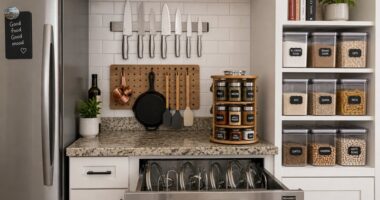
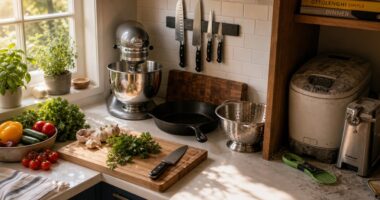
- Wall-mounted organization systems keep ladles, spice tins, and knives off the counter by using magnetic knife strips and shallow wall rails on the backsplash.
A multi-function convection oven handles air-frying and toasting from a single appliance, reducing the number of countertop devices a small kitchen needs to accommodate. Choosing one unit with multiple cooking modes frees up surface space along the primary work zone.
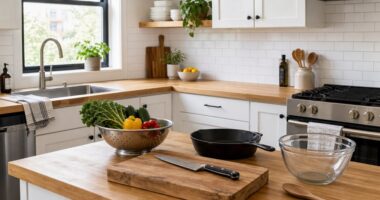
A double-sided cutting board serves two purposes by functioning as both a prep surface and a sink cover. This approach extends the usable counter area without requiring any structural changes to the kitchen layout.
Compact storage techniques work alongside layout decisions to keep the aisle passable and the workflow logical. Magnetic strips, nesting sets, and collapsible items each address a different dimension of the storage problem.
The National Kitchen and Bath Association’s planning guidelines put the work triangle perimeter at roughly 13 to 26 feet, a range that supports efficient movement between cooking zones even in apartments with limited total square footage.
Cheap or expensive is the wrong question. Cost per use is the honest one. Check out our new Calculator.
Cost-Per-Use Calculator →Key Points
- Prioritize nesting and stackable cookware (e.g., Dutch oven, 2‑quart saucepan, collapsible colander) to minimize cabinet depth while covering all cooking tasks.
- Install magnetic knife strips and wall rails 16–20 in. high to free counter space and keep essential tools within ergonomic reach.
- Use a universal lid set and removable‑handle pans to enable vertical stacking and reduce burner clutter in the galley.
- Choose a multi‑function compact appliance (convection oven/air‑fryer) to replace separate toaster, oven, and fryer, preserving the 4–6 ft aisle.
- Implement a clean‑as‑you‑go workflow with a small prep bowl, nearby compost bin, and over‑sink cutting board to keep the narrow work zone uncluttered.
| Modern Innovations 16″ Magnetic Knife Bar Organizer |  | Extended Capacity | Mounting Method: Screw mounting (included hardware) | Primary Material: Stainless steel (satin finish) | Load Capacity (Approx.): Holds multiple knives (≈ 5-10 lb total) | VIEW LATEST PRICE | Read Our Analysis |
| 17″ Magnetic Knife Holder with Hooks and Adhesive Tape |  | Integrated Hooks | Mounting Method: Screw or strong adhesive tape | Primary Material: 304 stainless steel | Load Capacity (Approx.): Holds 5-8 knives (≈ 5-10 lb) | VIEW LATEST PRICE | Read Our Analysis |
| Wall-Mount Metal Spice Rack, Screw-In (4 Pack) | 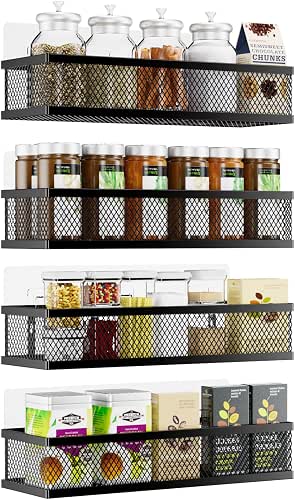 | Heavy-Duty Build | Mounting Method: Adhesive stickers or wall-mount brackets | Primary Material: Thickened carbon steel | Load Capacity (Approx.): Holds larger items (≈ 2-3 lb per rack) | VIEW LATEST PRICE | Read Our Analysis |
Links to Amazon are affiliate links. Buying through one costs you nothing extra and helps fund the research.
What a Galley Kitchen Demands From Every Tool
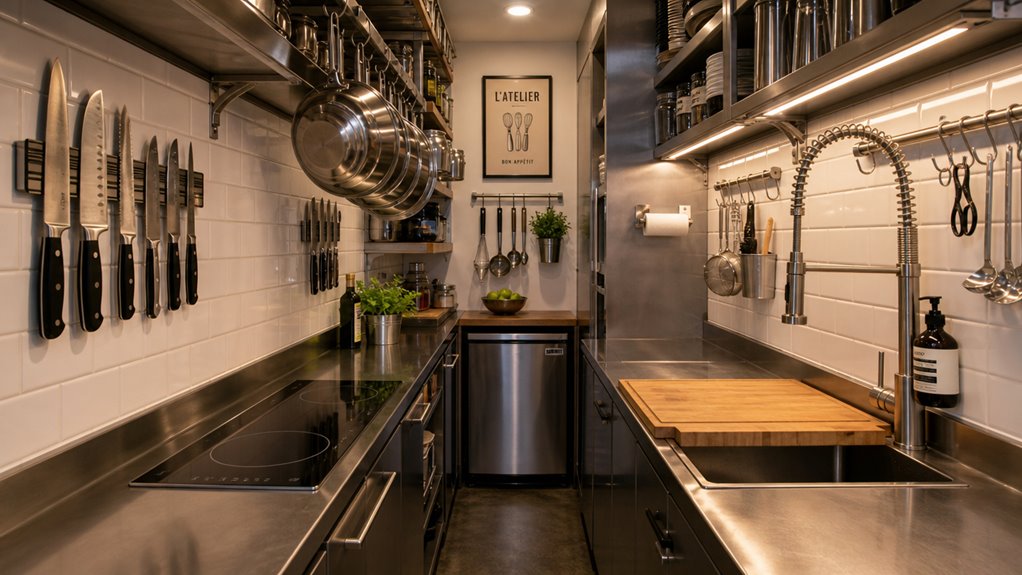
A galley kitchen demands that every tool justify its footprint, because counter space in a narrow layout is finite and any item that serves only one purpose creates a practical burden. The footprint-first constraint shapes every purchasing decision, pushing cooks toward tools that nest, fold, or stack and can be stored in a drawer or on a wall rail between uses. Workflow in a galley depends on keeping prep, cooking, and serving functions accessible without crowding surfaces, so a sauté pan with a fitted lid, for example, earns its place by consolidating two functions into a single cabinet slot. Cabinet space and counter clearance aren’t separate problems in this layout. How a tool stores directly affects how smoothly the kitchen operates. The sections that follow examine what those demands look like in practice across different tool categories.
Why Narrow Counters Punish Anything That Does Only One Job
Once a 24‑inch‑deep counter is down to a usable 15‑inch work zone, every gadget has to justify the space it takes. A single‑purpose toaster oven can occupy one to four square feet of that run, breaking the straight line between sink, stove, and fridge. That interruption forces you to shuffle dishes, lose momentum, and risk bumping the aisle walls.
Multi‑function tools, however, compress several appliances into one footprint. A 20‑inch convection oven that air‑fries, bakes, and toasts replaces three separate boxes, while a wall‑mounted magnetic knife strip frees the block’s edge. A narrow kitchen rewards anything that nests, hangs, or folds; anything that can’t stack or hide costs counter space it never earns back. Open shelving replaces upper cabinets for a lighter, airier feel.
The Footprint-First Rule for a Hundred Square Feet
In a galley that barely clears a hundred square feet, every tool has to earn its spot by doing more than one job. The best approaches for a kitchen this size focus on shrinking the counter footprint while boosting storage. Choose items that nest, collapse, or mount high, so the narrow aisle stays clear and the work zones stay efficient.
A tight kit reduces clutter, keeps the passageway between 4 and 6 feet, and lets the sink, fridge, and stove stay within reach.
- Nesting cookware set – pots stack inside each other, freeing cabinet space.
- Magnetic knife strip – holds blades on the wall, freeing the counter surface.
- Over‑sink board – adds prep space without occupying permanent counter area.
Using smart appliances can further cut energy consumption while maintaining performance.
| Chengu Magnetic Spice Rack Stainless Steel Wall Mount |  | Space Saver | Mounting Method: Self-adhesive stickers or magnetic surface | Primary Material: Stainless steel | Load Capacity (Approx.): Holds standard spice tins (≈ 1 lb per rack) | VIEW LATEST PRICE | Read Our Analysis |
| Metal Magnetic Refrigerator Spice Rack (4 Pack) |  | High-Weight Capacity | Mounting Method: Magnetic (refrigerator) | Primary Material: Iron (black finish) | Load Capacity (Approx.): 50 lb per shelf | VIEW LATEST PRICE | Read Our Analysis |
| LUCYCAZ Wall Mounted Spice Rack (2 Pack) |  | Compact Versatility | Mounting Method: Adhesive stickers or screws | Primary Material: Powder-coated metal | Load Capacity (Approx.): Holds spice jars (≈ 1-2 lb per shelf) | VIEW LATEST PRICE | Read Our Analysis |
Links to Amazon are affiliate links. Buying through one costs you nothing extra and helps fund the research.
The Cookware and Tools That Fit a Tight Layout
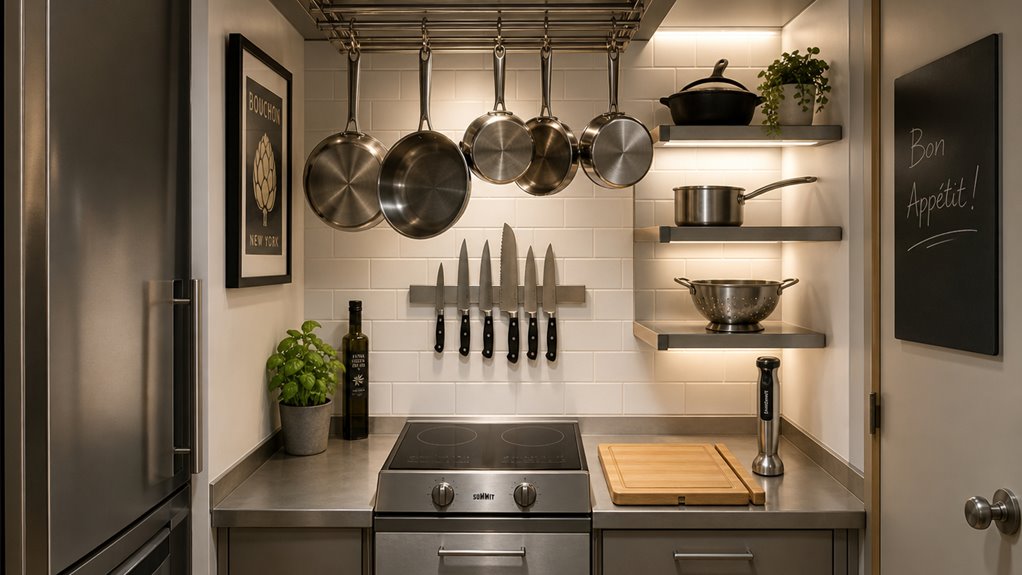
Cookware sized for a tight layout works by combining nesting, stacking, and collapsible designs so that a small cabinet or narrow counter can hold everything a cook needs without sacrificing capacity.
A nesting set, for example, lets a larger stockpot and a smaller saucepan share the same cabinet footprint, while a collapsible colander folds flat when not in use.
Vertical space above the fridge becomes usable storage when bowls stack cleanly rather than sprawl across shelves.
Multitasking pieces matter most in a galley kitchen, where a sauté pan that also functions as a shallow Dutch oven removes the need for redundant items that would otherwise crowd every surface.
The sections ahead cover how specific design features, materials, and use cases shape which cookware and tools hold up in a constrained space. PFAS-free nonstick coatings also help keep cleanup quick and safe in limited kitchen areas.
Nesting Pots, Stackable Bowls, and Collapsible Helpers
A handful of nesting pots can shrink a full cookware set to a twelve‑inch column, so you’ll actually have a counter to work on.
Nesting cookware lets you stack pans with detachable handles, and a universal lid covers three diameters, cutting cabinet clutter.
Stackable bowls nest four to six pieces into the footprint of one large bowl, and many have measurement markings, so you skip a separate jug.
A collapsible colander folds flat, saving up to 70 % of space, yet it’s dishwasher‑safe and heat‑resistant.
- Choose a nesting set with magnetic stainless steel for induction compatibility.
- Opt for stackable bowls with low‑profile lids and integrated markings.
- Pick a silicone collapsible colander that folds to a thin strip and includes a sturdy rim.
The Ninja Stackable set demonstrates that aluminum can provide even heating while remaining lightweight for tight kitchens.
Why Nesting Cookware Fits a Galley Where a Full Pot Set Cannot
Nesting cookware suits a galley because it stores as one column instead of several. You’ll see that a set of nesting pots compresses three or four pieces into the footprint of the largest pot, cutting cabinet demand by up to 70 %.
Full‑size sets with fixed handles need separate stacking zones, and their long handles clash on a 20‑inch range, forcing you to keep pots off the burners. Removable handles on nesting cookware eliminate that clash, letting you slide deeper over rear burners and keep the aisle clear.
Because each vessel often serves multiple roles (saucepan, stockpot, steamer), you replace a bulky 8‑piece set with three versatile pieces, freeing both vertical and counter space for pantry bins, cutting boards, and a small appliance. This reduction in volume also lessens visual clutter, making the narrow galley feel more open and functional.
How to Equip a Galley Kitchen Without Overcrowding It
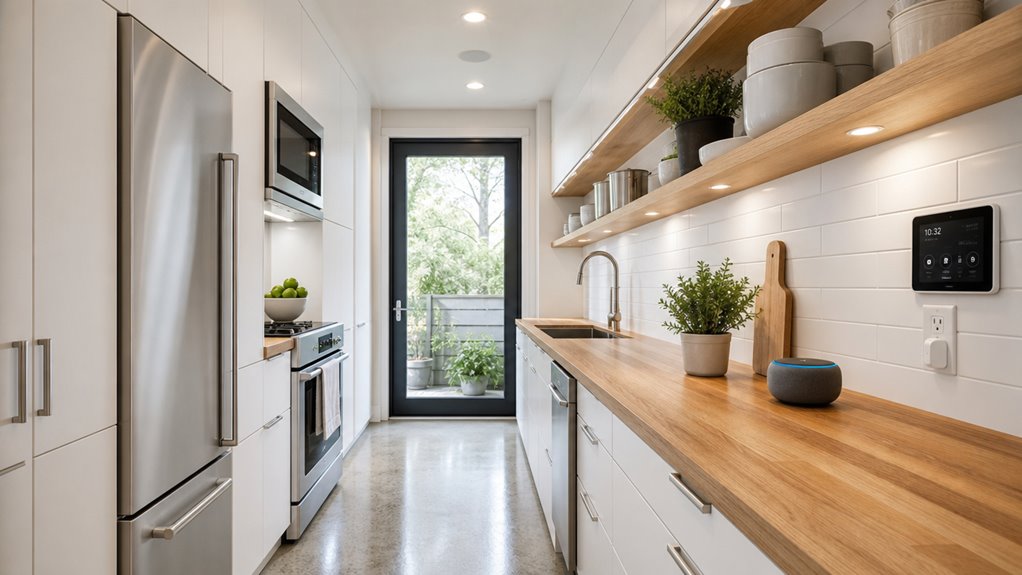
Equipping a galley kitchen without overcrowding it means arranging appliances and storage so the narrow aisle stays clear while every tool remains accessible during prep.
A work triangle layout puts the sink on one counter, the range on the opposite side, and a slim refrigerator at the far end. That spread distributes the core stations without compressing the walking space between them.
Vertical storage solves much of the crowding problem, since a magnetic knife strip on the wall and nesting cookware stacked in a cabinet move clutter off the countertop without sacrificing reach.
Collapsible and multitasking tools, such as a colander that folds flat into a drawer, earn their place in a tight kitchen precisely because they occupy minimal volume when not in use.
The choices that follow address each of these constraints in closer detail.
Working the Two Counters and the Vertical Space Between
When you line the two narrow counters up, the 4‑to‑6‑foot gap becomes your traffic lane, not a dead zone. Keep the lane clear and let the vertical space between the counters do the heavy lifting.
Install shallow wall shelves or a rail system with hooks to hold spices, ladles, and small pans, which frees every inch of counter. A magnetic knife strip at eye level replaces a bulky block and keeps blades within reach. Treat the wall between upper cabinets as a command surface with a slim rack for notes or a magnetic board.
- Add a 4‑inch deep shelf for spices.
- Mount a rail with hooks for cooking utensils.
- Use a magnetic strip for knives.
Building Up From Multitaskers Instead of Single-Use Gadgets
A few well‑chosen multitaskers can replace an entire drawer full of single‑purpose gadgets, keeping your galley clear and functional.
Start with a 5‑quart Dutch oven that sears, braises, and bakes, so you never need a separate pot, fryer, or bread pan. Pair it with a lidded 2‑quart saucepan that handles grains, sauces, and reheating, cutting down on multiple burners.
Choose a 12‑inch skillet with a tight‑fitting lid for sauté, shallow fry, and one‑pan meals, eliminating a whole set of smaller pans.
Add a nesting set of stackable bowls with lids; they double as prep, salad, and storage containers, freeing cabinet depth.
A double‑sided cutting board can act as a sink cover and extra prep surface.
Finally, a magnetic knife strip frees drawer space, and the multi‑function convection oven covered earlier replaces a separate toaster, oven, and fryer. Each piece is a multitasker, so your galley stays open for cooking, not clutter.
The Storage Moves That Free a Galley Counter
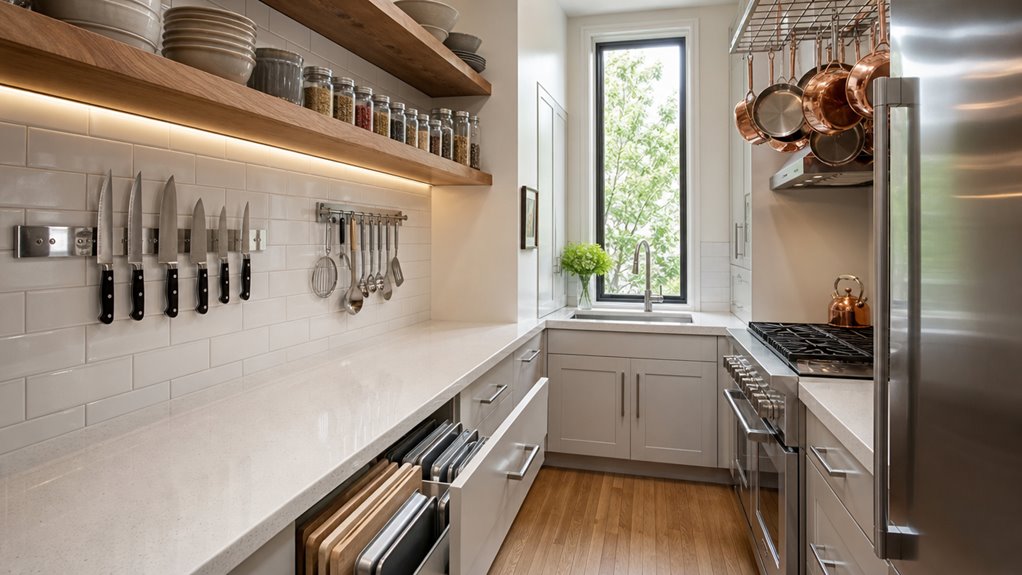
Freeing a galley counter depends on moving everyday tools off the work surface and onto walls or overhead space. Wall rails hold pots and pans, a magnetic knife strip replaces a bulky knife block, and an over-sink board adds usable prep area without consuming counter space.
In a galley layout, the counter runs narrow and linear, so even a single item left out can interrupt the flow of a cooking task. Magnetic knife storage is particularly effective because it keeps blades accessible without the footprint a traditional block requires.
The over-sink board works by turning otherwise unused space into a staging area for prep, which matters most when the counter offers only one continuous run. Each storage decision in a galley compounds, and the details behind each approach are worth understanding fully.
Wall Rails, Magnetic Strips, and Over-Sink Boards
Mount a wall rail above your galley backsplash and you instantly reclaim 2–4 linear feet of prep space. A sturdy wall rail keeps ladles, spatulas, and towels in reach while freeing the countertop for chopping.
Position it 16–20 inches up so you barely bend, and choose corrosion‑resistant steel to avoid rust from steam. Pair the rail with a magnetic strip for metal spice tins and small strainers, and slide an over‑sink cutting board across the basin for an extra 2–4 sq ft of work area that doubles as a colander.
- Wall rail – holds utensils, mini‑shelves, and a knife cup; limit: max 50 lb load.
- Magnetic strip – secures metal tools; limit: not for heavy pans.
- Over‑sink cutting board – adds prep surface; limit: must fit sink width.
Why a Magnetic Strip Saves the Galley Counter That a Knife Block Devours
In a galley where every inch counts, swapping a wooden knife block for a wall‑mounted magnetic strip instantly frees 6–9 in. of countertop depth that would otherwise sit unused. You’ll notice a clearer prep zone, quicker access to blades, and no block hogging space. The magnetic knife strip lives on the backsplash, holding 8–10 knives with zero counter footprint, while the knife block consumes 6–9 in. of depth and traps moisture.
| Feature | Counter Impact | Hygiene |
|---|---|---|
| Magnetic strip | +6–9 in. usable space | Open air dries blades |
| Knife block | –6–9 in. space | Traps crumbs, needs deep cleaning |
| Vertical layout | Flexible zones | Reduces clutter |
You gain a tidy surface, better drying, and fewer micro‑chips on edges. The only downside is you must remember to keep the strip dry; a wet blade can rust if left too long.
How to Keep a Galley Working Day to Day
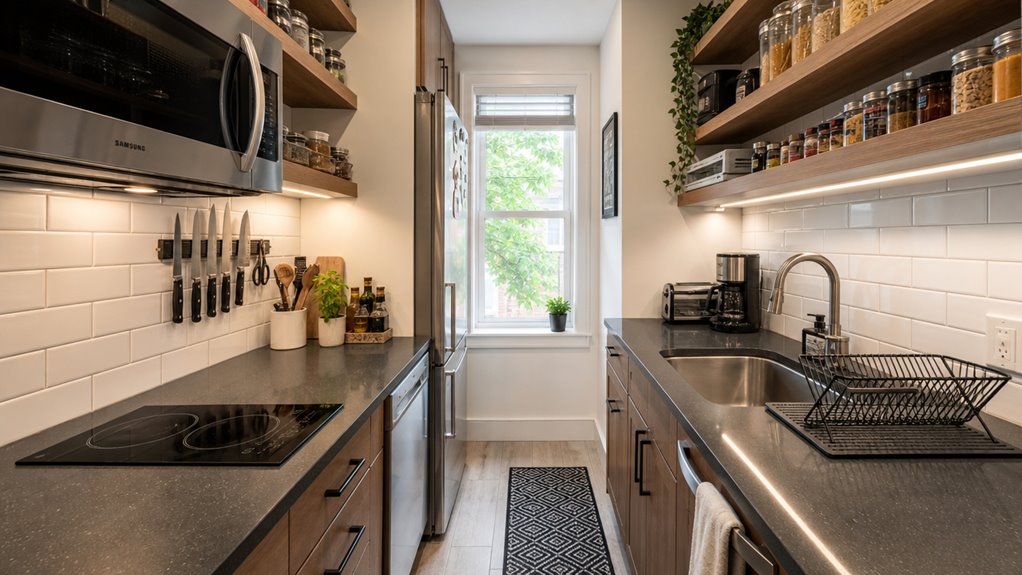
Keeping a galley functional day to day means maintaining a clean, organized workspace within a compact layout where every surface and tool serves a clear purpose.
Wiping down the stovetop, backsplash, and work counter after each meal prevents grease buildup from compounding into a larger cleaning task.
A tight budget, typically under thirty dollars per item, encourages intentional tool selection. Nesting pots, a magnetic knife strip, and a folding trivet all reduce clutter by consolidating function.
Ending the day with a quick sweep, mop, and trash-bin wipe resets the galley without requiring extra equipment or extended effort.
The sections ahead cover each part of this routine in practical detail.
A Clean-As-You-Go Flow for One Working Counter
Often the first thing you notice in a galley kitchen is how quickly the single counter can become a mess.
Start by creating a clear work zone: remove mail, idle appliances, and empty the sink before you begin. Keep only the ingredients and tools for the current recipe on the surface, and set up containment systems like a small garbage bowl and a compost bin nearby.
As you prep, work on a tray to catch peels, rinse jars right away, and drop used bowls into hot soapy water. Wipe spills instantly, and return utensils to their wall‑mounted or magnetic spots. A repeatable flow keeps the counter usable all day.
- Clear work zone before cooking.
- Use containment systems for waste and scraps.
- Keep washing and soaking active throughout prep.
Matching the Whole Kit to the Under-$30 Ceiling
When you cap each item at $30, the kit stays lean enough to fit on a single shelf or magnetic strip without crowding the counter. Choose space‑saving cookware that nests, like a 2‑piece pot‑bowl set that collapses into one stack, and pair it with under‑$30 budget anchors such as kitchen shears and a microplane grater. A magnetic measuring‑spoon set keeps tiny tools together, while a fold‑flat colander slides into a drawer when not in use. Prioritize multitaskers: a mandoline slices, juliennes, and crinkles, replacing several knives. This approach leaves a clear work surface and a tidy vertical wall.
| Item | Role in the kit |
|---|---|
| Kitchen shears | Multitasker: cuts, snips, opens packaging |
| Microplane grater | Zest, hard cheese, garlic; stores flat |
| Digital scale | Compact; replaces bulky measuring cups |
| Magnetic spoons | Nest together; no drawer clutter |
| Collapsible colander | Folds flat into a drawer |
Frequently Asked Questions
Can I Install a Pull‑Out Pantry in a Narrow Galley?
Yes, you can install a pull‑out pantry in a narrow galley. Choose a tall, slim unit, mount it on heavy‑duty slides, keep the depth under 12 in, and position it where it won’t block the 4-to-6-foot aisle.
What Is the Best Way to Organize Spices Without Taking Counter Space?
Install magnetic spice tins on a backsplash strip, mount a slim wall rack above the stove, and use uniform drawer inserts for the rest. This keeps jars visible, accessible, and completely off the counter.
How Do I Keep a Small Sink Area Tidy With Limited Storage?
Keep only daily cleaners in a slim caddy, use a vertical under‑sink organizer that slides around pipes, store rarely‑used items on a high shelf, and wipe the basin after each use.
Are There Fold‑Away Cutting Boards That Attach to the Wall?
Wall‑mounted, fold‑away cutting boards exist as DIY kits and as a few niche products. They hinge down to a prep surface and fold back flat against the wall, which suits a tight galley.
Which Compact Appliances Double as Storage Units?
You’ll love drawer dishwashers, under‑counter fridge drawers, microwave drawers, and appliance garages; they hide appliances while providing pull‑out shelves or cubbies, turning every appliance into a functional storage unit.
Conclusion
You’ve trimmed the excess and kept the essentials, so the galley runs on the tools that do more than one job. Nesting pots stack neatly, a magnetic knife strip frees a block, and a fold‑flat colander slides into a drawer when you’re done. The result is a functional, uncluttered workspace that lets you prep, cook, and clean without feeling cramped. Every piece in the kit earns its slot, which is what makes a hundred square feet workable at all.
| Fun Memories 30″ Magnetic Stove Top Shelf |  | Stove-Top Companion | Mounting Method: Magnetic bottom or screws for wall mounting | Primary Material: Pine wood (magnetic base) | Load Capacity (Approx.): Holds bottles/spices (≈ 5-10 lb) | VIEW LATEST PRICE | Read Our Analysis |
| Magnetic Aluminum Foil and Plastic Wrap Organizer (2-Pack) | 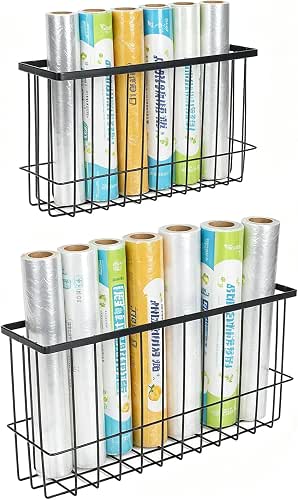 | Kitchen Organizer | Mounting Method: Magnetic back (no tools) | Primary Material: Steel (matte coating) | Load Capacity (Approx.): Holds rolls of wrap (≈ 2-3 lb) | VIEW LATEST PRICE | Read Our Analysis |
| Magnetic Spice Rack Wall-Mounted Shelf (Black) |  | Budget Magnetic Pick | Mounting Method: Magnetic (tool-free) | Primary Material: Carbon steel | Load Capacity (Approx.): Holds assorted items (≈ 5-10 lb) | VIEW LATEST PRICE | Read Our Analysis |
Links to Amazon are affiliate links. Buying through one costs you nothing extra and helps fund the research.

Michael Haralson worked in professional kitchens from 1979 to 1992: San Diego restaurants, six years with a catering company beside an Austrian chef, and two summers as a cook on the Finland to Sweden cruise route. He then built a fifteen-year career at Nokia. It began in product marketing and product management, where technical specifications and supplier evaluation were part of the work, and grew from a few countries to a region to global roles, then into sales and corporate strategy. That took him to Beijing for three years, where he spent many weekends in a different province trying the local food and took cooking classes. He has eaten in more than 40 countries and has been shown the kitchens of restaurants in Southern Europe. At home in Finland he cooks Cantonese, Sichuan and Mediterranean food, and still uses the cast iron skillet he bought in 1992. He is the author of Buy It Once, Book One of The Researched Kitchen, and writes here about the balance between kitchen tools that cost too much and those that fail too soon.