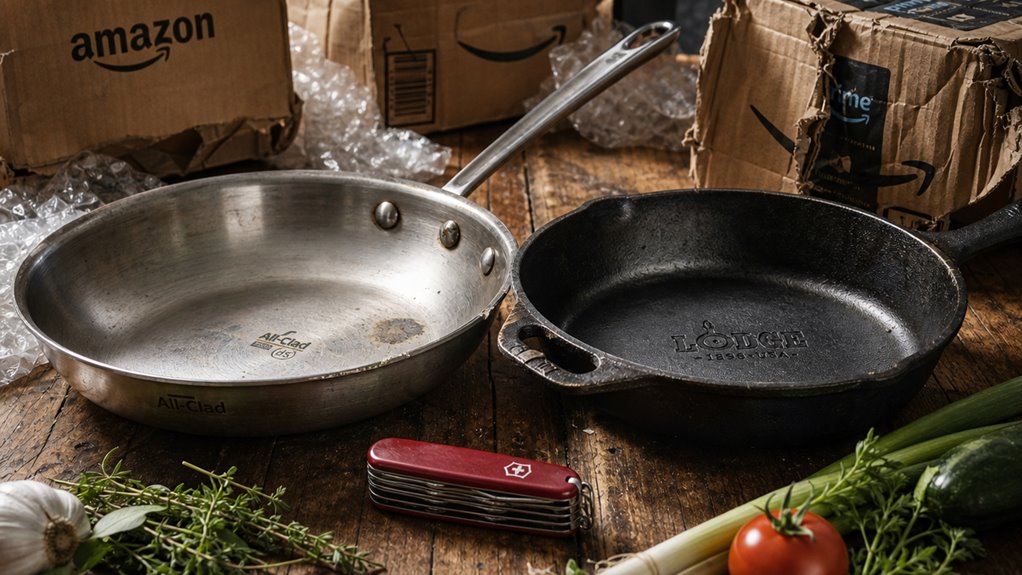
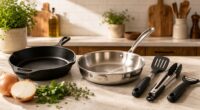
Fake All-Clad, Lodge, and Victorinox cookware on Amazon share five clear warning signs:
- Suspicious pricing below market value
- Mismatched or manipulated product photography
- Unverified third-party seller storefronts
Pricing tells the first story. A Lodge cast iron skillet listed at $19 or an All-Clad stainless steel pan at $40 signals a counterfeit operation exploiting margin gaps that legitimate retailers like Williams-Sonoma or Sur La Table would never sustain. Authentic cookware holds consistent pricing across verified channels.
Photography reveals the second truth. Lodge cast iron carries a matte, textured surface finish. A listing showing a glossy Lodge pan or a blurred foundry stamp means the seller photographs a substitute product. All-Clad stamps and Victorinox engravings follow precise tolerances — counterfeit versions shift, smear, or disappear entirely.
Seller identity exposes the third problem. Generic third-party storefronts with mismatched “Sold by” and “Ships from” disclosures on Amazon Marketplace hide the actual product origin. Authorized distributors maintain transparent supply chains.
Missing specifications signal the fourth red flag. Legitimate All-Clad listings state the steel alloy grade. Victorinox listings confirm blade steel composition. Absent materials data means the seller cannot verify what the product contains.
Review patterns complete the fifth warning. A sudden cluster of five-star ratings mentioning low prices and fast shipping indicates coordinated fake review activity targeting verified purchase loopholes.
Interesting Fact: The U.S. Customs and Border Protection seized over $1.4 billion worth of counterfeit goods in a single fiscal year, with kitchenware and cookware ranking among the most frequently intercepted product categories at American ports of entry.
Key Points
- Check price versus brand baselines; listings 25–50% below typical retail often indicate counterfeit or gray-market margin.
- Verify SKU/ASIN and model details match the brand system; warranty can be denied if the item can’t be verified.
- Inspect photos closely for mismatched logos/stamps, wrong colors, and inconsistent surface finish across images.
- Read review timing and patterns; sudden 5-star floods, “got it cheap,” and copy-paste praise are common counterfeit signals.
- Confirm listing integrity: look for correct “Sold by/Ships from” identity and avoid generic storefronts with vague specifications.
Why Amazon Counterfeits Hit All-Clad, Lodge, and Victorinox Specifically
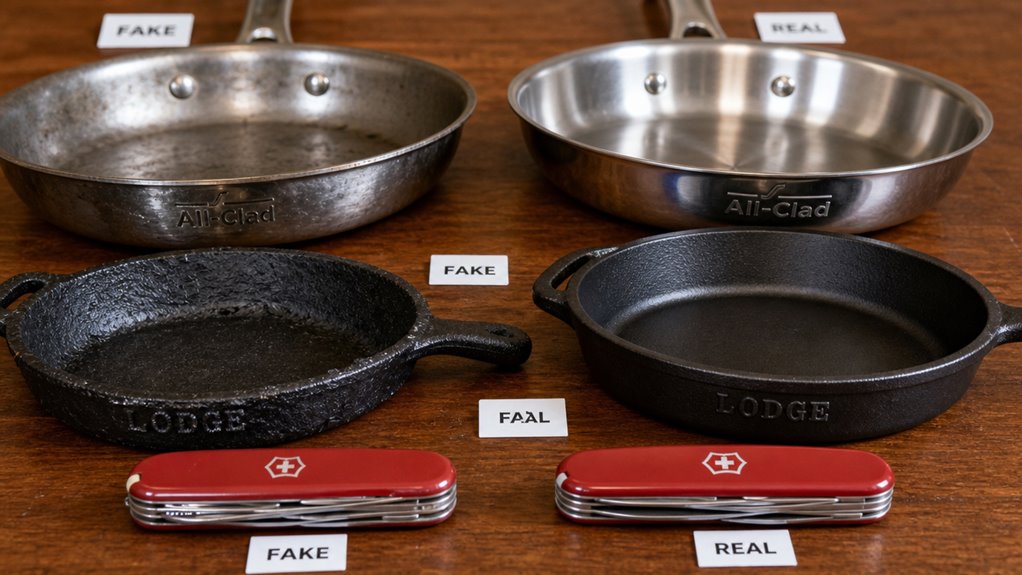
You’re more likely to see counterfeits for All-Clad, Lodge, and Victorinox because Amazon’s brand-registry verification doesn’t stop third-party sellers from listing under the brand name, then mixing or swapping inventory for the same-looking page. When you spot something like a $19 Lodge or a $40 All-Clad—far under the usual price floor—that’s usually the math of counterfeit margin, not a “deal,” and it’s your first hard signal to inspect the listing and seller. And if you ignore that and buy the fake anyway, the lifetime-warranty culture turns against you: Lodge, All-Clad, and Victorinox can deny service because the SKU or item can’t be verified through their system.
When inspecting the listing, look for low-quality or inaccurate photos that don’t match the product’s known design details or the images in reputable listings.
The Brand-Registry Loophole Third-Party Sellers Exploit
Amazon’s Brand Registry helps, but it doesn’t fully stop third-party sellers from listing under familiar brand names, and that’s the loophole counterfeiters exploit for All-Clad, Lodge, and Victorinox. You can see the Brand Registry conflict when third-party sellers keep counterfeit listings up despite delays in ownership verification. Enforcement often kicks in after reports, not before, so a gray-market ASIN can linger. Third-party sellers dominate Amazon’s marketplace—Statista reports 55% of paid units in Q4 2020 came from third-party sellers, giving bad actors plenty of opportunities to resurface.
Why $19 Lodge and $40 All-Clad Listings Are the Counterfeit Signal
So when you see a Lodge skillet for $19 or an All-Clad D3 pan for $40, treat the price like a flashing “check this closely” sign, not a bargain. That counterfeit pricing sits 60–80% off typical street value, and Amazon’s Buy Box favors lowest offers from Amazon third-party sellers. Nation-states also pursue illicit access and counterfeit-like fraud operations that prey on users’ trust and lack of verification, making unusually low prices a key red flag worth acting on.
- Buy Box price cuts beat legit sellers
- Discounts below floor look engineered
- Fake listings hide among valid offers
- Brand trust enables easy logo copying
How the Lifetime Warranty Risk Compounds the Bad Buy
The lifetime warranty promise only pays off when you buy from the right channel, and that’s exactly where Amazon counterfeits tend to break the deal for All-Clad, Lodge, and Victorinox. If you buy counterfeit cookware from unauthorized sellers, the lifetime warranty gets denied.
Because All-Clad ties its authorized distribution to quality-control requirements, unauthorized sellers are often where warranty eligibility fails, even when a listing looks legitimate. money-back guarantee is also commonly highlighted on marketplaces, but that doesn’t substitute for brand-backed coverage when the product is outside official channels. Then defects hit, you pay again, and brands refuse parts or repairs—because the SKU or serial won’t match. That compounds the original bad buy fast.
Red Flag #1 — Pricing 25-50% Below Brand Standard
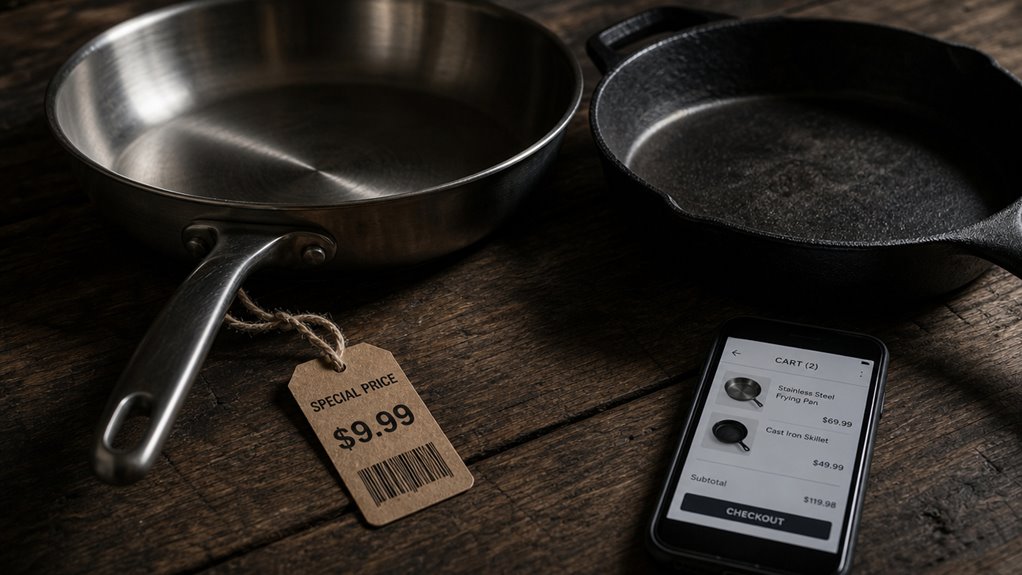
If you see Lodge L8SK3 priced at $12–15 when the usual retail range is $20–28, you should assume something’s off, especially if it’s “new.”
The same pattern shows up with All-Clad D3 at $40–70 versus $130–180, and Victorinox Fibrox at $12–18 versus $35–45, because brands keep pricing fairly steady with authorized dealers.
You can’t count on a real warranty or correct specs on those listings, so your first move is to compare the price against brand-site or major retailer baselines for that exact SKU.
This aligns with 25-50% below brand standard as a major warning sign.
Lodge L8SK3 Standard Retail $20-28 vs Knockoff at $12-15
Wondering why a “new” Lodge L8SK3 10.25″ skillet shows up on Amazon for $12–$15? Lodge L8SK3 pricing usually sits $20–$28, so that 25–50% drop screams counterfeit cookware risk, especially from Amazon third-party sellers. Naturally seasoned by Lodge with soy-based vegetable oil, the skillet should match the standard “out-of-the-box” finish you’d expect from the real product—not arrive looking inconsistent or poorly coated at an unusually low cost. Pre-seasoned by Lodge with soy-based vegetable oil, the skillet should match the standard “out-of-the-box” finish you’d expect from the real product—not arrive looking inconsistent or poorly coated at an unusually low cost.
All-Clad D3 Standard $130-180 vs Knockoff at $40-70
How low can an “All-Clad D3” 10-inch pan go before you should stop trusting the listing? If it’s $40–$70, you’re seeing price red flags: that’s about 50–75% below the $130–$180 norm from authorized retailers. You should treat it as counterfeit cookware and skip it. Because tri-ply bonded cookware is engineered for fast, even heating and resistance to warping, prices that far undercut the brand’s typical range are especially suspicious. You still can find deals near $100–$130, but not 25–50% off-brand. Aluminum core between layers of stainless steel helps explain why legitimate D3 pans heat up quickly and distribute heat more evenly than cheaper lookalikes.
Victorinox Fibrox Standard $35-45 vs Knockoff at $12-18
Pricing tells a big part of the truth with Victorinox Fibrox: a legit Fibrox Pro 8″ chef’s knife usually lands around $35–$45, so when you see “new” at $12–$18 on Amazon, that 25–50% below-brand-standard gap is your first red flag. Expect a counterfeit listing, not fibrox pro pricing. In stock; usually ships in 1-2 business days] on a legitimate Victorinox listing typically aligns with the normal retail pricing band, not $12–$18. Fibrox Pro Series is listed with multiple knives generally ranging about $35–$75, which means $12–$18 doesn’t match the collection’s typical price bands. – Compare authorized sellers’ ranges – Check sold-by identity – Look for clearance/no-clearance context – Treat Amazon red flags as evidence
Red Flag #2 — Listing Photos That Don’t Match Brand Photography
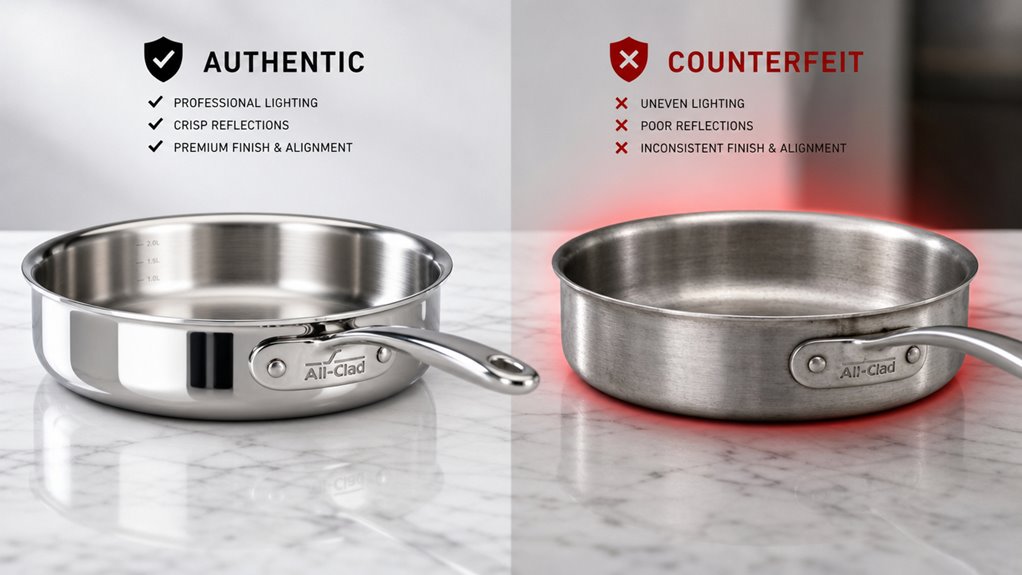
When you spot glossy “cast iron” in Lodge photos, treat it as a red flag, because Lodge preseasoned cast iron is typically matte, not shiny.
Next, zoom in on logos and stamps: if the cross-and-shield (Victorinox) or All-Clad markings look blurred, off-center, or oddly stretched, the images may be edited or taken from the wrong product.
Photo inconsistencies are often your first visible clue that the listing isn’t using the brand’s standard photography style, and the limitation is that lighting and camera differences can still fool you on honest listings.
Glossy Surfaces on Cast Iron (Lodge Is Always Matte)
If the Lodge cast iron looks glossy and mirror-like in the Amazon photos, treat that as a real inspection signal, not just “lighting.” Lodge’s standard marketing photos usually show a matte, utilitarian surface with visible texture, and preseasoned raw cast iron typically looks dark and a bit rough—not lacquered. rust can also create uneven, abnormal-looking surface sheen if the pan has been sitting in a moist environment, so a glossy “brand-new” appearance that doesn’t match Lodge’s normal matte texture should raise suspicion. Glossy surfaces can indicate the pan has an unnatural finish, which matters because surface condition and seasoning quality should look consistent rather than “lacquered.”
Watch for a glossy finish, and confirm image consistency.
- Compare against official Lodge images for matte cast iron cues
- Look for uniformly reflective “lacquer” sheen
- Check underside/handle/logo aren’t cropped or filtered
- Verify the surface texture isn’t unrealistically smooth
Off-Color Brand Logos and Misaligned Stamps
After you’ve checked the surface finish for weird shine (or the lack of it), look harder at the logos and stamps in the photos. Bright, gradient, or maroon Victorinox shields, faded Lodge yellows, or off-color logos on All-Clad packaging point to branding inconsistencies. Then hunt for misaligned stamps: tilted All-Clad bases, drifting Lodge cast marks, or Victorinox etching text running unevenly. One limitation: photos can’t prove depth or hardness.
Why Photo Inconsistency Is the First Visible Red Flag
Why do the pictures matter so much before you even zoom in on logos, stamps, or materials? Because photo inconsistency is your fastest counterfeit indicators. You’ll see branding imagery switch styles mid-listing: clean studio shots mixed with dim phone photos, conflicting handle/rivet details, or a blurred logo that blocks verification. Different angles don’t match one SKU. product-listing photos Color/finish shifts between images. Low-res or edited halos near stamps. Bundles/packaging photos are missing or wrong. Even though brands may appear on different stockist pages, an Amazon listing that fails to look like the brand’s standard photography is a first fast indicator.
Red Flag #3 — Third-Party Sellers With Generic Storefronts
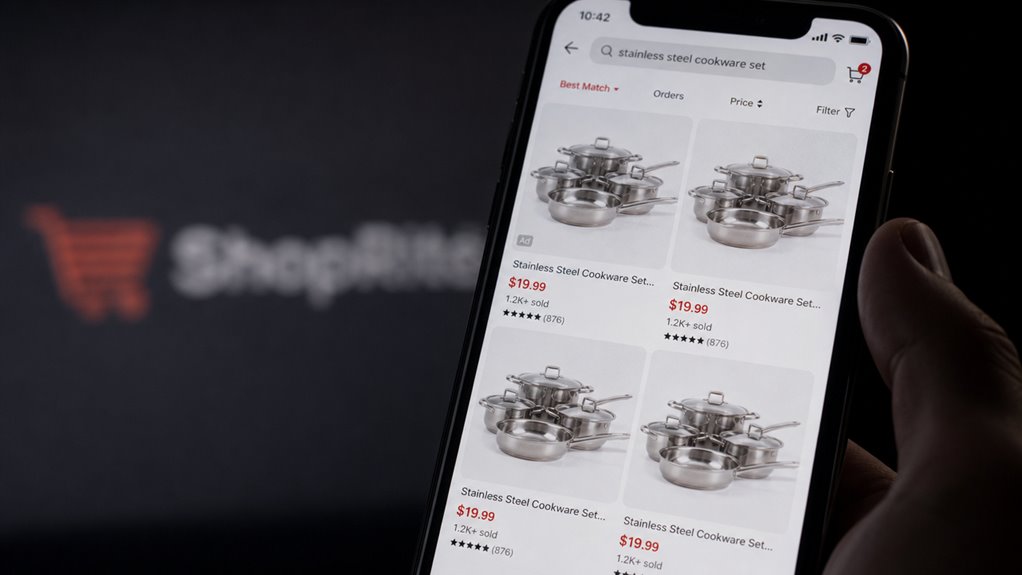
When you see a third-party seller with a generic storefront, you can’t just trust the brand name sitting in the title. Start by checking the Sold-By vs Ships-From: if it says “Sold by Lodge” or “Sold by Amazon,” you’ve got a real shot at an authorized path, but a mismatch usually means you’ll need extra inspection.
Also notice when the storefront looks unrelated to cookware or cutlery, because that kind of loose identity often goes with diverted or mixed-condition stock, which is exactly how fakes slip past.
The Sold-By vs Ships-From Distinction Most Buyers Miss
So, you might think “Ships from Amazon” equals “authentic,” but that’s only half the story. In the Sold by vs Ships from view, check who owns the item. With third-party sellers, FBA can still mix stock, so co-mingling inventory can send you the wrong unit on the same ASIN. Sold by Amazon is the merchant of record, meaning they’re the direct seller responsible for the transaction and customer support. “Sold by” is the merchant of record. Generic storefronts lack brand proof. Co-mingled bins blur source. Packaging specs may vary by batch.
Why “Sold by Lodge” or “Sold by Amazon” Is the Authenticity Anchor
Even if the photos look right, you still need to check the “Sold by” line, because that’s the authenticity anchor on Amazon for All-Clad, Lodge, and Victorinox. If you see brand-seller indicators like “sold by Amazon” or “sold by Lodge,” you’re more likely getting authorized inventory with real sourcing, traceability, and faster return/warranty handling than with generic storefront sellers. Look for Sold by authorized listings to reduce the odds of counterfeits, mismatched packaging, or gray-market stock.
Why a Third-Party Seller Storefront Unrelated to Cookware Hides the Knockoff
How does a “premium” cookware listing end up with a questionable pan attached to it? You’re often dealing with third-party storefronts that don’t belong in cookware. They exploit category-mismatch and commingling, so “Sold by Amazon” can still ship pooled units. Watch for:
- generic storefront names
- unrelated product catalogs
- thin seller profiles
- new accounts with broad discounts
This isn’t brand confidence; it’s brand noise.
Red Flag #4 — Missing Spec Disclosure
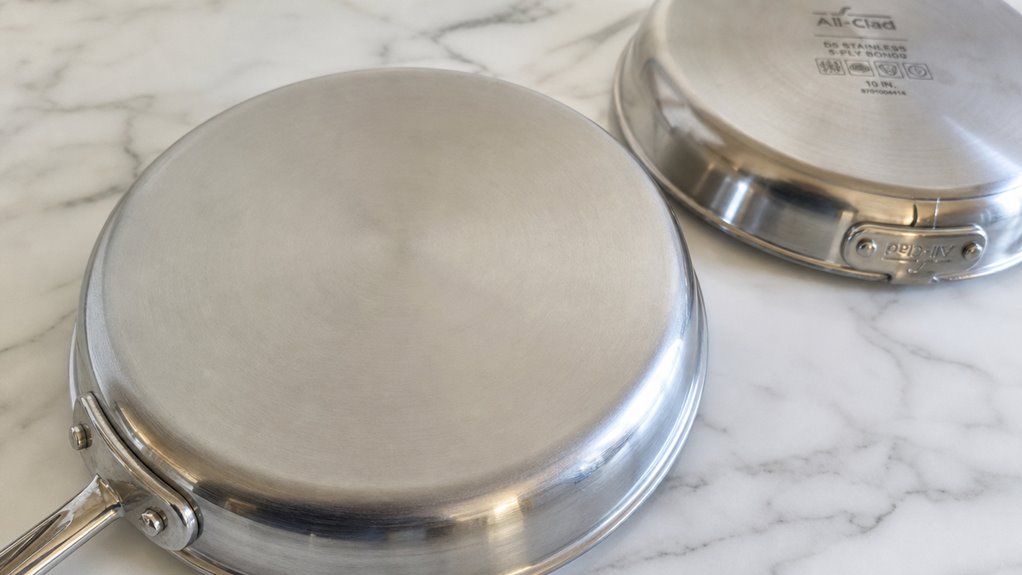
When a listing leaves out core specs, you’ve got a problem: real All-Clad, Lodge, and Victorinox sellers spell out materials, construction (like bonded multi‑ply vs single‑ply), and details like steel type or, for knives, the HRC/alloy designation. If you only see vague phrases such as “premium stainless” or “iron pan,” you can’t verify grade—meaning you might be looking at an easier-to-make steel variant that gets labeled to fit the box.
For a concrete limitation: missing blade length/overall length on Victorinox knives is a huge tell, because authentic SKUs list those measurements in the same way every time.
Why Authentic Listings Always Disclose Material and HRC
What catches people first is usually the price or the photos, but you should also check the boring stuff: material and HRC/steel-grade details. You’re looking for brand transparency and material disclosures that match the brand’s own tables. If alloy identification is missing, you can’t verify construction, and HRC checks for knives/tools get impossible.
- Named metals/chemicals listed
- Coating/handle material stated
- Steel family or hardness provided
- Aligns with AB1200/brand pages
The “Premium Stainless” Marketing Without Grade Confirmation
If you skim the listing after checking the material and HRC, this is the next place fakes tend to show up: the brand never tells you the actual stainless grade. If you only see “premium stainless,” “surgical,” or “food-grade,” without 304/316 or X50CrMoV15, that’s vague marketing. Without grade confirmation or traceability, you can’t verify corrosion resistance or warranty fit. Lodge and Victorinox get specific; fakes dodge.
How Vague Spec Listings Hide 420J2 in Branded Packaging
So how do some listings make you think you’re buying a better knife or blade while quietly skating around the actual steel? You’ll see branded photos, counterfeit packaging vibes, and vague specs instead of alloy truth. If the listing never names 420J2 (or HRC/chemistry), assume the low end.
- “Surgical stainless” only
- No HRC range
- No AISI/DIN/JIS
- “400 series” hand-waving
Red Flag #5 — Reviews Patterns That Hint at Counterfeit Lots
When you see a sudden cluster of 5-star reviews right after a new or relisted All‑Clad, Lodge, or Victorinox listing—especially with lots of unverified buys—you should treat that as a counterfeit-lot signal, not “hype.”
Watch for 4-star reviews that casually say you “got it cheap,” because that pattern often shows up right before quality complaints appear.
And if newer negatives mention wrong materials, warped surfaces, or failed warranty service, that’s usually the batch slipping through after the initial review padding.
The Sudden Cluster of 5-Star Reviews From Unverified Buyers
Got you looking at a “brand-new” listing with a sudden cluster of 5-star reviews, and it’s hard not to notice the timing. When unverified reviews hit fast, you should suspect a boost campaign tied to counterfeit cookware.
- Reviews land within days, not weeks
- Many reviewers show unverified purchase
- Copy-paste praise repeats
- Fresh accounts stack 5-star volume
For All-Clad, Lodge, or Victorinox, this pattern blocks warranty trust.
Why “Got It Cheap” Mentions in 4-Star Reviews Signal a Knockoff Batch
Why do a few 4-star reviews quietly talk about “got it cheap” as if price mattered more than the item itself?
When you see got it cheap in 4-star reviews, you’re often reading counterfeit signaling. Real All-Clad, Lodge, and Victorinox rarely dip far below MAP for long. These reviews praise price first, then mention minor fit, finish, or sharpness issues later. That mismatch points to knockoff batches.
When Recent Negative Reviews Mention Wrong Materials or Failed Warranties
If you spot a cluster of recent 1–2 star reviews that say the material feels wrong, behaves wrong (warping, magnet tests failing, coating chipping fast), or comes with “not covered” warranty emails, you should treat that listing like it might be carrying a counterfeit batch. Expect counterfeit reviews,wrong materials,warranty refusals.
- Thin “different metal” claims
- Lodge “not cast iron” or chipping fast
- All-Clad “batch not in records” replies
- Victorinox “imitation/not one of ours” notes
Frequently Asked Questions
Why Do Brands Like All-Clad and Lodge Refuse Warranties on Amazon Counterfeits?
Why do brands like All-Clad and Lodge refuse warranties on Amazon counterfeits?
Because the products were not purchased through an authorized retailer, brands cannot verify authenticity, trace purchase records, or confirm quality control standards were met.
What makes a retailer “authorized”?
An authorized retailer has a direct supply agreement with the brand, ensuring products are genuine, properly stored, and traceable via SKU or purchase records.
Why can’t brands just honor the warranty anyway?
Honoring warranties on unverified products exposes brands to fraud liability and forces them to cover defects caused by counterfeit manufacturing they had no control over.
How does Amazon’s marketplace complicate this?
Amazon uses commingled inventory, meaning authentic and counterfeit units can mix in the same warehouse, making it impossible to guarantee which version a customer received.
What risk does a counterfeit product pose to the brand?
A defective counterfeit can cause injury or damage, and if the brand honors its warranty, it implicitly accepts responsibility for a product it never made or inspected.
How can buyers protect themselves?
Purchase directly from the brand’s official website or verified retail partners like Williams Sonoma, Sur La Table, or authorized department stores.
Is “sold by Amazon” Always Authentic for All-Clad, Lodge, and Victorinox?
“Sold by Amazon” reduces but does not eliminate counterfeit risk. All-Clad, Lodge, and Victorinox are lower-risk brands on Amazon, but misboxed or return-swapped items can still reach buyers. Always verify the brand-authorized listing, match the exact SKU and product specs, and confirm warranty eligibility before purchasing.
How Can I Verify an All-Clad D3 Rim’s Bonded Layer From Listing Photos?
To verify an All-Clad D3 bonded rim from listing photos, zoom into macro rim shots and look for a continuous, even aluminum-to-stainless lamination stripe running up the side. Check for no gaps or bubbles in the bonded layer and confirm consistent flared rim thickness from base to top.
What Exact Photos Should Match for Lodge (Sand-Cast Texture) Authenticity Checks?
Sand-cast Lodge pieces display a pebble-grain, matte, uniformly rough interior texture visible under raking light. Logos appear cast directly into the metal, not stamped or applied. Sidewalls and rims match Lodge catalog reference photos exactly. Interior surfaces are never mirror-smooth.
Do NSF Stamps or “Nsf Certified” Claims Reliably Distinguish Fake Victorinox Fibrox?
NSF stamps and “NSF certified” claims do not reliably identify fake Victorinox Fibrox knives, as counterfeiters routinely copy these markings. Cross-reference the model against official Victorinox and NSF databases and inspect seller credentials and packaging for inconsistencies.
Conclusion
When you see All‑Clad, Lodge, or Victorinox deals sitting 25–50% under “normal,” you treat it like a lead stain, not a bargain. If the photos don’t line up with brand sourcing, the storefront looks generic, specs are fuzzy, or reviews read like a batch, you walk away. You’re not being paranoid; you’re doing five‑minute due diligence before the pan meets your stove and your warranty meets a wall.