Galley Kitchen Setup: A 100-square-foot apartment kitchen delivers roughly 12–20 square feet of usable counter space after accounting for sink cutouts and walkways.
- Counter Space Optimization
- Vertical Storage Solutions
- Compact Appliance Selection
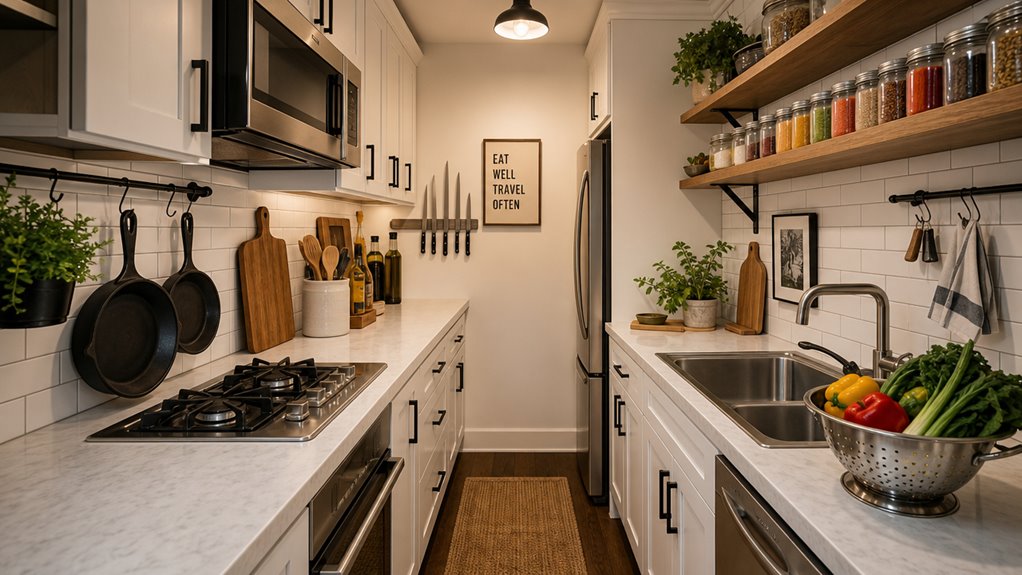
A galley kitchen contains limited horizontal surface area. IKEA’s SEKTION ceiling-height cabinets use vertical wall space efficiently. A GRUNDTAL magnetic knife strip from IKEA mounts blades off the counter and frees cutting room. A HULTARP vertical rail system holds utensils, spice jars, and small tools along the backsplash wall.
Breville produces a compact Smart Oven Air Fryer that replaces a conventional oven, a toaster, and an air fryer in a single footprint. A Nespresso Vertuo Next single-serve machine occupies less than six inches of counter width and eliminates a bulky drip coffee maker. Sur La Table and Williams-Sonoma carry compact kitchen toolkits designed specifically for urban apartment cooking.
Small-format grocery stores like Trader Joe’s stock pre-portioned ingredients that reduce the need for large storage containers. A narrow pull-out pantry unit from The Container Store holds dry goods vertically inside dead wall space. Counter gadgets that perform single tasks sit unused and consume workspace that a galley kitchen cannot spare.
A compact daily toolkit contains one chef’s knife, one paring knife, one cutting board, one skillet, and one saucepan. Serious Eats recommends limiting countertop appliances to those used at minimum four times per week.
Interesting Fact: The term “galley kitchen” originates from ship galleys, where naval cooks fed entire crews using corridor-style layouts averaging just 80 square feet of total cooking space.
Key Points
- Use vertical storage (ceiling cabinets, tall pullouts, wall racks) to reclaim the limited 12–20 sq ft usable counter.
- Mount a magnetic knife strip and hang/rail tools to keep blades and prep items off sink and heat zones.
- Choose compact, daily-driver tools (one versatile chef knife, one multipurpose tool, one cast-iron skillet) over bulky sets.
- Optimize appliance placement to free counters, e.g., over-the-range microwave and storing stand mixers in cabinets.
- Zone wall space for everyday items within 18–60 inches to reduce walking and simplify workflow in a narrow corridor layout.
What Makes a Galley Kitchen Different (And Why That Changes Everything)
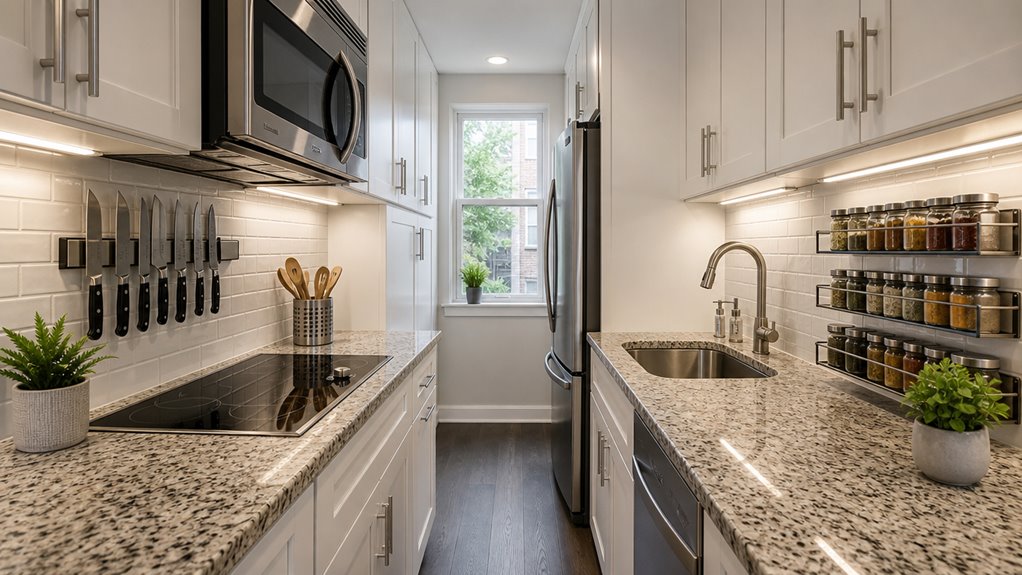
In a 100-square-foot apartment, you usually get only 12–20 square feet of usable counter, so every “starter set” that assumes suburban space quickly charges you in prime workspace. A galley kitchen already gives you a tight work triangle, but it also forces you to win with vertical storage—your 3-foot wall strip turns into extra room without eating counter space. And yeah, most setup guides ignore galleys, so they’ll push more tools than you can actually use daily. In a galley layout, the sink, stove, and refrigerator form a diagonal kitchen triangle for more efficient movement.
The 100-Square-Foot Counter Reality
You might think a “100-square-foot kitchen” gives you 100 square feet of usable counter, but in a galley it usually doesn’t. Your counter reality is typically 20–40 sq ft after cutouts and walkways, so galley kitchen storage must prioritize cabinets and walls over linear prep space. traffic planning In a corridor layout, each appliance, cabinet, and countertop position directly affects movement, cooking, and storage. – 24-in depth caps usable reach – Sink/cooktop steals prep zones – 36–48 in corridor limits adds – Work triangle compresses movement – Deeper counters don’t fix access
Why Galley Kitchens Need Vertical Storage (Not More Counter)
After you’ve accepted the counter reality (like the 12–20 sq ft you actually get to use), the next thing to notice in a galley kitchen is that your walls do most of the heavy lifting. You win with vertical storage: ceiling-height cabinets, tall pullouts, and open wall racks. This space-efficient storage keeps prep, cooking, and cleanup tools near eye level without narrowing the aisle. In tall cabinets, vertical storage lets you stack pantry items and everyday cookware where you can reach them quickly. Maximized space in a galley layout also means you can store more on both sides while maintaining an efficient workflow.
Why Most Kitchen Setup Guides Don’t Apply to Galleys
Most kitchen setup guides assume you’ve got a wide work area where you can “spread out” and still keep the aisle clear, but a galley kitchen doesn’t work like that. You’re fighting galley-kitchen-constraints, tight doors, and a short, line-like work triangle, so you need workflow-optimization and compact-apartment-storage, not big-kit layouts. A galley kitchen is defined by two parallel sides with a narrow passage between them, and that geometry is what forces tighter planning decisions. Keep daily tools within arm’s reach. Avoid knife blocks that eat counter. Mount stuff on the 3-ft wall strip. Plan door swings, not photos. Reduce shared-cook congestion.
The Tool Set That Fits 100 Square Feet
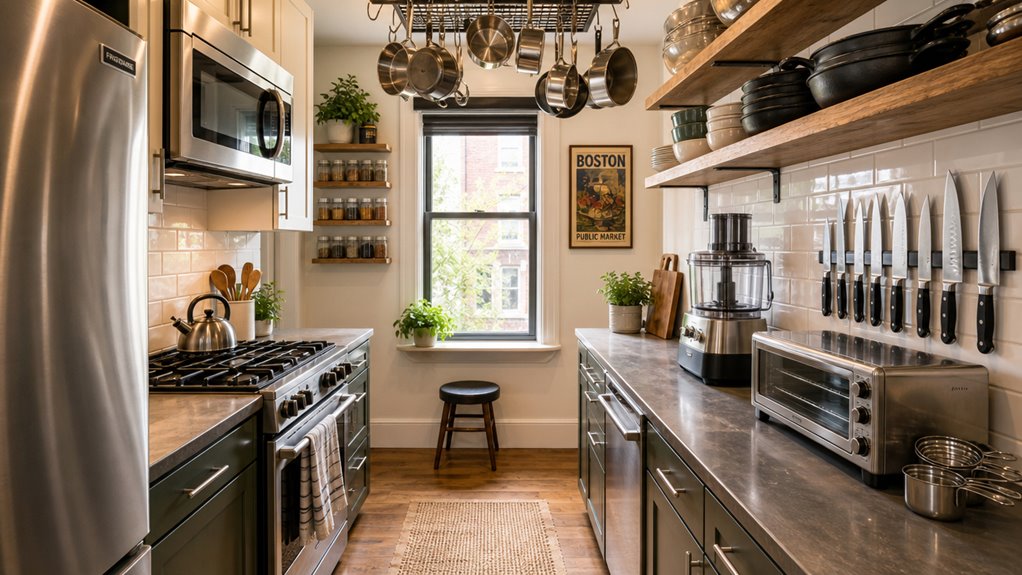
In a 100-square-foot galley, you don’t have room for “complete starter sets,” so you build a daily-driver kit that earns back your counter space: a Victorinox chef knife, a magnetic knife strip, an OXO 3-tool, and a single cast iron skillet. That skillet beats a 6-pan set because one Lodge L8SK3 covers sear, fry, and bake without storing six specialty duplicates, and you’ll actually use it weekly. If you keep it under about $70 instead of chasing a $200 block set, you get fewer redundant tools and a better fit for narrow drawers and tight storage, with the trade-off that you won’t have a specialty pan for every edge-case meal. The cast iron skillet’s pre-seasoned design helps it deliver long-lasting heat retention without frequent replacement. For cookware sets that claim dishwasher and oven safety, you can still end up with extra pieces you don’t use in a galley, so prioritize counter-saving versatility over large kit counts.
The Under-$30 Daily-Driver Toolkit That Earns Galley Space
What should you actually buy first if your galley kitchen gives you only about 12–20 sq ft of usable counter and you don’t want “complete starter set” leftovers? Build a compact tools daily-driver toolkit: one multipurpose hand tool, one cutter, one measure, and modular galley storage.
Stanley-style hammer/pliers/screwdriver basics.
Programmable slow cooking is an easy daily-driver win when you’re busy, and a 6-quart option lets you run meals through long office days without constant attention.
Klein 11-in-1 screwdriver (limitation: shorter bits).
Milwaukee FastBack utility knife (limitation: blade swaps).
WEN square/ruler (limitation: not for heavy carpentry).
Husky/RIDGID organizer (limitation: small capacity).
If you want to keep things truly compact, a stackable small-parts organizer helps you store dowels, screws, and jigs without taking over your limited counter space.
Why a Single Cast Iron Skillet Beats a 6-Pan Set
You don’t need a whole 6-pan lineup to cook well in a 100-square-foot galley; you need one 10–12″ cast iron skillet that actually covers the recurring jobs.
Skillet size is the key factor for deciding what you can reliably cook in it—desserts and sides fit best in smaller options like 3.5 and 6.5″, while family breakfasts and dinners fit larger sizes like 10.25 through 15″.Choosing a single larger pan is a space-saving alternative to buying many smaller ones.
This cast iron skillet is multi-function cookware: sear, bake, braise, shallow-fry, and even go stovetop-to-oven. It holds heat for better browning. You still need one limitation: it’s heavy and slow to cool, so plan your workflow for small kitchen efficiency.
Why an Under-$70 Toolkit Outperforms a $200 Block Set in Galley Layouts
A 100-square-foot galley kitchen punishes tool bloat, so a compact under-$70 toolkit usually beats a $200 block set on day-to-day use. You get compact-storage, fewer reach-misses, and better workflow with galley-kitchen-essentials spread across drawers and rails, not staged on prime counter. Permits influence long-term peace of mind and compliance even if inspectors aren’t present, so planning your work to be code-compliant upfront helps you avoid retroactive complications later. Less counter tied up Toolkit-vs-block flexibility Multiuse tools reduce duplicates Vertical/hid storage wins One-off gadgets stop piling up
The Vertical Storage Strategy (Where Galley Kitchens Win)
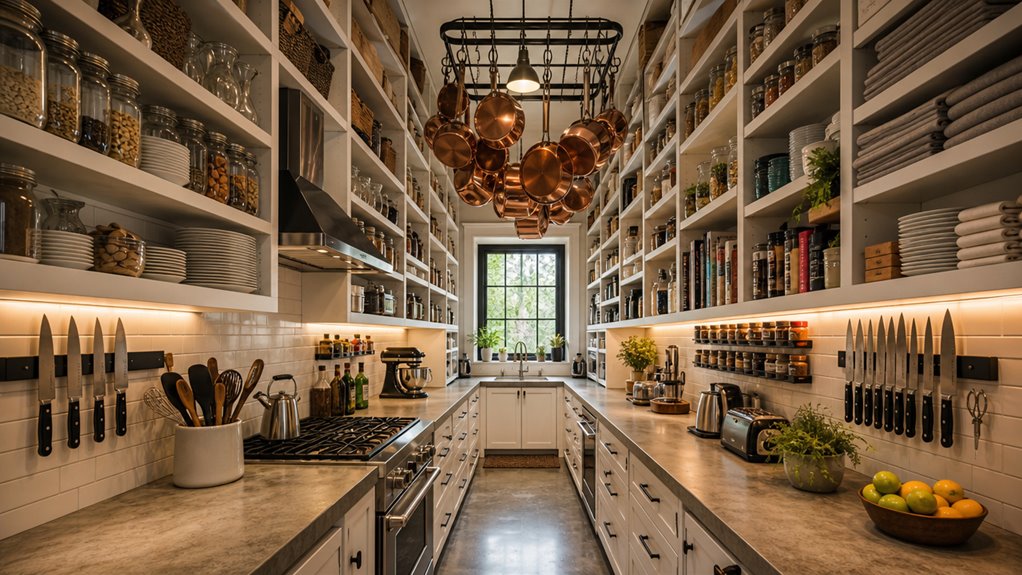
You can stop wasting your 12–20 sq ft of counter and stack storage up the walls instead. Swap a bulky knife block for a magnetic knife strip, hang a pot rack above the stove, and use a 3-foot vertical wall span to add about 9 sq ft worth of storage without crowding your aisle. If you mount with the wrong screws or onto weak drywall, everything gets risky fast, so anchor it properly and keep the heaviest pots over studs. Utilizing vertical space kitchen square footage without sacrificing access. vertical storage maximizes kitchen square footage without sacrificing access.
Magnetic Knife Strips Instead of Knife Blocks
Magnetic knife strips beat knife blocks in a galley kitchen because they free counter space while keeping blades dry and easy to grab. You get smartre knife storage and steadier galley kitchen organization: open-air drying, fewer moldy crevices, and quick selection near your prep zone. This hygienic & easy to clean design minimizes enclosed, moisture-prone areas so blades stay in better condition between uses.
- Mount into studs or use anchors/adhesive
- Use neodymium for consistent hold
- Place handles near eye level
- Keep blades off sink/heat zones
- Slide knives sideways to protect edges
Hanging Pot Racks Above Available Wall Space
How do you keep pots from chewing up the one cabinet you actually use? Go vertical with wall-mounted racks or hanging pot racks placed along the galley run. Mount into at least two studs, and keep the lowest pot 12–18 inches above counters. Use a 24–36 inch rail with 4-inch hook spacing to store 6–10 pieces while you free a full 24–30 inch cabinet.
Why a 3-Foot Vertical Strip Doubles Effective Storage
A hanging pot rack helps, but it only solves part of the “where do the pots go” problem. In a galley kitchen, a 3-foot vertical strip with 6–7 shallow shelves boosts shelving capacity by ~40% without touching counter space, roughly 20–24 cubic feet. You also reduce dead 12–24 inches above cabinets and keep tools in reach (18–60 inches).
- Zoning column for dry goods
- Tool visibility cuts duplicates
- Narrow gaps stop wasted stacking
- Eye-level ergonomics, faster grab
- Anchored shelves hold ~15–30 lb/linear ft
The Appliance Decision (What Earns Counter Space)
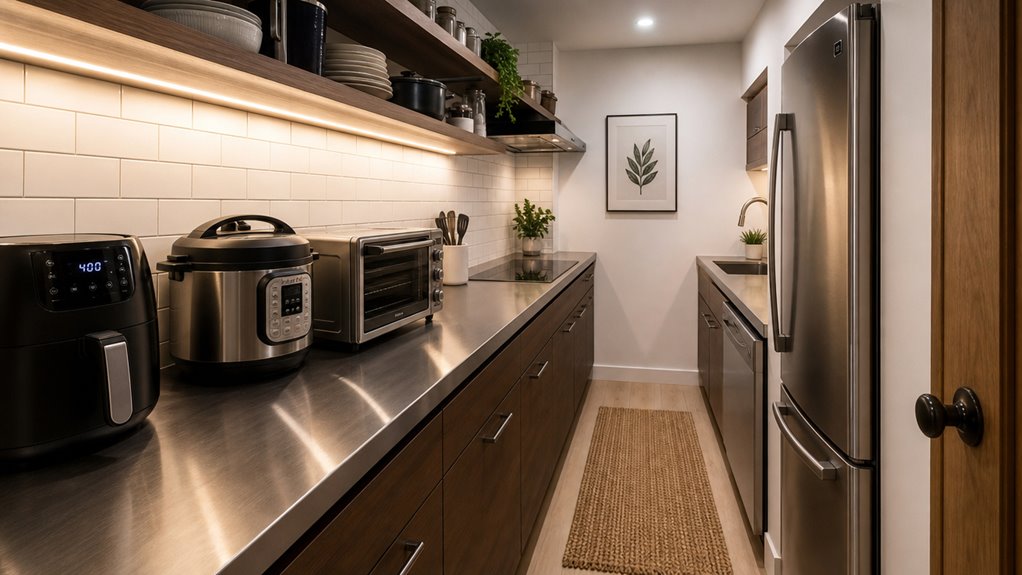
You earn counter space in a galley by picking appliances that get used weekly, starting with a single-serve coffee maker or an electric kettle you’ll actually touch, and skipping anything that lives out of sight. You store the stand mixer in a cabinet unless you bake a lot, because it’s a big footprint trade for a job you only do occasionally, and in 12–20 sq ft of counter you can’t afford that drag.
If you install a microwave above the stove you free prime counter, then keep a toaster oven only if you bake or roast regularly since it can’t fully replace a true oven for frequent bread and big-batch cooking.
Coffee Maker Yes, Stand Mixer Storage (And Why)
Coffee earns counter space in a galley because it runs on daily routines, while most other appliances just create “morning clutter” during setup and cleanup. Use a compact coffee maker or under-cabinet coffee so morning stays tight. Keep stand mixer storage in a cabinet: tilt-head models need 20–30 lbs and a clear pull-out path.
- Brew fast, 3–5 minutes
- One-button control
- Vertical mounting under cabinets
- Cup-size flexibility (8–12 oz)
- Mixer cabinet access cuts friction
Why Microwave Above Stove Frees Counter
Why does an over-the-range microwave matter more in a 100-square-foot galley than anywhere else? Because an over-the-range microwave clears 2–4 sq ft of precious counter space and keeps your galley kitchen layout continuous.
You reheat and defrost directly above the cooktop, so hot pots don’t need extra landing spots.
It also often replaces a separate hood, reducing clutter.
Limitation: installation clearance matters.
When the Toaster Oven Earns Its Spot (And When It Doesn’t)
So, when does a toaster oven actually deserve your cramped galley counter, and when does it just become another warm-metal countertop shelf?
If you bake a little often or reheat small batches, a toaster oven beats a full oven on energy efficiency, with faster preheat and less room heat.
If you cook full meals weekly, choose a countertop oven instead.
- Use for 9×13, pizzas, casseroles
- 4–6 slice capacity stays limiting
- Convection needs 3–6 inches clearance
- Skip if range already handles it
- Consider odor/heat near hood
The Items to Skip in a Galley (Reddit’s Verdict)
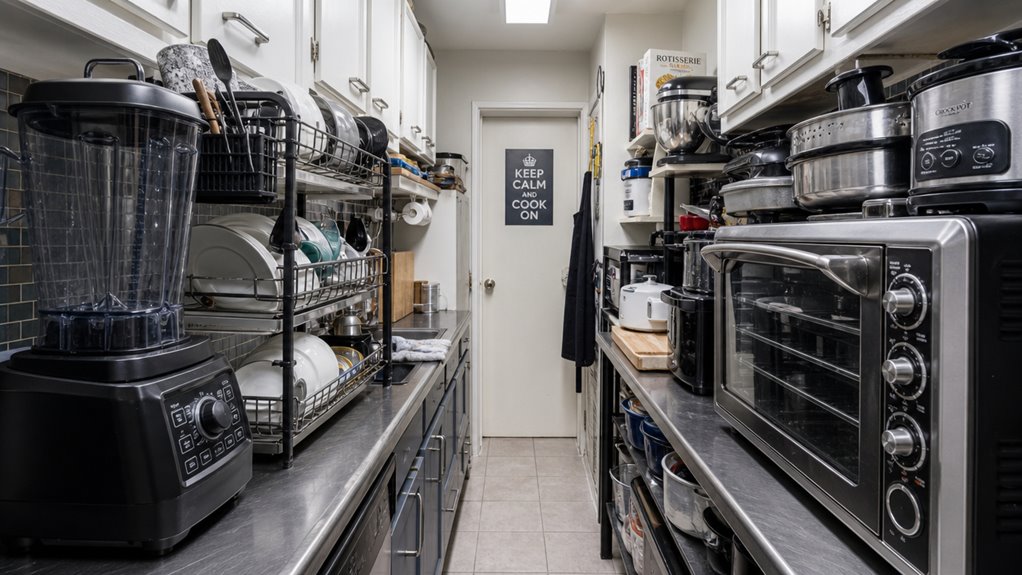
Skip the counter-hog buys first: stand mixers (usually a “space hog” in galley layouts), bread makers, and rice/ice-cream machines you’ll only use a few times a year. Also cut back on specialty pans and gadgetry—one Dutch oven or cast iron skillet beats a pile of rarely-used bakeware, and “unitaskers” like garlic presses and avocado slicers tend to vanish fast.
Finally, be careful with “complete kitchen starter sets,” because most bundle contents get pushed out within 6 months, and the knife block and open organizers steal prime counter space you can’t afford.
Stand Mixers, Bread Makers, and Other Counter-Hogs
In a 100-square-foot galley, stand mixers and bread machines tend to act like counter hogs, not because they “can’t” work, but because you’ll keep paying a space tax you can’t really afford. Store them until baking is weekly. Use a hand mixer instead. For bread, rely on Dutch-oven proofing, not a bread maker.
- Stand mixer: heavy, takes 1–1.5 sq ft depth
- Bread maker: single-purpose footprint
- Bread quality: crust varies vs oven
- Hand mixer: drawer storage, cheaper
- Replace with proofing + cast iron
Why Specialty Pans Lose to Universal Cast Iron in Galleys
Specialty pans sound tidy on paper, but a 100-square-foot galley punishes that kind of “one tool per job” thinking, because every extra pan takes up the same scarce cabinet real estate as something you’ll actually use.
A cast iron skillet earns space efficiency as versatile cookware: sear, bake, roast, shallow fry, and handle eggs.
Specialty shapes stack poorly, and nonstick specialty pans fail sooner.
When the “Apartment Kitchen Bundle” Misleads Most Buyers
Most “apartment kitchen bundle” deals don’t fit a galley well because they’re built for bigger counters and wider drawers than you actually have. You end up paying for filler, not space-efficient tools, and then you remove half the stuff later.
Skip duplicates, skip bulky blocks, and choose small-apartment essentials.
- Redundant spatulas and ladles
- Knife block that eats counter
- Low-power blender bundles
- Under-cabinet clearance issues
- 15–20 piece “aesthetic” sets
Frequently Asked Questions
How Do I Store Daily Tools Without Wasting 12–20 Sq Ft Counter?
What is the most space-efficient way to store daily tools?
Mount a 3-foot wall strip using a magnetic knife strip, hanging rails with S-hooks, and a spice rack.
How many items should stay on the counter?
5–8 daily-use items maximum.
Where do the remaining tools go?
Into pull-out trays stored away from the counter.
How much counter space does this method save?
12–20 square feet of counter space.
What hardware is needed for wall-mounted tool storage?
A magnetic knife strip, S-hooks, hanging rails, and a spice rack.
Where Should My Cutting Board and Knife Go After Cooking?
After cooking, place your knife on a magnetic wall strip. Stand your cutting board upright in a drying rack, then store it in a cabinet or wall-mounted rack once dry.
What’s the Maximum Number of Pots/Pans That Fit a Galley Cabinet?
A standard galley cabinet can theoretically hold 20–28 pots and pans, but 8–12 is the practical limit for easy daily access. Two 10-inch-high drawers typically fit 12–20 pieces when nested efficiently.
Do I Really Need a Magnetic Knife Strip, or Is a Small Rack Enough?
A magnetic knife strip is not required. A small rack can work if counter space is limited. However, a mounted magnetic strip higher on the wall offers faster access, better hygiene, and efficient use of vertical space in a narrow galley kitchen.
Which “starter Set” Items Should I Refuse Before Unboxing?
Which starter set items should I refuse before unboxing?
PTFE nonstick bakeware and pans release toxic fumes at high heat. BPA plastic containers leach chemicals into food. Electric gadget duplicates waste counter space. Specialty egg and omelet makers serve only one purpose. Multi-knife block sets include mostly low-quality, rarely used blades. Mystery-enamel cookware often contains unknown coatings. Overfilled canister sets include spices and tools you will never use.
Conclusion
So build your galley kitchen around real daily use, not a “starter set” that assumes suburban counter space. Cap your daily tools at about 8–10 items, and let vertical storage do the heavy lifting. If you’re tempted by gadgets, remember: most of them either get used once or they become drawer clutter. Even in a tiny setup, you can cook comfortably. That’s the part I’d bet on, like it’s 1987 and we’re optimizing.