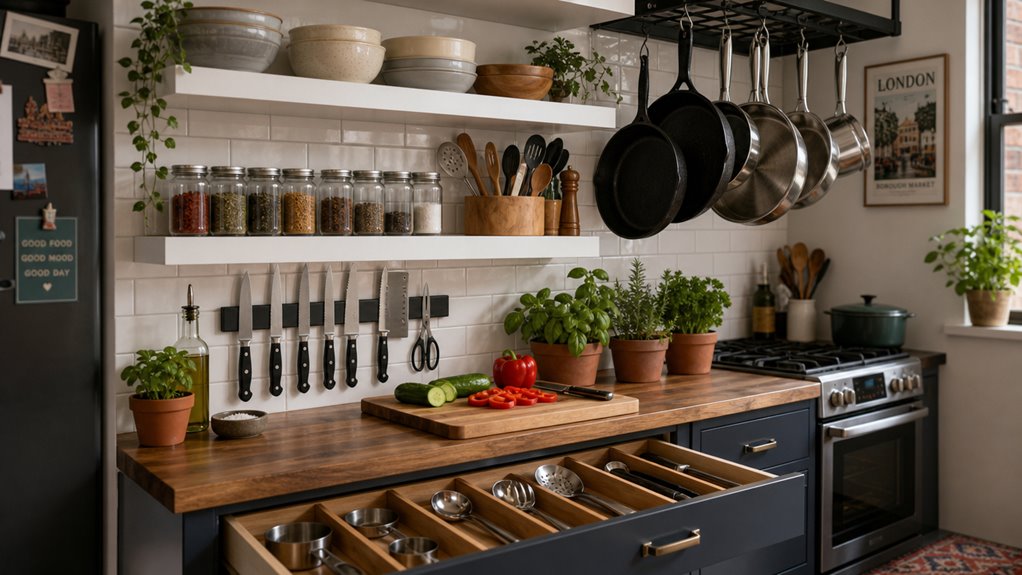

Apartment Kitchen Organization: Storage Solutions That Actually Work Without Renovating
Apartment kitchen organization works through four dedicated zones that require no drilling, no renovation, and no permanent changes to your space.
- Zone-Based Storage divides your kitchen into functional areas for daily use
- Vertical Wall Space transforms unused surfaces into active storage with removable hardware
- Under-Sink Systems converts wasted plumbing space into organized, accessible storage
Your countertop holds 8 to 10 daily tools. Nothing more. A KitchenAid stand mixer earns counter space. A rarely used rice cooker does not.
Your vertical wall space accepts magnetic knife strips from brands like OXO or IKEA’s GRUNDTAL system. Command adhesive hooks from 3M hold lightweight utensils without damage. Test 3M Command strips on rough or freshly painted walls before committing. Paint pulls away on contact with strong adhesive.
Your cabinets organize by frequency of use. Items you grab daily live at eye level. Seasonal pans from brands like All-Clad live on the highest shelf. Drawer dividers from The Container Store separate tools cleanly. Stackable tray dividers replace bulky drawer organizers.
Your under-sink area transforms with a waterproof tray from Rubbermaid. Tension rods from local hardware stores like Ace Hardware mount above plumbing pipes. Separate bins hold cleaning supplies from Method or Mrs. Meyer’s.
Avoid counter-stacked racks. Avoid opaque bins that hide contents and create clutter.
Interesting Fact: The average apartment kitchen contains 150 to 200 items, yet only 20 percent of those items are used on a weekly basis.
Key Points
- Use removable, renter-safe storage by mapping items into counter, vertical wall, cabinets, and under-sink zones.
- Keep counters to 8–10 daily tools and clear workflow paths to avoid clutter and wasted motion.
- Add under-sink organization with waterproof pull-out trays and tension-rod shelves around plumbing.
- Use adhesive magnetic strips/hooks only on compatible smooth surfaces, and follow prep steps for strong, tape-based mounting.
- Optimize cabinets with risers, lazy Susans for deep corners, and drawer dividers instead of mismatched stacks or permanent changes.
The Apartment Constraint (Why Most Storage Advice Doesn’t Apply)
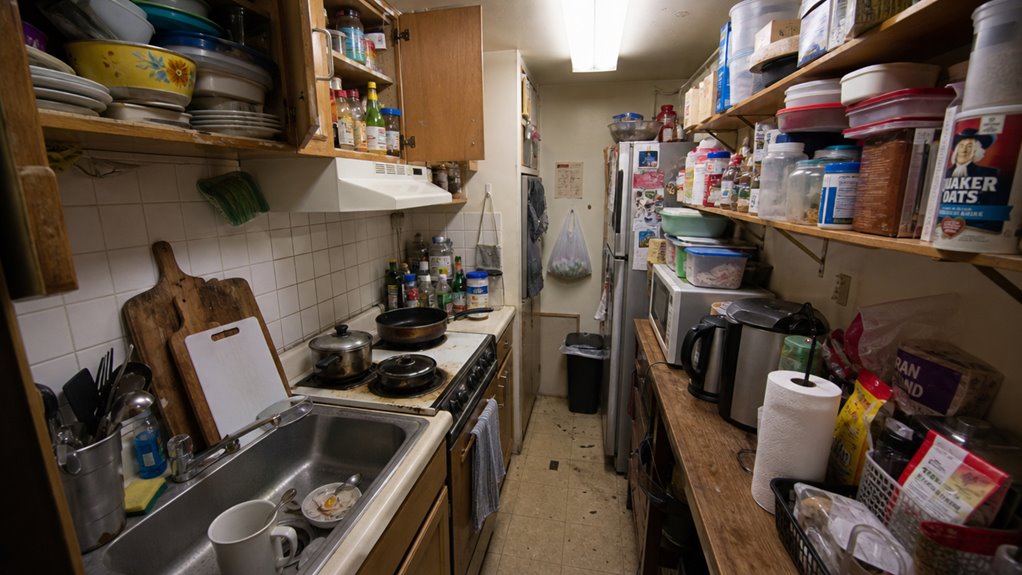
You live with limited counter and weird built-in plumbing, so most kitchen storage advice from big homes just doesn’t translate to your layout. You also can’t rely on permanent fixes, because your lease usually blocks drilling and cabinet mods, which is why removable options like Command hooks, tension rods, and adhesive-backed magnetic strips matter. If you trust adhesive hooks to hold real weight, you need to pick the right kind for your surface since their biggest downside is they can fail on rough or newly painted areas. Magnetic shelves can also hold substantial weight by sticking to magnetic surfaces like fridges using powerful backing strips.
The No-Renovation Reality (And Why It Matters)
Why does most “apartment kitchen organization” advice miss the mark? Because it assumes you can drill, cut, or swap cabinets. In rentals, that can cost money fast, especially with security deposits. You need removable kitchen storage and renter kitchen storage that fit weird layouts and move with you. Even apartment kitchen organization Reddit keeps repeating: skip fixed “dream kitchen” installs and use flexible hardware.
A key takeaway is that flexible storage solutions work best because they adapt to your space without permanent changes. One practical way to stay renter-friendly is to repurpose everyday hardware so you can add low-profile storage without drilling—like mounting a toilet paper holder to hold lightweight towels, accessories, or small baskets.
Why Apartment Kitchens Need Removable Storage Solutions
Apartment kitchen storage advice often assumes you can drill, swap shelves, or build fixed pantry “solutions” into the cabinetry. In rentals, you can’t, and you shouldn’t risk deposits. That’s why removable storage wins renter-friendly apartment kitchen organization: tension rods, freestanding bins, and Command-strip basics move with you, fit weird cabinet depths, and don’t block sink flow. You keep options as roommates and layouts change.
Because drawers in base cabinets are usually easier to access than doors (especially for reaching items without kneeling), renters can prioritize pullout bins and insert organizers that slide into base drawers to improve daily usability even when you can’t renovate.
Why Adhesive Hooks Outlast Cabinet Modifications
Adhesive hooks beat cabinet modifications in apartments because they work with the lease reality: most kitchens don’t allow drilling, screwing, or any permanent hardware changes. You skip approval, patching, and move-out damage. Here’s the trade-off for apartment storage:
| Choice | Time | Risk |
|---|---|---|
| adhesive hooks | 30 sec | light residue |
| cabinet modifications | hours | landlord + holes |
| rehangable setup | flexible | correct surface needed |
5 rows: backsplash, cabinet side, pantry door, smooth tile, painted wood.
In many kitchens, adhesive hooks are also the safer pick for renters because they don’t require magnets strong enough to interfere with nearby electronics or create pinching hazards during repositioning. Plus, under-sink organization with sides helps you make the cabinet feel “renovated” by using existing space without altering the structure at all.
The 4 Storage Zones Every Apartment Kitchen Has (And How to Use Each)
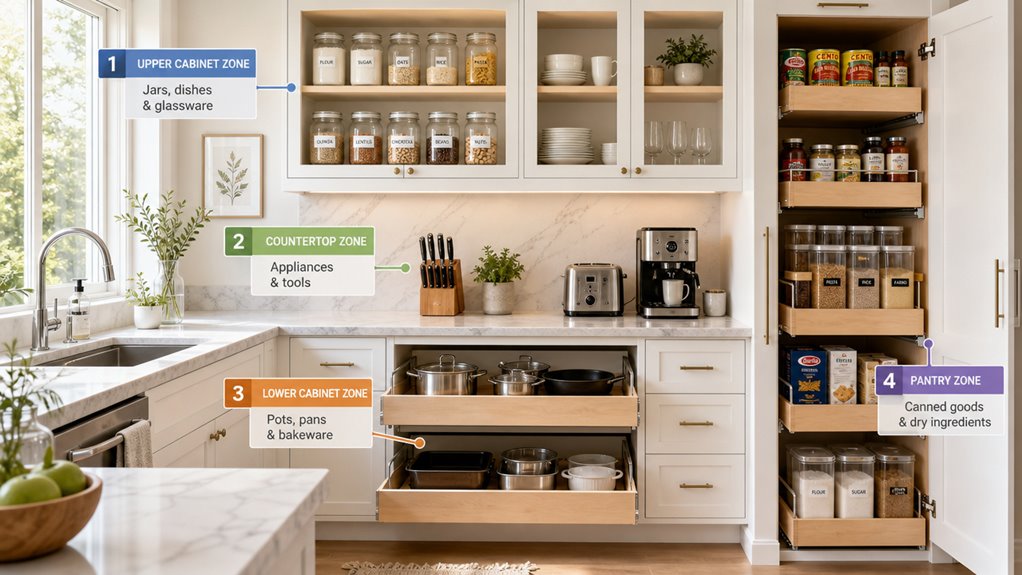
You’ve got four real storage zones in your apartment kitchen: the counter, vertical wall, cabinets, and the under-sink. Keep the counter as prime real estate for 8–10 daily tools, then use the vertical wall for things like a magnetic knife strip and pot hooks so your drawers don’t get swamped; in cabinets, tier by how often you reach for items, and save the under-sink for cleaning + bulk with a tension-rod shelf. In the Zone 1 setup, store appliances and cookware so you can access them fast, and keep your “refrigerator center” close to the grocery entrance with a nearby countertop landing spot for incoming bags. If your “organization set” can’t map those zones to your actual workflow without blocking the sink or wasting counter space, it’s probably just swapping problems around. A dedicated Prep Zone helps keep chopping, mixing, and assembling tools (like cutting boards, knives, and measuring cups) in the right place so you’re not hunting mid-cook.
Counter Zone (Prime Real Estate, 8-10 Tools Max)
Counter space is the prime real estate in a small kitchen, so you want to treat it like a limited budget, not a catch-all. Keep countertop clutter down by running 8–10 items max: your daily appliances, knife block/strip as one unit, and a small utensil crock. Split into prep, cooking-support, beverage, and sink-landing zones. Clean out first everything else goes off-counter, even weekly stuff. Hidden storage drawer-by-drawer Everything else goes off-counter, even weekly stuff.
Vertical Wall Zone (Where Galley Kitchens Win)
Once you’ve capped your counter zone at about 8–10 daily tools, your walls can do the rest of the work. In the vertical wall zone, use wall-mounted systems & hardware along the galley’s parallel runs for a shallow 4–8 inch band, so vertical storage keeps frequently used items within easy reach without stealing countertop space. Swap extra-drawer storage for a magnetic strip to hold metal tools like scissors or bottle openers, then add open shelving & shallow cabinetry for jars and plates, keeping 18 inches clearance above.
Cabinet Zone (Tiered by Retrieval Frequency)
Figuring out your cabinet zone is less about “more storage” and more about making the right stuff easy to grab without turning your kitchen into a treasure hunt. Use kitchen organization: put daily dishes at shoulder-to-waist height; add shelf risers for vertical layering inside cabinets; keep one layer deep. For small spaces, hidden/hidden-bed-style concepts makes limited storage work harder without renovation. Mid-cabinets hold weekly tools in bins; low shelves take bulky extras in labeled baskets.
| Zone | Put here | Setup |
|---|---|---|
| High | plates, mugs | risers, turntables |
| Medium | bowls, baking | bins, pull-outs |
| Low | serveware, pans | lidded bins |
| Rules | one layer | quick visibility |
Under-Sink Zone (The Most Underused Storage)
Your cabinet zone already gets most of the love, so the under-sink is where you’ll actually feel the difference. Use under-sink storage for backups, not pantry food. Add a vertical and modular structure around pipes with U-shaped cutouts, then stage bins on a waterproof tray. For pull-out access and door-based storage, go for sliding baskets and a shallow door rack for gloves and rags. vertical storage helps you avoid wasting the space above and around the plumbing. Consider using an Over-the-Door Organizer so you can keep frequently used essentials close without taking up valuable shelf space.
Magnetic Strips, Hooks, and Hanging Solutions
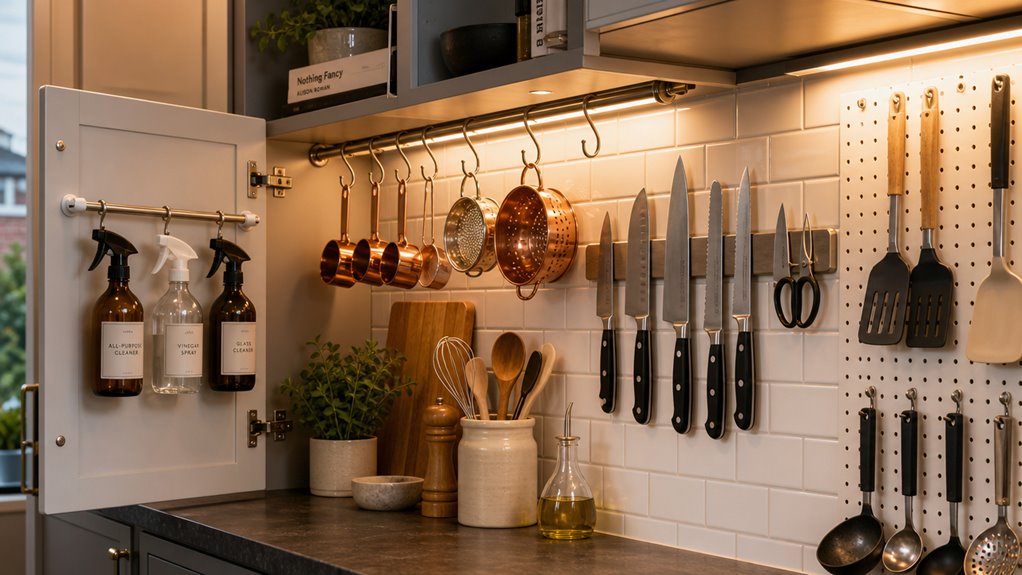
You can mount an adhesive-backed magnetic knife strip on tile or use a renter-friendly Command-strip base to keep knives and metal tools off your counter, freeing about 8–24 inches of space. For a stronger, space-saving hold, the Wood Magnet Knife Strip uses 5 magnets to keep knives and other metal tools securely within reach. In apartment kitchens, that’s a practical way to reduce clutter without renovating. Walnut magnetic knife strips are commonly sold in wall-mounted styles and can come in multiple wood finishes, which helps you match the look of your kitchen.
For pots, utensils, towels, and lighter items, use adhesive hooks in a staggered “utensil wall” layout, but remember each hook’s weight rating and limitation: it only works well on clean, dry, smooth surfaces.
In rentals, Command strips usually outlast drilled mounts because you don’t leave holes behind, but they can fail if your wall’s finish isn’t compatible.
Magnetic Knife Strip Mounting (Renter-Safe Install)
If you want a magnetic knife strip in a rental, tape-only mounting can work, especially on smooth backsplash surfaces. Prep with isopropyl alcohol, level it, and press hard 30 seconds; then cure 24 hours before loading. Use a magnetic knife strip for renter-safe mounting with no-drill installation, keeping it away from heat.
| Option | Best surface | Limitation |
|---|---|---|
| Double-sided tape | tile/metal | weak on chalky paint |
| Tape-ready strip | glazed tile | misalignment hard later |
| Heat-release rescue | sealed wood | repeated removals weaken |
Adhesive Hook Strategies for Pots, Utensils, Towels
Adhesive hooks and hanger systems give you the “vertical wall” zone without drilling, and they’re a nice follow-up to getting a magnetic knife strip on your backsplash.
Use apartment kitchen storage with adhesive hooks rated 3–5 lb per hook for pans; don’t exceed 50–75% load.
Mount on smooth tile/metal, and keep towels spaced 4–6 inches for airflow.
For under-sink organization, skip hooks that meet steam.
Why Command Strips Outlast Drilled Mounts in Rentals
Command strips usually beat drilled mounts in rentals because they solve the real problem—access without leaving damage—while still doing the job day-to-day. Use Command strips for damage-free removal: pull tabs straight down, prep with rubbing alcohol, and avoid heat/humidity zones. They don’t weaken drywall like repeated drilling.
Magnetic strips and hooks stay reconfigurable, but they won’t bond well to brick, concrete, or rough wood.
Cabinet Organization (Without Buying More Stackers)
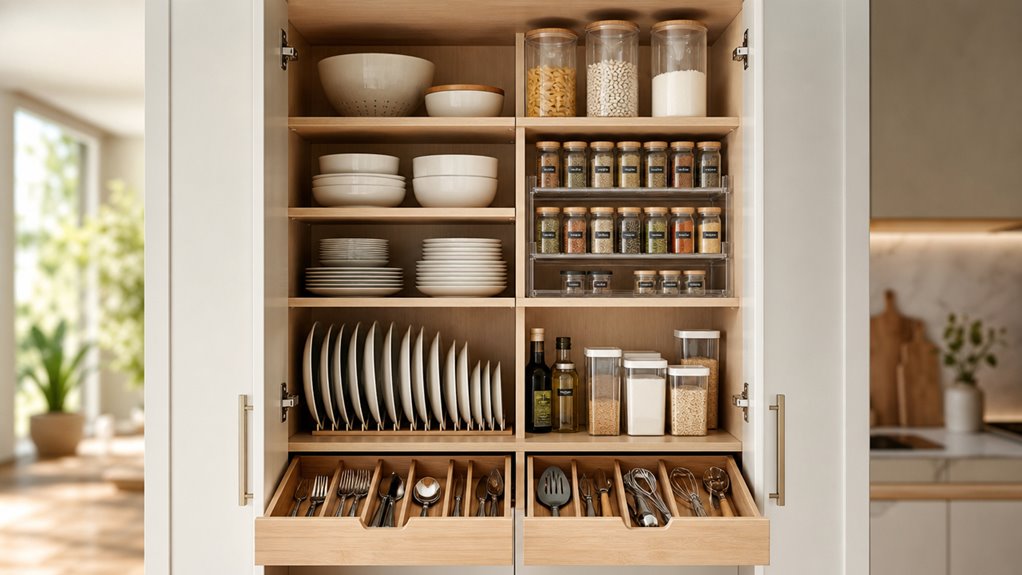
You’ll get more usable cabinet space by picking one clear rotation plan: use a Lazy Susan for bottles and condiments in deep corners, and skip tiered shelves when your cabinet depth doesn’t match the shelf spacing.
If your drawers are crowded, drawer dividers usually beat the “throw everything in” routine because they stop lids, packets, and wraps from turning into a jumbled search party.
And when you want that extra boost without stackers, under-shelf hooks can free roughly 30% more space, but they only work well if you’ve got something thin enough to hang without scraping the shelf below.
The Lazy Susan vs Tiered Shelf Decision
If your cabinet already feels like a black hole the moment you load things in, the Lazy Susan vs. tiered shelf choice comes down to how often you reach for the back row.
In small apartment storage, a Lazy Susan rotates, so one-handed access beats rummaging.
Use a Tiered shelf for visibility with similar items, but tall containers block upper tiers, creating blind spots near the back.
Why Drawer Dividers Beat the “Throw Everything In” Approach
After you’ve sized up whether your cabinet needs a Lazy Susan or a tiered shelf, the next improvement is usually inside the drawers: stop “throwing everything in” and start separating what you actually grab during cooking. Drawer dividers create divided drawers for baking tools, prep tools, and cutting tools, reducing clutter control. Add compartments for lids, utensils, and small hardware to speed setup, simplify cleaning, and protect edges from bangs.
When Under-Shelf Hooks Free 30% More Cabinet Space
Under-shelf hooks are one of those renter-safe tweaks that feels small until you look at the “dead” space you’ve been wasting.
In rental apartments, they’re space-saving storage that can free about 30% more cabinet space. Clip-on or adhesive rails under shelves let mugs and utensils hang in a second layer.
Limitation: adhesive under-cabinet rails usually cap at 5–8 lb.
Storage Solutions That Don’t Work (Reddit’s Verdict)
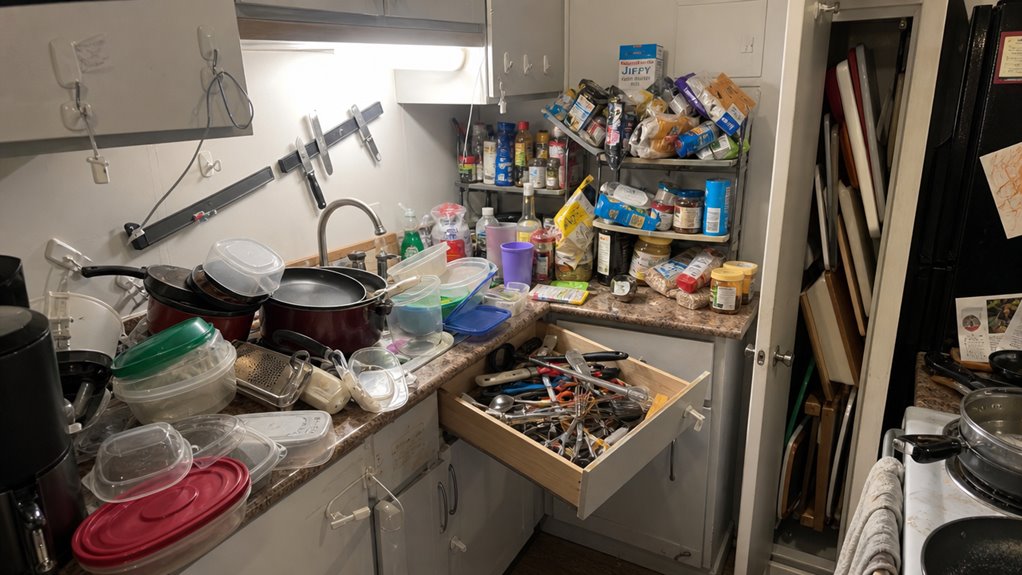
You’re probably seeing the “apartment kitchen organization” sets that look tidy in photos, but they usually charge you with the counter tax: counter-stacked spice racks swallow prep space for too few everyday items.
The over-sink cutting board is the other classic fail, because it blocks sink use right when you need the workflow most, and you end up skipping it or moving it constantly.
If your plan depends on a fixed, mismatched layout, you’ll fight it every day—Reddit’s verdict is basically that piecewise, renter-safe storage beats gimmicks that don’t fit your actual space.
Counter-Stacked Spice Racks (Counter Tax)
Counter-stacked spice racks sound like a quick win, but they charge you “counter tax” in daily use. In small kitchen storage, countertop spice racks steal 1–2 sq ft from prep and turn into clutter magnets. You also reach awkwardly for back jars, labels get obscured, and steam/grease near the stove ruins lids.
- Wasted prime counter space
- Slower access from tiers
- Wobble/tipping risk when loaded
- More dusting and label cleaning
Over-Sink Cutting Boards (Sink Use Loss)
An over-sink cutting board sounds like free prep space, but it quietly charges you “sink use loss” during the part of cooking you do most: washing and moving food. It blocks sink access, so you lift, rinse, and re-level constantly.
Over-sink boards wobble on mismatched rims, skidding knives, and trap moisture and splash beneath. In apartment storage, they also end up parked unused.
Why Most “Apartment Kitchen Organization” Sets Cause More Problems Than They Solve
Why do those “complete” apartment kitchen organization kits keep ending up half-used and somehow making your kitchen feel tighter? Because they’re mismatched, fixed-size, and push you into plastic storage containers you’ll stop maintaining. Shelf risers without adjustable height steal usable clearance, tipping you into “jenga” stress. Add 1) kits that ignore plumbing depth 2) duplicate organizers 3) back-row access issues 4) bin black-box frustration.
Frequently Asked Questions
What’s the Best Renter-Safe Way to Store Knives Without Drilling?
What’s the best renter-safe way to store knives without drilling?
Use an adhesive-backed magnetic strip mounted on tile, a fridge, or a metal panel.
How do you apply an adhesive magnetic strip?
Clean and dry the surface, attach the strip, then wait 24 hours before placing knives on it.
What are other renter-safe knife storage options?
A slim knife sheath or an in-drawer knife organizer.
What are the benefits of in-drawer organizers?
They keep counters clutter-free and knives safely stored without any wall damage.
How Do I Keep Spices Organized Without Losing Counter Space?
How Do I Keep Spices Organized Without Losing Counter Space?
Move spices vertical and off the counter using an over-the-door rack or cabinet pull-out organizer. Decant spices into uniform jars for neat stacking. Mount a magnetic strip or adhesive magnetic tins on steel surfaces for wall storage and quick access.
Where Should Cleaning Supplies Go Under a Typical Apartment Sink?
About 70% of under-sink space typically goes unused. Dish soap, sprays, sponges, and pods belong in front bins for easy access. Heavier cleaners should stand upright in a leakproof mat-backed bin positioned toward the back.
Will Command Hooks Damage Paint or Come off in Rentals?
Command hooks are generally safe for rentals when used correctly. They are designed to remove cleanly without damaging paint. However, damage can occur if hooks are overloaded beyond their weight limit, removed incorrectly, or applied to fresh, uncured, or wallpapered surfaces. Always pull the release strip slowly and straight down to avoid paint peeling.
Why Do “Complete Kitchen Organization Sets” Usually Fail in Apartments?
Why do complete kitchen organization sets fail in apartments?
They are designed for generic spaces, not your specific cabinet depths, counter dimensions, or workflow.
Do they waste space?
Yes. They often occupy prime counter real estate while leaving awkward gaps and unusable corners behind.
What is a “black hole” in kitchen organization?
A dead zone where items get pushed and forgotten, usually created when bins or organizers don’t match actual cabinet dimensions.
Do these sets work with renter-safe installation?
Rarely. Many require drilling or permanent mounting not permitted in most rental agreements.
Why don’t items stay organized after using these sets?
The system isn’t built around your habits or cooking style, so the layout fights your natural workflow.
Are cabinet depth mismatches a common problem?
Yes. Standard sets assume uniform cabinet sizes, which most apartments do not have.
Is buying individual pieces better than a complete set?
Yes. Single targeted pieces matched to your exact measurements outperform bundled sets almost every time.
Conclusion
If you’ve tried “kitchen organizing kits” and they still feel chaotic, you’re not doing it wrong. Stick to four zones: counter, vertical wall, cabinet, under-sink. Use adhesive magnetic strips for metal tools, under-shelf hooks for lids, and tension rods for spray bottles. The main limitation is that adhesive storage depends on clean, dry surfaces, so you’ll re-position it sometimes. Once the system matches your workflow, it stops being a project.
