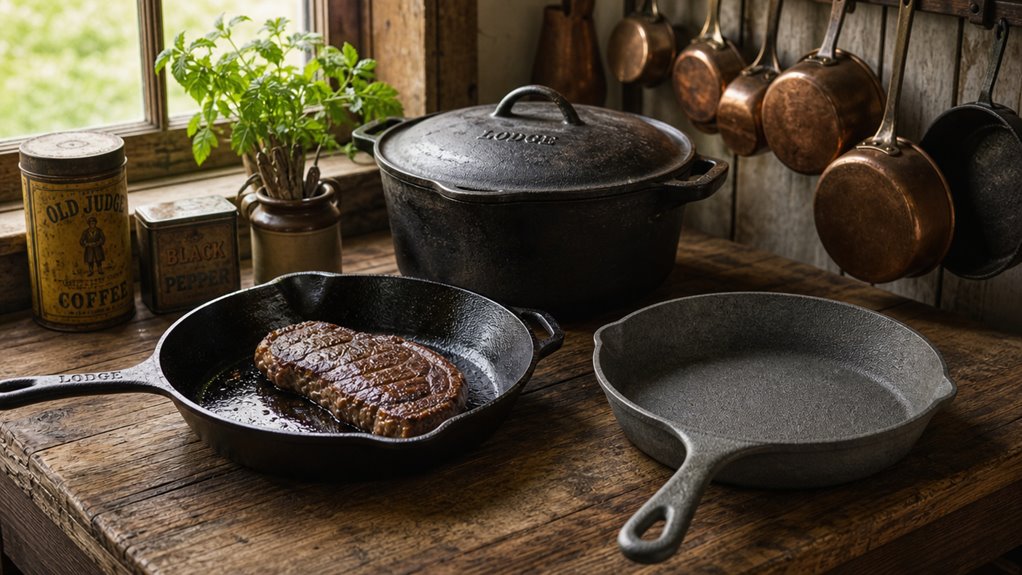

Lodge Cast Iron: it endures 100+ years because its iron-carbon alloy structure produces graphite flakes that absorb thermal stress without pitting the metal surface.
Three salient properties that drive Lodge Cast Iron‘s longevity:
- Iron-Carbon Alloy Composition — Lodge Cast Iron contains carbon that transforms into graphite flakes, giving the metal its heat-resistant and crack-tolerant structure
- Sand Casting Process — Lodge Manufacturing Company in South Pittsburg, Tennessee uses consistent sand molds, producing dense and uniform cookware walls that resist warping over decades
- Factory Oil-Based Pre-Seasoning — Lodge applies a soy-based oil seasoning at high heat before the pan ships, bonding a rust-resistant polymerized layer directly to the iron surface
To spot a lemon, inspect each piece with purpose. Run your finger along the seam near the handle and feel for hairline cracks. Lodge Cast Iron without visible cracks at the handle joint is structurally sound. Pinholes and sharp flash on the cooking surface indicate rough sand fill during casting at the South Pittsburg facility. Set the pan on a flat counter. A bottom that wobbles means uneven casting, and Lodge Cast Iron with bottom wobble will rock on a gas or electric burner.
Dry Lodge Cast Iron completely after washing. Water left on raw iron starts surface rust within hours.
Interesting Fact: Lodge Manufacturing Company, founded in 1896 in South Pittsburg, Tennessee, is the oldest surviving cast iron cookware manufacturer in the United States, making it the only major American brand still producing cast iron in its original factory location.
Key Points
- Lodge cast iron is a graphite-rich iron–carbon alloy that tolerates extreme heat with less pitting and better thermal shock resistance.
- Sand-casting’s slower cooling lowers internal stress, and the rough surface helps oil soak for durable seasoning adhesion.
- Lodge uses consistent modern molding, induction melting, and thinner vegetable-oil pre-seasoning, improving batch-to-batch quality and rust control.
- Spot lemons by inspecting for hairline cracks, pinholes, or sharp flash, especially near the handle or bottom walls.
- Verify longevity health with a bright-light and tactile check, plus a wobble test on flat glass for bottom warping.
The Material Science Behind 100-Year Cast Iron
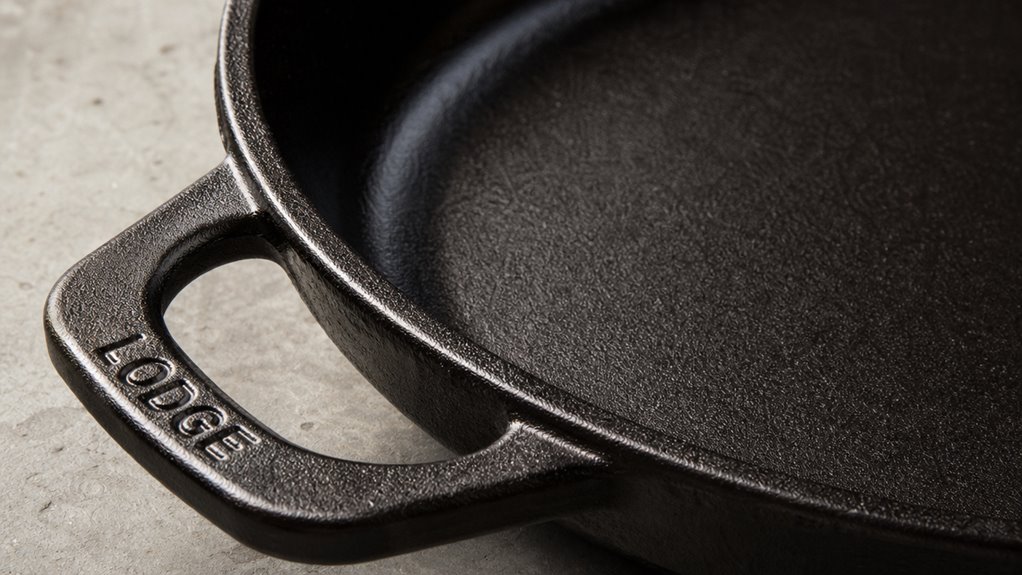
You’re getting long life because cast iron is an iron-carbon alloy (about 2–4% carbon) where carbon mostly ends up as graphite flakes instead of brittle cementite, which helps the pan handle heat swings without cracking as easily as many stainless setups. You can think of silicon (roughly 1–3%) as nudging that graphitization during solidification, so the iron forms a gray-iron structure that’s a bit more forgiving under daily thermal stress. graphite flakes And with sand-casting, Lodge pours molten metal into bonded sand molds, locking in that rough texture that holds seasoning better than smoother modern forming methods, though the same rough surface can feel less “slick” right out of the box. In fact, graphite morphology is the big reason gray cast iron tends to behave more like a heat-tolerant, self-lubricating cooking surface rather than a brittle one.
Why Iron-Carbon Alloy Beats Stainless for Heat Tolerance
Why does iron–carbon outlast stainless when you keep cranking up heat?
Start with CarbonSteelHighHeatTolerance: iron–carbon can handle roughly 1425–1540°C before melting, far above common stainless operating limits. Its iron-carbon structure resists deformation at 1000°F+ without pitting, so your skillet stays true longer. Higher-carbon heat-treated versions build strength as carbon hardens after 0.1% shifts. You also get steadier cooking because carbon steel’s thermal conductivity is about 45 W/(mK), helping prevent hot spots. Stainless holds up too, but chromium’s oxide behavior caps practical heat. One limitation: cast iron and carbon steel aren’t as corrosion-resistant. Carbon steel definition: carbon steel is an alloy of iron and carbon with carbon content typically 0.05% to 2.0%.
How Sand-Casting Differs from Modern Forming Methods
Sand-casting works a lot more like “casting the shape in place” than like modern metal-forming tricks. In sand casting, you pack bonded sand around a pattern, pour molten 97% iron (about 3% carbon), then let it cool in the mold before breaking the sand away. That slower cooling supports steadier grain development and lower internal stress than rapid processes, which helps cast iron last 100+ years. You also get rougher surfaces and more dimensional variation, so QC matters. sand casting supports flexibility in part size and alloy selection, which is why it remains common for traditional cast iron parts. iron casting materials can also be chosen to balance strength, wear resistance, and toughness for long service life.
| Sand casting | Modern forming |
|---|---|
| Lower tooling cost | Higher tooling cost |
| Recyclable molds | Fixed dies/molds |
| Slower cooling | Faster cooling |
| Rougher finish | Smoother finish |
Lodge-Specific Manufacturing That Drives Longevity
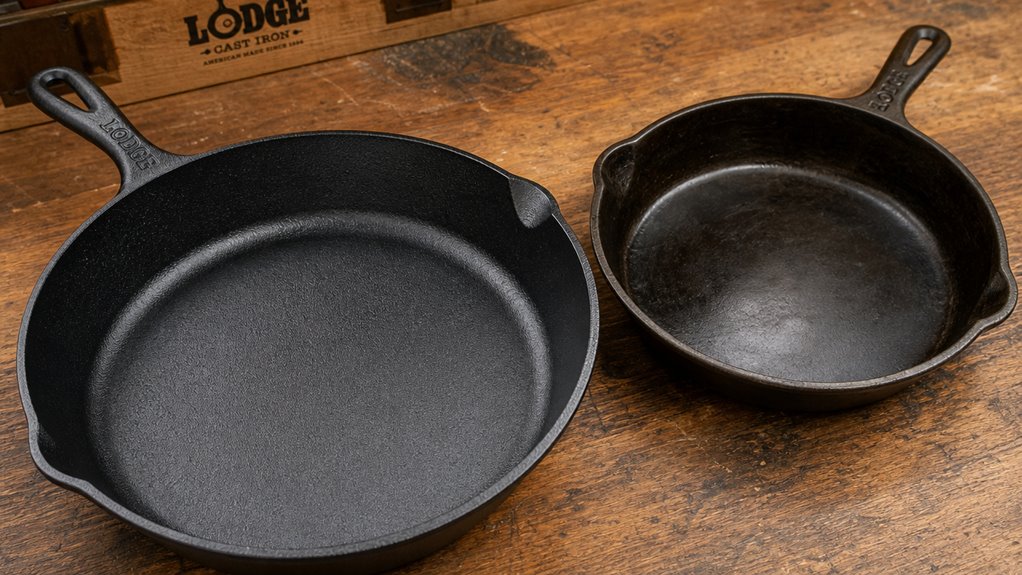
You get Lodge longevity partly because their South Pittsburg, Tennessee foundry has kept refining the process since 1896, and they moved from hand-pour to Disamatic automated molding in 1965 to keep each casting consistent. You can also see a production reality in 2010: Lodge stopped using Crisco for factory pre-seasoning stability and switched to a vegetable-oil-based finish, which changes how “easy-release” feels on day one. One trade-off to keep in mind is that the current pre-seasoning can be a bit less non-stick at first than some older pans you’ve handled, even though rust control is still solid. safety and risk control are built into every step of the process, from handling molten metal to inspection and finishing. The foundry’s casting core still relies on sand molding—a method that dates back to 680 B.C. and remains one of the most practical ways to cast iron cookware.
South Pittsburg Plant: 130 Years of Process Refinement
How did Lodge end up with cast iron that commonly lasts a lifetime-plus? You can trace it to the lodge factory south pittsburg: founded in 1896, with the current plant running since 1910. You’ll find two foundries there, both keeping the same core sand-casting workflow while refining details for 130 years. Family management also keeps continuity, plus the site hosts a museum that documents technique changes. By 2002, factory-seasoned skillets cut the old home-seasoning grind, and by 2007 everything shipped pre-seasoned for immediate use. One trade-off: modern pans can feel rougher than older ones, helping seasoning bond. Inside those same South Pittsburg operations, Lodge refined induction-based melting after 1994 to support consistent metal quality from batch to batch. That consistency starts with sand molding and the steady, repeatable pour process.
Why Lodge Stopped Using Crisco in 2010 (And What Replaced It)
By the time you’re looking at Lodge’s South Pittsburg process and how it learned to pre-season over the years, the 2010 change makes more sense than it sounds. During the Lodge Crisco discontinuation, they stopped factory Crisco and moved to a proprietary soy-based vegetable oil. You still get rust-proofing and an initial seasoning layer, but it’s thinner and you may notice less “instant slick” than older pans. The upside is consistent, low-odor application, without shortening refinement quirks. Here’s the trade:
| Change | Goal | What you’ll notice |
|---|---|---|
| Crisco → soy | Shelf-stable pre-season | Slightly less base non-stick |
| Same process | Thin oil coat | You still build seasoning |
| Care stays similar | Dry after washing | Flash rust if you skip it |
Polishing at lower temps depends on applying extremely thin layers and baking long enough to become non-tacky, so Lodge’s thinner base coating can feel a bit different until regular cooking adds more polymerized fat and carbon residue. Many forum members avoid factory pre-seasoning on Lodge pans and often strip the coating before seasoning them themselves.
How to Spot a Lemon: Defects That Predict Early Failure
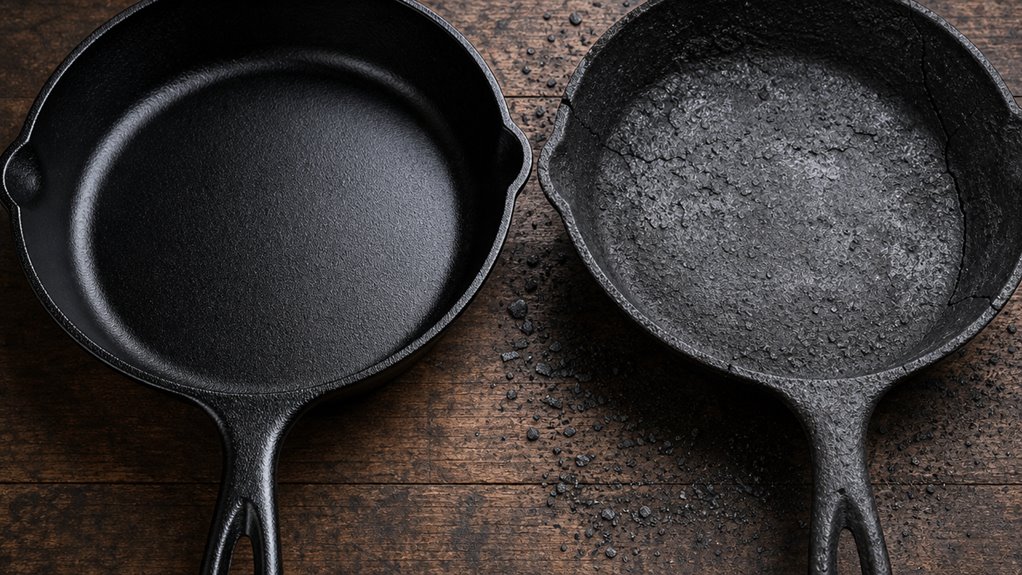
When you inspect a Lodge pan, look closely at hairline cracks near the thick sections and along the bottom wall, because those little splits can turn into real structural failure once heat and stress pile up. Cracks can be mistaken for scratches but may lead to complete breakage, so treat them as a critical defect. Next, do a quick wobble test on flat glass or steel: if it rocks or liquids pool oddly, the bottom may be warped and you’ll fight uneven cooking. Finally, don’t panic over normal sand-cast texture—pinholes and sharp flash are the red flags, while rough spots that match the surface finish (or oil bubbles that vanish with seasoning) are usually just part of the casting story.
When you see brown-tinged discoloration on a brand-new Lodge pan, it’s typically a temporary factory processing artifact from the seasoning step (not true rust), and those spots generally smooth out with use.
Hairline Cracks: Where to Look and What They Mean
Hairline cracks show up most often in the sidewall, usually from thermal shock—think rapid heating or cooling—or from a physical bump that you didn’t realize did anything. You’ll often see hairline cracks as thin cosmetic lines, and they usually don’t leak or seal instantly with seasoning. Check under bright light by holding the pan at an angle and look for counterparts crossing the rim. Tap gently with a wooden spoon; a clear resonant ring is a good sign, muffled tone can mean a hidden issue under seasoning. Use tactile checks by feeling around the cooking surface with your hands whenever possible, because some cracks are harder to confirm once rust and crud hide them. If you find hairline cracks near the handle, treat it as higher break risk.
Wobble Test: Flat Bottoms vs Warped Manufacturing
So you’re checking cast iron for “lifetime” potential, and the wobble test is one of the few checks you can do in a minute without guessing. Set the skillet on a flat table and watch for Warping: it’ll rock or spin. Wiggle both sides; then pour a little water and see if it pools to one side. If you catch warp signals light under a credit card, the bottom isn’t even, and that predicts early failure.
- Rocking back and forth
- Spinning in place
- Water pooling unevenly
- Credit-card gap on exterior
- Heat-ring wobble that matters
If it spins on glass or electric, you risk spills.
Rough Spots vs Surface Texture: Knowing the Difference
Roughness on a Lodge-style cast iron pan can look alarming until you know what “normal” means. In sand casting, you get a pebbly, uniform rough texture from the mold’s indentations, meant to help oil soak in and season evenly over time. That kind of texture usually looks consistent across the surface, with no weird shapes. A deeper oil penetration can happen because the rough pores and grooves help seasoning oil adhere more effectively. That same rough, pebbly finish is what modern manufacturers leave on purpose to make seasoning easier and more reliable. A lemon shows up as defects: cracks at edges, thin spots, deep pits, jagged voids, or excessive porosity beyond the normal rough texture. Also watch for irregular lumps or patchy pre-seasoning that won’t even out.
Why Vintage Wagner and Griswold Pans Often Outlast Modern Lodge
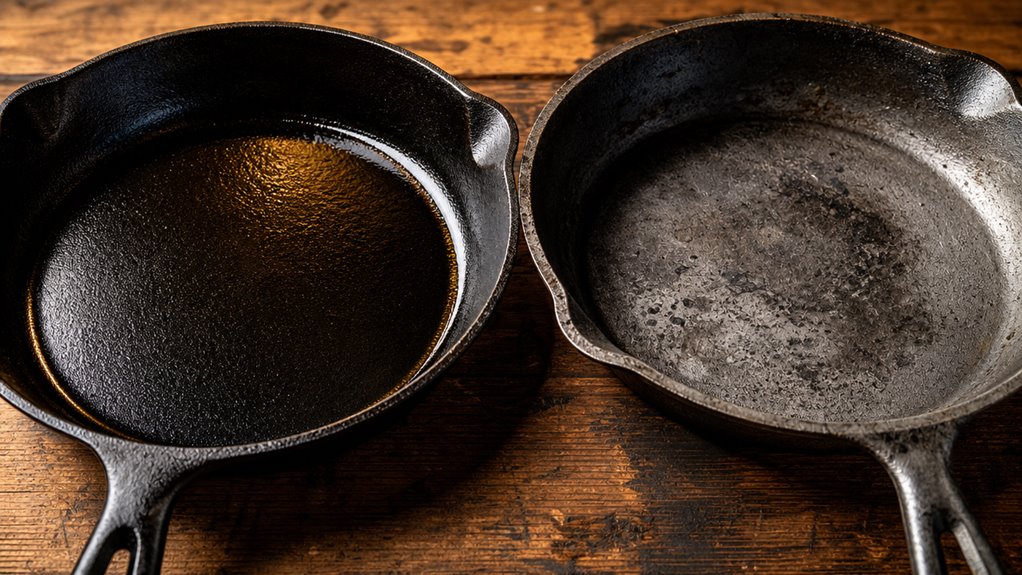
You’ll notice pre-1957 Wagner and Griswold pans often feel lighter because their thinner walls and early casting tolerances put less iron in the frame, which helps them heat and cool fast without stressing the pan.
Modern Lodge is commonly heavier with thicker walls, and that extra mass is partly why it’s so durable in everyday use, but it also means more time to come up to temperature and more stored heat to manage.
One limitation you should admit up front: if you want that smooth, machined cooking surface for easy sticking control, many newer Lodge interiors don’t match what older, more finely finished Wagner and Griswold pieces were built to do.
Pre-1957 Manufacturing Methods That Disappeared
Ever wonder why some pre-1957 Wagner and Griswold pans seem to shrug off decades of daily use while modern Lodge often needs a bit more care? In Vintage cast iron, molds were hand-tamped: sand, water, clay, then cope and drag halves mated manually. Foundrymen poured from single ladles, which slowed speed but kept detail crisp.
- Manual sand molding let thin walls survive
- Patterns pressed precisely without hydraulic rams
- Careful ladle pours reduced casting stress
- Breakout and cleaning were hands-on
- Finishing often used wax, so you seasoned later
That’s the trade-off: slower output, lighter reinforcement, longer life.
Why Modern Lodge Is Heavier Than Vintage (And Why That Matters)
After you’ve compared how older pre-1957 foundry practices often produced lighter, more detailed castings, the weight difference is the next tell. Modern Lodge uses a lodge sand cast mold, pours molten iron, and then keeps it thicker. For a 10-inch pan, you’re looking at about 5mm walls and a 6mm base, so it lands around 4.5 lb. Vintage Wagner and Griswold often get machined thinner, so similar sizes can run near 4.0 lb or lighter. That extra iron means more durability, but slower heat response and easier fatigue when you lift. One limitation: the rough, pebbly surface seasons slower.
Maintenance Habits That Determine Whether Your Pan Lasts 5 Years or 100
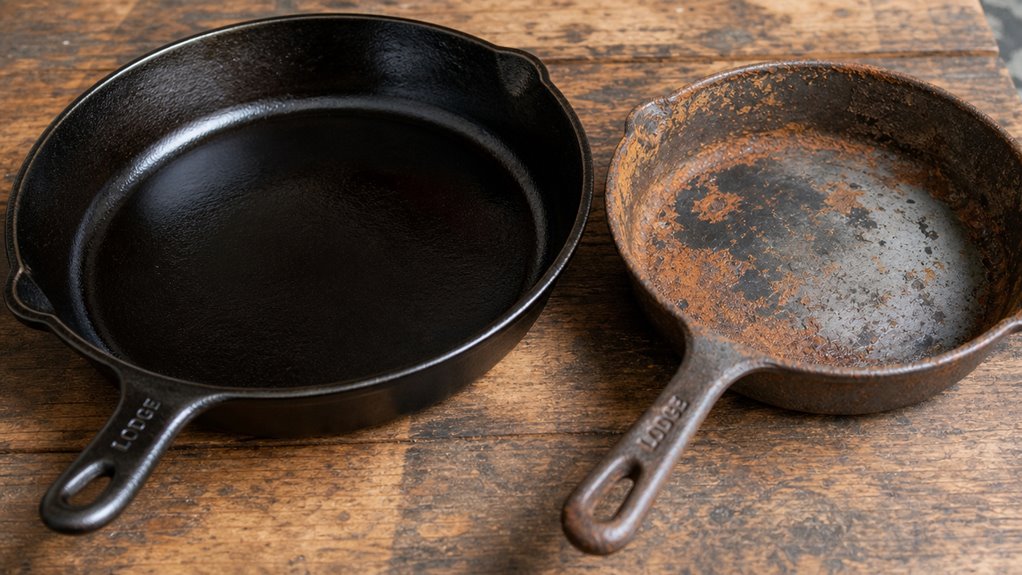
If you do just one thing, make it the wash–dry–thin-oil routine right after cooking; skipping the oil or leaving moisture behind turns surface rust into a weekend project fast.
When you store your Lodge, keep it in a dry spot with a light coating, and avoid soaking or air-drying because that’s where premature rust and seasoning loss start.
Even if the metal can take the heat up to about 700°F, your habits around cleaning and storage decide whether you see 5 years or 100.
The 30-Second Habit That Doubles Pan Lifespan
The 30-second habit that really changes the odds for your Lodge is how you handle it the moment you finish cooking: right after the pan goes off the heat, wash (as needed), then get it back on a stovetop burner just long enough to drive off every drop of water. This fast drying protects the seasoning bond you’re building, so you don’t waste your next session re-seasoning.
- Wipe out excess oil completely
- Keep heating until light smoking starts
- Use about one teaspoon vegetable oil
- Maintain medium heat for a few minutes
- Let it cool undisturbed before stacking
Storage Conditions That Cause Premature Rust
Once you’ve dried your Lodge right after cooking, storage decides whether that work pays off. If you stack it with a lid, you trap humidity in a sealed pocket, and moisture finds the pores. That can start rust fast, even if the surface looks dry. You also risk trouble in sink cabinets, basements, and bathrooms where humidity stays above 60%. In tight, unventilated cabinets, condensation doesn’t get a chance to evaporate. Use airflow, store the pan apart from lids, and keep a light, clean oil layer. This protects your lodge cast iron lifespan and seasoning barrier.
Frequently Asked Questions
Are Pre-Seasoned Lodge Pans Still “seasoning-Ready” for Generations of Cooking?
Lodge pre-seasoned pans arrive with a factory-applied polymerized oil layer bonded to the iron. This base layer is cooking-ready immediately. Full seasoning depth builds over years of use. Dry the pan after washing, oil lightly, and cook often to maintain it.
How Can I Verify a Lodge’s Continuous Warranty Eligibility Without Proof of Purchase?
Lodge may verify warranty eligibility without proof of purchase by reviewing your item number, size, color, purchase timeframe, damage photos, logo photos, preheating method, and contact information, with a response in 1–2 business days.
What Seasoning Oil Should I Use to Minimize Carbon Buildup on Rough Sand-Cast Pans?
For rough sand-cast pans, use refined avocado oil, vegetable oil, or canola oil. These have high smoke points that reduce carbon buildup. Always apply thin coats and stay below the oil’s smoke point.
Do Lodge Pans Warp From Overheating, and How Do I Prevent It?
Do Lodge pans warp from overheating?
Yes, Lodge pans can warp if exposed to temperatures exceeding ~900°F, rapid heat blasts, or sudden thermal shock.
How do I prevent my Lodge pan from warping?
Preheat gradually, cook on medium heat, skip self-clean oven cycles, and never place a hot pan in cold water.
How Do I Choose Between L8SK3 and Vintage Lodge for Similar Lifelong Durability?
Which lasts longer, L8SK3 or vintage Lodge?
Both offer lifelong durability when properly maintained.
What makes L8SK3 different from vintage Lodge?
L8SK3 has a thicker, rougher surface that grips seasoning more easily from new.
What is the texture of vintage Lodge cast iron?
Smoother and already worn-in, with an established patina.
Which is better for building seasoning quickly?
L8SK3, due to its rougher surface texture.
Which is better for immediate cooking comfort?
Vintage Lodge, because its surface is already broken in.
What defects should I avoid when buying either?
Warping, wobbling, and cracked junctions.
Conclusion
If you buy a Lodge cast iron that’s sound, you’re mostly buying for the long haul: good iron-carbon construction, sand-casting details, and clean contact at the base and handle. Just don’t skip the inspection. Look for hairline cracks, wobble, and rough flash you can’t fix with cleaning. One question: if the surface feels rough, should you trust it, or keep shopping? With basic care, your pan can plausibly last decades.