
This category rewards brand recognition more than most: the established sharpening-tool makers with replaceable or reversible components genuinely outlast the crowd of interchangeable ‘X-in-1’ bundle listings, whose glove-and-brush add-ons read as a sales gimmick rather than a durability signal.
Researched fit – which one is for you (1 of 2)
| Product | Very dull/damaged blade repair | Routine touch-up honing | Serrated blades |
|---|---|---|---|
| HENCKELS Handheld Ergonomic Knife Sharpener | ✓ | ||
| Smiths Pull Thru Knife Sharpener | ✓ | ✓ | |
| Gatco 6402 Double Duty Manual Sharpener | ✓ | ✓ | |
| AccuSharp Compact Pull Through Sharpener | ✓ | ✓ | |
| Lansky QuadSharp Knife Sharpener | ✓ | ||
| Rada Cutlery Quick Edge Sharpener | ✓ | ||
| KitchenIQ 50009 Edge Grip Sharpener | ✓ | ||
| Amazon Basics 4 in 1 Knife Sharpener |
Researched fit – which one is for you (2 of 2)
| Product | Beginner one-pass simplicity | Compact/travel |
|---|---|---|
| HENCKELS Handheld Ergonomic Knife Sharpener | ✓ | |
| Smiths Pull Thru Knife Sharpener | ||
| Gatco 6402 Double Duty Manual Sharpener | ||
| AccuSharp Compact Pull Through Sharpener | ✓ | |
| Lansky QuadSharp Knife Sharpener | ✓ | |
| Rada Cutlery Quick Edge Sharpener | ✓ | |
| KitchenIQ 50009 Edge Grip Sharpener | ✓ | |
| Amazon Basics 4 in 1 Knife Sharpener | ✓ |
Pull-through sharpeners promise quick fixes, but cheap models often slip, ruin a blade, or wear out after a few uses. The 2026 lineup focuses on sturdy abrasive materials: carbide or ceramic, preset angles, and compact designs that fit a key-ring or a countertop without wobbling.
Look for features such as replaceable cartridges, non-slip bases, ergonomic grips with finger guards, and clear warranty terms, these details separate a reliable tool from a flaky gimmick, and they hint at the balance between aggressive metal removal and fine honing that matters for kitchen, hunting, or pocket knives.
Cheap or expensive is the wrong question. Cost per use is the honest one. Check out our new Calculator.
Cost-Per-Use Calculator →The next sections break down the eight contenders and the criteria that matter most.
Key Points
- Prioritize models with dual-stage carbide-to-ceramic systems for fast coarse grinding and fine polishing.
- Choose units that offer preset angles (17°-30°) and V-Grip guides to ensure consistent bevel geometry.
- Opt for portable designs under 0.2 kg, slim profiles, and built-in key-ring holes for easy storage and transport.
- Verify replaceable abrasive inserts are tool-free snap-in or screw-mounted for quick maintenance without sacrificing stability.
- Ensure safety features like non-slip rubber bases, ergonomic soft-grip handles, and finger guards are included.
| Smith’s Pull-Thru Knife Sharpener |  |
Sports Enthusiast | Sharpening Stages: 2-stage (carbide + ceramic) | Material of Abrasives: Carbide & ceramic rods | Grip/Handle Type: Soft-grip rubber handle | VIEW LATEST PRICE | Read Our Analysis |
| HENCKELS Handheld Knife Sharpener – Ergonomic Compact |  |
Kitchen Pro | Sharpening Stages: 2-stage (coarse + fine ceramic) | Material of Abrasives: Ceramic grits | Grip/Handle Type: Ergonomic contoured plastic handle | VIEW LATEST PRICE | Read Our Analysis |
| KitchenIQ Edge Grip 2-Stage Knife Sharpener (Black) | 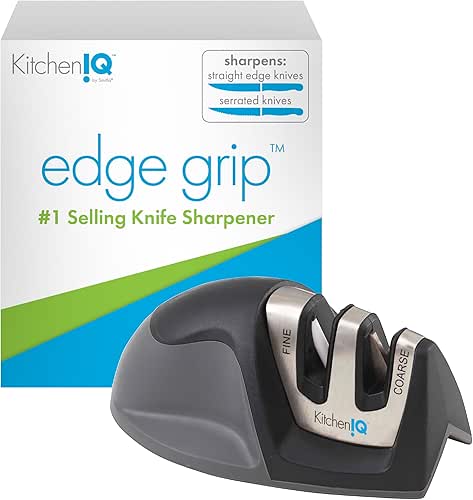 |
Compact Edge | Sharpening Stages: 2-stage (carbide + ceramic) | Material of Abrasives: Carbide blade & ceramic rods | Grip/Handle Type: Soft-grip rubber handle | VIEW LATEST PRICE | Read Our Analysis |
| Rada Cutlery Quick Edge Knife Sharpener (R119) |  |
Hunting Essential | Sharpening Stages: Dual-wheel (high-carbon steel) | Material of Abrasives: Hardened stainless steel wheels | Grip/Handle Type: Nylon base (no dedicated handle) | VIEW LATEST PRICE | Read Our Analysis |
| AccuSharp 2-Stage Compact Knife Sharpener |  |
Portable Power | Sharpening Stages: 2-stage (tungsten carbide + ceramic) | Material of Abrasives: Tungsten carbide & ceramic rods | Grip/Handle Type: ABS body, no dedicated grip | VIEW LATEST PRICE | Read Our Analysis |
| Lansky QuadSharp QSHARP | knife-sharpeners |  |
Angle Master | Sharpening Stages: 4-angle (carbide + ceramic) | Material of Abrasives: Carbide slots & ceramic benchstone | Grip/Handle Type: Synthetic handle, ergonomic shape | VIEW LATEST PRICE | Read Our Analysis |
| Gatco Double Duty Manual Knife Sharpener – Compact Pocket | 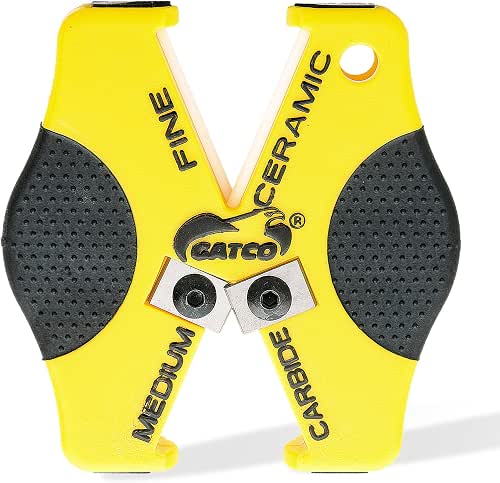 |
Pocket Ready | Sharpening Stages: 2-stage (tungsten carbide + ceramic) | Material of Abrasives: Tungsten carbide & ceramic rods | Grip/Handle Type: ABS frame with side pads | VIEW LATEST PRICE | Read Our Analysis |
| Amazon Basics 4-in-1 Knife Sharpener with Glove | 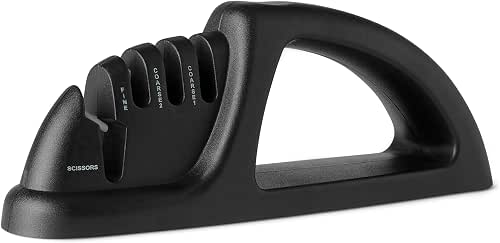 |
Safety First | Sharpening Stages: 4-in-1 (coarse + medium + fine + scissor) | Material of Abrasives: Metal & plastic (coarse-medium-fine) | Grip/Handle Type: Non-slip silicone base, no handle | VIEW LATEST PRICE | Read Our Analysis |
More Details on Our Top Picks
-
Smith’s Pull-Thru Knife Sharpener
The Smith’s Pull-Through Knife Sharpener appeals to anyone who treats their kitchen tools like a sports-carve, especially the sports enthusiast who demands quick, reliable edge restoration. It offers a two-stage system: a carbide stage for dull or damaged straight-edge blades, followed by ceramic rods that hone both straight and serrated edges.
The carbide removes metal smoothly, while the ceramic provides a fine finish. Its ergonomic soft-grip handle and non-slip rubber base give control and safety.
Key specs
- Model SP-50348, weight 0.1 kg, dimensions 2 × 1 × 6 in
- Gray blend material, coarse grit
- Replaceable carbide and ceramic components
Features
- Pre-set sharpening angles for consistency
- Pull-through operation, fast and easy
- Warranty via manufacturer, 30-day return guarantee
The design feels solid, but the coarse grit is better for initial sharpening than fine polishing. Use it for quick edge fixes, not for restoring a razor-sharp finish.
- Sharpening Stages:2-stage (carbide + ceramic)
- Material of Abrasives:Carbide & ceramic rods
- Grip/Handle Type:Soft-grip rubber handle
- Base Stability:Non-slip rubber feet
- Compatibility (Knife Types):Straight & serrated pocket/sports knives
- Dimensions (L × W × H):2 × 1 × 6 units
- Additional Feature:Replaceable carbide components
- Additional Feature:Ergonomic soft-grip handle
- Additional Feature:Non-slip rubber base
-
HENCKELS Handheld Knife Sharpener – Ergonomic Compact
A home chef who values consistency will find the HENCKELS Handheld Knife Sharpener a solid kitchen-pro companion. It combines a two-stage ceramic system, coarse grit for edge restoration and fine grit for polishing, into a matte-black, 8-ounce plastic body that measures 8.5″ × 7.7″ × 2″.
The ergonomic contoured handle works for left- and right-handed users, while a rubberized non-slip base and a safety grip keep fingers away from the blade.
Key attributes
- Coarse and fine ceramic grits (restore, hone)
- Ergonomic, ambidextrous handle
- Safety grip, non-slip base
- Compact dimensions, lightweight
The device is a single-unit package (model 11299-401, UPC 035886400828, ASIN B07GJXT272) backed by a manufacturer’s warranty. It offers a practical, low-profile solution for home chefs who want a reliable edge-maintenance tool without the hype.
- Sharpening Stages:2-stage (coarse + fine ceramic)
- Material of Abrasives:Ceramic grits
- Grip/Handle Type:Ergonomic contoured plastic handle
- Base Stability:Rubberized non-slip base
- Compatibility (Knife Types):Kitchen knives (straight)
- Dimensions (L × W × H):8.5″ × 7.7″ × 2″
- Additional Feature:Safety grip protects fingers
- Additional Feature:Rubberized non-slip base
- Additional Feature:Left-right hand friendly
-
KitchenIQ Edge Grip 2-Stage Knife Sharpener (Black)
KitchenIQ’s Edge Grip 2-Stage Sharpener fits cramped drawers while delivering a reliable edge. The black 50009 model measures 1.75 in L × 1 in W × 3.75 in H and weighs a feather-light 0.5 oz, so it slides into any utensil compartment without demanding space.
Its two stages, coarse carbide blade for damaged blades, fine ceramic rods for polishing, promise a quick fix and a razor-sharp finish. The patented V-Grip lets the user sharpen on a countertop edge, preventing tip drag, while non-slip rubber feet keep the unit steady.
Key points
- Carbide coarse stage handles very dull knives.
- Ceramic fine stage refines edges and works on serrated tools.
- Soft-grip handle offers comfort during repeated pulls.
- One-year limited warranty from GSM Outdoors.
The design feels sturdy despite its plastic housing, but the cheap-look finish may betray its modest durability.
Use it on flat surfaces or the V-Grip edge, but don’t expect professional-grade results; it’s a practical, budget-friendly solution for everyday kitchen chores.
- Sharpening Stages:2-stage (carbide + ceramic)
- Material of Abrasives:Carbide blade & ceramic rods
- Grip/Handle Type:Soft-grip rubber handle
- Base Stability:Non-slip rubber feet/base
- Compatibility (Knife Types):Straight & serrated knives
- Dimensions (L × W × H):1.75 × 1 × 3.75 units
- Additional Feature:Patented V-Grip edge
- Additional Feature:Compact drawer-friendly size
- Additional Feature:One-year limited warranty
-
Rada Cutlery Quick Edge Knife Sharpener (R119)
Dual wheels, high-carbon stainless steel, fine grit. The Rada Cutlery Quick Edge Knife Sharpener (R119) presents itself as a compact, 6 × 6 × 1.5 in. black unit weighing 27.22 g, built on a nylon base that promises stability without wobble.
Its two hardened wheels, each 3.5 in. × 2 in., target straight-edge blades, hunting, fillet, or everyday kitchen knives, offering a fine abrasive surface for a quick pull-through.
Key specs
- Dual wheels: high-carbon stainless steel, fine grit
- Base material: durable nylon
- Dimensions: 6 × 6 × 1.5 in.
- Weight: 27.22 g
- Warranty: lifetime guarantee on materials and workmanship
Pros
- Compact size fits drawers,
- Heavy-duty wheels hold edge longer than cheap plastic alternatives,
- Lifetime warranty suggests confidence in durability.
Cons
- Limited to straight blades; serrated knives are out.
- No coarse grit for severely dull knives,
- Sharpening Stages:Dual-wheel (high-carbon steel)
- Material of Abrasives:Hardened stainless steel wheels
- Grip/Handle Type:Nylon base (no dedicated handle)
- Base Stability:Nylon base, non-slip
- Compatibility (Knife Types):Straight-edge hunting/fillet knives
- Dimensions (L × W × H):6 × 6 × 1.5 units
- Additional Feature:Lifetime material warranty
- Additional Feature:High-carbon stainless steel wheels
- Additional Feature:Made in USA
-
AccuSharp 2-Stage Compact Knife Sharpener
The AccuSharp 2-Stage Compact Knife Sharpener, a white-and-blue ABS block that fits in a backpack and promises a professional edge without a workshop. The two-stage system pairs a coarse diamond-honed tungsten-carbide slot with a fine ceramic rod, so straight blades, serrated edges, kitchen and hunting knives can be repaired or maintained on the fly. It is not a universal tool, scissors and ceramic knives are out of scope.
- Dimensions: 4.75 in L × 1.75 in W × 2.25 in H
- Weight: 0.15 kg, solid ABS housing for durability
- Materials: ABS, carbide, ceramic, plastic, tungsten carbide
The design feels sturdy enough for repeated use in woods, on a boat, or in a workshop.
For users seeking a reliable, portable edge-maintenance solution without professional skill, this model offers a balanced mix of practicality and performance, provided expectations stay realistic about its limits.
- Sharpening Stages:2-stage (tungsten carbide + ceramic)
- Material of Abrasives:Tungsten carbide & ceramic rods
- Grip/Handle Type:ABS body, no dedicated grip
- Base Stability:Rubberized base (implicit)
- Compatibility (Knife Types):Straight & serrated, kitchen/hunting knives
- Dimensions (L × W × H):4.75″ × 1.75″ × 2.25″
- Additional Feature:Portable woods/boat use
- Additional Feature:Tungsten carbide coarse stage
- Additional Feature:ABS solid construction
-
Lansky QuadSharp QSHARP | knife-sharpeners
The Lansky QuadSharp QSHARP is a strong pick for anyone who wants consistent edge geometry without guessing. It offers four preset angles, 17°, 20°, 25°, and 30°, so users can match the bevel of kitchen knives, hunting blades, or pocket knives without trial and error.
The carbide slots promise a usable edge in three to four strokes, while a ceramic benchstone provides a fine polish finish. Its rugged metal body, weighing 0.12 kg and measuring 1.67 × 0.20 × 0.89 in, feels solid yet portable.
Key points
- Four angles cover most common edge profiles.
- Carbide and ceramic surfaces work together for speed and refinement.
- 100 % compatibility with existing Lansky kits.
The synthetic construction may not survive heavy abuse. The one-year limited warranty offers modest protection against premature wear.
- Sharpening Stages:4-angle (carbide + ceramic)
- Material of Abrasives:Carbide slots & ceramic benchstone
- Grip/Handle Type:Synthetic handle, ergonomic shape
- Base Stability:Non-slip base
- Compatibility (Knife Types):Straight-edge knives (all angles)
- Dimensions (L × W × H):1.67 × 0.2 × 0.89 units
- Additional Feature:Four preset angles
- Additional Feature:Rugged metal construction
- Additional Feature:1-year limited warranty
-
Gatco Double Duty Manual Knife Sharpener – Compact Pocket
For anyone who needs a reliable edge on the go, this pocket-ready pull-through sharpener delivers a compact solution without the gimmick. It combines two stages: a tungsten-carbide side that rebuilds a dull plain edge and a ceramic side that polishes the edge for smoother cuts. The carbide stage is preset at a 35° angle, so no fiddling with adjustments; a few light pulls are enough.
- Dimensions: 2.75 × 2.63 × 0.38 inches
- Weight: ~1.6 oz
- ABS polymer frame houses two precision-ground carbide elements and two fine ceramic rods
Slip-resistant feet and side pads keep the tool stable, while a key-ring hole lets you clip it to gear.
The design is sturdy enough for a toolbox but small enough for a pocket, making it a practical, no-frills option for occasional sharpening.
- Sharpening Stages:2-stage (tungsten carbide + ceramic)
- Material of Abrasives:Tungsten carbide & ceramic rods
- Grip/Handle Type:ABS frame with side pads
- Base Stability:Slip-resistant feet & side pads
- Compatibility (Knife Types):Straight-edge knives (plain)
- Dimensions (L × W × H):2.75 × 2.63 × 0.38 in
- Additional Feature:Key-ring attachment hole
- Additional Feature:Slip-resistant side pads
- Additional Feature:1.6-oz ultra-light weight
-
Amazon Basics 4-in-1 Knife Sharpener with Glove
Sharp, non-slip silicone base keeps the blade steady while the built-in safety glove protects hands, making the Amazon Basics 4-in-1 Knife Sharpener a solid pick for anyone who wants reliable maintenance without the usual kitchen mishaps. The three-stage sharpening system, coarse, medium, fine, covers most straight-edge blades, and a dedicated scissor slot adds a little extra utility. It fits kitchen, pocket, and hunting knives, but serrated tools are out of scope.
- Dimensions: 8.9 × 2.17 × 3.5 in, black metal-plastic construction.
- Safety glove: cut-resistant fabric, reusable.
- Cleaning: rinse or soap-wash after each use.
The non-slip base truly matters when you’re pulling a blade through repeatedly, because a slip can turn a routine sharpen into a kitchen nightmare. This model ranks well in Kitchen & Dining, but expectations should stay realistic: it sharpens, it protects, it does not magically restore a blade that’s already beyond repair.
- Sharpening Stages:4-in-1 (coarse + medium + fine + scissor)
- Material of Abrasives:Metal & plastic (coarse-medium-fine)
- Grip/Handle Type:Non-slip silicone base, no handle
- Base Stability:Non-slip silicone base
- Compatibility (Knife Types):Straight-edge knives + scissors (no serrated)
- Dimensions (L × W × H):8.9″ × 2.17″ × 3.5″
- Additional Feature:Included cut-resistant glove
- Additional Feature:Scissor-sharpening slot
- Additional Feature:Non-slip silicone base
Factors to Consider When Choosing Pull Through Knife Sharpeners
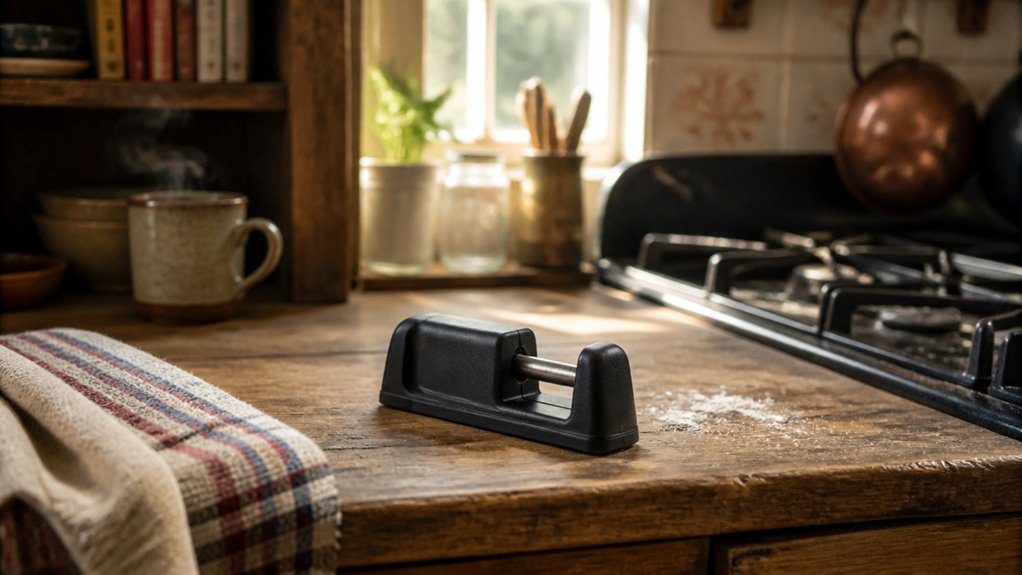
Choosing the right pull-through sharpener starts with checking the material angle consistency, if the preset angles shift, the edge will never be uniform, and a cheap plastic housing often hides this flaw. Material quality and durability matter too; stainless-steel rods or ceramic stones that resist wear will outlast flimsy aluminum frames that bend after a few uses, while a compact size and built-in storage slot keep the device from becoming a kitchen eyesore. Safety features such as a non-slip grip, finger guard, and replaceable sharpening elements add a layer of protection that cheap models typically omit, saving both knives and nerves.
Material Angle Consistency
Consistent preset angles do the quiet work behind a reliable pull-through sharpener. Each pass reproduces the same bevel geometry and protects the blade’s original profile. A rigid slot guide with precisely spaced abrasive elements locks the angle consistently per side, so a kitchen chef can trust a 20° setting while a hunter can rely on 30° for a sturdy edge.
- Fixed-angle guides prevent over-grinding, a common pitfall of variable-angle manual sharpening.
- Multi-angle models offer discrete slots; choose the one that matches the original bevel, or risk shaving off precious metal.
- Serrated blades need a matching micro-angle geometry; otherwise the broad guide will ruin the scallops.
And remember, any wear in the guide or abrasive spacing will shift the effective angle, shortening blade life faster than a cheap plastic handle.
Material Quality & Durability
Regarding pull-through knife sharpeners, the material of the abrasive and the housing decides how long it lasts; a unit built with tungsten-carbide or diamond-honed carbide inserts will keep a blade’s edge consistent far longer than a cheap aluminum oxide grindstone that flakes after a few dozen passes.
- Abrasive core: tungsten carbide, diamond-honed carbide, or high-density ceramic retain grit for thousands of strokes, reducing the need for replacement.
- Modular design: replaceable inserts let you swap worn parts without discarding the whole device, extending overall life.
- Housing: impact-resistant polymers or metal frames resist deformation, keeping preset angles accurate over years.
- Corrosion protection: sealed mounts and rust-proof metals prevent loosening and safety hazards.
Tighter tolerances and precision-ground surfaces also guarantee smoother metal removal, which preserves both the sharpener and the knives it services.
Portability & Storage Size
The durability of the abrasive core is only half the story; the next practical hurdle is whether the sharpener will actually fit into a kitchen drawer, a camping pack, or a cramped toolbox.
Portability rests on three measurable traits: length, thickness, and weight. A unit 2-5 inches long and under 0.2 kg (0.15-0.5 lb) slides into a pocket or a drawer without demanding a gymnastics routine. Slim profiles, under 1-2 inches thick, avoid crowding utensil rows or toolbox compartments.
Key considerations
- Attachment options: built-in key-ring holes or strap loops keep the sharpener from disappearing in a backpack.
- Material resilience: ABS or impact-resistant plastic survives drops when tossed into a travel bag.
- Protective housing: integrated covers shield the abrasive stone and prevent accidental scratches.
- Non-slip base: a rubberized foot lets the unit sit flat on a crowded counter or shelf.
Choosing a compact, low-profile model with these features prevents the “I-bought-a-tiny-sharpener-but-it-won’t-stay-in-my-drawer” disappointment.
Safety Features & Grip
In the kitchen or on a campsite, a pull-through sharpener that slides around like a careless razor is a recipe for bruised fingertips, so a solid grip and built-in safety features matter more than a flashy logo.
- Non-slip base, rubber feet or a textured underside keep the unit from moving, eliminating accidental blade contact.
- Ergonomic handle, a soft-grip or contoured grip lets the hand stay in a natural position, keeping fingers clear of the sharpening path.
- Fixed-angle guide, preset angles stop users from forcing the blade, reducing slips and uneven pressure.
- Finger guard, recessed slots or a built-in guard create a physical barrier between skin and the sharpening elements.
Compact, lightweight construction with clear left-/right-hand labeling further prevents fatigue and mis-use, making the whole experience feel safer and less like a gamble.
Replaceable Sharpening Elements
A solid grip and safety features only get you so far; the real test of a pull-through sharpener lies in the replaceable sharpening elements hidden beneath the housing.
- Material choice, carbide offers aggressive grit for dull blades, ceramic is gentler for fine edges, diamond provides the longest life but at a premium price.
- Availability, check part numbers and whether cartridges sell singly or in multi-packs; a cheap set may hide a costly refill schedule.
- Tool-free vs. screw-mounted, snap-in elements save time, but if the snap is flimsy you risk dropping a fragment on the counter.
- Wear indicators, manufacturers often note a loss of cutting performance or visible abrasion as a cue to replace the element.
And remember, proprietary cartridges lock you into one brand, while standardized rods invite third-party options and keep future costs in check.
Multi-Knife Compatibility
Unlike many budget pull-through sharpeners that claim universal fit, real multi-knife compatibility hinges on a handful of practical details that often get glossed over.
- Edge type support, check that the unit handles both straight-edge and serrated blades; many cheap models only sharpen a plain edge.
- Blade thickness and profile, fixed-angle slots must accommodate thin chef blades and thick hunting blades, otherwise the V-groove misses the edge entirely.
- Angle options, interchangeable slots or a range such as 17°-30° let users match fine kitchen knives to heavier outdoor blades without guesswork.
- Sharpening stages, coarse carbide, medium grit, and fine ceramic stages should cover edge repair and finishing for dull, routine, and lightly serrated edges.
- Size and portability, consider overall length, slot spacing, and weight so long swords, pocket knives, and storage constraints are all manageable.
And remember, a slightly larger footprint often means sturdier construction, which is a quiet win over flimsy, travel-size pretenders.
Related knife guides
Frequently Asked Questions
Can I Use a Pull-Through Sharpener on Serrated Knives?
They can sharpen smooth edges, but serrated knives require a specific profile; a standard pull-through sharpener will not restore the teeth correctly, often damaging the edge or leaving it ineffective.
Do Pull-Through Sharpeners Damage Ceramic Blades?
They generally treat ceramic blades gently, yet the abrasive nature of pull-through systems can subtly wear the edge over time, especially if used frequently or with excessive pressure, potentially diminishing the blade’s precision.
How Often Should I Replace the Sharpening Stones in a Pull-Through?
Replace the stones when the abrasive surface becomes glazed or loses grit, typically after 6-12 months of regular use, depending on frequency, blade hardness, and intensity of sharpening.
Are Pull-Through Sharpeners Safe for High-Carbon Steel Knives?
Pull-through sharpeners can be safe for high-carbon steel if the abrasive is fine, pressure is controlled, and the knife’s angle matches the device’s preset.
Can I Sharpen a Dull Knife Without Removing Much Material?
Yes, a dull knife can be sharpened with minimal material removal by using fine-grit stones or ceramic rods, employing light, consistent strokes at the proper bevel angle to restore edge sharpness without significant wear.
Conclusion
You’ll end up with a sharper knife and a lighter wallet if you skip the cheap, one-stage plastic rigs that promise “restaurant-grade” results but wear out after a dozen pulls. The models listed, cartridges of carbide or ceramic, ergonomic grips, and non-slip bases, offer consistent angles, replaceable stones, and warranties that actually mean something. In short, invest in a solid two- or three-stage system now and avoid the inevitable disappointment of a dull edge and a broken promise.

Michael Haralson worked in professional kitchens from 1979 to 1992: San Diego restaurants, six years with a catering company beside an Austrian chef, and two summers as a cook on the Finland to Sweden cruise route. He then built a fifteen-year career at Nokia. It began in product marketing and product management, where technical specifications and supplier evaluation were part of the work, and grew from a few countries to a region to global roles, then into sales and corporate strategy. That took him to Beijing for three years, where he spent many weekends in a different province trying the local food and took cooking classes. He has eaten in more than 40 countries and has been shown the kitchens of restaurants in Southern Europe. At home in Finland he cooks Cantonese, Sichuan and Mediterranean food, and still uses the cast iron skillet he bought in 1992. He is the author of Buy It Once, Book One of The Researched Kitchen, and writes here about the balance between kitchen tools that cost too much and those that fail too soon.