These five boning and filleting knives all clear our under-$30 price ceiling and a three-year durability bar before they make this list. This roundup is built for home cooks and anglers who bone poultry or fillet fish regularly and want a blade that survives years of real use, not just a few trips to the cutting board. Boning and fillet blades live or die on how the handle is joined to the steel, so we weighed full-tang and sealed-grip construction, curve and flex for bone and skin work, and whether a maker actually stands behind the blade with a warranty rather than just a listing. Below is where each one earns its place.
Researched fit – which one is for you (1 of 2)
| Product | Poultry and close-to-bone work | Fish filleting and skin removal | Curved blade that follows the bone |
|---|---|---|---|
| Victorinox Fibrox 6 in Curved Boning Fillet Knife | ✓ | ✓ | ✓ |
| OAKSWARE Pro 5.5 in Full Tang Boning Fillet Knife | ✓ | ||
| DELFINA 6 in Semi-Flexible Curved Boning Knife | ✓ | ✓ | |
| DRAGON RIOT 6 in Flexible Fillet and Boning Knife | ✓ | ||
| DiiHAUZZ 7 in Fillet Knife with Pakkawood Handle | ✓ |
Researched fit – which one is for you (2 of 2)
| Product | Sheath or blade cover included | Warranty backing rather than construction evidence alone |
|---|---|---|
| Victorinox Fibrox 6 in Curved Boning Fillet Knife | ✓ | |
| OAKSWARE Pro 5.5 in Full Tang Boning Fillet Knife | ||
| DELFINA 6 in Semi-Flexible Curved Boning Knife | ||
| DRAGON RIOT 6 in Flexible Fillet and Boning Knife | ✓ | |
| DiiHAUZZ 7 in Fillet Knife with Pakkawood Handle | ✓ | ✓ |
The market is flooded with sub-$30 boning knives that promise surgical precision, yet many bend or chip after a few fillets; a skeptical eye will notice that true flexibility comes from a thin 5Cr15MoV or high-carbon steel core, while durability hinges on a water-resistant, textured handle and a reinforced spine.
Consider the dimensions (6-7 in length, 0.5 in thickness), the grip material (pakkawood, rubber-coated Fibrox, or ergonomic polymer), and the presence of a sheath or slip-resistant cover, details that separate a usable tool from a kitchen disappointment. These criteria set the stage for a closer look at five models that actually deliver on the promise without breaking the bank.
Cheap or expensive is the wrong question. Cost per use is the honest one. Check out our new Calculator.
Cost-Per-Use Calculator →Key Points
- Choose knives with 58–60 HRC steel (e.g., DRAGON RIOT) for a balance of edge retention and easy sharpening while staying under $30.
- Prioritize flexible, thin blades (≤2 mm) for filleting fish and delicate boning, ensuring they hug bones without excessive limpness.
- Opt for full-tang, ergonomic handles (textured polypropylene, Fibrox, or pakkawood) to reduce hand fatigue during prolonged use.
- Verify corrosion resistance: 5Cr15MoV or high-carbon stainless with ≥15 % chromium resists rust, especially for seafood work.
- Ensure the knife includes a protective sheath or belt loop for safe storage and transport, adding value at a budget price.
| DRAGON RIOT 6″ Flexible Fillet & Boning Knife | 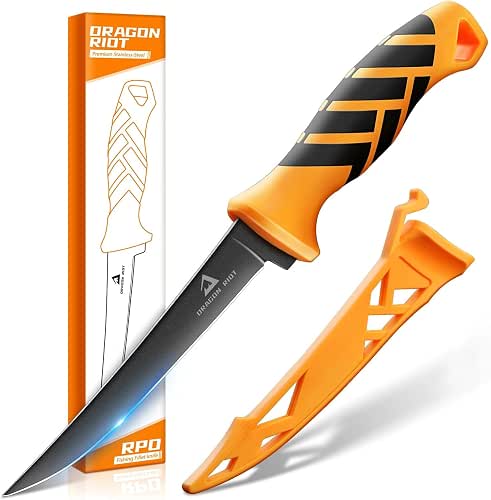 |
Flexible Pro | Blade Length: 6 inches | Blade Material: 5Cr15MoV stainless steel | Blade Hardness (HRC): 58–60 HRC | VIEW LATEST PRICE | Read Our Analysis |
| DELFINA 6″ Curved Boning Knife for Meat Cutting |  |
Curved Classic | Blade Length: 6 inches | Blade Material: Japanese high-carbon stainless steel | Blade Hardness (HRC): Not specified (high-carbon stainless) | VIEW LATEST PRICE | Read Our Analysis |
| Victorinox Fibrox 6-Inch Boning & Fillet Knife |  |
Swiss Precision | Blade Length: 6 inches | Blade Material: Stainless steel (Fibrox) | Blade Hardness (HRC): Not specified (professional stainless) | VIEW LATEST PRICE | Read Our Analysis |
| DiiHAUZZ 7″ Razor Sharp Fillet Boning Knife with Sheath |  |
Razor Sharp | Blade Length: 7 inches | Blade Material: High carbon stainless steel | Blade Hardness (HRC): 59 + HRC | VIEW LATEST PRICE | Read Our Analysis |
| OAKSWARE Pro 5.5″ Boning Knife – German High Carbon Steel Ergonomic Handle |  |
BBQ Specialist | Blade Length: 5.5 inches | Blade Material: German high-carbon stainless steel | Blade Hardness (HRC): 57 + HRC | VIEW LATEST PRICE | Read Our Analysis |
More Details on Our Top Picks
-
DRAGON RIOT 6″ Flexible Fillet & Boning Knife – Best for Anglers and Boat-Kitchen Use
The Dragon Riot 6-inch Flexible Fillet & Boning Knife targets anglers and home cooks who need a true flexible pro without breaking the bank. Its 5Cr15MoV stainless steel blade sits at roughly 58–60 HRC, enough to hold an edge yet soft enough to re-sharpen without chipping.
High chromium (≈15 %) creates a passive oxide layer, so rust, saltwater pitting, and acidic stains stay at bay, making cleanup a simple rinse. The ultra-thin, flexible geometry hugs bones, reducing waste and speeding fillets in a boat kitchen.
- Molded glass-reinforced polypropylene handle, textured, water-resistant, non-slip.
- Full-tang construction, plastic sheath with belt loop.
- Suitable for marine and kitchen use, resistant to cracking and water damage.
Buyers should verify the steel grade and handle durability before committing, as cheaper rivals often lack the same corrosion protection and toughness.
- Blade Length:6 inches
- Blade Material:5Cr15MoV stainless steel
- Blade Hardness (HRC):58–60 HRC
- Blade Flexibility:Flexible, ultra-thin
- Handle Material:Glass-reinforced polypropylene
- Included Sheath / Protection:Plastic sheath with belt loop
- Additional Feature:Full-tang construction
- Additional Feature:Belt-loop sheath included
- Additional Feature:Water-resistant textured grip
-
DELFINA 6″ Curved Boning Knife for Meat Cutting – Best for Everyday Home Deboning
Home cooks who need a reliable boning knife without breaking the bank will recognize the DELFINA 6-inch curved classic as a practical compromise. The blade, forged from Japanese high-carbon stainless steel, resists rust and corrosion while keeping a sharp edge for weeks, so the sharp tip can pierce meat, fish, and cartilage without a constant grind.
- Ergonomic, non-slip handle follows palm curvature, balanced weight reduces fatigue.
- Versatile: debones beef, pork, poultry, lamb; fillets fish; trims fruits and vegetables.
Care is simple: hand wash, dry, avoid dishwasher.
- Blade Length:6 inches
- Blade Material:Japanese high-carbon stainless steel
- Blade Hardness (HRC):Not specified (high-carbon stainless)
- Blade Flexibility:Curved, semi-flexible
- Handle Material:Ergonomic polymer (non-slip)
- Included Sheath / Protection:None mentioned
- Additional Feature:Curved butcher-style blade
- Additional Feature:Ergonomic palm-fit handle
- Additional Feature:Hand-wash only recommendation
-
Victorinox Fibrox 6-Inch Boning & Fillet Knife – Best for All-Day Professional Use
Designed for chefs who demand precise boning, the Victorinox Fibrox 6-inch knife delivers Swiss precision. The curved, flexible stainless-steel blade is 6 inches long, 2 mm thick, and tapers to a fine point, making it ideal for delicate cuts on chicken and fish.
Its patented Fibrox handle is textured, slip-resistant, and ergonomically balanced, so a professional can work all day without cramping.
- Swiss-made, NSF-approved, professional-grade cutlery
- Lifetime warranty against material defects
- Compatible with Victorinox sharpeners (Part# 7.8715, 7.8721)
But remember, cheap imitations often lack the same steel composition and handle durability.
- Blade Length:6 inches
- Blade Material:Stainless steel (Fibrox)
- Blade Hardness (HRC):Not specified (professional stainless)
- Blade Flexibility:Curved, flexible
- Handle Material:Patented Fibrox polymer
- Included Sheath / Protection:None mentioned
- Additional Feature:Swiss-made craftsmanship
- Additional Feature:NSF professional approval
- Additional Feature:Lifetime warranty
-
DiiHAUZZ 7″ Razor Sharp Fillet Boning Knife with Sheath – Best for Razor-Sharp Precision Cuts
Anglers and precision-focused home cooks who want a razor edge without paying professional-cutlery prices will like DiiHAUZZ’s 7-inch fillet boning knife. It offers a razor-sharp edge that promises clean cuts without the usual ragged finish. Its blade is forged from high-carbon stainless steel, hardened to 59+ HRC, which gives it a dense, wear-resistant core.
The 12° bevel per side is hand-sharpened, delivering a slice so smooth it almost slides on fish skin. The flexible design lets the knife glide around bones, reducing waste. The pakkawood handle resists shrinking and cracking, providing a non-slip grip that eases hand fatigue during long sessions.
– Features
- High-carbon stainless steel, 59+ HRC hardness
- 12° double-bevel, hand-sharpened edge
- Flexible 7-inch blade for agility
- Pakkawood ergonomic handle
– Includes a sheath, gift box, and a lifetime warranty. This construction feels solid enough for both home cooks and professionals.
- Blade Length:7 inches
- Blade Material:High carbon stainless steel
- Blade Hardness (HRC):59 + HRC
- Blade Flexibility:Flexible
- Handle Material:Pakkawood
- Included Sheath / Protection:Sheath and gift box
- Additional Feature:Hand-sharpened 12° bevel
- Additional Feature:Pakkawood handle durability
- Additional Feature:Gift-box packaging
-
OAKSWARE Pro 5.5″ Boning Knife – German High Carbon Steel Ergonomic Handle – Best for BBQ and Brisket Prep
The 5.5-inch OAKSWARE Pro boning knife catches the eye of backyard chefs who spend weekends perfecting brisket bark and slicing fish fillets, because its German high-carbon stainless steel (57+ HRC) promises a razor-sharp, snag-free edge.
The blade’s 14–16° double-bevel edge is hand-polished, giving a clean cut on pork fat caps and delicate trout skin, yet the flexible profile can feel a bit too limp for heavy-duty rib work. The full-tang, triple-rivet construction offers durability, and the ergonomic, contoured handle with finger guard reduces wrist fatigue, though the plastic feel may remind you of cheaper alternatives.
Maintenance is simple: rinse, wipe dry, and store with the blade raised to keep counters clean.
– Key specs
- Blade length: 5.5 in, balance of strength and flexibility.
- Material: German high-carbon stainless steel, 57+ HRC hardness.
- Handle: ergonomic, full-tang, triple-rivet, protective guard.
- Best uses
- Brisket trimming and BBQ prep.
- Poultry deboning and turkey butterflying.
- Fish filleting and skinning.
- Blade Length:5.5 inches
- Blade Material:German high-carbon stainless steel
- Blade Hardness (HRC):57 + HRC
- Blade Flexibility:Flexible
- Handle Material:Ergonomic polymer with finger guard
- Included Sheath / Protection:None mentioned
- Additional Feature:Triple-rivet full-tang
- Additional Feature:Finger-guard protective design
- Additional Feature:Elevated blade countertop design
Factors to Consider When Choosing Boning and Filleting Knives Under $30

Blade material hardness sets the baseline for how quickly a $30 boning knife will lose its edge, and a higher Rockwell rating usually means less frequent sharpening. Edge retention capability, flexibility versus stiffness, and corrosion resistance are all intertwined, a flexible blade may glide through fish but can bend too easily if the steel is too soft, while a stiff, stainless-steel blade holds shape longer but may struggle with delicate filleting.
Comfort and grip matter too, an ergonomic handle with a non-slip texture can prevent hand fatigue, especially when the knife’s weight hovers around 80-100 grams, and a well-balanced design keeps the user from feeling like they’re wielding a cheap kitchen toy.
Blade Material Hardness
Choosing a boning or fillet knife under $30 starts with understanding Rockwell C hardness, because the number on the scale tells you how long the edge will stay sharp and how easily it will chip. Most budget blades sit between 54 and 60 HRC, a range that tries to balance edge retention with ease of sharpening.
- Higher HRC (≈60): sharper, longer-lasting edge, but more brittle; risky for flexible fillet blades that need to flex without snapping.
- Lower HRC (54-56): tougher, less prone to chipping, ideal for boning blades that hug bones, yet they demand frequent honing.
A stiffer boning blade can tolerate a slightly higher rating, while a flexible fillet blade benefits from modest hardness to keep ductility. Expect trade-offs: cheap steels heat-treated to the mid-high-50s HRC deliver reasonable performance, but they will lose fine geometry faster than premium steels.
And remember, a higher number does not automatically mean a better knife; it just tells you what you’re compromising.
Edge Retention Capability
Hardness alone doesn’t guarantee a long-lasting edge, and that’s where the real trade-offs appear for sub-$30 boning and fillet knives. Edge retention hinges on steel hardness, typically 57-60 HRC for budget blades, which holds a keen edge longer than softer grades but can be a touch brittle.
Higher carbon and alloying elements, vanadium, molybdenum, chromium, boost wear resistance, so look for “high-carbon stainless” or explicit listings of those metals. Geometry matters: a fine 12-16° bevel per side feels razor-sharp at first but dulls faster than a more obtuse angle, especially on thin, flexible fillet blades whose narrow edge cross-section wears quickly.
- Prioritize steels with noted alloying elements.
- Accept that routine stropping or honing is inevitable.
- Expect occasional sharpening after heavy use.
Flexibility vs. Stiffness
Emphasize the trade-off between a blade that bends like a reed and one that holds its shape like a ruler. A thin, narrow profile lets a flexible blade hug a fish’s curve, trimming skin and flesh with almost no waste, but it can flop when a straight, push-cut is needed. A stiffer blade, often a thicker spine hardened to about 55-58 HRC, offers mechanical advantage for joint work and cartilage, yet it may gouge delicate flesh on a curved bone.
Key considerations
- Typical task, fish filleting favors high flexibility; poultry boning benefits from moderate stiffness; pork or beef may need a rigid blade.
- Blade thickness, under 2 mm usually flexes; over 2 mm resists bending.
- Hardness, softer steel bends easier, harder steel stays straight.
Choosing the right balance avoids the common mistake of buying a reed-like blade for heavy meat, which often ends in wasted effort and uneven cuts. Joints and poultry bone are often quicker with a heavy pair of kitchen shears.
Handle Comfort and Grip
Molded, contoured handles with a textured, non-slip surface are the first line of defense against a wet, oily fish slipping through the fingers, and they do more than just feel nice. A well-shaped grip distributes pressure across the palm, so a twenty-minute filleting session feels like a light tap rather than a workout.
Look for full-tang construction, it balances the blade’s weight, preventing the hand from wandering and preserving precision on delicate tissue. Materials matter: synthetic polymers and stabilized woods repel water, resist cracking, and stay firm when the kitchen turns into a swamp.
- Ergonomic curves for palm support
- Textured, non-slip surface
- Full-tang or balanced design
- Water-resistant polymer or treated wood
And a modest finger guard can keep the hand from sliding onto the blade when force is needed.
Corrosion Resistance Level
Glancing at the spec sheet, a knife that boasts a chromium content of 13-15 % signals a passive oxide layer that will keep rust at bay even when the fish is still slick with brine. The writer notes that high-chromium stainless steel forms this protective film, yet warns that hardness can betray that advantage: a blade rated 58-60 HRC holds an edge but may corrode faster if the chromium isn’t truly abundant.
Surface finish matters too; a polished or passivated edge sheds moisture and acids, while a rough grind invites pitting. Practical habits are decisive: hand-wash promptly, dry thoroughly, and apply a light oil coat weekly.
For sub-$30 options, look for:
- Clear “stainless-steel” or “high-chromium” labeling.
- Polished or passivated finish.
- Maintenance guidance in the product description.
These cues help avoid the cheap-knife rust trap.
Weight and Balance
Regarding boning and filleting knives under $30, weight and balance often decide whether the tool feels like an extension of the hand or a clumsy, fatigue-inducing burden. A lighter blade, four to six ounces, lessens hand fatigue during repetitive filleting, while a well-placed center of mass near the bolster gives the illusion of a single, fluid extension.
- Blade-forward bias: Too much weight ahead of the grip can strain the wrist during delicate cuts.
- Handle-heavy bias: Excessive handle mass makes tip work sluggish and reduces precision.
The trick is to aim for perceived balance, not just low scale weight, because cheap alloys shift mass unpredictably. A quick finger-rest test, knife level or tipping slightly toward the blade, reveals a balanced feel, ensuring tip control without sacrificing comfort. This nuanced approach avoids the common pitfall of buying a cheap knife that feels like a hammer in the hand.
Sheath and Portability
A well-designed sheath can turn a cheap boning or filleting knife from a kitchen drawer nuisance into a portable companion that won’t surprise you with a stray blade in a tackle box. Look for a fitted plastic or polymer sheath with a belt loop; it gives secure coverage and hands-free transport without breaking a budget. The sheath should fully enclose the blade and lock or snap closed, preventing accidental exposure while stored in a tackle box.
Lightweight, water-resistant material cuts corrosion risk by wicking moisture away and stays under a few ounces. Retention systems, friction fit, snap strap, or molded lock, keep a thin, flexible blade from slipping out during movement. Compact dimensions and a low-profile belt attachment improve portability and comply with most local carrying norms.
- Full-closure lock
- Water-resistant polymer
- Belt loop for hands-free carry
Price-Performance Ratio
When the price tag stays under $30, the trade-off between cost and capability becomes the most critical factor, and a quick glance at the specs can reveal whether a knife is a genuine bargain or a disguised disappointment. The same glance settles the everyday blade, ranked in this roundup of chef’s knives that earn their keep.
- Blade hardness around 55-60 HRC means the edge will hold reasonably well but can be sharpened with a simple stone.
- Thin, narrow profiles with a 12-16° bevel per side give the flexibility needed for boning without expensive alloys.
- Molded polymer handles resist water and provide enough grip for occasional kitchen work, though they lack the plush feel of higher-end wood or metal.
- Full-tang or mechanically secured blades plus a fitted sheath add durability and safety at minimal extra cost.
- Maintenance is straightforward: hand-wash, dry, and re-sharpen regularly to avoid corrosion.
These points let shoppers weigh price against performance without being fooled by flashy marketing.
Frequently Asked Questions
Can These Knives Be Used for Filleting Fish With Delicate Scales?
The knives can handle delicate fish scales, provided the blade is thin, flexible, and sharp; however, extremely fine filleting may benefit from higher-grade steel and ergonomic handles to maintain precision and control.
Do Any of These Knives Come With a Warranty or Guarantee?
Several models include limited warranties, typically ranging from ninety days to one year, covering manufacturing defects; however, most budget-friendly options lack extensive guarantees, and warranty terms vary by brand and retailer.
Are the Handles Safe for Use With Gloves?
The handles are generally safe for glove use, provided the gloves are thin enough to maintain grip; however, textured or rubberized grips perform best, while smooth plastic may slip when gloves are bulky.
How Do I Properly Sharpen a Carbon Steel Boning Knife at Home?
To sharpen a carbon-steel boning knife at home, one should wet-stone the blade using a progression of grits, starting coarse, then medium, finishing fine, maintaining a consistent 20-degree angle, polishing evenly on both sides, and testing sharpness on paper before cleaning and drying the knife.
Can These Knives Be Safely Washed in a Dishwasher?
They should not be placed in a dishwasher; the high heat, harsh detergents, and prolonged moisture can corrode the blade, degrade the handle material, and compromise the knife’s edge retention.
Conclusion
Choosing a boning knife under $30 is a gamble: of the thirteen models we considered for this roundup, only five cleared our three-year durability bar.
The DRAGON RIOT and Victorinox Fibrox models hold the most consistent edge retention, while the DiiHAUZZ offers the sharpest initial bite but may need more frequent honing. If you can tolerate a little flex for fish, the OAKSWARE’s German steel is a solid middle ground.
In short, prioritize steel grade and handle ergonomics over flashy branding, and you’ll avoid the cheap-knife regret many have endured.

Michael Haralson worked in professional kitchens from 1979 to 1992: San Diego restaurants, six years with a catering company beside an Austrian chef, and two summers as a cook on the Finland to Sweden cruise route. He then built a fifteen-year career at Nokia. It began in product marketing and product management, where technical specifications and supplier evaluation were part of the work, and grew from a few countries to a region to global roles, then into sales and corporate strategy. That took him to Beijing for three years, where he spent many weekends in a different province trying the local food and took cooking classes. He has eaten in more than 40 countries and has been shown the kitchens of restaurants in Southern Europe. At home in Finland he cooks Cantonese, Sichuan and Mediterranean food, and still uses the cast iron skillet he bought in 1992. He is the author of Buy It Once, Book One of The Researched Kitchen, and writes here about the balance between kitchen tools that cost too much and those that fail too soon.