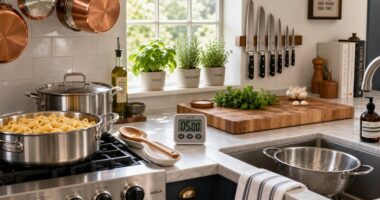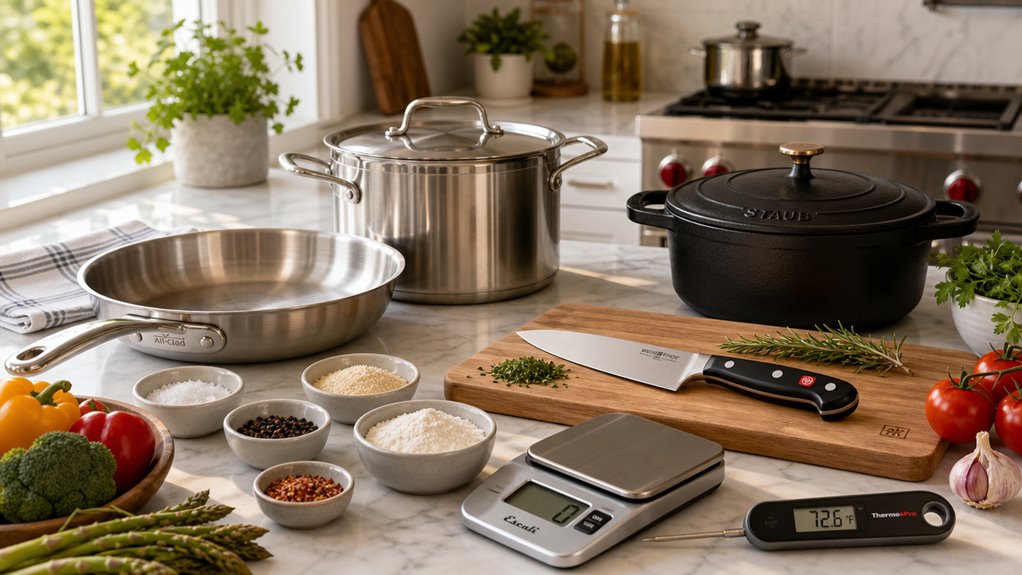

Kitchen essentials for avoiding costly cooking mistakes refers to a core set of durable, maintainable tools that address specific errors, dull cutting, uneven heat, imprecise portioning, spoilage, and guesswork, before those errors drain a grocery budget. Choosing repair-friendly tools over disposable ones reduces repeated replacement costs over time.
- Full-tang stainless-steel chef’s knife stays sharp through regular honing and sharpening, reducing the blade drag that causes uneven cuts and food waste.
- Cast-iron skillet distributes heat evenly across the cooking surface and accepts re-seasoning, extending its functional life well beyond most nonstick alternatives.
- Digital kitchen scale measures ingredients by weight, which produces consistent portion sizes and reduces over-buying or over-cooking losses.
A modular whisk with a replaceable beater head solves a narrower problem: worn wire loops degrade emulsification and aeration, but replacing only the head costs far less than buying a new tool. This design feature reflects a broader principle: repairability extends tool life without sacrificing performance.
An instant-read thermometer removes heat guesswork from meat, fish, and baked goods. Overcooking is one of the most common causes of avoidable food loss, and a thermometer gives a cook a concrete internal-temperature reading rather than a visual estimate.
Maintaining these five tools, sharpening, seasoning, calibrating, and cleaning them correctly, keeps replacement cycles long and kitchen costs low.
Household food waste studies typically estimate that families discard around 30 to 40 percent of the food they purchase, a figure researchers often link in part to imprecise cooking techniques such as poor portioning and temperature mismanagement.
Here are the five money-losing mistakes and the essential that fixes each:
Cheap or expensive is the wrong question. Cost per use is the honest one. Check out our new Calculator.
Cost-Per-Use Calculator →- Dull cutting: a full-tang, sharpenable chef’s knife keeps cuts clean, so ingredients cook evenly and less food is wasted.
- Uneven heat: a cast-iron skillet spreads heat across the surface and re-seasons, ending scorched, discarded batches.
- Imprecise portioning: a digital kitchen scale measures by weight, cutting over-buying and over-cooking losses.
- Spoilage: airtight containers and a fridge thermometer hold food below 40°F and slow the rot that empties a grocery budget.
- Guesswork: an instant-read thermometer replaces visual guessing, the leading cause of overcooked, tossed meals.
Key Points
- Use a reliable instant‑read thermometer to prevent overcooking and waste.
- Keep airtight containers and a fridge thermometer to extend ingredient freshness and avoid spoilage.
- Choose a full‑tang, sharpenable chef’s knife and a modular food processor for precise cuts and maintenance over replacement.
- Employ a digital kitchen scale and portion‑control habits to avoid excess leftovers and reduce waste.
- Invest in a durable, replaceable‑handle skillet and a silicone baking mat to eliminate non‑stick coating failures and parchment waste.
| HIC Kitchen Onion Chopper with Stainless Steel Blades |  | Best Overall | Primary Function: Onion and vegetable chopping | Material (Blade/Key Component): Stainless steel blades | Hand-Operated Mechanism: Spring-action plunger | VIEW LATEST PRICE | Read Our Analysis |
| OXO Good Grips Vegetable Chopper – Easy-Press Blade Container |  | Budget-Friendly Pick | Primary Function: Vegetable and herb chopping | Material (Blade/Key Component): Stainless steel blade | Hand-Operated Mechanism: Pump-handle rotation | VIEW LATEST PRICE | Read Our Analysis |
| Kwik-kut Manual Food Chopper Stainless Steel Blade USA Made |  | Compact Power | Primary Function: Manual chopping and shaping | Material (Blade/Key Component): Stainless steel blade and ring | Hand-Operated Mechanism: Up-and-down manual motion | VIEW LATEST PRICE | Read Our Analysis |
Links to Amazon are affiliate links. Buying through one costs you nothing extra and helps fund the research.
How Cheap Buys Trap You in Constant Kitchen Replacement Parts
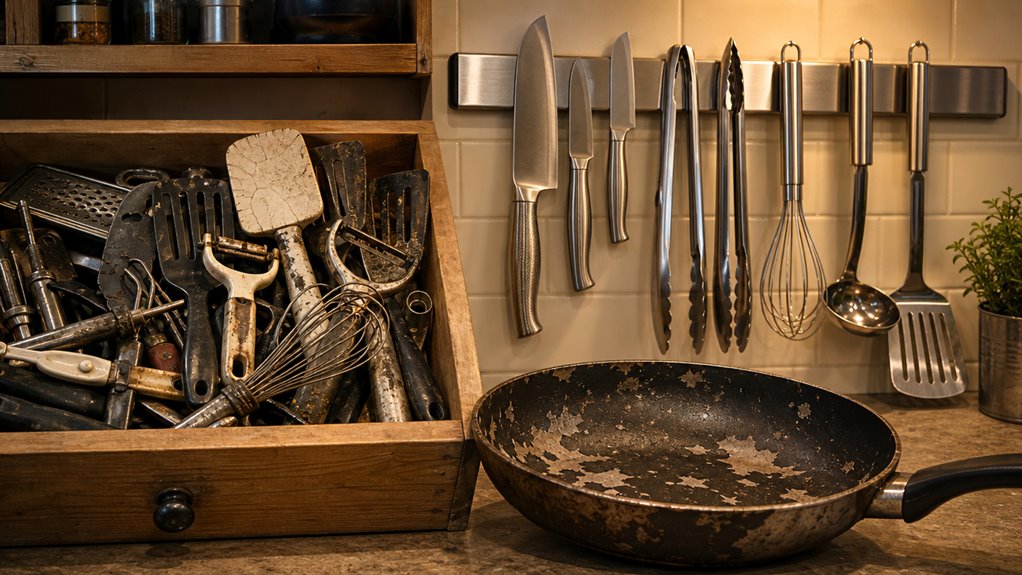
Cheap kitchen tools create a replacement cycle that drains budgets over time because low-cost hinges, blades, and handles tend to fail faster than their sturdier counterparts, pushing repeated purchases that compound across months and years. A knife built from durable materials and designed to accept resharpening, for example, avoids the recurring budget-range spending that disposable tools demand. Each failure treated as a reason to buy new rather than repair adds another layer of cost that rarely gets tracked until the total becomes obvious. Choosing tools with repairable construction and replaceable parts shifts spending from constant replacement toward occasional maintenance. The factors that determine whether a kitchen tool holds up, or quietly empties a budget, run deeper than price tag alone.
The Repeated-Replacement Cycle That Drains a Budget
When you keep swapping cheap gadgets every few months, the savings you thought you were getting evaporate faster than a simmering sauce.
The replacement cycle drags you into a hidden expense loop: a $12 peeler fails after three washes, you buy another, and the pattern repeats. Those low‑cost parts often lack replaceable components, so you discard the whole tool instead of fixing it. In contrast, repairable kitchen tools let you swap a worn blade or a busted seal, extending life by years. Each micro‑purchase adds up: $15 every six months totals $180 in two years, more than a single $80 stainless steel whisk would have cost. Break the cycle by choosing items with modular parts and a clear repair guide.
Why Replacing Cheap Tools Costs More Than One Durable Buy
Swap a cheap peeler for a $3 version and you’ll be buying a replacement every few months, which quickly adds up to more than a single $30 stainless‑steel whisk would cost over the same period.
You’ll notice the same pattern with a $2 garlic press that cracks after a dozen uses; each failure forces a new purchase, inflating your kitchen budget.
A durable kitchen tool worth buying, like a stainless‑steel whisk, spreads the cost across years because the material resists warping and the design includes replaceable parts such as a detachable handle.
When a part wears, you swap it instead of tossing the whole tool. That single repair is far cheaper than repeatedly buying cheap equivalents, and it cuts food waste from uneven mixing and the time you spend hunting for replacements.
The handheld torch sold at hardware stores is often more powerful, more durable, and cheaper than its culinary‑market counterpart.
| Digead Stainless Steel Hand Push Egg Whisk (12in) | 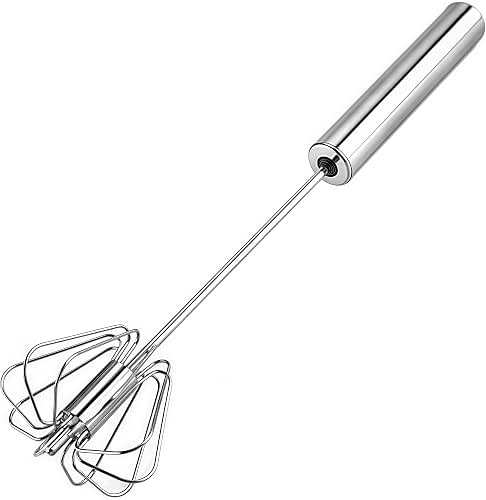 | Fast Whisk | Primary Function: Egg whisking and mixing | Material (Blade/Key Component): Stainless steel whisk | Hand-Operated Mechanism: Hand-push rotary action | VIEW LATEST PRICE | Read Our Analysis |
| Zulay Stainless Steel Garlic Press Rocker Set (Black) |  | Garlic Pro | Primary Function: Garlic pressing | Material (Blade/Key Component): 304 stainless steel | Hand-Operated Mechanism: Rocker back-and-forth motion | VIEW LATEST PRICE | Read Our Analysis |
| Farberware Nylon Meat and Potato Masher Aqua Sky |  | Multi-Tasker | Primary Function: Meat and potato mashing | Material (Blade/Key Component): Stainless steel blades | Hand-Operated Mechanism: Hand-held 5-blade mash | VIEW LATEST PRICE | Read Our Analysis |
Links to Amazon are affiliate links. Buying through one costs you nothing extra and helps fund the research.
The Five Cooking Mistakes That Quietly Cost You Money
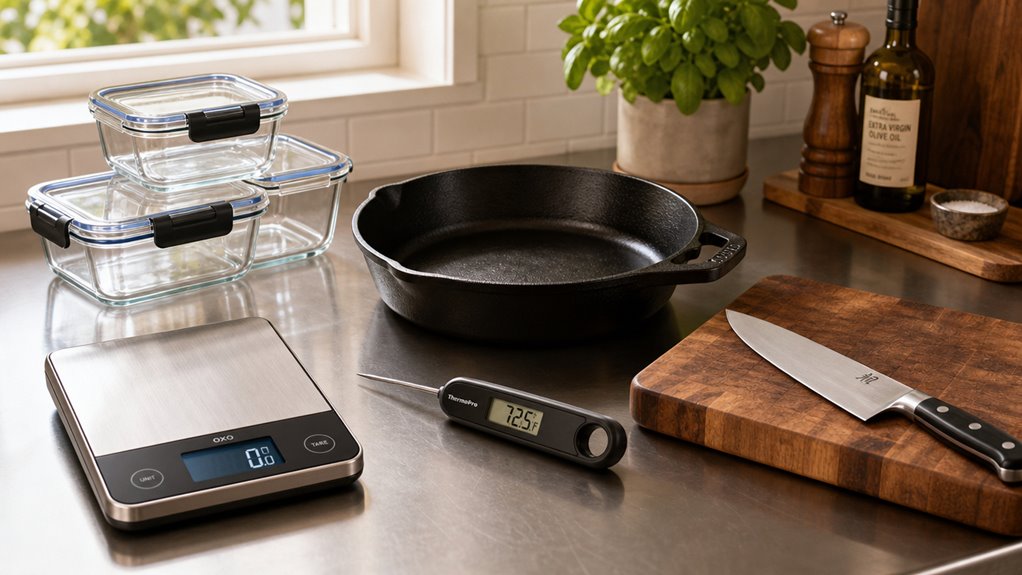
Five common cooking mistakes quietly drain kitchen budgets by causing food spoilage, burned meals, wasted ingredients, and premature equipment failure, problems that compound over months without ever appearing as a single obvious expense. Proper food storage slows spoilage by limiting moisture and air exposure, while a reliable thermometer removes the guesswork that leads to overcooked or discarded meals. Cookware with replaceable or modular components, such as detachable handles, extends the usable life of a pan well beyond what disposable alternatives offer. Choosing the right tool for each task reduces the cycle of cheap replacements that quietly inflate overall kitchen spending. The sections ahead cover each mistake in detail alongside the gear decisions that prevent it. Using an instant‑read thermometer ensures precise doneness and cuts waste.
Wasted Food, Burnt Meals, and Tools That Fail Early
If you keep buying cheap knives that dull after a few weeks, you’ll end up tossing food that’s gone bad or burning meals because the tool can’t slice or stir properly. Cheap blades force you to over‑chop, which leads to uneven cooking and waste.
A solid, sharpenable chef’s knife you buy once will keep cuts clean, preserve texture, and let you portion accurately. Pair it with a reliable fridge thermometer; staying at or below 40°F slows spoilage and saves leftovers you’d otherwise discard.
Use airtight containers and label dates so you see what’s inside, preventing hidden food from slipping your mind.
Finally, scale recipes to real serving sizes, don’t cook a pot of rice for five when only three will eat. This cuts burnt edges and excess waste, keeping your budget intact. 40% of food is wasted annually in the U.S., highlighting the importance of proper storage and portion control.
The Essentials That Stop Each Money-Losing Mistake
Wasted food and burnt meals showed how cheap tools force you into a cycle of replacement and waste, but the real budget drain happens before the pan even heats up. A sturdy set of measuring spoons and a digital scale let you hit the exact salt, spice, and oil ratios every time, so you stop guessing and tossing under‑seasoned batches.
Keep a pinch bowl for fine salt control and a sealed spice grinder to preserve potency; you’ll need less salt and fewer extra ingredients. A small citrus juicer and vinegar dispenser let you balance acidity without buying new sauces.
Finally, a spare stockpot and a fine‑mesh strainer give you room to dilute oversalted soups instead of dumping them. These durable, repairable tools replace the cheap‑replace cycle with lasting savings.
Escaping the Kitchen Replacement Parts Cycle for Good
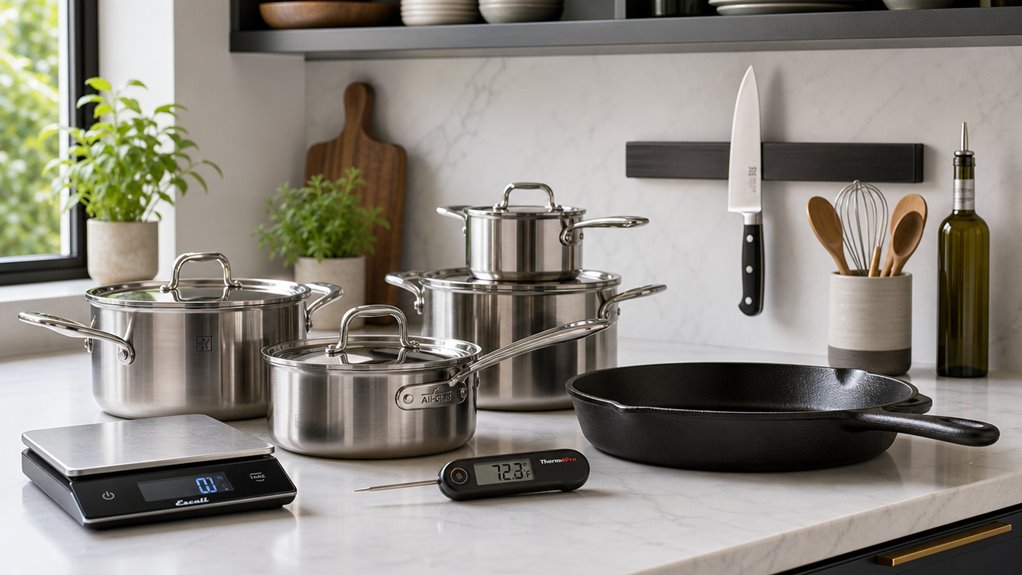
Escaping the replacement parts cycle means choosing kitchen tools designed for repair and longevity rather than tools built around a sealed, disposable construction.
Cast iron can be re-seasoned and restored after years of heavy use, while a non-stick pan with a factory-applied coating typically degrades within months and offers no path to renewal.
A chef’s knife that accepts sharpening and a food processor built with interchangeable blades follow the same principle: the initial purchase holds its value because the tool can be maintained rather than discarded.
Repair costs are consistently lower than replacement costs, and that gap tends to widen over time as budget-tier alternatives accumulate.
The decisions that determine which side of that gap a kitchen lands on are worth examining in detail.
Buying Durable, Repairable Tools Once
Swap out the cheap, disposable gadgets you’ve been buying and invest in a few sturdy, repairable tools that will stay with you for years. You’ll notice that durable tools with modular construction let you replace a broken handle or a worn gear instead of tossing the whole thing.
The repairability of a full‑tang chef’s knife, for example, means a $5‑$10 sharpening can keep it functional for a decade, shaving off the $40‑$100 price of a new knife. Over time the savings add up, and you avoid the endless cycle of buying replacements.
- Clad‑steel skillet – riveted handle, can be re‑tightened; limited to occasional seasoning.
- Stand mixer – screw‑access panel, interchangeable gears; motor may overheat if overused.
- Cast‑iron Dutch oven – solid cast, re‑seasonable surface; heavy for small stovetop tasks.
Why a Tool With Replaceable Parts Outlasts a Sealed Disposable One
Cutting out the endless buy‑replace cycle starts with a tool that lets you swap out the worn parts instead of trashing the whole thing. A kitchen mixer with replaceable parts means you change a worn gear or motor module, not discard the bowl, motor, and housing together.
Those modular components cost a fraction of a new unit and keep the base alive 2–3 times longer than a sealed disposable model that forces a full‑price purchase when the motor burns out. Spare‑part ecosystems let you upgrade the blade or battery later, spreading cost over years.
In contrast, sealed tools lock you into a buy‑break‑replace loop, generating unnecessary kitchen replacement parts waste and recurring expense. This predictability saves money and reduces landfill load.
The Habits That Turn Mistakes Into Savings
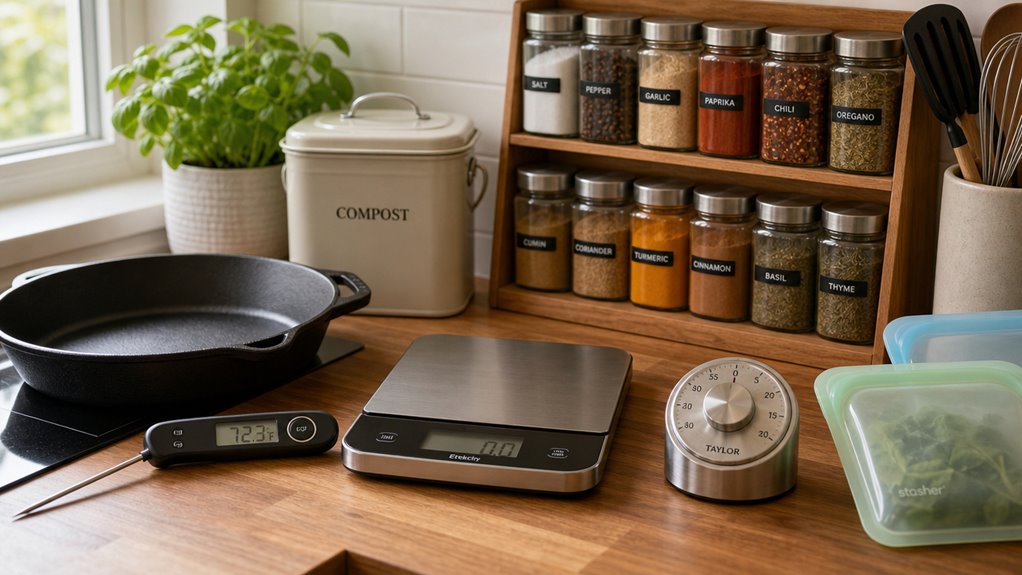
Small habits around food storage, cooking control, and tool maintenance turn recurring kitchen mistakes into measurable savings over time.
Airtight containers slow vegetable spoilage by limiting moisture loss and oxygen exposure, which reduces how often produce gets discarded before use.
Consistent pan temperature management prevents uneven cooking and burned food, making each ingredient go further.
Keeping knives sharp through a regular honing or sharpening routine extends blade life and reduces the need for early replacement.
The sections ahead examine each of these habits in practical detail.
Storing Food Right, Cooking Evenly, and Maintaining Tools
When you store food at the right temperature, 40 °F (4 °C) or below for the fridge and 0 °F (‑18 °C) for the freezer, you keep bacteria out of the danger zone and cut waste before it starts.
Use airtight containers for nuts, grains, and leftovers; they lock out moisture and air, slowing spoilage.
Keep a cast iron skillet seasoned and dry, then it won’t rust and you’ll avoid buying a replacement pan.
Organize by visibility: clear, shallow bins let you see stock and rotate older items first, preventing forgotten food that goes bad.
- Label every container with a date and use first‑in‑first‑out.
- Keep raw meat on the lowest shelf so it cannot drip onto anything, and store cooked and ready‑to‑eat food above it.
- Clean and sanitize cutting boards and handles daily.
Where Small Fixes Prevent Big Recurring Costs
Saving money in the kitchen often starts with tiny, repeatable actions that keep your tools and food from turning into trash. Small fixes, like portion‑freezing meat, using a microwave cover, or pre‑heating pans on medium, cut the cost per use of appliances and reduce food storage waste. When you plan meals and shop with a list, you avoid buying duplicate items that later expire. Maintaining a sharp knife or re‑seasoning a cast‑iron pan prevents premature replacement, so each tool serves you longer. These habits turn recurring losses into steady savings without demanding new gadgets.
| Habit | Typical Savings |
|---|---|
| Meal planning | 15‑25 % less waste |
| Portioning before freezing | Fewer discarded leftovers |
| Using a microwave cover | Extends appliance life |
| Medium‑low pan heating | Avoids burnt batches |
| Regular knife sharpening | Lowers cost per use |
How to Spend Once and Stop Losing Money
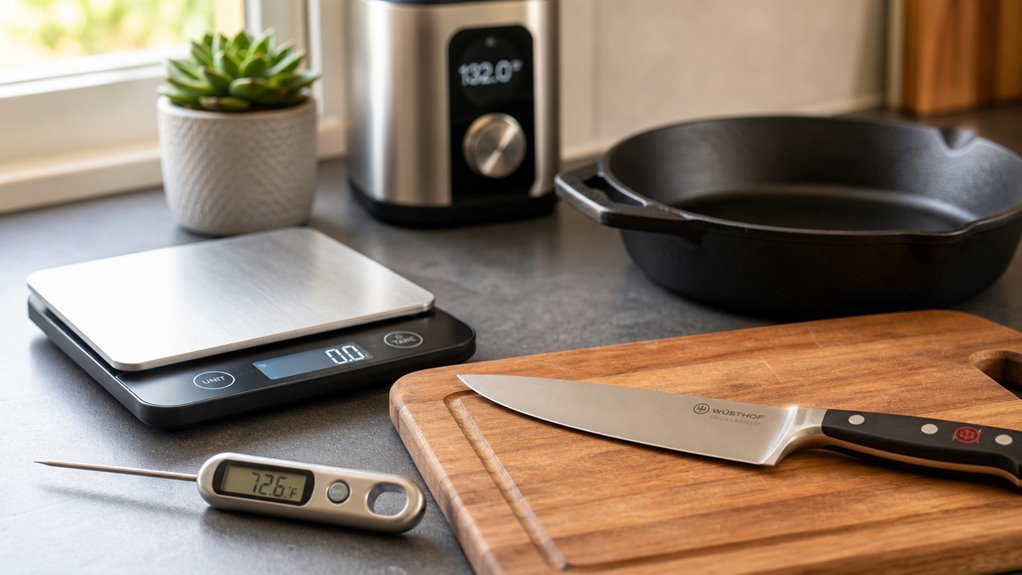
Spending once and stopping repeat losses comes down to choosing tools designed for repair rather than replacement, especially when shopping in the budget price tier where durability tradeoffs are sharpest.
A stainless-steel skillet with a replaceable handle, for example, lets you swap a broken grip instead of discarding the entire pan, which keeps long-term costs closer to occasional part replacements than full repurchases.
Material properties still shape outcomes here, since stainless-steel alloys can warp under excessive heat, so matching a product’s durability ceiling to how it will actually be used determines whether the value holds over time.
Repairability, material grade, and price tier work together to decide whether a single purchase stays in service or quietly becomes another repeat buy.
The details that make that difference are worth examining closely.
Choosing Essentials by Durability and Repairability
If you keep swapping cheap pans for new ones every couple of years, the hidden cost adds up fast; a well‑made clad stainless skillet may cost two to three times more upfront, but it will outlast a budget non‑stick pan by a decade or more.
You’ll notice that buying it for life brings long‑term savings when you compare the total cost of ownership. Look for multi‑ply stainless, full‑tang knives, and cast‑iron pieces that can be reseasoned. Check warranties and repair manuals, since those signals mean you won’t be forced to replace the whole item when a gasket or blade wears out.
- Clad stainless skillet – thick‑gauge, riveted handle; limited to stovetop use only.
- Full‑tang carbon‑steel knife – replaceable blade; handle may loosen over decades.
- Modular pressure cooker – replaceable gasket; sealing ring needs periodic replacement.
Matching Money-Saving Essentials to the Under-$30 Ceiling
You’ve already seen how a solid stainless skillet or a full‑tang knife can outlast a cheap replacement, so let’s look at the tools you can snag for under $30 that keep the money‑saving cycle from spinning again.
A $12 instant‑read thermometer tells you when food is actually done, stopping overcooked waste, but its plastic probe can melt if you leave it in a hot pan. Cook to the USDA’s published safe minimum internal temperatures: 165°F (74°C) for all poultry, whole birds and ground alike; 160°F (71°C) for ground beef, pork, lamb and veal; 145°F (63°C) followed by a three‑minute rest for whole cuts of beef, pork, lamb and veal, meaning steaks, chops and roasts; 145°F (63°C) for fish and shellfish; and 165°F (74°C) for reheated leftovers and casseroles. The 145°F figure applies only to whole cuts and to fish, never to poultry and never to ground meat.
A $15 oven thermometer catches a 30°F calibration error, saving burnt roasts; it’s not waterproof, so you must keep it out of steam.
Silicone baking mats, $18 for a full‑sheet set, prevent sticking and eliminate parchment waste, yet they can tear if you cut them with a sharp knife.
A $20 digital kitchen scale lets you portion flour precisely, reducing discarded dough, but the battery life drops after a few months.
Finally, a $10 vacuum‑seal hand pump plus zip bags slows oxidation and freezer burn on what you store, cutting quality losses; the pump’s rubber seal wears out after a year. Vacuum sealing does not extend how long raw meat stays safe in the refrigerator, and pulling the air out does not protect against pathogens that grow without oxygen.
These under‑$30 prevention tools show how to save money in the kitchen without sacrificing durability.
Frequently Asked Questions
How Do I Choose Tools With Replaceable Parts Under $30?
You check for snap‑in blades, removable heads, and listed part numbers; verify replacement blades stay under $10, confirm stainless steel or modular construction, and read reviews confirming easy, cheap part sourcing.
What Maintenance Schedule Prevents Food Waste?
You prevent waste by checking dates daily, rotating stock with FIFO, logging fridge temps each day, cleaning surfaces and spills every shift, and doing weekly deep‑cleaning and inventory audits to spot excess before it spoils.
Which Affordable Brands Offer Repairable Knives?
You’ll find Opinel, Ontario Knife Company, Kershaw, Gerber and Benchmade all deliver affordable, repairable knives, and each offers replaceable blades or parts, easy sharpening, and solid warranties that keep you from endless replacements.
How Can I Season Cast Iron Without Professional Help?
You can season cast iron at home by cleaning, drying, coating with a thin layer of high‑smoke‑point oil, wiping off excess, then baking it upside‑down at 450‑500°F for an hour, cooling inside, and repeating two to three times.
What Storage Methods Extend the Life of Cheap Gadgets?
You might think cheap gadgets aren’t worth protecting, but storing them in airtight, labeled containers, grouping similar items together, and keeping daily‑use tools in easy‑reach spots will prevent dust, damage, and premature wear.
Conclusion
You’ve swapped cheap, disposable gear for tools that last, and the math shows it. A solid cast‑iron skillet, a replaceable‑blade chef’s knife, a dual‑sensor induction cooktop, a sealed‑lid pressure cooker, and a calibrated digital thermometer each cost more upfront but eliminate the hidden expense of constant replacement. Keep them clean, sharpen, and store them right, and you’ll spend once and stop watching your wallet bleed. The payoff is steady, not flashy.
| KitchenAid Classic Multifunction Can and Bottle Opener |  | Dual-Function | Primary Function: Can and bottle opening | Material (Blade/Key Component): Stainless steel cutting wheel | Hand-Operated Mechanism: Manual turn knob | VIEW LATEST PRICE | Read Our Analysis |
| HULISEN Serrated Hand Food Chopper - 3″ Stainless Steel |  | Heavy-Duty Chopper | Primary Function: Food chopping | Material (Blade/Key Component): Stainless steel serrated blades | Hand-Operated Mechanism: Twisting/chopping motion | VIEW LATEST PRICE | Read Our Analysis |
| Professional 4-in-1 Knife Sharpener with Tungsten and Ceramic Slots |  | Sharpener Pro | Primary Function: Blade sharpening | Material (Blade/Key Component): Tungsten, diamond, ceramic slots (metallic) | Hand-Operated Mechanism: Pull-through sharpening | VIEW LATEST PRICE | Read Our Analysis |
Links to Amazon are affiliate links. Buying through one costs you nothing extra and helps fund the research.

Michael Haralson worked in professional kitchens from 1979 to 1992: San Diego restaurants, six years with a catering company beside an Austrian chef, and two summers as a cook on the Finland to Sweden cruise route. He then built a fifteen-year career at Nokia. It began in product marketing and product management, where technical specifications and supplier evaluation were part of the work, and grew from a few countries to a region to global roles, then into sales and corporate strategy. That took him to Beijing for three years, where he spent many weekends in a different province trying the local food and took cooking classes. He has eaten in more than 40 countries and has been shown the kitchens of restaurants in Southern Europe. At home in Finland he cooks Cantonese, Sichuan and Mediterranean food, and still uses the cast iron skillet he bought in 1992. He is the author of Buy It Once, Book One of The Researched Kitchen, and writes here about the balance between kitchen tools that cost too much and those that fail too soon.