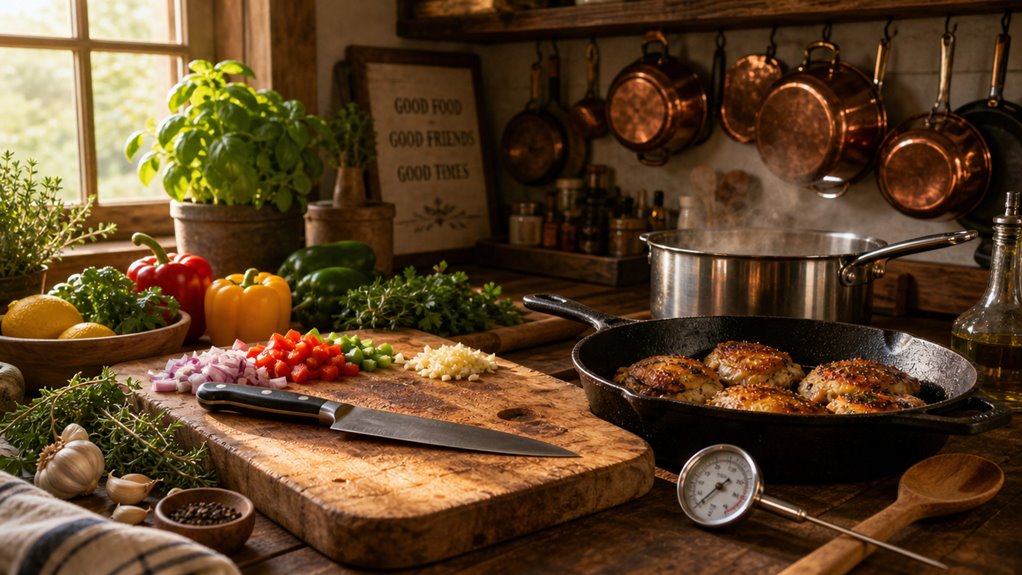
Cooking well requires mastering a small set of foundational skills before investing in specialized equipment. An 8-inch chef’s knife, a heavy-bottom skillet, and consistent seasoning technique form the practical core of a functional home kitchen.
- Knife work enables precise cuts, whether slicing, dicing, or julienning, that help ingredients cook evenly and safely on a sturdy board.
- Heat control determines the quality of sears and sauces, and a heavy-bottom 12-inch skillet paired with an instant-read thermometer provides reliable, consistent results.
- Layered seasoning builds flavor at each stage of cooking, with kosher salt applied early and uniform pieces timed to finish together.
Organized prep supports every skill listed above. Nesting bowls, a digital scale, and a bench scraper keep ingredients measured and accessible before cooking begins. Resting proteins on a cooling rack after cooking allows juices to redistribute through the meat.
A thermometer removes guesswork from heat management. Checking internal temperature at the right moment produces consistent results across different proteins and cooking methods. The USDA’s published safe minimum internal temperatures give the targets to cook to: 165°F (74°C) for all poultry, whole birds and ground alike; 160°F (71°C) for ground beef, pork, lamb and veal; 145°F (63°C) followed by a three‑minute rest for whole cuts of beef, pork, lamb and veal, meaning steaks, chops and roasts; 145°F (63°C) for fish and shellfish; and 165°F (74°C) for reheated leftovers and casseroles.
Understanding these five skills, knife work, heat control, seasoning, protein resting, and prep organization, reveals which kitchen tools genuinely serve a purpose. Gadgets that duplicate these functions rarely add meaningful value for a cook who has developed the underlying technique.
Studies on home cooking behavior suggest that cooks who practice fundamental knife and heat skills tend to need fewer specialized tools to produce consistent meals.
Here are the five skills worth mastering first, each one earning its place before any new gadget:
Cheap or expensive is the wrong question. Cost per use is the honest one. Check out our new Calculator.
Cost-Per-Use Calculator →- Knife work: a claw grip and uniform cuts on a stable board let one chef’s knife handle most prep with precision and safety.
- Heat control: a steady pan temperature and an instant-read thermometer give reliable sears, sautés, and sauces.
- Seasoning: layering salt early and at each stage builds flavor that no gadget can add later.
- Timing: cutting uniform pieces so everything finishes together keeps nothing under- or overcooked.
- Resting: letting proteins settle after cooking keeps the juices in the food instead of on the board.
Key Points
- Master the chef’s knife grip, claw technique, and uniform cuts to ensure safety, precision, and consistent cooking.
- Develop heat‑control skills with a heavy‑bottom skillet or cast‑iron pan to achieve proper searing, sautéing, and sauce consistency.
- Learn timing and doneness by using a kitchen timer and instant‑read thermometer for precise cooking and resting.
- Practice proper seasoning layering and dry‑brining to build flavor without relying on specialty gadgets.
- Organize prep with a sturdy cutting board, digital scale, and a few essential small tools, keeping the toolkit lean and efficient.
| 8-Inch Professional Chef Knife with Ergonomic Handle | 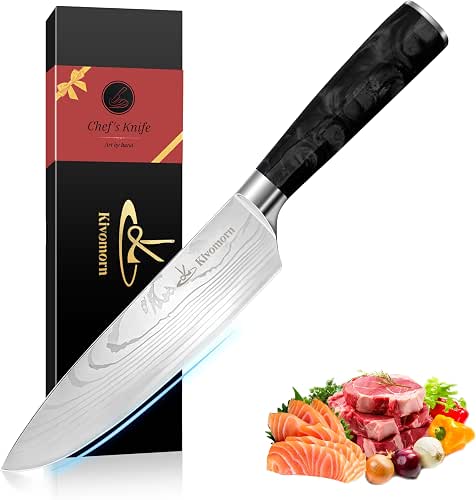 | Ergonomic Choice | Blade Length: 8 in | Blade Material: High-carbon stainless steel | Edge Type: Plain | VIEW LATEST PRICE | Read Our Analysis |
| OLULU 8″ Chef Knife with Ergonomic Handle |  | Lightweight Performer | Blade Length: 8 in | Blade Material: German stainless steel | Edge Type: Plain | VIEW LATEST PRICE | Read Our Analysis |
| Amazon Basics 8″ High Carbon Stainless Steel Chef's Knife |  | Everyday Essential | Blade Length: 8 in | Blade Material: High-carbon stainless steel | Edge Type: Plain | VIEW LATEST PRICE | Read Our Analysis |
Links to Amazon are affiliate links. Buying through one costs you nothing extra and helps fund the research.
Why Skills Beat Basic Kitchen Tools at First
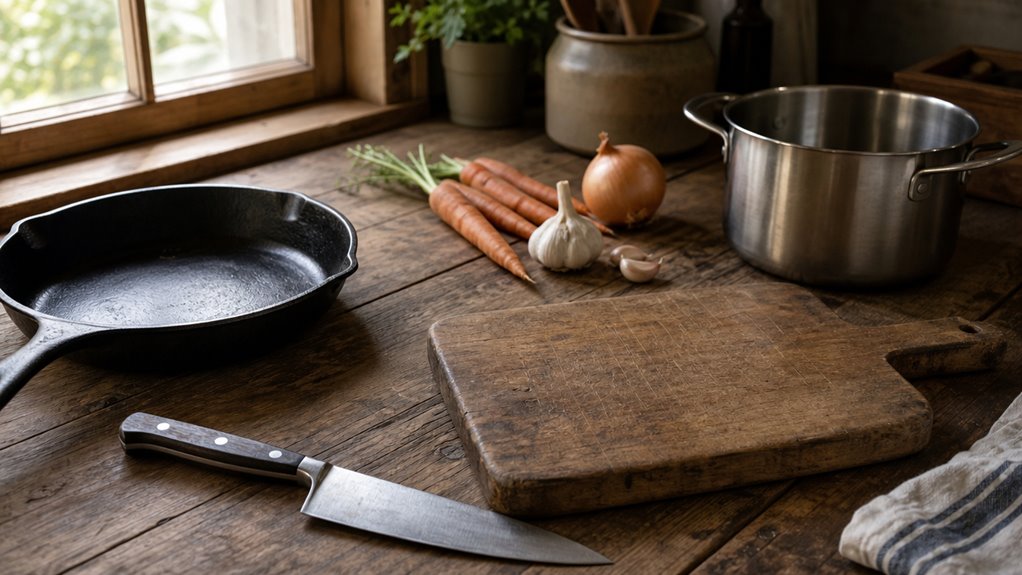
Cooking skills outperform basic kitchen tools in early kitchen development because technique shapes outcomes that equipment alone can’t deliver.
Knife skills, the ability to chop, dice, and julienne with control and consistency, determine how evenly ingredients cook and how efficiently prep work moves forward.
A single chef’s knife, used with practiced technique, replaces several specialized slicers and reduces the need to invest in redundant gear.
Developing foundational skills first also builds an understanding of why precision matters in cutting and preparation, not just how to execute it mechanically.
The sections ahead go deeper into what that foundation actually looks like in practice.
Mastering proper heat control ensures that sauces and pan‑finishing techniques achieve the right consistency without burning.
How Technique Improves Cooking More Than Any Gadget
If you focus on mastering a few core techniques before splurging on gadgets, you’ll see the biggest jump in your cooking. Technique lets you control heat, seasoning, and timing, so a simple pan can sear meat as well as any pricey grill. Skill‑led buying means you only pick tools that fill a gap you already know how to use, avoiding idle clutter.
| Skill | Tool Needed |
|---|---|
| Heat control | Heavy‑bottom pan |
| Seasoning | Salt shaker |
| Timing | Kitchen timer |
| Resting | Cutting board |
| Prep organization | Mixing bowl |
You’ll notice that a dry‑brined steak tastes better than a sous‑vide machine, and a properly pre‑heated tray roasts potatoes faster than a convection oven’s fan. Master the process first; the gear will follow naturally. Dry brining means salting the meat and then refrigerating it uncovered for the full brining time, whether that is a short rest or overnight. Salted raw meat should not sit out at room temperature.
Innovative, compact tools turn tedious motions into quick, effortless actions.
Why Knife Skills Improve Your Cooking More Than Another Gadget
Mastering knife work beats grabbing a gadget any day because the skill multiplies the value of the few tools you already own.
With solid knife skills you turn a single chef’s knife into a slicer, dicer, and trimmer, so you rarely need a separate mandoline or vegetable peeler.
Uniform cuts cook evenly, preserving flavor and texture, while sharp, controlled chopping cuts prep time in half.
The claw grip and stable board setup keep your fingers safe, far more reliably than juggling a gadget that slips.
Precise trimming also trims waste, saving money on meat and produce.
Investing in a good knife and practicing technique yields a higher return than buying another single‑purpose tool.
| 8″ Chef Knife Safety Notch 5CR15MOV Steel | 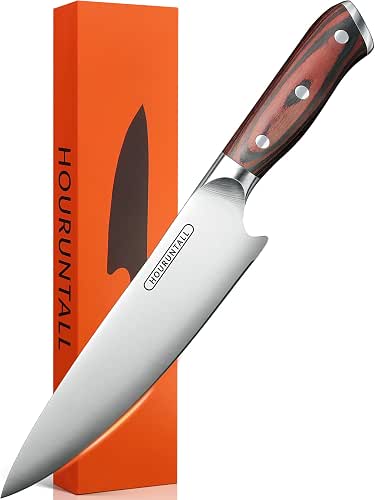 | Safety First | Blade Length: 8 in | Blade Material: 5CR15MOV high-carbon stainless steel | Edge Type: Plain | VIEW LATEST PRICE | Read Our Analysis |
| Leking 8″ Chef Knife with Sharpener and Guard | 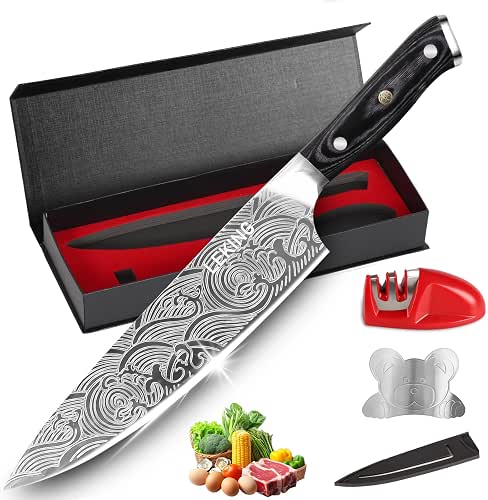 | Professional Grade | Blade Length: 8 in | Blade Material: High-carbon stainless steel | Edge Type: Plain | VIEW LATEST PRICE | Read Our Analysis |
| Farberware Edgekeeper 8″ Chef Knife with Self-Sharpening Cover |  | Self-Sharpening | Blade Length: 8 in | Blade Material: High-carbon stainless steel | Edge Type: Plain | VIEW LATEST PRICE | Read Our Analysis |
Links to Amazon are affiliate links. Buying through one costs you nothing extra and helps fund the research.
The Five Skills Worth Mastering First
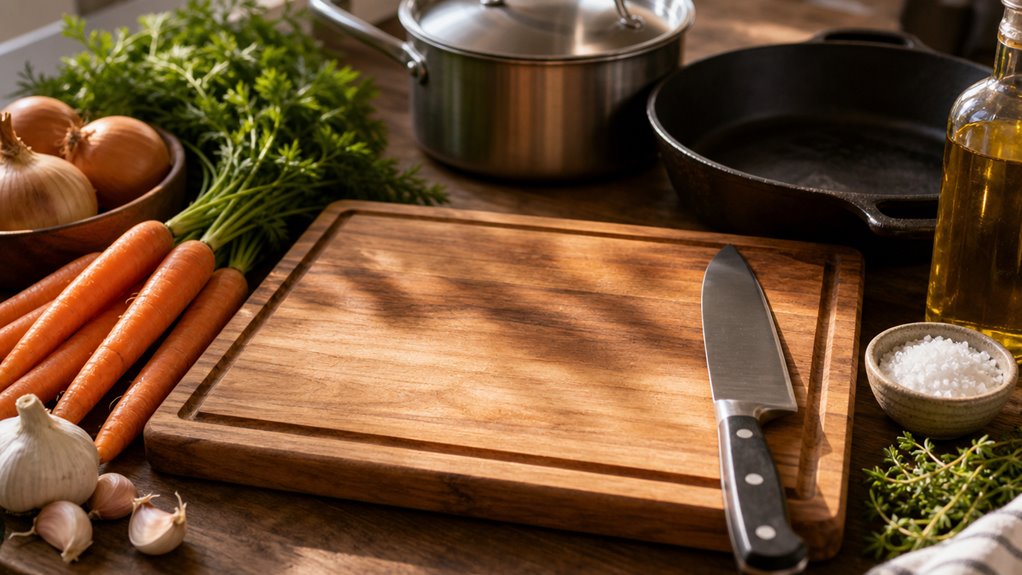
Knife work, heat control, seasoning, timing, and resting are the five foundational cooking skills because each one multiplies what a single well‑chosen tool can accomplish, reducing the need for a drawer full of rarely used gadgets.
A sharp knife paired with a stable cutting board handles the majority of prep tasks with precision and safety, while a reliable pan and basic thermometer give a cook direct control over temperature at every stage.
Seasoning and timing shape flavor and texture in ways that no extra equipment can substitute for, and resting, which cooks often skip, determines whether moisture stays in the food or ends up on the board.
These skills compound on each other, so improving one tends to sharpen the others. Each one is worth understanding in detail. Adding a sharp knife dramatically improves prep efficiency and safety.
Knife Work, Heat Control, Seasoning, Timing, and Resting
Start with the basics: a solid grip, a reliable pan, and a clear sense of timing.
Mastering knife work means using a claw grip, rocking or cross‑chopping for consistent cuts, and slicing straight through without hesitation. Sharp knives reduce slipping and required force, improving safety and efficiency.
Heat control follows. Keep the pan at a steady temperature, avoid overcrowding, and watch for steady sizzle and even color.
Seasoning is a layering game; sprinkle kosher salt early, especially when mincing aromatics, to build flavor throughout.
Timing ties prep to cook: uniform pieces finish together, so you don’t pull some out early and leave others overcooked.
Resting lets juices settle, giving you a juicier slice.
- Knife skills basics
- Heat control
- Layered seasoning
- Precise timing and resting
Why Three Mastered Tools Outcook a Drawer of Half-Used Ones
When you keep just a chef’s knife, a sturdy cutting board, and a 12‑inch skillet on hand, you’ll notice a steady improvement in speed and consistency that a drawer full of single‑purpose gadgets can’t match.
You’ll slice vegetables uniformly because the same blade and board teach muscle memory, and you’ll sear proteins evenly with the cast iron skillet’s heat retention. One board does have a limit worth respecting: use a separate board for raw protein, or wash the board in hot soapy water before it touches anything ready-to-eat.
Switching between unfamiliar tools forces you to relearn grip, angle, and timing, which slows you down and creates uneven results.
A focused toolkit also cuts clutter, so you spend less time hunting for the right gadget and more time cooking.
Over time you waste less food and avoid burns, because you know exactly how each tool behaves.
This lean approach saves money, space, and frustration while delivering reliable flavor and texture.
Which Basic Kitchen Tools Follow the Five Skills
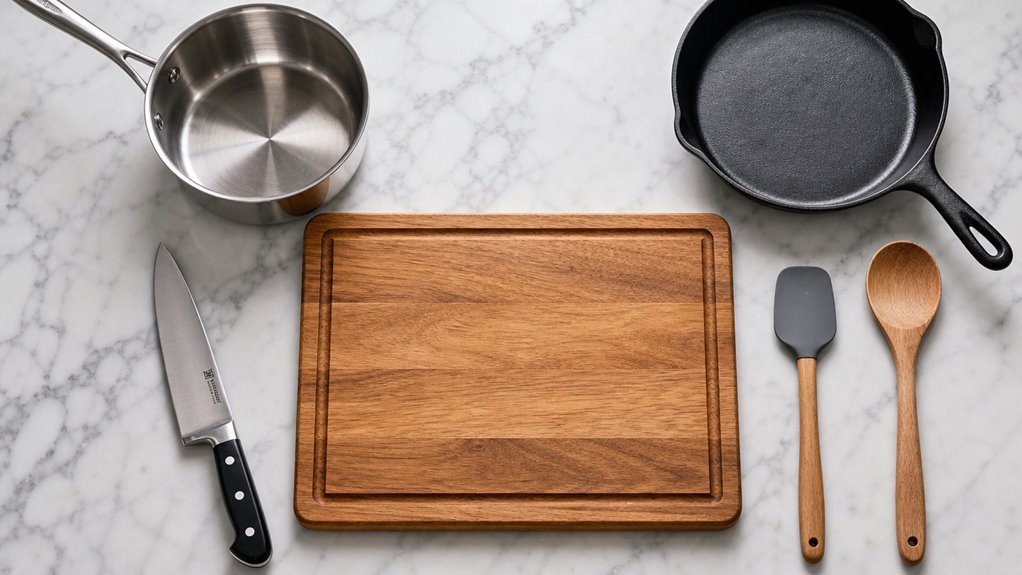
Basic kitchen tools align with core cooking skills when each piece of equipment supports a specific technique rather than filling counter space by default. A chef’s knife and a cutting board cover the full range of knife work, from rough chopping to fine slicing, while a heavy-bottomed skillet handles the heat-control demands that most stovetop cooking requires.
Simpler items like a kitchen timer and kitchen shears serve narrower roles, stepping in once the relevant skill is developed enough to need them. Matching gear to ability keeps the kitchen functional without overloading it with tools that sit unused. The sections that follow break down each skill category in detail.
The Handful of Tools Each Skill Actually Needs
If you focus on mastering the five core cooking skills first, you’ll find that only a handful of tools are truly necessary. You’ll see that each skill leans on a few basic kitchen tools that reinforce cooking fundamentals without crowding your drawer. The key is to match function to skill, not to chase every gadget.
- Knife work – an 8‑10 inch chef’s knife, a sturdy cutting board, and a honing rod keep edges sharp; a paring knife handles tiny tasks, but the chef’s knife covers most cuts.
- Heat control – a heavy skillet for searing, a medium saucepan for boils and reductions, and basic tongs for safe turning.
- Measuring & timing – a digital scale for precision, a set of dry measuring cups, and an instant‑read thermometer for doneness.
- Mixing & prep flow – nesting mixing bowls, a balloon whisk, and a silicone spatula for clean folds and scrapes.
Matching Tools to Skills Instead of Buying Blind
Because the right tool only shines when the skill behind it’s solid, you should let your five core cooking abilities decide what you bring into the kitchen. Match each ability to a single, functional piece before you chase gadgets.
For knife work, a sharp chef’s knife and a sturdy board give you grip, claw technique, and uniform cuts. Heat control needs a heavy skillet or a modest Dutch oven so you can preheat, season, and avoid overcrowding.
Timing and precision rely on a digital scale and an instant‑read thermometer; they let you hit exact doneness and ratios. Resting benefits a simple cooling rack. You’ll find that “cooking skills to master” and “what to learn before buying kitchen gadgets” guide every purchase, keeping your drawer lean and your meals reliable.
The Tools You Can Skip Until a Skill Demands Them
Some kitchen tools are worth skipping until a specific skill or cooking volume actually requires them. A mandoline, onion chopper, or specialty slicer earns its place only when a cook is processing large, repeated batches where consistent slice thickness or speed becomes a limiting factor.
Until that point, a sharp chef’s knife paired with a solid cutting board handles the same cutting tasks with comparable efficiency and no additional storage burden. Buying specialty slicers before technique and volume justify them adds cost without adding meaningful capability.
The sections below cover how to recognize when a tool has crossed from optional to genuinely useful.
Specialty Gear That Waits Behind Fundamentals
When you’ve nailed the five core skills, knife work, heat control, seasoning, timing, and resting, the temptation to add a gadget collection fades, because the real progress comes from technique, not tools.
Fundamentals dictate what to learn before buying kitchen gadgets, so you hold off on specialty gear until the skill truly calls for it.
- Mandoline slicer – great for uniform julienne once you can already produce consistent knife cuts; safety guard can slip, risking cuts.
- Copper‑core pan – excels at precise sauce work after you’ve mastered heat control; expensive and requires careful cleaning.
- Wok – ideal for high‑heat stir‑fry once you’ve practiced searing; needs a powerful burner to shine.
- Sous‑vide circulator – perfect for low‑temperature cooking after you understand resting and temperature; takes hours and a reliable water bath. It also holds food below conventional cooking temperatures, so safety depends on holding it long enough at that temperature, not just on reaching it. Follow the time-and-temperature guidance published by the maker of your circulator rather than improvising.
Where Buying Ahead of Skill Wastes Money and Space
If you load the drawer with a mandoline, a bagel slicer, or a single‑task chopper before you’ve nailed basic knife work, you’ll end up with a gadget that sits idle while a good chef’s knife and board do the same jobs more reliably.
A sharp knife on a sturdy cutting board handles julienne, dice, and slice without extra attachments, so you’ll ask yourself, do you need fancy kitchen tools?
The same logic applies to appliances: a stand mixer clutters the counter when you’re still hand‑kneading dough, and a high‑powered blender duplicates a simple immersion whisk for soups you rarely make.
Specialty pans like a wok, crepe pan, or tagine just take up space until you master heat control in a basic skillet.
Buy only when a skill truly demands the tool; otherwise, keep your kitchen lean and functional.
How to Grow Your Kit as Your Skills Grow
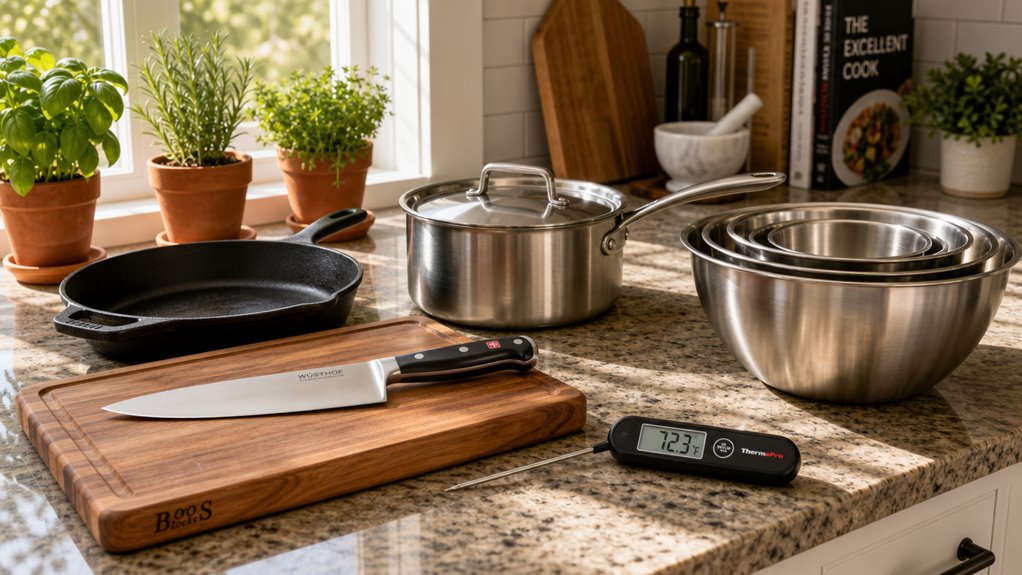
Growing your kitchen kit in step with your skills means adding tools only when a gap in your current setup is holding back work you can already do consistently. A new pan becomes worthwhile once sautéing technique is solid and better heat retention would produce a measurable improvement in results.
Knife maintenance follows the same logic: a honing steel or a budget sharpening stone earns its place when blade care becomes a regular part of prep rather than an afterthought. Matching each purchase to a demonstrated skill keeps equipment justified by use rather than aspiration, which prevents idle gadgets from accumulating on shelves.
The sections ahead explore how that progression works across different skill levels and tool categories.
Adding a Tool Only When a Skill Calls for It
Because your cooking routine already shows you’re chopping a lot, a single, well‑balanced chef’s knife and a sturdy cutting board become the first upgrade worth making. You’ll notice that tool purchases driven by recurring tasks make sense only after a skill‑first mindset shows the need. When you slice dozens of veggies daily, the dull blade slows you and creates uneven cuts, so a sharp, high‑carbon knife solves that bottleneck.
The board’s surface stability prevents slips, keeping your hands safe while you practice julienne and dice techniques. Upgrading only when the task becomes frequent keeps your kit lean and your budget honest.
- Replace a dull knife once you consistently prep >30 min per meal.
- Add a cast‑iron skillet after you master pan‑searing and need even heat.
- Get an immersion blender when sauces require smooth emulsions more often than manual whisking.
- Buy a food processor once batch prep and large‑volume chopping become routine.
Matching Skill-Led Tool Buying to the Under-$30 Ceiling
Start with the basics: a sharp 8‑inch chef’s knife and a sturdy cutting board.
When you’ve nailed knife work, add a bench scraper for mise en place; it slides ingredients onto the board without dulling the blade.
A compact pull‑through sharpener keeps the edge ready, but it can’t replace a proper whetstone if you need fine control.
For heat control, an instant‑read thermometer under $30 lets you gauge doneness, while a cast‑iron skillet teaches searing, but remember it needs seasoning and can rust if left wet.
A silicone spatula survives high heat, yet it won’t flip heavy cuts as well as metal tongs.
Skip single‑use gadgets until the skill demands them; they clutter drawers and waste money.
Frequently Asked Questions
How Many Knives Should a Beginner Own?
You should start with three essential knives: a chef’s, a serrated bread, and a paring, covering most tasks; add a fourth utility or carving knife only when a specific need repeatedly appears.
Can I Skip a Thermometer if I Master Seasoning?
No, you can’t skip a thermometer even if you master seasoning; flavor won’t guarantee safety, and guessing doneness risks undercooked food, so use a thermometer and cook to the USDA’s published safe minimum internal temperatures: 165°F (74°C) for all poultry, 160°F (71°C) for ground beef, pork, lamb and veal, 145°F (63°C) with a three‑minute rest for whole cuts of beef, pork, lamb and veal, 145°F (63°C) for fish and shellfish, and 165°F (74°C) for reheated leftovers and casseroles.
What’s the Cheapest Pan That Handles Heat Control?
You’ll find a 10‑inch carbon‑steel skillet around $20‑$30 that gives rapid, precise heat control; its thickness resists warping, it handles high‑heat searing, and it seasons into a semi‑nonstick surface.
Do I Need a Digital Timer for Timing Skill?
You don’t need a digital timer yet; focus on feeling heat and listening for sizzles. Mastering intuition first saves money, then add a timer when timing precision becomes essential.
When Should I Consider Buying a Cast‑Iron Skillet?
You should buy a cast‑iron skillet once you’ve mastered heat control and basic seasoning, feel comfortable hand‑washing and drying, and need a reliable pan for high‑heat searing, roasting, and stovetop‑to‑oven dishes.
Conclusion
You’ve got the basics down, so you can stop buying gadgets that promise miracles. Focus on knife work, heat control, seasoning, timing and resting; they’ll make any pan or thermometer work better. When your skills call for a new tool, you’ll know exactly why it matters. Build the foundation first, and your kitchen stays functional, uncluttered, and ready for whatever you cook next.
| Sunhouse 7.5″ Chef Knife – Ultra Sharp Ergonomic Handle | 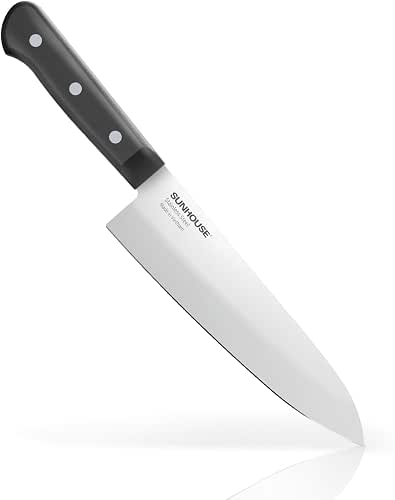 | Compact Sharp | Blade Length: 7.5 in | Blade Material: High-carbon stainless steel | Edge Type: Plain | VIEW LATEST PRICE | Read Our Analysis |
| Kiwi Brand Stainless Steel 8 inch Thai Chef's Knife No. 21 |  | Classic Thai | Blade Length: 8 in | Blade Material: Stainless steel (forged) | Edge Type: Plain | VIEW LATEST PRICE | Read Our Analysis |
| 5-Piece Kitchen Chef Knife Set with Scissors and Peeler |  | Complete Set | Blade Length: 7 in (cleaver), 7 in (Santoku), 4.5 in (utility) | Blade Material: Stainless steel | Edge Type: Plain | VIEW LATEST PRICE | Read Our Analysis |
Links to Amazon are affiliate links. Buying through one costs you nothing extra and helps fund the research.

Michael Haralson worked in professional kitchens from 1979 to 1992: San Diego restaurants, six years with a catering company beside an Austrian chef, and two summers as a cook on the Finland to Sweden cruise route. He then built a fifteen-year career at Nokia. It began in product marketing and product management, where technical specifications and supplier evaluation were part of the work, and grew from a few countries to a region to global roles, then into sales and corporate strategy. That took him to Beijing for three years, where he spent many weekends in a different province trying the local food and took cooking classes. He has eaten in more than 40 countries and has been shown the kitchens of restaurants in Southern Europe. At home in Finland he cooks Cantonese, Sichuan and Mediterranean food, and still uses the cast iron skillet he bought in 1992. He is the author of Buy It Once, Book One of The Researched Kitchen, and writes here about the balance between kitchen tools that cost too much and those that fail too soon.