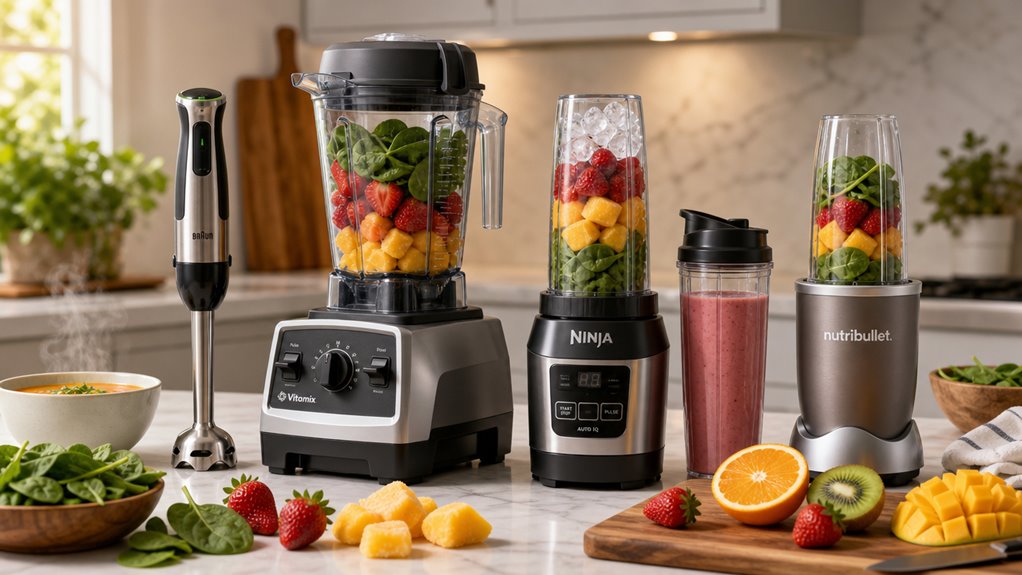
Choosing the right blending tool depends on the task, the batch size, and the ingredients involved. Immersion blenders, countertop jars, and single-serve cups each handle a different range of jobs in the kitchen.
- Immersion blender fits directly into a pot and purees soups or sauces without transferring hot liquid to a separate container.
- High-torque motor drives thick blends like nut butters and frozen desserts through resistance that lower-powered machines cannot sustain.
- Single-serve container limits volume to one portion but reduces cleanup and suits daily smoothie routines.
An immersion blender handles quick, on-pot purees and sauces with minimal cleanup. Its handheld design keeps it convenient, but it cannot process large batches or frozen ingredients reliably.
A Vitamix uses a high-torque motor to move through thick smoothies, nut butters, and frozen desserts. Its large jar suits batch cooking, though the size and mid-to-high price tier make it less practical for single-serve use. Ninja offers comparable versatility at a more modest price, and it uses a stacked blade assembly, which has more joints than a single-piece assembly does. That is a construction difference rather than a measured failure rate.
NutriBullet uses a compact, single-serve container that reduces prep and cleanup time. Its smaller motor can overheat when processing thick or dense mixtures, which limits how long each session should run.
High-performance countertop blenders typically run motors rated at around 1,000 watts or more, roughly two to three times the wattage of a standard single-serve blending cup.
Cheap or expensive is the wrong question. Cost per use is the honest one. Check out our new Calculator.
Cost-Per-Use Calculator →Key Points
- Immersion blenders excel at in‑pot blending of soups and sauces, eliminating hot‑liquid transfers and minimizing cleanup.
- Vitamix‑class countertop blenders deliver the highest power for ultra‑smooth purees, frozen drinks, and nut‑butters, but require a dedicated jar and countertop space.
- Ninja blenders offer strong mid‑range performance for batch smoothies and crushed ice, balancing power and price without the premium cost of a Vitamix.
- NutriBullet personal blenders are ideal for single‑serve smoothies and quick “blend‑and‑go” tasks, though their motor power and batch capacity are limited.
- For most home cooks, match the tool to the job: use an immersion blender for soups and small hot‑liquid tasks, and a countertop blender only for smoothies, ice, or nut‑butter batches.
What an Immersion Blender Does Best
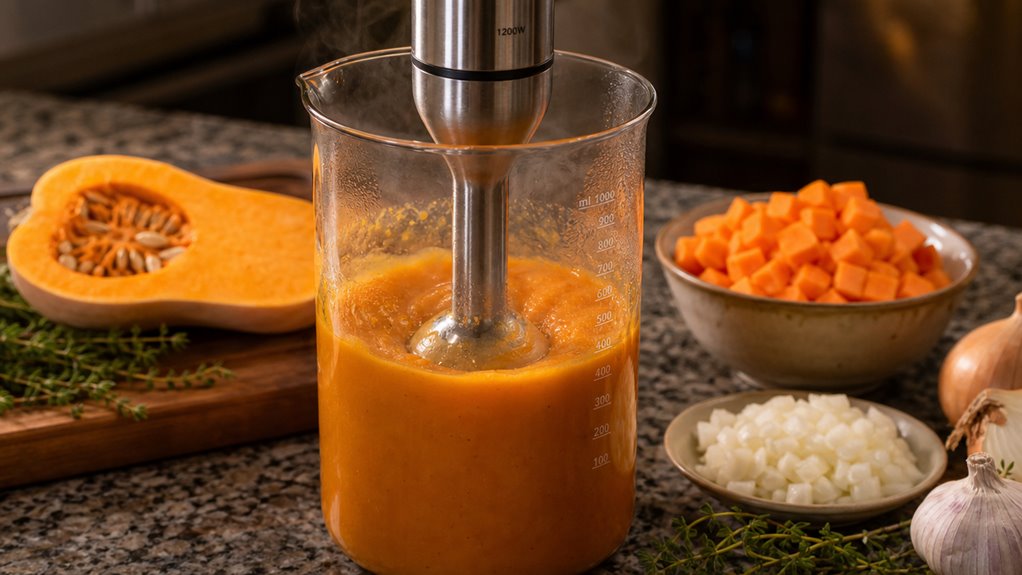
An immersion blender handles tasks where a countertop blender creates unnecessary work. It shines most notably at pureeing hot soup directly in the pot, blending small-batch sauces without transferring liquids, and controlling texture on the fly.
The lightweight shaft and short blade guard allow the motor housing to stay clear of hot liquid while giving the cook direct feedback over consistency.
Because the unit is compact, it stores easily in a drawer rather than occupying counter space.
Motor power is a meaningful constraint, however: the modest motors common to immersion blenders manage smooth purees and emulsified sauces well, but they aren’t well suited to crushing frozen or very hard ingredients.
Understanding these trade‑offs helps clarify where an immersion blender fits into a kitchen and where its limits begin. Handheld design also means the blades stay submerged, preventing splatter and protecting non‑stick cookware.
Blending Soups in the Pot With Nothing to Pour
Blending soups directly in the pot eliminates the need to ladle hot liquid into a separate jar, which cuts down on spills and the extra dishwashing.
An immersion blender lets you puree 4‑6‑quart batches right where they simmer, so you stay on the burner and keep the heat steady. Its blending power is modest compared with a Vitamix, but it’s enough to turn cooked carrots or beans into a velvety bisque in seconds. You can pulse for a chunky texture or run continuously for silk‑smooth results, adjusting on the fly without moving the pot.
The metal shaft tolerates boiling temps, and the guard reduces splatter if you submerge it partially. Cleanup is just the pot and the detachable shaft, saving you a jar, lid, and gasket. This in‑pot method streamlines weeknight meals and avoids the burn risk of pouring hot soup into a sealed blender jar. One‑pot convenience is especially valuable for busy home cooks.
Why It Stores in a Drawer Instead of Owning the Counter
Often you’ll find the immersion blender tucked in a drawer rather than on the counter, and the reason is simple: its slim, stick‑shaped design fits into tight spaces without demanding a permanent spot.
The 15‑inch, 2‑pound handle slides into a standard kitchen drawer, and the detachable shaft nests with its whisk and chopper attachments, keeping everything in one bin. Because you blend directly in the pot, you never need a bulky jar, so the device stays compact and ready for quick use.
Drawer storage also means you grab the immersion blender for soup or a small sauce, press a button, and you’re done. No assembly, no mess, and minimal cleanup.
The trade‑off is a modest motor that can’t crush ice like a Vitamix, but for everyday in‑pot tasks it’s more than sufficient. It also offers variable speed control for delicate sauces and tougher purees.
Type in what a kitchen tool cost you, how often you use it, and how long you expect it to last. The math answers whether the price was worth it.
The tool you are weighing
Enter a price to run the numbers.
Lifespans above 50 years are capped at 50 for this calculation.
The cheaper version
Enter a price to run the numbers.
Lifespans above 50 years are capped at 50 for this calculation.
Your result appears here after you press Calculate.
How the Countertop Blenders Compare
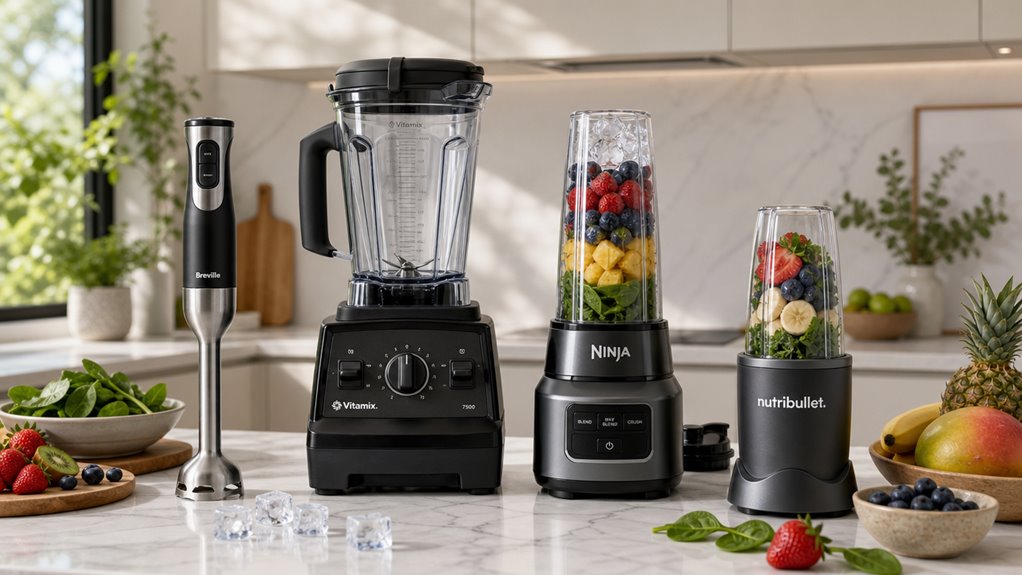
Countertop blenders differ in motor wattage, pitcher capacity, blade coupling design, and the kinds of recipes they can handle reliably.
The Vitamix draws typically 1,400 to 1,650 watts, generating enough friction to bring cold ingredients up to a hot puree temperature, though its tall housing can reduce usable counter space in smaller kitchens.
The Ninja offers a larger 72-ounce pitcher suited to batch preparation, and its drive coupling uses plastic components where the premium tier uses metal, which is a construction difference worth weighing if you expect frequent heavy loads.
The NutriBullet runs at around 600 to 1,200 watts, which is adequate for single-serve smoothies yet often lacks the sustained torque for dense tasks like nut-butter processing without the motor stalling.
Vitamix’s published warranty runs 5, 7 or 10 years depending on the model, covering parts, performance and labour, so check the term for the specific machine rather than assuming a single figure applies across the range. Certified reconditioned machines carry their own separate warranty terms.
Vitamix Power, Ninja Versatility, and NutriBullet Simplicity
When you compare a Vitamix, a Ninja, and a NutriBullet, the biggest difference is how each one balances power, flexibility, and size. The Vitamix delivers 2 hp, metal‑drive torque, and ten‑plus speeds, so it pulverizes nuts, frozen fruit, and even hot soups with a velvety finish. Its downside is the noise and the countertop footprint of a full‑size pitcher. Ninja offers multiple containers, stacked blades, and auto‑iQ presets that handle ice, chopping, and dough in one machine; however, its motor is weaker than the Vitamix and can strain on very thick nut butter. The NutriBullet stays compact, uses a small base and personal cups, and is quick for single‑serve smoothies, but its modest motor can’t reliably crush large ice cubes or dense grains. Choose the tool that matches the batch size and texture you need. If a Vitamix is the direction you are going, a certified reconditioned machine bought direct is the cheapest route into that tier, and it carries its own published warranty rather than none at all. Check that warranty term against a new machine’s before deciding, since the two differ.
Why a NutriBullet Suits the Single Smoothies That a Vitamix Overpowers
The NutriBullet’s single‑serve design trims the whole blending process down to a cup you can drink from, so you never have to pour a hot or cold batch into a larger jar. You pop your fruit, a splash of liquid, hit one button, and the motor whirs just enough to smooth soft ingredients. The personal blender’s compact base and travel‑ready cup keep the footprint tiny, and cleanup is a quick rinse.
A Vitamix, by contrast, comes with a 48‑oz pitcher, high‑wattage motor, and ten speeds that far exceed a single‑smoothie’s needs. That power is great for nut butters or hot soups, but you’ll often wonder if a Vitamix is worth it when you only make one cup a day. The trade‑off is clear: NutriBullet handles one‑serve smoothies efficiently; Vitamix shines when you need bulk or heavy‑duty blending.
Where an Immersion Blender Beats a Countertop Jar
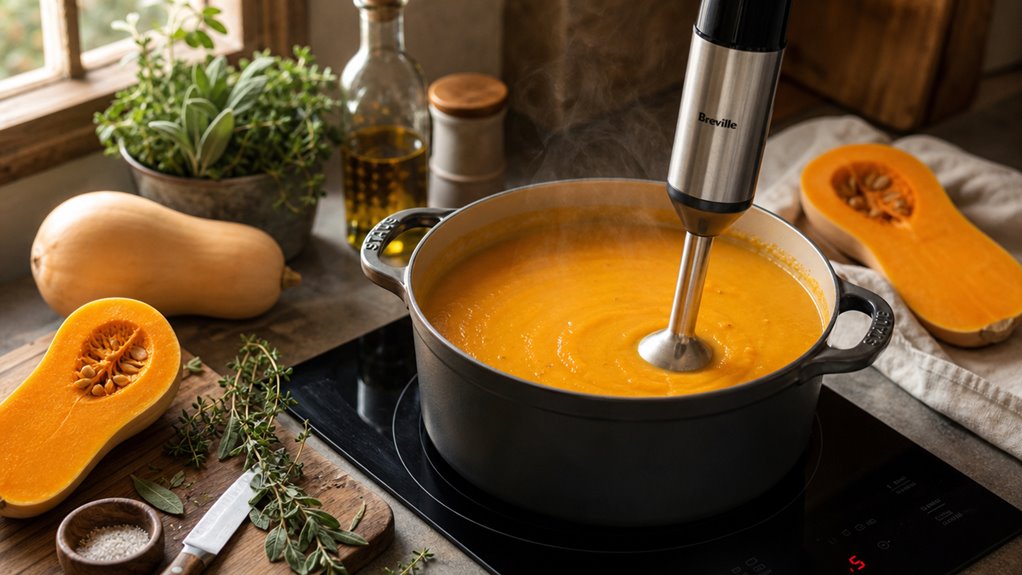
An immersion blender handles tasks that a countertop jar blender manages poorly, particularly when working with hot liquids, small volumes, or situations where minimal cleanup matters.
Pureeing soup directly in the pot removes the risk of transferring hot liquid into a separate jar, which can cause pressure buildup and spills.
Small-batch work, like a single-serve salsa or a quarter-cup dressing, stays practical because the handheld blade has no minimum-fill requirement, so ingredients aren’t wasted padding out a larger vessel.
A countertop blender such as a Vitamix holds an advantage for high-volume emulsions or large smoothie batches, where motor power and jar capacity together produce a smoother texture than a handheld unit can consistently achieve.
The factors shaping which tool suits a given task go deeper than volume alone.
In-Pot Tasks, Small Batches, and Easy Cleanup
You can blend a pot of soup right in the pan without ever lifting it, and that saves you a trip to the countertop and a mess of hot liquid spilling into a tall jar.
For in‑pot work, the immersion blender wins outright: you stay on the stove, keep the heat, and avoid splatter.
Small‑batch efficiency and waste reduction become obvious when the shaft reaches into a mug or a narrow saucepan; you don’t need a minimum fill level, and there’s no leftover sauce clinging to a jar wall.
Cleanup is a rinse‑and‑go. Just the wand and a guard, no bulky pitcher, gasket, or self‑clean cycle. The result is less waste, faster turnover, and a kitchen that stays tidy.
Why an Immersion Blender Wins in the Pot but a Vitamix Wins in the Jar
If you’re finishing a soup on the stove, the immersion blender lets you stay in the pot and keep the heat where it belongs. You can dip the blade straight into the liquid, avoid pouring hot broth into a jar, and finish in under a minute.
The handheld tool follows the pot’s shape, reaches corners, and keeps the cooking vessel intact. In contrast, a Vitamix works best in its dedicated jar where the motor creates a stable vortex, delivering uniform texture for large batches, smoothies, and nut‑butter emulsions. The jar’s fixed walls keep ingredients circulating evenly, something a hand‑held head can’t replicate over long periods.
- In‑pot blending saves steps and heat loss.
- Immersion blender fits tall, narrow pots.
- Vitamix jar assures consistent vortex for big volumes.
- Hand‑held blades need manual repositioning; jar blades do not.
The Durability and Power Differences
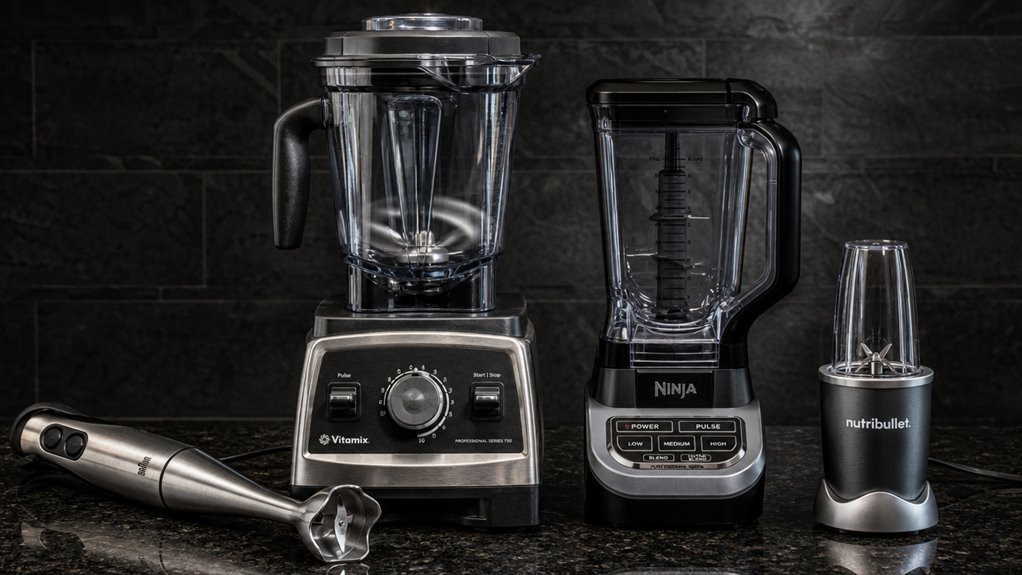
Durability and power output differ meaningfully across blender categories, with wattage typically ranging from around 600 W in entry-level personal blenders to around 1500 W in full-size countertop models, and those differences shape how well a motor handles dense or frozen ingredients over time.
Higher-wattage motors maintain blade speed under load, which matters when processing tough foods like frozen nuts or fibrous vegetables. Lower-wattage motors, common in immersion designs, can overheat under sustained stress and may struggle with tasks that demand consistent torque.
Build quality compounds these differences over hundreds of cycles: metal-on-metal couplings hold up far longer than plastic drive components, which wear and flex with repeated use until they fail. The sections that follow examine how these factors interact across real-world conditions.
Motor Strength, Blade Wear, and Build Over Time
Comparing motor strength and blade durability shows why each blender fits a different niche.
A Vitamix runs 1,400‑1,650 W with a hardened stainless‑steel blade assembly that stays sharp despite continuous duty. Ninja’s 1,000‑1,500 W motor pairs with a stacked stainless blade assembly; it crushes ice well but the extra joints can wear faster under heavy use. NutriBullet offers 600‑1,200 W and a cross‑style blade assembly that dulls when you push it with nuts or frozen fruit. Immersion blenders sit at 200‑800 W; their small prop‑type blade assembly rounds off quickly if you blend hard particles directly in the pot.
- Vitamix: highest motor wattage, durable laser‑cut blades
- Ninja: strong peak wattage, multi‑level blade assembly, more joint wear
- NutriBullet: moderate wattage, cross‑style blades, faster dulling on tough mixes
- Immersion: modest wattage, prop blades, quick edge rounding with hard ingredients
Where a Cheap Blender’s Motor Burns Out and a Sturdy One Lasts
When you push a cheap blender’s motor past its design limits, whether crushing ice, blending thick nut butter, or running it for long bursts, heat builds up faster than the motor can shed it, and repeated overheating is what shortens a motor’s working life.
Those low‑cost units lack the copper windings and thermal protection that premium models use, so they have less thermal margin when a load runs long or a mixture is very thick.
A Vitamix, built with a reinforced steel shaft and high‑torque motor, trades that for longevity; it can pulverize frozen fruit and soups for years without overheating.
Ninja sits in the middle: stronger than a NutriBullet, and its drive components are built to a lower cost than a Vitamix’s.
A NutriBullet’s single‑serve design means its motor is sized for short bursts, so thick batches will shorten its lifespan.
Matching the task to the tool, an immersion blender for pot soups and a sturdy countertop for heavy duty, keeps you from swapping a cheap blender for a new one every season.
Which Blending Tool You Actually Need
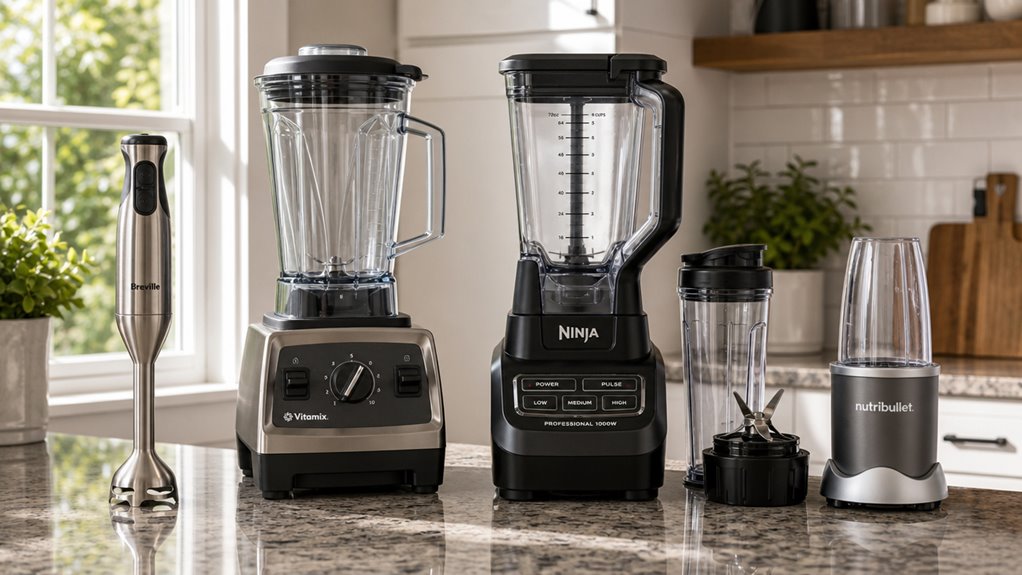
The blending tool you actually need depends on whether you’re pureeing hot food in the pot or processing cold, dense ingredients in bulk.
An immersion blender handles soups and small sauces directly in the pot, removing the need to transfer hot liquid to a separate container.
A countertop blender, such as a Ninja or a Vitamix, suits smoothies, nut butters, and frozen drinks where volume and motor power matter more than in-pot convenience.
Mid-range countertop motors can overheat under continuous heavy use, while higher-end models carry a noticeably steeper price.
The details below cover how each design performs across common kitchen tasks.
Matching the Tool to Soups, Smoothies, or Both
If you’re deciding whether to blend soup, smoothies, or both, start by matching the task to the tool’s core strength.
An immersion blender lets you puree hot soup right in the pot, so you avoid pouring and reduce burn risk.
A Vitamix delivers the silk‑smooth texture you expect from cream soups and can crush ice for robust smoothies, but it occupies permanent counter space and requires a jar for every batch.
- Immersion blender: best for in‑pot soups, quick sauces, low‑batch work.
- Vitamix: excels at large‑batch soups, ultra‑smooth smoothies, nut butters.
- Ninja: solid middle ground, decent soups and smoothies, lower cost.
- NutriBullet: single‑serve smoothies only, not suited for hot soups.
Matching a Capable Immersion Blender to the Under-$30 Ceiling
Usually, the best way to stay under $30 with an immersion blender is to focus on the essentials: a lightweight motor, a simple one‑hand trigger, and a short, ergonomic shaft.
Look for a model that weighs under two pounds, has a 15‑inch shaft, and a bell‑shaped guard that stays fully submerged. A detachable shaft makes cleaning easy, and a rubberized grip reduces fatigue while you puree soup directly in the pot.
Skip heavy handles, multi‑speed dials, and bulky accessories. They add cost without improving basic performance.
Compared with a countertop blender, the immersion blender saves counter space and eliminates the need to pour hot liquid into a jar. Expect modest power; it will puree, not crush ice. This trade‑off keeps the price under $30 while still handling everyday purees reliably.
Frequently Asked Questions
Can an Immersion Blender Crush Ice for Cocktails?
You can crush ice with an immersion blender only if the ice is pre‑crushed or tiny, and you work in short pulses with lots of liquid; otherwise it strains the motor, dulls blades, and may overheat.
Will a Nutribullet Handle Hot Soups Without Damage?
Hot soups can damage a standard NutriBullet, warping the seals and forcing steam past the gasket. Use the vented pitcher or a dedicated hot‑soup model, or switch to an immersion blender for safe, in‑pot blending.
Do Ninja Blenders Include a Built‑In Heating Function?
Yes, only Ninja’s Foodi Cold & Hot models have a built‑in heater; standard Ninja blenders don’t. Those heated units can boil soups and sauces directly in the jar, while the rest work just for cold blending.
How Often Should I Replace an Immersion Blender’s Shaft?
Replace the shaft when it shows wear or damage, or when it no longer seats correctly, usually after long hot‑soup runs or a few years of heavy use.
Is a Vitamix Warranty Longer Than a Ninja’s?
Vitamix publishes warranty terms of 5, 7 or 10 years depending on the model, with reconditioned machines covered separately. Ninja’s coverage also varies by model. Both change over time, so compare the two brands’ current published terms for the specific machines you are choosing between rather than relying on a general rule.
Conclusion
You’ll keep the immersion blender for soups and sauces, where its handheld reach saves you from spilling hot liquid. Reach the Vitamix when you need consistent, high‑speed pulverizing for smoothies, nut butters, or frozen desserts, accepting its larger footprint and higher price. Choose Ninja for a middle ground: strong enough for most tasks but less pricey than a Vitamix, though its jar can be noisy. The NutriBullet fits single‑serve smoothies, but its motor struggles with thick, frozen mixtures. Match the tool to the job, and you’ll avoid unnecessary cost and mess.

Michael Haralson worked in professional kitchens from 1979 to 1992: San Diego restaurants, six years with a catering company beside an Austrian chef, and two summers as a cook on the Finland to Sweden cruise route. He then built a fifteen-year career at Nokia. It began in product marketing and product management, where technical specifications and supplier evaluation were part of the work, and grew from a few countries to a region to global roles, then into sales and corporate strategy. That took him to Beijing for three years, where he spent many weekends in a different province trying the local food and took cooking classes. He has eaten in more than 40 countries and has been shown the kitchens of restaurants in Southern Europe. At home in Finland he cooks Cantonese, Sichuan and Mediterranean food, and still uses the cast iron skillet he bought in 1992. He is the author of Buy It Once, Book One of The Researched Kitchen, and writes here about the balance between kitchen tools that cost too much and those that fail too soon.