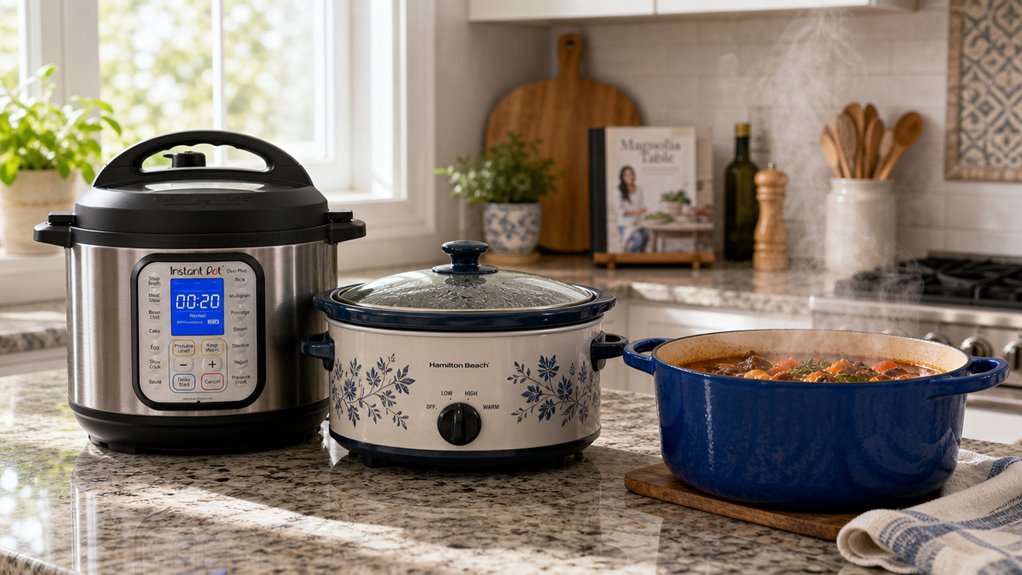

This site is built around a $30 ceiling. A basic slow cooker or a budget Dutch oven can land in or near that tier, while a full multi-mode Instant Pot sits above it. So read this as honest buyer education rather than a push to overspend: when an under-$30 pot with a lid already covers the cooking you do, stay there. The comparison below is for the narrower moment when it does not. That is when stepping up to one of these is genuinely worth the counter space and the cost.
Choosing between a pressure cooker, slow cooker, and Dutch oven depends on how much time, attention, and browning depth a cook needs from a single piece of equipment. Each tool uses a distinct heat method to produce different results in the kitchen.
- Instant Pot combines searing, pressure-cooking, and slow-cooking in one sealed unit, cutting most meals down to under an hour.
- Slow cooker runs low-temperature cycles for typically six to eight hours, making it suited to large, hands-off dishes that require no browning.
- Dutch oven moves from stovetop searing to oven finishing, allowing a cook to build layered flavor through direct heat control.
Pressure cooking works by trapping steam inside a sealed chamber, which raises the internal temperature above the normal boiling point and shortens cook time significantly. Slow cooking relies on sustained low heat to break down connective tissue in tougher cuts of meat over several hours. Neither method produces the Maillard reaction that open, high-heat cooking in a Dutch oven achieves at the surface of food.
Durability varies across all three tools. The Instant Pot uses a sealing ring that wears out with regular use. Slow cooker ceramic inserts can crack under thermal stress. Cast iron Dutch ovens may rust or chip if a cook skips seasoning and proper drying after washing.
Speed, unattended convenience, and browning depth represent the three core trade-offs a cook weighs when selecting among these tools. Matching the tool to a cooking priority produces more consistent results than owning all three without a clear use case for each.
Cheap or expensive is the wrong question. Cost per use is the honest one. Check out our new Calculator.
Cost-Per-Use Calculator →Cast iron, the material used in most Dutch ovens, has been manufactured for cookware for roughly five centuries, making it one of the oldest standardized cooking materials still in common household use.
Key Points
- Choose an Instant Pot for fast, one‑pot meals when you need pressure‑cooked braises, beans, or grains in under an hour.
- Opt for a slow cooker if you prioritize set‑and‑forget, low‑temperature cooking that can run unattended for 6‑8 hours without searing.
- Use a Dutch oven when you want stovetop searing, oven braising, and maximum flavor development from Maillard browning.
- Consider durability: Instant Pots have electronic and gasket wear points; slow cookers have simple thermostats; Dutch ovens mainly risk rust or enamel chipping.
- Match the appliance to your kitchen space and routine: Instant Pot saves counter space with multi‑mode use; slow cookers fit small kitchens with minimal prep; Dutch ovens require stovetop and oven space but offer versatile cooking methods.
What an Instant Pot Does That the Others Cannot
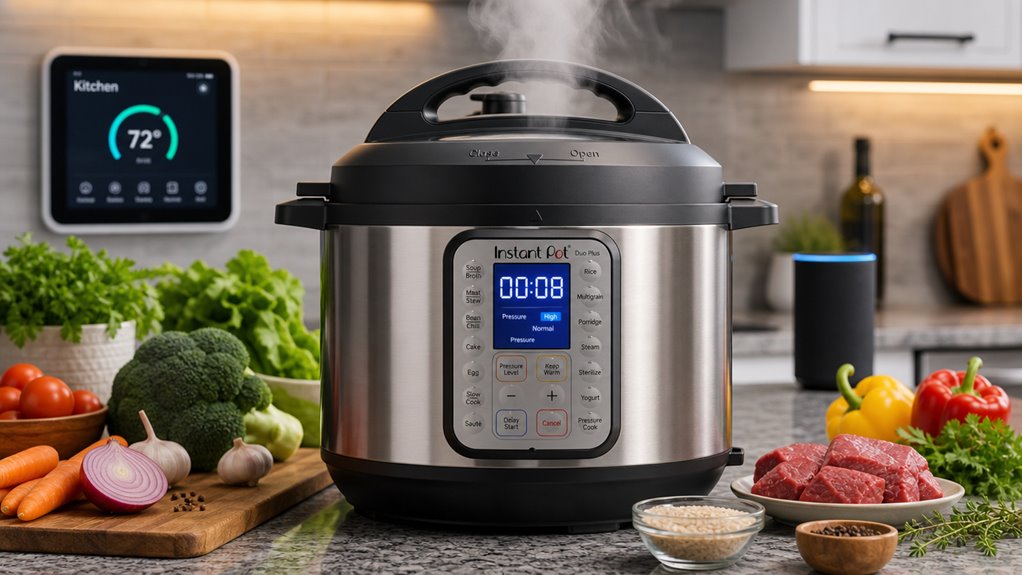
The Instant Pot distinguishes itself from a slow cooker or conventional oven by sealing completely and reaching around 240–250 °F under pressure, which can reduce a braise that would otherwise take three hours in a Dutch oven to under an hour.
That sealed, pressurized environment is the defining feature. It drives heat deeper into food faster than any open or low‑temperature cooking method can.
The electronic controls add a second practical advantage: sautéing, pressure cooking, and warming all happen in the same vessel, so multi‑step recipes require fewer dishes and less hands‑on attention.
The one maintenance consideration is the sealing ring, a consumable part that wears out over time and needs periodic replacement, unlike the simpler components found in slow cookers or ovens.
Understanding how these design choices interact helps clarify which cooking situations the Instant Pot handles well and where its limits appear.
The Dutch oven’s ability to sear and deglaze adds layers of flavor that the Instant Pot cannot replicate without an extra step.
Pressure Cooking, Speed, and the Multifunction Pitch
Seal the pot, crank up the pressure, and you’ll see why an Instant Pot can finish a beef stew in under an hour while a Dutch oven needs three to four.
The sealed environment pushes water’s boiling point to 240‑250 °F, so tough cuts soften quickly and beans cook without soaking. Beans are the one case that needs care: they foam heavily under pressure, so fill the pot no more than half full, add a spoonful of oil to knock the foam down, and let the pressure drop naturally rather than firing the quick release, which can drive foam into the vent.
You still get about 80‑85 % of the depth a slow‑cooked Dutch oven provides, but the moisture stays high and sauces stay thinner unless you thicken later.
The Instant Pot’s pressure cooking also bundles sauté, slow‑cook, rice‑cook, and keep‑warm modes, so you skip the extra pan and the countertop clutter.
- Speed: 70‑90 % faster than low‑and‑slow methods.
- Versatility: pressure, sauté, steam, rice, keep‑warm in one unit.
- Limitation: sealing ring wears and must be replaced.
Low‑and‑slow cooking is ideal for tenderizing meat over many hours.
Where the Electronics Add Capability and Risk
You’ve just seen how pressure cuts cooking time, now let’s look at what the electronics actually add. The Instant Pot’s digital timer and programmable modes turn it into a true multifunction device. You can pressure‑cook, sauté, slow‑cook, make rice, soup, or yogurt without swapping pots.
Its built‑in sauté function browns meat right in the sealed insert, so you skip the skillet step. Automatic pressure regulation and a quick-release valve manage the steam for you, but they do not turn the pot into something you set and abandon, and three habits matter more than any program setting.
Never fill past the marked maximum fill line. That is two-thirds of the pot for most foods and no more than half for anything that expands or foams: beans, split peas, lentils, pasta, rice, oats and other starches. Foam from those foods is the classic way the vent gets blocked, and a blocked vent is how a pressure cooker fails dangerously rather than merely badly. Know which release you are using. A natural release lets pressure fall on its own and is the right choice after anything liquid, starchy or foaming. A quick or manual release fires a jet of steam hot enough to scald: keep hands, face and overhanging cupboards out of its path, move the valve with a long utensil rather than your fingers, and never try to force a lid that has not fully depressurised. Check the sealing ring, float valve and vent for trapped food before every cook, because those parts are what the safety systems actually rely on.
But every electronic component, from the control board to the heating element to the seals, introduces failure points that a cast‑iron Dutch oven never has. A broken gasket or fried circuit means the whole unit stops working, whereas a Dutch oven simply endures. A stovetop pressure cooker can reach pressure in minutes, but lacks the programmable safety features of the Instant Pot.
How a Slow Cooker and a Dutch Oven Compare
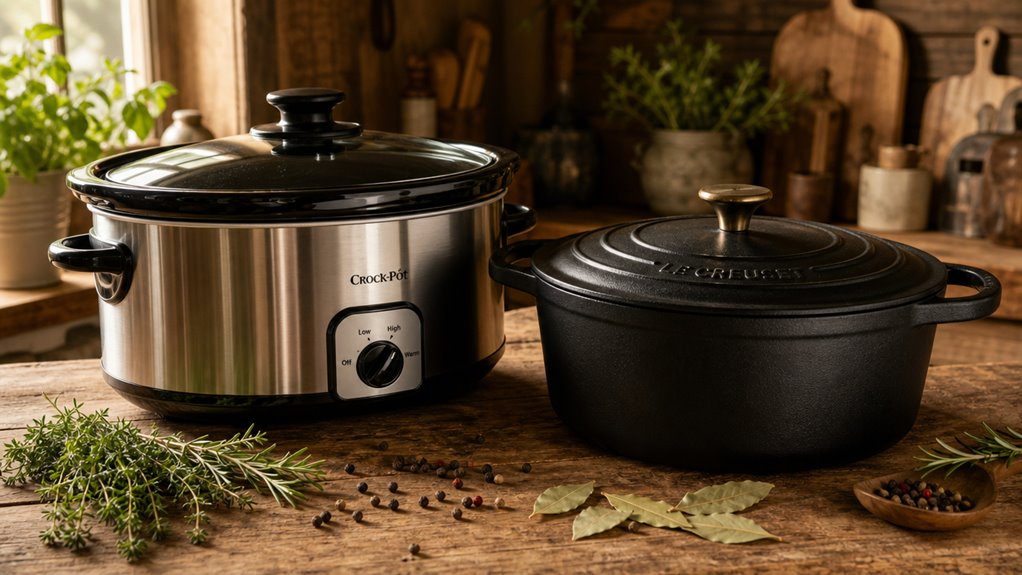
A slow cooker and a Dutch oven solve the same cooking problem through different designs, and understanding that difference shapes how each fits into a kitchen routine.
A slow cooker uses an electric base to hold a steady low temperature for hours, requiring no adjustments once the lid goes on. A Dutch oven is a heavy pot that moves from stovetop to oven, letting a cook brown and deglaze ingredients before a long simmer, all in the same vessel, but with ongoing heat management.
That hands‑on control gives the Dutch oven more flexibility across cooking techniques, while the slow cooker trades that flexibility for a reliable, unattended process.
The details behind each approach reveal more than a surface comparison suggests. Both can produce tender stews but the Dutch oven also allows for Maillard browning, enhancing flavor depth.
Set-and-Forget Simplicity Versus Stovetop-to-Oven Range
When you set a slow cooker and walk away, the electric thermostat holds the temperature steady while you’re out running errands, so the pot effectively cooks itself. You get true set-and-forget ease, but you lose the ability to sear or adjust heat quickly. A Dutch oven, on the other hand, lets you start on the stovetop, brown meat, then slide it into the oven for a slow braise, giving you a full stovetop-to-oven workflow. The trade‑off is you must monitor liquid and stir occasionally, which adds a bit of hands‑on time. The slow cooker is a plug‑in, low‑maintenance option with limited browning; the Dutch oven works across heat sources but needs periodic checks. Both produce tender results, but only the Dutch oven adds flavor depth. The Dutch oven’s heavy lid creates a tight seal that retains moisture more effectively than a slow cooker lid.
Why a Slow Cooker Still Beats an Instant Pot for Set-and-Forget Cooking
Cooking low‑and‑slow in a slow cooker lets you set a timer, walk out the door, and return to a pot that’s been simmering at a steady, sub‑boiling temperature the whole time.
You don’t have to watch pressure levels, release steam, or reset a program mid‑cycle; you simply choose low or high and forget it. Because it runs at atmospheric pressure, the appliance feels safe to leave on for hours, and the vented lid prevents the high‑pressure hazards an Instant Pot can present.
The ceramic crock doubles as a serving dish, so you avoid extra transfers. Timing is forgiving: six to eight hours on low still yields fork‑tender meat, whereas a pressure cooker can overcook the moment the timer ends. This reliability makes the slow cooker the true set‑and‑forget workhorse.
When an Instant Pot Earns Its Counter Space
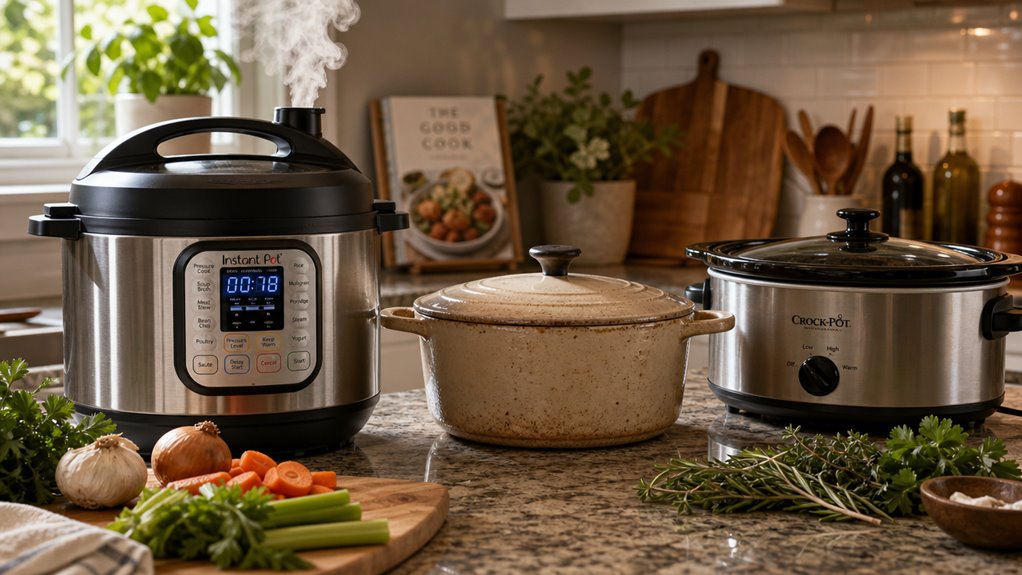
An Instant Pot earns its counter space when speed and consolidation matter more than dry-heat cooking methods. Pressure cooking can cut the time needed for stews and beans to around a third of what a Dutch oven requires, making it a practical choice for weeknight meals where time is limited.
In a small kitchen, replacing a slow cooker, rice cooker, and steamer with a single electric unit reduces both clutter and cost without sacrificing core functionality.
The sealing ring requires periodic replacement, so long-term ownership involves modest but real maintenance.
For braises that depend on oven versatility and open browning, a Dutch oven remains the more capable tool, and the two appliances aren’t direct substitutes.
The details ahead clarify when each approach fits and what trade-offs to expect.
The Cooks and Households It Genuinely Suits
If you’re juggling a full‑time job, a long commute, and a kitchen that barely fits a cutting board, an Instant Pot can actually earn a spot on your counter. It shines for busy households that need dump‑and‑go weekday dinners, for families with long commutes who rely on unattended cooking, and for renters in small kitchens where space is at a premium.
You’ll appreciate the one‑touch programs for beans, grains, and tough cuts, and the energy‑efficient pressure cycle that beats a stovetop or oven. The downside is the sealing ring that wears and must be replaced periodically.
- Fast‑track meals for time‑pressed cooks
- Batch‑prep for freezer‑ready portions
- Compact, multi‑function appliance for small kitchens
Compared with a slow cooker, the Instant Pot’s electronic controls and pressure cooking give it a clear edge in speed, while still fitting cramped countertops.
Why an Instant Pot Wins on Speed but a Dutch Oven Wins on Everything Else
You’ve already seen how an Instant Pot can squeeze a weeknight stew into a single hour, but speed isn’t the whole story. Compared with a Dutch oven, the pressure cooker wins on time: it pushes liquid to about 250 °F, so a braising job that needs three to five hours in a Dutch oven finishes in 45 minutes to an hour and a half. That’s a lifesaver when dinner is tight.
Yet the Dutch oven beats the Instant Pot on everything else. It moves from stovetop to oven, lets steam escape for reduction, and builds deeper flavor in long‑slow braises. Its cast‑iron body has no parts that wear out, though it does take up cabinet space and needs occasional seasoning. The Instant Pot saves counter space only if you truly need its speed and multi‑mode convenience.
The Durability and Failure Differences
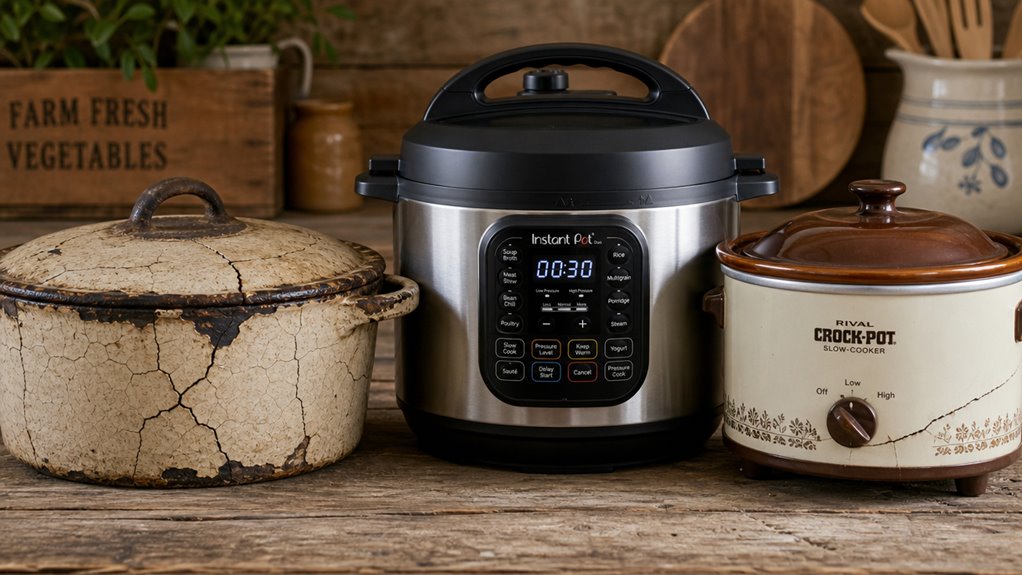
Each cooking appliance type fails in predictable ways, and understanding those failure patterns helps explain why durability varies so widely across cast iron, electronic pressure cookers, and slow cookers.
The Instant Pot’s control board and silicone sealing ring are its most vulnerable components, with the sealing ring often requiring replacement every 12 to 18 months and the electronics carrying a risk of failure that cast-iron cookware simply doesn’t face.
A cast-iron Dutch oven has no electronic components, so rust and enamel chipping are its primary failure modes, both of which proper seasoning and careful handling can largely prevent.
Slow cookers occupy a middle position, relying on simple thermostats that can last for decades, though their ceramic inserts are vulnerable to cracking under sudden temperature changes.
The sections ahead examine each failure mode in closer detail.
Electronics and Seals Versus Bare Cast Iron
A pressure‑cooker’s heart is a maze of heating elements, control boards, gaskets and valves, each a separate point that can quit. You’ll find a silicone gasket that hardens after a few hundred steam cycles, and a control board that hates moisture and power spikes.
In contrast, a cast iron Dutch oven has no electronics and only a simple lid seal, so failure usually means a crack or a rust spot you can re‑season away.
- Sealing wear – Silicone rings lose elasticity, while cast iron lids stay functional despite surface discoloration.
- Electronic risk – Control boards can die from humidity or surges; cast iron never suffers that.
- Thermal tolerance – Cast iron endures open flame and 500 °F ovens, whereas electric housings may warp near stovetops.
Where a Pressure Cooker’s Parts Wear and Cast Iron Does Not
The lid‑lock and vent assembly on a pressure cooker are built to click, seal, and release dozens of times a day, so the metal tabs, springs and silicone gasket all fatigue with use. Those parts loosen, the float valve can stick, and the thin‑gauge steel body may warp after repeated pressure cycles.
In contrast, an enameled cast iron Dutch oven has no moving joints; its thick walls and lid only expand and contract with heat, never experiencing hoop stress. You’ll never replace a sealing ring or worry about a spring failing. The only wear you might see is surface rust if you neglect seasoning, which is easy to scrub off.
That durability gap is what the pressure-cooker-versus-slow-cooker decision usually comes down to: maintenance versus longevity.
Which One You Actually Need (Or Whether One Is Enough)
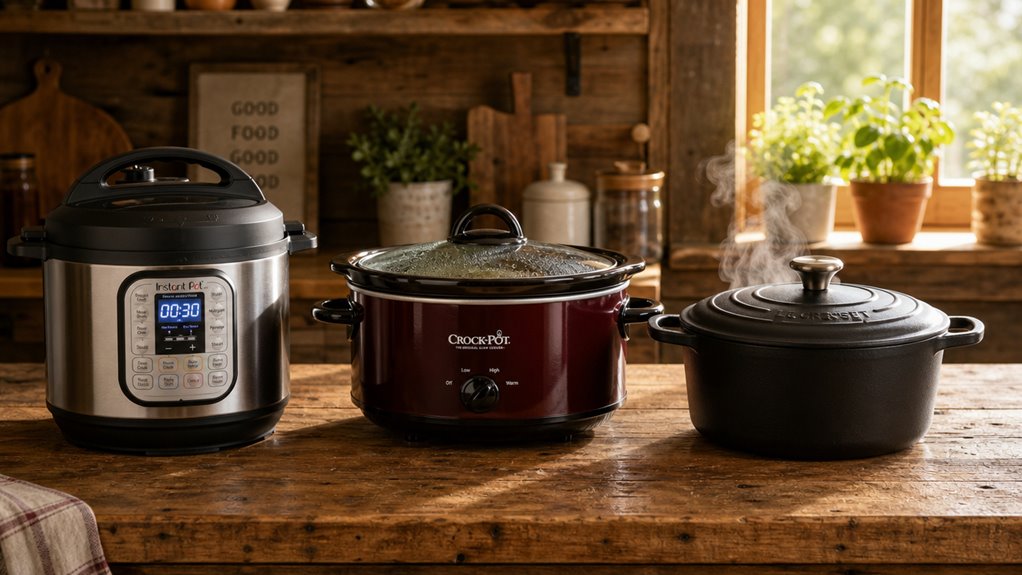
One pot can often handle what multiple appliances promise, but the right choice depends on how you actually cook, how much counter space you have, and whether speed, flexibility, or convenience matters most to you.
A cast-iron Dutch oven moves from stovetop to oven in a single vessel and typically stays within a budget price tier, making it a practical starting point for cooks who want one tool to cover searing, braising, and roasting.
Pressure cooking cuts down cook time significantly but requires maintenance, since the sealing ring wears out with regular use and can’t replicate dry oven heat.
A slow cooker handles set-and-forget meals well but lacks the ability to sear or deglaze, which often means reaching for a second piece of equipment. That second pan is usually a skillet, and how each surface browns and builds fond is set out in the stainless, non-stick and cast iron comparison.
The details below help clarify which combination of features, materials, and cooking methods aligns with the way you use your kitchen.
Matching the Pot to How You Cook and Store
When you line up the three options, the key is matching how you actually cook and where you’ll stash the pot. You’ll likely keep the appliance you use most often within arm’s reach, and the one you store rarely can sit in a cabinet. Think about speed, hands‑off convenience, and durability when you decide.
- Speed – If you need a meal in under an hour, the Instant Pot’s pressure system wins, but its sealing ring will need periodic replacement.
- Set‑and‑forget vs flexibility – A slow cooker lets you prep in the morning and walk away, yet its bulky footprint can crowd a small countertop.
- Durability and storage – A Dutch oven’s cast‑iron body lasts decades and fits in a pantry shelf, but it can’t be left on a stovetop unattended for hours.
Matching a Single Smart Choice to the Under-$30 Ceiling Where It Fits
Speed and budget often clash, so narrowing the choice to a single pot under $30 means matching the cooking style you rely on most. If you mostly set‑and‑forget stews, a slow cooker gives you the largest capacity and simplest mechanics for that price. If you value browning, crusty bread, and stovetop‑to‑oven flexibility, a budget Dutch oven covers those tasks without electronics. An electric pressure cooker can fit under $30 only as a tiny or refurbished unit, and its limited volume and fragile seals make it a niche pick. For the everyday frying and simmering that sits underneath all three, the compact cookware shortlist covers what a small kitchen needs first.
| Pot | Best Fit | Main Limitation |
|---|---|---|
| Slow cooker | Set‑and‑forget meals | Small capacity under $30 |
| Dutch oven | Browning & oven work | Thin casting may chip |
| Mini pressure cooker | Speed for tiny batches | Limited programs |
Frequently Asked Questions
Can I Use a Dutch Oven on an Induction Cooktop?
Yes, you can use a Dutch oven on induction if its base is magnetic. Cast iron or enameled cast iron usually works. Do a magnet test, check for a flat bottom, and match the burner size for best results.
Do Instant Pot Seals Need Regular Replacement?
Yes. Swap the silicone ring every 12‑18 months, or sooner if it cracks, stiffens, or retains odors.
What’s the Best Way to Convert a Stovetop Recipe to a Slow Cooker?
Start by browning meat and aromatics on the stovetop, then transfer them to the slow cooker with reduced liquid, layer denser veggies first, set to LOW for 6‑8 hours, and add quick‑cooking items in the last hour.
How Much Energy Does Each Appliance Consume per Use?
You’ll find the Instant Pot uses roughly 0.5-1.5 kWh per pressure cook, the slow cooker about 0.2-0.5 kWh, and a Dutch oven in the oven 1.2-2.4 kWh per batch.
Can I Safely Bake Bread in an Instant Pot?
Only with the lid unsealed. Never pressure-cook dough. Dough expands as it warms, and under a sealed, pressurised lid an expanding mass of dough is a vent-blockage scenario, which is the failure path that makes these pots dangerous. Use the pot for proofing or a partial cook with the lid off or set to venting, then finish the loaf in a hot oven for proper crust and browning.
These Appliances Can Cost More Than $30 — Why Cover Them on a Budget Site?
Because the honest answer to which pot you actually need sometimes points above the $30 ceiling, and pretending otherwise would not serve a cook well. For set-and-forget stews a basic slow cooker, and for searing and oven braising a budget Dutch oven, can sit in or near the budget tier and should be the default when they cover your cooking. The step up to a full multi-mode pressure cooker is worth it only when speed and consolidation genuinely change how often you cook from scratch. The comparison above is meant to make that call clear, not to talk anyone past a budget they do not need to cross.
Conclusion
You’ll end up with the pot that matches your routine, not the one that looks cooler. If you need fast, set‑and‑forget meals, the Instant Pot’s pressure‑cooking and programmable sensors win, but its electric parts can fail after a few years. A slow cooker gives low‑and‑slow results with minimal control, yet it can’t brown or bake. The Dutch oven handles high‑heat searing, braising, and oven cooking, though it’s heavy and needs a stovetop or oven. Choose the tool that fits your cooking cadence.

Michael Haralson worked in professional kitchens from 1979 to 1992: San Diego restaurants, six years with a catering company beside an Austrian chef, and two summers as a cook on the Finland to Sweden cruise route. He then built a fifteen-year career at Nokia. It began in product marketing and product management, where technical specifications and supplier evaluation were part of the work, and grew from a few countries to a region to global roles, then into sales and corporate strategy. That took him to Beijing for three years, where he spent many weekends in a different province trying the local food and took cooking classes. He has eaten in more than 40 countries and has been shown the kitchens of restaurants in Southern Europe. At home in Finland he cooks Cantonese, Sichuan and Mediterranean food, and still uses the cast iron skillet he bought in 1992. He is the author of Buy It Once, Book One of The Researched Kitchen, and writes here about the balance between kitchen tools that cost too much and those that fail too soon.