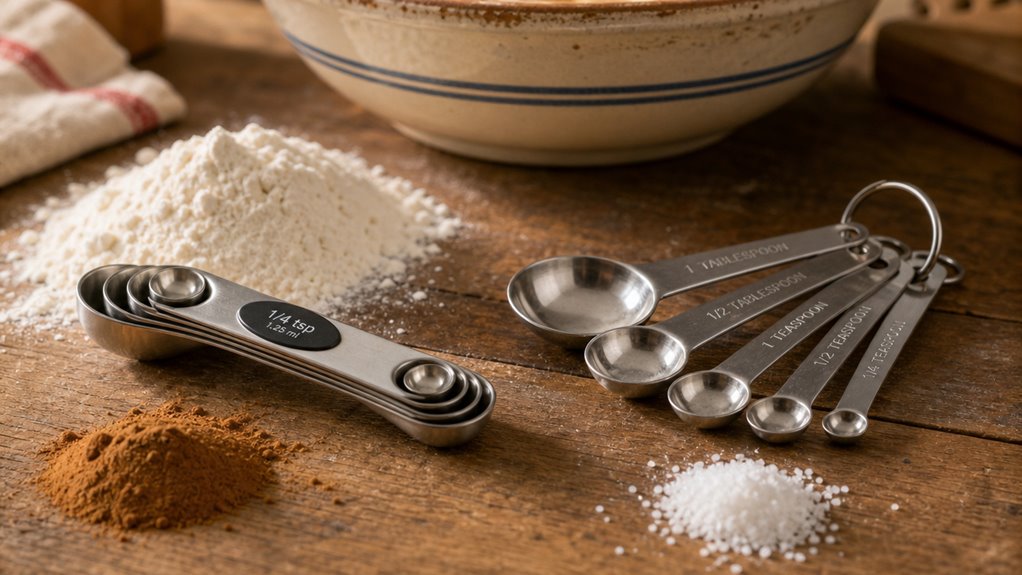
Magnetic measuring spoons work by using embedded magnets to stack and separate spoon sizes cleanly, keeping sets organized in a drawer without clips or rings. The design depends on magnet strength and bowl construction to function reliably.
- Neodymium magnets hold stacked spoons firmly, preventing wobble and accidental separation during single-handed retrieval.
- Stainless steel bowls resist warping and rust, giving the spoon set structural integrity through repeated use and washing.
- Sealed magnet housing protects the magnetic core from water exposure, allowing the set to survive dishwasher cycles without degrading.
Magnet quality determines whether the concept is practical or merely decorative. Sets using weak ceramic magnets allow the stack to shift and spoons to spill, which removes the organizational benefit entirely. Neodymium magnets provide the holding force the design requires.
Bowl shape and handle material affect daily usability. Stainless steel handles resist the warping that affects plastic alternatives, and a range of bowl shapes, including narrow spice-jar sizes, expands where the spoons can be used. A set that covers common volume measurements while offering specialty sizes delivers broader utility.
Price tier influences material quality in this product category. Mid-range sets, typically priced under $30, are more likely to include solid stainless steel construction and sealed magnets than budget alternatives. Traditional ring-linked sets remain a reliable option when magnet quality cannot be confirmed before purchase.
Neodymium is the strongest class of permanent magnet available by volume. At comparable sizes a neodymium magnet holds substantially harder than a ceramic ferrite one, which is why magnet type, not spoon weight, decides whether a stack actually stays together. Manufacturers rarely publish a holding-force figure for kitchen sets, so judge it in the hand rather than from a number.
Cheap or expensive is the wrong question. Cost per use is the honest one. Check out our new Calculator.
Cost-Per-Use Calculator →Key Points
- Strong neodymium magnets keep spoons securely stacked and enable one‑handed access, turning storage into a real convenience rather than a gimmick.
- Narrow, elongated bowls fit spice jars and supplement bottles, reducing spillage and improving measurement accuracy for dry ingredients.
- Stainless‑steel construction with sealed magnets resists rust, warping, and magnetic degradation, ensuring durability through dishwasher cycles.
- Families, small kitchens, and heavy‑recipe users benefit most from compact stacking and reduced counter clutter; casual users gain little.
- If the set uses weak ceramic magnets or cheap plastic, the magnetic feature becomes unreliable and adds cost without practical advantage.
| Magnetic Measuring Spoons Set with Leveler Stackable |  | Space Saver | Primary Function: Measuring spoons | Material (main component): Stainless steel | Ergonomic Design: Double-sided design for easy scooping | VIEW LATEST PRICE | Read Our Analysis |
| Umite Chef Thickened Silicone Kitchen Utensil Set (Stainless Steel Core) |  | Professional Grade | Primary Function: Multi-purpose utensils | Material (main component): Food-grade silicone with stainless-steel core | Ergonomic Design: Wooden ergonomic handles | VIEW LATEST PRICE | Read Our Analysis |
| ChefAide 5-Piece Silicone Spatula Set Heat-Resistant |  | Best For Beginners | Primary Function: Silicone spatulas | Material (main component): Food-grade silicone | Ergonomic Design: Upgraded strong ergonomic grip | VIEW LATEST PRICE | Read Our Analysis |
Links to Amazon are affiliate links. Buying through one costs you nothing extra and helps fund the research.
What Magnetic Measuring Spoons Promise Over Standard Sets
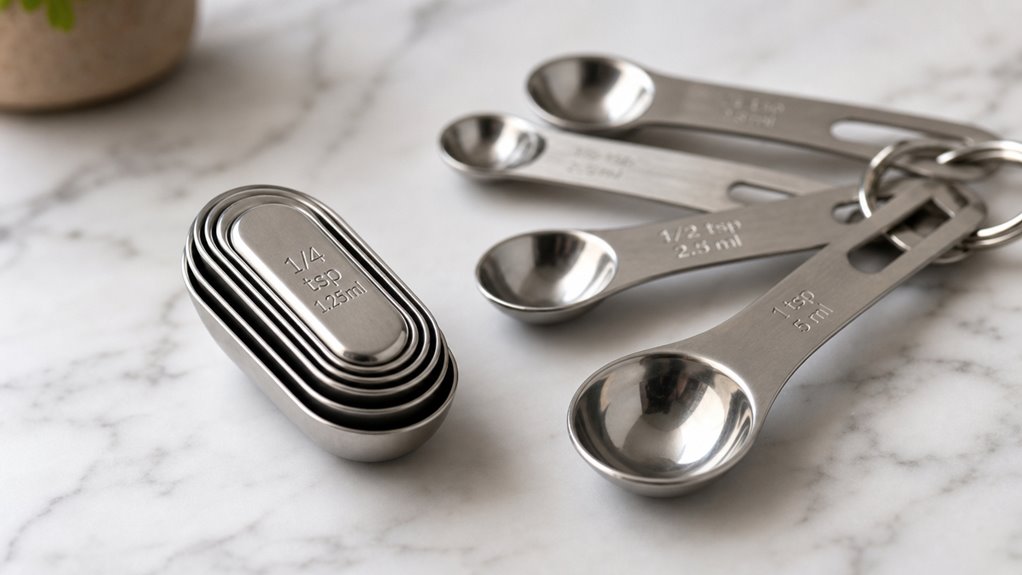
Magnetic measuring spoons differ from standard sets by holding all sizes in a single stacked column through embedded magnets, letting each spoon detach individually rather than requiring a full ring to be unclipped. This nested arrangement keeps a kitchen drawer organized and speeds up access during cooking.
The narrow bowl profile on one end is shaped to fit into spice jars, which reduces spillage when measuring dry ingredients. Magnet strength is the practical variable here. A weak hold lets the stack separate during normal handling, removing the organizational advantage the design is meant to provide.
The details below examine how these factors play out across different designs and use cases.
Tidy Storage and Single-Spoon Use
Because the spoons snap together magnet to magnet, they stay in a compact stack that fits neatly in a drawer or on a metal surface, cutting down on the visual clutter you get with loose ring‑bound sets.
You’ll notice magnetic measuring spoons nest tightly, so the horizontal footprint shrinks and you can even lean the stack against a fridge door.
When you need just one size, single‑spoon use lets you pull out the ½‑tsp without rattling the whole set, keeping the other spoons clean and out of the way.
The magnets hold each piece firmly, so they don’t wander during a dishwasher cycle.
The trade‑off: if the magnet is weak, the stack can separate, turning the benefit back into a loose bunch.
Look for food-grade 18/8 stainless in the specification, which is the grade that resists rust through repeated washing. Check it on the manufacturer’s own listing rather than a retailer’s copy, since retail descriptions frequently repeat a grade the maker never claimed.
The Narrow Bowl Shape Hidden Behind the Magnet
The magnetic stack keeps your drawer tidy, but the real advantage hides in the spoon’s shape.
A narrow bowl on magnetic measuring spoons slides into spice jars and supplement bottles where a round spoon would snag. At about 0.5–0.75 in wide for teaspoons, the oval profile reaches deeper into tall containers, reducing spill and waste. The slim edge pairs with a dedicated leveler, giving you a flat fill and more repeatable measurements. You’ll notice less clumping of dry powders because the narrow well guides ingredients straight out. The handle‑mounted magnet keeps the bowl light and balanced, so you can pick up a single size without juggling a ring set. Just remember: if the magnet is weak, the bowl’s benefit disappears. Set sizes vary: some run to four spoons, others to eight or more with half and quarter increments. Count the sizes against the measurements your recipes actually call for rather than paying for a longer list you will not use.
| Farberware Pro2 Euro Vegetable Peeler with Swivel Blade |  | Most Versatile | Primary Function: Vegetable peeler | Material (main component): High-carbon stainless steel (blade) / Nylon (handle) | Ergonomic Design: Nylon ergonomic handle | VIEW LATEST PRICE | Read Our Analysis |
| Farberware 7″ Stainless Steel Tongs with Silicone Tips |  | Compact Choice | Primary Function: Tongs | Material (main component): Stainless steel / Silicone tips | Ergonomic Design: Comfortable grip with lock | VIEW LATEST PRICE | Read Our Analysis |
| Taylor Digital 99-Minute Timer White Compact Kitchen Timer |  | Precise Timing | Primary Function: Kitchen timer | Material (main component): Plastic housing (digital timer) | Ergonomic Design: Compact, easy-to-clip design | VIEW LATEST PRICE | Read Our Analysis |
Links to Amazon are affiliate links. Buying through one costs you nothing extra and helps fund the research.
Where the Magnet Helps and Where It Disappoints
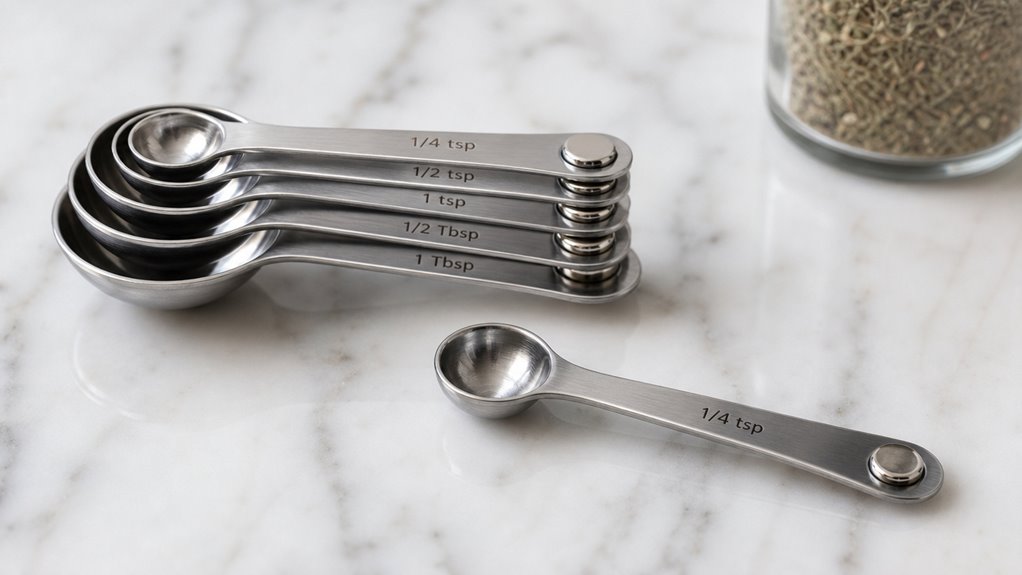
Magnetic measuring spoons succeed or fail on magnet strength. Strong magnets hold every spoon size in a compact, drawer-friendly stack, while under-powered magnets leave the set behaving like a loose, disorganized ring.
When the magnetic connection holds reliably, a cook can pull a single spoon free with one hand rather than wrestling with a linked ring that resists separation. That single-handed access is a practical advantage during active cooking, where speed and clean hands matter.
Magnet strength is therefore not a minor design detail but the factor that determines whether the magnetic format actually improves on a conventional set.
The sections below examine how this plays out across real storage and daily-use conditions. The practical test is the one you can do in a shop or on arrival: hold the stack by the smallest spoon and see whether the rest stay attached when you shake it gently. A set that passes that has magnets worth having; one that does not is a ring set without the ring.
Strong Magnets Versus the Weak Ones That Separate
When you pull a spoon from a magnetic set, a strong neodymium magnet keeps the rest of the stack snug, so you can grab one size without the others scattering across the drawer.
Magnet strength matters; a high‑grade neodymium piece holds firm even when you yank a spoon out, preventing the whole stack from wobbling. Weak magnets, often ceramic or ferrite, let spoons slip, spin, or fall off with a slight bump, turning the tidy promise into a gimmick.
You’ll notice the difference when you hang the set on a fridge rail: strong magnets stay put, while weak ones slide down. The difference comes from the material itself: neodymium alloys sustain a far stronger field than the ceramic ferrite used in cheap sets, which is why magnet type matters more than magnet size here.
Why Magnetic Spoons Store Neatly but a Ring Set Never Loses One
Magnetic spoons snap together, so you pull one out and the rest stay bundled, cutting down on drawer chaos.
The magnetic measuring spoons cling at a central point, letting you grab a single size with one hand and drop the stack back in a tight nest. That neat stack saves space and stops you from hunting for a missing spoon after a bake.
Ring‑linked spoons, by contrast, stay joined by a metal loop that never lets a piece slip away, so you never lose one, but the loop adds bulk and makes the bundle harder to pull apart quickly.
The magnet’s strength decides whether the stack stays intact; a weak magnet will let spoons drift, turning the promise of tidy storage into a gimmick.
Both designs keep the set together, yet only a strong magnetic connection offers the compact, one‑handed convenience many cooks appreciate.
When Magnetic Measuring Spoons Earn Their Place
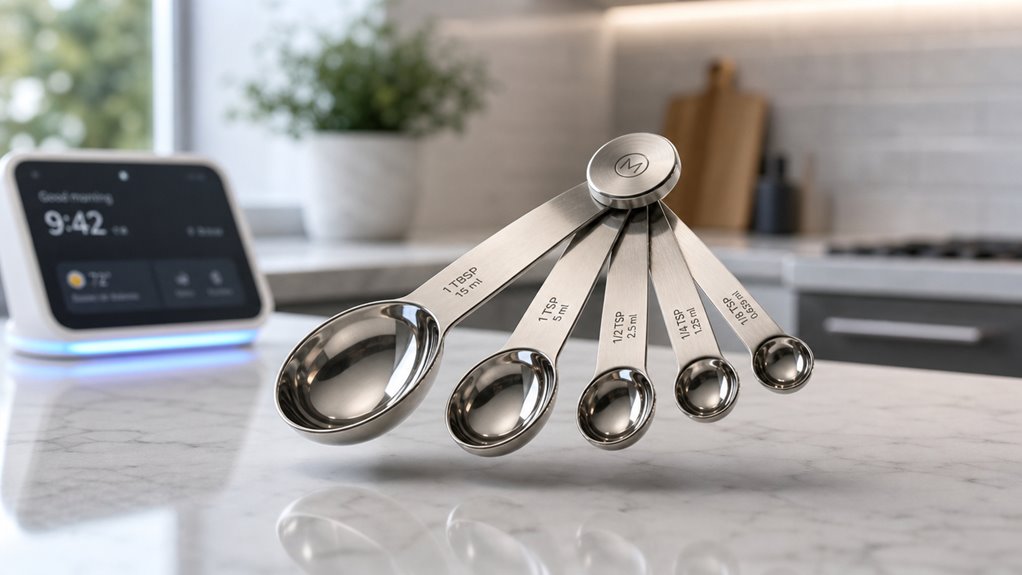
Magnetic measuring spoons earn their place when a cook regularly works with multiple measurements and needs a set that stores compactly, either stacked together through magnetic nesting or held flat against a fridge strip.
The slender, elongated bowl design lets the spoon fit inside narrow spice jars without spilling, which standard round-bowl sets can’t reliably do.
Precise liquid measurements also benefit from this shape, since the narrower profile gives more control when leveling ingredients.
For cooks who rely on only one or two sizes or prefer the familiar convenience of a ring-linked set, the added magnet strength provides little practical advantage and typically raises the cost without a clear return.
The details that determine whether this design is worth it go further than storage and shape alone.
The Cooks Who Benefit and the Ones Who Will Not
Often the biggest gain shows up in kitchens where you’re juggling many recipes at once.
Heavy‑recipe users and frequent bakers reap the most benefit. Their nested sets stay complete, the calibrated markings stay legible, and the strong magnet lets you grab a spoon from the fridge or oven‑side rack without rummaging through a drawer. The narrow bowl design gives a true spice jar fit, letting you scoop into tiny containers without spilling. Small, space‑limited homes also love the single‑footprint stacking that keeps counters clear. Families with shared kitchens avoid lost pieces because each spoon snaps back into place. Professional kitchens, however, often need sealed containers and bulk tools, so the magnetic advantage fades quickly.
Why Narrow Magnetic Spoons Reach Into Spice Jars That Round Ones Cannot
Heavy‑recipe cooks love the way a narrow magnetic spoon slides straight into a spice jar, and the reason is simple geometry. The oval‑pill shape cuts the width to roughly three quarters of an inch, letting you bypass the rim that stops a round bowl. You can drop the spoon down, level it against the jar mouth, and scoop without spilling or tilting the container. That reach is the whole reason a narrow bowl beats a round one when the jar opening is tight.
- Flat sides glide along the jar wall, reducing wedging.
- Low profile reaches the bottom of tall jars without your fingers.
- Consistent sizing means you always know if it will fit.
You’ll notice less residue, smoother removal, and more accurate fills.
The Build Quality That Separates Worth-It From Gimmick
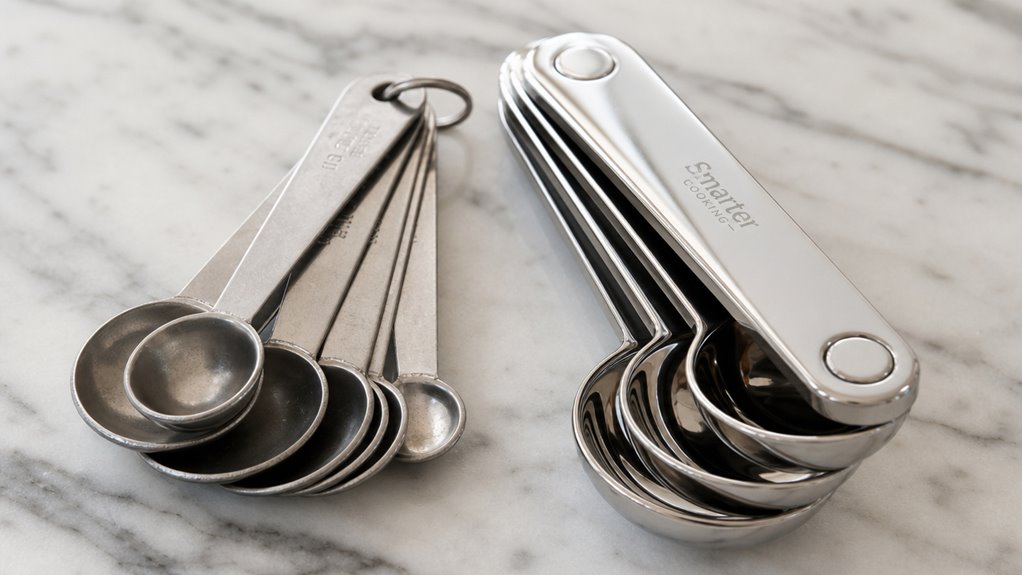
Build quality separates a magnetic measuring spoon set worth keeping from one that ends up unused, and the line comes down to material integrity, magnet strength, and how well the design holds up through repeated use.
Stainless steel construction with a one-piece handle eliminates the loosening that plagues cheaper sets, while a sealed neodymium magnet maintains its pull even when the drawer is packed tight.
The narrow bowl geometry is a functional detail that matters in practice, since it lets the spoon reach into spice jars cleanly rather than spilling at the rim.
Budget plastic alternatives tend to flex, rust at stress points, or lose magnetic retention after washing, which is what makes a set feel like a gimmick rather than a tool.
The factors that determine which side of that line a set falls on are worth examining closely.
Stainless Versus Plastic and Magnets That Hold
When you compare stainless‑steel and plastic magnetic spoons, the build quality is what really separates a worthwhile set from a gimmick. Stainless steel measuring spoons stay rigid, resist warping, and won’t leach additives, while plastic bowls can crack, stain, and lose markings after a few washes.
The magnets inside matter too: a strong rare‑earth magnet keeps the stack tight, but a weak one lets spoons slip apart, making the “magnetic” claim feel empty. You’ll notice the difference when you pull a spoon out, level it, and see it stay put without wobbling.
- Heavy, sealed magnets that hold a full stainless stack
- Narrow, laser‑etched bowls that fit spice jars snugly
- Non‑porous stainless surfaces that stay clean and odor‑free
So do they work? Yes, provided the magnet is strong and the material is stainless. Plastic sets often fail this test, turning a clever idea into a gimmick.
Where a Cheap Set Bends, Rusts, or Loses Its Pull
If you buy a cheap magnetic spoon set, the first thing you’ll notice is how easily the handles bend under normal kitchen pressure. The plastic or thin‑metal stems flex after a few scoops, and that flex turns into permanent deformation after a week of scraping dry herbs.
Rust shows up too, especially if the coating is just a cheap spray; a single spot can spread after a few dishwasher cycles, making the set look worn and the metal corrode.
The magnetic pull loss is another tell‑tale sign: the spoons no longer snap together, they wobble and fall apart in the drawer. In contrast, a stainless steel set keeps its shape, resists rust, and maintains a firm magnetic hold, so you avoid the cheap‑set gimmick altogether.
How to Decide If a Magnetic Set Is Worth Buying
A magnetic measuring spoon set is worth buying when its magnet strength, bowl shape, and price tier align with how the spoons will actually be used. Bowl shape affects reach and accuracy: narrow bowls fit into spice jars, while deeper bowls handle liquids without spilling.
Magnet pull strength determines whether the snap-together storage functions as a genuine convenience or simply adds an awkward handling step each time the spoons are separated. Mid-range sets are the ones most likely to pair sealed neodymium with stainless bowls, while the cheapest sets are where weak magnetic connections undercut the core advantage the design promises. The details behind each of these factors deserve a closer look.
Matching the Feature to How You Measure
Magnetic spoons can tidy up a cluttered drawer by snapping together, but the real test is whether the magnets stay locked when you pull a single size out. If you often measure directly from spice jars, look for narrow bowls that slide in without spilling. Strong magnets keep the stack intact while you pull one spoon, and a dual‑ended design lets you switch between a round liquid bowl and an oval dry‑ingredient bowl in seconds.
- A stainless set with thick magnets that hold firm even when you yank a ½‑tsp out.
- Narrow, engraved bowls that fit standard spice jars, reducing transfers.
- Dual‑ended spoons: round for liquids, oval for dry, keeping workflow smooth.
Match these features to how you cook, and you’ll see whether a magnetic set earns its price or stays a gimmick.
Matching a Worthwhile Set to the Under-$30 Ceiling
Because most reputable magnetic spoon sets sit comfortably under the $30 ceiling, they leave room for the dual‑ended design that lets you measure both dry and liquid ingredients without buying a second set.
You should first check magnet strength; a strong magnetic nesting set holds each spoon snugly, preventing loose pieces that slip into drawers. Next, look at bowl shape. Narrow bowls reach into spice jars and reduce spill, while round bowls are fine for bulk ingredients. Stainless construction matters too, because 18/8 steel resists rust and survives dishwashers. If a set uses weak, unsealed magnets or flimsy plastic handles, it’s a gimmick, not a genuine upgrade. Focus on these functional specs, and you’ll match a worthwhile set to the under‑$30 ceiling.
Frequently Asked Questions
How Does Magnet Material Affect Spoon Durability?
Ferrite magnets tolerate corrosion and heat well but pull weakly. Neodymium offers far higher pull and is the reason a stack holds at all; bare neodymium can corrode and lose strength in hot, wet cycles, which is exactly what a sealed housing prevents. In a properly sealed stainless set, the magnet outlasts the dishwashing.
Can Magnetic Spoons Be Used on Glass or Metal Surfaces?
Magnets stick to ferromagnetic metal, not glass. Magnetic spoons hold on a steel fridge door or a metal rail, but on a glass surface they behave like any other metal spoon, with no adhesion and the same handling.
Do Magnetic Spoons Interfere With Dishwasher Cleaning Cycles?
You won’t see any dishwasher issues; magnetic spoons are labeled dishwasher‑safe, and the magnets don’t weaken or disrupt cycles. Just place them in the rack and let the machine clean as usual.
Are Magnetic Spoons Safe for Use With Acidic Ingredients?
Yes, for the brief contact a measuring spoon involves. Food-grade stainless is used for acidic foods precisely because the chromium oxide layer resists them, and a spoon touches an ingredient for seconds rather than hours. Any figure you see quoted for how much nickel migrates is meaningless without stating the food, the temperature and the contact time, so treat unattributed numbers with suspicion. If you have a diagnosed nickel allergy, ask your clinician rather than a cookware article. On the buying side, choose a set with a solid stainless body and a properly seated magnet, and avoid the cheap plastic-bodied sets where the magnet is glued into a recess.
What Is the Typical Lifespan of a Strong‑Magnet Spoon Set?
Neodymium magnets lose strength very slowly at kitchen temperatures, so in practice these sets are ended by mechanical wear rather than by the magnets fading: a cracked housing, a magnet working loose from its recess, or rust where the plating has been breached. Keep them dry, keep them away from a hot hob or oven, and the limiting factor will be the build rather than the magnetism.
Conclusion
You’ll find that a magnetic set only pays off when the magnet is genuinely strong, the bowls are narrow enough for spice jars, and the steel is solid. If any of those pieces falter, you end up with a clunky drawer ornament that slides apart at the first shake. So weigh the specs, not the sparkle, and decide whether the convenience of a snap‑together stash justifies the extra cost.
| KitchenAid Classic Can and Bottle Opener Razor Sharp Steel Wheel Ergonomic Handles Black |  | Best Overall | Primary Function: Can and bottle opener | Material (main component): Stainless steel | Ergonomic Design: Oversized ergonomic handles | VIEW LATEST PRICE | Read Our Analysis |
| Amazon Basics 12-Piece Color-Coded Knife Set with Guards |  | Best Value | Primary Function: Knife set | Material (main component): Stainless steel (blade) / Plastic (handle) | Ergonomic Design: Ergonomic plastic handles | VIEW LATEST PRICE | Read Our Analysis |
| BYkooc 8-Piece Paring Knife Set – Ultra Sharp German Steel |  | Budget-Friendly Pick | Primary Function: Paring knives | Material (main component): Stainless steel (blade) / PP plastic (handle) | Ergonomic Design: Ergonomic PP handles | VIEW LATEST PRICE | Read Our Analysis |
Links to Amazon are affiliate links. Buying through one costs you nothing extra and helps fund the research.

Michael Haralson worked in professional kitchens from 1979 to 1992: San Diego restaurants, six years with a catering company beside an Austrian chef, and two summers as a cook on the Finland to Sweden cruise route. He then built a fifteen-year career at Nokia. It began in product marketing and product management, where technical specifications and supplier evaluation were part of the work, and grew from a few countries to a region to global roles, then into sales and corporate strategy. That took him to Beijing for three years, where he spent many weekends in a different province trying the local food and took cooking classes. He has eaten in more than 40 countries and has been shown the kitchens of restaurants in Southern Europe. At home in Finland he cooks Cantonese, Sichuan and Mediterranean food, and still uses the cast iron skillet he bought in 1992. He is the author of Buy It Once, Book One of The Researched Kitchen, and writes here about the balance between kitchen tools that cost too much and those that fail too soon.