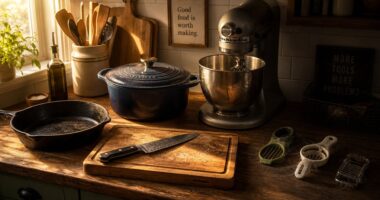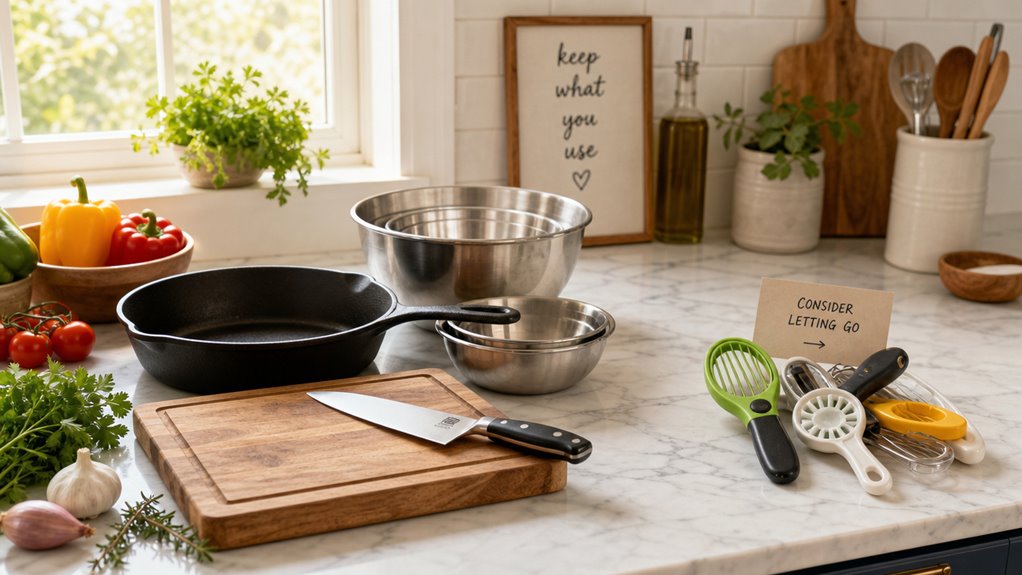
The declutter test is a sorting method that requires emptying a kitchen drawer or cabinet and evaluating each item against three quick criteria: frequency of use, functional overlap, and physical footprint. Tools that fail any check get removed; tools that pass earn a designated spot near the cooking area.
- Frequency of use determines whether a tool justifies drawer space by confirming it appears in regular meal preparation.
- Functional overlap identifies items that duplicate the role of a single multitasking tool, making one of the two redundant.
- Physical footprint measures whether an item fits the available storage space without crowding out higher-priority tools.
The three-second keep-or-cull rule structures the evaluation process. Each item receives roughly three seconds of assessment against all three criteria before a keep or remove decision is made.
The empty-and-sort pass is the physical technique that makes the rule work. Removing every item from a drawer or cabinet first forces a deliberate evaluation rather than a passive acceptance of whatever accumulated there.
Tools that pass all three checks move back into storage near the point of use. Tools that fail go into a donate or trash pile, clearing space and reducing visual clutter in the kitchen.
Walk through most kitchens and the pattern repeats: a large share of what fills the drawers gets used only a few times a year, so prime storage ends up holding low-frequency items instead of daily-use essentials.
Cheap or expensive is the wrong question. Cost per use is the honest one. Check out our new Calculator.
Cost-Per-Use Calculator →Key Points
- Apply the three‑second “keep‑or‑cull” rule: if you can’t identify daily use, unique purpose, or clear benefit, set the item aside.
- Ask the three diagnostic questions for each item: frequency of use, functional overlap, and space efficiency.
- Prioritize multitaskers (e.g., chef’s knife) over single‑purpose gadgets; replace duplicates with one versatile tool.
- Use the 50 % rule and one‑in‑one‑out habit: keep only the most essential half of similar items and remove any new addition by donating an old one.
- Store kept items near their point of use and place rarely used items in higher or vertical storage to preserve prime countertop and drawer space.
The Declutter Kitchen Mindset That Decides What Stays
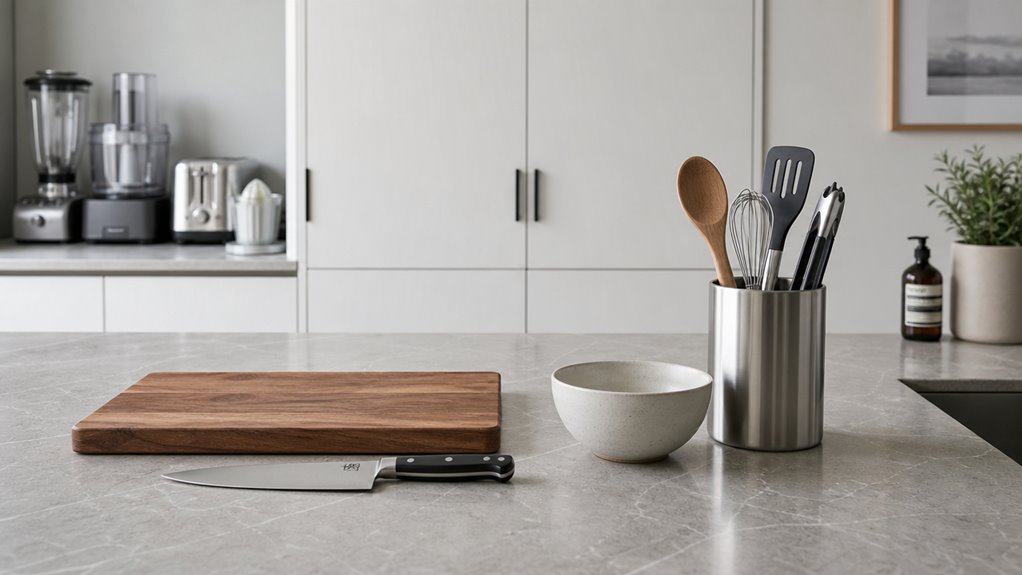
A declutter kitchen mindset replaces the default habit of keeping everything with a deliberate keep-or-cull decision applied to each item based on how often it gets used, whether it duplicates another tool, and how much drawer or cabinet space it consumes.
Most kitchens accumulate gadgets, duplicate utensils, and rarely used appliances simply because no clear decision-making framework was applied when they arrived.
Multitaskers that handle daily tasks earn their place; single-use gadgets and gifted items that sit untouched do not.
Space constraints make this framework necessary, since a crowded kitchen slows down practical cooking rather than supporting it.
The sections that follow break down how to apply this mindset systematically.
The one‑for‑one rule helps prevent accumulation when new items are introduced.
Why Keeping Is the Default That Quietly Fills Drawers
Most of the time you just put a tool back where you first found it, and that habit quietly fills drawers. Your brain leans on status quo bias, so you keep items by default instead of weighing usefulness. When you’re tired, default storage behavior wins: you slide the spatula into the nearest slot, the whisk into the top drawer, without asking if it earns its footprint. This low‑effort choice feels safe, yet it lets rarely used gadgets linger. Over weeks, the cumulative effect is a drawer that looks full but contains many items you never reach for. Recognizing that you’re preserving the familiar, not the functional, is the first step toward breaking the cycle. Keeping frequently used items like the coffee maker accessible on the counter can prevent the habit of over‑stuffing drawers with rarely used tools.
Replacing Habit With a Simple Keep-or-Cull Rule
Swap out the default “just put it back” habit for a quick, three‑second keep‑or‑cull check.
You pull an item, glance, and decide in under three seconds whether it earns a spot. If you can’t name a daily use, a unique job, or a clear benefit, you cull it. Apply the keep‑or‑cull pass to every drawer: empty, sort, then return only tools that pass the three‑second decision rule.
A coffee maker stays because you brew daily; a single‑purpose slicer goes because a chef’s knife does the same job. The rule removes guilt‑driven storage and duplicates, keeping your counter clear and your cooking flow smooth.
One‑in‑one‑out habits then keep the system from swelling again. The 50% rule can be used as a quick, quantitative sanity check when you feel overwhelmed.
The Questions That Power the Declutter Test
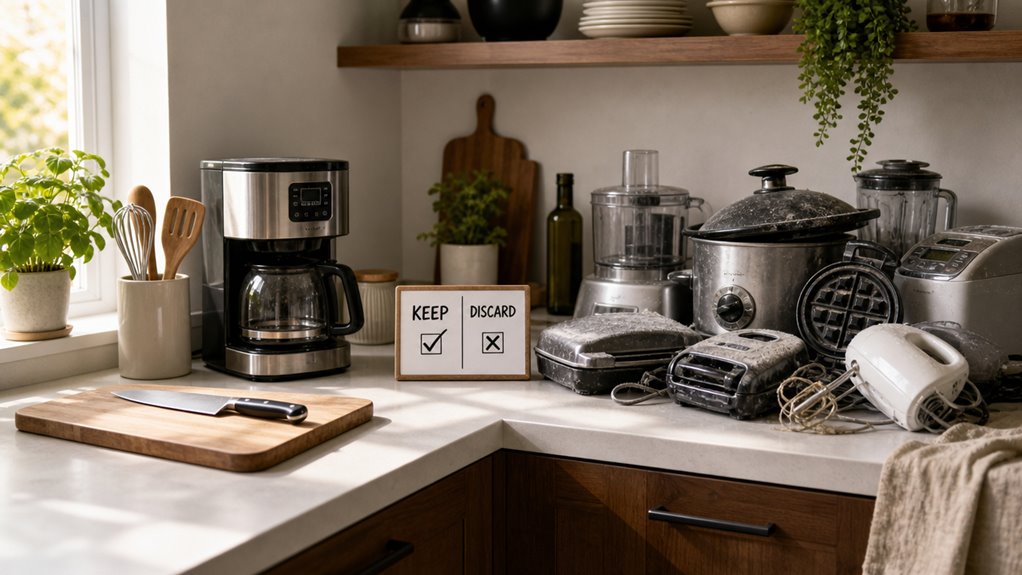
The declutter test works by running each kitchen item through three diagnostic questions: how often it gets used, whether another tool already covers its function, and how much physical space it claims relative to that use.
Frequency of use carries the most weight because an item reached for daily earns its place regardless of sentiment, while one that sits untouched for months rarely justifies its footprint.
Functional overlap is the second pressure point. When a multitasker handles the same task, a single‑purpose duplicate becomes a strong removal candidate.
Space efficiency completes the evaluation, since a bulky gadget that rarely leaves the drawer costs more in storage than it returns in utility.
The criteria behind each question reveal more nuance than the questions alone suggest. Living out original purpose is a key indicator that an item still serves its intended function.
Frequency, Overlap, and the Space a Tool Demands
Often the easiest way to decide if a kitchen item belongs in your cabinets is to ask three blunt questions: how often you actually use it, whether it duplicates something you already have, and how much space it consumes relative to that use.
You start by measuring frequency of use; a waffle iron that only appears on holiday mornings fails the test. Next, check overlap: three slicers for the same job are redundant, so keep the multitasker and cull the rest. Finally, assess space demand. A bulky plastic‑bag dispenser that fills a drawer but sees only weekly use claims more space than it returns, while a small zip‑top container that handles daily leftovers earns its keep. Apply these filters, and you’ll see a clearer, more functional kitchen.
Why Frequency of Use Beats Sentiment When Deciding What Stays
The three‑question filter you used for frequency, overlap, and space works great, but the next step is to let usage drive the decision, not sentiment. When you count frequency‑of‑use, you see which tools actually speed up cooking and which just sit in a drawer. A whisk you grab daily earns its footprint; a decorative spatula you never touch adds sentimental clutter and creates friction. Use the “used in the last 3–6 months?” check to flag low‑use items. Pair that with “needed for regular weekly meals?” and “does it serve a unique function?” If the answer is no, the item is a candidate for donation. This objective filter cuts decision fatigue, keeps countertops clear, and prevents guilt‑driven hoarding. Vertical storage can also be used to keep infrequently used items out of sight while preserving easy access when needed.
How the Declutter Kitchen Pass Works in Practice
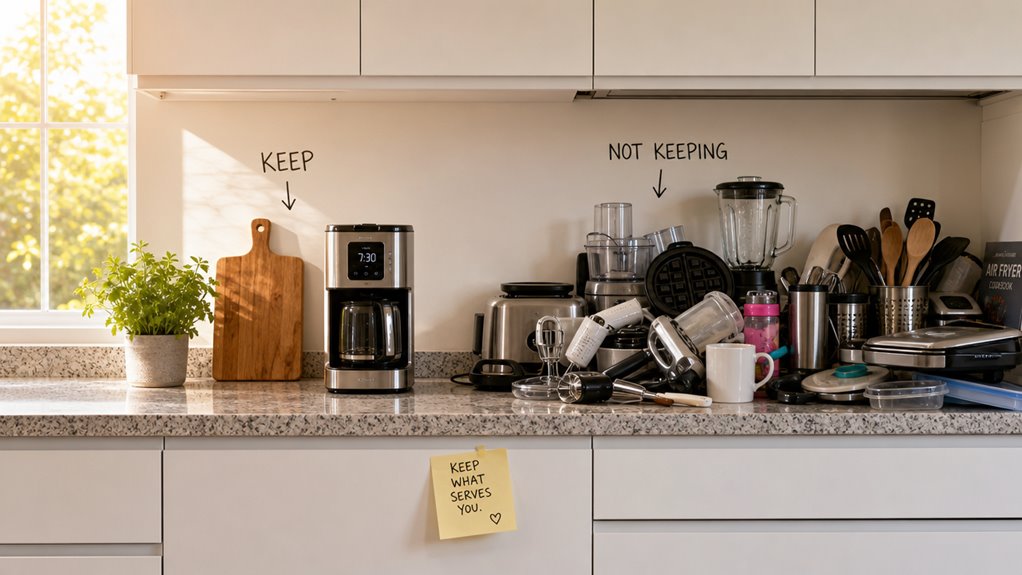
The declutter kitchen pass works by emptying a drawer or cabinet completely, then sorting every item against three practical filters: frequency of use, function, and physical fit. Nothing goes back until it clears all three.
This sequence matters because it forces a deliberate decision on each tool rather than a quick tidy that leaves redundant gadgets in place.
A multitasker that handles several jobs displaces the need for multiple single-task slicers, which reduces footprint without reducing capability.
Fit matters alongside function: a tool that technically works but jams a drawer or stacks awkwardly tends to go unused, making it clutter regardless of its purpose.
The sections ahead cover how to apply each filter consistently across different storage zones.
Emptying, Sorting, and Returning Only What Earns It
When you empty a cabinet completely onto the counter, the mess becomes a clear snapshot of how much you actually own. You wipe the surface, then sort every piece into four piles: keep, donate/sell, trash, and a “time will tell” box for items you haven’t used in a year.
The declutter test tells you to ask three questions for each object: frequency, overlap, and footprint. If it’s a daily multitasker, fits near its point of use, and doesn’t crowd the space, it earns a spot back.
Duplicates, broken tools, and sentiment‑driven keeps go straight to donation or trash. Finish the zone, wipe the shelves, and move on only when the area is truly reset. This systematic pass keeps your kitchen functional and prevents the habit of mindlessly refilling drawers.
Why One Multitasker Earns Its Place Over Three Single-Task Slicers
Emptying a drawer and laying every tool on the counter forces you to ask, “Does this really earn its spot?”
A chef’s knife that chops, slices, minces, and carves can replace three separate slicers, so it clears the overlap filter. It clears the frequency filter too, because you’ll reach for it daily.
The multitasker handles tomatoes, avocados, and bananas with a single, sharp blade, cutting down on storage and cleaning time.
A single‑task slicer often has a tiny hinge that traps food and requires disassembly after each use, adding micro‑delays. You’ll also avoid the hidden safety risks of spring‑loaded blades that can pinch fingers.
When the knife covers the same jobs as three gadgets, the slicers fail the “earns its place” test, and you keep the multitasker instead.
The Items Most People Wrongly Keep
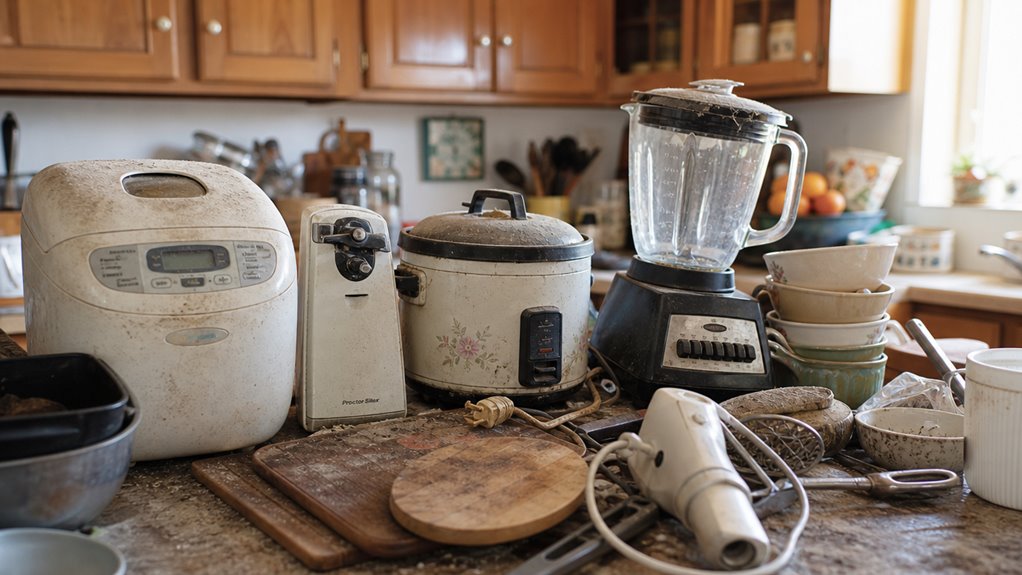
Most kitchens accumulate items that take up measurable space while serving little practical purpose: duplicate gadgets, single-purpose tools that rarely leave the drawer, and gifts that never matched an actual cooking habit.
Clutter builds because sentiment and routine override honest assessment of how often each item gets used.
Overlap is a reliable signal of excess: when two tools perform the same task, one is occupying space without justification.
Frequency of use, storage footprint, and functional redundancy are the three clearest criteria for deciding what stays and what goes.
The sections ahead apply those criteria to the specific categories most households struggle to part with.
Duplicates, Gifts, and Gadgets Used Once
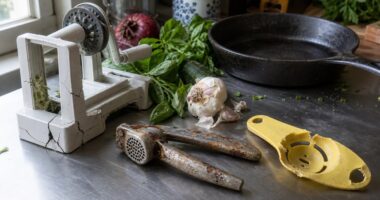
You’re probably keeping a few extra can openers, a second colander, and that avocado slicer you never actually use because they felt safe to stash away. Those duplicate tools waste drawer space while adding no value.
You might also hold onto gifts, novelty kitchen gadgets you never needed, just because they came with a bow.
And those single-use, once-used gadgets, like a banana cutter or a chocolate fountain, sit idle after one or two occasions.
To decide what stays, ask yourself three questions: How often do you reach for it? Does it overlap with a multitasker you already own? How much room does it claim? If the answer is “rarely” or “redundant,” it belongs in the donation bin. Keeping only the items that earn their footprint prevents the hidden clutter that slows cooking and fills cabinets without purpose.
Where Sentiment Outweighs Usefulness and Costs You Space
Heirloom plates and that fancy china set you inherited from grandma often end up hogging the top shelf, even though you reach for them less than once a year. Those heirloom and inherited kitchenware pieces feel like a link to family, yet they occupy prime cabinet space that could hold daily pots, pans, and utensils.
The same happens with special-occasion items rarely used: formal glassware, ornate platters, and a full wedding‑registry set that sits eye‑level while you scramble for a spatula. Because you keep them out of guilt or imagined future parties, they crowd functional zones and force everyday tools into drawers or onto counters.
Cut the sentimental clutter by keeping only the handful you truly love and use; donate or sell the rest to free up space and simplify cooking.
How to Make the Decluttered Kitchen Stay That Way

Keeping a decluttered kitchen that way depends on two habits working together: replacing old tools with new ones rather than adding to the total count, and storing only the items that match how you actually cook.
A one-in-one-out rule holds the overall inventory steady, so no single purchase quietly expands counter space or cabinet load. Use-based filtering sharpens that further. A sauté pan that never gets pulled out occupies the same space as a multitasker that earns its place every day, and only one of those justifies staying.
Matching storage decisions to real cooking habits prevents the slow accumulation that makes a kitchen feel crowded again over time. The practical methods for applying both principles consistently go deeper than the basics covered here.
A One-In-One-Out Habit for New Tools
If you let a new gadget slip into the kitchen without a trade, the drawer will fill up again in weeks; the one‑in‑one‑out habit stops that by making every addition a forced removal. You’ll decide what to keep by asking if the tool saves at least five minutes, cuts effort in half, cleans easily, costs proportionally, or replaces several single‑purpose items.
When you buy, pick a matching “out” item in the same category and drop it in a donation bin. This simple swap caps capacity and prevents hidden clutter.
- Designate a bin near the sink for tools exiting the rule.
- Track by category: one spatula in, one spatula out.
- Pause before purchase; identify the “out” tool first.
- Scan monthly for items unused over 12 months.
- Prioritize multi‑purpose tools over novelty gadgets.
Matching What You Keep to How You Actually Cook
Your new one‑in‑one‑out habit keeps the drawer from refilling, but it won’t stay effective unless the tools you keep actually match the way you cook every day.
Start by tracking what you use for two weeks; note the chef’s knife, cutting board, sauté pan, and Dutch oven that appear in every meal. Those are your high‑use, multitask items. Group the rest by task: chopping, simmering, baking. Then discard anything you haven’t touched in several months unless it’s truly seasonal.
Create zones: prep tools near the counter, stove tools by the burners, baking tools in a higher cabinet. Keep only the items that earn their footprint, and the kitchen will stay aligned with your real cooking habits.
Frequently Asked Questions
Can I Keep Sentimental Items if I Never Use Them?
You can keep sentimental items, but only if they fit within a defined space, serve as intentional décor, or have a digital record. Otherwise they become clutter, so set limits and prioritize usefulness.
How Many Duplicate Tools Are Acceptable Before Culling?
You should keep only one primary tool and, at most, one backup: no more than two copies. If you have three or more, it’s time to cull the extras and free up space.
What Footprint Size Qualifies a Tool as “Worth Keeping”?
Think of your kitchen like a puzzle: a tool earns its spot if it fits within a dinner‑plate footprint—no larger than 12″ × 12″ × 1‑inch‑thick—and delivers daily, multitask value.
Should I Replace a Multitasker With a Specialized Gadget?
You should replace it only if the gadget solves a frequent task the multitasker can’t handle reliably, and its footprint and cost stay under $30. Otherwise keep the multitasker and cull the gadget.
How Often Must I Perform the One‑In‑One‑Out Habit?
You should apply the one‑in‑one‑out habit every time a new kitchen item arrives, whether it’s a gadget, dish, or container, so you’re always culling one before adding one, keeping the space balanced.
Conclusion
You’ve got the test, the habit, and the mindset to keep only what truly serves you. When you pull a drawer, the three questions will instantly tell you if that gadget belongs or if it’s just clutter. Stick to the one‑in‑one‑out rule, and the kitchen stays functional without the guilt. Your cooking space becomes predictable, faster, and, most importantly, free of the hidden duplicates that never get used.

Michael Haralson worked in professional kitchens from 1979 to 1992: San Diego restaurants, six years with a catering company beside an Austrian chef, and two summers as a cook on the Finland to Sweden cruise route. He then built a fifteen-year career at Nokia. It began in product marketing and product management, where technical specifications and supplier evaluation were part of the work, and grew from a few countries to a region to global roles, then into sales and corporate strategy. That took him to Beijing for three years, where he spent many weekends in a different province trying the local food and took cooking classes. He has eaten in more than 40 countries and has been shown the kitchens of restaurants in Southern Europe. At home in Finland he cooks Cantonese, Sichuan and Mediterranean food, and still uses the cast iron skillet he bought in 1992. He is the author of Buy It Once, Book One of The Researched Kitchen, and writes here about the balance between kitchen tools that cost too much and those that fail too soon.