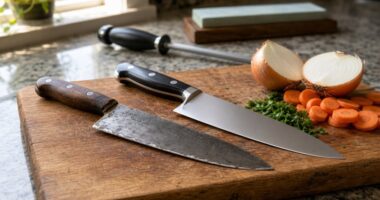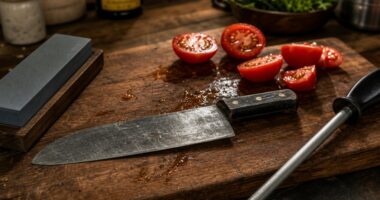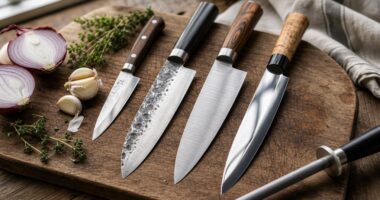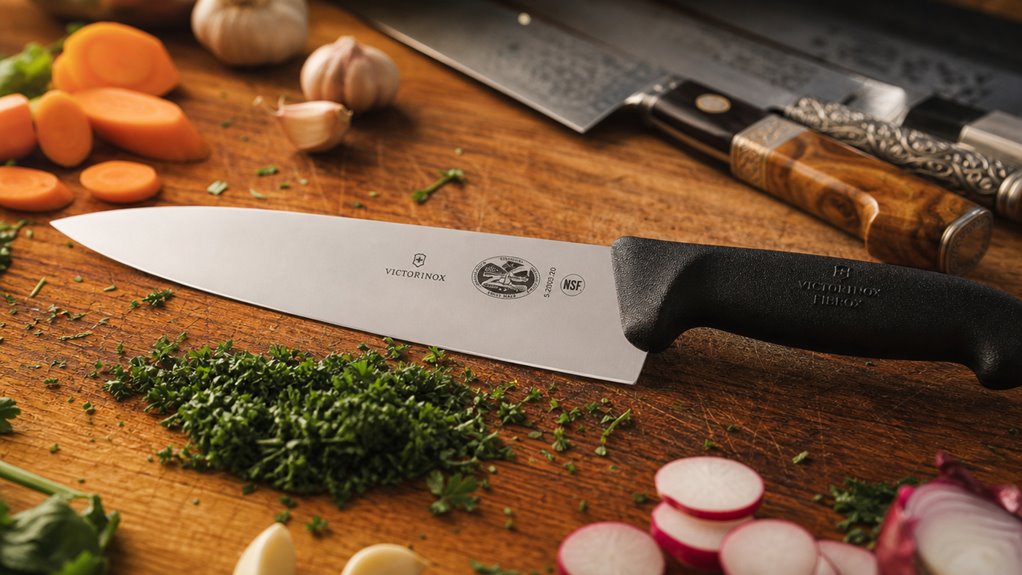
The Victorinox Fibrox depends on a combination of steel hardness, blade geometry, and handle design to perform reliably across demanding kitchen tasks. Its X50CrMoV15 steel, ground to a 15–20° edge, requires less force to cut than many premium-tier knives.
- X50CrMoV15 steel sits at roughly 55–56 HRC, which allows the blade to flex under stress rather than chip at the edge.
- Stamped blade construction produces a thinner profile than forged alternatives, reducing the effort needed during slicing tasks.
- NSF certification signals that the slip-resistant Fibrox handle meets commercial kitchen hygiene and safety standards.
The steel’s relatively low hardness rating shapes how the knife behaves under everyday use. Bone contact and lateral pressure cause the edge to bend rather than fracture, which preserves the cutting surface over time.
Sharpening the Fibrox on a 1000-grit stone typically restores the edge without the finer grits that harder Japanese steels often require. That easier maintenance cycle offsets the faster wear rate the steel shows under heavy use.
Budget price and low maintenance requirements make the Fibrox a practical choice for high-volume kitchens where knives are sharpened and used frequently.
X50CrMoV15 steel is one of the most widely used alloys in commercial kitchen knives, partly because its chromium content of roughly 15 percent typically provides strong corrosion resistance alongside workable hardness.
Cheap or expensive is the wrong question. Cost per use is the honest one. Check out our new Calculator.
Cost-Per-Use Calculator →Key Points
- Softer X50CrMoV15 steel (≈55 HRC) bends instead of chipping, giving forgiving performance under abuse where harder VG‑10 blades crack.
- Thin, stamped 15‑20° grind with a 2 mm spine reduces cutting resistance, allowing faster cuts and less fatigue than thicker forged German knives.
- Victorinox steel removes quickly on 1000‑grit stones, enabling rapid, inexpensive edge maintenance without needing ultra‑fine grits.
- Semi‑bolster/no‑bolster design lets the entire edge be sharpened in one pass, avoiding dead zones that full bolsters create.
- NSF‑certified Fibrox handle provides reliable, non‑slip ergonomics and sanitation, surpassing many premium‑tier knives in professional kitchen practicality.
| Astercook 8″ Professional Kitchen Chef Knife (Gift Box) |  | Gift-Ready | Blade Length: 8 in | Blade Material: German high-carbon stainless steel | Edge Type: Plain | VIEW LATEST PRICE | Read Our Analysis |
| OLULU 8″ Chef Knife with Ergonomic Handle |  | Lightweight Performer | Blade Length: 8 in | Blade Material: German stainless steel | Edge Type: Plain | VIEW LATEST PRICE | Read Our Analysis |
| Sunhouse 7.5″ Chef Knife – Ultra Sharp Ergonomic Handle |  | Compact Sharp | Blade Length: 7.5 in | Blade Material: High-carbon stainless steel | Edge Type: Plain | VIEW LATEST PRICE | Read Our Analysis |
Links to Amazon are affiliate links. Buying through one costs you nothing extra and helps fund the research.
Why the Victorinox Knife Earns the Pro Consensus
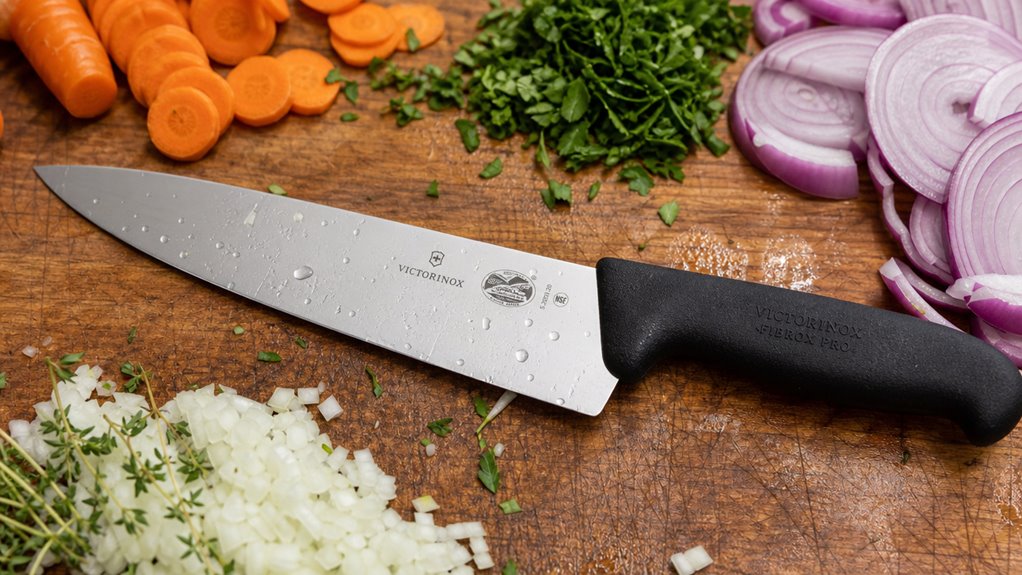
The Victorinox 8-inch chef’s knife earns consistent professional endorsement because its X50CrMoV15 steel, hardened to around 55–56 HRC, produces an edge that holds up under sustained kitchen use without becoming brittle or prone to chipping. That balance between hardness and toughness matters because a blade that chips under pressure requires frequent reprofiling, adding time and cost over the knife’s lifespan.
The NSF-certified Fibrox handle reinforces that reliability at the grip level, maintaining traction when wet or greasy. Those conditions are common in professional and home kitchens alike. One practical limitation is the handle-to-blade junction, which can trap food debris and demands more deliberate cleaning than a fully seamless design.
The details behind each of these factors reveal why this knife holds its standing across a wide range of kitchen environments. Sharpness is estimated to last one to two months with regular honing.
The Fibrox Pro 8-Inch, X50CrMoV15 Steel, and a 55-56 HRC Edge
Gripping the Fibrox Pro 8‑inch feels like holding a kitchen workhorse that’s built to stay sharp without demanding a master’s touch.
The Fibrox Pro 8‑inch uses X50CrMoV15 steel, a high‑carbon stainless alloy with about 0.5% carbon and 15% chromium, plus molybdenum and vanadium for wear resistance. Heat‑treated to 55‑56 HRC, the edge lands in a sweet spot: tough enough to bend rather than chip when you slice through chicken bone or a crusty rind, yet soft enough to touch‑up on a simple honing steel.
You’ll notice a consistent 15‑20° grind per side, giving a thin, efficient cut without the brittleness of a 60+ HRC Japanese blade. The stamped construction keeps the blade light, so you can maneuver quickly, but the lack of a full bolster means you must be careful not to apply excessive pressure near the heel.
This balance of durability, maintainability, and cost makes the Fibrox Pro a practical choice for everyday pro work. The shop’s in‑house sharpening service can keep the blade at peak performance.
The NSF-Certified Fibrox Handle Built for Wet, Greasy Grips
Most chefs rely on a knife that stays secure when the kitchen gets wet and greasy, and the Victorinox Fibrox handle delivers exactly that.
The NSF certification on the Fibrox handle proves it meets commercial sanitation standards, so health inspectors can spot it quickly. Its textured, non‑slip polypropylene surface holds firm even when your hands are slick with sauce or oil, letting you maintain control while trimming fat or filleting fish. The grip doesn’t require extra towels or rubber sleeves, and the material resists detergents and high‑temperature washes without swelling.
The handle’s ergonomic contour and safety guard reduce wrist strain during long prep sessions, making it a practical, low‑maintenance choice for busy cooks. The only drawback is that the handle feels slightly bulkier than a thin wooden grip. Professional‑grade design ensures the blade maintains precision cuts even under heavy use.
| 8-Inch Professional Chef Knife with Ergonomic Handle |  | Ergonomic Choice | Blade Length: 8 in | Blade Material: High-carbon stainless steel | Edge Type: Plain | VIEW LATEST PRICE | Read Our Analysis |
| Mercer Culinary M22608 Millennia Black Handle 8-Inch Chef's Knife | 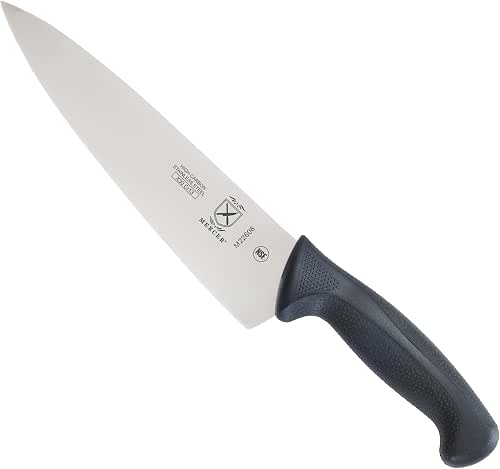 | Reliable Classic | Blade Length: 8 in | Blade Material: High-carbon Japanese steel | Edge Type: Plain | VIEW LATEST PRICE | Read Our Analysis |
| Leking 8″ Chef Knife with Sharpener and Guard | 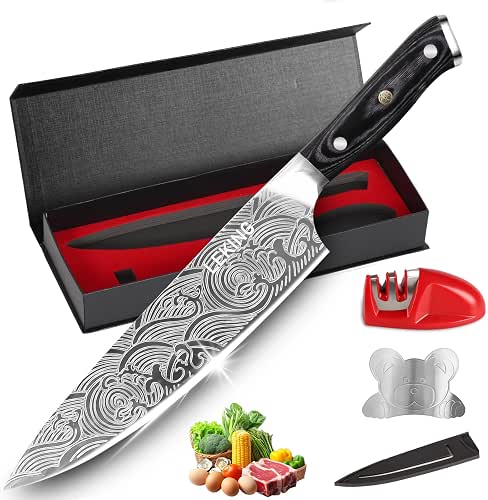 | Professional Grade | Blade Length: 8 in | Blade Material: High-carbon stainless steel | Edge Type: Plain | VIEW LATEST PRICE | Read Our Analysis |
Links to Amazon are affiliate links. Buying through one costs you nothing extra and helps fund the research.
Stamped Versus Forged: What Actually Drives Performance
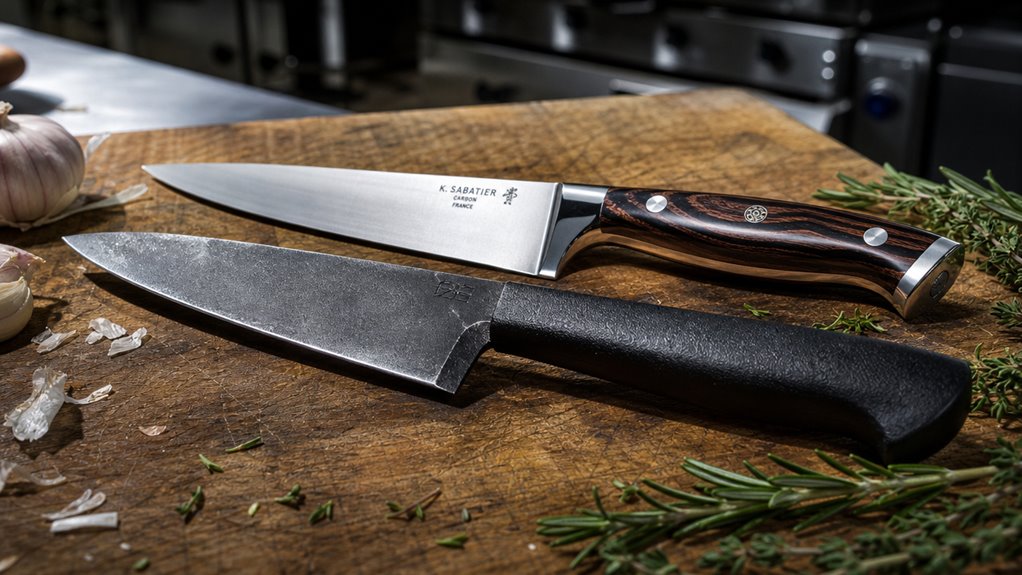
Blade performance in stamped versus forged knives comes down to geometry and edge design, not manufacturing method alone. A stamped blade like those from Victorinox carries a thinner profile, which reduces cutting resistance and allows the edge angle to work more efficiently through food.
Forged knives often feature a full bolster that adds heft and balance, but that same bolster can block the heel of the blade during sharpening, making it difficult to maintain a consistent edge along the full length. Lighter stamped knives may feel less substantial to users accustomed to the weight of a forged piece, though that weight difference reflects a design trade-off rather than a quality gap.
The details behind each construction method reveal why neither approach is inherently superior for every kitchen task. Victorinox knives are renowned for their ease of sharpening thanks to a softer steel that flexes rather than chips.
Why a Stamped Victorinox Blade Outcuts Heavier Forged German Knives
Why does a thin, stamped Victorinox chef’s knife often slice faster than a heavier forged German counterpart?
The edge geometry is tighter—15–20° per side versus the German 20–22°—so you need less force to start a cut. The spine is only 2.0–2.2 mm thick, cutting wedging and letting the blade glide through dense foods with less resistance. The X50CrMoV15 steel at 55–56 HRC balances hardness and toughness, so the thin edge stays sharp without chipping, and you can hone it quickly on a 1000‑grit stone. Light weight and forward‑neutral balance keep your wrist comfortable, letting you work faster without fatigue. Forged knives typically feature a full tang for better stability full tang.
- Thinner spine reduces cutting resistance
- Acute edge angle cuts with less force
- Lighter feel improves tip agility and reduces fatigue
These factors let the Fibrox Pro 8-inch outcut a heavier forged German knife, even though both use similar hardness steel. The trade‑off is a less robust bolster, which can feel flimsy if you lean on the heel.
The Bolster Myth and Why Full Bolsters Block Sharpening
When you look at a full‑bolster knife, the extra metal isn’t there to make the blade stronger; it’s mostly a legacy from forging methods and a visual cue that premium knives have “more protection.” In everyday chopping, the spine and tang carry the load, so the bolster adds weight without improving durability.
The real issue is sharpening. A full bolster extends to the heel, creating a dead zone where stones can’t reach the edge. After a few resharpenings you’ll notice bolster droop: the bolster sits lower than the cutting edge, lifting the heel off the board. That “smile” at the heel shortens the effective blade and forces you to skip the back or grind the bolster off, adding extra time, cost, and skill. Semi‑bolster or no‑bolster knives avoid this, letting you sharpen the entire edge in one pass.
How the Victorinox Knife Compares to Premium Japanese Steel
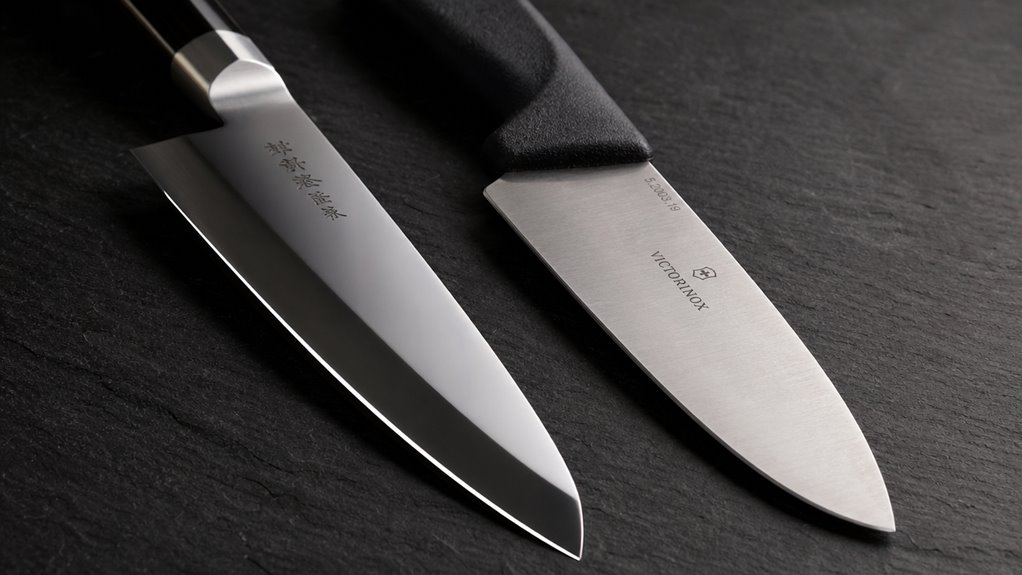
The Victorinox Fibrox and premium Japanese knives like VG‑10 gyutos occupy different positions on the hardness spectrum, and that gap shapes nearly every practical difference between them. Japanese knives typically run around 60 to 62 HRC, which allows the steel to hold a finer edge longer but also makes the blade prone to chipping under lateral stress or contact with bone.
Victorinox steel sits at a softer range, often around 55 to 56 HRC, which trades some edge retention for flexibility — the blade deforms slightly under abuse rather than fracturing. That difference in hardness also affects sharpening: softer steel removes more easily on a whetstone, making maintenance faster and more forgiving for cooks who sharpen infrequently.
The sections ahead examine how those trade-offs play out across real cutting tasks and long-term upkeep. Whether the harder steel earns its price is the subject of this look at premium Japanese chef knives.
VG-10, 60-62 HRC, and the Edge-Retention Premium You Pay For
Edge retention is the quiet workhorse that keeps a chef’s knife reliable through a busy prep.
VG‑10’s rockwell hardness sits at 60‑62 HRC, a noticeable jump from the 55‑56 HRC of a Victorinox Fibrox. That extra hardness means the edge stays sharp longer, so you’ll sharpen less often during a service.
The trade‑off is a thinner, more brittle blade that can chip if you hit bone or twist it too hard. In everyday kitchen work the difference shows up as a steadier bite and fewer dull spots, but the premium price reflects the alloy and heat‑treatment costs.
- Higher edge‑retention, fewer sharpenings
- Harder steel, more prone to chipping on abuse
- Price increase tied to alloy and processing
Why Harder Japanese Steel Chips Where Victorinox Forgives
VG‑10’s 60‑62 HRC hardness gives it a long‑lasting edge, but that same hardness makes the steel brittle enough to chip when you twist, pry, or hit bone. Victorinox Fibrox relies on a softer, tougher steel (X50CrMoV15, 55-56 HRC) that bends a little instead of fracturing. When you press a hard board or a piece of bone, the Japanese blade sprouts micro‑chips that need material removal, while the Fibrox edge rolls and can be straightened in a few strokes. The softer steel also sharpens quickly on cheap stones, so you spend less time maintaining it.
| Property | Japanese VG‑10 | Victorinox Fibrox |
|---|---|---|
| Hardness | 60‑62 HRC | 55-56 HRC |
| Failure mode | Micro‑chip | Roll/blunt |
| Sharpening ease | Hard, needs fine grit | Easy, coarse grit |
You’ll notice the Fibrox forgives occasional abuse, whereas the premium Japanese steel demands careful technique and frequent, precise sharpening.
Why Victorinox Forgives Abuse Where a VG-10 Gyuto Snaps
Most home cooks notice that a Victorinox Fibrox will keep chopping even if you accidentally twist the blade or press it against a bone, while a VG‑10 gyuto often gives a micro‑chip or even snaps under the same stress.
The Fibrox uses a softer, tougher X50CrMoV15 steel around 55 HRC, so it bends and rolls instead of cracking. Its thicker spine and wider edge angle spread the force, letting the edge deform plastically. In contrast, VG‑10 gyuto is hardened to about 60 HRC, making it brittle; the thin, acute grind concentrates stress at the tip, so a sideways load can start a micro‑crack that quickly propagates.
- Softer steel absorbs impact, preventing fracture.
- Thicker cross‑section gives higher torsional strength.
- Conservative edge geometry reduces chip risk.
Edge Geometry, Sharpening, and the 15-to-20-Degree Question
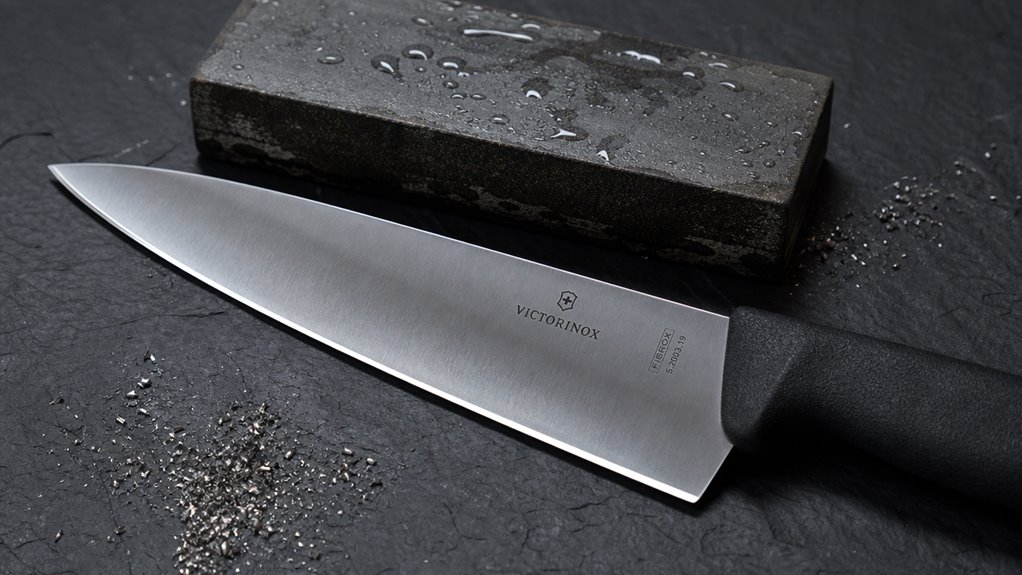
Edge geometry for a knife like the Fibrox centers on matching the bevel angle to the steel’s hardness — typically a back bevel in the 10 to 12 degree range that a 1000-grit stone can restore without extended effort.
X50CrMoV15, the steel used in the Fibrox, sits in a softer hardness range that performs reliably at working angles between around 15 and 20 degrees but begins to roll when pushed beyond that threshold.
Keeping the edge functional means maintaining a fine convex profile and avoiding aggressive sharpening angles that would compromise the geometry rather than refine it.
The relationship between steel composition, bevel angle, and honing frequency determines how long a working edge holds between maintenance sessions.
The details that follow examine how each of these variables interacts in practice.
Why a Softer Blade Resharpens in Minutes on a 1000-Grit Stone
Grind a Victorinox Fibrox on a 1000‑grit stone and you’ll see the edge come back in minutes because the steel’s 55‑56 HRC softness lets the abrasive particles bite easily. The softer matrix means each stroke removes material quickly, and the thin 15‑20° micro‑bevel requires only a few dozen passes to raise a burr and set a fresh edge.
You won’t need a 400‑grit prep step; the 1000‑grit whetstone both repairs rolling and creates a functional edge in one go. This forgiving geometry also tolerates a bit of over‑pressure without chipping, so you can maintain sharpness without a workshop‑level setup.
- Faster metal removal on 1000‑grit stone
- Minimal grit progression needed
- Low‑angle bevel restores edge with few passes
Victorinox fibrox sharpening stays reliable, but remember the blade is stamped, so it lacks the heft of a forged premium knife.
Honing Versus Sharpening and Keeping the Fibrox Edge Keen
When you’re keeping a Victorinox Fibrox sharp, the first thing to sort out is whether you’re honing or sharpening, because the two tasks solve different problems.
Honing realigns the rolled apex; you’ll do it before or after most cooking sessions, using a standard steel rod at roughly a 20° angle, five strokes per side.
Sharpening removes steel to recreate the bevel and is reserved for when honing no longer restores bite, usually once or twice a year, or after heavy use.
The Fibrox factory grind sits near 15°‑20° per side; a 15° angle gives a keen slice, while 20° adds durability for rough board contact.
After a stone sharpen, a quick hone smooths the new edge and extends the interval before the next grind.
This routine keeps your Victorinox knife functional without the expense of premium steel.
Who Should Buy the Victorinox and Who Should Spend More
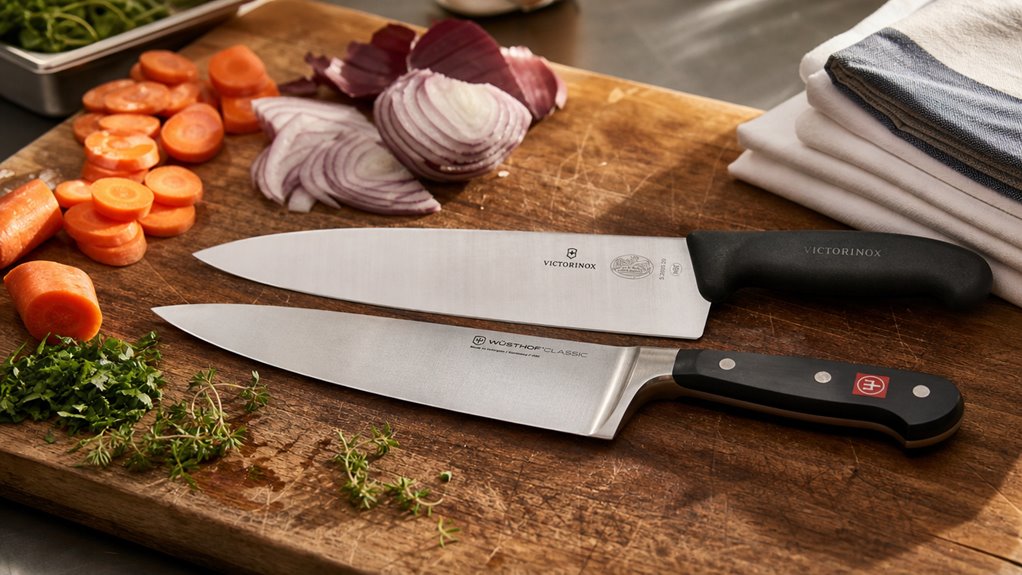
The Victorinox Fibrox suits home cooks who want a dependable, budget-friendly knife for everyday tasks — its softer steel, typically rated around 55 to 56 HRC, sharpens easily and forgives inconsistent technique.
That same softness means the edge wears faster under heavy, sustained use, so the knife performs well in moderate kitchen workloads rather than relentless, high-intensity cutting.
Cooks who prioritize longer edge retention, a heavier feel, or a more refined finish will find that premium Japanese or German blades justify their higher price through differences in steel hardness, blade geometry, and overall construction.
Matching knife to workload, rather than defaulting to price, is what shapes a sound buying decision.
The sections below cover the specific factors that determine which direction makes sense.
The Everyday Home Cook Who Wants One Knife That Lasts
Usually you’ll find yourself chopping veggies, slicing chicken, and trimming a roast with the same knife, and the Victorinox Fibrox fits that routine without asking for a premium budget. You’re an everyday cook who needs a reliable all‑rounder, not a collection of specialist blades. The softer 56 HRC steel is forgiving on accidental twists, and the slip‑resistant Fibrox handle stays dry even when you’re rushing. You’ll sharpen it on a basic stone in minutes, and it will hold a decent edge for weeks of normal home use. At a budget-tier price it delivers pro‑grade performance without the financial risk of a pricey Japanese or German piece.
| Victorinox Fibrox 8-inch | Budget tier — well below premium Japanese (VG-10) and German chef’s knives |
- Light weight makes maneuvering easy
- No full bolster lets you reach the heel for longer cuts
- Stainless X50CrMoV15 tolerates occasional neglect
If you cook several meals a week and want a single knife that lasts, the Victorinox Fibrox is a dependable budget chef’s knife for you. Where it lands against the rest of the field is set out in this roundup of budget chef’s knives that last.
When a Premium Knife Genuinely Earns Its Place
If you’re running a busy kitchen or just want a reliable all‑rounder without blowing your budget, the Victorinox Fibrox chef’s knife makes sense.
You’ll appreciate its 55‑56 HRC steel, which is forgiving and easy to sharpen, and the textured NSF‑certified handle that stays dry in a rush. The trade‑off is lower edge retention; you’ll need to hone it more often than a premium blade.
A premium knife earns its place when you need higher edge retention for long prep sessions, or when you value a refined fit and finish that feels balanced in the hand.
If you slice delicate fish, carve fine vegetables, or simply enjoy the tactile polish of a forged Japanese or German steel, the extra cost can be justified. Otherwise, the Fibrox delivers solid performance without the premium price tag.
Sharpening changes the math. A budget knife kept sharp can outlast the upgrade.
Open the calculator →Frequently Asked Questions
Is the Fibrox Handle Dishwasher‑Safe?
Yes, the Fibrox handle’s dishwasher‑safe, but you’ll want to hand‑wash to protect the edge. Rinse, dry immediately, and avoid harsh detergents to keep the blade sharp and prevent staining.
Can I Use the Fibrox for Boning and Heavy Bone Work?
It is not built for heavy bone work. A thin, flexible blade of this type excels at trimming and steering around joints, but it is the wrong tool for chopping through thick bone, where the impact can chip or bend the edge. Use a cleaver or a stiff-backed butcher’s knife for that.
Will a Softer Steel Rust Faster Than Premium Japanese Steel?
No, softer steel doesn’t rust faster by default; rust depends on alloy composition and care. Victorinox’s X50CrMoV15 is stainless and resists stains, while premium Japanese steels vary in corrosion resistance.
Do I Need a Special Stone for Maintaining the Fibrox Edge?
You don’t need a special stone; a standard 400‑grit coarse stone, then 1,000‑grit for everyday sharpness, and an optional 5,000‑grit polish works perfectly for your Fibrox edge.
How Does the Fibrox Perform in a Professional Kitchen Environment?
You’ll find the Fibrox stays razor‑sharp through endless prep, handles wet or greasy grips comfortably, and resharpens in minutes; its forgiving steel endures heavy use without chipping, making it a reliable workhorse.
Conclusion
You’ll notice the Fibrox feels light, the handle stays dry, and the edge holds for weeks without a full bolster. In contrast, a forged German knife adds weight and a costly edge that chips under stress. The Fibrox’s 55‑56 HRC steel lets you sharpen to the heel, while premium VG‑10 steel often needs a jig and a finer stone. If you value everyday reliability over showroom flash, the Fibrox delivers the performance you need.
| Cuisinart 8″ Stainless Steel Chef's Knife Guard | 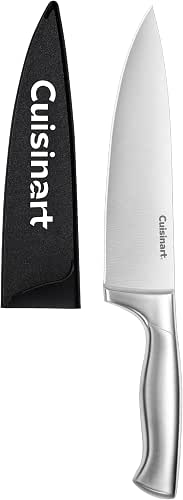 | Best Value | Blade Length: 8 in | Blade Material: Stainless steel | Edge Type: Plain | VIEW LATEST PRICE | Read Our Analysis |
| 3-Pc Ultra Sharp Kitchen Knife Set (8″ 5″ 3.5″) |  | Versatile Trio | Blade Length: 8 in | Blade Material: High-carbon German steel (3CR13MOV) | Edge Type: Plain | VIEW LATEST PRICE | Read Our Analysis |
| MOSFiATA 8″ Super Sharp Chef's Knife with Guard and Sharpener |  | Premium Set | Blade Length: 8 in | Blade Material: High-carbon German stainless steel (EN1.4116) | Edge Type: Plain | VIEW LATEST PRICE | Read Our Analysis |
Links to Amazon are affiliate links. Buying through one costs you nothing extra and helps fund the research.

Michael Haralson worked in professional kitchens from 1979 to 1992: San Diego restaurants, six years with a catering company beside an Austrian chef, and two summers as a cook on the Finland to Sweden cruise route. He then built a fifteen-year career at Nokia. It began in product marketing and product management, where technical specifications and supplier evaluation were part of the work, and grew from a few countries to a region to global roles, then into sales and corporate strategy. That took him to Beijing for three years, where he spent many weekends in a different province trying the local food and took cooking classes. He has eaten in more than 40 countries and has been shown the kitchens of restaurants in Southern Europe. At home in Finland he cooks Cantonese, Sichuan and Mediterranean food, and still uses the cast iron skillet he bought in 1992. He is the author of Buy It Once, Book One of The Researched Kitchen, and writes here about the balance between kitchen tools that cost too much and those that fail too soon.