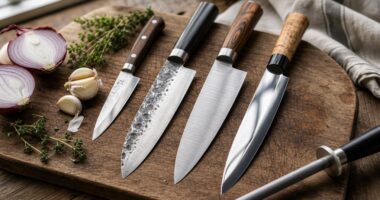
Premium Japanese chef knives depend on a combination of high-hardness steel, thin bevel geometry, and careful technique to deliver precise, low-resistance cuts. These design choices produce a blade that holds a sharp edge longer than many Western-style alternatives but also requires more deliberate handling and maintenance.
- High-hardness steel typically rates around 60–64 HRC on the Rockwell scale, allowing the blade to stay sharp through extended use without frequent resharpening.
- Bevel angle ranges roughly 12–15 degrees on most Japanese chef knives, reducing cutting resistance and improving slicing precision on boneless, soft foods.
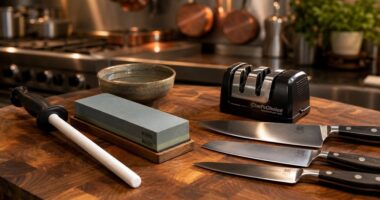
- Whetstone sharpening restores the thin edge that high-hardness steel requires, making it the standard maintenance method for this knife category.
High-hardness steel holds an edge well, but the same hardness makes the blade more prone to chipping under lateral stress or contact with hard surfaces. Twisting the knife or cutting through bone increases the risk of edge damage.
Wood and bamboo cutting boards suit this knife style because they absorb impact rather than deflect it back into the edge. Hard surfaces accelerate edge degradation and raise the chipping risk.
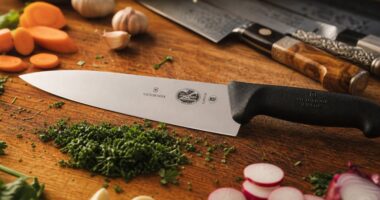
For high-impact prep work, softer Western steel — such as that used in the Victorinox Fibrox line — resists chipping more reliably. That flexibility comes at the cost of edge retention, so the blade requires more frequent sharpening.
Steel hardness in kitchen knives is measured on the Rockwell C scale, and blades rated above roughly 60 HRC hold a fine sharpening angle that softer steels in the 54–58 HRC range cannot maintain as long.
Cheap or expensive is the wrong question. Cost per use is the honest one. Check out our new Calculator.
Cost-Per-Use Calculator →The short answer: premium Japanese chef knives are worth the money if you slice mostly boneless, unfrozen food on a wood or bamboo board, sharpen on a whetstone, and value an edge that stays keen for weeks longer between sharpenings. They are not worth it if you chop through bone, use hard glass or stone boards, or would rather not baby a blade, because the thin, high-hardness edge chips where a softer steel would bend. For that kind of everyday prep a budget Victorinox Fibrox delivers comparable durability for a fraction of the outlay.
Key Points
- Premium Japanese knives retain a sharper edge longer (weeks‑to‑months) due to higher hardness (60‑64 HRC) and finer bevel angles.
- Their thin, acute geometry yields smoother, cleaner cuts on boneless, soft foods, but is more prone to micro‑chipping on hard surfaces or bones.
- Softer Western steels (e.g., Fibrox, 55‑56 HRC) are more forgiving, deforming rather than fracturing under lateral forces, making them better for heavy chopping and occasional bone contact.
- Maintenance for Japanese knives requires careful sharpening with whetstones and proper cutting boards; neglect or abuse can cause costly edge repairs.
- The higher upfront cost is justified only if you prioritize precision slicing, low sharpening frequency, and are willing to maintain the blade; otherwise, a quality Western workhorse offers comparable durability at a lower price.
| Mercer Culinary M22608 Millennia Black Handle 8-Inch Chef's Knife | 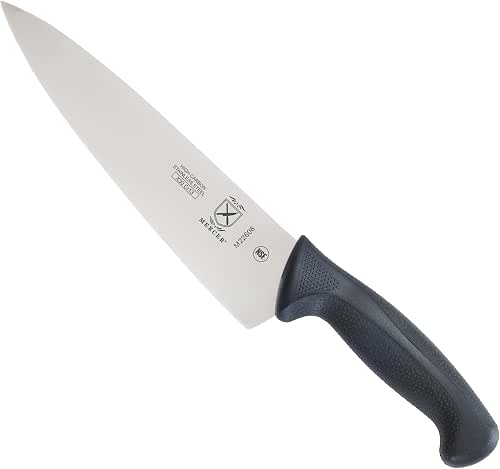 | Reliable Classic | Blade Length: 8 in | Blade Material: High-carbon Japanese steel | Edge Type: Plain | VIEW LATEST PRICE | Read Our Analysis |
| Astercook 8″ Professional Kitchen Chef Knife (Gift Box) | 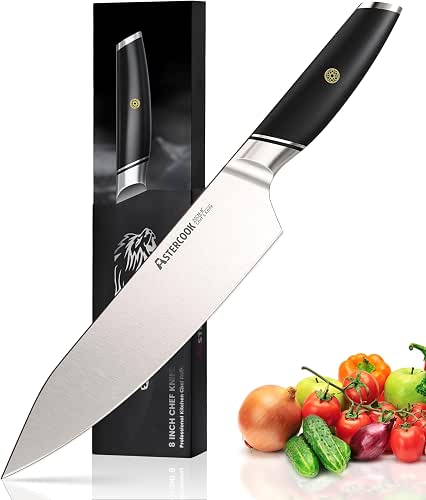 | Gift-Ready | Blade Length: 8 in | Blade Material: German high-carbon stainless steel | Edge Type: Plain | VIEW LATEST PRICE | Read Our Analysis |
| OLULU 8″ Chef Knife with Ergonomic Handle |  | Lightweight Performer | Blade Length: 8 in | Blade Material: German stainless steel | Edge Type: Plain | VIEW LATEST PRICE | Read Our Analysis |
Links to Amazon are affiliate links. Buying through one costs you nothing extra and helps fund the research.
What Sets a Japanese Chef Knife Apart From a Western Blade
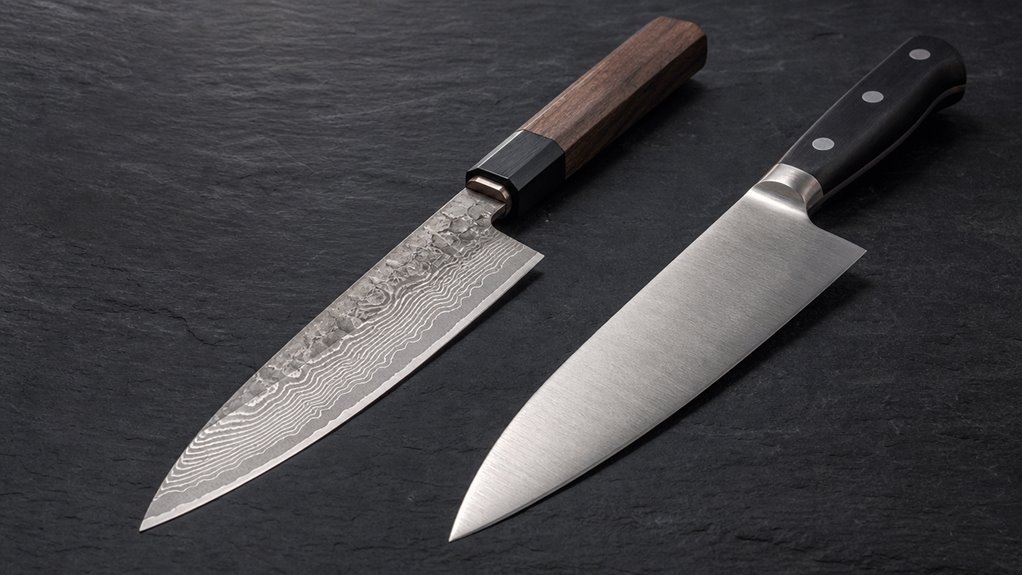
Japanese chef knives differ from Western blades primarily through their steel hardness, edge geometry, and the way those two factors interact during cutting tasks. Japanese knives are typically forged from harder, high-carbon steel, which allows the blade to hold a lower cutting angle and retain a finer edge over extended use. Western knives use softer steel ground to a wider angle, giving the blade enough flexibility to bend and recover when it contacts bone or a hard surface rather than chip. That difference in hardness makes Japanese knives well suited to precise slicing work, though it also means the thin spine is more vulnerable to lateral force and rough handling. Understanding how steel composition and bevel angle shape real-world performance reveals why choosing between the two styles involves more than personal preference. Japanese steel typically has a Rockwell hardness of 61–64, compared to 56–58 for Western steel.
The Harder Steel and Thinner Edge Behind the Sharpness
Slice a Japanese chef knife and you’ll notice the edge is finer and the steel feels harder than a typical Western blade. That hardness comes from a harder steel composition, usually 60‑64 HRC, and the factory sets a 15‑degree edge bevel per side. The result is a razor‑thin V‑shaped grind that slices with little force, but it also means the tip can chip if you press it against bone.
- Edge retention: High carbon core keeps the blade keen longer, so you sharpen less often.
- Cutting feel: Thin spine and acute angle reduce wedge resistance, making push‑cuts feel effortless.
- Trade‑off: Hard steel is less forgiving; accidental twists or hard impacts can create micro‑chips you’ll need to hone or grind away.
- Blade geometry differs between styles: Japanese knives feature a flatter edge and downward‑curving spine, while German knives have a pronounced belly and upward‑curving spine for rocking cuts.
Why a Thinner Blade Chips Where a Thicker One Bends
Cutting a chicken bone with a Japanese gyuto often ends with a tiny chip at the tip, while a German‑style chef knife would simply flex or roll the edge.
You’ll notice that a thin Japanese blade concentrates stress at the apex because its cross‑section is minimal and the edge angle sits around 15 degrees. When you pry a frozen shrimp or hit a hard seed, that stress exceeds the fracture toughness of a high-hardness steel, so a micro‑crack propagates and you get a chip.
A thicker Western blade, tempered to 55‑58 HRC, has more metal behind the edge. The same load yields plastic deformation, letting the edge bend or roll instead of cracking.
The geometry, a pronounced taper and thin grind, helps the Japanese knife slice effortlessly, but it also means it’s less forgiving under abuse. In short, the harder, thinner design gives you razor sharpness, while the softer, bulkier design trades a bit of edge acuity for durability. Hard steels are more sensitive to lateral forces.
| Leking 8″ Chef Knife with Sharpener and Guard | 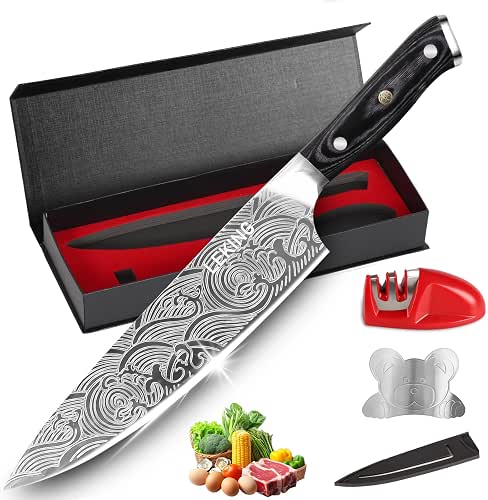 | Professional Grade | Blade Length: 8 in | Blade Material: High-carbon stainless steel | Edge Type: Plain | VIEW LATEST PRICE | Read Our Analysis |
| MOSFiATA 8″ Super Sharp Chef's Knife with Guard and Sharpener |  | Premium Set | Blade Length: 8 in | Blade Material: High-carbon German stainless steel (EN1.4116) | Edge Type: Plain | VIEW LATEST PRICE | Read Our Analysis |
| Farberware Edgekeeper 8″ Chef Knife with Self-Sharpening Cover |  | Self-Sharpening | Blade Length: 8 in | Blade Material: High-carbon stainless steel | Edge Type: Plain | VIEW LATEST PRICE | Read Our Analysis |
Links to Amazon are affiliate links. Buying through one costs you nothing extra and helps fund the research.
The Steel and Geometry That Justify the Premium
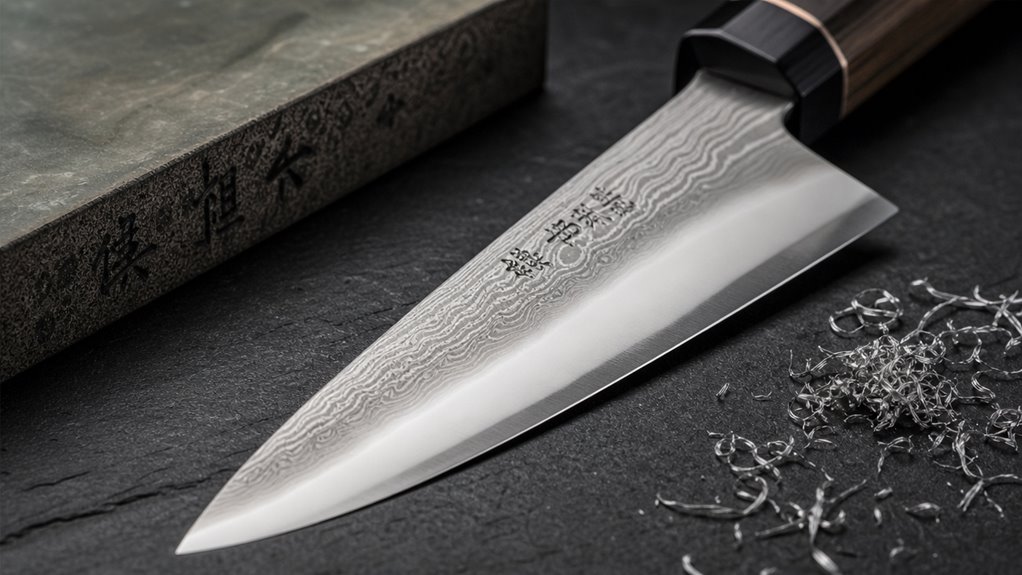
VG-10 steel typically sits around 60–62 HRC, a hardness level that holds a sharper edge longer than softer German stainless steels, which often range around 55–58 HRC, but that harder core trades some brittleness into the equation — pressing the blade against bone can cause chipping rather than the forgiving flex softer steels allow.
Bevel angle shapes how that hardness translates to real cutting performance, and a 15-degree grind reduces resistance through vegetables compared with wider angles common on European knives.
The thinner geometry that makes slicing efficient also makes the edge more vulnerable to rolling when the knife meets dense or fibrous material.
Understanding how hardness, bevel angle, and steel composition interact explains why premium knives carry a higher price and why that price reflects engineering choices rather than branding alone.
The details behind each of those trade-offs reward closer examination. Those alloys sit on a spectrum described in this guide to how knife steel grades differ.
The high carbon content of VG-10 contributes to its superior edge retention.
How VG-10 and a Higher Hardness Change Edge Retention
Because VG‑10 contains about 1 % carbon, 15 % chromium, and a mix of molybdenum, vanadium and cobalt, it can be heat‑treated to roughly 60‑61 HRC—significantly harder than the 56‑58 HRC typical of German stainless like X50CrMoV15.
That higher hardness means the matrix holds the carbides tighter, so the edge resists rolling and blunting longer.
You’ll notice VG‑10 steel keeping its keen slice through vegetables and fish for many more shaves than a softer X50CrMoV15.
The trade‑off is a bit more brittleness; a hard tap on a bone can chip the tip if you’re not careful.
- Higher carbon → more wear‑resistant carbides
- Chromium adds corrosion protection and hard carbides
- Cobalt raises tempering resistance, stabilizing hardness
VG‑10’s superior edge retention is a key reason why many chefs prefer it for precision tasks.
Why a 15-Degree Edge Cuts Cleaner but Dulls Differently
VG‑10’s higher hardness lets you grind a 15‑degree bevel without the edge rolling as quickly as a softer 20‑degree German steel, so the slice feels feather‑light and clean.
A 15‑degree edge creates a thin wedge that concentrates pressure, letting you glide through veg and fish with minimal tearing. The reduced contact area at the apex means you push less, and a polished finish glides like glass, leaving a smooth cut surface.
Because the steel is harder, it doesn’t bend; instead it wears and micro‑chips, so the apex rounds faster than a 20‑degree edge that merely rolls. You’ll need a stone to restore sharpness, but the primary bevel stays thin, keeping the edge keen longer for fine slicing.
Why VG-10 Holds an Edge Longer but Chips When German Steel Bends
When you compare VG‑10 to a typical German X50CrMoV15, the chemistry tells most of the story. VG‑10’s higher carbon (≈1 % C) and added vanadium, molybdenum, and cobalt let you harden it to 58‑61 HRC, so the edge stays sharp longer. The German steel stays softer (55‑57 HRC) and more ductile, so it bends or rolls instead of breaking.
The trade‑off is that VG‑10’s thin, acute grind is less forgiving; impact or hard bone can cause micro‑chips, while the German blade will simply flex.
- Higher hardness → slower wear, longer intervals between sharpening.
- Carbide‑rich microstructure → resistance to edge rounding.
- Reduced toughness at the tip → micro‑chips when you push it beyond its limits.
Under hard loads, Japanese steel can chip while German steel bends. This explains the premium price: you buy edge longevity, not indestructibility.
How a Japanese Chef Knife Compares to a Budget Workhorse
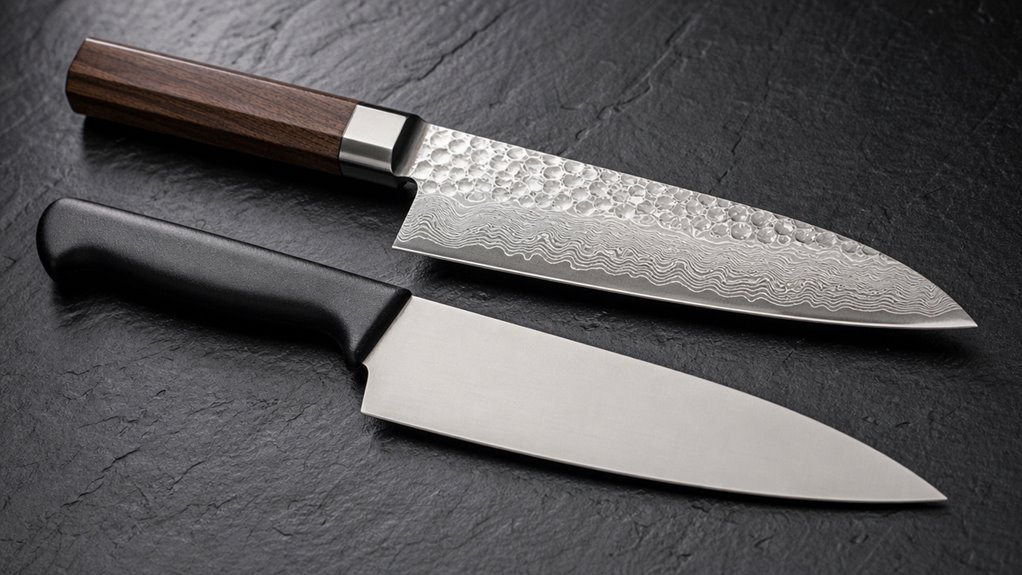
Japanese chef knives and budget workhorses like the Victorinox Fibrox differ primarily in steel hardness, edge geometry, and how each responds to daily use and sharpening.
Budget knives typically use steel hardened to around 55–56 HRC, which flexes rather than chips when it meets bone or a hard surface, making edge maintenance straightforward on standard sharpening tools. Japanese knives are often hardened to around 60–64 HRC, which supports a finer bevel angle — typically around 15 degrees — and holds a sharper edge longer, though that harder steel becomes more brittle under lateral pressure.
The trade-off is real: the Fibrox forgives rough technique, while a Japanese blade rewards careful stone work with greater precision and longer intervals between sharpenings. The details behind those differences, and how they shape everyday prep, are worth examining closely.
What a Victorinox Fibrox Does for a Fraction of the Outlay
You’ll find the Victorinox Fibrox 8‑inch chef’s knife handles like a steady workhorse that won’t break the bank. It costs a fraction of a typical Japanese gyuto, yet still chops, dices, and slices most home‑cooking tasks without fuss.
The steel is softer (HRC 55‑56), so you’ll need to hone it more often, but it bends rather than chips when you hit a bone. The 15‑20° bevel gives you a forgiving edge that holds up under heavy use. In the cost‑vs‑performance balance, you’ll ask yourself: are Japanese knives worth it? For everyday prep, the Fibrox delivers reliable results without the premium price tag.
- Soft steel, easy to sharpen on basic stones
- Textured thermoplastic handle stays secure when wet
- Lower edge angle than many Japanese knives, offering durability over razor‑thin finesse
Where the Premium Blade Genuinely Pulls Ahead
The Fibrox proves that a soft‑steel, 55‑56 HRC blade can handle everyday chopping without breaking, but its 20‑degree bevel and forgiving geometry also mean you’ll need to hone it every few weeks. A Japanese gyuto typically runs 60–62 HRC, letting you slice at 12‑15° per side with a razor‑thin edge that stays keen longer. The higher Rockwell hardness means less micro‑chipping, so you’ll spend less time on full resharpening and more on prep. You’ll notice thinner drag on carrots, cleaner herb ribbons, and more consistent portion sizes. The trade‑off is brittleness; a hard tip can chip on bone if you’re not careful.
| Feature | Premium Japanese | Budget Workhorse | |
|---|---|---|---|
| Hardness (HRC) | 60‑62 | 55‑56 | |
| Edge angle | 12‑15° | 20‑22° | |
| Edge retention | Weeks to months | Weeks | |
| Thin grind? | thicker | ||
| Chip‑resistance | Lower on bone | Higher | steel |
Why a Premium Edge Chips in an Everyday Kitchen
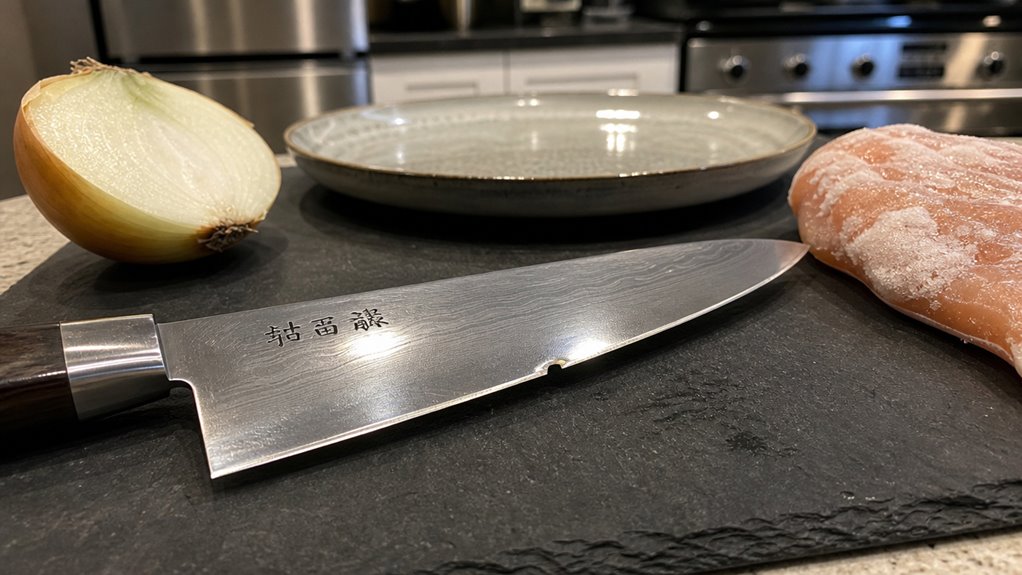
A premium kitchen knife earns its edge through a combination of high-hardness steel and a narrow bevel angle, typically around 15 degrees per side, which allows the blade to slice with minimal pressure but also makes it vulnerable to chipping under lateral stress.
Steel hardened to around 60 HRC or above holds a keen edge longer than softer alloys, yet that same hardness reduces toughness, meaning the blade resists wear well but absorbs impact poorly.
Cutting surfaces matter significantly here — hard materials like glass or ceramic boards concentrate force directly at the edge, accelerating micro-fractures that dull or chip the blade.
Technique shapes outcomes just as much as material does, since twisting, prying, or aggressive chopping transfers sideways force that thin bevels aren’t designed to handle.
Understanding how these factors interact reveals why a premium edge requires deliberate use to perform as intended over time.
Hard Boards, Bones, and the Damage Nobody Warns You About
Slice on a glass or marble board and you’ll feel the edge dull faster than you expected. Those hard cutting boards act like sandpaper on a carbon steel core, grinding the thin Japanese grind into micro‑chips before you notice.
The same thing happens when you press a chicken joint or a pork rib into the blade; the high‑HRC steel is brilliant at staying sharp, but it lacks the toughness to absorb that impact, so a tiny fracture becomes a visible chip.
Even a frozen pea or a hard cheese can create a side load that frays the edge.
- Use end‑grain wood or bamboo instead of stone or glass.
- Reserve Japanese knives for boneless, unfrozen foods.
- Keep the blade away from hard pits or shells.
Who Sidesteps the Damage and Who Keeps Paying for It
When you cut a chicken joint or press a frozen pea against a VG‑10 blade, the thin 15° edge meets the hard surface and the high‑HRC steel can chip rather than bend.
You’ll see the same pattern with any japanese chef knife for home cooks that sports a razor‑thin edge geometry.
If you rock the blade, lift ingredients with the tip, or twist while slicing, you’re applying lateral torque that the brittle steel can’t absorb, so micro‑chips appear quickly.
Chefs who stick to straight push or pull cuts avoid that stress, letting the edge stay intact longer.
Home cooks who use a chopping motion or scrape the board will keep paying for frequent honing or professional sharpening.
The trade‑off is clear: technique matters more than the price tag.
Whether the Upgrade Earns Its Place Under Real Use
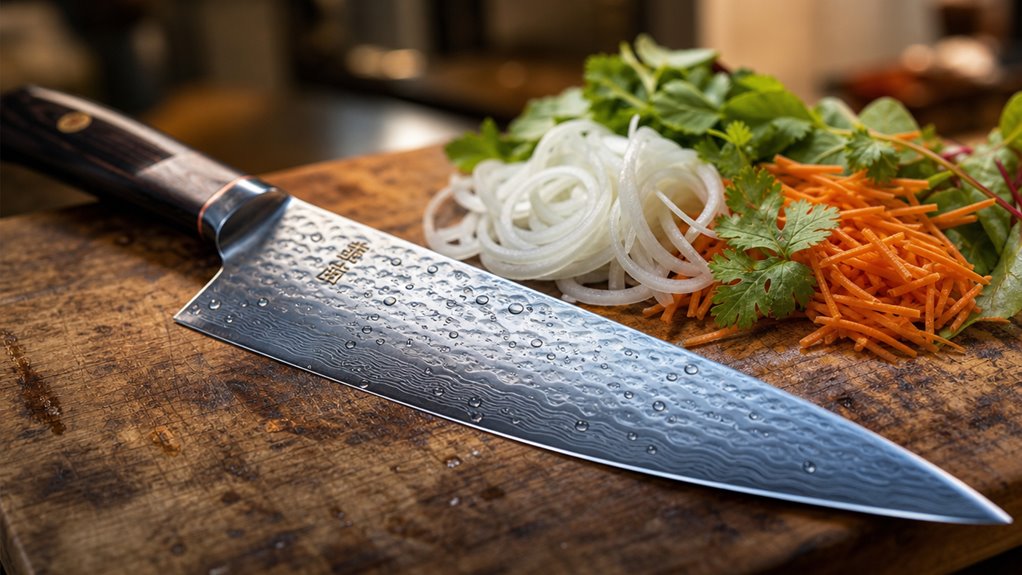
Whether a knife upgrade earns its place depends on how closely the blade’s design matches the way you actually cook.
A Shun’s 15-degree bevel moves through vegetables with less drag than a Victorinox’s 20-degree edge, but the thinner geometry becomes a liability against bone or frozen food, where chipping is a real risk.
Cooks who work primarily on soft boards and maintain edges with a whetstone tend to get the most from harder Japanese steel, since longer edge retention can offset the occasional need for tip repair.
For everyday meals that don’t demand razor-thin cuts, a budget Victorinox holds its own with far less maintenance.
The sections below examine the conditions that determine which trade-offs actually matter in practice. Where the affordable alternatives land is set out in this roundup of chef’s knives at the budget end.
Matching the Knife to How You Actually Cook
Because you cook most nights and handle a mix of meat, fish, and veggies, a 180‑210 mm Gyuto or a 170 mm Santoku will feel more natural than a thin Nakiri that’s built for veg‑only prep.
The best Japanese chef knife balances hardness with a forgiving edge. A 15° bevel per side gives a thin, precise cut but needs careful maintenance.
If you’re chopping boneless proteins and vegetables daily, a Gyuto’s longer blade lets you rock‑chop without re‑gripping, while a Santoku’s flatter belly speeds up mincing. A Nakiri only shines when vegetables dominate your prep.
- Harder steel holds edge longer, but chips on bone.
- Thinner grind reduces force, yet tip is fragile.
- 15° angle cuts cleanly, demanding consistent honing.
Why a Shun Out-Slices a Victorinox Without Out-Lasting It
So you’re wondering why a Shun blade can glide through a tomato smoother than a Victorinox but doesn’t stay sharp longer. The secret lies in geometry and steel. Shun’s VG‑10 core is hardened to about 60 HRC and ground to a 15° bevel per side, giving a razor‑thin edge that cuts with minimal drag. Victorinox uses a softer 56 HRC stainless and a wider 20° profile, which is sturdier but less acute. The thin grind lets Shun slice cleanly, yet the harder steel is more brittle, so a bone or frozen item can chip the tip. Victorinox tolerates abuse better, so its edge lasts through rough handling even if it loses that initial keenness faster.
| Feature | Shun (vg10) | Victorinox |
|---|---|---|
| Hardness (HRC) | 60‑61 | 55‑58 |
| Edge angle | ~15° per side | ~20° per side |
| Ideal use | Fine slicing, delicate foods | General chopping, bone contact |
Frequently Asked Questions
Do Japanese Knives Require Special Sharpening Stones?
Yes, you’ll need water-based whetstones (coarse for repairs, medium for regular sharpening, fine for polishing) because Japanese steel’s high hardness and thin angles don’t work well with generic oil or pull‑through sharpeners.
Can I Use a Japanese Knife on a Glass Cutting Board?
You’ll quickly notice glass chips your Japanese blade; hardness and thin edge make it brittle. Stick to wood or soft composite boards; otherwise you’ll dull or break the edge after just a few cuts.
How Does a Japanese Blade Perform After Dishwasher Exposure?
You’ll see faster dulling, corrosion spots, and handle wear, especially on high-carbon steel. Stainless Japanese blades survive a few cycles, but repeated dishwasher use still erodes edge precision and longevity.
Do High‑Carbon Japanese Steels Rust in Humid Kitchens?
You’ll see rust form quickly on high‑carbon Japanese steels in humid kitchens unless you dry and oil them after each use; moisture, acidic foods, and poor storage accelerate corrosion dramatically.
Is a 15‑Degree Edge Safe for Cutting Boneless Meat?
You’re safe: a 15° edge reduces cutting force by 30% on boneless meat, but it chips easier on bone. Use it on soft boards, avoid hard contacts, and sharpen regularly.
Conclusion
You’ll find a Japanese chef knife can stay razor‑sharp longer, but it also demands careful handling and regular honing. If you’re willing to treat it gently, the higher Rockwell rating and thinner bevel give you cleaner cuts and less drag. For rough chopping, a sturdy German stainless or even a budget Victorinox will survive the abuse without chipping. In short, the premium edge pays off only when you respect its maintenance routine; otherwise, a budget workhorse does the job just fine.
| 8-Inch Professional Chef Knife with Ergonomic Handle | 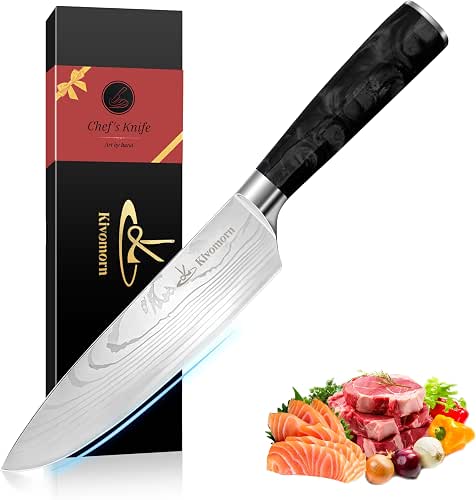 | Ergonomic Choice | Blade Length: 8 in | Blade Material: High-carbon stainless steel | Edge Type: Plain | VIEW LATEST PRICE | Read Our Analysis |
| Sunhouse 7.5″ Chef Knife – Ultra Sharp Ergonomic Handle | 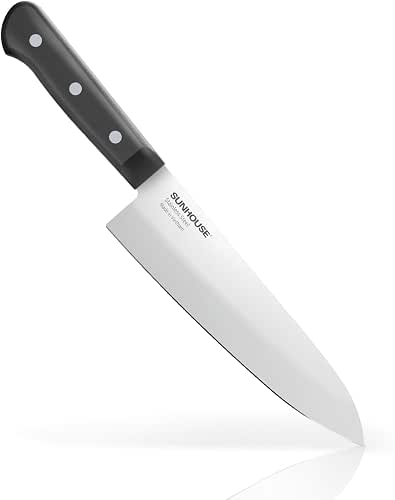 | Compact Sharp | Blade Length: 7.5 in | Blade Material: High-carbon stainless steel | Edge Type: Plain | VIEW LATEST PRICE | Read Our Analysis |
| Amazon Basics 8″ High Carbon Stainless Steel Chef's Knife |  | Everyday Essential | Blade Length: 8 in | Blade Material: High-carbon stainless steel | Edge Type: Plain | VIEW LATEST PRICE | Read Our Analysis |
Links to Amazon are affiliate links. Buying through one costs you nothing extra and helps fund the research.

Michael Haralson worked in professional kitchens from 1979 to 1992: San Diego restaurants, six years with a catering company beside an Austrian chef, and two summers as a cook on the Finland to Sweden cruise route. He then built a fifteen-year career at Nokia. It began in product marketing and product management, where technical specifications and supplier evaluation were part of the work, and grew from a few countries to a region to global roles, then into sales and corporate strategy. That took him to Beijing for three years, where he spent many weekends in a different province trying the local food and took cooking classes. He has eaten in more than 40 countries and has been shown the kitchens of restaurants in Southern Europe. At home in Finland he cooks Cantonese, Sichuan and Mediterranean food, and still uses the cast iron skillet he bought in 1992. He is the author of Buy It Once, Book One of The Researched Kitchen, and writes here about the balance between kitchen tools that cost too much and those that fail too soon.