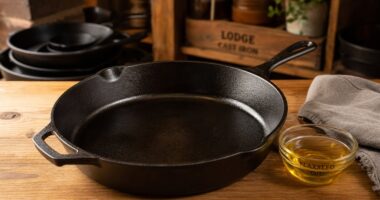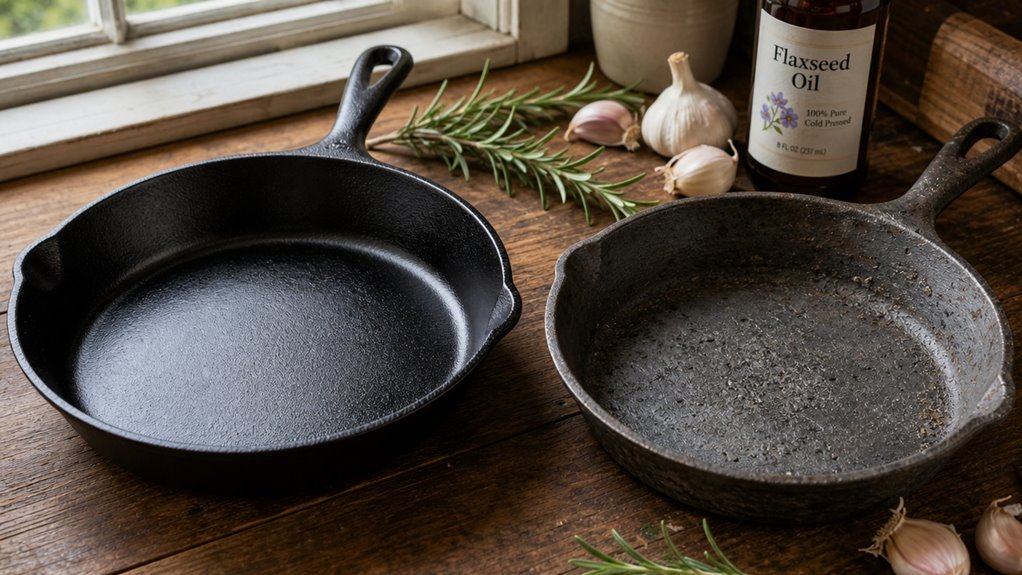

Spotting a counterfeit Lodge cast iron skillet depends on knowing which physical and commercial details distinguish a genuine pan from a fake one. Sellers, price tiers, weight, surface finish, and logo clarity each serve as reliable verification points.
- Seller identity signals risk level before the pan ships. Listings fulfilled directly by the manufacturer or a major retailer carry lower counterfeiting risk than third-party sellers.
- Weight and construction reveal casting quality, since a genuine 10.25-inch skillet typically weighs around 4.5 pounds with a smooth, continuous bottom heat ring.
- Surface finish indicates authenticity, because real cast iron carries a matte texture rather than a glossy coating.
Price is a practical first filter. Genuine cast iron skillets in this category sell in a mid-range price tier, and a steep discount often signals a counterfeit rather than a bargain.
Physical inspection narrows the verification further. A crisp, raised logo and size number on the handle confirm correct manufacturing standards. A glossy surface or an irregular heat ring suggests the casting process did not meet those standards.
Logo placement and legibility work together as a final check. Counterfeit pans often reproduce the logo shape but lose the sharp raised edges that result from quality sand casting.
Lodge Manufacturing has operated in South Pittsburg, Tennessee since roughly 1896, making it one of the longest-running cast iron foundries in the United States. That longevity is something counterfeiters frequently exploit by copying its branding.
Cheap or expensive is the wrong question. Cost per use is the honest one. Check out our new Calculator.
Cost-Per-Use Calculator →To tell a genuine Lodge from a fake before you cook on it, run this quick check:
- Read the “Ships From and Sold By” field. Lodge Manufacturing or Amazon.com is low risk; an unfamiliar third-party seller is higher risk.
- Sanity-check the price. A listing far below Lodge’s usual retail range is a warning sign, not a bargain.
- Inspect the molded markings. The Lodge name, size number, and heat ring should be crisp and evenly raised, not blurry or incomplete.
- Weigh it. A 10.25-inch skillet runs about 4.5 pounds; a pan more than 10 to 15 percent lighter is suspect.
- Feel the surface. Authentic sand-cast iron is matte and lightly pebbled, not glossy or machined-smooth.
- Scan the reviews. Overnight clusters of five-star reviews with repeated phrasing point to a hijacked listing.
Key Points
- Verify the seller: “Ships From and Sold By Lodge Manufacturing” or “Ships from and sold by Amazon.com” indicates authentic stock; third‑party sellers are higher risk.
- Check the price: listings priced far below Lodge’s usual retail range often signal counterfeit or relabeled inventory.
- Examine the skillet’s markings: crisp, evenly raised “Lodge” logo, solid size numerals, and a smooth, continuous heat ring are hallmarks of genuine cast iron.
- Assess weight and construction: authentic 10.25‑inch pans weigh ~4.5 lb, feel solid, sit flat on a straight edge, and have no wobble or thin walls.
- Review buyer feedback: clusters of five‑star reviews posted overnight, repeated phrasing, or complaints about missing logos indicate a hijacked or fake listing.
| Lodge 6.5″ Cast Iron Skillet – PFAS‑Free Non‑Toxic |  | Professional Grade | Material: Cast iron | Pre‑Seasoned Surface: Pre‑seasoned with natural vegetable oil | Oven‑Safe: Oven‑safe | VIEW LATEST PRICE | Read Our Analysis |
| Victoria 6.5″ Pre-Seasoned Cast Iron Skillet |  | Best Overall | Material: Cast iron | Pre‑Seasoned Surface: Pre‑seasoned with kosher flaxseed oil | Oven‑Safe: Oven‑safe up to 750 °F | VIEW LATEST PRICE | Read Our Analysis |
| 10‑Inch Cast Iron Skillet with Pour Spouts Natural Nonstick |  | Best For Beginners | Material: Cast iron | Pre‑Seasoned Surface: Unseasoned (requires initial seasoning) | Oven‑Safe: Oven‑safe (any temperature) | VIEW LATEST PRICE | Read Our Analysis |
Links to Amazon are affiliate links. Buying through one costs you nothing extra and helps fund the research.
How to Spot Fake Amazon Kitchen Listings Posing as Lodge
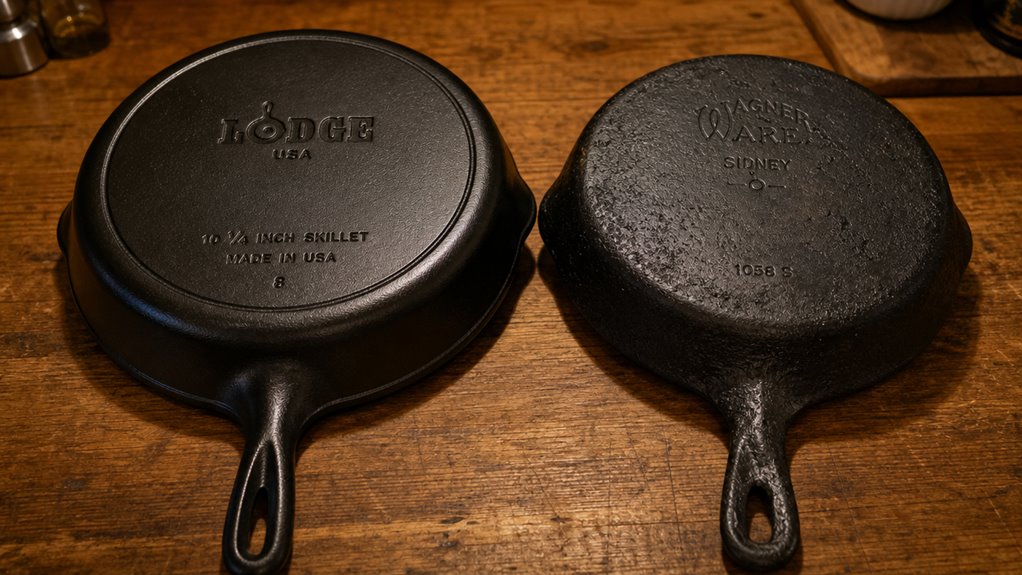
Fake Amazon kitchen listings posing as Lodge typically reveal themselves through the “Ships From and Sold By” field, which should display Lodge Manufacturing directly rather than a generic warehouse or third‑party seller.
The seller’s identity matters because counterfeit castings and relabeled imports often bypass Lodge’s U.S. foundry entirely, arriving without the embossed markings that authentic Lodge skillets carry on their surface.
Thin, uneven walls are a common physical indicator of knock‑off cookware, since genuine Lodge pieces maintain consistent casting standards that cheaper imitations typically can’t replicate.
Checking the seller profile and shipping origin before purchasing is a reliable first filter against mislabeled products.
The details ahead go further into how each warning sign plays out across real listings.
Lodge describes its 3rd Street Foundry and its Disamatic moulding machines on its own how-it’s-made page. Treat that as the company describing its own operation rather than an independently verified capacity figure.
Counterfeit Castings, Knockoffs, and Relabeled Imports
When you spot a Lodge skillet on Amazon that’s priced far below its usual retail range, treat it as a warning sign rather than a bargain. Counterfeit lodge cast iron often comes from commingled inventory, where genuine and fake units share the same warehouse.
Look for mismatched box branding, a blurry or missing molded logo, and a teardrop handle that feels cheap or uneven. Check the seller’s history; new or inactive accounts usually hide a mix of relabeled imports and knockoffs.
Finally, compare weight and dimensions against Lodge’s spec sheet. Thin casting and odd model numbers betray a fake.
- Verify molded markings and handle shape.
- Scrutinize seller age and return policy.
- Measure weight and compare to published specs.
Fake accounts can be spotted by profile picture consistency and activity.
Why “Ships From and Sold By” Matters More Than the Logo
Because Amazon’s “Ships from and sold by Amazon.com” label means the item comes straight from the retailer’s own inventory, you can trust that the product matches the brand’s specifications and that the return process follows Amazon’s standard policies. That flag is more informative than any logo on a third-party page, though it is not an absolute guarantee: as the commingling section below explains, Amazon’s shared inventory pools mean even an Amazon-sold unit can in principle be drawn from mixed stock. It still narrows the risk considerably compared with an unknown third-party seller. When the Buy Box rotates to a seller who only “ships from” themselves, the risk of hijacked listings spikes, bringing mixed stock, uneven casting, and missing warranty. Stick to the Amazon‑owned label; it’s the simplest safeguard against warped pans.
| Listing Type | Shipping Source | Risk Level |
|---|---|---|
| Ships from and sold by Amazon.com | Amazon warehouse (brand‑approved) | Low |
| Sold by third‑party, fulfilled by Amazon | Amazon warehouse (commingled) | Medium |
| Ships from seller, sold by seller | Seller’s own logistics | High |
| Hijacked listing (any) | Mixed inventory | Very high |
| Cast Iron Skillet with Lid Scrubber and Oven Mitts (8.5″) |  | All‑In‑One | Material: Cast iron | Pre‑Seasoned Surface: Pre‑seasoned (seasoned cast iron) | Oven‑Safe: Oven‑safe | VIEW LATEST PRICE | Read Our Analysis |
| 8 Inch Round Medium Pre-Seasoned Cast Iron Skillet |  | Best Durability | Material: Cast iron | Pre‑Seasoned Surface: Pre‑seasoned (proprietary oil blend) | Oven‑Safe: Oven‑safe | VIEW LATEST PRICE | Read Our Analysis |
| Cast Iron 10″ Skillet with Pour Spouts and Silicone Grip |  | Premium Quality | Material: Cast iron | Pre‑Seasoned Surface: Pre‑seasoned (PFAS‑free) | Oven‑Safe: Oven‑safe | VIEW LATEST PRICE | Read Our Analysis |
Links to Amazon are affiliate links. Buying through one costs you nothing extra and helps fund the research.
Reading the Casting: What a Genuine Lodge Skillet Shows
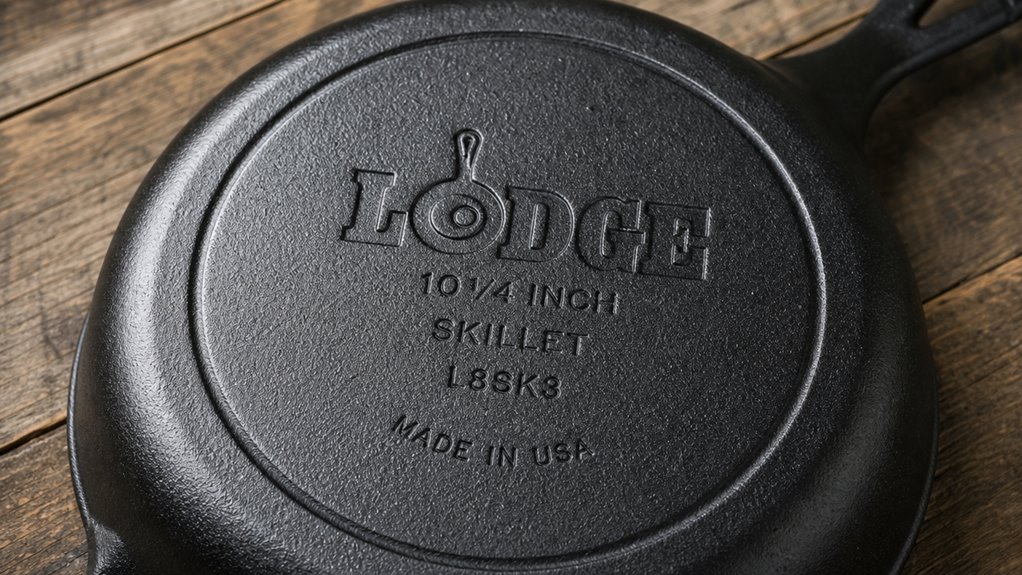
A genuine Lodge cast iron skillet carries its identifying marks directly in the iron itself — the Lodge name, size number, and heat ring are molded into the casting during production, not applied as labels or surface printing. This approach means the markings remain legible through decades of use, since nothing can peel, fade, or rub away.
The sand-cast texture of an authentic piece also produces a consistent surface finish and a weight that typically runs around 4.5 lb for a 10.25-inch skillet, both of which reflect controlled foundry standards. Counterfeits tend to betray themselves through blurry or incomplete markings, a noticeably lighter feel, and an uneven finish that sand-cast iron doesn’t produce.
Understanding what these physical characteristics mean, and why they matter for performance and longevity, informs everything that follows.
The Molded Lodge Name, Size Number, and Heat Ring
Spotting a real Lodge skillet starts with the casting. You’ll see a molded “Lodge” name that’s crisp, evenly raised, and centered. The lettering is clean, not fuzzy, and the egg‑shaped “O” or block “LODGE” matches Lodge’s modern logo. Look for the size number on the handle—simple numerals, solid depth, and placed consistently. Finally, check the heat ring on the bottom; a genuine piece has a smooth, uniform ring that runs the perimeter without gaps.
- Molded “Lodge” name – clear, raised, correct font.
- Size number – clean numerals, proper placement on handle.
- Heat ring – even height, continuous shape, no breaks.
- The pattern number on the side can help verify the series and production era.
Surface Texture, Weight, and Finish That Counterfeits Get Wrong
If you run your hand over a genuine Lodge skillet, the grainy, pebbled texture of the sand‑cast surface will be the first thing you notice.
The sand‑cast wall feels uniformly fine, not spiky or pitted, and the transition to the sidewall is a smooth curve with no abrupt ledges.
When you lift it, the skillet feels heel‑heavy and balanced; a 10.25‑inch piece weighs about 4.5 lb, and the base is thick enough that it doesn’t ring or flex when tapped.
Counterfeit cookware often feels light, has uneven wall thickness, and shows a glossy, machined finish instead of the matte, seasoned black you should expect from a genuine Lodge.
Check the parting line—it should be a narrow, lightly ground seam, not a jagged edge.
These details are the key to authenticating a Lodge skillet bought on Amazon.
If you notice any black flakes on the surface, they are harmless carbonised bits of oil, and a quick oil bake will clear them.
How Fake Amazon Kitchen Sellers Fool Buyers on Lodge
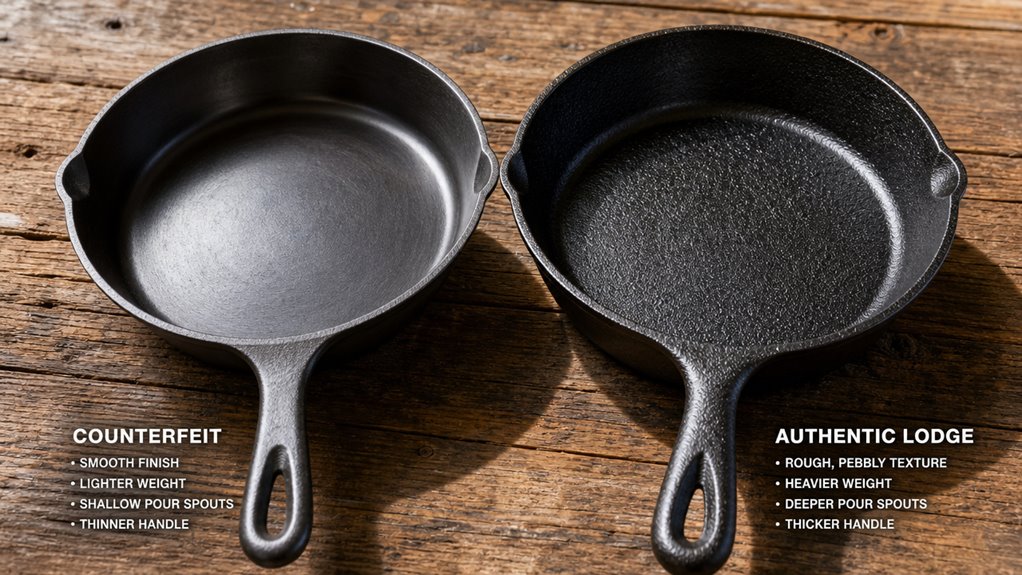
Fake sellers on Amazon exploit Lodge listings by hijacking legitimate ASINs and shipping generic pans in their place, so a buyer who expects an authentic sand-cast skillet may receive a thin counterfeit instead. Commingled inventory compounds the problem, because even orders fulfilled by Amazon can draw from a pool that includes non-Lodge stock. The counterfeit’s casting is typically lighter and less uniform than the original, which causes it to warp or pit under sustained heat where a properly weighted Lodge pan would hold its shape. Review patterns often expose the fraud early, with sudden clusters of complaints about missing logos or products that don’t match the listed photos. Understanding how each stage of this deception works reveals what to look for before and after placing an order.
Hijacked Listings, Mixed Inventory, and Commingled Stock
Because Amazon’s fulfillment system pools units under a single ASIN, a genuine Lodge skillet can be shipped from the same bin as a cheap knock‑off, and you won’t see the difference until you crack the pan open. The platform’s “stickerless” model lets multiple sellers drop their stock into a shared pool, so a legit Lodge from an authorized dealer can be swapped with a counterfeit that uses the same barcode.
Meanwhile, a listing hijack lets a bad actor jump onto the real Lodge page, undercut the price, and capture the Buy Box, making you think you’re buying from a trusted source when you’re not.
- Commingled inventory – pooled bins hide seller identity.
- Listing hijack – unauthorized sellers use the same ASIN and reviews.
- Buy Box capture – low‑price offers win, often from non‑Lodge stock.
Review Manipulation and Photos That Don’t Match the Product
When you scroll past the glossy Lodge skillet photos, the first red flag is often the review section—many five‑star comments that read like a press release, posted within days of each other, from accounts with no other purchases.
You’ll spot these tactics when the same phrasing repeats across dozens of reviews, especially if reviewers have no history of cooking gear.
Look for clusters of glowing feedback that appear overnight; that pattern usually masks a counterfeit.
Next, compare the images. Photos that don’t match the product often show a polished pan, a different handle shape, or a logo placement that differs from Lodge’s standard.
If the pictures look too perfect or are stock‑photo generic, request a fresh angle or a dated selfie to verify the seller actually has the skillet.
This cross‑check of review authenticity and image consistency helps you avoid a cheap knockoff.
Why a Genuine Lodge Outlasts a Visually Identical Knockoff
If you compare a genuine Lodge skillet to a copy that looks just as sleek, the differences show up in the metal and the seasoning, not the paint job.
A real Lodge has a solid sand‑cast wall, a crisp molded name and size number, and a factory‑seasoned surface that resists rust from day one.
A knockoff may look identical but its thinner casting warps, the markings blur, and the seasoning peels, causing stickiness and early rust.
Those traits decide whether your Lodge cast iron is genuine or just a hopeful guess.
- Weight and flatness – authentic pans sit flat and weigh about 4.5 lb; lighter, wobbly pieces signal a fake.
- Molded markings – sharp, legible cast lettering versus fuzzy, missing stamps.
- Seasoning durability – factory‑seasoned, non‑rusting versus dry, quickly rusting surface.
Knowing how to spot a fake Lodge skillet saves you from a short‑lived kitchen disappointment. Building up your own seasoning on top of the factory layer is worth doing on any new pan, genuine or not, because the factory coat is a starting point rather than a finished surface. On a counterfeit it matters more, since a thin or poorly applied coating is one of the things that gives a fake away in the first weeks of use.
Inspecting a Cast Iron Skillet the Moment It Arrives
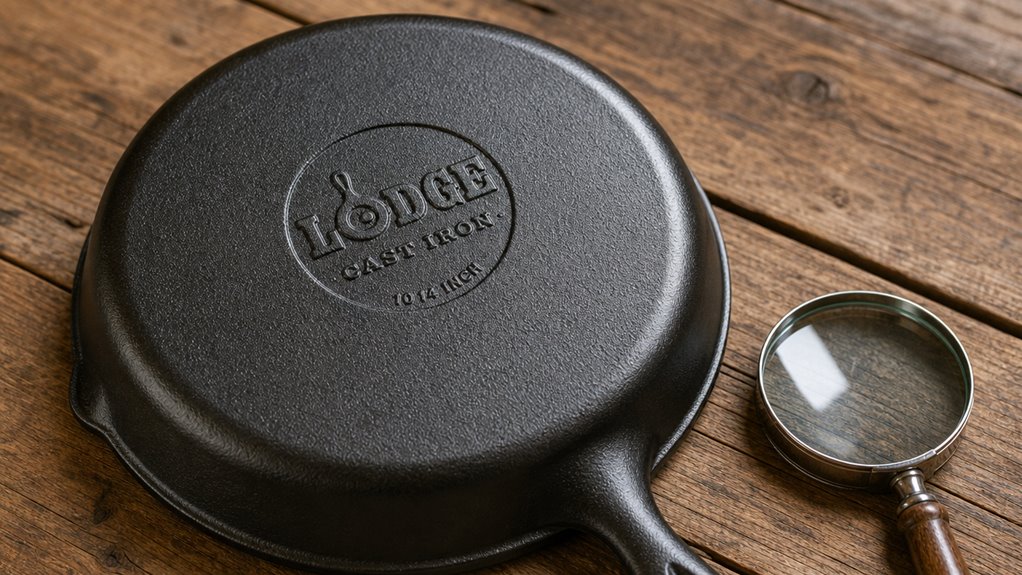
Inspecting a cast iron skillet the moment it arrives means checking for structural defects — wobble, uneven casting, thin metal, and surface flaws — before the pan ever touches a stove.
A skillet that rocks on a flat surface often signals warped or unevenly cast iron, which compromises cooking performance and points toward low-quality manufacturing.
Weight is a reliable indicator of metal thickness; Lodge publishes around 4.5 lb for a 10.25-inch skillet, and a pan that falls notably short of that typically has walls too thin to retain heat evenly.
Running fingertips along the edges and across the bottom reveals burrs or pitting that authentic, well-finished cast iron shouldn’t have.
The checks that follow cover each of these areas in greater detail.
Wobble Checks, Burrs, and Pitting on Arrival
Usually you’ll spot a wobble right after you unbox the skillet, so start by setting it on a flat, rigid surface and watching for any rocking or spinning.
A warped base will rock back and forth or spin like a top, signaling the pan won’t sit evenly on a stove.
Next, run a credit card or ruler along the cooking surface; light under the edge means the pan isn’t flat.
Finally, feel the rim and handle junction for burrs, and inspect the face for pits or cracks before you season.
Document any defect with photos while the skillet is still in its as‑delivered condition.
- Wobble test – flat surface, check for rocking or spinning.
- Straight‑edge check – card or ruler, look for light gaps.
- Burr and pit inspection – run a finger, note sharp spots or deep pits.
Weight and Balance Against Lodge’s Published Specs
Because the skillet’s weight is the quickest clue to its authenticity, you should compare the number you hold to Lodge’s published specs for that exact diameter and line.
Grab the pan, note its heft, then check the catalog: an 8‑inch Classic should be around 3.44 lb, a 10.25‑inch roughly 4.5 lb, and so on. If you’re off by more than 10‑15 %, you’re likely looking at a counterfeit.
Next, feel the balance. A genuine Lodge feels “head‑heavy” but stable; the bowl should counterbalance the handle without tipping forward.
An underweight bowl or a handle-heavy feel signals thin walls or a non‑Lodge design, both red flags for a knock‑off. Use these tactile checks alongside the spec sheet to catch fakes before they become a kitchen disappointment.
What to Do If You Receive a Fake or Defective Pan
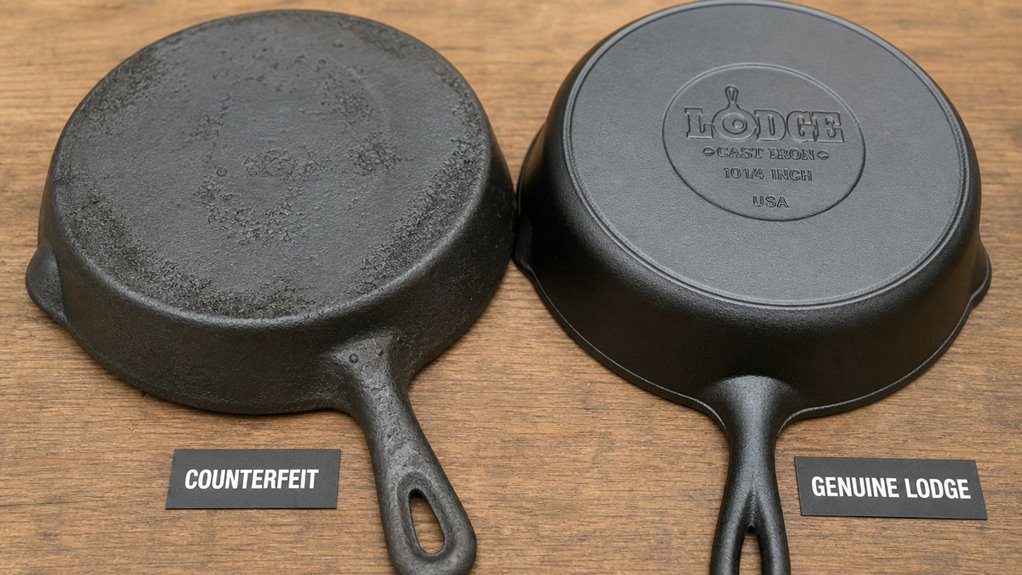
Receiving a fake or defective pan requires immediate action: photograph the unboxing, retain all packaging, and contact the seller directly to initiate a return.
For suspected counterfeit cookware, Amazon’s A-to-Z Guarantee provides a route to a full refund when “suspected counterfeit” is selected as the reason.
Genuine manufacturing defects follow a different path, since Lodge’s published limited lifetime warranty covers cracking, warping and named casting defects for the original purchaser or gift recipient, and is claimed direct rather than through the retailer.
How the situation resolves often depends on how quickly the issue is reported and how carefully the return process is tracked.
The sections below cover each step in detail.
Returns, A-to-z Claims, and Reporting Counterfeit Sellers
If the Lodge skillet you ordered arrives warped, missing the crisp molded logo, or feels noticeably lighter than the 4.5 lb spec, you’re likely looking at a counterfeit.
First, document everything: snap clear photos of the logo, weight, and any warping.
Then, if the seller is a third party and has not put things right, open an A-to-z Guarantee claim. Check the conditions and timings on that page before you file rather than working from a figure quoted here: they vary by situation and Amazon changes them, and filing before you are eligible can count against you.
Finally, report the seller to Amazon for using commingled inventory fake listings, which helps protect other buyers.
- Gather visual evidence and order details.
- File the A-to-z claim under “not as described” or “counterfeit.”
- Submit a seller‑report for commingled inventory fake behavior.
Amazon may refund the full price plus shipping if the claim succeeds.
Keep all messages; they strengthen your case.
When to Return for a Refund and When Lodge’s Warranty Wins
When a Lodge skillet arrives warped, missing the crisp molded logo, or feels noticeably lighter than the 4.5 lb spec, you’re likely looking at a counterfeit rather than a genuine defect. First, inspect the packaging and weight. If the box is generic and the pan feels under‑weight, treat it as a counterfeit casting and file a return through the marketplace. For a genuine defect such as cracks, casting voids, or coating issues, contact Lodge with your receipt. Their limited lifetime warranty covers manufacturing flaws, not misbranding.
| Issue | Action |
|---|---|
| Wrong logo, off‑weight | Return for refund |
| Cracks, holes, coating defects | Lodge warranty claim |
| Shipping damage | Seller/shipping claim |
Follow the platform’s return window for non‑warranty cases and keep the order confirmation handy for any warranty request.
Frequently Asked Questions
Does Amazon’s “ships From” Field Affect Authenticity Risk?
You should trust “Ships from Amazon” with Amazon as seller, because it usually means brand‑sourced inventory; “Ships from Seller” raises risk unless the seller is a verified Lodge retailer.
Can I Verify Lodge’s Weight Using a Kitchen Scale?
You can verify Lodge’s weight on a kitchen scale: tare the scale, place the skillet, compare the reading to the official 4.5-lb (≈2.04 kg) spec, and flag any deviation over 5 % as suspicious.
Are “Limited‑Time” Discounts a Red Flag for Counterfeit Listings?
You’ll notice that many counterfeit Lodge deals lean on “limited‑time” wording; that’s a strong red flag. Spot the urgency, compare price history, and verify seller credentials before you click ‘Buy’.
How Does Lodge’s Lifetime Warranty Differ for Fakes?
You’ll find the lifetime warranty only covers genuine Lodge pieces; fakes get no Lodge warranty, just the seller’s short‑term return policy, so you can’t claim any manufacturer‑backed repair or replacement.
What Platform Recourse Exists if a Fake Arrives After Return Window?
After the return window, you can still file an Amazon A‑to‑Z claim, contact seller support, preserve photos and packaging, and, if needed, pursue a credit‑card chargeback or consumer‑protection complaint.
Conclusion
You’ve got the tools to separate a true Lodge from a cheap copy, so you can skip the wobble and the weight‑guesswork. Check the molded name, the cast‑size number, and the uniform heat‑ring; weigh it, and verify the seller’s details before you click “Buy.” If anything feels off when the box opens, you’ve got a solid case for a refund or warranty claim. Stay sharp, and your skillet will last for years.
| Lodge Seasoned Cast Iron Griddle 10.5″ Round |  | Heavy-Duty Performer | Material: Cast iron | Pre‑Seasoned Surface: Pre‑seasoned (iron and oil only) | Oven‑Safe: Oven‑safe | VIEW LATEST PRICE | Read Our Analysis |
| Pre-Seasoned Cast Iron Skillet 5 Inch Mini Deep Pan with Handle Black |  | Compact Choice | Material: Cast iron | Pre‑Seasoned Surface: Pre‑seasoned natural non‑stick | Oven‑Safe: Oven‑safe | VIEW LATEST PRICE | Read Our Analysis |
| Pre-Seasoned Cast Iron Skillet Black 6 Inch Mini Frying Pan with Handle |  | Outdoor Ready | Material: Cast iron | Pre‑Seasoned Surface: Pre‑seasoned natural non‑stick | Oven‑Safe: Oven‑safe (max 250 °C) | VIEW LATEST PRICE | Read Our Analysis |
Links to Amazon are affiliate links. Buying through one costs you nothing extra and helps fund the research.

Michael Haralson worked in professional kitchens from 1979 to 1992: San Diego restaurants, six years with a catering company beside an Austrian chef, and two summers as a cook on the Finland to Sweden cruise route. He then built a fifteen-year career at Nokia. It began in product marketing and product management, where technical specifications and supplier evaluation were part of the work, and grew from a few countries to a region to global roles, then into sales and corporate strategy. That took him to Beijing for three years, where he spent many weekends in a different province trying the local food and took cooking classes. He has eaten in more than 40 countries and has been shown the kitchens of restaurants in Southern Europe. At home in Finland he cooks Cantonese, Sichuan and Mediterranean food, and still uses the cast iron skillet he bought in 1992. He is the author of Buy It Once, Book One of The Researched Kitchen, and writes here about the balance between kitchen tools that cost too much and those that fail too soon.