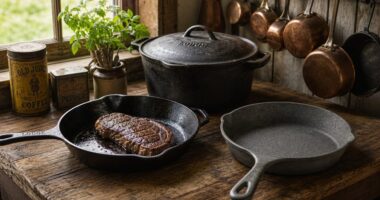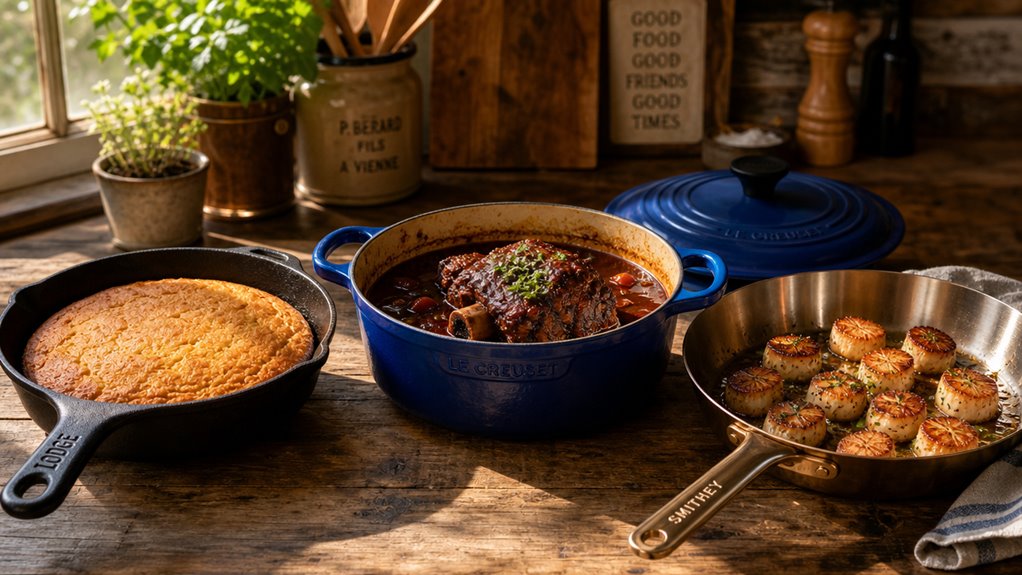
Lodge Cast Iron vs Le Creuset vs Smithey: Lodge wins on value, Le Creuset wins on convenience, and Smithey wins on surface refinement.
- Lodge Cast Iron — a Sand-cast American cookware brand founded in South Pittston, Tennessee in 1896, producing raw iron skillets that build seasoning over decades of use
- Le Creuset — a French enameled cast iron manufacturer founded in Fresnoy-le-Grand in 1925, producing porcelain-coated cookware that requires zero seasoning maintenance
- Smithey Ironware — a Charleston, South Carolina premium cookware company founded in 2015, producing CNC-milled cast iron skillets with a polished cooking surface
Lodge Cast Iron: the most accessible entry point, stocked at mainstream retailers like Walmart and Target and at Lodge’s factory store in South Pittston, Tennessee. Its sand-cast iron surface holds seasoning molecules deep within the pores. The pan needs an initial pre-season and occasional scrubbing with coarse salt or a Lodge Chain Mail Scrubber.
Le Creuset: the enameled surface eliminates seasoning requirements entirely. The porcelain coating on a Le Creuset Signature Skillet offers fast cleanup but chips under metal utensils or sharp thermal shocks. Le Creuset cookware depends on a consistent fat film to maintain non-stick performance. Retailers like Williams Sonoma and Sur La Table carry the full line.
Smithey: the No. 10 Skillet releases eggs with minimal oil from the first use. Smithey’s CNC-milled surface is ground smooth to near-polished tolerance before leaving the Charleston facility. The lid sells separately, adding to the cost of the already premium base pan.
Interesting Fact: Lodge Cast Iron has operated continuously through two World Wars, producing cast iron cookware in the same South Pittston, Tennessee location for over 125 years, making it the oldest surviving cast iron manufacturer in the United States.
Key Points
- Lodge offers the cheapest workhorse with sand‑cast texture that builds a durable seasoning layer over time, but requires a well‑seasoned surface for true non‑stick performance.
- Le Creuset’s enameled cast iron provides instant, zero‑seasoning convenience and vibrant color choices, yet relies on a consistent oil film and pre‑heat for non‑stick, and can chip under thermal shock.
- Smithey’s CNC‑milled, mirror‑smooth interior delivers day‑one non‑stick feel with minimal oil, but the thin seasoning wears faster and the lid adds $45 to the total cost.
- Heat retention and searing are strongest in the heavier Smithey (6.7 lb) and Lodge (4.5 lb) pans, while Le Creuset’s enamel retains heat well but offers less searing intensity.
- Premium price gaps stem from finish work—enameling for Le Creuset and precision machining for Smithey—while all three share a similar cast‑iron core material.
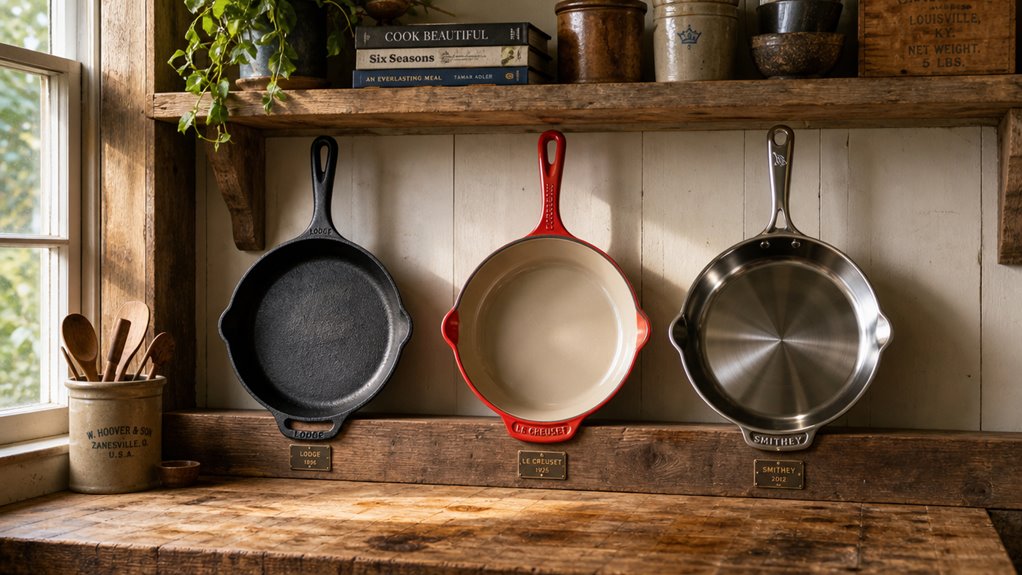
You’ll notice that Lodge’s sand-cast texture actually traps seasoning, so the pan gets more non-stick over years despite its rough feel.
With Le Creuset the enamel gives you color choices and zero-seasoning convenience, but the coating can chip and you lose the iron core’s repairability.
Smithey’s CNC-milled surface feels almost mirror-smooth out of the box, yet the lack of texture means the seasoning won’t cling as well, so you’ll need to maintain it more carefully.
Smithey’s lid is sold separately, so the full set costs noticeably more than the skillet alone — worth factoring in if you want the matching cover.
Lodge Cast Iron: Why Sand-Cast Texture Doesn’t Hurt Performance
If you’ve ever wondered why Lodge’s sand-cast surface isn’t a flaw, the answer lies in how the texture actually works. The tiny peaks and valleys act like a microscopic grip for seasoning oil, so each layer sticks better and you get a non-stick feel faster than on a polished pan.
That same roughness doesn’t sap heat; the cast is thick enough to retain temperature, so searing stays even and the drop after adding cold food is modest.
Lodge sits at the budget tier, which makes it easy to own several pans for high-heat abuse without a second thought. Its quality shows in durability and repairability, though the pebbly finish can look industrial and may need a little extra scrubbing to keep it smooth.
Le Creuset Enameled: When You’re Paying for Color Not Cooking
Le Creuset’s enameled cast iron sits at the top of the heirloom tier, where most of what you pay buys a wide palette of colors and a glossy finish rather than a cooking edge.
You’ll notice the interior behaves like any heavy enameled Dutch oven: steady heat, a medium-high stovetop limit, and solid retention for braises.
The enamel doesn’t improve searing compared with a bare pan, and it can chip if you slam a cold liquid into a hot pot.
What you do get is a broad color range, a high-gloss exterior, and a lifetime defect warranty. If you’re weighing whether Le Creuset is worth it against Smithey, the latter gives a smoother surface and a longer expected lifespan, while the heirloom tier’s main draw is aesthetics, not cooking performance.
Smithey No. 12: What Machined-Smooth Surface Actually Buys You
Le Creuset’s color-first approach leaves the cooking-performance side of the story mostly untouched, so let’s look at what the Smithey No. 12 actually brings to the table.
The machined-smooth interior cuts high spots, meaning eggs slide out with less oil and metal spatulas glide effortlessly. Seasoning spreads evenly across the flat base, giving you a reliable non-stick feel after just a few uses. You’ll notice cleaner cleanup because there are no deep pores to trap browned bits.
• Less oil needed for decent release
• Easier visual check of seasoning wear
• More refined serving appearance
It sits firmly in the premium tier, so you’ll weigh whether Smithey is worth it against Lodge’s durability and far lower cost. The smooth finish is a genuine advantage for delicate foods, but it still demands regular seasoning. The skillet’s deep wall angle makes it especially suited to pan-frying chicken and searing steaks.
Why Lodge Sand-Cast Texture Holds Seasoning the Way Machined Smithey Cannot
Because the sand‑cast process leaves a pebbled, micro‑rough interior, the seasoning oil finds plenty of “tooth” to grip onto, and that mechanical keying is what lets a Lodge skillet hold a durable, self‑healing non‑stick layer for decades.
The rough peaks (250‑400 Ra) trap polymerized oil, so each bake builds a thicker, interlocking coating that repairs itself when you scrub.
A machined Smithey, polished to 8‑15 Ra, lacks those micro‑cavities; its seasoning sits on a smoother surface and can flake until you re‑season fully.
In a cast iron skillet comparison, that texture difference is why the workhorse tier—Lodge—outlasts the heirloom feel of Smithey.
When you weigh lodge vs le creuset, remember the enameled version can’t be re‑seasoned, while Lodge’s sand‑cast texture keeps seasoning alive for decades.
Cooking Performance: The Honest Side-by-Side
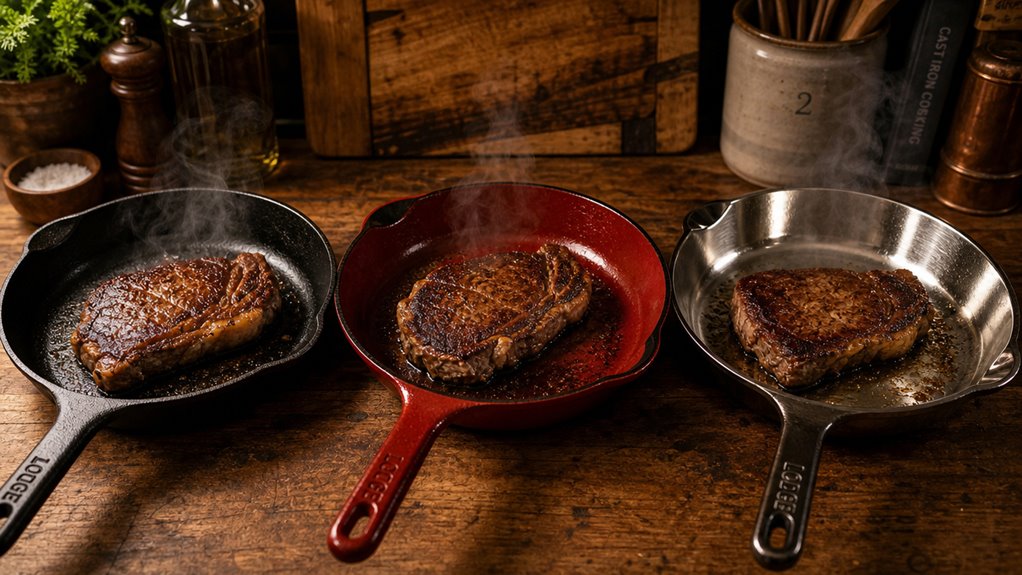
You’ll notice the 4.5‑lb Lodge holds heat a bit less long than the 6.7‑lb Smithey, which drops about 100 °F in four minutes versus six for the heavier pan.
When you sear a steak at 500 °F, all three reach the same temperature, but the Smithey’s smoother interior gives a more even crust while the Lodge’s sand‑cast texture can create a slightly more pronounced Maillard layer if you preheat it well.
For eggs, the polished Smithey releases effortlessly, whereas the textured Lodge surface may need a few extra seasoning layers before the sticking eases.
Heat Retention by Pan Weight (Lodge 4.5 lb vs Smithey 6.7 lb)
Heat retention hinges on thermal mass, and the 6.7‑lb Smithey carries roughly 49 % more weight than the 4.5‑lb Lodge, so it stores more heat at any given temperature. You’ll notice the Smithey holds temperature longer when you drop cold food in, while the Lodge heats up a touch quicker. The heavier pan also smooths out burner hot‑spots, giving a steadier surface for searing.
- Smithey: slower preheat, but 30‑50 °F less sag under load.
- Lodge: faster to heat, but temperature drops faster with heavy ingredients.
- Best cast iron brand? If you value steadier heat for long cooks, the Smithey’s mass wins; if you prioritize quick start‑up, the Lodge’s lighter build serves you better.
Sear Quality on Steak: All Three Cross-Referenced at 500°F
When you bring a 1‑inch ribeye to a 500 °F Lodge, Smithey, or Le Creuset skillet, the first thing you notice is how the pan’s surface texture shapes the crust.
The sand‑cast Lodge, with its 250‑400 Ra micro‑cavities, traps seasoning and yields a spotty, slightly softer bark that varies across the pan.
The CNC‑milled Smithey, at 8‑15 Ra, creates a darker, more uniform crust that shatters when you cut it, thanks to its smoother, more “day‑one” non‑stick feel.
Le Creuset’s enamel, rated to 500‑600 °F, gives a lighter, even brown layer but loses heat faster once the steak hits the surface, making the crust a touch less aggressive.
Preheat times differ: Lodge reaches 500 °F in 5‑7 minutes, Smithey in 7‑10 minutes, and Le Creuset in 8‑12 minutes on a typical home burner.
Use a high‑smoke‑point oil and add butter after the crust forms for best flavor.
The trade‑off is clear: Lodge offers texture and durability, Smithey delivers a steakhouse‑style bark, and Le Creuset provides a clean, easy‑clean surface at the cost of a slightly milder sear.
Egg Release Reality: Smooth vs Textured Surface
If you’ve ever tried a sunny‑side‑up in a Lodge, a Smithey, or a Le Creuset, you’ll notice the pan’s surface decides how much butter or oil you need to keep the egg from clinging.
Smooth, CNC‑machined interiors (Smithey, enamel) let a thin film of high‑smoke‑point oil work instantly, so you can season a pan in minutes.
Rough sand‑cast Lodge walls trap seasoning faster, but they need a well‑built layer before the egg slides cleanly.
Enameled Le Creuset stays micro‑textured; it never builds a permanent non‑stick coating, so preheat and fat film matter more than seasoning.
- Smooth pans: quick non‑stick start, but thin seasoning can wear without careful maintenance.
- Textured Lodge: builds a thick seasoning over time, reducing stick after many cooks.
- Enamel: relies on consistent oil layer each session; over‑heat can brown egg bottoms.
Where the Price Premium Actually Lives
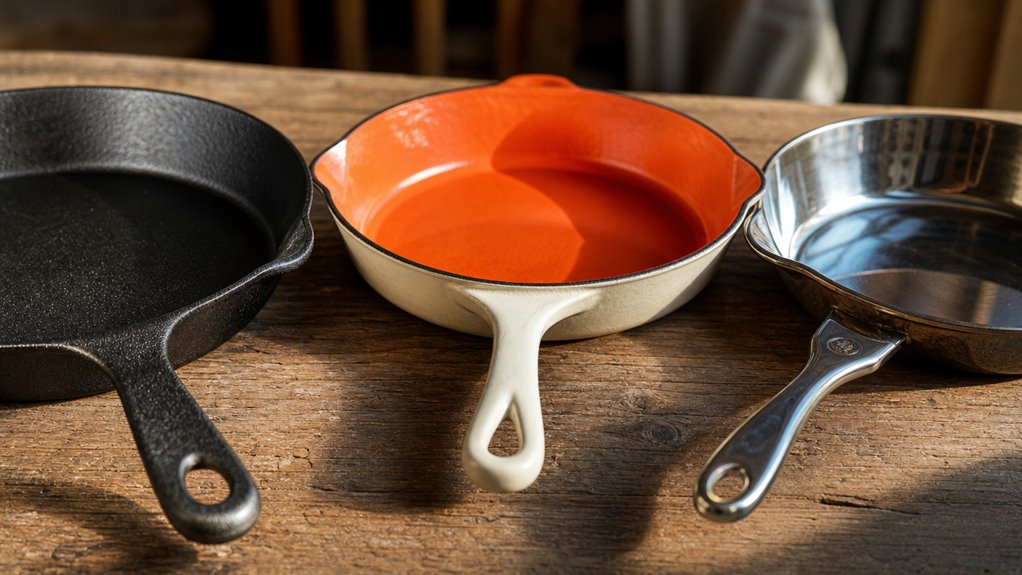
You’ll see the price gap comes from three places: Le Creuset’s enamel coating, which adds material, labor, and kiln time; Smithey’s CNC-milled surface, which requires precision machining and polishing; and Lodge’s simpler sand-cast process that skips those steps.
Each adds cost without changing the cheap iron base, so the premium lives in finish, not raw material.
The downside is that the enamel can chip, the machined surface can be pricier to repair, and Lodge’s rougher texture needs seasoning to become non-stick.
Le Creuset Enameling Cost Breakdown
Start by looking at what actually adds cost to a Le Creuset pan: the enamel process, not the cast‑iron core. The iron itself is a commodity, but the multi‑layer vitreous enamel, strict food‑contact testing, and high‑temperature kiln firings drive the price premium. You’re paying for a flawless, color‑stable surface that won’t chip under normal use, but each step adds labor, energy, and waste‑control expenses.
- Shot‑blasting, grinding, and thorough cleaning of the cast‑iron before enamel application.
- Multi‑stage enamel coating (primer, color, clear) with specialty pigments and compliance testing.
- High‑temperature kiln firings, controlled ramps, and scrap‑rate losses for each color/finish.
These three cost drivers explain why Le Creuset sits above Lodge and Smithey on the price ladder.
Smithey Machining Cost Breakdown
Smithey’s price premium lives in the machining shop, not in the raw iron. You’ll notice each skillet goes through a CNC mill that strips the sand‑cast texture, flattens the base, smooths sidewalls, and details the logo.
Those passes require high‑grade cutters, frequent tool changes, and hand‑polishing, so labor hours stack up. Because the company runs small batches in Charleston, every piece hits multiple skilled operators—inspection, setup, finishing, seasoning, and quality control.
That limits throughput and raises per‑unit labor costs compared with a mass‑producer like Lodge. Their tighter alloy tolerances and thinner walls also mean more scrap during machining, further driving up the effective cost.
The result is a polished surface that feels like a vintage mirror, but the price you pay reflects the craft‑shop labor, not the iron itself.
Lodge Manufacturing Cost Breakdown
Lodge keeps its price low by leaning on scale and simplicity. You benefit from two high‑volume foundries that spread fixed costs over millions of pieces, so each skillet bears only a tiny share of the plant’s overhead.
The sand‑casting process uses reusable patterns and green sand, which cuts tooling and material waste.
Minimal machining and bulk pre‑seasoning on automated conveyors keep labor hours per pan low.
The result is a product that costs far less to make than a CNC‑machined or enameled rival.
- Two Tennessee foundries give economies of scale.
- Sand‑casting with reusable patterns reduces tooling cost.
- Automated bulk seasoning lowers labor and energy expense.
The Lifespan Math: Cost Per Decade
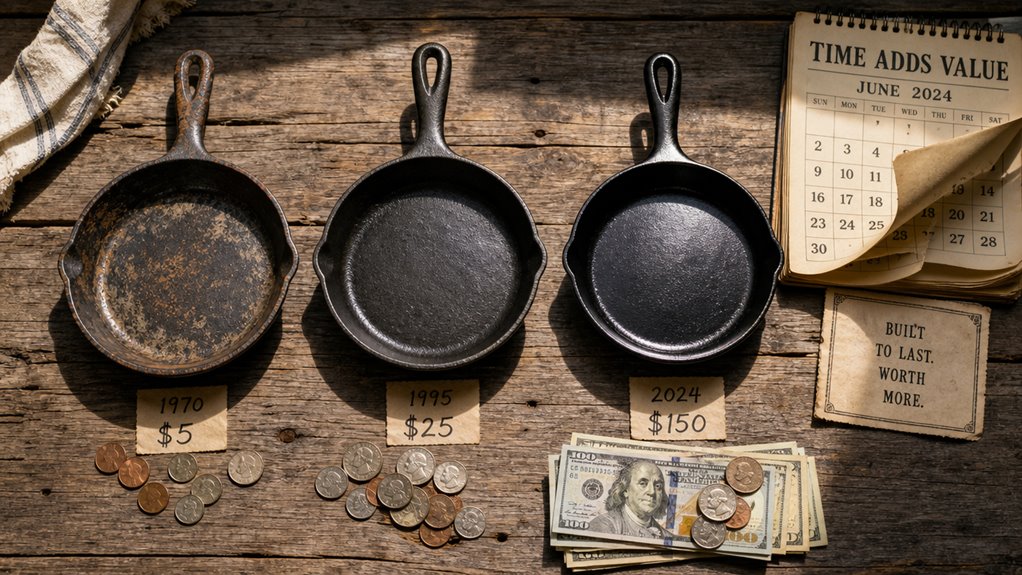
Here’s the part that flips the intuition: the gap that feels enormous at the register nearly closes over a lifetime. A Lodge L8SK3 can stretch past 50 years, while a Le Creuset skillet usually caps out around 30 years because the enamel may chip. Smithey’s pans also aim for a 50-year horizon.
When you spread each pan’s upfront cost across the decades it actually lasts, the budget tier amortizes to almost nothing per decade, and the premium tiers — despite costing several times more at purchase — still land in single-digit-dollars-per-decade territory because they last just as long. The cost-per-decade gap is far smaller than the sticker gap.
Lodge L8SK3 Over 50 Years
Because the pan’s solid cast-iron body has no non-stick coating to wear away, you’re basically buying a piece of equipment that keeps working for decades.
With seasoning and no long soaks, an L8SK3 can last 50 years or more, which spreads its budget-tier cost down to a rounding error per year — a few dollars per decade at most. Even if you replaced it once in that span, the lifetime cost stays trivially low.
The pan’s one-piece construction eliminates joints that could fail, and the thick iron tolerates open flame, induction, and high-heat ovens without warping.
• Tier: budget workhorse
• Expected lifespan: 50 years with proper care
• Cost per decade: a few dollars — effectively negligible over a lifetime
Le Creuset Over 30 Years (Chip Risk)
When you buy a Le Creuset you’re counting on roughly a 30-year horizon, but the enamel’s chip risk can cut that timeline short.
The porcelain coating shields the cast iron, so you skip seasoning and can even use the dishwasher, but a dropped lid or a sudden cold-water splash can chip the rim or edge. A small chip may look cosmetic, yet it exposes iron that can rust if you ignore it.
If you avoid metal utensils, hand-wash gently, and store the pot with a protective layer between stacks, you often reach the full three decades, which keeps the heirloom tier’s cost-per-decade within a few times the budget pan’s, not the order-of-magnitude gap the purchase price suggests. A major chip, however, forces early retirement and erodes that advantage.
Smithey Over 50 Years
If you’re looking at Smithey’s 10-inch skillet as a long-term investment, think of it as a premium-tier piece that could last five decades.
Spread across 50 years, even the premium upfront cost amortizes down to single-digit dollars per decade. The matte-polished surface stays non-stick from day one, but you still need to season it regularly to avoid rust. The warranty covers workmanship, so a crack or casting defect won’t force a replacement.
Compared with cheaper non-stick pans that need swapping every few years, Smithey’s amortized cost looks reasonable — the premium is paid once and spread thin over a lifetime, even though the upfront figure is high.
• Single skillet: amortizes to single-digit dollars per decade
• Full set: a few dollars per year spread across the pieces
You’ll get strong heat retention and induction compatibility, but the pan can chip if you drop it onto a hard surface.
Which One to Buy First (And Whether You Need More Than One)
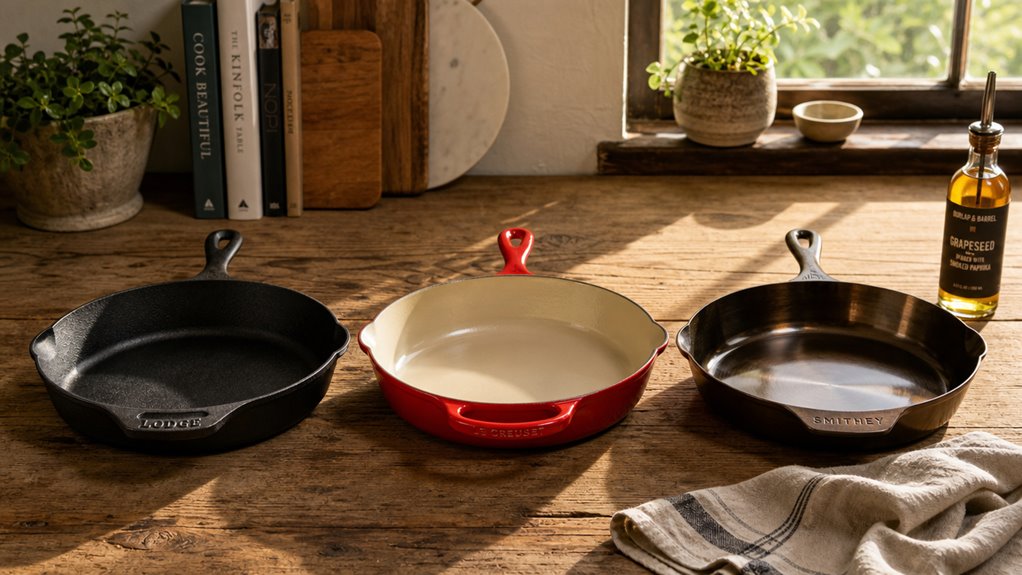
You’ll find that a budget-tier Lodge skillet covers most everyday searing and oven work, so it’s the logical first pan even if you could splurge.
When you need acid-safe, low-and-slow heat control, the enamel on a Le Creuset Dutch oven justifies its premium, but it won’t survive a campfire.
If you’re after a polished, near-non-stick surface and are willing to tend the seasoning, the Smithey skillet moves into aspirational territory — its higher cost and delicate finish make it a secondary addition rather than a starter.
When Lodge Is Genuinely Enough
In a modest kitchen, the 10.25-inch Lodge skillet often does the job pricier brands promise. Its sand-cast surface builds seasoning over time, so you get a non-stick feel without paying for a CNC-machined finish.
Heat retention matches a 500°F oven, and searing tests show only a few degrees behind boutique pans — negligible for everyday meals.
Because it sits at the budget tier, the money you save can go toward a good set of knives or a Dutch oven, and the lifetime warranty means you won’t be hunting for a replacement.
• Performance — sears steaks, bakes cornbread, and holds heat for casseroles as well as higher-priced cast iron
• Cost — a fraction of the premium tiers, a several-fold price advantage upfront
• Longevity — can be stripped and re-seasoned, lasting 50+ years with care
When Le Creuset Earns the Premium
When you’re cooking slow‑braised dishes or acidic sauces, the enameled core of a Le Creuset actually matters, because the porcelain coating prevents the iron from reacting with the food and lets you skip the seasoning ritual entirely. The even wall thickness spreads heat, while the tight‑fitting lid traps moisture, so you get steady simmering without constant stirring. If you often make stews, curries, or tomato‑based sauces, the non‑reactive surface saves you from metallic off‑flavors and the enamel’s smooth base protects glass tops. A 5.5 qt round Dutch oven is the most versatile first piece; a matching 10‑inch skillet covers quick sautés.
| Size | Ideal Use |
|---|---|
| 4.5 qt | Small families, limited storage |
| 5.5 qt | Core cooking, soups, bread |
| 7.25 qt | Large roasts, batch meals |
| 10‑inch skillet | Searing, shallow frying |
When Smithey Crosses Into Aspirational Territory
If you’re eyeing a Smithey skillet as your first premium cast-iron piece, start with the 10-inch chef model. It balances cost and versatility, giving you a non-stick-from-day-one surface and a polished look that feels more like a showpiece than a workhorse. The 10-inch covers most daily tasks — eggs, a steak, a quick sauté — while staying lighter than the 12-inch, which is better for batch cooking.
A single Smithey usually handles most stovetop work; adding a second, larger pan only makes sense if you host often or need a dedicated griddle.
• 10-inch chef: best first purchase, fits small kitchens
• 12-inch traditional: ideal for families, larger searing surface
• 11-inch flared: versatile, lighter weight, good for sauces
Why the Budget Workhorse Is the Right First Pan Even If You Can Afford the Premium
You’ll find that a Lodge skillet costs a fraction of a Smithey or Le Creuset, yet it handles the same everyday tasks: sautéing, searing, and finishing a dish in the oven, without the premium price tag.
Because it amortizes over decades, a seasoning mishap or a rust spot isn’t a financial disaster. The sand-cast surface traps seasoning, making it more non-stick as you use it, and you can scrub it with metal tools without fear of chipping enamel.
It works on gas, electric, induction, grill grates, and campfires, tolerating high heat that would damage enameled cookware. The trade-off: you must season it and maintain that seasoning, which takes a few minutes after each use.
Starting with this workhorse lets you learn how often you truly reach for a pan before committing to the premium tiers, which cost several times as much for finish, not for fundamentally better cooking.
Frequently Asked Questions
Q: What are the main differences between a Lodge cast iron skillet, Le Creuset enameled cast iron, and Smithey ironware when comparing skillets and dutch oven options?
A: The principal differences revolve around material finish, cooking surface, and price. Lodge cast iron skillet and Lodge dutch oven are typically bare cast iron, often pre-seasoned with a coating of oil and known for a rougher surface; they are durable and economical. Le Creuset enameled cast iron features an enamel coating that provides a nonstick-like finish for acidic cooking and easier cleaning but is heavier and commands a high price. Smithey ironware focuses on polished cast iron cooking surfaces with smoother finish and aesthetic appeal; Smithey skillets sit between Lodge and Le Creuset on price and offer a refined cooking surface that many home chefs prefer as their favorite cast iron. Performance differences include heat retention (all strong), ease of cooking and cleaning (enameled easiest), and seasoning needs (bare cast iron and polished cast iron require maintenance to last a lifetime).
Q: Are cast iron skillets from Lodge, Smithey, or Le Creuset the best cast iron for non-stick cooking and how does seasoning affect nonstick performance?
A: For raw nonstick performance, a well-maintained bare cast iron pan—whether a Lodge cast iron skillet or a polished Smithey—can become highly nonstick after proper seasoning. Lodge arrives pre-seasoned and offers immediate utility, though the rougher surface may require more layers of oil to achieve a smooth nonstick surface. Smithey’s polished finish typically reaches nonstick quality faster due to its smoothness. Le Creuset’s enameled cast iron provides a different path: not traditionally seasoned, it offers easier release for many foods without the need for a coating of oil but should not be relied on as identical to seasoned bare iron.
Q: How does price difference factor into choosing between a cheap Lodge skillet, Smithey, or a splurge like Le Creuset as the best overall cookware purchase?
A: Price difference is significant: Lodge offers excellent value and access to best cast iron skillets for budget-conscious buyers; Smithey and Le Creuset represent mid- to high-end options. Choose based on use-case: if you want durable, functional skillets on the market without high price, Lodge is hard to beat. If you value polished aesthetics and a refined cooking surface, Smithey justifies a higher cost. If you want enamel convenience and brand prestige, Le Creuset is a splurge that is often considered best overall by buyers prioritizing ease of cleaning and color options.
Q: For a home chef deciding between a 12-inch skillet from Lodge or Smithey, or a Le Creuset dutch oven, which is more versatile for everyday cooking?
A: A 12-inch skillet—whether a Lodge chef collection skillet, a Lodge Blacklock variant, or a Smithey 12-inch—provides maximum versatility for searing, frying, and oven finishing and is a common favorite cast iron for many kitchens. A Le Creuset dutch oven excels for braises, soups, and slow cooking but is less suited for high-heat searing. If you must choose one piece for everyday tasks, the 12-inch cast iron pan or chef skillet from Smithey or Lodge is generally more versatile; choose Smithey for smoother cooking surface and easier release, Lodge for cost-effective durability.
Q: How do maintenance, cooking and cleaning differ between bare cast iron, polished cast iron, and enameled cast iron?
A: Bare cast iron (e.g., classic Lodge, Griswold-era repros) needs regular seasoning and careful drying to prevent rust; it benefits from a coating of oil after cleaning and may be tougher to clean initially due to rough cast iron texture. Polished cast iron, as with Smithey and some Field Company-style pieces, offers easier release and is generally easier to maintain because the smoothness resists food adhesion. Enameled cast iron (Le Creuset, Emile Henry-style ceramics) requires no seasoning and is easier to clean—often requiring only soap and water—but the enamel can chip if abused. Each will last a lifetime with proper care, but the routines differ.
Q: Do pour spouts, handles, and other design details justify choosing one brand over another, for instance Smithey vs Lodge cast iron pan features?
A: Small design features can influence daily use. Lodge often includes functional pour spouts and stout handles on models like the Lodge chef collection skillet; some users prefer the heft and utilitarian design. Smithey emphasizes refined ergonomics, smoother edges, and sometimes more elegant pour spouts, improving ease of handling. Le Creuset’s enameled pieces feature broad, comfortable handles suited to heavier dutch ovens. If easier to handle and pour spouts matter to you, those details can justify choosing Smithey or a higher-end Lodge model over a basic cheap Lodge skillet.
Q: How does the “smithey and lodge” debate compare to historic names like Griswold or newer makers like Field Company when evaluating best cast iron skillets?
A: The smithey vs lodge debate centers on finish and price: Smithey aims for polished cast iron with premium fit-and-finish, Lodge focuses on heritage, affordability, and widespread availability. Griswold is a historic reference often admired for its old-school casting and patina potential. Field Company and other boutique field skillets emphasize lightweight designs and refined profiles. Choice depends on priorities: collectability and vintage feel (Griswold), modern smoothness and aesthetics (Smithey, Field Company), or rugged, budget-friendly utility (Lodge). All can produce excellent cooking results; differences in performance often come down to smoothness and seasoning rather than dramatic functional gaps.
Q: Will buying a high price Le Creuset or Smithey skillet truly last a lifetime more reliably than a cheap Lodge, or is durability comparable?
A: All three brands—Lodge, Smithey, and Le Creuset—produce durable ironware that can last a lifetime when cared for correctly. A cheap Lodge will still be highly durable, though it may have a rougher surface and require more seasoning work. High price often buys finer finish, smoother cooking surface, and sometimes better customer service, but it does not inherently confer greater longevity; many vintage Griswold and modern Lodge Blacklock pieces remain functional for generations. Evaluate based on desired surface finish, ease of cooking and cleaning, and budget rather than assuming lifetime durability differs drastically.
Q: If I’m choosing one skillet as my favorite cast iron to buy now, which should I pick as the best overall: Lodge, Le Creuset, or Smithey?
A: For most home cooks seeking best overall value and functionality, a Lodge 12-inch skillet or Lodge chef collection skillet is an excellent starting point—affordable, dependable, and versatile. If you prioritize a polished cooking surface and a more refined look with quicker nonstick development, Smithey is often recommended as the best overall upgrade. If ease of cleaning, enameled convenience, and color options are paramount—and you are willing to splurge—then Le Creuset may be the right best overall pick. Consider how you cook, your tolerance for maintenance, and the price difference when deciding.
Conclusion
You’ll get a Lodge that’s as sturdy as a workbench, a Smithey that feels like a precision‑engineered tool, and a Le Creuset that behaves like a dishwasher‑safe ceramic. Lodge needs seasoning and can rust if you ignore it; Smithey’s polished surface chips under aggressive metal utensils; Le Creuset can’t be repaired once the enamel cracks. If you want a pan that will last a decade with minimal upkeep, the Lodge is the pragmatic pick. If you value out‑of‑the‑box non‑stick and don’t mind occasional seasoning, go Smithey. If you need acid‑safe, low‑maintenance cooking and are okay with a higher price tag, Le Creuset fits.