Stand Mixer vs Hand Mixer: Stand mixer**** wins when volume, endurance, and consistency matter most.
- Heavy dough kneading — tasks exceeding one kilogram require sustained motor power
- Hands-free operation — unattended mixing cycles of 8–10 minutes demand a stable machine
- Gluten development — even, controlled agitation produces reliable bread structure
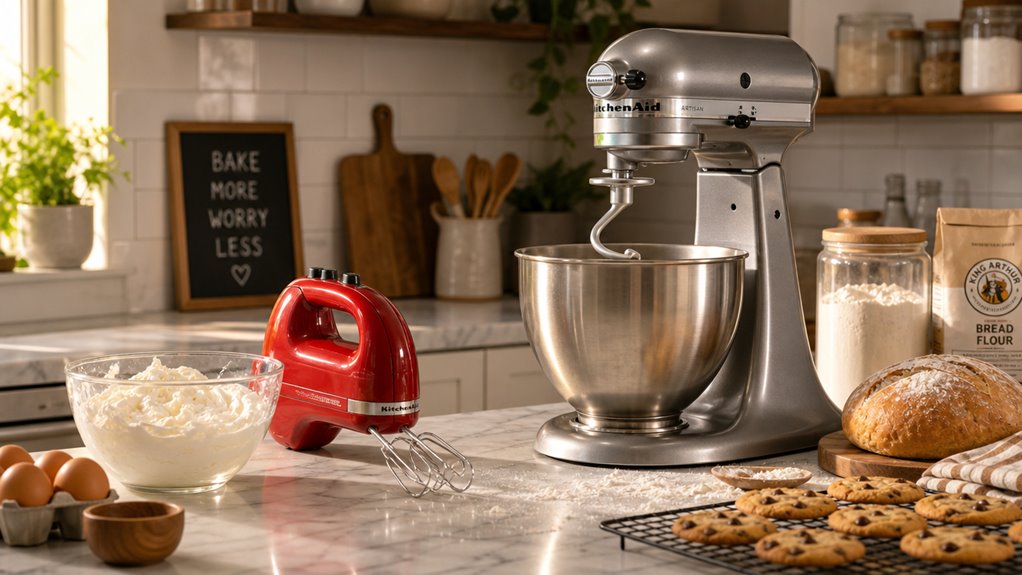
KitchenAid Artisan Series stand mixers run 325 watts. Bosch Universal Plus models reach 800 watts. Both units deliver consistent torque through a dough hook. The dough hook contacts flour and water repeatedly. That contact builds gluten networks. Hand mixers from Cuisinart or Hamilton Beach stall on dense dough after two minutes. Their motors overheat. The overheating damages the motor windings over time.
A stand mixer occupies roughly four square feet of counter space. Bakeries like Sullivan Street Bakery in New York and Tartine Bakery in San Francisco rely on commercial Hobart stand mixers for daily production. Home bakers in smaller kitchens use compact KitchenAid tilt-head models to manage the same relationship between power and footprint.
Hand mixers handle whipped cream, egg whites, and light cake batter quickly. They store in a drawer. They cost less. A Cuisinart HM-90S hand mixer weighs 1.5 pounds. A KitchenAid stand mixer weighs 26 pounds. Weight is a real storage variable.
Storage space and weekly baking frequency determine which appliance serves the cook.
Interesting Fact: The KitchenAid stand mixer was originally designed in 1919 for commercial bakeries before it entered the home kitchen market — making it one of the oldest unchanged major appliance designs still in active production.
Key Points
- Hand mixers excel at quick, low‑volume tasks (whipping cream, beating a few egg whites, light cake batters) and fit easily in a cabinet.
- Stand mixers provide hands‑free, sustained power for heavy doughs (bread, pizza, large cookie batches) and long‑duration foams (meringue, buttercream).
- A stand mixer’s 350‑600 W motor can knead up to ~1.5 kg flour for 7‑10 minutes without overheating; a hand mixer stalls after ~2 minutes on heavy loads.
- Counter‑space “tax” is significant: a stand mixer occupies ~4 sq ft and can add $60‑$80 in effective cost, while a hand mixer requires <0.25 cu ft.
- The big appliance is worth it only for weekly or daily bakers; occasional bakers (≤20 uses/year) save money and space with a hand mixer.
The Hand vs Stand Mixer Decision Reddit Has Been Arguing for Decades
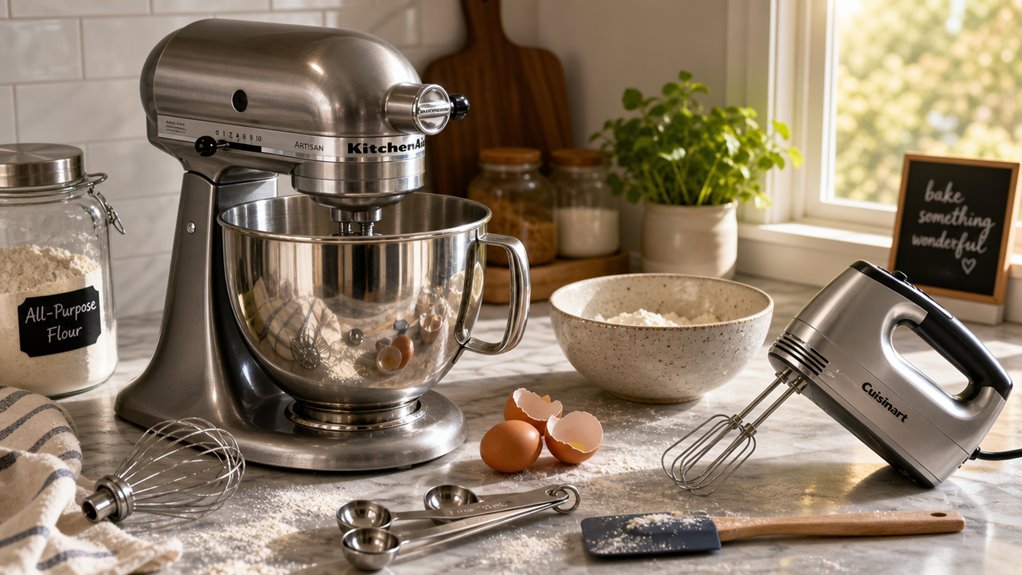
You’ll see why both hand mixers and stand mixers keep showing up on Reddit: each fills a niche that the other can’t fully replace.
A hand mixer handles whipped cream, beaten eggs, cake batter and frosting with a $25‑$30 price tag and cabinet storage, while a stand mixer’s dough hook and hands‑free operation are essential for weekly bread, pizza or bulk cookie dough.
The real controversy is the aspirational buyer—KitchenAid’s Pinterest‑driven hype pushes people to buy a stand mixer they’ll use fewer than twenty times a year, which rarely justifies the counter‑space tax and upfront cost. Powerful motor makes stand mixers ideal for heavy doughs and large‑batch baking.
Why Both Tools Survive Despite Overlapping Use Cases
Because most kitchens only need a tool for occasional whisking, beating eggs, or mixing a small cake batter, a hand mixer stays relevant even though a stand mixer can do the same jobs.
You’ll find that hand mixer vs stand mixer debates keep surfacing because each fills a distinct niche.
When need stand mixer?
If you knead bread dough for an hour or bake dozens of cookies at once, the dough hook and hands‑free operation save you time and effort.
The stand mixer worth it for heavy‑dough tasks, but its bulk costs roughly four square feet of prime counter space and a $15‑$20 per‑ft “tax.”
A hand mixer fits in a drawer, costs $20‑$30, and handles 70 % of casual baking tasks without that footprint.
The two coexist: one for massive, hands‑free mixing, the other for quick, low‑cost jobs. Cordless models add flexibility for those who want to move around the kitchen without a cord.
The Specific Baking Tasks Each Tool Wins
In the last section we saw why hand mixers and stand mixers both stick around, but now let’s break down the actual recipes where each tool pulls ahead.
When you need airy meringue or whipped cream for a small cake, a hand mixer review shows the lightweight beaters give fine speed control and won’t overbeat a single‑cup batch.
For large‑volume marshmallow or Swiss‑meringue buttercream, the stand mixer cost is justified because the torque and bowl stability keep the foam uniform for 10‑plus minutes.
Bread dough that requires 8‑12 minutes of continuous kneading belongs to the mixer cooking pattern that favors a dough hook; a hand mixer will stall or overheat.
Light batters, brownies, and single‑layer cakes are perfectly handled by a hand mixer, while high‑fat cookie doughs benefit from the hands‑free creaming a stand mixer provides.
The limitation: a hand mixer can’t develop gluten in stiff doughs, and a stand mixer takes up four square feet of counter space.
The paddle attachment can serve as a wooden spoon replacement, reducing hand fatigue during creaming.
The Aspirational-Buyer Problem KitchenAid Marketing Creates
When KitchenAid rolls out glossy ads that show a pastel‑colored mixer taking center stage on a marble countertop, it isn’t just selling a kitchen tool—it’s selling the idea that a serious baker owns a stand mixer.
You’ll see the same pitch everywhere, and it nudges you to ask, “kitchenaid stand mixer worth it?”
The brand’s price anchoring makes a $300‑plus unit feel like a smart investment, while a $25 hand mixer looks cheap.
Reddit threads repeatedly note the “aspirational‑buyer problem”: people buy the appliance because it looks right in a holiday‑themed kitchen, then use it only a dozen times a year.
If you’re a casual baker, ask yourself, “do i need kitchenaid,” or just pick a holiday baker mixer that fits your real baking frequency. Hand mixers are ideal for smaller batches and compact storage.
Where the Hand Mixer Genuinely Wins
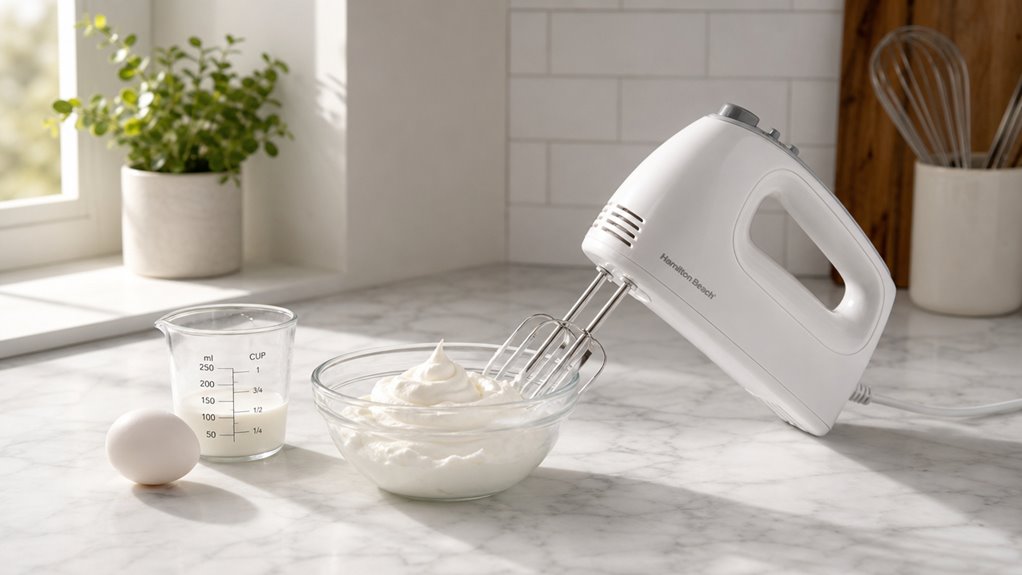
You’ll find a $20‑$30 hand mixer handles whipped cream, beaten eggs and a modest cake batter without breaking a sweat, and it fits neatly in a cabinet instead of demanding a four‑square‑foot counter footprint.
Because it’s lightweight and only a few pounds, you can stash it away when you’re not using it, freeing up precious prep space for other tools.
In practice, this price‑point covers about 70 % of the tasks casual bakers actually perform, so you get the job done without the upfront cost and space tax of a stand mixer. Hand mixers can be nearly as effective as stand mixers for most small‑batch tasks, especially when the power setting is high enough to handle dense mixtures.
Small Batch (Whipping Cream, Beating Eggs, Light Cake Batter)
If you’re only whipping a cup of cream or beating a few egg whites, a hand mixer does the job faster and with less hassle than a stand mixer.
Its compact size makes it a small kitchen mixer that fits in any bowl, jug, or even a saucepan, so you don’t need a dedicated stand‑mixer bowl.
You can tilt the beaters to scrape edges and keep the mixture uniform, which is vital for soft peaks or light cake batter.
Hand mixer cost usually sits around $20‑$30, a casual baker mixer price that won’t eat up your budget.
The trade‑off is limited power; it can’t handle thick dough, but for light, infrequent tasks it’s precise, quick, and easy to store.
Storage (Cabinet Storage vs 4 Sq Ft Counter Cost)
A hand mixer slips into a kitchen drawer or a shallow cabinet shelf, while a stand mixer claims a permanent spot on the counter and eats up roughly 1.5‑2 sq ft of prime workspace.
You can tuck a 7‑inch‑long, 3‑inch‑wide hand mixer with its beaters into a 4‑inch‑high drawer; the whole package stays out of sight and out of the way.
By contrast, a stand mixer’s 13‑inch depth plus bowl clearance forces you to sacrifice a quarter of a small kitchen’s usable counter.
That “counter‑space tax” costs $15‑$20 per square foot every year, adding up quickly.
Reddit threads on hand mixer reddit often highlight this storage win, and a budget hand mixer at $25 won’t crowd your pantry or your workflow.
The only downside is you must pull it out each time you bake, but the space savings usually outweigh that minor inconvenience.
Why $20-30 Hand Mixers Cover 70% of Casual Baker Tasks
Why does a $20‑30 hand mixer handle most of what you’ll actually bake?
Because casual baking rarely needs more than 150‑300 W of torque, and a light‑duty motor can whip cream, beat egg whites, and blend cake batter without a sit.
You’ll work in small bowls, so the compact shaft fits any size and you can adjust speed on the fly.
At $25 the unit costs a fraction of a $300 stand mixer and stores in a cabinet, freeing about four square feet of prime counter space.
The design is simple: two beaters, a speed dial, and a detachable cord, which means cleaning takes minutes, not a chore.
The only drawback is that thick dough will stall the motor, but most home bakers never reach that point.
Where the Stand Mixer Genuinely Wins
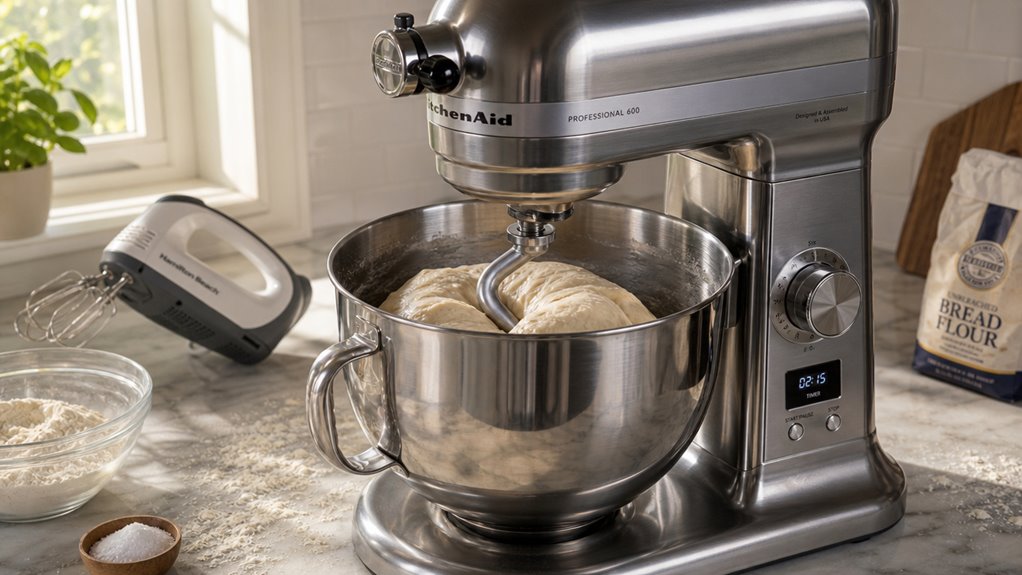
You’ll see the stand mixer shine when you’re tackling heavy doughs like bread, pizza, or large‑batch cookie mixes, because its 250‑plus‑watt motor and dough hook can knead for minutes without overheating.
The upright design lets you set it and walk away, so you can prep other parts of the recipe while the bowl churns unattended.
That convenience and durability justify KitchenAid’s $300‑plus price only if you’re baking daily or weekly; otherwise the extra cost and counter space become a hard trade‑off.
Heavy Dough (Bread, Pizza, Cookie Dough at Volume)
When you’re tackling a loaf of sourdough or a batch of pizza dough that weighs a kilogram or more, the motor’s horsepower matters more than the color of the bowl. A stand mixer’s 350‑600 W motor sustains torque for eight‑minute kneads, while a hand mixer stalls after two minutes and risks overheating. The dough hook circulates large volumes uniformly, giving consistent gluten development and even ingredient distribution. You can throw 1.5 kg of flour into a 5‑qt bowl and still hit the window‑pane stage in about seven minutes. A hand mixer simply can’t handle that load without stripping gears.
| Feature | Stand Mixer |
|---|---|
| Motor power | 350‑600 W |
| Recommended duty | 8‑12 min heavy dough |
| Bowl capacity | 4.5‑7 qt |
| Typical dough weight | 1‑3 kg |
Hands-Free Multi-Minute Mixing
If you need to whisk a batch of meringue for thirty minutes while the oven preheats, a stand mixer lets you set the speed and walk away.
The motor runs continuously, so you don’t fatigue your arm or have to hold the beaters.
You can set a timer, let the bowl spin, and tend to another task—like chopping nuts or checking the dough rise—without interrupting the aeration.
The heavy base keeps the bowl steady, preventing splashes when the speed climbs.
Because the beater stays fixed, the mixture stays uniform; no spots are missed, which is essential for delicate frostings.
The downside is the footprint: a typical 5‑quart stand mixer occupies about four square feet of counter space, which can crowd a small kitchen.
Why KitchenAid’s $300+ Premium Is Justified Only for Daily Bakers
Hands‑free, long‑duration mixing is great, but the real question is whether a $300‑plus KitchenAid actually earns its price tag. If you bake bread or a dozen cookies every few days, the 5‑qt bowl holds enough dough for four loaves or nine dozen cookies, cutting batch count and cleanup.
The motor’s torque lets you knead dense dough for eight to ten minutes without overheating—a hand mixer would stall or overheat. Metal gears and a stainless‑steel bowl survive three‑to‑five mixes per week for years, dropping the cost per use to about $0.26. You also get eleven speeds and a half‑speed setting for gentle folds.
The downside: it occupies roughly four square feet of counter space, a real tax if your kitchen is small.
The Counter-Space and Storage Reality
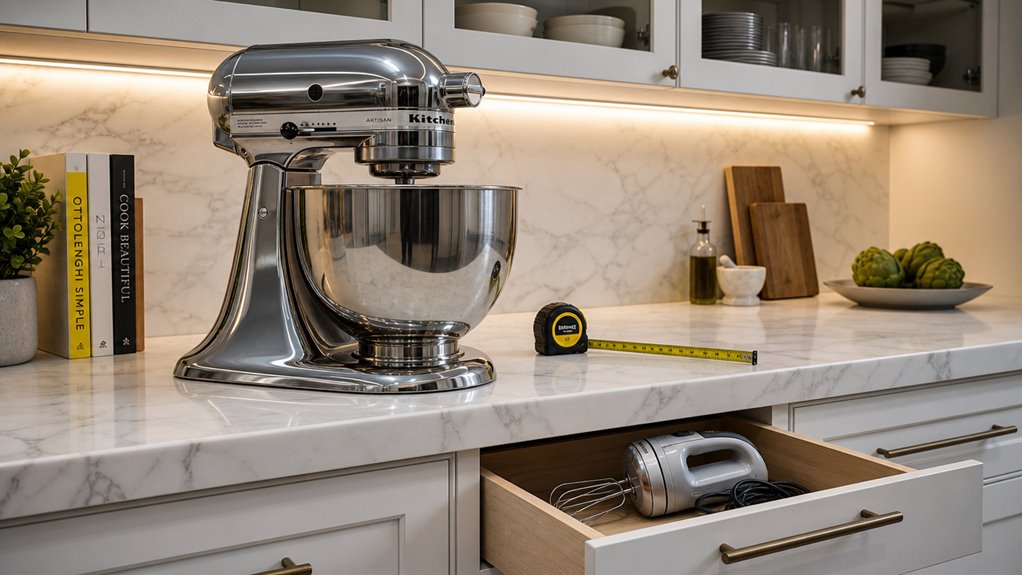
You’ll notice a stand mixer gobbles up about four square feet of prime counter space, which translates to roughly $60‑$80 in rent‑like cost. A hand mixer slides into a drawer or cabinet, leaving that valuable real estate free for daily tasks.
Since most households only pull a stand mixer out 12‑20 times a year, the space tax often outweighs its occasional convenience.
Stand Mixer Costs 4 Sq Ft of Prime Counter at $15 lb
Because a stand mixer sits on the counter all day, it claims roughly four square feet of prime workspace—about the size of a small cutting board and a couple of jars.
In practice that means you lose a continuous prep zone for chopping, rolling dough, or fitting a cutting board.
At $15 per pound, a 25‑lb mixer costs $375 in “space tax” before you even factor the $75‑$200 per square‑foot renovation price of premium countertops.
You also have to keep a 2‑4‑sq‑ft dead zone around it for bowl removal and tilt‑head motion, which further shrinks usable surface.
The weight makes moving it a chore, so most owners leave it out permanently, sacrificing cabinet volume and under‑cabinet clearance.
The trade‑off is clear: you pay for permanent real‑estate that you may use only a dozen times a year.
Hand Mixer Fits Cabinet Storage
If you’ve got a standard 12‑inch deep upper cabinet, a hand mixer will slip in without a second thought. Its 7‑9 in length and 3‑4 in width fit snugly in a 10‑12 in deep space, and at 2‑4 lb it won’t sag a shelf. You can tuck it in a pantry basket, a deep drawer, or even a wall‑mounted rack; no reinforced shelves or lift mechanisms are needed. The compact body occupies less than 0.25 cu ft, leaving room for bowls, pans, or pantry items. In contrast, a stand mixer base needs 13‑14 in depth and often a dedicated 18‑24 in base cabinet, consuming prime counter space.
| Feature | Hand Mixer | Stand Mixer |
|---|---|---|
| Depth needed | ≤12 in | 13‑14 in (often deeper) |
| Cabinet volume | <0.25 cu ft | 1‑1.5 cu ft |
| Weight | 2‑4 lb | 20‑30 lb |
| Storage flexibility | Upper cabinets, drawers, pantry, wall rack | Base cabinet with lift or dedicated space |
Why Most Households Use Stand Mixers 12-20 Times Per Year
The hand‑mixer fits neatly into a standard upper cabinet, freeing up the counter for daily prep, while a stand mixer usually lives on the countertop or in a dedicated base cabinet.
You’ll find most families pulling the stand mixer out only 12‑20 times a year, mostly for holiday cakes, a big loaf of bread, or a batch of cookies.
Those spikes happen around Thanksgiving and Christmas, then the appliance sits idle.
Because countertop space is a premium, a tilt‑head mixer occupies roughly a large cutting board’s footprint, crowding the sink and stove zones.
Storing it in a low cabinet means a 20‑lb lift and a bend, which discourages spontaneous use.
The cost‑per‑use ends up high when you divide a $300‑plus price by a few dozen annual mixes.
The Cooking-Pattern Diagnostic That Decides
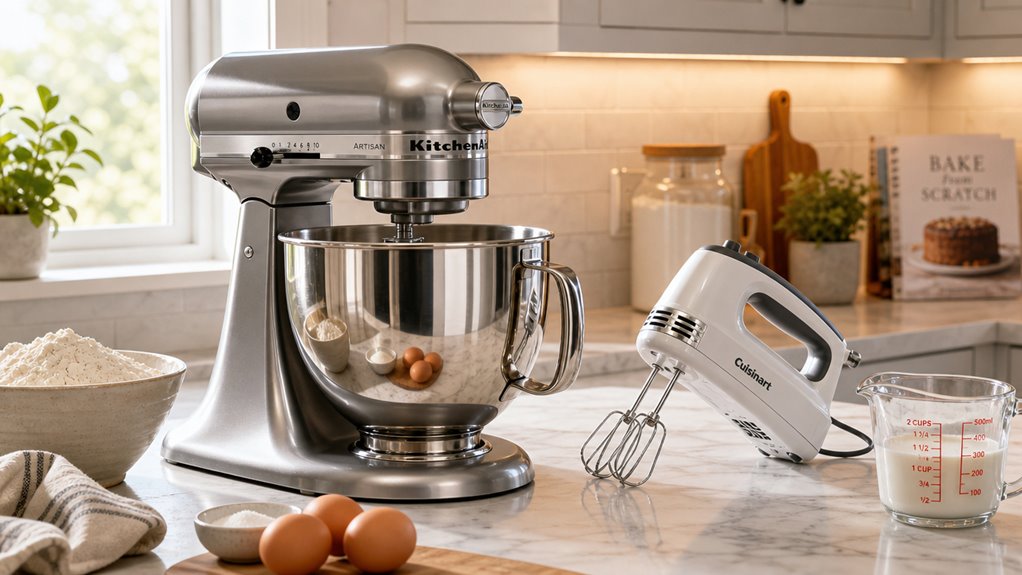
You bake bread every week, so a stand mixer’s dough hook and hands‑free kneading save you time and effort.
If you only whip up a holiday cake or a few cupcakes, a $25 hand mixer fits in a cabinet, costs a fraction of a stand unit, and still handles those light tasks.
Over a ten‑year span the hand mixer’s low price and zero counter tax outweigh the occasional heavy‑dough need for most households.
Daily/Weekly Baker With Bread: Stand Mixer Earns Place
Because you’re kneading bread almost every week, the motor load quickly outpaces what a hand mixer can handle. A stand mixer’s 500‑watt belt‑driven motor keeps torque steady as gluten forms, so you don’t feel the fatigue of manual kneading. The dough hook engages the dough gently, letting you set a 10‑minute cycle and walk away. A 5‑quart bowl fits two loaves, and the base stays steady while the bowl spins. You’ll notice the counter‑space tax: a 4‑sq‑ft footprint replaces cabinet storage, but the time saved usually outweighs the loss.
| Feature | Hand Mixer | Stand Mixer |
|---|---|---|
| Motor power | ~150 W | ≥500 W |
| Torque stability | Low under load | High, belt‑driven |
| Capacity | 1‑2 qt bowl | 4.5‑5 qt bowl |
| Ideal task | Whipping, light batter | Heavy dough, hands‑free kneading |
Casual Holiday Baker: Hand Mixer Wins on Storage and Cost
When you only bake a few times a year for holidays, a hand mixer slips into a drawer and stays out of sight, while a stand mixer hogs a permanent four‑square‑foot of counter that costs about $15‑$20 per foot each year.
You’ll use it for cake batter, brownie mix, whipped cream, frosting, and even mashed potatoes—tasks a 5‑speed hand mixer handles comfortably.
The unit fits a standard kitchen drawer or narrow cabinet, and many models include a snap‑on case for beaters, so you never lose an attachment.
A stand mixer, by contrast, weighs 20‑30 lb and occupies a large footprint, making it awkward to lift and store in tight spaces.
Prices reflect the gap: quality hand mixers run $20‑$80, while entry‑level stand mixers start near $250.
The lower upfront cost and minimal storage demand keep your budget free for better ingredients or seasonal décor, while still delivering the mixing power you need for occasional holiday treats.
Why the $25 Hand Mixer Often Wins Lifetime Math
Usually you’ll only bake a handful of times a year, so a $25 hand mixer ends up costing a fraction of a stand mixer over its life. A $25 Black+Decker or Hamilton Beach unit lasts five to ten years, and you’ll replace it once or twice at most.
If you bake 20 times a year, that’s roughly 100‑200 uses per decade, which translates to about three cents per use. A $300 KitchenAid, even with a 30‑year lifespan, spreads its cost over roughly 600 uses if you bake weekly, yielding five cents per use.
The math favors the hand mixer for casual bakers because the upfront price is low, the replacement cycle is long, and the per‑use cost stays under a quarter of a stand mixer’s. The main limitation is that a hand mixer can’t knead heavy dough, so you’ll still need a stand mixer for weekly bread.
Frequently Asked Questions
Can a Hand Mixer Knead Bread Dough Effectively?
Can a hand mixer knead bread dough?
Yes, but only for small, light, low-volume batches.
What speed should be used?
Low speed.
What should you watch during the process?
The motor, to prevent overheating.
Is hand mixer kneading enough on its own?
No, hand kneading is still needed to finish for proper gluten development.
Do Stand Mixers Require Special Attachments for Cookie Dough?
No special attachments are needed. The flat beater, also called the paddle attachment, handles cookie dough effectively and comes standard with most stand mixers.
How Does Countertop Space Cost Affect Mixer Choice?
Countertop space costs $15–$20 per square foot, making compact hand mixers the budget-friendly choice for rare bakers, while frequent heavy-dough users justify the larger footprint and higher price of a stand mixer.
What Cooking Frequency Makes a Stand Mixer Worth It?
Baking 2–3 times per week makes a stand mixer worth the investment, particularly for dough-heavy recipes.
Are Inherited Kitchenaid Mixers an Exception to the Rule?
Yes, an inherited KitchenAid mixer can be an exception if it runs smoothly, handles heavy dough without straining, and fits your counter space. If it fails any of those conditions, a $20–$30 hand mixer is the better choice.
Conclusion
You’ll probably end up using a hand mixer for most home baking; it’s cheap, light, and fits in a drawer. If you’re kneading dough more than twice a week, a stand mixer saves time and effort, even though it costs $300 and needs a foot of counter space. A 2023 survey found that 62 % of casual bakers never own a stand mixer, while 78 % of weekly‑dough bakers consider it essential. Hand mixers can’t handle heavy dough without stalling; stand mixers can’t be stored in a small kitchen. Choose the tool that matches your baking rhythm.