
Kitchen Essentials for Your First Apartment: What to Buy Now vs Later
First apartment kitchen essentials: three tools determine whether you cook real meals or order takeout every night.
- Chef’s Knife
- Cutting Board
- Cast-Iron Skillet
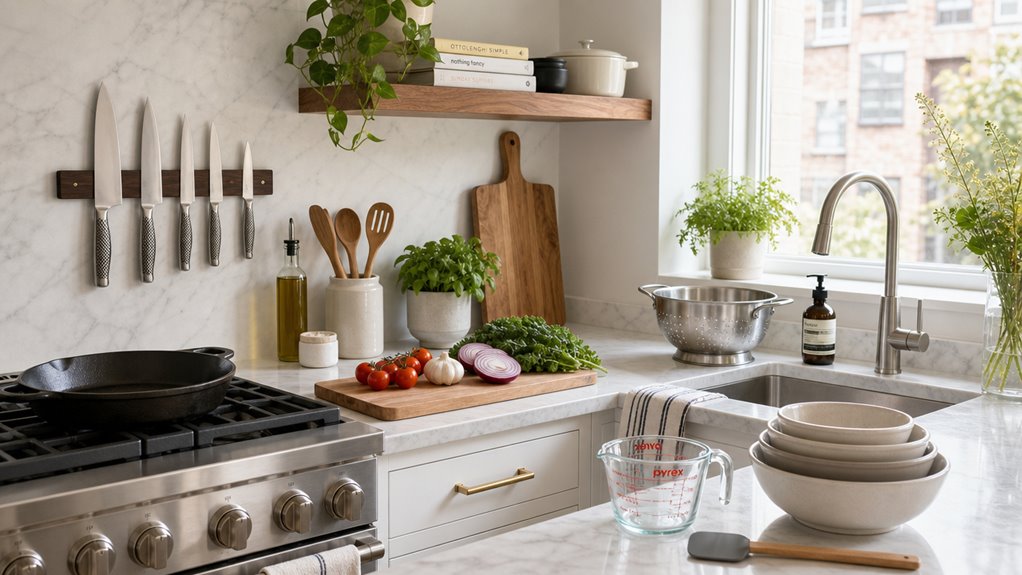
A Victorinox Fibrox 8-inch Chef’s Knife**** costs under $50 and outperforms knives priced three times higher. It handles 80% of all cutting tasks. Buy it on day one.
A John Boos maple wood cutting board** protects knife edges and resists deep scoring. Hand-wash it. Dry it immediately. Never use it for raw meat on day one — designate that task for a second board added within 30 to 90 days**.
A Lodge 10.25-inch Cast Iron Skillet moves from stovetop to oven to table without damage. It sears, bakes, and fries. It lasts decades with basic care. Buy it alongside the knife.
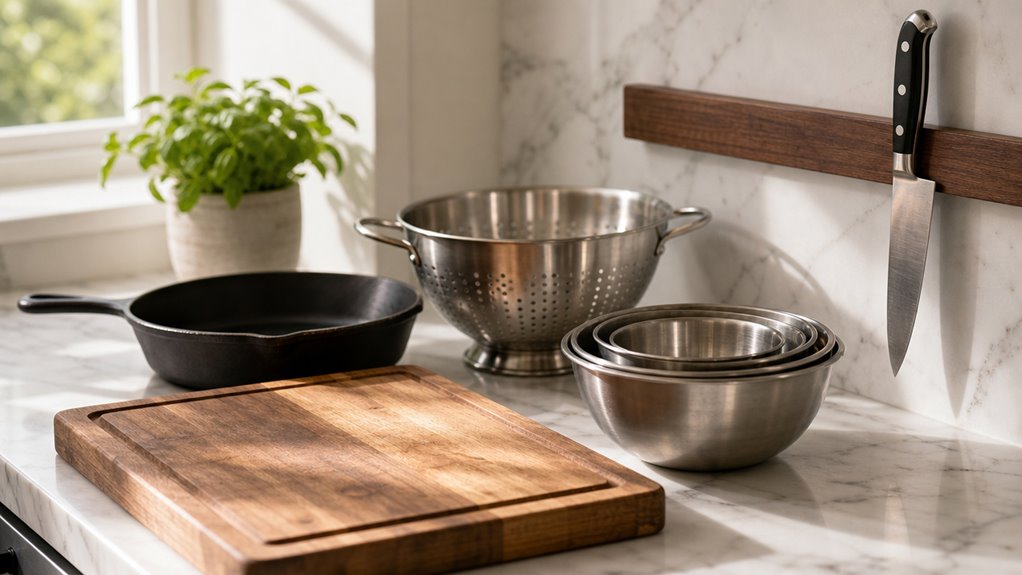
Between 30 and 90 days, add a Cuisinart 3-quart saucepan, a 5 to 6-quart stockpot, and a OXO Good Grips measuring set. Staff at local kitchen supply stores like Williams-Sonoma or independent shops such as The Wooden Spoon can match these tools to your specific stovetop.
Between six and twelve months, add only what your actual cooking demands. A Breville coffee maker or OXO airtight storage containers belong in this phase. Buying them earlier wastes money.
Interesting Fact: Cast iron skillets retain heat up to 10 times longer than standard aluminum pans, making them the most energy-efficient cooking surface available for home cooks.
Key Points
- Build a day-1 kit under $70: chef knife + wood cutting board + cast-iron skillet + a 3-tool utensil set.
- Avoid knife-and-block and “complete starter kit” bundles; they often include low-grade tools that fail under normal use.
- Buy piecewise to prevent duplicate filler items and reduce clutter, especially with appliance and grocery rack jobbers.
- In 1–3 months, add based on cooking patterns: consider a second pan or coffee maker vs kettle, plus meal-prep cookware.
- Skip specialty gadgets until repeated use proves value; core tools cover 80–90% of cooking needs safely.
The First-Apartment Reality (And the Mistakes Most Buyers Make)
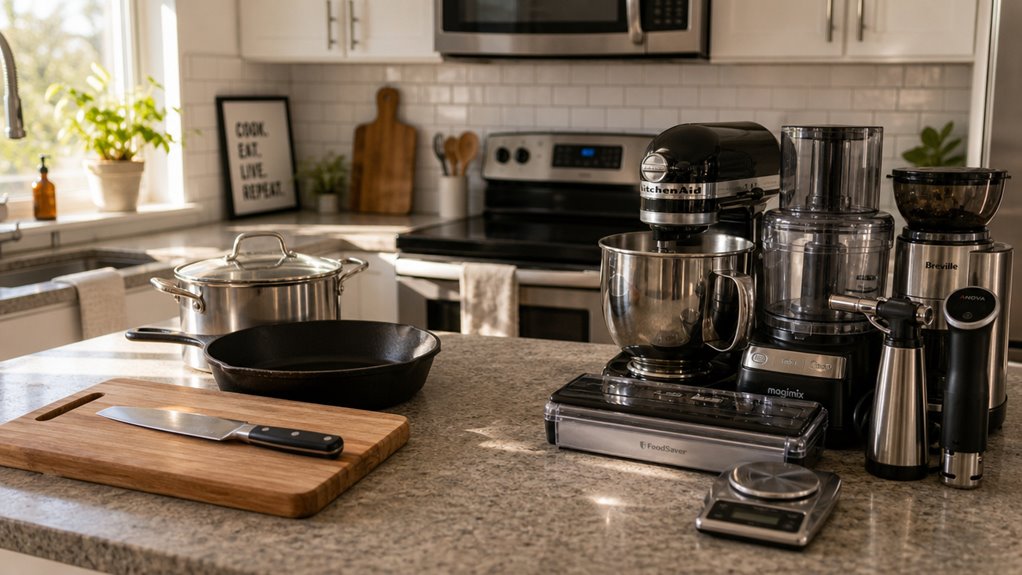
You don’t need a “complete starter kit” to cook on day one—you need a sharp chef’s knife, a cutting board, and a solid pan that you’ll actually use. Buying everything at once usually pushes you into unused specialty tools, bad per-item quality, and cabinet clutter, while ignoring basics like cleaning supplies and pantry staples that quietly blow up your budget. If you set $70 for day-1 essentials and add about $30 in the next 1–3 months based on what you really cook, you end up spending less than a $200 all-at-once bundle and you don’t waste money on tools you never reach for. For everyday cooking, a 10- or 12-inch frying pan is one of the most useful pieces you can own. A sharp 8-inch chef’s knife is your workhorse for chopping, slicing, dicing, and mincing.
The “Complete Starter Kit” Trap
A “complete starter kit” sounds like a shortcut, but it usually just front-loads the mistakes: you pay for a bunch of low-grade stuff you won’t use, then replace it fast once normal cooking puts real stress on it. That kitchen starter kit can mean overbuying warped pans, thin knives, and flimsy utensils with weak durability. When you finally buy better pieces, you’re left with mismatched storage clutter and sunk costs. Instead, build around baseline kitchen staples so everyday cooking works smoothly before you splurge on extras. A good starting core is to include Pots and pans so home-cooked meals can work from day one.
Why Buying Everything at Once Often Costs More Than Building Piecewise
Building a first-apartment kitchen “all at once” usually feels efficient, but it often ends up costing more than you expect because you’re paying for duplicates, low-grade filler, and convenience markups before you even learn how you actually cook. Discounts can look compelling in appliance bundles, yet the total value can shrink if you don’t fully use every included feature. appliance bundles hide extra features and “free” items that you still won’t use, raising life-cycle costing. grocery rack jobbers often supply kitchen items to stores while also taking a commission, and that convenience markup is reflected in what you pay—especially when you buy everything at once instead of comparing elsewhere.
| Plan | Buy | Tradeoff |
|---|---|---|
| Bundles | Sets | Duplicates |
| Piecewise | Core tools | Wait for patterns |
| DIY build | Quality picks | Fewer specs |
Why a $70 Now Plus $30 Later Outperforms $200 All At Once
Why drop $200 all at once on a “complete kitchen” when your move-in months already eat cash fast?
With cash-flow optimization, you buy first apartment essentials for about $70 now, then add $30 later based on what you actually cook.
Traditional rent payments are monthly payments to the landlord in exchange for occupying the rental property.
Split-rent fintechs similarly split up hefty payments so renters can pay in two smaller amounts instead of one.
Staged purchases beat credit-card stress and rent-now-pay-later fees, and they prevent 30–50% low-value extras from sitting unused.
The 5 Things to Buy on Day 1 (Before You Cook Once)
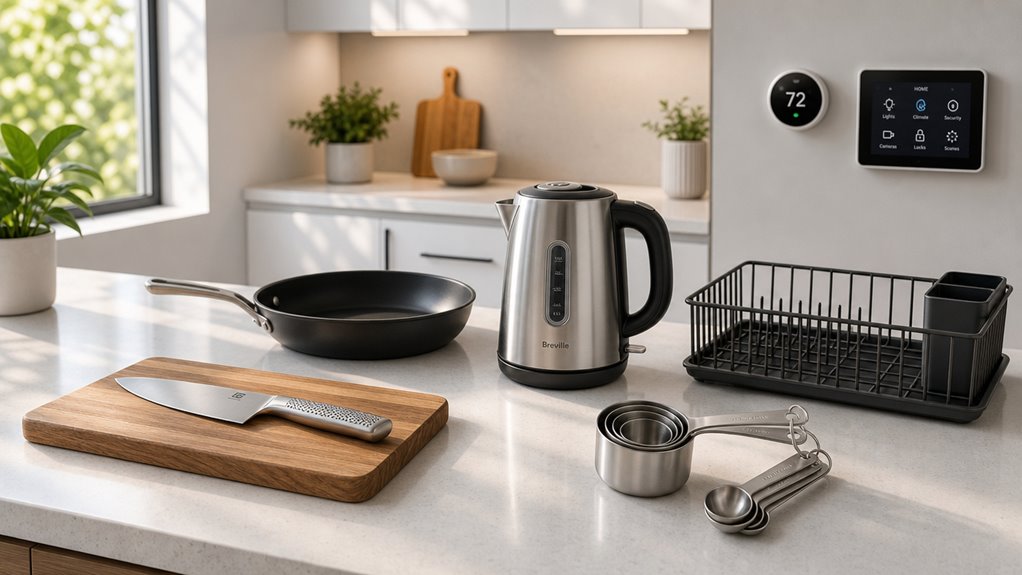
Day 1, you’re buying the daily-driver pair (a chef knife + cutting board), a single universal pan (a cast-iron skillet), and a 3-tool utensil set (wooden spoon, spatula/turner, and tongs) so you can actually cook without pausing for random gadgets. If you have to pick only five, skip the $200 knife block “bundle” stuff and build a simple under-$70 kit instead, because it prevents the classic waste where specialty tools sit unused. The one limitation to know up front: cast-iron skillet needs a little extra care than nonstick, but it’ll handle eggs, sautéing, and a lot more from day one.
Chef Knife + Cutting Board (The Daily-Driver Pair)
Your chef’s knife and cutting board are the two things you’ll touch almost every time you cook, so they’re the smart start before you add any “maybe” tools. Get the basics now:
- Chef’s knife (8–9 in) for most prep; limitation: you must hand-wash and dry. Start with a knife.
- Medium wood cutting board for general use; limitation: don’t use on raw meat.
- Optional plastic board later for raw proteins.
When you keep your chef’s knife sharp, it stays more effective and cuts more safely between sharpening sessions.
Cast Iron Skillet (The Universal Pan)
So you need one pan you’ll actually use, not a drawer full of “might someday” cookware. Add a cast iron skillet to your kitchen essentials checklist for first apartment cooking: it sears, sautés, bakes, braises, and goes stovetop-to-oven-to-table. A pre-seasoned 12-inch is a solid default (10 inches of space). even heat retention helps keep cooking results consistent, which matters when you’re learning your new kitchen. USA-made with recycled iron and green sand casting, plus pre-seasoned with three coats of grapeseed oil, makes it ready to cook right away. It’s heavy and stays very hot, so use a handle cover and trivets.
3-Tool Utensil Set (Wooden Spoon, Spatula, Tongs)
A simple 3-tool utensil set is a smart first buy because it covers the most common cooking motions without turning your kitchen drawer into a gadget museum. In your first apartment kitchen, choose wooden utensils that stay heat-safe and nonreactive. You get:
- Stir: wooden spoon
- Scrape/flip: spatula
- Grab/turn: tongs
Acacia wood utensils are eco-friendly and are designed to resist moisture and deformation. Limitation: wood can’t go in the dishwasher, so you’ll hand-wash daily. Hand wash after use is the key to keeping them in good condition for everyday cooking.
Why an Under-$70 Day-1 Kit Outperforms a $200 Block Set
Not surprisingly, a $200 knife-and-block bundle usually loses on day 1, because you pay for a bunch of “maybe someday” blades you won’t actually reach for. Buy a $70 set: a reliable chef’s knife, one stable cutting board, and core cookware like a skillet or Dutch oven. You’ll cut 80–90% of food tasks safely, without thin pans or unused knife clutter. In addition, having a paring knife and a serrated knife covers smaller prep and bread/tomato cuts when you need them.
The 5 Things to Add at 1-3 Months (After You Know How You Cook)
At 1–3 months, you add tools based on what you actually do most nights, not what a bundle says you’ll “probably” need. Pick one upgrade that matches your pattern (like a coffee maker or kettle for daily brew, or a second pan/pot once cooking gets multi-step), and only buy specialty items after you’ve repeated the same recipe style a few times. Add frozen meat so you can handle busy nights without sacrificing protein variety. If you don’t wait, you end up with the usual bundle leftovers—the stuff you keep meaning to use, like specialty pans or gadget extras with a “one-off” learning curve.
Specific Tools Based on Your Cooking Pattern
Once you’ve cooked a few weeks and you know what you actually repeat, you can stop buying “maybe” tools and add the ones that match your rhythm.
Your kitchen basics apartment upgrade list depends on batch cooking gear and your patterns.
Add: 1) 2 cutting boards. 2) 3–4 qt saucepan + 5–6 qt stockpot for meal-prep. 3) Mixing bowls and measuring cups for scratch.
Limitation: boards still need separate raw-protein care.
Coffee Maker or Kettle (Once You Know Your Preference)
So, how do you decide between a coffee maker and an electric kettle after the first few weeks? If you drink coffee daily and want predictable strength and speed, pick a coffee maker. If you do tea, instant, or manual brews (and you like flexible temps), choose an electric kettle. For kitchen essentials, wait 1–3 months: you’ll see your ratio and avoid buying both. Limitation: pods can get pricey.
Why Waiting Reveals What You Actually Need
After you’ve made a few weeks of meals, your kitchen stops feeling like a blank page and starts showing patterns. You’ll see which storage you actually need, which cookware you reach for, and where organization breaks down. Add only what your routine proves:
- Clear containers sized to leftovers
- Drawer/spice zones for prep-cook-store
- Targeted cookware like a deeper skillet or second board
The 5 Things to Add at 6-12 Months (And Why Most People Skip Them)
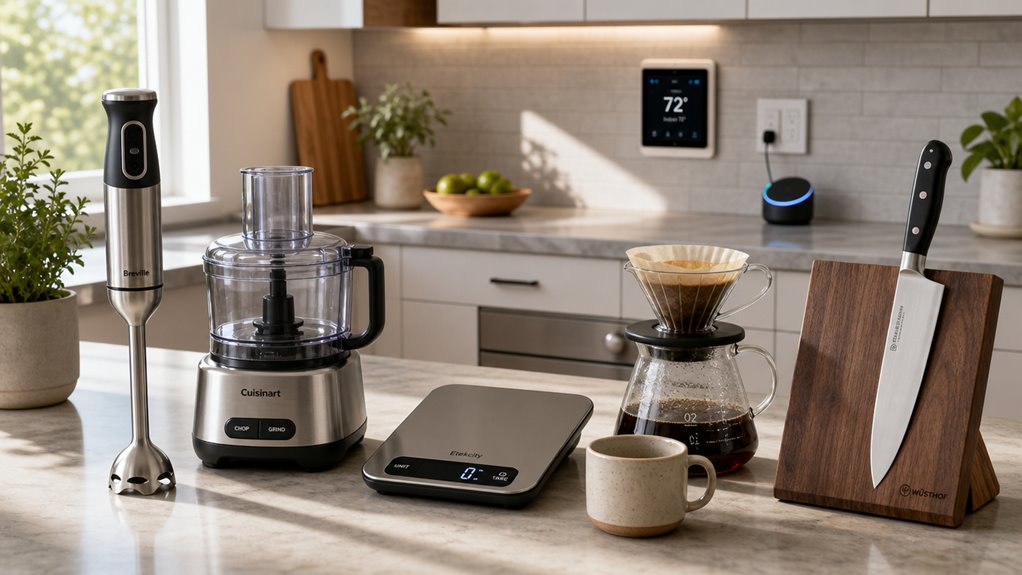
At 6–12 months, you add tools only after your actual cooking patterns show up, not before you “might need it” them, because those specialty gadgets usually end up unused and take up cabinet space.
If you bake a couple times a week, that stand mixer earns its spot fast by replacing lots of one-off shortcuts, but if you don’t, you’re better off waiting.
Also, this is when smart storage upgrades start paying off—like pull-out pantry drawers and roll-out spice storage—because visibility and access make the tools you already own get used more.
Specialty Tools Earned Through Use Patterns
If you cook for a baby (or you’re planning to), you don’t need to buy a whole “baby kitchen” box on day one—you need to earn the specialty tools. Use kitchen tools usage patterns to guide a piecewise kitchen setup. In 6–12 months, you’ll add:
- Kid-safe knife or crinkle cutter (supervised, not solo).
- Preloaded spoons (skip if fine-motor never starts).
- Splat mat under a high chair (optional).
Why “I Might Need It” Items Almost Always Stay Unused
Ever wonder why the “I might need it” gadgets you bought for your first apartment end up buried in a cabinet?
Loss aversion makes you buy a starter kit for imagined meals, not your real week.
Small storage and clutter mean bulky, multi-part tools stay in the back.
Plus, if it’s harder to clean or has fuzzy use-cases, you’ll skip it for sure.
When the Stand Mixer Earns Its Cabinet Space
By the time you’ve cooked the same basic week a few dozen times, you stop buying “maybe” tools and you start noticing patterns. At 6–12 months, your stand mixer earns cabinet space if you bake weekly or run meal-prep twice. It also speeds shredded meat and uniform batters. Trade-off: it’s heavy and noisy. Use appliance placement wisely. Add these:
- bread/muffin routine
- double-batch capacity
- whisk/paddle/dough hook set
What to Skip Entirely (Reddit’s Honest Verdict)
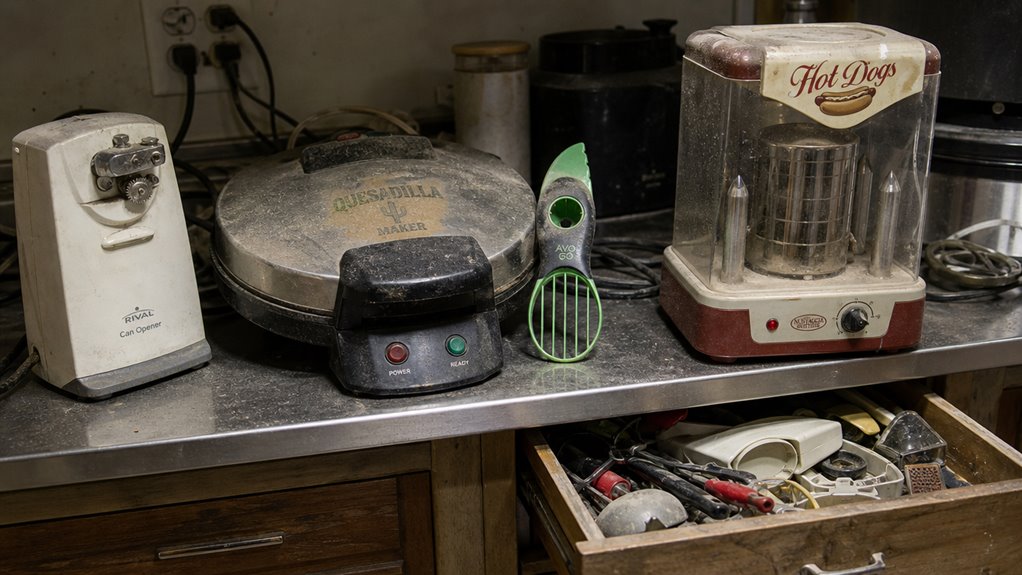
Skip the 6-knife block set, because most first-apartment cooks only use 1–3 knives regularly and the rest turns into cabinet clutter. Also skip specialty gadgets you’ll only use twice, like waffle makers, electric quesadilla/panini devices, or banana slicers—use a skillet and save the counter space. Finally, avoid “complete apartment kitchen bundles,” since Reddit’s consistent verdict is that they’re mostly low-quality extras bundled to hit a price point, not your actual cooking patterns.
The 6-Knife Block Set Trap
That “6-knife block set” you see everywhere is mostly a space-and-budget trade, not a skills upgrade. In a minimalist kitchen, block sets often hide lower knife quality behind filler blades. You usually use a chef and maybe a paring; the rest becomes paid-for clutter. Skip it and buy individually later.
- Cheaper steel dulls fast
- Overlapping knives waste money
- Big blocks hog counter space
Specialty Gadgets You’ll Use Twice
Some gadgets look fun online, but Reddit keeps circling back to the same pattern: if a tool only does one niche job, you’ll probably use it twice and then it’ll live in a cabinet like a souvenir.
For minimal kitchen setup, skip impulse buys that cause appliance clutter: quesadilla makers, egg gadgets, popcorn machines, panini presses, and avocado slicers. Use a skillet, sheet pan, and knife instead.
Why “Complete Apartment Kitchen Bundles” Fail Every First-Apartment Buyer
If you’ve been shopping “complete apartment kitchen bundles” after reading gadget lists, here’s the sober part: those sets usually fail because they overstuff your cabinets with pieces you won’t use and underdeliver on the basics you actually touch every day. Apartment bundles fail when budget cookware warps, nonstick flakes, and tools duplicate. Skip the clutter. Start with essential tools, then add later.
- Thin aluminum pots warp
- Flaky nonstick resurfaces
- Useless duplicates hog space
Frequently Asked Questions
What’s the Minimum Knife I Should Buy First, Not a Whole Set?
An 8-inch chef’s knife is the minimum first knife to buy. It handles most kitchen tasks, including chopping, slicing, and dicing.
Which Pan Replaces Nonstick, Cast Iron, and All “specialty” Pans?
A tri-ply or multi-ply stainless steel skillet replaces nonstick, cast iron, and most specialty pans for everyday cooking.
How Do I Choose a Cutting Board That Won’T Warp or Slip?
What material is best for a cutting board that won’t warp?
Thick hardwood like maple or walnut, or a dense composite such as Epicurean.
How thick should a cutting board be to avoid warping?
At least 1.5 inches thick for wood boards.
What prevents a cutting board from slipping?
Integrated non-slip rubber feet or a textured bottom surface.
Should I put my cutting board in the dishwasher?
No. Dishwasher heat causes warping and cracking.
How should I dry a wooden cutting board?
Stand it upright to allow even airflow on both sides.
How often should I oil my cutting board?
Once a month to maintain moisture balance and prevent warping.
What Utensil Tools Do I Actually Need Before Buying Anything “Extra”?
What is the minimum number of utensils needed?
Three core tools cover most cooking tasks.
Which three utensils are considered essential?
A solid spatula/turner, a slotted spatula, and tongs.
What is a wooden or silicone spoon used for?
Mixing and scraping.
When should extra gadgets be purchased?
Only after repeated cooking proves a specific need for them.
What nickname describes the core utensil set?
The utensil “Swiss Army knife.”
How Can I Budget for Later Upgrades Without Wasting Money on Gadgets?
How much should I reserve in my budget for later upgrades?
Reserve 10–15% of your total gadget budget for future replacements or upgrades.
What should I buy first?
Buy only day-1 essentials — nothing more.
How long should I wait before buying upgrades?
Wait 1–3 months after your initial purchase before adding new tools.
How do I know when an upgrade is actually necessary?
Track friction points like limited storage or slow prep time, and only buy after a repeated, confirmed need.
What spending rule helps avoid wasting money on gadgets?
Set a tight spending cap upfront and stick to it strictly.
When is it a sign I should NOT buy a new gadget?
When the need is based on “maybe I’ll use this” rather than a demonstrated, recurring problem.
Conclusion
You don’t need a $200 “complete starter bundle” on day one. Buy your core tools first, then let your cooking habits teach you what to add. Day 1 covers the basics you’ll touch every week: cut, cook, and manage food safely. After 1–3 months, you can justify the extras based on actual use, not marketing. Think of it like seasoning: start plain, then add complexity when you’re sure you’ll eat it.
