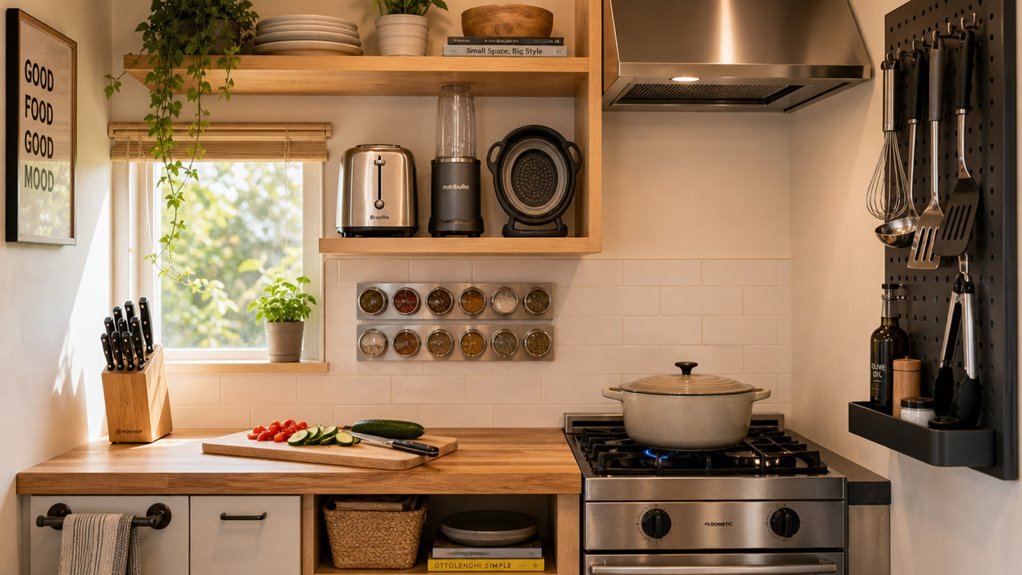

Small kitchens demand strategy, not sacrifice: the right tools protect workflow and preserve every inch of counter space.
- Counter space shrinks fast under niche gadgets that serve one purpose
- Kitchen flow breaks down when movement paths fill with clutter
- Multipurpose tools replace entire drawers of single-use equipment
A small kitchen holds roughly 12 square feet of usable prep area. That number comes from National Kitchen and Bath Association standards. Every object placed on that surface cuts movement and slows cooking.
Lodge cast iron skillets handle searing, baking, and sautéing without switching pans. A Victorinox chef’s knife replaces a paring knife, a bread knife, and a utility knife for most home cooks. OXO Good Grips measuring cups nest flat and stack without wasting shelf depth.
A garlic press occupies the same drawer space as a chef’s knife but performs one task. The chef’s knife minces garlic in under thirty seconds. Small kitchen owners benefit from applying that test to every tool they own.
Williams-Sonoma and Sur La Table both stock vertical magnetic knife strips that pull storage off counters and onto walls. Broadway Panhandler in New York City carries compact pot racks built specifically for apartments under 700 square feet. Vertical storage keeps prep surfaces clear and cleanup fast.
Interesting Fact: The average American kitchen contains over 20 single-use gadgets, yet professional chefs at restaurants like Per Se in New York City rely on fewer than 8 core tools to execute hundreds of dishes per service.
Key Points
- Small kitchens need workflow-first tools because counter “landing space” is limited, not just total square footage.
- Universal tools beat smaller-only versions since they cover more tasks per inch and reduce clutter and tool searching.
- Specialty gadgets often fail in tight spaces because they don’t replace core techniques and they block doors and cabinets.
- Layout flow matters, so choose tools that stack and store without creating storage barriers or awkward corners.
- A streamlined kit—one pan, one knife, a minimal utensil set—keeps setup fast and cleanup simple.
The Small-Kitchen Reality (Why Suburban-Kitchen Advice Fails)
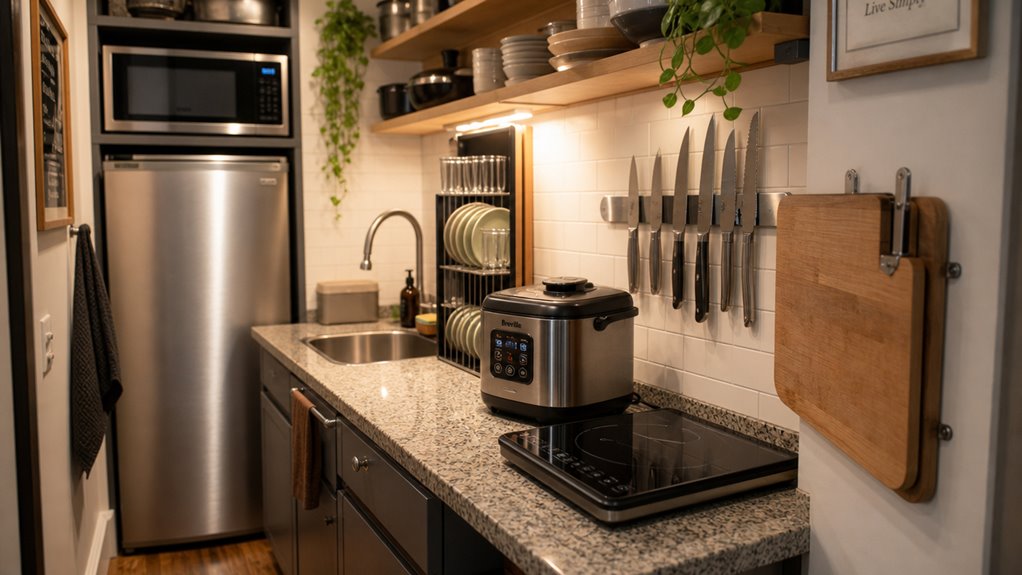
You can’t fix a small kitchen with “smaller tools” when your real constraint is about usable counter and workflow—often roughly 12 square feet of true prep space once doors, traffic, and awkward corners are accounted for. Suburban advice assumes a roomy triangle layout, deep cabinets, and dedicated pantry storage, so it keeps recommending extra gadgets that stack up and steal the exact space you’re trying to protect. The solution is to design for light and flow, because a light, connected work zone—such as a sink placed under the window—can make the busiest part of the kitchen feel far more open than generic “compact” upgrades. Window placement and layout friction can also break the flow between work zones when renovation choices introduce awkward corners or disjointed relationships between appliance and storage areas. Universal tools win because one good pan, knife, and basic utensil set can cover many tasks (with less footprint than specialty replacements), while “apartment-sized” versions still take up space and often don’t perform as fully as their full-size job descriptions promise.
The 12-Square-Foot Counter Constraint
After you subtract appliances, corners, and door swings from a 12×12 footprint, your “usable” counter quickly turns into a narrow run you can actually work on. In a small kitchen layout, counter space is your workflow asset, not storage overflow. Protect landing space so you can prep, stack, and clear without bumping aisles. Aim for 42 inches between counters so you can move comfortably while staying productive, because inefficient circulation is the real limiter in a 12×12 kitchen. In the 12×12 kitchen specifically, it helps to plan for at least 42 inches between counters so you can move comfortably while staying productive.
Why “Just Use Smaller Tools” Misses the Point
Smaller tools sound like a clean fix, but most suburban kitchen advice talks as if you still have a 36–48 inch work aisle and a full-size layout to spread things out. In your cramped space, volume matters, not just dimensions. stacking appliances Tiny, space-smart designs prioritize stacking and vertical storage to reduce wasted footprint and improve flow. Tiny appliances still block doors and cabinets. They also harm workflow: you keep walking, bending, and clearing. Instead, choose multi-function tools that consolidate setup and storage. Avoid over-reliance on wall cabinets
Why Universal Tools Beat Smaller Specialty Tools Every Time
“Just use smaller tools” sounds tidy, but in a small kitchen it usually just shrinks the problem, not the clutter. Universal tools cover more tasks per inch, so workflow efficiency rises and you stop hunting for niche gear. Even honest assessment of actual cooking patterns helps you choose what to keep, because most households cycle through a limited set of core recipes rather than rare one-off projects. efficient kitchen organization is what keeps that small workspace usable instead of constantly reverting to piles. – fewer tools, faster prep
- pan+knife+board stay in rotation
- storage geometry stays workable
- fewer swaps, less cleanup
Even a roomy skillet can’t replace a grill pan.
The 5 Tools Small Kitchens Need (And the 5 They Don’t)
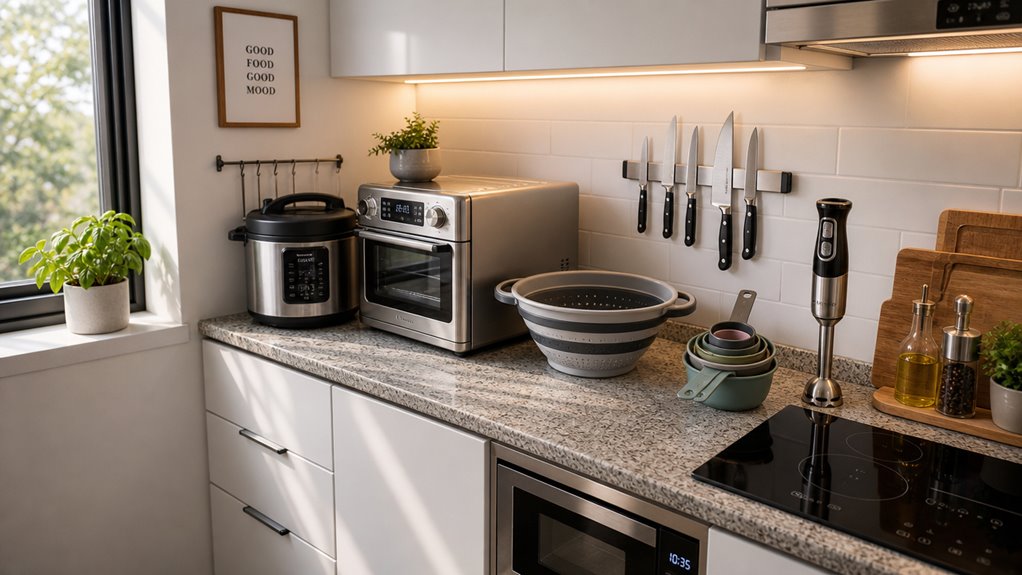
Start with a Lodge-style cast iron skillet: it gives you one pan that can sear, bake, fry, braise, do eggs, and handle cornbread in about 0.5 sq ft, and it’s an easier fit than buying a specialty pan for every mood. It also acts like a versatile cast iron skillet you can use without non-stick cookware. Cast iron is best for frying chicken or breaded pork and for certain baking tasks.
Then grab one solid universal knife (a Victorinox Fibrox-style chef knife) and let it handle most chopping and slicing without growing into a 6-knife block. With just a small set, you can reduce clutter while still keeping prep safe and accurate.
After that, you can skip specialty single-use gadgets, because they usually save you nothing on workflow and they add real counter or cabinet tax instead—like a garlic press that still won’t replace proper mincing when you need control.
Cast Iron Skillet as Universal Cookware (One Pan, 6 Use Cases)
Why does one cast iron skillet pull so much weight in a small kitchen? It’s cast iron, so it holds heat for real searing, browning, and stable stovetop-to-oven baking, then shallow-fries and crisp-ups cutlets without extra pans. You get multifunctional cookware with small kitchen efficiency. It’s especially good at even heat distribution because its thick, heavy construction reduces hot spots and heats slowly and evenly across the surface, helping you get consistent cooking results throughout. It’s especially good at searing with cast iron because its flat surface and strong heat conduction create full contact for even browning and char. – Sear and Maillard crust – Bake in the oven – Crisp and shallow-fry – Press and smash Limitation: it’s heavy.
Chef Knife as Universal Cutting Tool
Most small-kitchen “knife collections” fail the same test: they take up drawer or counter space for jobs your everyday chef’s knife already covers. Use one slim, full-tang blade for dicing, mincing, slicing, trimming, scoring, and quick transfers. Chef’s knife offers the kind of versatility that covers a wide range of everyday tasks without adding extra tools. Multi-tasking beats clutter. For a compact setup, focus on versatile pieces that reduce countertop clutter.
| Tool type | Small-kitchen fit |
|---|---|
| Chef’s knife | Yes |
| Specialty knives | Usually no |
| Bench scraper | Optional |
| Extra gadget | Skip |
Why Specialty Single-Use Tools Are Worse in Small Kitchens, Not Better
Specialty single-use tools sound efficient, but in a small kitchen they usually create a new problem: you gain one task and lose storage, counter space, and workflow calm. Those single-use gadgets breed small kitchen clutter, sit unused, and then feel annoying to wash. Stick with multi-use tools instead.
They often have more parts to clean, which is especially frustrating when counter and storage space is already tight. Those single-use gadgets breed small kitchen clutter, sit unused, and then feel annoying to wash. Stick with multi-use tools instead.
- More parts to clean
- More “someday” storage
- More cluttered drawers
- Rare use, ongoing cost
In fact, the environmental cost tends to track how often you use a gadget—daily-use tools amortize their footprint, while rare-use gadgets just keep adding planetary and financial overhead.
Storage Strategy That Multiplies Small-Kitchen Space
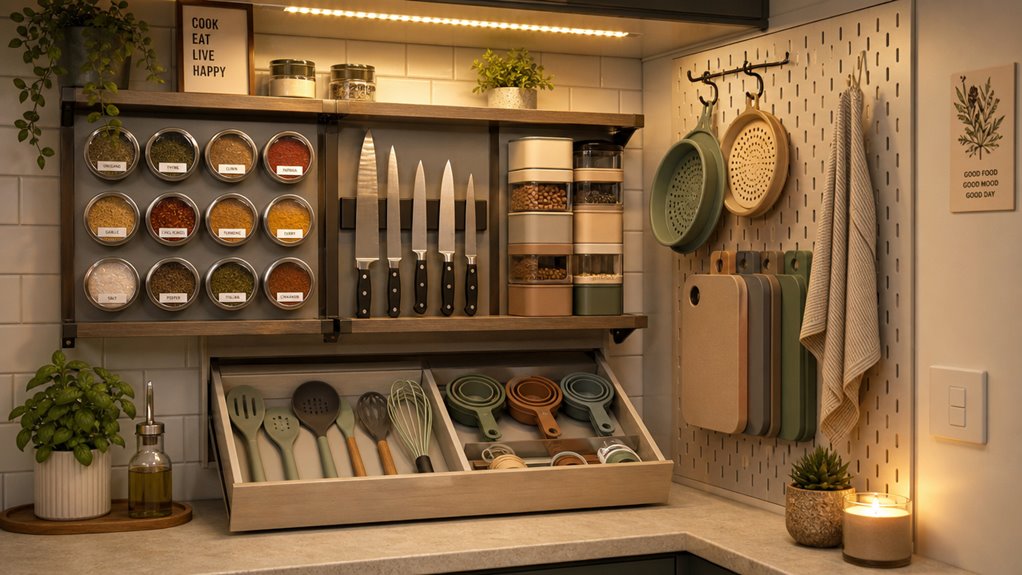
You’ll get the biggest storage win by using vertical wall space: rails, shallow shelves, and hooks turn “empty” areas into places for jars, spices, pans, and the tools you reach for daily. You can also keep daily items most-accessible by placing them at eye level and reserving higher shelves for less-frequent extras ( vertical organization ). Purge often so you’re not trying to store duplicates or rarely used items, which is what truly makes vertical space feel bigger.
Next, treat under-sink storage like the 70% empty zone it is, using simple bins and drawer organizers so you stop storing everything in one wet, slippery pile.
And if you want changes that actually stick, adhesive mounts usually outlast drilled cabinet modifications because you can reposition them later without new holes, just keep in mind they won’t hold as well on textured or greasy surfaces.
Vertical Wall Storage (The Single Biggest Gain)
Vertical wall storage is usually the single biggest gain in a small kitchen, because floor space stays locked in by appliances, walkways, and base cabinets. You’ll free counters using vertical storage and wall-mounted systems, plus open shelves near prep. Keep some wall sections open so it doesn’t feel cluttered. When you plan around vertical work zones, wall storage becomes more useful and keeps your kitchen feeling visually open.
- Pegboard zones for utensils
- Magnetic knife rails
- Floating spice shelves
- Door racks for bottles
Under-Sink Storage (The 70% Empty Zone)
That “open space” under your sink isn’t free storage so much as it’s awkward dead volume: plumbing lines, a garbage disposal, and sink bowls block the back, so you end up stacking stuff at the front until it’s hard to reach or even clean.
Start undersink organization with decluttered zones.
Add waterproof liners.
Install modular pull-out storage to wrap around pipes and keep wet items contained.
Why Adhesive Mounts Outlast Drilled Cabinet Modifications
Skip the cabinet drill bit and lean into adhesive mounts instead. You keep factory load paths intact, so drilled cabinet modifications don’t chip laminate or weaken particleboard. Adhesive mounts spread load over the bonded area, cutting screw pull-out and helping cabinet durability last 5–10 years indoors with proper prep.
- Cleaner surfaces, stronger cure
- Vertical side storage without holes
- Fewer re-mount failures
- Easy reconfiguration later
Why Apartment-Sized Versions of Suburban Tools Don’t Work
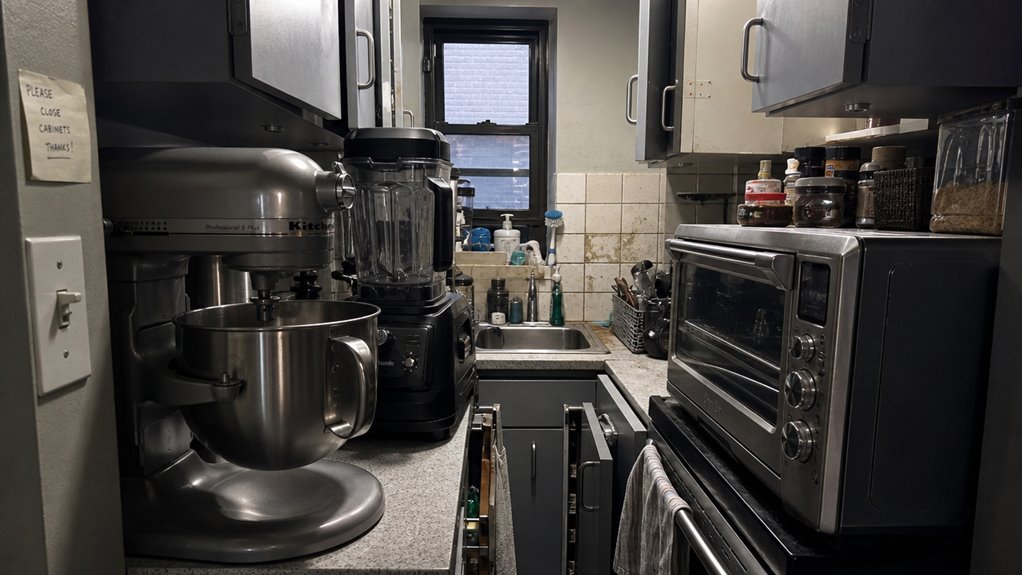
When you buy an “apartment-sized” stand mixer, you still pay in counter space, and you lose some mix performance for the same kinds of dough you’d make with a full model.
Compact food processors sound like a shortcut, but smaller capacity and weaker processing often mean longer runs and more pulsing, which you feel right away during chopping and slicing.
And that marketing trick keeps repeating the same suburban assumptions—shrinking each tool instead of cutting single-use redundancy—so you end up with counter “dead space” plus extra cleanup overhead.
Mini Stand Mixers That Still Consume Counter Space
Mini stand mixers look like the “small version” of a suburban baking appliance, but they still take up meaningful counter space—so you end up paying for the inconvenience without the payoff. You’re juggling height, depth, dead zones, and cords, which clashes with compact kitchen tools and small kitchen organization tools.
- 12–13″ width/depth sits out
- ~12–13″ tilt-head blocks clearance
- 10–16 lb discourages cabinet storage
- 3–3.5 qt pushes batches
Use small kitchen essentials, not counter tax.
Compact Food Processors That Underperform Larger Models
You don’t save much real work with a compact food processor, because the downsized bowl and weaker motor change how it handles food. Compact food processors hit performance limitations fast: less real capacity, more overflow risk, more pulsing, uneven chops, and short duty cycles. That means extra batches and cleanup, not fewer small kitchen tools.
| Problem | Why it happens | Result |
|---|---|---|
| 50–60% usable volume | overflow control | more batches |
| 100–350W motor | lower torque | stalls/overheats |
| shallow bowl | food rides walls | uneven texture |
| short duty cycle | 1 min on/off | stops mid-job |
When the “Apartment Size” Marketing Mislead Buyers
“Apartment size” labeling usually just shrinks the outer dimensions, not the workflow problems. You end up with the same suburban architecture, but tighter landing space, awkward lid clearances, and more refills that hurt workflow efficiency.
That’s not a win; it’s missing product redesign. Look for tools that solve access, cleanup, and storage:
- stackable parts
- easy-wipe surfaces
- stable bases
- one-handed or top access
The Universal-Tool Approach (What Reddit Recommends Instead)
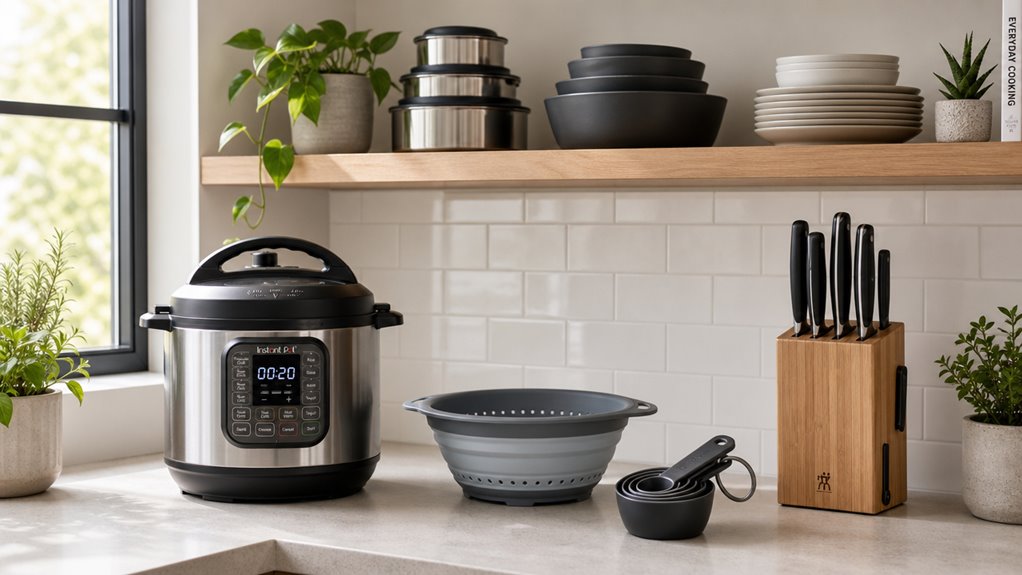
If you follow Reddit’s universal-tool logic, you build around one cast-iron pan, one chef’s knife, and a simple 3-tool utensil set instead of collecting mini specialty gear. That under-$70 core covers most daily prep and cooking while keeping your counter and drawers usable, which is the whole game in a small kitchen.
You’re still choosing quality, but you’re choosing it to replace multiple narrow tools, not to squeeze the same idea into a smaller footprint.
One Cast Iron + One Chef Knife + 3-Tool Utensil Set
Honestly, the universal-tool version of a small-kitchen setup boils down to three pieces: one cast iron skillet, one good chef’s knife, and a 3-tool utensil set, not a drawer full of “specialty” extras. You rely on minimalist utensils, not gadgets.
- Cast iron: sear, sauté, bake, broil in one pan
- Chef’s knife: handles 90% of prep; requires sharpening
- Spatula/turner, spoon, tongs: cover flipping, stirring, serving
- Wipe-oil-care: small upkeep, no special cleaners
Why Under-$70 Tool Set Beats $200 “Small Kitchen Set” Every Time
| Buy | Why |
|---|---|
| $70 kit | covers 95% tasks |
| $200 set | repeats specialty overlap |
| Replace anytime | one item at a time |
| Store less | fewer duplicates |
How Universal-Tool Logic Outperforms Specialty Tools at Smaller Scale
Smaller kitchens don’t just shrink your counter space—they multiply tool overlap, so specialty gadgets start feeling like clutter instead of upgrades. With universal-tool logic, you buy multiuse utensils that cover frequent motions, not one niche job. That’s small kitchen efficiency: less drawer crowding, faster setup, easier cleanup.
- tongs for flipping/serving
- silicone spatula for stirring
- wooden spoon for hot mixing
- whisk for sauces
Frequently Asked Questions
Which Single Cast-Iron Pan Replaces the Most Small-Kitchen Specialty Pans?
A 10–12 inch cast-iron skillet replaces a grill pan, griddle, sauté pan, fry pan, and most roasting or baking dishes.
What Knife Length and Type Covers 90% of Prep Tasks in Tiny Kitchens?
What knife length covers 90% of prep tasks in tiny kitchens?
An 8-inch chef’s knife handles approximately 90% of prep tasks in small kitchens.
Is there a shorter option for cramped spaces?
A 6-inch chef’s knife offers better control in tighter workspaces.
Which knife type works best for mixed meals?
A standard chef’s knife is the top choice for mixed meal preparation.
What knife suits veggie-heavy cooking?
A 7-inch Santoku knife is best suited for vegetable-focused cooking.
How Much Counter Space Should a “Universal” Tool Realistically Take?
A “universal” tool should take up 0.15–0.2 ft² of counter space, or roughly 4–6 inches in one dimension. A standard 6-inch utensil crock covers approximately 28–30 in².
Do Compact Gadgets Beat Real Tools When You Include Storage and Cleanup?
Compact gadgets rarely beat real tools when storage and cleanup are factored in. Extra parts require dedicated space. Crevices trap food and demand detailed scrubbing. A single quality knife and a reliable pan outperform most specialty gadgets in speed and range of tasks.
What’s the Under-$70 Universal Kit, and What Should You Skip Entirely?
What is the Under-$70 Universal Kit?
A budget kitchen starter set including a Victorinox chef’s knife, Lodge L8SK3 cast iron skillet, OXO 3-piece silicone utensil set, a small cutting board, and nesting storage containers.
What should you skip entirely?
Single-use gadgets, bulky stand mixers, food processors, and “complete” cookware sets bundled with unnecessary extra pans.
Conclusion
You don’t need “smaller” tools so much as the right “coverage.” Suburban advice gets you gadgets that look tidy, then feel cramped because each one does less than it claims. Instead, pick universal basics you’ll actually use: one cast-iron pan, one solid chef’s knife, and a few matching utensils. Then store by function, not by category. That’s the trade: fewer items, fewer compromises, more workable counter space.
