Cost-per-use math refers to the total purchase price of a tool divided by the number of times it gets used before replacement. This calculation often reveals that budget options deliver lower per-use expenses than premium alternatives, particularly when a component like a non-stick coating drives the replacement cycle rather than the overall build quality.
- PTFE coating degrades through normal cooking use, typically wearing out within two to three years regardless of the pan’s price tier.
- Budget non-stick pans deliver a lower cost-per-use figure because a modest upfront price divided across hundreds of meals produces a smaller per-meal expense.
- Coating lifespan determines when a non-stick pan requires replacement, making it the dominant variable in any cost-per-use calculation.
A budget non-stick pan priced in the under-thirty-dollar range can serve roughly 700 meals before the PTFE coating fails. Dividing that price across those meals produces a per-use cost of around three cents. A premium pan in a higher price tier may survive closer to 1,800 meals, yet its steeper upfront price pushes the per-use cost to roughly six or seven cents.
The pan’s base construction, including its thickness, heat distribution, and handle attachment, does not extend PTFE coating life in a proportional way. Coating wear responds to cooking frequency, utensil type, and cleaning habits more than to pan price. This means the replacement timeline stays similar across price tiers, and the math consistently favors the lower starting cost.
Applying the same cost-per-use formula works across many tool categories where a consumable component, not the core structure, dictates how long the product remains functional.
What wears a PTFE surface out is cumulative heat cycling plus abrasion, not calendar age. Anyone quoting you a precise number of cooking hours is guessing, because the figure depends on how hot you cook, what utensils you use and how you clean the pan. Judge yours by how it behaves: when food starts gripping where it used to release, the coating is going.
Cheap or expensive is the wrong question. Cost per use is the honest one. Check out our new Calculator.
Cost-Per-Use Calculator →Key Points
- Budget items have lower upfront cost, so even with similar lifespans, their cost‑per‑use is lower than premium equivalents.
- Nonstick coatings wear out after 2–3 years regardless of price, making premium pans a consumable rather than a lasting investment.
- Cost‑per‑use calculations based on realistic lifespan (not manufacturer claims) reveal diminishing returns past $50–$60 for nonstick cookware.
- Durable alternatives (cast iron, high‑carbon steel) amortize cost over decades, delivering far lower per‑use expense than any coated pan.
- Treat consumables as replaceable tools; allocate budget to them and invest in long‑lasting items where construction outlasts multiple cheap replacements.
| Lodge 6.5″ Cast Iron Skillet – PFAS‑Free Non‑Toxic |  | Professional Grade | Material: Cast iron | Pre‑Seasoned Surface: Pre‑seasoned with natural vegetable oil | Oven‑Safe: Oven‑safe | VIEW LATEST PRICE | Read Our Analysis |
| Utopia Kitchen Pre-Seasoned Cast Iron Skillet with Lid (10″) |  | Most Versatile | Material: Cast iron | Pre‑Seasoned Surface: Pre‑seasoned (additional seasoning recommended) | Oven‑Safe: Oven‑safe | VIEW LATEST PRICE | Read Our Analysis |
| 8 Inch Round Medium Pre-Seasoned Cast Iron Skillet |  | Best Durability | Material: Cast iron | Pre‑Seasoned Surface: Pre‑seasoned (proprietary oil blend) | Oven‑Safe: Oven‑safe | VIEW LATEST PRICE | Read Our Analysis |
Links to Amazon are affiliate links. Buying through one costs you nothing extra and helps fund the research.
Why a Budget Non Stick Pan Can Beat a Premium One on Cost Per Use
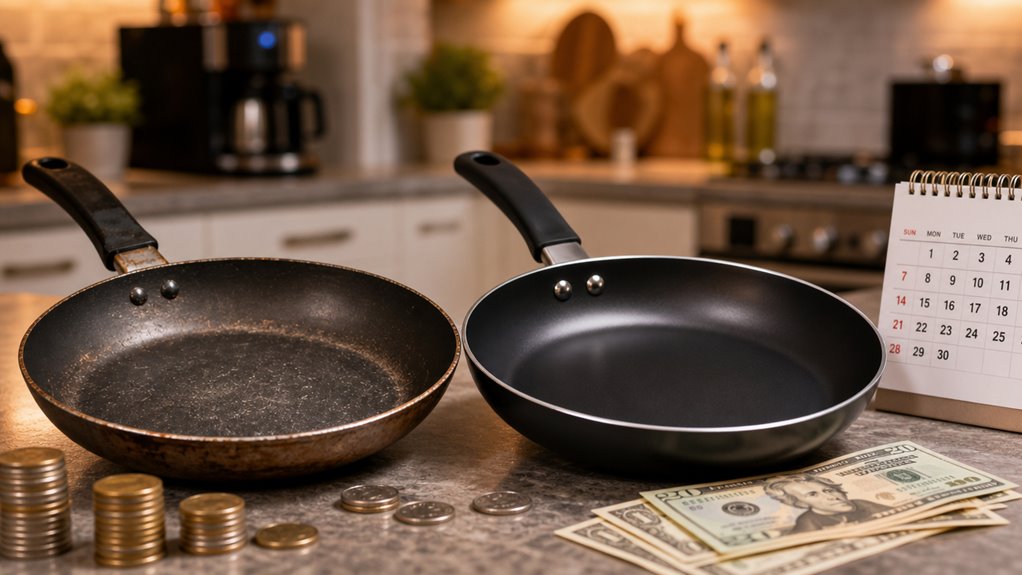
Budget non-stick pans often deliver a lower cost per use than premium models because non-stick coating lifespan tends to be similar across price tiers, meaning the higher upfront cost of a premium pan doesn’t typically translate into proportionally longer service life.
The coating itself, not the underlying metal, determines when a pan needs replacing, so a budget pan priced under $30 and a premium pan priced several times higher often reach the end of their useful life within a similar timeframe.
On a per-use basis, that gap in purchase price makes the budget option noticeably more economical over the life of the pan.
Cooking performance during that lifespan is also comparable, since food release depends on the condition of the non-stick surface rather than on what was paid for the pan.
The factors shaping this cost calculation are worth examining in detail. Typical lifespan for a non‑stick coating is roughly 2–3 years regardless of price.
The Coating That Wears Out Regardless of Price
Because the PTFE coating chemistry is the same in cheap and premium pans, the wear mechanisms don’t care how much you paid. You’ll find that a non stick pan loses its release properties after a few hundred heat cycles, whether it cost $30 or $150. Thermal degradation, metal spatulas, and abrasive scrubbers all erode the thin multi‑layer film at the same rate.
In practice, a $30 pan lasting two years and a $130 pan lasting three years work out at roughly $1.25 and $3.60 a month respectively, which is a wide gap in the cheaper pan’s favour and a good illustration of why the coating, not the price, sets the terms. The coating’s life ends when the top layer scratches through. That is why you should treat any PTFE pan as a consumable and budget accordingly.
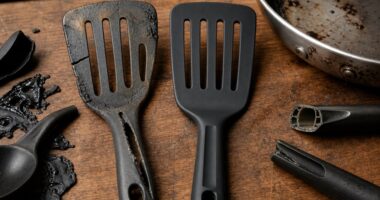
Consumable means retire it on schedule, not cook it to destruction. Flaking is the end of the pan’s life, not a stage of it. Once you can see the coating lifting, blistering or flaking anywhere on the cooking surface, stop using it: flakes come off into food, and a broken-down coating stops behaving predictably at heat. PTFE is stable through ordinary cooking, but it begins to decompose above roughly 260 °C, about 500 °F, and the fumes from a badly overheated pan are the recognised hazard with this material. Those fumes are dangerous to pet birds at concentrations a person would barely notice. So: never heat a coated pan empty, never put one under a broiler or leave one on a burner at maximum with nothing in it, keep the kitchen ventilated, keep birds out of the kitchen, and use silicone or wooden utensils rather than metal ones, which is the single cheapest way to make the coating last its full term.
Durable primer layers can extend the functional life of a nonstick pan by helping the top coating stay attached longer.
Why Paying More Rarely Buys Proportionally Longer Life Here
When you trade a budget pan for a premium one, you’re not buying a lifetime guarantee; you’re buying a slightly thicker base and a fancier handle that may last a year or two longer, but the coating still wears out after a few hundred heat cycles. The extra dollars don’t translate into a proportional drop in cost per use because wear mechanisms like thermal cycling, abrasion, and handle loosening hit both tiers. A $25 nonstick pan used daily yields about 700 uses in two years, roughly 3‑4 cents per use. A $120 premium pan gives 1,800 uses over five years, about 6‑7 cents per use. The math shows diminishing returns past $50‑$60. The heat distribution of budget pans, as shown in pancake tests, is often comparable enough for everyday cooking.
| Measure | Typical budget nonstick pan | Typical premium nonstick pan |
|---|---|---|
| Price | $20 to $30 | $80 to $120 |
| Lifespan | 2-3 years | 2-5 years |
| Uses per year | ~350 | ~350 |
| Cost per use | Around three cents | Around six to seven cents |
| Main wear | Coating, base warping | Coating, same as budget |
Paying more rarely buys proportionally longer life here; you’re better off spending those extra dollars on a durable cast‑iron skillet or a quality knife that truly amortizes over decades.
| 10‑Inch Cast Iron Skillet with Pour Spouts Natural Nonstick | 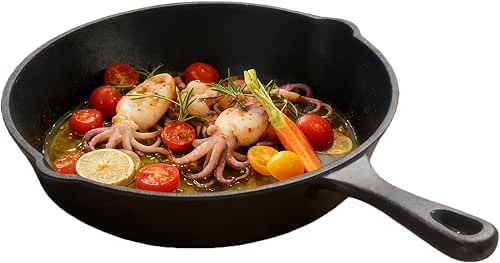 | Best For Beginners | Material: Cast iron | Pre‑Seasoned Surface: Unseasoned (requires initial seasoning) | Oven‑Safe: Oven‑safe (any temperature) | VIEW LATEST PRICE | Read Our Analysis |
| Pre-Seasoned Cast Iron Skillet 5 Inch Mini Deep Pan with Handle Black |  | Compact Choice | Material: Cast iron | Pre‑Seasoned Surface: Pre‑seasoned natural non‑stick | Oven‑Safe: Oven‑safe | VIEW LATEST PRICE | Read Our Analysis |
| Lodge Seasoned Cast Iron Griddle 10.5″ Round | 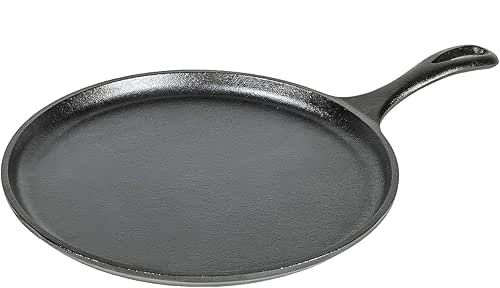 | Heavy-Duty Performer | Material: Cast iron | Pre‑Seasoned Surface: Pre‑seasoned (iron and oil only) | Oven‑Safe: Oven‑safe | VIEW LATEST PRICE | Read Our Analysis |
Links to Amazon are affiliate links. Buying through one costs you nothing extra and helps fund the research.
The Cost-Per-Use Math Most Buyers Miss
Cost-per-use divides a tool’s upfront price by the number of times it gets used over its lifespan, giving a truer picture of value than the sticker price alone.
A cast-iron skillet in the mid-range tier can stretch across a decade of daily cooking, which often brings the per-meal cost down to a few cents. A nonstick pan at a premium price point that degrades within a year carries a far higher cost-per-use than its initial tag suggests, and a budget version that fails just as quickly offers no meaningful advantage.
Durability is what determines whether a higher upfront cost actually pays off, because a longer usable lifespan is the only variable that lowers the per-use figure in a meaningful way. The factors that drive real-world lifespan, including material construction, coating integrity, and how a pan handles heat, are worth examining closely. Manual entry can add significant hidden costs, making the true cost-per-use of free budgeting tools higher than they appear.
Upfront Price Divided by a Tool’s Real Lifespan
If you take a tool’s sticker price and split it across every real use you actually get out of it, the cost‑per‑use number drops dramatically, especially for items that last years.
The math is simple: upfront price divided by the tool’s real lifespan gives you a per‑use figure that tells you if you’re overpaying.
A cast‑iron skillet bought for $80 and used daily for ten years ends up costing about $0.02 per use, while a cheap nonstick pan at $20 used once a week for two years costs roughly $0.14 per use.
The key is to estimate the actual lifespan, not the manufacturer’s claim, and factor in maintenance that can extend it.
When the lifespan is long, even a higher price can translate into pennies per use, making the purchase sensible.
Conversely, a premium nonstick that wears out after a few months offers a high cost per use, showing that cheap replacements are smarter for consumables.
Cost‑Per‑Use helps you prioritize purchases that deliver value over time.
Why Premium Pays Off in Cast Iron but Wastes Money in Nonstick
A cast‑iron skillet’s price spreads over decades, so its cost per use drops to a few pennies, while a premium nonstick pan, no matter how pricey, wears out in a couple of years and ends up costing a few dimes each time you cook.
You’ll season a cast iron skillet, scrub it, and it’ll keep heating evenly for generations; each reheating cycle only adds a cent to the total.
A nonstick coating, even from a top brand, peels after three years of metal spatulas and high‑heat sears, forcing you to replace it and lose the upfront dollars.
Because you can’t repair a nonstick surface, you pay for the same performance over and over, while a cast iron skillet amortizes its cost into pennies per use.
Type in what a kitchen tool cost you, how often you use it, and how long you expect it to last. The math answers whether the price was worth it.
The tool you are weighing
Enter a price to run the numbers.
Lifespans above 50 years are capped at 50 for this calculation.
The cheaper version
Enter a price to run the numbers.
Lifespans above 50 years are capped at 50 for this calculation.
Your result appears here after you press Calculate.
When a Non Stick Pan Is the Smart Budget Buy
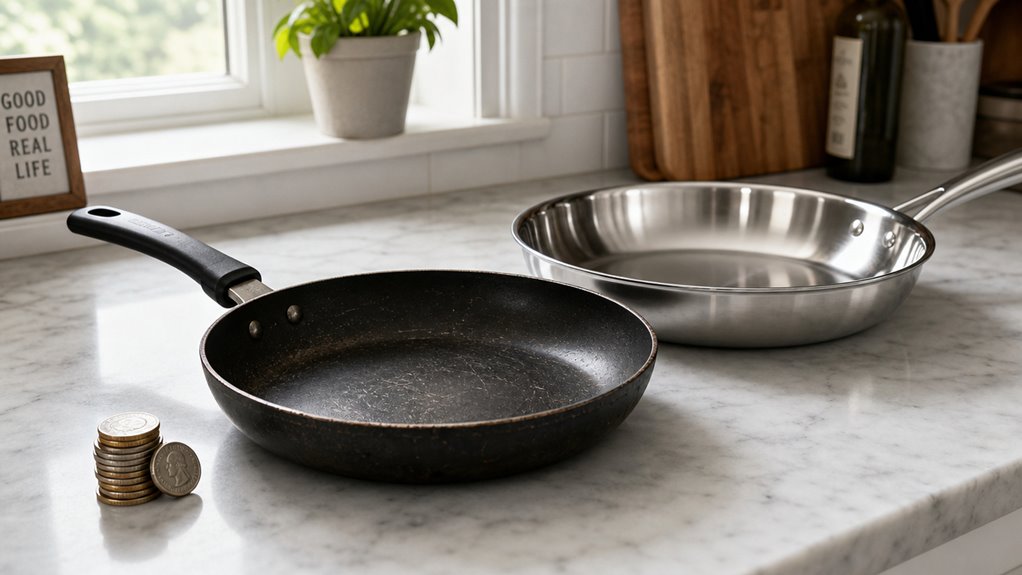
A nonstick pan is a consumable kitchen tool rather than a lasting investment, because the coating degrades over time regardless of price point, and recognizing that changes how to evaluate cost.
Hard-anodized construction adds durability to the pan body itself, but no coating material is permanent, and everyday use will eventually compromise the nonstick surface.
A budget-priced pan with a reasonable warranty can deliver a lower cost-per-use than a premium option whose higher price is spread across the same limited coating lifespan.
For low-heat cooking tasks, where nonstick performance matters most and coating wear accelerates least, the math typically favors the less expensive choice.
The factors shaping that decision go deeper than sticker price alone.
Treating a Coated Pan as a Consumable, Not an Heirloom
Treating a coated pan as a consumable means accepting that its nonstick surface will wear out, no matter how pricey the brand. You’ll get the same convenience of easy release and quick cleanup, but you must budget for replacement every few years. That’s why you treat it as consumable cookware rather than an heirloom. Premium pricing doesn’t make the coating immune to wear, so the cost‑per‑use math stays the same.
| Feature | Budget Pan | Premium Pan |
|---|---|---|
| Up‑front cost | $20‑$30 | $80‑$120 |
| Expected lifespan (average use) | 2-3 years | 2-5 years, but set by the coating either way |
| Replacement frequency | Every 2-3 years | Every 2-5 years |
| Cost per use (estimate) | Around $0.03 per meal | Around $0.06 to $0.07 per meal |
You’ll find that “do expensive nonstick pans last longer?” is a false promise; they still need the same medium‑heat, silicone‑tool care. Accepting the pan as a consumable lets you spend less now and keep money for truly durable tools like cast‑iron or a good knife.
Why a Budget Nonstick Pan Wins When Every Coating Eventually Wears Out
When the nonstick coating starts to peel after a few years, the price you paid upfront matters less than how many meals you actually got out of it. You’ll find that a cheap nonstick pan can be the smarter choice because the coating wears out whether you spend $30 or $150. The cost per use math shows a $30 pan delivering the same number of non‑sticking meals as a premium one, but at a fraction of the expense. Plus, the lower upfront cost lets you replace it without regret when performance drops.
- Aluminum base heats fast, meeting everyday cooking needs.
- Coating lifespan is 2‑3 years for both cheap and premium, equalizing real‑world durability.
- Replacement cost stays low, keeping the per‑meal expense minimal.
- Money saved can fund durable tools like cast‑iron or quality knives.
Where Premium Genuinely Earns Its Price
Premium pricing earns its place when a tool’s construction lets it outlast several cheaper replacements. A cast-iron skillet and a high-carbon chef’s knife are the clearest examples, because the upfront cost spreads across decades of regular use rather than seasons.
Materials like cast iron and high-carbon steel can be maintained through simple, low-cost practices such as seasoning and sharpening, which extend functional life without significant ongoing expense. A non-stick pan, by contrast, degrades through ordinary use regardless of price tier, so a higher purchase price rarely produces a lower cost per use over time.
The distinction worth drawing is between durable tools that reward investment and consumable items where budget options close the gap. The sections that follow examine where that line falls and why it shifts depending on how a tool is made and used.
Durable Categories Where Cost Spreads Over Decades
Because a cast-iron skillet’s price spreads over decades rather than seasons, its cost-per-use falls to a level no coated pan can reach, however cheap the coated pan was. The kitchen categories that behave this way share one trait: the working surface is maintainable, so nothing is quietly counting down to the end of the item’s life.
The math is simple. A longer lifespan means fewer replacement cycles, and each cycle you skip is the whole purchase price avoided rather than a fraction of it. That is why paying more once, in the right category, beats paying less repeatedly.
- Cast iron and carbon steel – the seasoning is a renewable surface, so the pan outlives its owner if it is kept dry.
- Fully clad stainless – no coating to fail; the failure modes are dents and loose rivets, not surface breakdown.
- A good chef’s knife – sharpening restores the working edge indefinitely, so the blade is consumable only in the very long run.
- Solid wood boards and stainless bowls – both can be resurfaced or simply scrubbed; neither has a layer that wears through.
The Kitchen Tools Worth Spending On and the Ones to Buy Cheap
If you use something almost daily and it can be maintained, it is worth paying once for the version that holds up. A chef’s knife, a cast-iron or carbon-steel pan, a heavy-gauge sheet pan and a dense end-grain board all reward the extra spend, because each one has decades of service in it and a repair path when something goes wrong. A knife can be sharpened, a pan can be re-seasoned, a board can be sanded and re-oiled.
Coated nonstick pans, silicone spatulas, plastic storage and single-task gadgets belong in the budget lane, because nothing about paying more extends their life in proportion. Replace them when they wear out and the per-use cost stays low. Choose durability where it actually amortises, and stay cheap where the replacement cycle is short no matter what you spend.
How to Apply Cost-Per-Use Before You Buy
Cost-per-use is a calculation that divides a tool’s upfront price by its expected number of uses, giving you a concrete way to judge whether a budget or premium option delivers more value before you spend anything.
Applying it starts with sorting each item into a consumable category or a lasting one, because a coating that degrades quickly changes the math entirely compared with a durable material built for long-term use.
For lower-priced items, the formula is especially useful, since a nonstick pan under a budget ceiling may appear economical until its coating wears out after relatively few uses.
Understanding how lifespan, use frequency, and price tier interact determines whether a cheap option genuinely costs less over time or simply costs less upfront.
The sections below work through each factor in depth.
Sorting Tools Into Consumable and Lasting
When you start sorting tools into consumable and lasting categories, the first step is to look at how often the item needs replacement and how its performance changes over time.
You’ll see that budget vs premium kitchen tools often fall into the consumable side, while an heirloom tool belongs in the lasting group.
Use cost‑per‑use math to decide: cheap non‑stick pans get replaced every few years, but a cast‑iron skillet or a high‑grade chef’s knife amortizes its price over decades.
- Frequency – anything you expect to replace on a schedule is a consumable.
- Performance drop – a coating that stops releasing food has reached the end of its life, not a bad patch.
- Maintenance – sharpening a knife extends life, making it lasting.
- Resale value – tools that hold value after years belong in the lasting bucket.
Matching the Smart Budget Buy to the Under-$30 Ceiling
Sorting tools into consumable and lasting buckets showed you where cheap replaceable wins and where durable investments pay off. To match a smart budget buy to the under‑$30 ceiling, start with the cost‑per‑use formula: price divided by projected uses.
Say an $18 vegetable peeler gets used 300 times over two years. That is six cents a use, which beats a $9 one you replace twice in the same period and throws in a better handle. Use-intensity is what decides it: a tool you reach for daily earns the sturdier version, because the extra cost is spread across enough uses to bring the per-use figure down.
For a job you do twice a year, the cheap version is the right answer. Its per-use cost is high, but it is spread over so few uses that the total spend stays trivial either way. Buying cheap or buying well comes down to lifespan, failure risk, and how often you will realistically reach the projected use count.
Frequently Asked Questions
How Do I Calculate Cost‑Per‑Use for a Multi‑Piece Cookware Set?
You calculate cost‑per‑use by adding purchase price, accessories, upkeep, and energy adjustments, subtracting resale value, then dividing each piece’s allocated share of that total by its projected uses over its ownership years.
Does Using a Silicone Spatula Extend a Nonstick Pan’s Lifespan?
Yes. Using a silicone spatula extends a nonstick pan’s life by reducing coating scratches, slowing wear, and keeping performance smoother for many more meals.
Can I Apply Cost‑Per‑Use to Electric Kitchen Gadgets?
Yes, you can calculate cost‑per‑use for electric gadgets by adding their amortized purchase price to the energy cost per cycle, then dividing by total expected uses to see if they’re worth the expense.
What’s the Break‑Even Point for a $30‑Priced Cast‑Iron Skillet?
You’ll break even after roughly 300‑600 uses; at 300 uses the cost per use matches a cheap nonstick, and beyond 600 uses it drops below $0.05, making the $30 skillet clearly cheaper.
How Does Frequent High‑Heat Cooking Affect Nonstick Coating Wear?
It shortens the coating’s life sharply: each high-heat blast breaks polymer chains, creates micro-cracks and accelerates flaking, so the surface blisters, discolours and loses its slickness far sooner than the same pan used at medium heat. That is an argument for not searing on nonstick at all, rather than for buying a cheaper pan to burn through. Keep coated pans for low and medium heat, use a cast-iron or stainless pan when you want a hard sear, and retire any coated pan once it starts to flake rather than cooking on it until it fails.
Conclusion
You’ll find that a cheap, replaceable non‑stick pan often costs less per meal than a high‑priced set, especially when you factor in a three‑year lifespan. A coated pan is disposable by design: cheap, replaceable, and effective enough until the surface gives out. For tools that truly last, like cast‑iron or a solid chef’s knife, the upfront price spreads over decades, making the premium choice worthwhile. Apply the cost‑per‑use formula before you buy, and you’ll keep your kitchen budget realistic without chasing hype.
| Pre-Seasoned Cast Iron Skillet Black 6 Inch Mini Frying Pan with Handle |  | Outdoor Ready | Material: Cast iron | Pre‑Seasoned Surface: Pre‑seasoned natural non‑stick | Oven‑Safe: Oven‑safe (max 250 °C) | VIEW LATEST PRICE | Read Our Analysis |
| Cast Iron 10″ Skillet with Pour Spouts and Silicone Grip |  | Premium Quality | Material: Cast iron | Pre‑Seasoned Surface: Pre‑seasoned (PFAS‑free) | Oven‑Safe: Oven‑safe | VIEW LATEST PRICE | Read Our Analysis |
| MIRRO 6in Cast Iron Preseasoned Skillet | 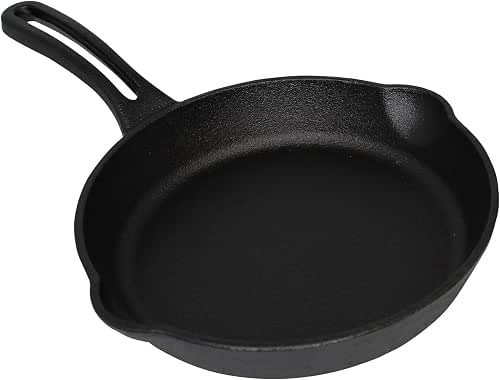 | Best Ergonomics | Material: Cast iron | Pre‑Seasoned Surface: Pre‑seasoned interior | Oven‑Safe: Oven‑safe up to 500 °F | VIEW LATEST PRICE | Read Our Analysis |
Links to Amazon are affiliate links. Buying through one costs you nothing extra and helps fund the research.

Michael Haralson worked in professional kitchens from 1979 to 1992: San Diego restaurants, six years with a catering company beside an Austrian chef, and two summers as a cook on the Finland to Sweden cruise route. He then built a fifteen-year career at Nokia. It began in product marketing and product management, where technical specifications and supplier evaluation were part of the work, and grew from a few countries to a region to global roles, then into sales and corporate strategy. That took him to Beijing for three years, where he spent many weekends in a different province trying the local food and took cooking classes. He has eaten in more than 40 countries and has been shown the kitchens of restaurants in Southern Europe. At home in Finland he cooks Cantonese, Sichuan and Mediterranean food, and still uses the cast iron skillet he bought in 1992. He is the author of Buy It Once, Book One of The Researched Kitchen, and writes here about the balance between kitchen tools that cost too much and those that fail too soon.