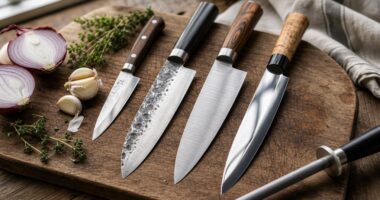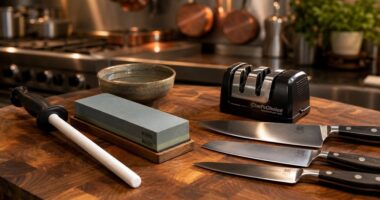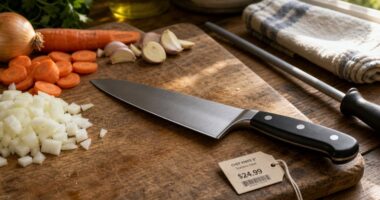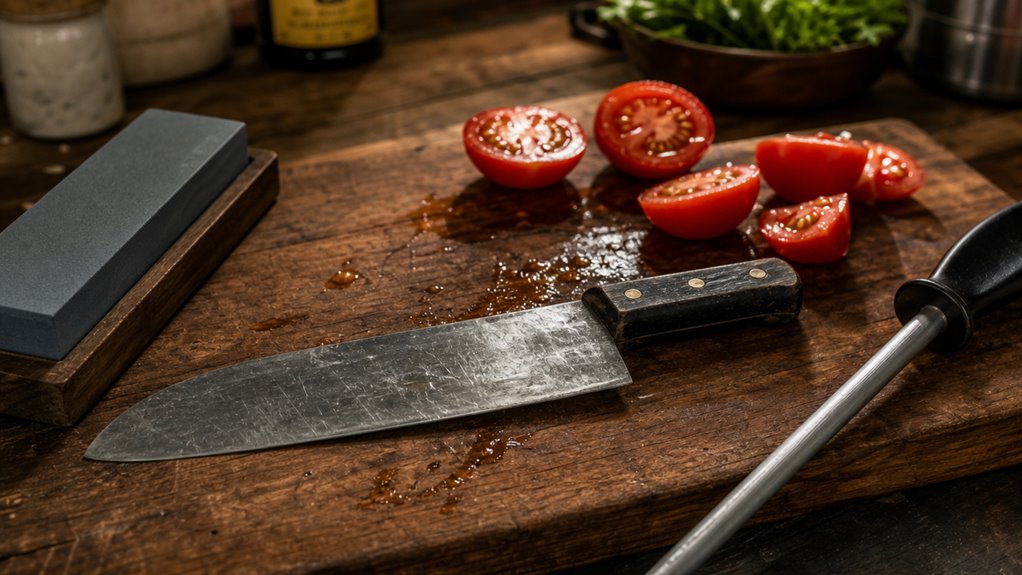
Knife maintenance depends on two distinct tools that serve different purposes: a honing rod and a sharpener. A honing rod realigns a bent microscopic apex without removing metal, while a sharpener grinds away material to rebuild a worn edge from scratch.
- Honing rod realigns a rolled or bent apex after each use, extending the life of a freshly sharpened edge without altering blade geometry.
- Knife sharpener removes metal to create a new apex, making it necessary once the edge has rounded beyond what honing can correct.
- Microscopic apex degrades with every cut, bending or chipping until the tip rounds enough that no amount of honing restores a sharp feel.
A honing rod works by nudging the apex back into alignment. Each stroke corrects minor bending without changing the blade’s underlying shape. This process has limits: once the apex rounds completely, the rod produces no noticeable improvement regardless of how many strokes are applied.
A sharpener addresses that limitation by grinding the blade to form a new apex. Removing metal resets the geometry that honing alone cannot rebuild. Budget knives, including those in the under-$30 range, typically benefit from pairing both tools to maintain consistent cutting performance.
The two tools work together rather than interchangeably. Regular honing reduces how often sharpening is needed, and timely sharpening restores what honing can no longer fix.
A knife’s edge apex is typically around 10 to 20 microns wide after sharpening, making it thin enough that ordinary cutting pressure can roll or chip the tip after relatively few uses.
Cheap or expensive is the wrong question. Cost per use is the honest one. Check out our new Calculator.
Cost-Per-Use Calculator →Key Points
- Honing rods realign a rolled edge without removing metal, while sharpeners grind away steel to recreate a fresh apex.
- A blade feels dull when its microscopic tip is bent or rolled; rods can fix this only if the apex isn’t fully worn flat.
- Repeated cutting on hard surfaces (glass, stone, dense composites) accelerates edge roll and chip formation, outpacing rod maintenance.
- Using a rod on a truly rounded or chipped edge wastes time; only abrasive sharpening can restore cutting performance.
- Regular light honing (after each use) prolongs intervals between sharpening, but heavy use on hard boards demands more frequent honing and periodic sharpening.
| KitchenIQ Edge Grip 2-Stage Knife Sharpener (Black) | 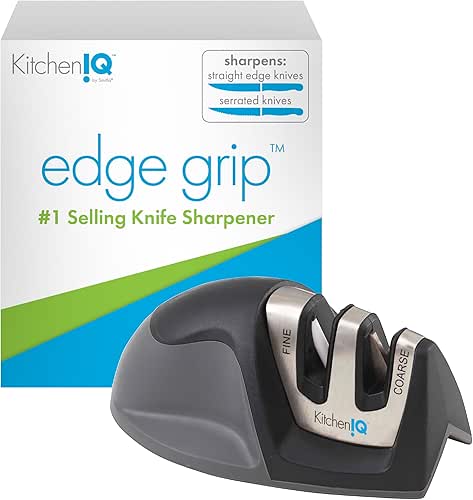 | Compact Edge | Sharpening Stages: 2-stage (carbide + ceramic) | Material of Abrasives: Carbide blade and ceramic rods | Grip/Handle Type: Soft-grip rubber handle | VIEW LATEST PRICE | Read Our Analysis |
| Smith's Pull-Thru Knife Sharpener |  | Sports Enthusiast | Sharpening Stages: 2-stage (carbide + ceramic) | Material of Abrasives: Carbide and ceramic rods | Grip/Handle Type: Soft-grip rubber handle | VIEW LATEST PRICE | Read Our Analysis |
| HENCKELS Handheld Knife Sharpener – Ergonomic Compact |  | Kitchen Pro | Sharpening Stages: 2-stage (coarse + fine ceramic) | Material of Abrasives: Ceramic grits | Grip/Handle Type: Ergonomic contoured plastic handle | VIEW LATEST PRICE | Read Our Analysis |
Links to Amazon are affiliate links. Buying through one costs you nothing extra and helps fund the research.
What a Honing Rod Actually Does to Your Knife’s Edge
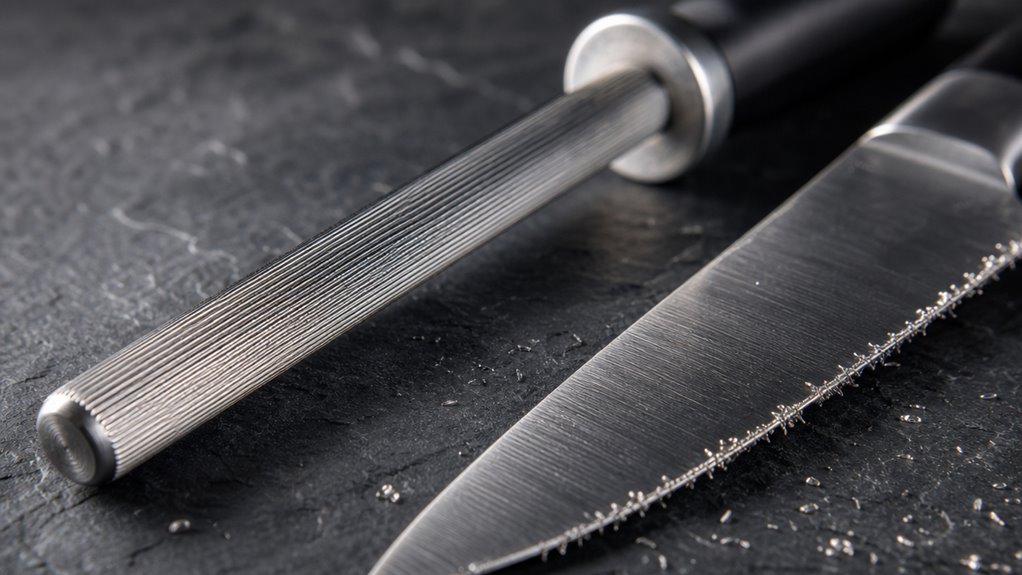
A honing rod realigns a knife’s edge rather than removing metal, making it a maintenance tool rather than a sharpening device. During regular cutting, the thin apex of a blade rolls or bends slightly out of alignment, and a honing rod corrects this by nudging that bent edge back into position. This distinction between alignment and abrasion matters because a rod can’t rebuild a blade that has gone genuinely dull — a whetstone or dedicated sharpener is required for that kind of edge restoration. The condition of the blade’s apex before honing determines how effective the rod will be, which is why routine use after light cutting sessions tends to produce more consistent results than infrequent use after heavy ones. Using a smooth honing rod realigns the edge without removing metal, preserving the blade’s original geometry.
Realigning a Rolled Edge Without Removing Metal
Often the edge you think is dull is actually a rolled apex that’s been bent sideways, not worn away. A honing rod can push that bent tip back into place without shaving off any steel. You’re not grinding; you’re realigning the microscopic teeth that folded under pressure. Light strokes at the factory bevel angle straighten the edge, restoring the cutting line instantly.
- Smooth steel rod: pushes apex upright, no metal loss.
- Ceramic rod: gentle, works on softer steels, same principle.
- Light pressure: roughly the knife’s own weight, avoids burrs.
- Correct angle (15‑20°): concentrates force on the apex, not the sides.
When the edge is completely worn a honing rod will no longer be effective, and you’ll need to sharpen the blade. Do this a few times per side after each use, and you’ll keep the blade sharp longer before you ever need a stone.
Why Honing Is Maintenance, Not Sharpening
When you pull a knife across a honing rod, you’re not carving away anything; you’re simply nudging the microscopic teeth that have bent from everyday use back into line.
A honing rod realigns a rolled edge, straightening the V‑shape without removing metal. That’s why a steel or ceramic rod feels like a quick fix, but it doesn’t rebuild a worn apex.
Honing rods do not sharpen; they maintain. They straighten burrs and coax bent micro‑teeth back into line, extending the time between true sharpening sessions.
When the edge is truly dull—rounded or chipped—only a whetstone or pull‑through sharpener can remove enough steel to create a new bevel. Use the rod frequently, then sharpen occasionally. Regular honing keeps the blade efficient and safe.
Why a Knife Goes Dull Faster Than You Expect
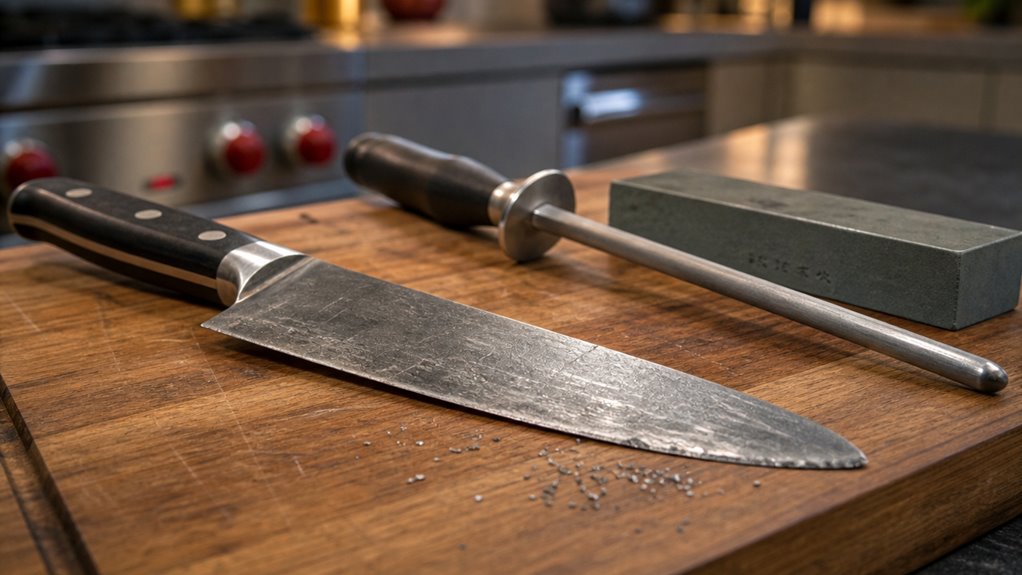
A knife goes dull faster than expected because each cutting motion bends the microscopic apex of the blade edge slightly to one side, and those small deformations accumulate quickly across even a short session of use.
Hard surfaces like stone or dense plastic cutting boards accelerate this process by forcing the thin steel apex into direct, concentrated contact with an unyielding material.
Skipping regular honing allows those minor edge rolls to set into permanent bends, which is why a blade can feel noticeably blunt after only a modest amount of cutting work.
The steel’s hardness, the cutting surface, and the frequency of maintenance all shape how fast a working edge degrades.
Using a hard‑cutting surface such as ceramic or marble can dramatically increase edge wear.
The Microscopic Edge Roll That Happens Every Cut
Because each slice pushes the knife’s apex past its elastic limit, the thin edge bends sideways and forms a microscopic “fin” of steel. That microscopic edge roll hides behind the edge bevel, so the blade still looks sharp but slices with a flattened tip. You can’t see it without a microscope, but you feel it as a duller cut after a few chops. The roll forms quickly because the pressure at the apex exceeds the steel’s yield strength, especially on thin, acute bevels.
- Lateral forces from steering cuts bend the apex.
- Hard inclusions like bone or salt spike local stress.
- Softer steel yields sooner than harder alloys.
- Repeated friction heats and fatigues the edge.
Realigning the roll with a honing rod restores the V‑shape without removing metal.
Edge losses are often caused by burrs that develop during light use, accelerating the roll formation.
Hard Boards and Skipped Honing That Speed It Up
The microscopic roll you just learned about stays hidden until the edge hits a surface that won’t give a little. Hard board materials such as glass, stone, metal, or dense composites create high friction and no give, so each chop pushes the edge into micro‑chipping and abrasion. Skipping your regular routine lets those tiny deformations pile up, and you’ll notice the blade feels dull far sooner. A 1500‑grit ceramic rod works well for daily upkeep, and how often you hone depends on what you cut on. If you cut on a glass board every night, expect to hone at least twice a week; otherwise a weekly session usually suffices.
| Board type | Hardness (relative) | Typical dulling speed |
|---|---|---|
| Wood (soft) | Low | Slow |
| Plastic (soft) | Low‑medium | Moderate |
| Composite (bamboo) | Medium | Faster |
| Glass | High | Fast |
| Stone/Metal | Very high | Very fast |
Why a Honing Rod Cannot Fix a Truly Dull Knife
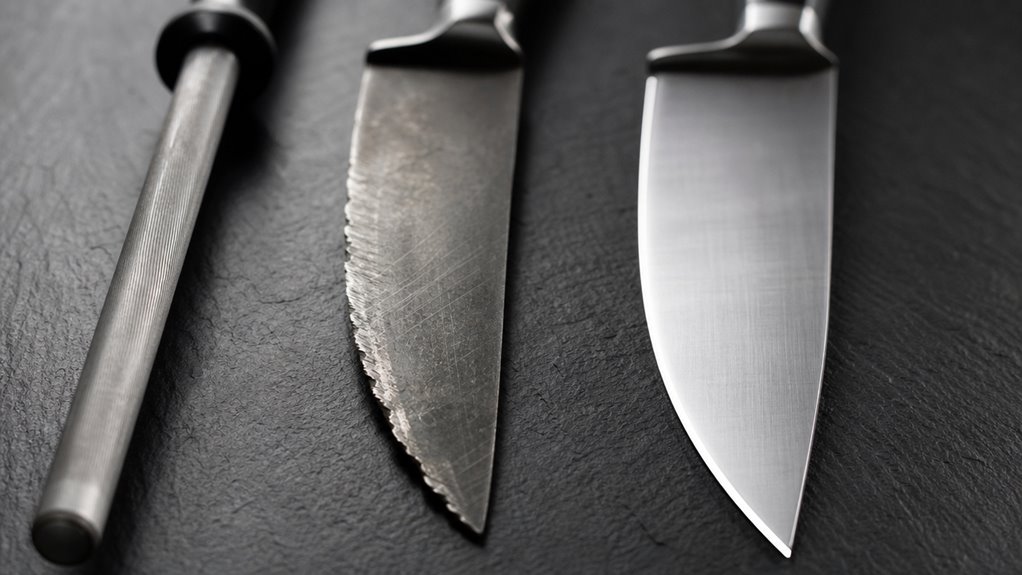
A honing rod can’t restore a truly dull knife because it realigns metal rather than removes it, and a blade that has lost its apex entirely has no fine edge left to realign.
When repeated use wears the cutting edge down to a rounded bevel, the geometry of the blade changes in a way that steel realignment alone can’t reverse. Sharpening with an abrasive surface — such as a whetstone — physically removes metal to rebuild that geometry, creating a new thin apex where the worn one existed before.
The distinction between honing and sharpening matters because using the wrong tool on a dull blade wastes time and leaves the knife no sharper than before.
When the Edge Is Rounded Past Realignment
If the knife’s apex has been worn down into a rounded profile, a honing rod won’t bring it back to life. At that point the edge is truly dull: no thin lip, just a thick, blunt shoulder.
The rod can only push metal around; it can’t carve a new point. You’ll notice the blade slides over tomato skin, skates on onion, and loses its bite despite careful honing. The only fix is to remove material and reshape the bevel with an abrasive sharpener.
- Plastic deformation only; no metal removal
- Rounded apex can’t be bent back into a fine edge
- Rod merely polishes the blunt area, hardening the dull shape
- Only stones, diamond plates, or pull‑through sharpeners can rebuild the apex
Why a Honing Rod Realigns the Edge That a Sharpener Has to Rebuild
Because a honing rod only pushes the bent edge back into shape, it can’t rebuild an edge that’s lost its thin apex.
You’ll feel the difference the moment the apex has worn flat; the rod can’t thin a thickened bevel or remove chips. It merely realigns microscopic folds, restoring the last sharpened geometry but not creating a new one.
Sharpening, on the other hand, grinds away metal, reshaping the bevel and forming a fresh apex.
When the edge is rounded or chipped, only abrasive stone work can pull material away, raise a burr, and then polish it clean.
Use the rod for daily upkeep, but schedule a sharpening session once the knife stops responding to realignment.
The Sharpening Options That Rebuild an Edge
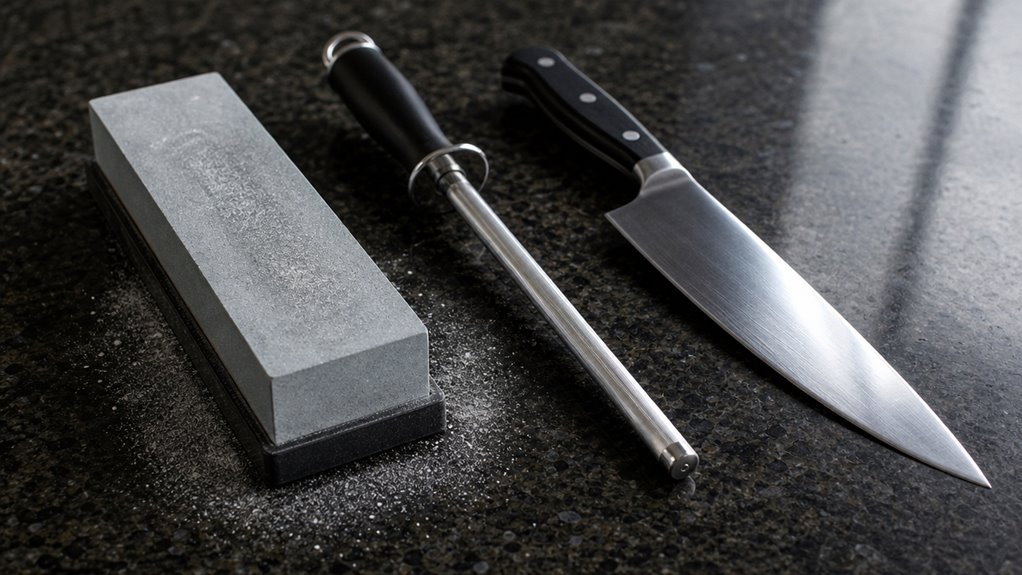
Three sharpening methods can rebuild a rolled or damaged edge: whetstones, pull-through sharpeners, and electric sharpeners, each working through different levels of abrasion and angle control to restore a usable bevel.
A whetstone with a coarse grit, typically around 400, removes enough metal to reshape a worn edge, while a finer stage at around 3000 grit polishes the bevel once the geometry is set.
Pull-through sharpeners work faster but use a fixed angle that may not match the geometry of a budget or thin blade, and their coarse slot can remove more metal than necessary in just a few strokes.
Electric sharpeners automate abrasion through multiple belt stages, though their preset angles often fall outside the roughly 15 to 20 degrees that thinner, lower-cost knives typically require.
Whetstones, Pull-Throughs, and Electric Sharpeners Compared
When you sit down to rebuild a dull edge, the tool you choose dictates how much metal you actually lose and how much control you keep. A whetstone lets you set the angle, grind slowly, and preserve blade life, but you must flatten it regularly.
A pull‑through sharpener offers a fixed angle and fast results, yet it can remove more steel than needed. An electric sharpener automates the process, giving three stages in minutes, but the motor can overheat thin blades.
- Whetstone – manual, precise, low metal loss, requires soaking and flattening.
- Pull‑through sharpener – quick, repeatable angle, higher steel removal, limited angle flexibility.
- Electric sharpener – fastest, multi‑stage, risk of heat damage, less tactile feedback.
- Ceramic honing rod – daily realignment, no metal loss, only refines a rolled edge.
How Often a Sub-$30 Knife Actually Needs Sharpening
Usually you’ll hone a sub‑$30 knife after each use and only reach for a sharpening stone once every few months, but the exact interval depends on how you use it.
If you chop daily on a glass board, a rolled edge will become a worn edge in four weeks, so expect a pull‑through sharpener or whetstone session every 2–4 weeks.
Light cooks who stick to a wooden board can stretch the rebuild to 3–4 months, especially when they pair a steel or ceramic honing rod for regular realignment.
The key is to watch for slipping on tomatoes or a failed paper test—those signs trump any calendar.
Keep honing, then sharpen only when the edge truly dulls.
Choosing the Right Rod for an Under-$30 Knife
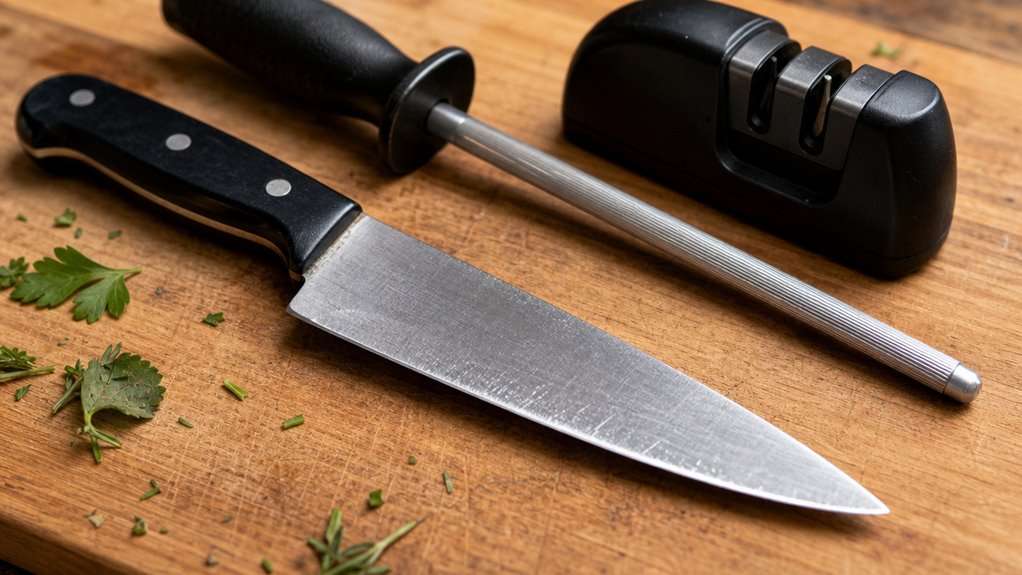
For knives in the under-$30 price range, a fine steel rod is the standard starting point because it straightens a rolled edge by realigning the metal rather than removing it, making it well-suited to softer blade steel that can deform under regular use.
Ceramic rods take a different approach — they lightly abrade the edge, removing a small amount of material to produce a refined cutting bite that a steel rod alone can’t achieve.
Diamond rods, by contrast, are typically too aggressive for budget blades, stripping metal at a rate that can damage the factory-sharpened bevel before the knife has seen meaningful use.
Matching the rod material to the blade’s steel hardness and edge geometry is what separates a maintained knife from a degraded one.
Steel, Ceramic, and Diamond Rods Explained
Grab the right rod and you’ll stop mistaking a rolled edge for a truly dull blade.
A steel honing rod works on softer stainless steel, straightening a bent edge without taking metal off.
Ceramic rods add a light abrasive, polishing the edge at roughly 1000–2000 grit and giving a smoother bite.
A diamond rod removes metal quickly, so it can revive a very dull tip in a few strokes, but it also eats away the thin edge if you over‑use it.
Choose based on how often you’ll realign versus rebuild.
- Steel: realigns, cheap, can get gritty buildup.
- Ceramic: light removal, smooth finish, needs regular cleaning.
- Diamond: fast removal, aggressive, particles wear out quickly.
- Pull‑through slot: convenient, but coarse angles can damage budget knives.
Why a Ceramic Rod Refines the Edge That a Steel Rod Only Straightens
Straightening a rolled edge and lightly reshaping it are two different jobs, and the tool you pick decides which one you get. A steel honing rod pushes bent teeth back into place, so it straightens without taking metal. A ceramic rod, on the other hand, scrapes off a microscopic layer while polishing, which refines the edge a bit. For an under‑$30 knife, the softer steel benefits from frequent straightening and occasional light refinement. Use the steel rod when the blade still feels sharp but has lost bite. Switch to a ceramic rod when the edge feels tired or inconsistent, and you’ll delay a full whetstone session.
| Tool | What it does |
|---|---|
| Steel honing rod | Realigns rolled edge |
| Ceramic rod | Removes tiny metal, refines |
| Diamond rod | Aggressive micro‑sharpen |
| Pull‑through slot | Fast, coarse edge |
| Whetstone | Rebuilds bevel, removes metal |
Frequently Asked Questions
Do I Need to Oil My Honing Rod Before Use?
You don’t need oil; use the rod dry. Oil reduces friction, makes the blade slip, and leaves residue. Just wipe it clean after each use, and you’ll keep the edge realigned efficiently.
Can a Ceramic Rod Damage a High‑Carbon Knife?
You can damage a high‑carbon knife with a ceramic rod if you press hard, use a steep angle, or over‑hone; light, occasional strokes are safe, but aggressive use will chip or wear the edge.
How Many Strokes Are Safe on a Steel Rod per Session?
Six to ten light strokes per side is the usual working habit, and it is a rule of thumb rather than a measured finding: the point is to realign the edge without grinding metal away, so stop as soon as it bites cleanly again.
Is a Pull‑Through Slot Worth the Extra Cost?
You’ll find pull‑through slots cheap, but they waste metal and ruin geometry, so the extra cost isn’t worth it for a sub‑$30 knife; stick with a ceramic or steel honing rod and occasional stone sharpening.
Will a Diamond‑Coated Rod Remove Metal Like a Stone?
Yes, a diamond‑coated rod removes metal much like a stone, especially if you press hard or use many strokes; it’s abrasive enough to actually shave steel off the edge.
Conclusion
You’ll keep a $30 kitchen knife razor‑sharp by honing daily and sharpening only when the edge is truly worn. A fine‑steel rod realigns a rolled‑back bevel in seconds; a whetstone removes metal to rebuild the bevel. Think of a chef who honed his knife every night but still noticed a ragged slice after a week. He then spent ten minutes on a medium‑grit stone and the cut was clean again. The trade‑off is clear: honing is quick, sharpening is restorative.
| AccuSharp 2-Stage Compact Knife Sharpener |  | Portable Power | Sharpening Stages: 2-stage (tungsten carbide + ceramic) | Material of Abrasives: Tungsten carbide and ceramic rods | Grip/Handle Type: ABS body, no dedicated grip | VIEW LATEST PRICE | Read Our Analysis |
| Gatco Double Duty Manual Knife Sharpener – Compact Pocket | 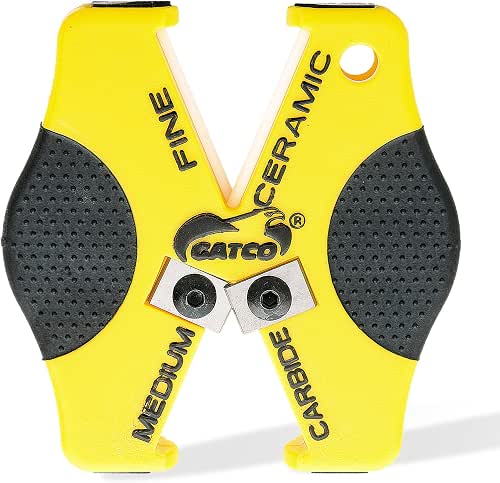 | Pocket Ready | Sharpening Stages: 2-stage (tungsten carbide + ceramic) | Material of Abrasives: Tungsten carbide and ceramic rods | Grip/Handle Type: ABS frame with side pads | VIEW LATEST PRICE | Read Our Analysis |
| Amazon Basics 4-in-1 Knife Sharpener with Glove | 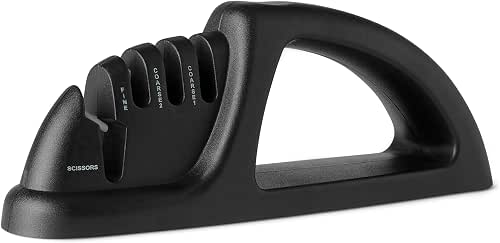 | Safety First | Sharpening Stages: 4-in-1 (coarse + medium + fine + scissor) | Material of Abrasives: Metal and plastic (coarse-medium-fine) | Grip/Handle Type: Non-slip silicone base, no handle | VIEW LATEST PRICE | Read Our Analysis |
Links to Amazon are affiliate links. Buying through one costs you nothing extra and helps fund the research.

Michael Haralson worked in professional kitchens from 1979 to 1992: San Diego restaurants, six years with a catering company beside an Austrian chef, and two summers as a cook on the Finland to Sweden cruise route. He then built a fifteen-year career at Nokia. It began in product marketing and product management, where technical specifications and supplier evaluation were part of the work, and grew from a few countries to a region to global roles, then into sales and corporate strategy. That took him to Beijing for three years, where he spent many weekends in a different province trying the local food and took cooking classes. He has eaten in more than 40 countries and has been shown the kitchens of restaurants in Southern Europe. At home in Finland he cooks Cantonese, Sichuan and Mediterranean food, and still uses the cast iron skillet he bought in 1992. He is the author of Buy It Once, Book One of The Researched Kitchen, and writes here about the balance between kitchen tools that cost too much and those that fail too soon.