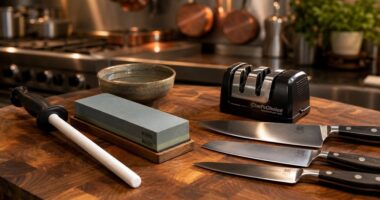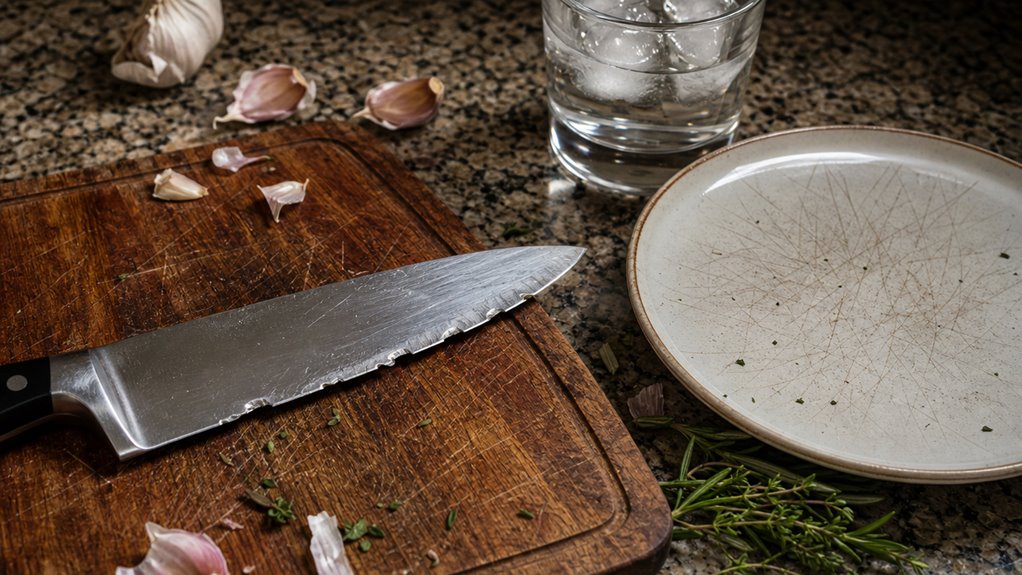
Knife longevity depends on the daily habits surrounding how a blade is stored, sharpened, and cleaned. A handful of common habits — pull-through sharpeners, glass cutting boards, scraping and prying with the edge, loose drawer storage, and dishwasher cleaning — accelerate edge damage faster than most cooks recognize.
- Pull-through sharpeners remove more steel per stroke than necessary, thinning the blade edge at an aggressive rate.
- Glass cutting boards force micro-chipping and edge roll along the blade’s bevel with repeated contact.
- Dishwasher cleaning exposes knife handles and blades to heat and abrasive detergents, warping handles and promoting rust.
Pull-through sharpeners work by grinding both sides of the blade simultaneously with preset carbide or ceramic slots. This method sacrifices metal quickly and offers no control over the sharpening angle, which degrades the bevel over time.
Glass cutting boards rank among the most damaging surfaces a knife edge can contact regularly. Unlike wood or plastic, glass provides no give, so the blade absorbs the full force of each cut directly at the edge.
Honing with a whetstone or ceramic rod preserves the existing bevel and removes minimal metal per session. Consistent, light honing corrects edge roll before it compounds into deeper damage that requires full resharpening.
Dishwasher heat cycles and alkaline detergents attack both the blade steel and the handle material. Carbon steel and wooden handles suffer the most, often showing visible rust or cracking after repeated exposure.
Cheap or expensive is the wrong question. Cost per use is the honest one. Check out our new Calculator.
Cost-Per-Use Calculator →Edge sharpness degrades roughly twice as fast on glass or ceramic surfaces as it does on wood or plastic cutting boards under similar conditions. This is the single biggest reason a hard board quietly shortens a blade’s working life.
Key Points
- Using pull‑through sharpeners or coarse stones with excessive pressure removes too much steel, thinning and weakening the blade.
- Honing with a ceramic rod every few uses preserves the edge; over‑sharpening with whetstones after every cut accelerates wear.
- Cutting on hard surfaces like glass or stone rolls the edge and creates micro‑chips; softer wood or polymer boards protect the blade.
- Storing knives loosely, tossing them in drawers, or attaching them edge‑first on magnetic strips causes micro‑impacts and rust buildup.
- Dishwashers’ heat and harsh detergents warp handles and erode steel, leading to corrosion and edge damage.
| Amazon Basics Dual-Sided Whetstone with Angle Guide Non-Sip Bamboo Base. Black and Grey |  | Best Overall | Grit Levels: 400 / 1000 | Water-Based Use: Water only | Base Material: Bamboo + silicone insert | VIEW LATEST PRICE | Read Our Analysis |
| Sharp Pebble 2-Sided Knife Sharpening Stone Kit (400/1000 Grit) |  | Beginner Friendly | Grit Levels: 400 / 1000 | Water-Based Use: Water only | Base Material: Non-slip rubber | VIEW LATEST PRICE | Read Our Analysis |
| Whetstone Cutlery Sided Gray Knife Stone, Dual 400/1000 Grit, Limestone |  | Budget Choice | Grit Levels: 400 / 1000 | Water-Based Use: Water only | Base Material: None (flat limestone block) | VIEW LATEST PRICE | Read Our Analysis |
Links to Amazon are affiliate links. Buying through one costs you nothing extra and helps fund the research.
Knowing How to Sharpen Knife Edges Without Grinding Away the Blade
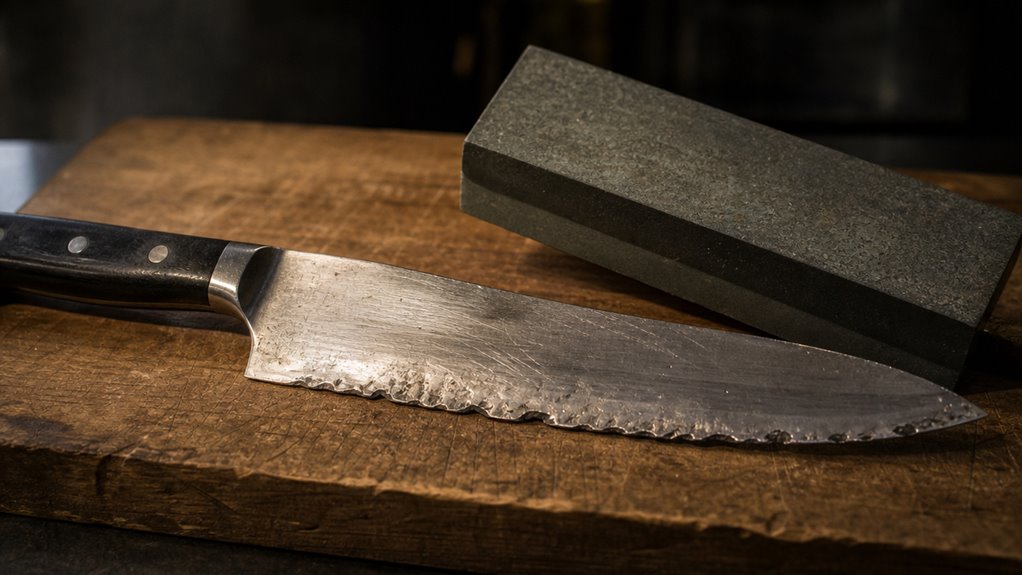
Sharpening a knife without grinding away the blade depends on controlling angle, pressure, and the condition of the edge before abrasive contact begins.
A rolled or folded edge — caused by skipping regular honing — forces the sharpener into more aggressive strokes than the steel actually needs, removing more material than the task warrants. Each unnecessary pass takes away a thin layer that accumulates into meaningful blade loss over time.
Keeping the sharpening angle consistent and applying light pressure lets the abrasive work the edge rather than the body of the blade, while reading the burr tells you when to stop. The techniques and tools that make this possible are worth understanding in detail. Proper grit progression is essential to avoid damaging the blade.
Why Over-Sharpening Removes Years of Steel
Often you’ll think a little extra grinding will keep the blade razor‑sharp forever, but each full‑edge pass strips away a thin layer of steel that adds up over months and years.
Over‑sharpening removes metal faster than the blade can recover, thinning the spine‑to‑edge profile and weakening the apex. When you use a pull‑through sharpener or a coarse stone too often, you lose more steel per pass than a light whetstone touch‑up would.
The result is a fragile bevel that chips or rolls under normal use.
To preserve years of steel, sharpen only when performance drops, keep the angle consistent, and use the finest grit that still reshapes the edge. Light touch‑ups extend life far better than chasing maximum keenness after every chop. Excessive pressure can also cause uneven steel removal, further shortening the blade’s lifespan.
The Honing Step Most People Skip Entirely
Skipping the honing step is like polishing a car without ever changing the oil. The blade looks fine, but the edge is already rolling under the surface.
A honing rod realigns microscopic rolls, while a whetstone removes metal only when the edge truly needs a new bevel.
By honing every 2–3 cooking sessions, you keep the apex straight, delay steel loss, and save the stone for occasional touch‑ups.
Use a ceramic honing rod every few sessions, applying light pressure at a 15-degree angle.
Test the edge with paper; if it drags, the rod can likely fix it.
Reserve the whetstone for when the blade no longer bites after honing.
Store knives on a magnetic strip to avoid edge damage.
Avoid glass boards; they roll the edge faster than wood or poly.
The importance of consistent edge maintenance is highlighted by the fact that even a high‑quality steel will dull faster without regular honing.
The Everyday Habits That Dull a Blade Without You Noticing
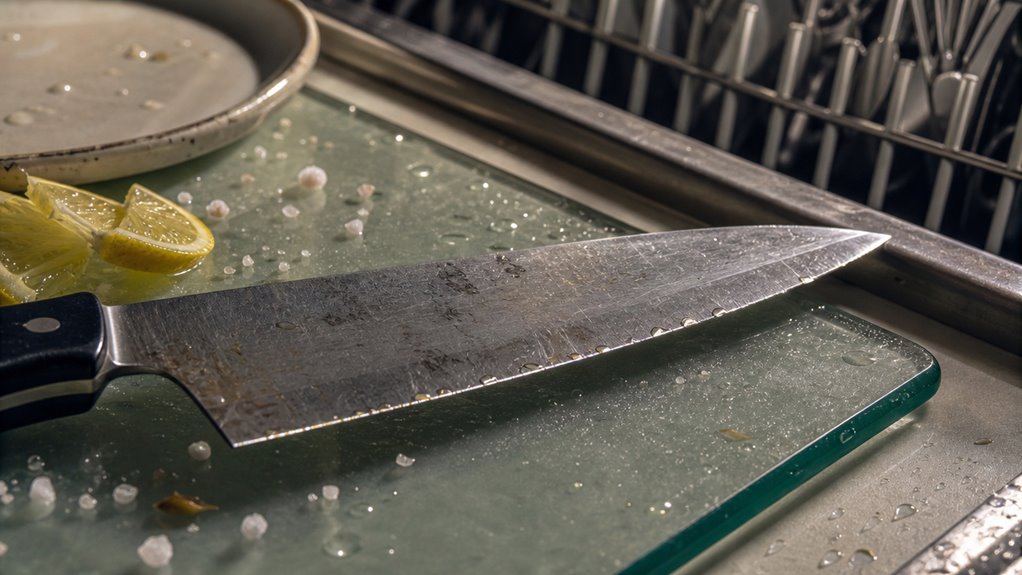
Everyday habits like using a glass cutting board, scraping food with the blade edge, or twisting a knife to pry open containers gradually dull a blade without any single action feeling harmful enough to notice.
Glass is hard enough to roll and chip the bevel with repeated contact, creating microscopic damage that accumulates before the dulling becomes obvious during a cut.
Scraping with the blade rather than the spine bends the thin edge in the same way, compounding wear that a honing rod or sharpening stone then has to correct through unnecessary metal removal.
Switching to a softer wood or poly cutting board and reserving the spine for scraping preserves the bevel geometry and reduces how much work a hone needs to do.
Understanding the full range of habits that cause this kind of hidden wear makes it easier to protect an edge between sharpenings.
Storing knives loosely in a drawer leads to micro‑impact damage from collisions with other cutlery.
Why a Glass Cutting Board Destroys the Edge That a Wood Board Protects
You’ll notice a glass cutting board wears a blade down faster than a wood one, and it’s not just because the glass looks sleek. The glass cutting board is harder than most knife steels, so each slice forces the edge to roll or chip instead of the board giving way.
An end‑grain cutting board, by contrast, compresses under pressure, letting the blade stay sharp longer. The friction on glass is high and the surface absorbs almost no impact, creating microscopic flat spots that make every chop feel tougher. Wood’s softer fibers cushion the blade, dispersing force and reducing micro‑damage.
- Glass hardness exceeds steel, causing edge roll‑off
- Wood’s elasticity lets the board deform, not the blade
- High friction on glass concentrates stress at the edge
- Low‑friction wood spreads impact, preserving the bevel
- Switching to an end‑grain cutting board cuts dulling rate dramatically
Stone and granite are harder than steel and damage blades quickly.
Scraping, Twisting, and Prying With the Edge
Scraping food with the edge, twisting the blade while it’s still in the cut, and using the knife as a pry bar are all habits that silently shave away your edge.
When you scrape food off the board with the cutting edge, the apex rolls and micro‑chips form, especially on hard boards. The edge then loses its fine angle and you’ll need to hone or stone more often.
Twisting the blade in a cut adds sideways torque; the thinnest part of the bevel fractures, creating dull spots and sometimes a broken tip.
Using the edge as a pry bar forces bending loads the steel wasn’t tempered for, leading to large chips or a snapped tip.
Switch to a bench scraper for food, pull the knife out before you twist, and keep a proper pry tool for lifting lids. These small changes preserve the bevel and cut down on unnecessary sharpening.
How to Sharpen Knife Edges by Hand Versus With a Pull-Through
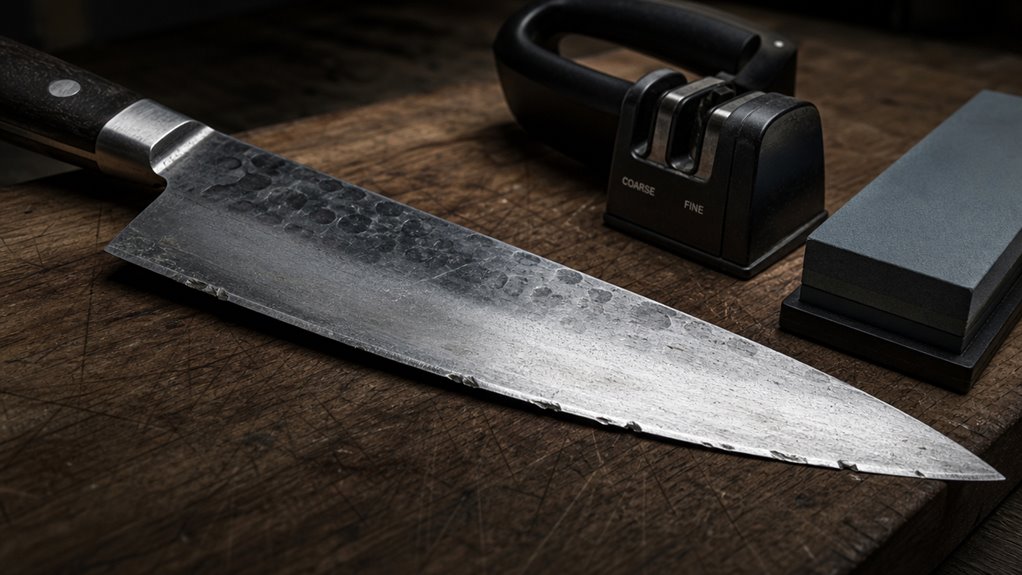
Hand sharpening on a whetstone and using a pull-through sharpener produce different results because each method controls the bevel angle and metal removal in fundamentally different ways.
A whetstone allows the user to set a precise bevel angle and apply deliberate pressure, which keeps steel removal low and preserves the blade’s original geometry over repeated sharpenings. A pull-through sharpener relies on fixed carbide slots that impose a coarse, predetermined angle, scraping away more metal with each pass and gradually hollowing the edge. Over time, that difference in material loss affects how long a blade holds its edge and how much of its working life remains.
The sections that follow examine these differences in greater depth.
What a Whetstone Controls That a Carbide Slot Cannot
Honing on a whetstone lets you shape the edge exactly how you want, while a pull‑through slot locks you into its preset angle. You can fine‑tune the edge angle from 12° to 20° per side, keep the original bevel, or add a micro‑bevel for extra durability. A pull‑through sharpener forces a single V‑edge, so you lose that flexibility.
On the stone you see the marker‑ink wear, feel the drag change, and hear the bite, which tells you when a burr forms and when to stop. You also control pressure, stroke length, and can work only the tip or heel without grinding the whole blade.
- Adjust edge angle freely
- Preserve factory bevel or re‑profile
- Spot‑work damaged sections only
- Choose grit progression for finish
- Get tactile feedback on burr formation
Why a Pull-Through Sharpener Grinds Away the Steel That a Whetstone Would Preserve
Even if you’re careful, a pull‑through sharpener will shave off more metal than a whetstone because its carbide slot is built to bite hard and fast. The slot’s fixed abrasive grinds a chunk of steel each stroke, so you lose edge material quickly. A whetstone lets you control angle and pressure, removing only a thin layer and keeping the bevel intact.
Pull‑throughs also apply uneven pressure, creating gouges and a ragged micro‑edge that chips sooner. The aggressive bite flattens the apex, thickening the edge behind it and distorting the original profile, especially near the tip. With a stone you can progress through grits, refining scratches and eliminating burrs. The pull‑through’s speed comes at the cost of long‑term blade life.
The Storage and Cleaning Mistakes That Chip and Rust a Knife
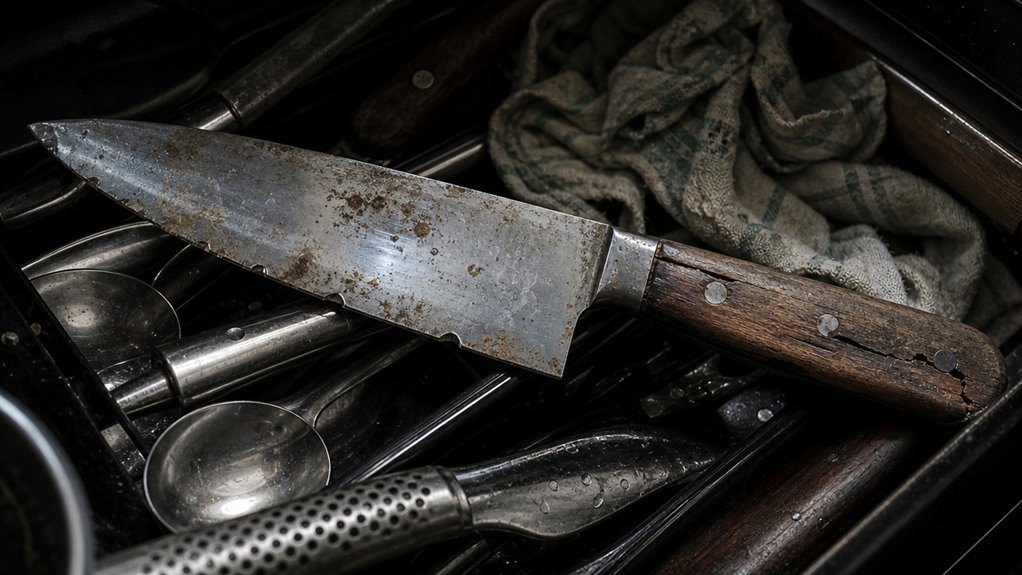
Storage and cleaning mistakes damage knife blades and handles in ways that shorten a knife’s working life, with the dishwasher, loose drawer storage, and improper magnetic strip use among the most common culprits.
Dishwasher heat and caustic detergent warp wooden handles and gradually erode the steel edge, weakening the blade along its length.
Knives stored loose in a drawer strike one another repeatedly, and that contact produces micro-chips that degrade a sharp edge into a ragged one.
Even a magnetic strip can scratch or nick a blade when a knife is snapped onto it edge-first rather than laid spine-first against the surface.
Understanding how each storage and cleaning method affects blade steel and handle material helps in choosing habits that keep a knife performing as intended.
The Dishwasher Heat and Detergent That Wreck a Handle
Running your knives through the dishwasher may seem convenient, but the heat cycles and aggressive detergents quickly turn a sturdy handle into a cracked, water‑logged mess.
The high‑temperature rinse dries out wood handles, causing them to shrink and warp. Steam penetrates the epoxy bond, and the alkaline dishwasher detergent eats away protective finishes, leaving the metal and wood vulnerable to rust and splits. Over time the bolsters loosen, moisture pools at the tang, and the blade’s temper can soften, making it harder to sharpen.
- Heat expands wood, then cools, creating fatigue cracks.
- Detergent chemicals strip sealants, exposing wood and metal.
- Steam penetrates epoxy, weakening the handle‑tang joint.
- Moisture trapped after a cycle fuels rust on the blade and tang.
- Repeated thermal cycling loosens rivets and creates gaps for debris.
Loose Drawer Storage and the Chips It Causes
When you toss knives into a loose drawer, the metal edges start bumping into each other and the drawer’s metal sides, and those tiny impacts chip the heel and tip before you even notice.
The metal‑on‑metal contact creates micro‑chips, especially on thin, high‑HRC Japanese blades.
Utensils and ceramic tools add harder abrasives, turning a simple clatter into a tip‑breaking event.
Moisture trapped between knives fuels rust, even on stainless steel, because condensation can’t evaporate in a crowded space.
Food acids and salts left on a damp blade accelerate pitting at the edge.
Storing knives uncleaned lets organic residue linger, worsening corrosion.
Inspect each knife regularly, dry it thoroughly, and consider a magnetic strip or dedicated block instead of loose drawer storage to keep chips at bay.
Which Mistakes Are Recoverable and Which End a Blade
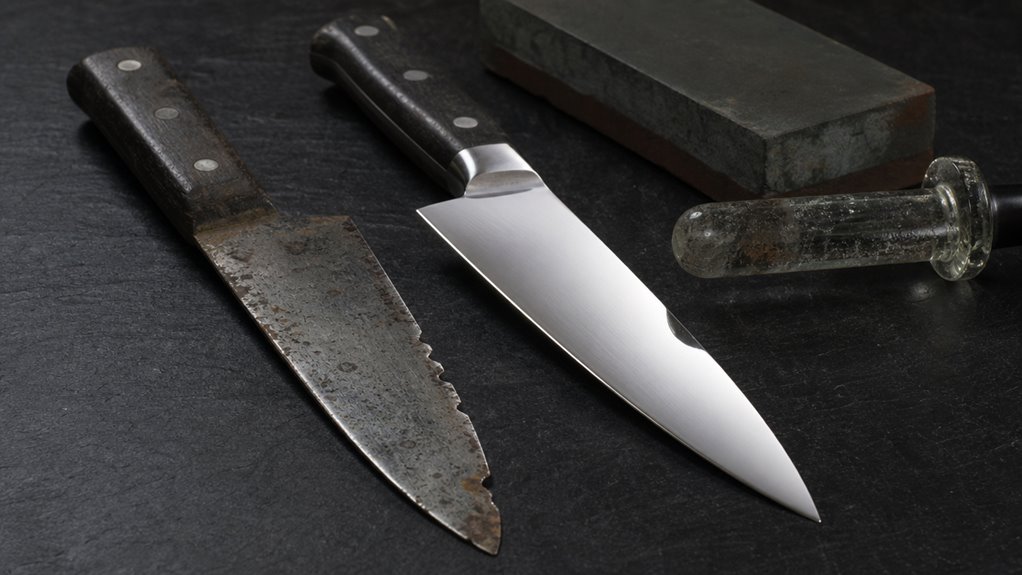
Recoverable knife damage is damage that a hone or sharpening stone can correct without removing significant steel, while permanent damage alters the blade’s geometry in ways that grinding alone can’t fully restore.
Rolled edges and light surface rust typically fall into the recoverable category, because a quick pass on a stone realigns or removes only a shallow layer of metal.
Deep chips and warped tips require grinding away a noticeable amount of steel, which shortens the blade and shifts the original grind angle in ways that are difficult to reverse.
Once that geometry changes, the knife’s cutting performance changes with it, and no amount of maintenance brings the original profile back.
Understanding how each failure type progresses helps clarify which corrective approach is appropriate and when a blade has reached its limit.
Rolled Edges, Light Rust, and Easy Fixes
If you keep chopping on a glass board or twisting your knife into a hard edge, the apex will bend and you’ll end up with a rolled edge. A rolled edge isn’t lost steel; it’s just deformed, and you can usually fix it with a fine‑grit stone or a ceramic rod at the factory angle.
Light rust, the orange film that shows up after a splash, also wipes off with a soft abrasive and a thin oil coat. Both problems are recoverable if you act quickly and avoid aggressive pull‑through sharpeners.
- Realign mild rolls on a 1000‑3000 grit stone, light pressure.
- Use a smooth steel rod for a quick roll‑straightening pass.
- Scrub light rust with a cork or fine eraser, then oil the blade.
- Strop on leather with fine compound to polish the restored edge.
- Store on a magnetic strip, keep the knife dry, and skip the dishwasher.
Deep Chips and Warped Tips That Never Fully Return
A rolled edge can be straightened with a fine‑grit stone, but a deep chip or a warped tip isn’t that forgiving. When you hit bone, frozen meat, or glass, you create deep edge chips that demand grinding back to the original profile. That removes several millimetres of steel and can tuck the blade in, shortening the knuckle clearance. Likewise, warped blades often stem from heat or lateral abuse; cold‑straightening may help a minor twist, but repeated bends fatigue the metal and may crack. If the tip snaps cleanly, you can reshape it, sacrificing length but keeping function. Once the damage reaches the hardened zone or the primary bevel, the blade is effectively finished.
| Issue | Typical Fix |
|---|---|
| Deep edge chips | Grind back to original line |
| Shallow chip | Hone or light stone |
| Snapped tip | Re‑profile spine, blend edge |
| Minor warp | Cold straightening in vise |
| Severe warp | Discard; stock removal too high |
Frequently Asked Questions
Does Using a Ceramic Mug to Clean a Knife Affect Its Edge?
Yes, rubbing a knife on a ceramic mug will remove metal, so you’ll thin the edge and dull it faster; a quick touch‑up can restore sharpness, but overuse shortens the blade’s life.
How Does Humidity in a Kitchen Drawer Influence Knife Rust?
Think of your drawer as a steam‑room: humidity traps moisture on the blade, accelerates oxidation, and lets rust bite into high‑carbon steel. Dry knives instantly, store them on a magnetic strip, and keep the drawer well‑ventilated.
Can a Magnetic Strip Cause Micro‑Bends in a Thin Blade?
You’ll see micro‑bends only if you yank the thin blade off a strong, rigid strip; the magnetic field itself doesn’t bend it. Use gentle, spine‑side lifts and a compliant backing to stay safe.
Is It Safe to Wash a Knife With Acidic Fruit Juices?
No. Acidic juice corrodes the steel and pits the edge. Rinse the blade with mild soap and water, dry it quickly, and don’t leave it sitting in juice.
Do Wooden Cutting Boards Need Periodic Oiling to Protect Knives?
Yes, you should oil your wooden board regularly, about every few weeks, to keep it smooth, prevent grain-raising, and protect your knife’s edge from micro-chipping and rolling.
Conclusion
You’ve seen how easy it is to sabotage a good blade with everyday habits, and you now have a clear plan to fix it. Switch to a softer board, hone regularly, and store knives on a magnetic strip; the edge will stay sharp far longer. Some mistakes, like a chipped tip, can be revived with a fine stone, while a warped edge often means a new knife. Treat your knives right, and they’ll keep cutting like they’re brand new.

Michael Haralson worked in professional kitchens from 1979 to 1992: San Diego restaurants, six years with a catering company beside an Austrian chef, and two summers as a cook on the Finland to Sweden cruise route. He then built a fifteen-year career at Nokia. It began in product marketing and product management, where technical specifications and supplier evaluation were part of the work, and grew from a few countries to a region to global roles, then into sales and corporate strategy. That took him to Beijing for three years, where he spent many weekends in a different province trying the local food and took cooking classes. He has eaten in more than 40 countries and has been shown the kitchens of restaurants in Southern Europe. At home in Finland he cooks Cantonese, Sichuan and Mediterranean food, and still uses the cast iron skillet he bought in 1992. He is the author of Buy It Once, Book One of The Researched Kitchen, and writes here about the balance between kitchen tools that cost too much and those that fail too soon.