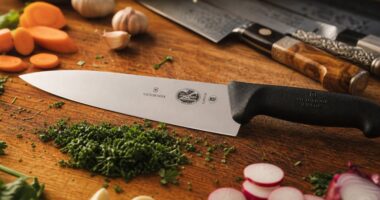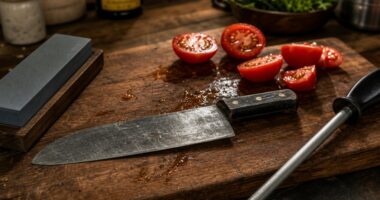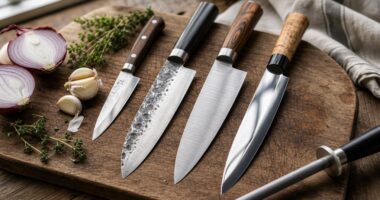
A kitchen knife’s lifespan depends on the quality of its materials and the consistency of its maintenance. A well-maintained chef’s knife typically lasts decades when the steel core stays intact and the edge receives regular care.
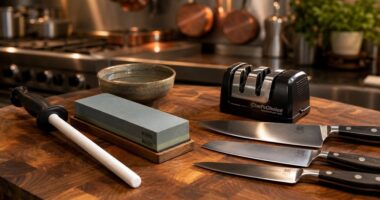
- Honing realigns the blade edge after each use and prevents micro-bends from compounding into dull spots.
- Whetstone sharpening removes minimal metal from the blade and restores a clean cutting edge when honing alone no longer maintains performance.
- Tang integrity determines structural stability, and a cracked or loose tang signals that a knife has reached the end of its functional life.
A chef’s knife faces the most stress from hard surfaces and frozen food. Cutting on glass or stone boards chips the edge rapidly, while frozen food places lateral force on the blade that weakens the steel over time.
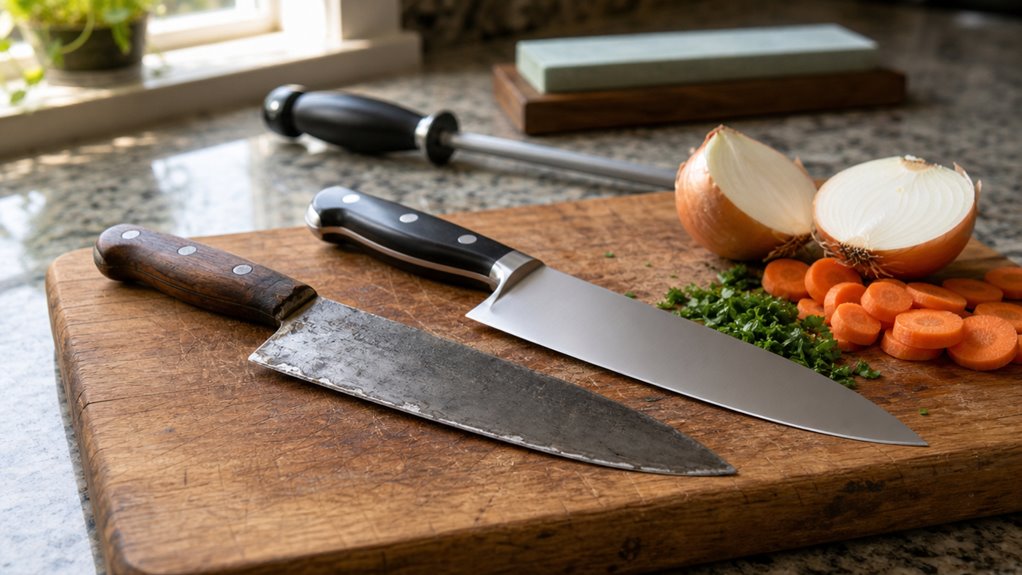
The blade profile offers a reliable indicator of wear. When the profile appears visibly thinned from repeated sharpening cycles, the knife has lost enough geometry that restoration becomes impractical.
Handle condition matters as much as blade condition. A handle that loosens from the tang creates instability during cutting and signals a structural failure that regular sharpening cannot address.
Carbon steel and stainless steel kitchen knives sharpened on a whetstone rather than a pull-through sharpener typically retain their blade geometry significantly longer, because a whetstone removes metal in a more controlled and gradual manner.
Cheap or expensive is the wrong question. Cost per use is the honest one. Check out our new Calculator.
Cost-Per-Use Calculator →Key Points
- A well‑maintained chef’s knife can last decades, often outliving its owner, if the steel reserve and tang stay intact.
- Regular honing 2–3 times weekly and sharpening only when the edge tears on paper preserves steel and extends life.
- Avoid glass, frozen foods, and prying with the tip; these cause micro‑fractures, chips, and tang damage that shorten lifespan.
- Replace the knife when the tang cracks, deep chips reach the spine, or the blade profile is visibly altered and cannot be reshaped.
- Forged full‑tang knives generally outlast stamped knives; for budget knives under $30, replacement is usually cheaper than costly repairs.
| 3-Piece Ultra Sharp Carbon Steel Chef Knife Set |  | Carbon Steel | Blade Length: 8 in | Blade Material: High-carbon German steel (3Cr13MoV) | Edge Type: Plain | VIEW LATEST PRICE | Read Our Analysis |
| Mercer Culinary M22608 Millennia Black Handle 8-Inch Chef's Knife | 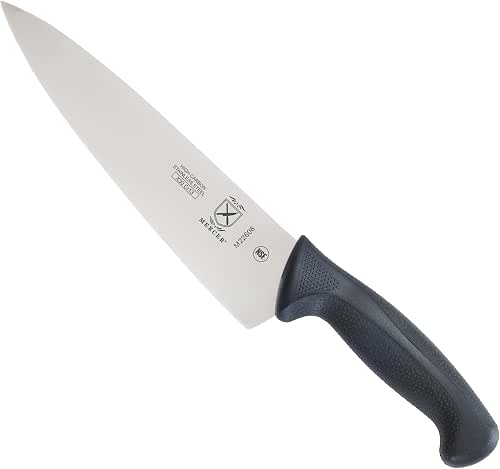 | Reliable Classic | Blade Length: 8 in | Blade Material: High-carbon Japanese steel | Edge Type: Plain | VIEW LATEST PRICE | Read Our Analysis |
| 8″ Chef Knife Safety Notch 5CR15MOV Steel | 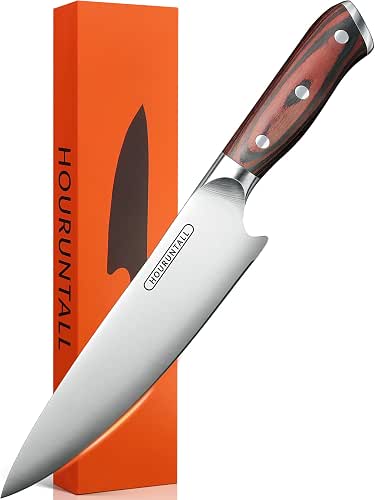 | Safety First | Blade Length: 8 in | Blade Material: 5CR15MOV high-carbon stainless steel | Edge Type: Plain | VIEW LATEST PRICE | Read Our Analysis |
Links to Amazon are affiliate links. Buying through one costs you nothing extra and helps fund the research.
How Long a Chef Knife Should Realistically Last
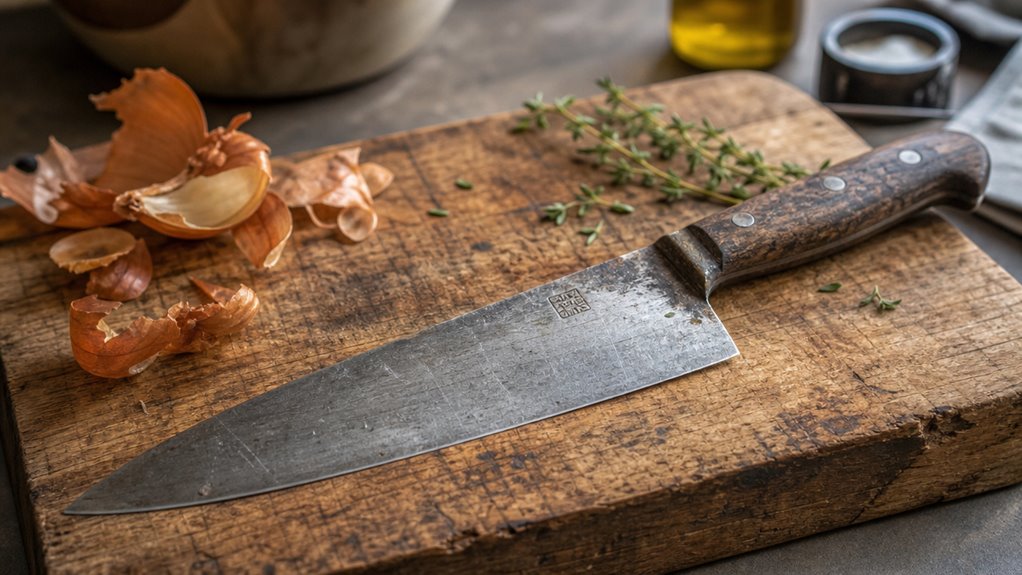
A well-maintained chef knife can typically last decades, and in some cases outlast its owner, provided the blade steel retains enough material and the tang remains structurally sound.
Consistent honing preserves the edge between sharpenings, which slows the cumulative thinning that repeated sharpening sessions cause over time.
Hard cutting surfaces accelerate wear along the edge, and neglecting to dry the blade after washing can compromise both the steel and the handle over years of use.
When the steel’s reserve is depleted or the tang cracks, replacing the knife is generally more practical than attempting restoration.
The sections below examine the specific factors that determine how long a chef knife holds up in regular use.
The daily workload of a knife significantly influences its lifespan, with frequent, high-demand use accelerating wear compared to occasional use.
Why a Maintained Blade Outlasts Its Owner
Honing a blade every week and sharpening it a few times a year keeps the edge from thinning too fast, so the steel itself lasts decades. When you keep the bevel straight, you remove only a thin layer of metal each grind, and the steel stays robust for 20–50 years. Regular care also stops micro‑fractures that would otherwise weaken the spine. Use wood or plastic boards, dry immediately, and store in a block or magnetic strip; these habits protect the tip and tang. If you follow this routine, a chef knife’s working life easily exceeds the replacement intervals that marketing tends to push.
Professional sharpening can handle hundreds of cycles, extending a knife’s usable life far beyond its original purchase date.
| Maintenance | Effect |
|---|---|
| Weekly honing | Realigns edge, no metal loss |
| Sharpen 2‑3 × / year | Removes thin layer, preserves steel |
| Wood/plastic board | Reduces edge wear |
| Immediate drying | Prevents corrosion |
| Proper storage | Avoids tip damage |
What Quietly Shortens a Knife’s Working Life
Often the quiet habits you overlook—like scraping a knife across a glass plate or leaving it to soak after dinner—do more damage than any big mistake. Small actions erode edge retention and invite corrosion, shortening a knife’s working life without you noticing.
A quick rinse followed by towel‑drying prevents moisture from lingering and keeps the steel from pitting. Storing the blade loose in a drawer lets it knock against forks, nicking the edge and creating micro‑chips that later require aggressive sharpening.
Using the tip to pry open a jar or to cut through frozen food exceeds the blade’s design, causing micro‑fractures that accumulate. Even a mild dishwasher cycle can introduce heat‑induced stress and detergent‑driven rust, especially on stamped stainless steel.
Treat the knife like a tool, not a disposable gadget, and you’ll extend its useful years. Handwashing is preferred over dishwashing to avoid heat, harsh detergents, and jostling that dull blades.
| Farberware Edgekeeper 8″ Chef Knife with Self-Sharpening Cover |  | Self-Sharpening | Blade Length: 8 in | Blade Material: High-carbon stainless steel | Edge Type: Plain | VIEW LATEST PRICE | Read Our Analysis |
| Leking 8″ Chef Knife with Sharpener and Guard | 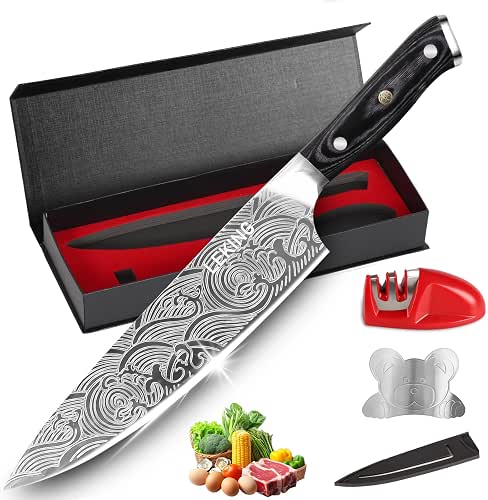 | Professional Grade | Blade Length: 8 in | Blade Material: High-carbon stainless steel | Edge Type: Plain | VIEW LATEST PRICE | Read Our Analysis |
| MOSFiATA 8″ Super Sharp Chef's Knife with Guard and Sharpener |  | Premium Set | Blade Length: 8 in | Blade Material: High-carbon German stainless steel (EN1.4116) | Edge Type: Plain | VIEW LATEST PRICE | Read Our Analysis |
Links to Amazon are affiliate links. Buying through one costs you nothing extra and helps fund the research.
The Maintenance That Decides Whether a Knife Lasts Decades
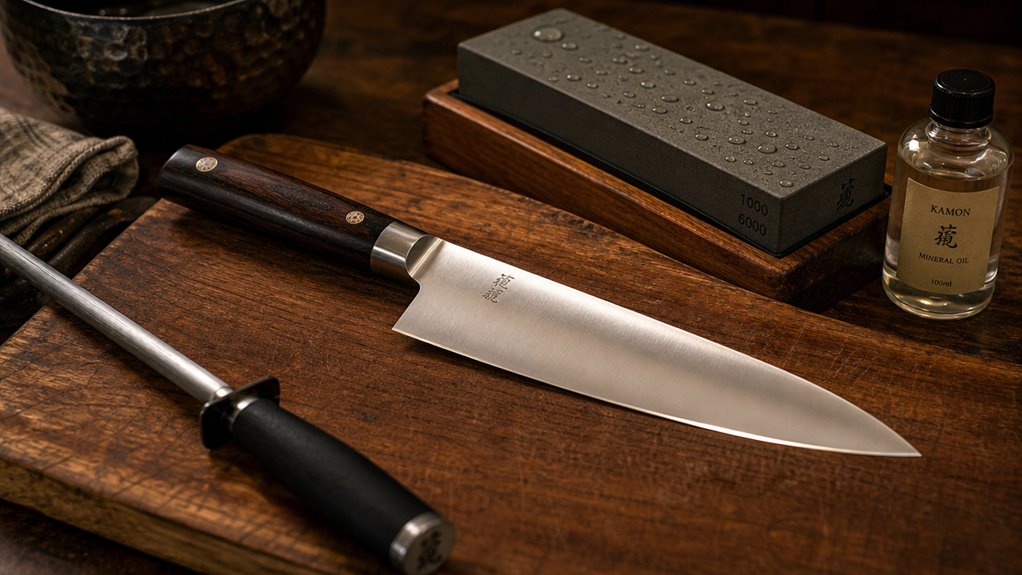
Consistent maintenance determines whether a kitchen knife stays serviceable for decades or degrades within a few years, and the difference comes down to two habits: honing the edge regularly to realign the steel without removing metal, and sharpening only when the blade has genuinely dulled beyond what honing can correct.
Moisture is the other critical factor — rust and pitting develop quickly on carbon and stainless steel alike when a knife is left wet after washing. Proper storage, whether in a wooden block or on a magnetic strip, keeps the edge from contacting hard surfaces that cause micro-chips while also reducing exposure to humidity.
Each of these practices compounds over time, and neglecting any one of them accelerates wear in ways that sharpening alone can’t reverse. The sections that follow examine these maintenance decisions in closer detail. Regular light stoning can preserve edge geometry with minimal material loss.
Honing, Sharpening, and the Difference Between Them
Because the edge is the only part that actually cuts, keeping it aligned is far cheaper than constantly grinding it away.
Honing uses a honing rod to straighten a rolled edge without taking metal off, while a whetstone removes material to create a fresh bevel. You’ll hone every few uses—2‑3 times a week at home—to keep the blade whisper‑sharp. When the paper test shows tearing or the knife feels noticeably dull, it’s time to sharpen. Sharpening restores performance but slowly eats the steel reserve, so you’ll do it only a few times a year.
Honing realigns the edge microscopically after each use, preventing the need for frequent sharpening.
- Align with a honing rod after each cooking session.
- Test the edge on paper; if it slides cleanly, you’re good.
- When the paper resists, move to a whetstone for a new bevel.
- Limit sharpening to two or three times a year to preserve the blade’s lifespan.
Why Drying and Storage Stop a Blade From Pitting
You probably think a quick rinse and a casual towel swipe are enough, but moisture left on a blade is the silent trigger for pitting.
Water mixed with salts or acids forms tiny electrochemical cells that eat into stainless steel, especially near the edge and bolster.
When you dry immediately, you remove that electrolyte and stop the reaction before pits start.
Wipe from edge to spine in linear strokes, use a separate towel for the handle, and finish within ten seconds.
Then store the knife in a dry, ventilated block or on a magnetic strip made of non‑porous material.
Avoid leather sheaths or rubber inserts that trap humidity.
This simple routine keeps pitting corrosion at bay and lets a stamped knife last decades.
When a Chef Knife Is Worth Replacing Versus Restoring
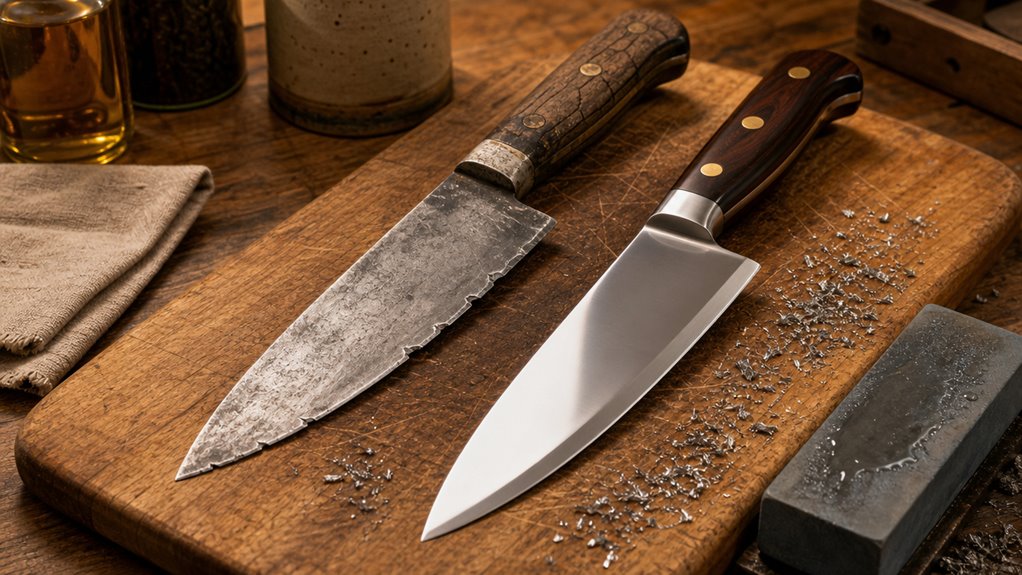
A chef knife is worth restoring when the steel and tang remain structurally sound, and worth replacing when the damage undermines either safety or cost efficiency.
Forged knives with a full tang, such as those from Wusthof, typically retain enough material to benefit from repeated sharpenings, making restoration a practical choice.
Stamped knives that have lost meaningful steel thickness through years of grinding, or that show a cracked tang, become safety risks that a new budget blade can address more reliably.
The condition of the edge matters less than the condition of the spine and handle connection, since chips and worn edges are recoverable while a compromised tang is not.
The details ahead cover how to assess each of these factors across common knife constructions. When the verdict is replacement, this roundup covers what to look for in a budget chef’s knife replacement.
Reading Edge Wear, Chips, and a Loose Handle
Inspect the edge first; a dull blade that still slices paper or a tomato with a few strokes is usually just waiting for a stone, not a new handle.
Look at the edge bevel: if it’s thin and you can restore it with a honing rod, the knife lives. If the bevel has thinned to a wedge and you need a full regrind, the steel reserve is low and replacement may be smarter.
Check for chips—tiny nicks disappear with a few strokes, deep gouges that reach the spine mean you’re losing too much metal.
Finally, examine the handle rivets; loose or corroded rivets signal structural failure that a cheap fix won’t solve.
- Edge bevel worn thin → sharpen, not replace.
- Micro‑chips near edge → grind out, keep knife.
- Deep chip into spine → replace blade.
- Loose handle rivets → replace knife.
Why a Cheap Knife Is Cheaper to Replace Than Re-Handle
Swap the handle and you’ll see the cost gap widen fast. A budget stamped knife such as a Victorinox Fibrox sits at the bottom of the price range, well under the $30 ceiling at the size most home cooks buy, while a professional re-handling job costs several times more once labor, shipping, and insurance are added.
The labor alone—removing scales, drilling, pinning, sanding, finishing—eats most of that price. Mass‑produced handles are molded at scale; custom work is a one‑off, three‑hour process.
When the steel is mid‑grade stainless, its edge will wear out after a few dozen sharpenings, so you’re paying for a handle you’ll soon discard anyway. In contrast, a cheap replacement restores the full blade‑to‑handle package for a fraction of the re‑handle bill.
That’s why, for a stamped knife in the budget tier, the rule of thumb is: replace when the tang or steel is gone, not when the handle cracks.
Why It Pays to Restore a Wusthof but Replace a Worn Victorinox
Because a Wüsthof’s forged blade holds a thick steel reserve, you can shave off enough material to restore a dull edge without sacrificing structural integrity, and the cost of a professional sharpening is usually a fraction of a new premium knife. Its full tang runs end‑to‑end, so the handle stays solid while you grind away a few millimetres of steel.
In contrast, a Victorinox’s stamped construction offers limited steel thickness; each sharpening eats a larger proportion of the blade, and the handle is a thin riveted piece that can crack under repeated stress. When the edge is merely dull, restoring the Wüsthof saves money; when the Victorinox shows blade thinning or handle wear, replacement is cheaper and safer.
- Wüsthof forged blade → deep steel reserve
- Full tang → reliable grip after sharpening
- Victorinox stamped edge → thin, quick‑wear steel
- Handle integrity → riveted vs. full‑tang durability
The Damage That Actually Ends a Knife for Good
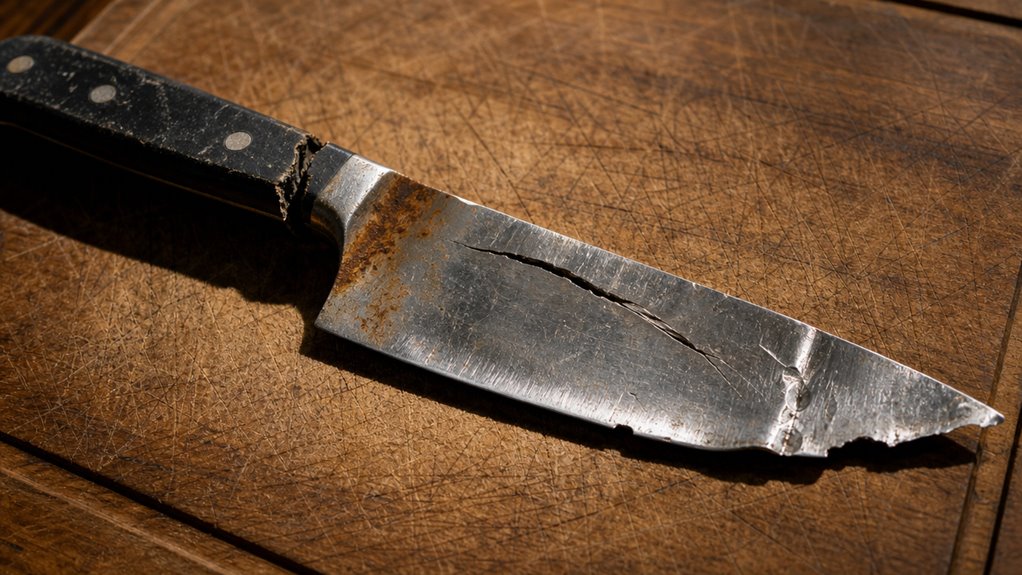
A knife reaches the end of its useful life when structural or edge damage crosses the threshold that sharpening and repair can’t address.
Tang fractures fall into this category because a cracked tang compromises the connection between blade and handle, and welding that joint risks introducing new failure points under load.
Deep chips that extend below the bevel remove steel that can’t be recovered without grinding away a substantial portion of the working edge, and a snapped tip that leaves only a stub presents the same problem — restoring the geometry costs more metal than the blade can spare.
In each case, replacement is the more reliable and cost-effective path forward. The factors that determine when damage crosses that threshold are worth examining in detail.
A Cracked Tang and Why It Cannot Be Saved
If the tang in your chef’s knife cracks, the problem isn’t just a dull edge—it’s a structural failure that can’t be fixed without changing the knife’s core geometry.
A knife tang crack compromises the load‑bearing spine, so the blade can break even while the edge still slices. You’ll notice a weak spot near the handle, and any attempt to grind it out shortens the tang, altering balance and strength.
In practice, the time to replace a kitchen knife is when the crack is visible and erasing it would require substantial metal removal. Otherwise you’re just reshaping a tool that’s no longer safe.
- Visible fissure at the handle junction
- Required grinding that shortens the tang
- Loss of original geometry and balance
- Cost of repair exceeding price of a new sub‑$30 knife
Deep Chips, Snapped Tips, and the Point of No Return
When a chip digs deep into a chef’s knife, the repair work quickly turns into a gamble with the blade’s geometry.
A deep chip forces you to grind away a lot of steel, often with a 200‑grit diamond or ceramic stone, to erase the flaw. That aggressive removal thins the edge and can create a U‑shaped profile, leading to geometry loss that compromises balance and cutting efficiency.
If you keep grinding, the blade’s height drops and the original angle disappears, making the knife feel weak and uneven.
A snapped tip on a stamped blade is similar—once the tip breaks, you can’t restore the original shape without sacrificing too much material.
When the profile is visibly altered, the knife has reached the point of no return. Replace it instead of spending more on a repair that only shortens the blade’s useful life.
Whether Forging or Maintenance Earns the Longer Lifespan
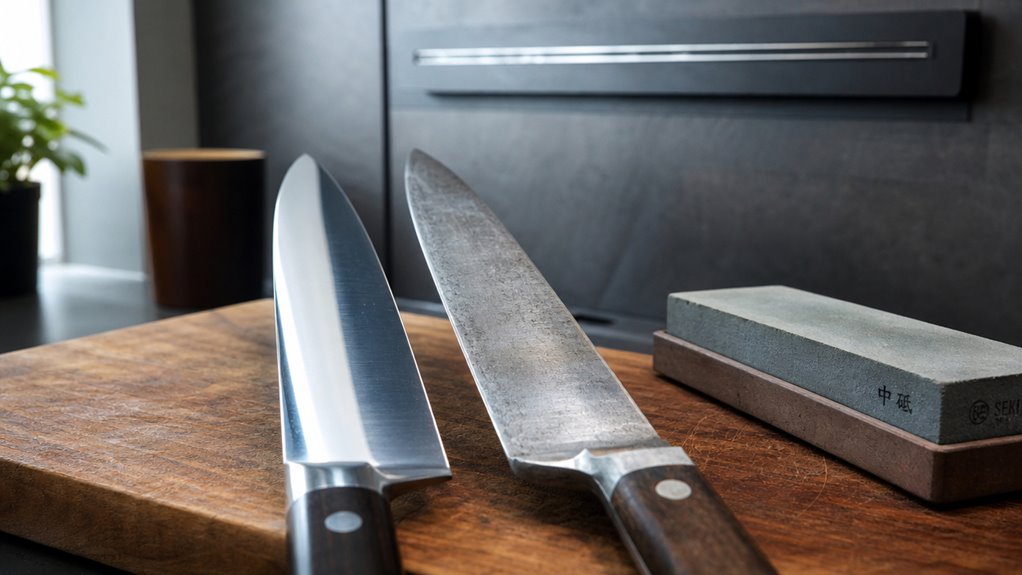
Consistent maintenance often extends a knife’s lifespan further than the forging method used to make it, meaning a well-cared-for stamped blade can outlast a neglected forged one regardless of price tier.
A full-tang forged knife offers more steel for re-sharpening over time and typically carries a bolster that adds balance and spine protection, but that same bolster introduces weight and a potential chipping point near the edge if handling is careless.
A stamped knife like a Victorinox, kept dry and honed on a weekly schedule, benefits from simpler construction that responds reliably to routine care.
Sharpening only when the edge genuinely needs it, rather than on a fixed calendar, preserves the blade’s geometry across years of use. Why that routine suits a soft stainless blade is argued in this case for the Victorinox Fibrox over pricier knives.
The factors shaping long-term performance run deeper than this overview captures.
What a Bolster and Full Tang Really Add
So, what does a bolster and a full tang actually give you beyond the usual stainless blade? You get a sturdier core and a safer grip. The full tang runs the steel through the entire handle, so the knife resists wobble and handle separation. The bolster spreads the force where blade meets handle, keeping your hand from slipping and balancing the weight. Together they lower the chance of warping under heavy use, but they don’t replace good steel or regular honing.
- Full tang → continuous steel, fewer weak points.
- Bolster → guard against hand‑slide, smoother transition.
- Full tang + bolster → distributes stress, reduces breakage risk.
- Both → modest lifespan boost when you still dry, sharpen, and store properly.
Why a Stamped Victorinox Outlives the Forged Knife Most Cooks Buy
A few years of regular cooking can show you that a stamped Victorinox chef’s knife often outlasts the forged German‑style knives most home cooks buy.
The Victorinox Fibrox stamped blade uses X50CrMoV15 steel at about 55–56 HRC, so it’s a bit softer but far tougher than a typical forged German blade hardened to 58 HRC. That toughness lets the edge survive occasional bone contact or board flaws without micro‑chipping.
The thin, flexible profile spreads stress evenly, reducing the chance of cracks in the tang or handle. You can hone it weekly and sharpen a few times a year on a simple stone; the softer steel responds quickly, keeping maintenance cheap and frequent.
In contrast, a forged knife holds an edge longer but demands more skill and time to sharpen, so many users let it degrade. Over decades of modest care, the stamped Victorinox stays functional while the forged counterpart may need costly re‑handles or replacement.
Frequently Asked Questions
Can I Use a Ceramic Sharpener on a Stamped Stainless Knife?
Yes, you can use a ceramic sharpener on a stamped stainless knife—just keep the angle around 15‑20°, apply light pressure, and clean the rod often to avoid micro‑chipping or excessive steel loss.
How Does a Knife’s Handle Material Affect Its Lifespan?
You’ll notice synthetic handles resist moisture, heat, and chemicals, so they stay solid for decades, while wood handles absorb water, swell, and crack unless you oil them regularly, shortening the knife’s service life.
Is a Micro-Bevel Necessary for Extending Edge Life?
You don’t need a micro‑bevel unless you cut hard, abrasive foods or use a very thin steel. For everyday kitchen work, regular honing and occasional sharpening keep a stamped knife sharp for decades.
What Temperature Range Can a Kitchen Knife Tolerate Without Warping?
You can safely use a kitchen knife from room temperature up to about 150 °C (300 °F); anything hotter, especially uneven heating above 200 °C, risks warping, temper loss, or permanent damage.
Do Dishwasher Cycles Accelerate Terminal Damage on Stamped Knives?
Yes. Dishwasher cycles jostle, heat, and corrode stamped blades, pushing them toward cracked tangs and snapped tips, so repeated cycles do accelerate terminal damage.
Conclusion
You’ve learned that a well-kept stamped blade can last decades, but only if you hone regularly and watch for cracks, chips, or a ground-past-bevel edge. When the tang splits or the edge is beyond repair, replacement beats costly restoration. Think of your knife as a partner with a measurable lifespan. Maintenance extends it, but inevitable damage ends it. Keep it sharp, inspect it often, and you’ll know exactly when to let go and buy a new one.
| Cuisinart 8″ Stainless Steel Chef's Knife Guard | 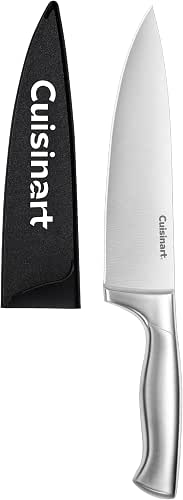 | Best Value | Blade Length: 8 in | Blade Material: Stainless steel | Edge Type: Plain | VIEW LATEST PRICE | Read Our Analysis |
| 3-Pc Ultra Sharp Kitchen Knife Set (8″ 5″ 3.5″) |  | Versatile Trio | Blade Length: 8 in | Blade Material: High-carbon German steel (3CR13MOV) | Edge Type: Plain | VIEW LATEST PRICE | Read Our Analysis |
| Kiwi Brand Stainless Steel 8 inch Thai Chef's Knife No. 21 |  | Classic Thai | Blade Length: 8 in | Blade Material: Stainless steel (forged) | Edge Type: Plain | VIEW LATEST PRICE | Read Our Analysis |
Links to Amazon are affiliate links. Buying through one costs you nothing extra and helps fund the research.

Michael Haralson worked in professional kitchens from 1979 to 1992: San Diego restaurants, six years with a catering company beside an Austrian chef, and two summers as a cook on the Finland to Sweden cruise route. He then built a fifteen-year career at Nokia. It began in product marketing and product management, where technical specifications and supplier evaluation were part of the work, and grew from a few countries to a region to global roles, then into sales and corporate strategy. That took him to Beijing for three years, where he spent many weekends in a different province trying the local food and took cooking classes. He has eaten in more than 40 countries and has been shown the kitchens of restaurants in Southern Europe. At home in Finland he cooks Cantonese, Sichuan and Mediterranean food, and still uses the cast iron skillet he bought in 1992. He is the author of Buy It Once, Book One of The Researched Kitchen, and writes here about the balance between kitchen tools that cost too much and those that fail too soon.