
The “Use It Twice a Year” test requires a kitchen tool to earn at least two genuine, task-solving uses within a twelve-month period before it earns a permanent place in your kitchen. Items that appear once or never during that window get earmarked for donation or deep storage.
- Single-use gadgets accumulate quickly and typically fail the two-use threshold because they solve only one narrow task without becoming a regular habit.
- Seasonal gear qualifies for a labeled storage bin even when used only a few times per year, since its infrequent use reflects calendar timing rather than genuine redundancy.
- Safety equipment operates under separate rules because frequency of use is not the right metric for items that exist to prevent harm.
The test works by turning vague intuition into a countable record. A kitchen tool either shows up in your cooking at least twice, or it does not.
Single-use gadgets, such as avocado slicers, expose themselves quickly under this system. One documented use is not enough to justify the drawer space they consume.
Uncertain items benefit from a one-week wait combined with a photo record. Keeping a brief visual log of actual use during that window removes the guesswork from borderline decisions and reduces the likelihood of post-declutter regret.
You will see this framed elsewhere as a statistic about how small a fraction of what people own actually gets used. Ignore the number, because the versions in circulation are not traceable to any study. The test below does not need one: it produces your own figure, for your own kitchen, which is the only one that should decide what you keep.
Cheap or expensive is the wrong question. Cost per use is the honest one. Check out our new Calculator.
Cost-Per-Use Calculator →Key Points
- Count each item’s actual, complete uses over the past 12 months; only items used at least twice stay.
- Keep a simple log (date, item, task) to avoid recall bias and ensure consistent counting.
- Items used fewer than two times are moved to donation, except seasonal or safety tools that need special handling.
- Store seasonal or low-frequency items in labeled deep-storage bins, keeping everyday tools within easy reach.
- Re-run the count once a year, applying a one-week waiting period with photo and reason for any uncertain items before discarding.
| Wall-Mount Metal Spice Rack, Screw-In (4 Pack) | 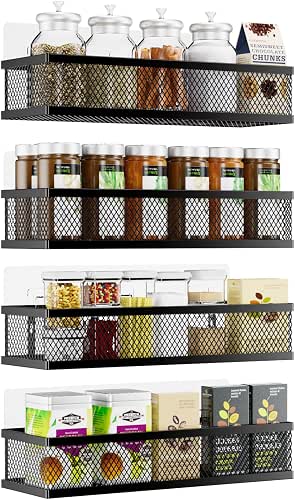 | Heavy-Duty Build | Mounting Method: Adhesive stickers or wall-mount brackets | Primary Material: Thickened carbon steel | Load Capacity (Approx.): Holds larger items (≈ 2-3 lb per rack) | VIEW LATEST PRICE | Read Our Analysis |
| LUCYCAZ Wall Mounted Spice Rack (2 Pack) |  | Compact Versatility | Mounting Method: Adhesive stickers or screws | Primary Material: Powder-coated metal | Load Capacity (Approx.): Holds spice jars (≈ 1-2 lb per shelf) | VIEW LATEST PRICE | Read Our Analysis |
| Magnetic Aluminum Foil and Plastic Wrap Organizer (2-Pack) | 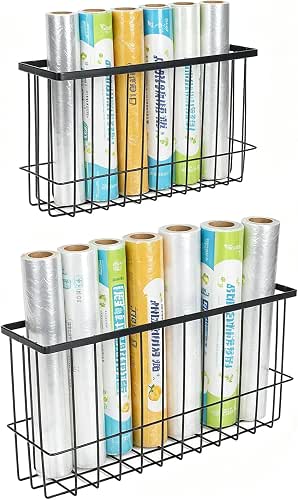 | Kitchen Organizer | Mounting Method: Magnetic back (no tools) | Primary Material: Steel (matte coating) | Load Capacity (Approx.): Holds rolls of wrap (≈ 2-3 lb) | VIEW LATEST PRICE | Read Our Analysis |
Links to Amazon are affiliate links. Buying through one costs you nothing extra and helps fund the research.
Why the Twice-a-Year Test Catches Single Use Kitchen Tools
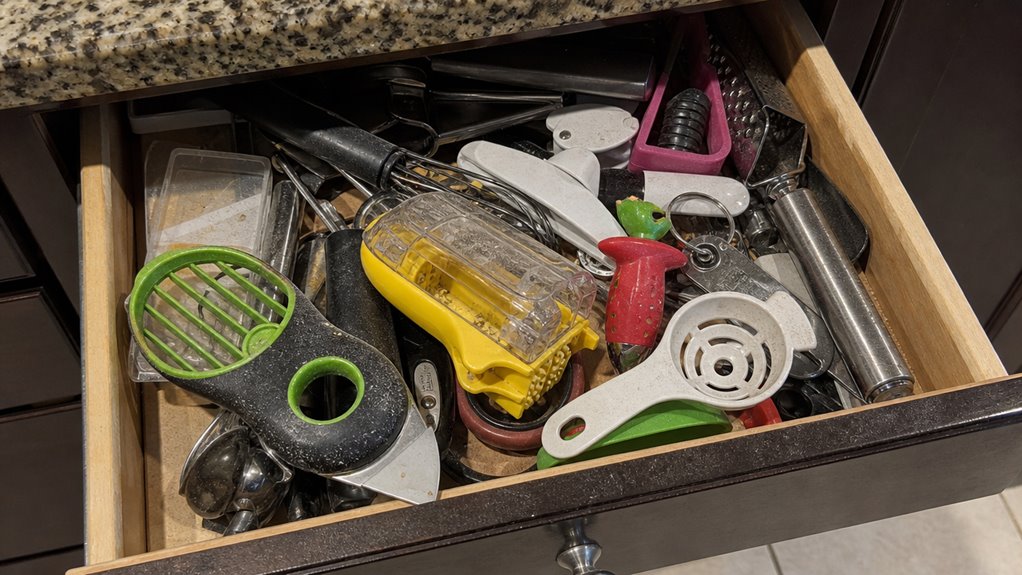
The twice-a-year threshold works by flagging any kitchen tool that hasn’t seen actual use at least twice within the past twelve months, giving single-use gadgets like an avocado slicer or banana cutter no cover behind vague intentions. Most drawers accumulate these tools gradually, each one purchased for a specific task that a chef’s knife or standard pan handles just as well in practice. The rule shifts the measure from potential use to documented use, which exposes how rarely a holiday-only pan or specialty cutter justifies the drawer space it occupies year-round. Storage footprint becomes the deciding factor, not sentiment or theoretical convenience. The sections that follow examine how this threshold applies across common kitchen tool categories and what it reveals about long-term kitchen organization.
A Frequency Threshold That Cuts Through Sentiment
Rarely used kitchen gadgets survive on imagination rather than evidence, because they look handy in a recipe video, but the twice-a-year test cuts through that sentiment with a simple, objective rule: if you haven’t used an item at least twice in the past twelve months, it doesn’t belong on the countertop.
The test works as a frequency threshold that separates genuine utility from novelty. You count real uses, not “maybe someday” plans, and the rule flags anything that falls below two uses.
This binary cutoff trims decision fatigue, letting you quickly see which tools earn a drawer space and which belong in the donation pile. It also mirrors seasonal coverage, keeping a roasting pan for holidays while discarding a one-off avocado slicer that never saw a second slice.
How the Rule Exposes the Gadgets You Forgot You Owned
The twice-a-year test pulls the curtain on those specialty gadgets that have been living in the back of a drawer while you’re busy with the everyday tools you actually reach for. You’ll discover a single-task gadget like an avocado slicer hidden in deep storage, never used because a knife does the job.
When you tally real usage, those items fall below the two-times-a-year cutoff and pop up in a systematic review. Because they sit in secondary locations, you rarely see them, so the test forces you to pull them out and count. The result is a clear picture of redundancy, letting you move genuine seasonal tools to deep storage and donate the rest.
| Wider Magnetic Shelf Basket with Bamboo Top (XXL) | ![[WIDER SHELF] 1 SET Strong Magnetic Shelf Basket for Fridge](https://m.media-amazon.com/images/I/81E+PU5Bb8L._AC_SL500_QL70_ML2_.jpg) | XXL Storage | Mounting Method: Magnetic panels or screw-mount (bamboo top) | Primary Material: Steel with bamboo top | Load Capacity (Approx.): Up to 60 lb total | VIEW LATEST PRICE | Read Our Analysis |
| Metal Magnetic Refrigerator Spice Rack (4 Pack) |  | High-Weight Capacity | Mounting Method: Magnetic (refrigerator) | Primary Material: Iron (black finish) | Load Capacity (Approx.): 50 lb per shelf | VIEW LATEST PRICE | Read Our Analysis |
| Fun Memories 30″ Magnetic Stove Top Shelf |  | Stove-Top Companion | Mounting Method: Magnetic bottom or screws for wall mounting | Primary Material: Pine wood (magnetic base) | Load Capacity (Approx.): Holds bottles/spices (≈ 5-10 lb) | VIEW LATEST PRICE | Read Our Analysis |
Links to Amazon are affiliate links. Buying through one costs you nothing extra and helps fund the research.
How to Run the Twice-a-Year Test Honestly
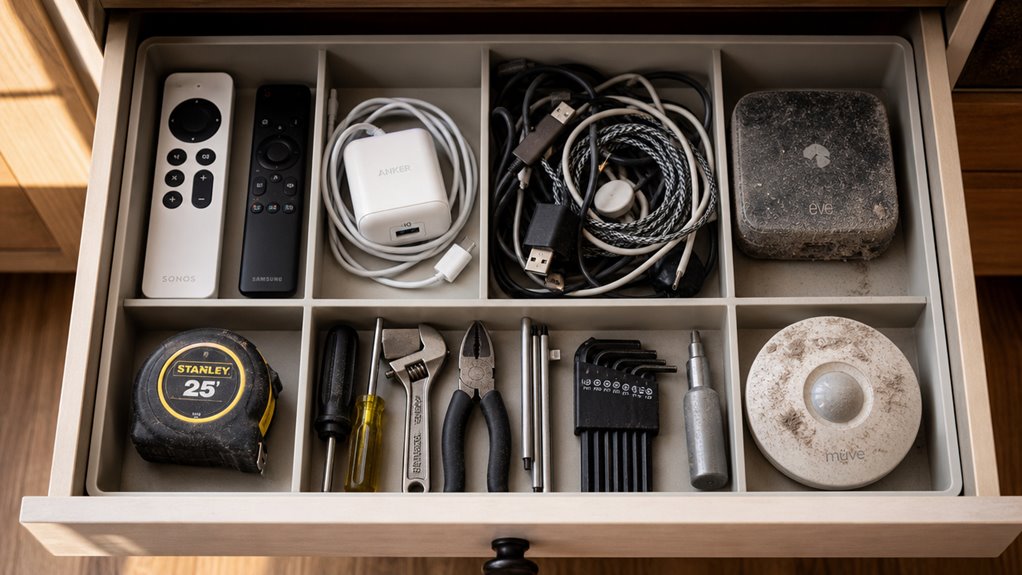
Running the twice-a-year test honestly means tracking actual tool use with a simple written record, such as a dated sticky note or a quick log entry, rather than estimating how often a tool might come in handy.
The data gathered this way separates genuine kitchen workhorses from occasional-use items that only appear once a year. A chef’s knife pulled out repeatedly for tasks like slicing meat and preparing salads will easily clear a two-use minimum across any given period, while a turkey baster used only at Thanksgiving will not.
That gap between imagined use and documented use is where most kitchens quietly accumulate clutter. Understanding the mechanics behind the test reveals how to apply it consistently across every drawer and cabinet.
Counting Real Use, Not Imagined Use
Usually you’ll start by defining what counts as a “use” before you even touch the drawer. Write a rule that says a use is a complete, purposeful task the item solved, not a brief handling or a “maybe someday” thought. Keep a simple log with three fields: date, item, task. Fill it in right after you finish cooking. At the end of the twelve-month window, tally the real use frequency. Anything used fewer than two times flags for removal; genuine seasonal tools can go to deep storage, while daily essentials stay on hand. This honest audit stops recall bias, so the items you rarely reach for surface on their own.
| Item | Uses in 12 mo |
|---|---|
| Immersion blender | 0 |
| Holiday roasting pan | 3 |
| Silicone spatula | 12 |
Why a Chef’s Knife Clears the Twice-a-Year Bar That a Turkey Baster Cannot
Start by logging each time you actually pick up a tool, noting the date, the item, and the task it solved.
Your chef’s knife will appear daily, chopping onions, slicing chicken, mincing herbs, and even carving a roast. Those entries quickly surpass the twice‑a‑year threshold, proving real, varied use.
A turkey baster, meanwhile, shows up only on holiday roast nights when you baste a turkey or splash pan juices. That’s usually once or twice a year, and you could replace it with a spoon or ladle.
The knife’s versatility covers dozens of prep steps, while the baster’s single‑purpose role makes it a low‑frequency, high‑maintenance clutter piece. Keep the knife on hand; store or donate the baster.
What the Test Reveals About Single Use Kitchen Gadgets
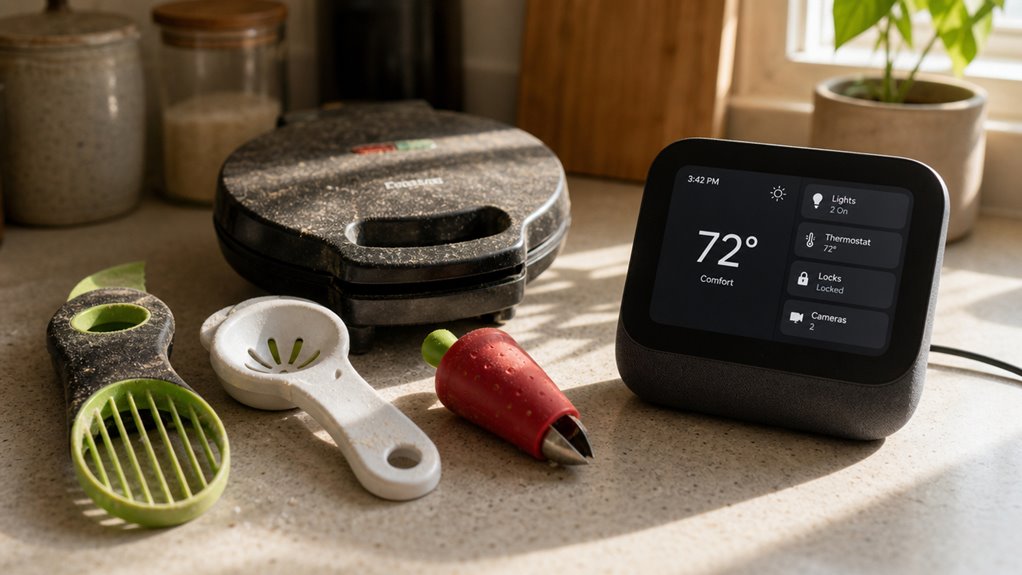
A kitchen audit reveals which single-use gadgets earn their drawer space and which ones do not. Seasonal tools like a holiday roaster and specialty items such as a sushi mat tend to surface during this process, flagged by how rarely they’re reached for during routine cooking.
Novelty gadgets that have been used once or never follow the same pattern, occupying storage without contributing to daily function. Flagged pieces move into deep storage when they’re genuinely seasonal, or into a donate box when they serve no recurring purpose, freeing up drawer space for tools that see regular use.
The reasoning behind each sorting decision runs deeper than it first appears.
The Seasonal, Specialty, and Novelty Items It Flags
Most seasonal and specialty kitchen gadgets fall short of the twice‑a‑year rule, so they end up flagged for deep storage or donation. A holiday-themed serving platter, for example, is a seasonal item that only sees action during one celebration, leaving drawers empty the rest of the year.
Your avocado slicer, a classic single‑use kitchen gadget, tackles one task that a regular knife already handles, so it rarely passes the test. Likewise, a waffle iron that came out for one birthday brunch and then went back in the cupboard will likely be flagged, because it never reached a second use.
Novelty tools look fun but sit idle once the trend fades, which pushes them into the donate pile. Color‑changing spatulas and character‑shaped cookie cutters are the usual offenders.
Sorting Flagged Items Into Deep Storage or the Donate Box
Sorting flagged gadgets into deep storage or the donate box hinges on whether they truly fill a niche you can’t cover with a basic tool.
If a gadget supports batch cooking, preserving, or seasonal bulk work that a regular pot or pan can’t handle, you file it in deep storage. A high‑quality cherry pitter that you use for holiday pies fits here, even though you only pull it out twice a year.
Conversely, a pineapple corer that you tried once for a party belongs in the donate box, because a chef’s knife does the job just as well. Redundant slicers, single‑use appliances, and awkwardly shaped tools that sit idle for twelve months also go to the donate box.
This split keeps your countertop clear while preserving truly seasonal tools off‑site.
The Edge Cases the Rule Has to Handle
The edge cases a frequency-based storage rule has to handle fall into four patterns: items used on a fixed seasonal cycle, single-purpose gadgets, occasional hobby gear, and safety equipment kept on hand for rare but necessary checks.
A roasting pan used twice a year sits right at the threshold the rule is designed to test, while a cheap plastic egg timer raises the question of whether a tool that costs almost nothing to store is worth counting at all.
Hobby gear such as a camping stove or a canning kit adds further complexity, because seasonal necessity doesn’t always align with a twice-a-year benchmark.
Safety equipment like a fire extinguisher occupies a separate category entirely, where usage frequency is a poor proxy for whether the item belongs in active storage.
The cases examined here reveal how a rule built around frequency must account for item type, seasonal patterns, and functional role to produce consistent outcomes.
Holiday Tools, Hobby Gear, and Genuine Once-a-Year Needs
Occasionally you’ll run into tools that only appear during the holidays, a hobby season, or that single annual emergency. They do not meet the twice‑a‑year usage threshold, but they still have a purpose.
Holiday cookware like a deep‑dish roasting pan sits in a spare cabinet, used once for Thanksgiving and again for Christmas dinner; you can deep‑store it because the metal holds heat evenly and it replaces a disposable tray each year.
Hobby gear such as a compact camping stove may see three trips a year, yet it saves rental fees and fits a small bin.
Genuine once-a-year kitchen needs also merit a dedicated shelf if replacing them would cost more than storing them. A canning kit, a large stockpot for batch cooking, and a holiday roasting rack all qualify.
Count actual uses, not “maybe someday,” and move anything below two uses to donation.
This keeps counters clear while preserving seasonal essentials.
Why a Roasting Pan Earns Deep Storage Where a Single-Use Gadget Earns the Door
Often you’ll find a big roasting pan tucked away in a deep cabinet, and that’s exactly where it belongs.
It handles dry roasting, braising, searing, and even casserole baking, so a few holiday uses cover a whole cooking category.
Because you can replace a popcorn popper or a rice cooker with a pot and lid, those single‑use gadgets add little beyond what you already own.
Their cords, lids, and accessories spill into drawers, raising your storage footprint.
A sturdy roasting pan, usually stainless or heavy‑gauge metal, lasts decades and needs only a soak and a non‑abrasive scrub.
It earns deep storage as a seasonal kitchen tool, while the gadget that never exceeds twice‑a‑year use should go out the door.
How to Apply the Result Without Regret
Applying a decluttering result without regret means matching what stays in your kitchen to how you genuinely cook, then using a brief review step to catch decisions you might later question.
Everyday tools earn a permanent spot within reach, while seasonal items like a roasting pan belong in a labeled deep-storage bin rather than an accessible drawer.
A one-week waiting period, supported by a photograph and a single written reason for each item, slows impulsive choices without complicating the overall system.
Donation boxes handle the remainder, keeping the outcome clear and actionable rather than ambiguous.
The details below address how each part of this process works in practice.
Keeping the Few, Storing the Seasonal, Releasing the Rest
Typically you’ll find that only the tools you actually reach for at least twice a year deserve a permanent spot on the counter.
Anything else should move out of sight: single-use kitchen gadgets, bulky holiday bakeware, and rarely needed specialty knives.
First, tally real uses from the past twelve months; if you hit two, keep it on hand.
Second, sort the rest into seasonal storage: label bins, place winter cookware in a climate‑stable closet, and stack summer grill tools in a clear plastic box.
Third, donate or recycle anything that never crossed the threshold.
Finally, leave some slack in every drawer and on the counter rather than filling them to the edge. A drawer you can see into is a drawer you will actually use, and one that is packed solid is where things go to be forgotten.
- Count actual uses
- Label and bin seasonal items
- Store in climate‑controlled zones
- Release flagged single‑use kitchen pieces
Matching What You Keep to How You Actually Cook
You’ll find the tools that actually show up on your weekly menu are the ones worth keeping, and the rest can go.
Start by listing every multitasker you reach for most days: skillet, spatula, tongs, thermometer, measuring cups. If you sauté, stir, and sear daily, those items earn their spot. Match each core task to a single, reliable piece; a non‑stick pan stays only while its surface is smooth and scratch‑free.
Cut the counter footprint by discarding specialty gadgets you’ve used fewer than twice this year. Keep cutting boards that separate raw from ready‑to‑eat foods, and store seasonal bakeware in a deep‑storage bin.
Finally, retire anything cracked, warped, or odor‑laden. Its performance is already compromised.
Frequently Asked Questions
How to Handle Tools Used Exactly Twice but Months Apart?
Treat them as seasonal: store them together, label the location, and set a reminder for each expected use. If you can replace them cheaply, consider donating instead.
Can Seasonal Items With Irregular Dates Count Toward the Threshold?
Yes, you can count seasonal items with irregular dates if they show predictable recurrence, clear future plans, and reasonable value. Treat them as “twice‑a‑year” when they reliably appear each season.
What if a Gadget Is Shared With Another Household?
If a gadget’s shared across households, count only the times you personally use it; treat other households’ usage as irrelevant, so your twice‑a‑year tally reflects your own real usage.
Do Replacements Affect the Audit for the Original Item?
Yes, replacements change the audit: if the new item fully covers the function, you should flag the original as redundant and consider donating it, unless you need it as a backup.
Should I Count Use When I Borrow a Tool From a Friend?
Yes, count borrowed use as evidence of need, but don’t treat it like owned use unless you borrow it repeatedly. One‑off loans are weak signals, while frequent borrowing suggests you should consider owning it.
Conclusion
You’ll keep the tools that actually earn two uses a year, and you’ll stash or donate the rest. The test strips away sentiment, letting data decide what stays on the counter, in a drawer, or in deep storage. Seasonal items find a dedicated zone; one‑off novelties disappear. The result is a kitchen that feels lighter, more functional, and free of clutter, without sacrificing the gadgets you truly need.
| Magnetic Stainless Steel Wall-Mounted Trash Bag Holder |  | Dual-Mount Flexibility | Mounting Method: Magnetic or screw-mounted | Primary Material: Epoxy-coated carbon steel + PP plastic | Load Capacity (Approx.): Holds 1× regular organizer capacity (≈ 5-8 lb) | VIEW LATEST PRICE | Read Our Analysis |
| Chengu Magnetic Spice Rack Stainless Steel Wall Mount |  | Space Saver | Mounting Method: Self-adhesive stickers or magnetic surface | Primary Material: Stainless steel | Load Capacity (Approx.): Holds standard spice tins (≈ 1 lb per rack) | VIEW LATEST PRICE | Read Our Analysis |
| Magnetic Spice Rack Wall-Mounted Shelf (Black) |  | Budget Magnetic Pick | Mounting Method: Magnetic (tool-free) | Primary Material: Carbon steel | Load Capacity (Approx.): Holds assorted items (≈ 5-10 lb) | VIEW LATEST PRICE | Read Our Analysis |
Links to Amazon are affiliate links. Buying through one costs you nothing extra and helps fund the research.

Michael Haralson worked in professional kitchens from 1979 to 1992: San Diego restaurants, six years with a catering company beside an Austrian chef, and two summers as a cook on the Finland to Sweden cruise route. He then built a fifteen-year career at Nokia. It began in product marketing and product management, where technical specifications and supplier evaluation were part of the work, and grew from a few countries to a region to global roles, then into sales and corporate strategy. That took him to Beijing for three years, where he spent many weekends in a different province trying the local food and took cooking classes. He has eaten in more than 40 countries and has been shown the kitchens of restaurants in Southern Europe. At home in Finland he cooks Cantonese, Sichuan and Mediterranean food, and still uses the cast iron skillet he bought in 1992. He is the author of Buy It Once, Book One of The Researched Kitchen, and writes here about the balance between kitchen tools that cost too much and those that fail too soon.