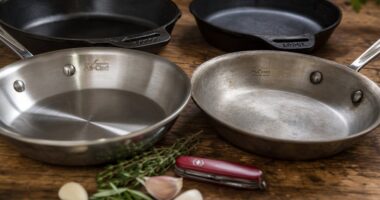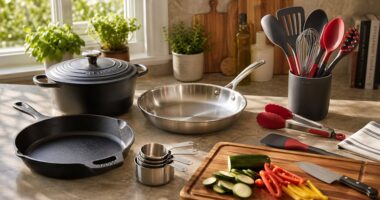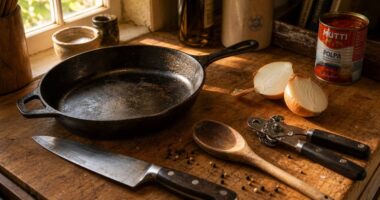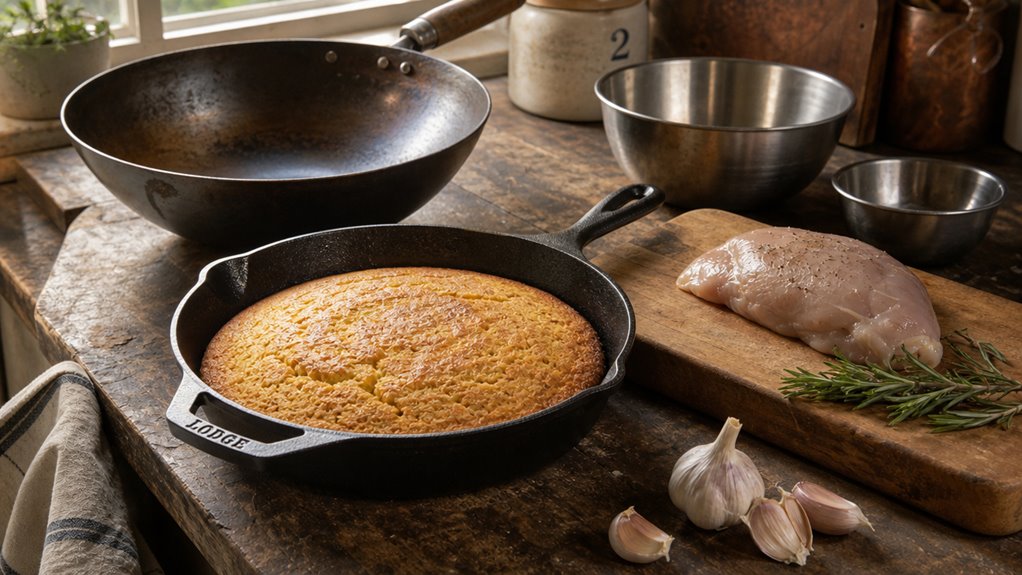
Buy-it-for-life cookware depends on thick-gauge metal construction and mechanical fastening rather than coatings or adhesives. Lodge cast-iron skillets and tri-ply stainless pans share this design logic: the material itself carries the durability, not a surface treatment applied on top.
- Cast iron resists warping because its thickness distributes heat slowly and evenly across a single dense mass.
- Tri-ply stainless construction bonds aluminum and steel into one solid core, eliminating the delamination risk that thinner bonded pans carry.
- Riveted or bolted handles attach mechanically to the pan body, removing the glued or welded joints most likely to fail under repeated heat cycling.
Thick-gauge metal tolerates the abuse that destroys budget cookware. A cast-iron surface can be sanded down or re-seasoned when it degrades, making the pan restorable rather than disposable. A tri-ply stainless pan offers similar longevity through its fused core, which holds its shape across decades of use.
The tradeoff for both materials is weight. Thicker metal means a heavier pan, and cast iron requires periodic seasoning maintenance to stay non-stick. Neither trait disqualifies the cookware; both reflect the same material logic that makes the pans last.
Choosing either material over a coated non-stick pan typically shifts the maintenance burden from replacement to upkeep, which favors long-term cost efficiency over short-term convenience.
The reason cast iron is spoken about in terms of generations rather than years is structural: there is no coating counting down to the end of the pan’s life, and a neglected surface can be stripped and rebuilt rather than replaced. How long any individual piece lasts is a function of how it is kept.
Cheap or expensive is the wrong question. Cost per use is the honest one. Check out our new Calculator.
Cost-Per-Use Calculator →Key Points
- Lodge’s cast‑iron pans are a single‑piece, solid‑material construction that resists warping and delamination, allowing decades of use.
- Thick‑gauge steel or cast‑iron walls distribute heat evenly, reducing thermal stress and extending the life of the cookware.
- Riveted or bolted handles and replaceable gaskets make repairs simple, unlike glued or welded plastic components that fail quickly.
- Bare metal surfaces (cast iron, stainless) can be re‑seasoned or repolished, while coated pans have a consumable layer that degrades permanently.
- The low cost per year of a durable, repairable tool outweighs the higher price of cheap, multi‑material gadgets that break or become obsolete.
| Lodge 6.5″ Cast Iron Skillet – PFAS‑Free Non‑Toxic |  | Professional Grade | Material: Cast iron | Pre‑Seasoned Surface: Pre‑seasoned with natural vegetable oil | Oven‑Safe: Oven‑safe | VIEW LATEST PRICE | Read Our Analysis |
| Lodge Seasoned Cast Iron Griddle 10.5″ Round | 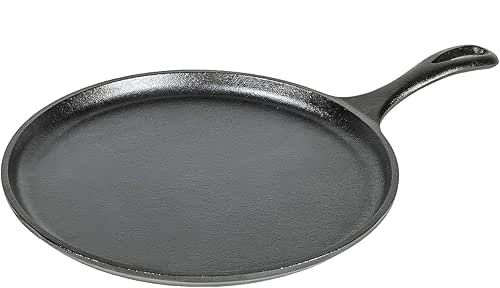 | Heavy-Duty Performer | Material: Cast iron | Pre‑Seasoned Surface: Pre‑seasoned (iron and oil only) | Oven‑Safe: Oven‑safe | VIEW LATEST PRICE | Read Our Analysis |
| 10‑Inch Cast Iron Skillet with Pour Spouts Natural Nonstick | 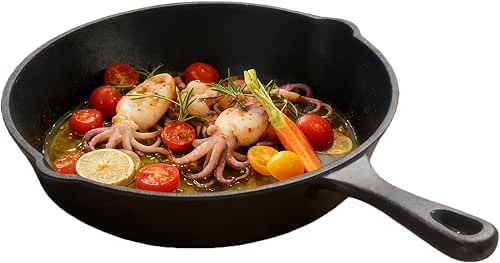 | Best For Beginners | Material: Cast iron | Pre‑Seasoned Surface: Unseasoned (requires initial seasoning) | Oven‑Safe: Oven‑safe (any temperature) | VIEW LATEST PRICE | Read Our Analysis |
Links to Amazon are affiliate links. Buying through one costs you nothing extra and helps fund the research.
What Buy It For Life Really Means for a Cheap Kitchen Tool
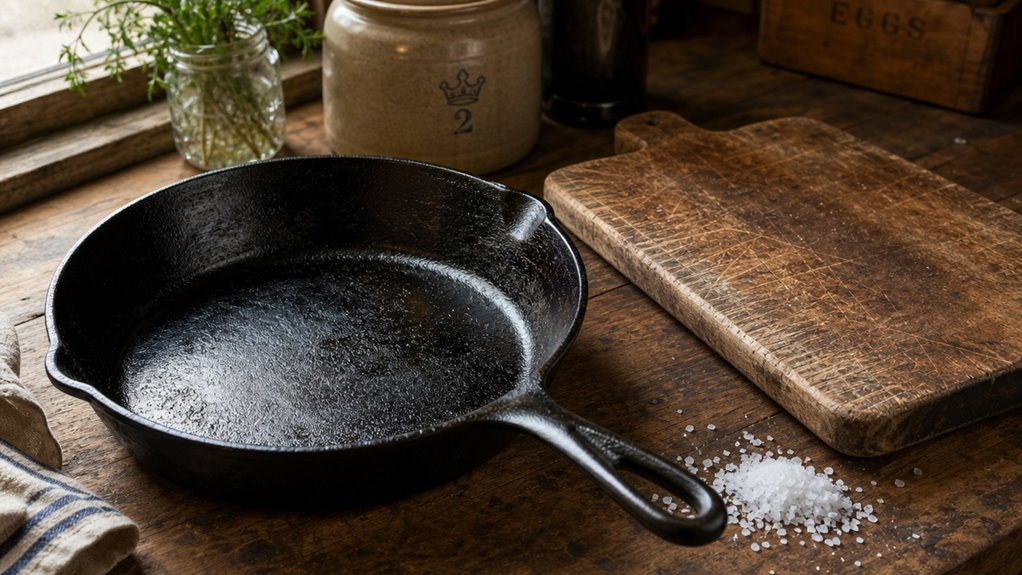
Buy it for life, applied to a cheap kitchen tool, means the construction outlasts the price tier — a budget cast-iron skillet built from a single, thick-gauge material can remain functional for decades, while a more expensive nonstick pan often fails at its coating layer within a few years. Durability is determined by how a tool is built, not what it costs. Features like solid body construction, riveted handles, and a seasoable surface resist the failure points that end a pan’s useful life early. A nonstick coating, by contrast, degrades with heat and abrasion regardless of the pan’s original price. The details behind what separates lasting tools from disposable ones reward a closer look.
Durability That Comes From Construction, Not Price
When you look past the price tag and focus on how a pan is built, you’ll see that construction drives durability far more than cost. Lodge cast iron exemplifies single‑material construction: a solid piece of iron with no welds or glued layers, so there are fewer failure points. The thick walls and base spread heat evenly and resist warping, while the seasoning layer can be stripped and rebuilt forever. No synthetic coating means you won’t face peeling or toxic fumes, and the iron tolerates temperatures that far exceed home cooking. The trade‑off? The pan is heavy and needs regular seasoning to stay non‑stick. The same logic applies to fully clad multi-ply cookware, where the bonded layers run edge to edge rather than stopping at a disc on the base, so there is no joint for thermal stress to work on.
| Material | Construction | Typical Lifespan |
|---|---|---|
| Cast iron | Single‑piece, single‑material | Lifetime with re‑seasoning |
| Tri‑ply stainless | Bonded aluminum core | Decades |
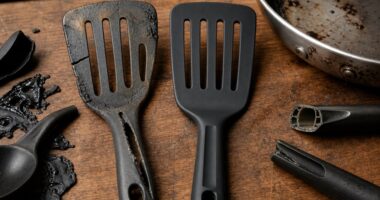
| Non‑stick PTFE | Coated, multi‑layer | Few years |
| Disc‑bottom aluminum | Glued plate | Shorter, may delaminate |
Why a Cheap Tool Can Outlast a Luxury One
The heavy, single‑piece cast‑iron skillet you saw in the last section doesn’t need a fancy label to survive a decade of daily use; its durability comes from the material itself, not a premium price tag.
You’ll notice that cheap tools often have fewer moving parts, thicker gauge steel, and no proprietary coating that can peel.
That simplicity means a seasoning layer can be rebuilt forever, and a solid wood handle can be sanded and oiled instead of replaced.
When you compare a budget single‑material pan to a premium nonstick set several times its price, the cheaper one wins on repairability and lifespan.
- Single‑material construction eliminates delamination.
- Standard screw sizes let you fix a loose handle with a screwdriver.
- Thick‑gauge steel resists warping under high heat.
| Victoria 6.5″ Pre-Seasoned Cast Iron Skillet |  | Best Overall | Material: Cast iron | Pre‑Seasoned Surface: Pre‑seasoned with kosher flaxseed oil | Oven‑Safe: Oven‑safe up to 750 °F | VIEW LATEST PRICE | Read Our Analysis |
| 8 Inch Round Medium Pre-Seasoned Cast Iron Skillet |  | Best Durability | Material: Cast iron | Pre‑Seasoned Surface: Pre‑seasoned (proprietary oil blend) | Oven‑Safe: Oven‑safe | VIEW LATEST PRICE | Read Our Analysis |
| Cast Iron 10″ Skillet with Pour Spouts and Silicone Grip |  | Premium Quality | Material: Cast iron | Pre‑Seasoned Surface: Pre‑seasoned (PFAS‑free) | Oven‑Safe: Oven‑safe | VIEW LATEST PRICE | Read Our Analysis |
Links to Amazon are affiliate links. Buying through one costs you nothing extra and helps fund the research.
The Materials That Decide Whether a Tool Lasts Forever
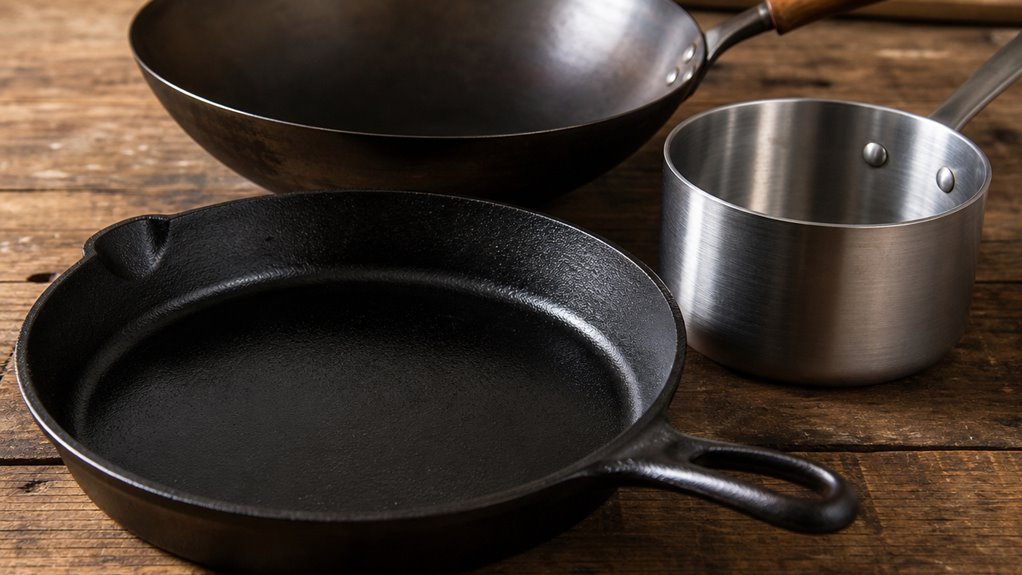
Whether a tool lasts a season or a lifetime comes down to material composition — specifically, whether the functional surface is the material itself or a coating applied on top of it.
Cast iron and stainless steel are uniform throughout, so there’s no separate layer to fail or peel away. Solid wood handles share the same logic: the structural material and the working surface are one and the same.
Coated pans introduce a thin, consumable layer that degrades with use and can’t be meaningfully restored once it breaks down, making the coating itself the weakest point in the tool’s lifespan.
Understanding how these material choices interact with durability, repairability, and long-term performance clarifies why some tools outlast others by decades. Pre-seasoned cast iron arrives with a factory-applied polymerised oil layer rather than a sprayed coating, so the iron surface itself is still the functional layer and can be rebuilt at any point.
Cast Iron, Stainless, and Solid Wood Versus Coatings
Durability isn’t a marketing buzzword; it’s the result of what the tool’s actually made of. You’ll find that cast iron, stainless steel, and solid wood each avoid the pitfalls of coatings in their own way.
- Cast iron – a monolithic block that tolerates 300 °C, resists warping, and can be re‑seasoned after scratches or rust. Its only drawback is the need for regular seasoning to keep the surface non‑sticky. Its high thermal mass is what makes it hold a steady temperature through slow-cooked stews and braises.
- Stainless steel – austenitic alloy forms a self‑repairing chromium‑oxide film, endures abrasive cleaning, and stays dimensionally stable. It can discolor with heat tint, but that’s cosmetic.
- Solid wood – single‑material handles and utensils won’t peel or blister; they char slowly instead of melting. Wood can dry out if not oiled, requiring occasional maintenance.
These materials outlast any nonstick coating that will eventually peel or wear away.
Why Bare Cast Iron Renews Where a Nonstick Coating Only Wears Out
When you heat a cast‑iron skillet, the oil you cook with actually bonds to the metal, forming a thin, polymerized layer that can be rebuilt each time you season it. That layer is a cross‑linked fat polymer, not a sprayed‑on film, so every scrape or bite only removes a micro‑stratum while the iron stays protected.
You can scrub rust or a peeled spot, then re‑oil and bake; the pan restores itself without a new product. A PTFE nonstick coating, by contrast, is a single, fixed‑thickness film. Once scratches or heat break through, the underlying metal is exposed and the coating can’t be regenerated at home.
The result is a pan that can last a lifetime versus a nonstick that wears out in a few years. Seasoning creates a durable, self‑healing surface that can be refreshed repeatedly.
Why Buy It For Life Is About Materials, Not Brand Marketing
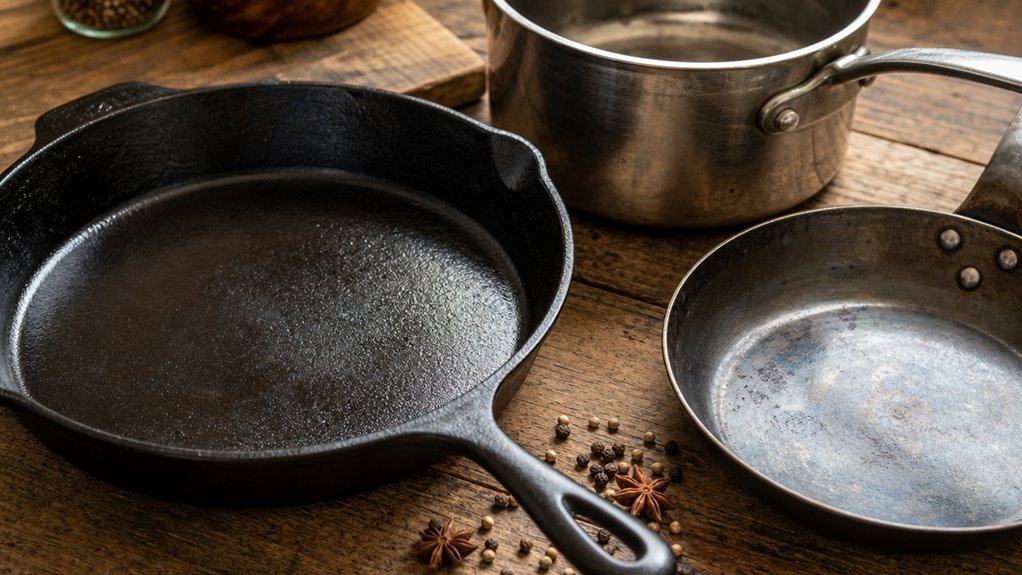
Buy-it-for-life value comes from how a tool is constructed, not from the reputation of the name stamped on it.
Cast iron, for example, is formed as a single solid piece, which means there are no welds, bonded layers, or mechanical joints that can fail under heat or repeated use.
That continuous structure also allows the cooking surface to be re-seasoned when it wears, extending the functional life of the pan without requiring replacement parts or professional repair.
A material’s ability to be maintained or restored is what separates a genuinely durable tool from one that simply carries a durable-sounding marketing claim.
The reasoning behind these distinctions runs deeper than any single material or construction method.
Reading Construction Instead of Believing the Box
If you skip the glossy claims and look at the metal itself, you’ll see why material matters more than any brand slogan. The way you read a tool’s construction tells you whether it will last. You can judge durability by wall thickness, handle attachment, and whether the body is a single material. Those cues beat any box promise.
- Wall thickness & weight – Thick, heavy bases resist warping and spread heat evenly.
- Handle construction – Riveted or one‑piece metal handles stay solid under heat, unlike plastic‑welded knobs.
- Monomaterial body – All‑iron or all‑steel pans avoid delamination, so the pan stays functional for decades.
These simple checks let you skip hype and pick tools that truly endure.
The Repairable Designs That Refuse to Die
Skipping the glossy claims about “engineered durability,” you’ll see that the real secret to a tool that refuses to die lies in its construction.
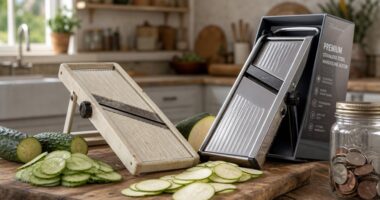
You’ll notice full tang knives with riveted handles; the metal runs the entire length of the handle, so stress spreads evenly and the blade stays secure. Look for cast‑iron skillets and carbon‑steel pans that have bolted or screwed‑on handles—when a handle loosens you can replace it with a standard screw from any hardware store. Manual coffee grinders and mandolines expose separable burrs and springs, letting you swap worn parts instead of trashing the whole unit. These repairable designs keep you cooking without hunting for obscure brand parts.
How Cheap Lodge and Tri-Ply Tools Beat Pricey Gadgets
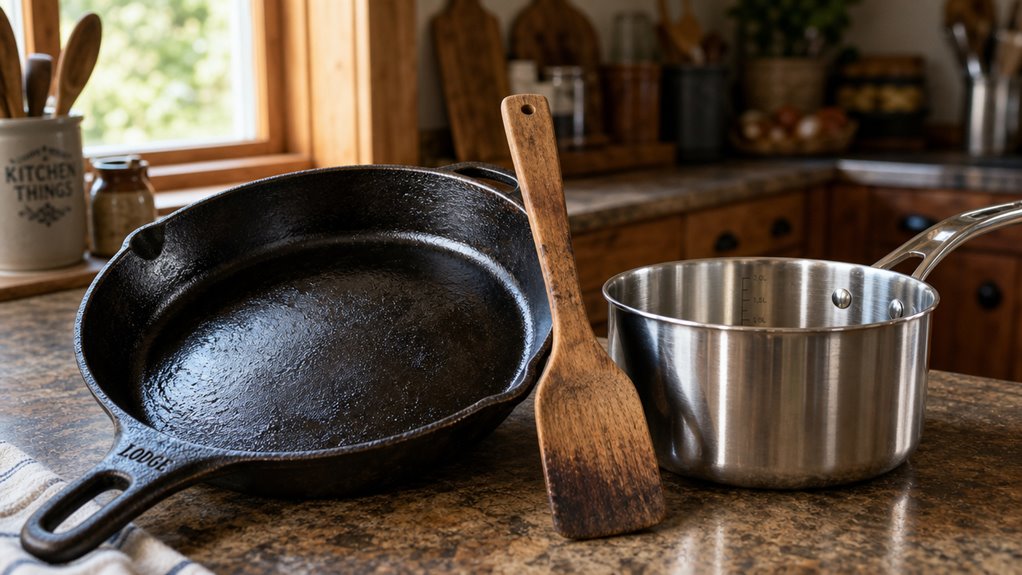
Lodge cast iron and Tramontina tri-ply pans outperform pricier gadgets because their construction eliminates the electronic components and proprietary parts that cause higher-tech cookware to fail or become unrepairable.
Tri-ply bonding sandwiches an aluminum core between two stainless steel layers, giving the pan structural stability that holds across decades of repeated heating cycles.
Budget gadgets often rely on a glued disc bottom instead, which separates under thermal stress and can’t be restored.
Cast iron and coating-free stainless surfaces can be seasoned, re-oiled, or re-seasoned when they wear, making the pan serviceable rather than disposable.
The details behind each of these advantages are worth examining closely.
No Electronics, No Proprietary Parts, Nothing to Peel
A cast‑iron skillet from Lodge has no circuit board, no sensor, and no battery. It is just a solid piece of seasoned iron that you can toss on a stove, an oven, or a campfire. You can buy it for life because there’s nothing that can fail electrically, and you won’t wonder about durability when the pan never needs a firmware update. The same logic applies to tri‑ply pans: they’re all‑metal, no glued bottoms, no proprietary knobs.
- No electronics means no hidden failure points; the metal endures 300 °C cycles.
- No proprietary parts let you swap lids or handles with generic ones.
- No peelable coating gives a surface you can re‑season forever.
These simple designs outlast gadgets that break after a few years.
Why Bonded Tri-Ply Lasts Decades Where a Glued Disc Bottom Fails
When you compare a bonded tri‑ply skillet to a pan with a glued disc bottom, the difference shows up in the way the metal is put together. Bonded cladding rolls a single sheet of stainless‑aluminum‑stainless into a permanent laminate, so the core runs from base to rim. No joint means no place for water or steam to creep in, so delamination never becomes a problem.
A glued disc bottom, on the other hand, attaches a thick aluminum plate to a thin stainless shell. The mismatched expansion creates shear stress at the bond line, leading to warping, rattling, and eventually the disc separating. Because the tri‑ply spreads heat evenly across the sidewalls, it avoids hot‑spot stress that would otherwise fatigue a disc‑bottom design. The result is a pan that keeps its shape and performance for decades, while the glued‑disc version often fails after a few years of normal cooking.
How to Tell a Buy-It-For-Life Tool Before You Buy
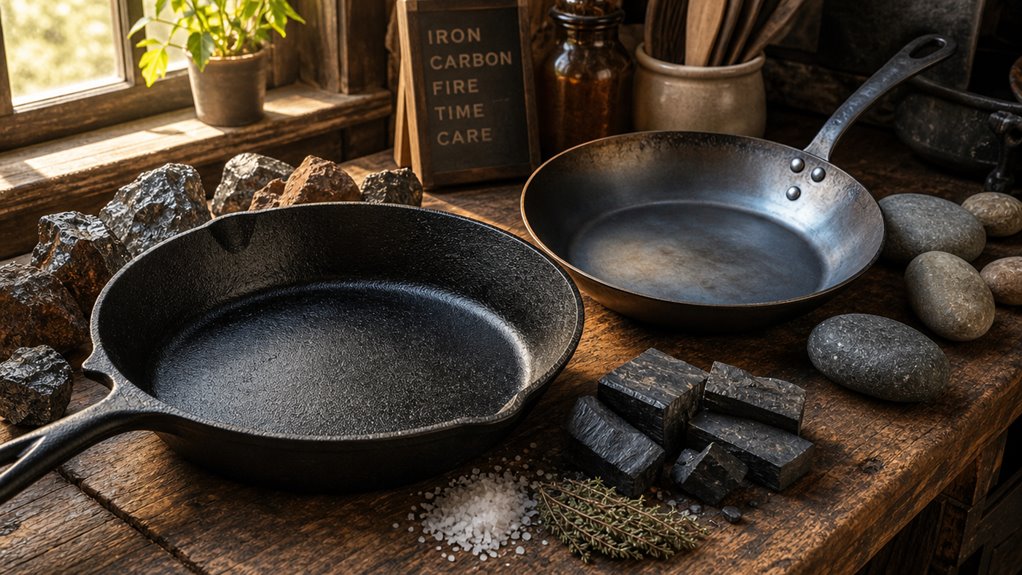
A buy-it-for-life tool earns that designation through material integrity, repairability, and a cost-per-year ratio that holds up over decades of use.
Single-material construction with riveted or bolted joints resists the warping and delamination that tend to shorten the lifespan of glued composite tools.
Repairability matters just as much, because a tool whose handles, knobs, or gaskets can be unscrewed and swapped out remains functional long after a sealed design would be discarded.
Budget-tier pricing doesn’t disqualify a tool from this category — when a well-built item under thirty dollars lasts for decades, the annual cost typically drops to a negligible figure.
The criteria that distinguish durable tools from disposable ones are worth examining closely.
The Quick Checks for Material, Joints, and Repairability
If you walk past a kitchen aisle and spot a spatula that looks cheap but claims “professional‑grade durability,” start by checking what it’s really made of.
First, confirm the base material—solid cast iron, carbon steel, thick‑gauge stainless, or hardwood. Thin stamped metal or mystery alloys mean you’ll lose lifetime value fast.
Next, examine the joint. A full‑length tang riveted through a solid handle beats a spot‑welded or glued connection that will loosen under torque.
Finally, assess repairability. Tools that can be re‑seasoned, re‑oiled, or have replaceable rivets stay functional for decades.
- Material thickness and uniformity
- Rivet type and joint reinforcement
- Ability to re‑season or replace parts
Matching Lifetime Value to the Under-$30 Ceiling
A solid, single‑material tool can outlast a pricey gadget, even when it costs less than $30. To match lifetime value to that ceiling, focus on cheap kitchen tools that last forever because their material is simple and repairable.
Look for a stainless‑steel spatula, a cast‑iron skillet, or a carbon‑steel whisk—each has one dominant metal, no nonstick coating, and no glued plates that can delaminate. Those are the tools most likely to outlast their pricier rivals.
They survive years of daily use, need only occasional seasoning or a new handle, and replace multiple specialty gadgets. Calculate cost‑per‑use: a budget pan lasting twenty years amortizes to pennies per meal, far cheaper than a pricier nonstick that peels in three.
Frequently Asked Questions
Can I Use Cast‑Iron on Induction Without a Disc?
Yes, you can place cast‑iron directly on induction; its ferrous material couples with the magnetic field, so you don’t need a disc. Just make sure the bottom’s flat and clean for peak contact.
How Often Should I Re‑Season a Lodge Pan?
You should re‑season a Lodge pan about once or twice a year. Think of it like a car’s oil change; occasional full‑oven cycles keep the “engine” running smoothly while daily oiling handles the wear.
Do Tri‑Ply Pans Need Special Utensils?
You don’t need special utensils for tri‑ply pans; metal, silicone, wood, or nylon tools work fine. Just avoid sharp edges that could gouge the finish, and rinse gently to keep the surface intact.
What’s the Best Way to Store Wooden Handles?
You should hang wooden‑handled tools on a pegboard or store them upright in a ventilated crock, keep them dry, away from heat, UV, and steam, and oil the finish regularly.
Are There Any Safe DIY Repairs for Cracked Non‑Stick Coatings?
You can’t safely fix a cracked non‑stick coating; the only reliable DIY is thorough cleaning and re‑seasoning a still‑intact surface. For real cracks, discard the pan and replace it with a repairable, coating‑free alternative.
Conclusion
You’ll keep a Lodge skillet on the stove for decades, while a pricey non‑stick pan flakes after a few seasons. The tri‑ply pot’s single‑core aluminum stays even‑heated, unlike a cheap‑priced bottom that warps over time. Both survive scratches, rust, and heat, but Lodge’s weight can be a hassle to lift. Choose the tool that endures, not the brand that promises eternity.
| Utopia Kitchen Pre-Seasoned Cast Iron Skillet with Lid (10″) |  | Most Versatile | Material: Cast iron | Pre‑Seasoned Surface: Pre‑seasoned (additional seasoning recommended) | Oven‑Safe: Oven‑safe | VIEW LATEST PRICE | Read Our Analysis |
| 4-Pack Mini Cast Iron Skillet Set 6‑Inch Pre‑Seasoned Non‑Stick | 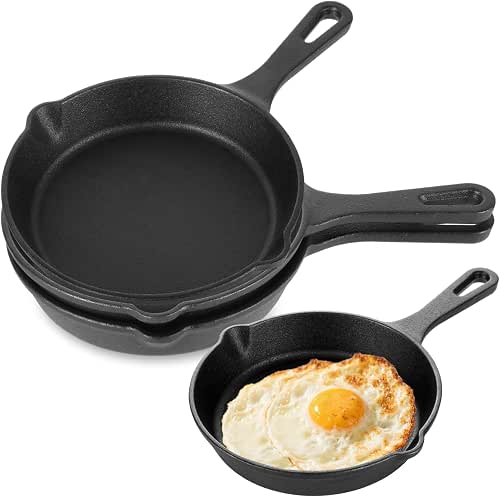 | Value Pack | Material: Cast iron | Pre‑Seasoned Surface: Pre‑seasoned non‑stick | Oven‑Safe: Oven‑safe | VIEW LATEST PRICE | Read Our Analysis |
| Cast Iron Skillet with Lid Scrubber and Oven Mitts (8.5″) |  | All‑In‑One | Material: Cast iron | Pre‑Seasoned Surface: Pre‑seasoned (seasoned cast iron) | Oven‑Safe: Oven‑safe | VIEW LATEST PRICE | Read Our Analysis |
Links to Amazon are affiliate links. Buying through one costs you nothing extra and helps fund the research.

Michael Haralson worked in professional kitchens from 1979 to 1992: San Diego restaurants, six years with a catering company beside an Austrian chef, and two summers as a cook on the Finland to Sweden cruise route. He then built a fifteen-year career at Nokia. It began in product marketing and product management, where technical specifications and supplier evaluation were part of the work, and grew from a few countries to a region to global roles, then into sales and corporate strategy. That took him to Beijing for three years, where he spent many weekends in a different province trying the local food and took cooking classes. He has eaten in more than 40 countries and has been shown the kitchens of restaurants in Southern Europe. At home in Finland he cooks Cantonese, Sichuan and Mediterranean food, and still uses the cast iron skillet he bought in 1992. He is the author of Buy It Once, Book One of The Researched Kitchen, and writes here about the balance between kitchen tools that cost too much and those that fail too soon.