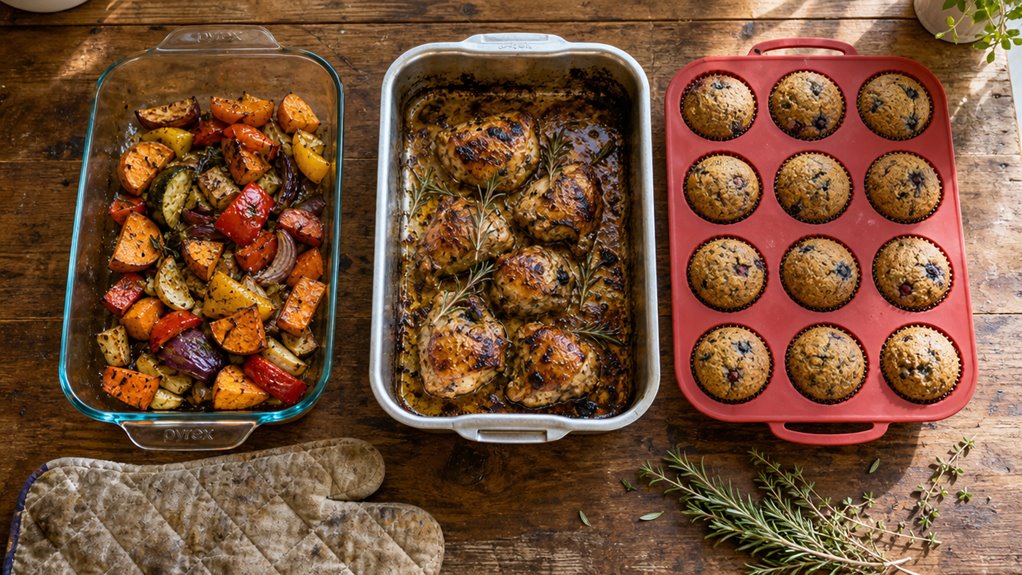
Choosing bakeware depends on how each material handles heat, releases food, and holds its shape over time. Glass, metal and silicone each suit different tasks, and understanding their thermal and structural properties helps cooks match the right pan to the right recipe.
- Glass heats slowly and distributes warmth evenly, making it well suited for custards and deep casseroles.
- Metal pans conduct heat rapidly, producing crisp edges and browned surfaces that slower materials cannot match.
- Silicone bakeware releases food cleanly and tolerates repeated use, though it can lose structural rigidity after extended wear.
Glass holds temperature well once it reaches the target heat, but it carries a notable vulnerability. Rapid thermal change, such as moving a dish directly from freezer to oven, can cause the glass to crack. Handling glass bakeware with gradual temperature shifts reduces that risk considerably.
Metal pans vary widely by gauge and coating. Thin-gauge metal warps under high heat, and non-stick coatings typically wear out before the underlying metal shows any structural failure. Heavier-gauge metal holds its shape longer and performs more consistently across repeated use cycles.
Silicone remains cool to the touch and resists damage across many baking cycles. After extended use, however, silicone can become floppy and fail to hold its molded shape, which affects how evenly baked goods form and release.
One distinction matters more than any number here. Borosilicate glass, used in older US bakeware and still common in European glass bakeware, tolerates a much larger temperature differential than tempered soda-lime glass, which is the formulation used in modern US-made Pyrex-branded dishes. Published thermal-shock figures vary by manufacturer and by product, so rather than trusting a single number, work out which material your own dish is and follow that manufacturer’s use-and-care instructions. Whichever you have, the freezer-to-oven move is the one that breaks glass bakeware.
Cheap or expensive is the wrong question. Cost per use is the honest one. Check out our new Calculator.
Cost-Per-Use Calculator →Key Points
- Glass bakeware endures many bake cycles but fails under rapid temperature changes or broiler exposure, cracking or shattering.
- Heavy‑gauge metal pans resist warping and last for years; thin or non‑stick‑coated metal warps or peels sooner under high heat.
- Silicone holds its molded shape through many bake cycles, then loses elasticity and goes floppy after repeated high‑temperature cycles, though it rarely cracks.
- Metal offers fastest browning and crisp edges, but its high conductivity can cause uneven cooking in moist, deep dishes.
- Glass provides even, steady heat ideal for custards and casseroles, yet its low conductivity delays crust formation compared with metal.
| Pyrex 9″ Pie Plate (Pack of 2) Glassware |  | Best Overall | Material: Nonporous glass | Oven Safe: Yes | Microwave Safe: Yes | VIEW LATEST PRICE | Read Our Analysis |
| Anchor Hocking Glass Baking Dishes 2-Piece Set (2 Qt and 3 Qt) |  | Budget-Friendly | Material: Tempered glass | Oven Safe: Yes | Microwave Safe: Yes | VIEW LATEST PRICE | Read Our Analysis |
| Anchor Hocking Glass Bread Pan 1.5 Quart Loaf Pan Set of 3 |  | Space Saver | Material: Tempered glass | Oven Safe: Yes | Microwave Safe: Yes | VIEW LATEST PRICE | Read Our Analysis |
Links to Amazon are affiliate links. Buying through one costs you nothing extra and helps fund the research.
How Glass Bakeware Behaves in a Hot Oven
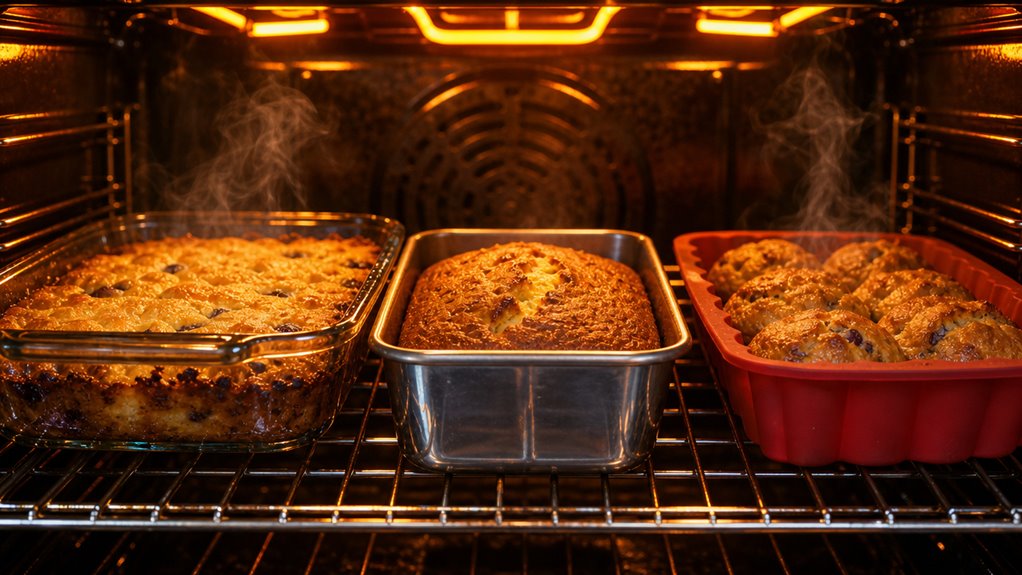
Glass bakeware heats gradually and distributes heat evenly across its surface, which makes it well-suited for temperature-sensitive preparations like custards that can curdle under uneven or intense heat. In most modern US dishes, including Pyrex-branded ones, the material is tempered soda-lime glass, which handles the steady ambient heat of a pre-heated oven without issue. Where soda-lime glass becomes vulnerable is thermal shock. A rapid temperature swing, such as moving a cold dish directly from the refrigerator into a hot oven set around 425 °F, creates stress the glass can’t absorb and can cause it to crack. Understanding how the material responds to heat, and where its limits fall, shapes how safely and effectively the bakeware performs. The details that follow cover what those conditions mean in practice. Glass bakeware is generally oven-safe to a stated maximum and should never be placed under a broiler. Check the figure printed on your own dish or its use-and-care sheet, since it differs between manufacturers and product generations.
Slow Even Heat and the Thermal-Shock Weakness
A glass dish comes up to temperature slowly. Its low thermal conductivity means the heat spreads gently across the walls, keeping the interior temperature even but taking its time to reach the target.
The glass is tempered soda‑lime, so it holds a surface compression that helps it survive modest temperature shifts, yet it still suffers from thermal shock if a hot spot appears.
As the oven warms, the base and rim heat faster than the center, creating internal gradients that can stress corners and handles.
You’ll notice the food cooks uniformly, but the dish retains heat long after you pull it out, so the bake continues.
To protect the tempered glass, preheat fully, place it on the middle rack, and avoid direct contact with heating elements.
This slow, even heat is great for custards, but it also means sudden temperature changes can crack the dish. Thermal shock is the failure mode to manage here, rather than oven temperature on its own. It is also why a shortlist of glass bakeware sets from known glassmakers is worth more than an unbranded dish at the same price. For the temperature ceiling and the handling limits that apply to the dish you actually own, check the manufacturer’s own use-and-care information, since the formulation and the ratings differ between brands, regions and product generations.
Why Modern Pyrex Can Crack on a Sudden Temperature Swing
When you slide a modern Pyrex dish straight from the freezer into a pre‑heated oven, the sudden temperature jump can push the glass past its stress limit and cause it to crack.
Today’s U.S. Pyrex is made of soda‑lime glass, not the borosilicate of older models. Soda‑lime has a lower thermal‑shock tolerance, so the rapid gradient between a frozen surface and a 425 °F oven creates high internal stress.
The glass is tempered, meaning the surface is under compression while the interior is under tension; any micro‑crack or chip acts as a stress concentrator. When the temperature swing exceeds the material’s safe envelope, the stored tension releases, and the dish shatters or cracks.
Avoid moving a cold dish straight into hot heat, and let it warm gradually to stay safe. Microcracks significantly lower the temperature resistance of even modern soda‑lime Pyrex.
What Metal and Silicone Each Do Differently
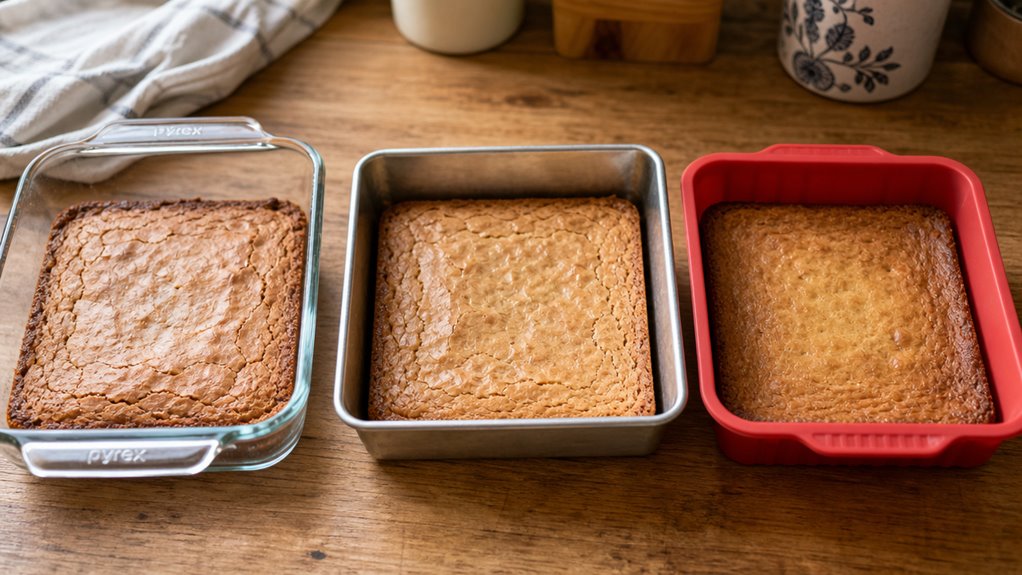
Metal and silicone behave differently because they transfer heat in fundamentally different ways. Metal conducts heat rapidly and efficiently, producing browned, crisp edges on baked goods, while silicone resists heat transfer, staying cooler longer and releasing finished items cleanly from the mold without the same crust formation. Heat conductivity is the core variable that separates these two materials in practical baking outcomes.
Metal pans can warp under repeated high heat, particularly when the gauge is thin, whereas silicone molds may lose structural rigidity over time and become floppy with extended use. Each material suits different baking tasks, and understanding their physical properties helps explain why one performs where the other falls short.
The sections ahead cover how those differences play out across specific baking conditions. Metal’s superior heat conduction enables faster browning, while silicone’s low conductivity preserves delicate textures.
Fast Heat and Crisp Browning From Metal
Metal bakeware delivers fast heat and crisp browning because its high thermal conductivity shuttles burner energy to the food surface in seconds, while silicone barely moves heat at all.
You’ll notice the difference the first time you drop a cold dough into a metal pan and the same dough into a glass dish; the metal reaches searing temperature almost at once, while the glass lags but holds heat longer.
Aluminum spreads heat at about 200 W/m·K, copper near 400 W/m·K, so the surface recovers quickly after a cold ingredient lands.
That rapid spread prevents cool spots, giving you uniform, golden edges.
The trade‑off is that thin metal can warp under high heat, so choose a sturdy gauge if you plan to push the oven hard. Reinforced rims and heavier gauge are what separate the pans in our rundown of Nordic Ware sheet and cake pans from the thin trays that bow on the first bake.
Silicone, by contrast, behaves like an insulator, so it won’t help you get that crisp crust.
Thermal diffusivity is higher in copper and aluminum, allowing them to equalize temperature across the pan surface faster than stainless steel.
Why Metal Browns and Heats Faster but Glass Holds Heat Longer
Heat moves through a metal pan in seconds because aluminum and steel conduct energy at hundreds of watts per meter‑kelvin, shuttling oven heat straight to the food surface and pulling it back out as the air cools.
Metal bakeware’s high conductivity means the crust hits 350 °F quickly, so Maillard reactions start early and you get that crisp edge.
Glass bakeware, by contrast, has low conductivity and higher heat capacity, so it warms slowly and stores heat longer.
When you pull a glass dish from the oven, the retained energy keeps the interior cooking for minutes, reducing carry‑over cooling.
The downside: glass’s insulation delays browning, so you often need to lower the oven temperature and add a few minutes to the bake time.
When Glass Bakeware Outlasts Metal and Silicone
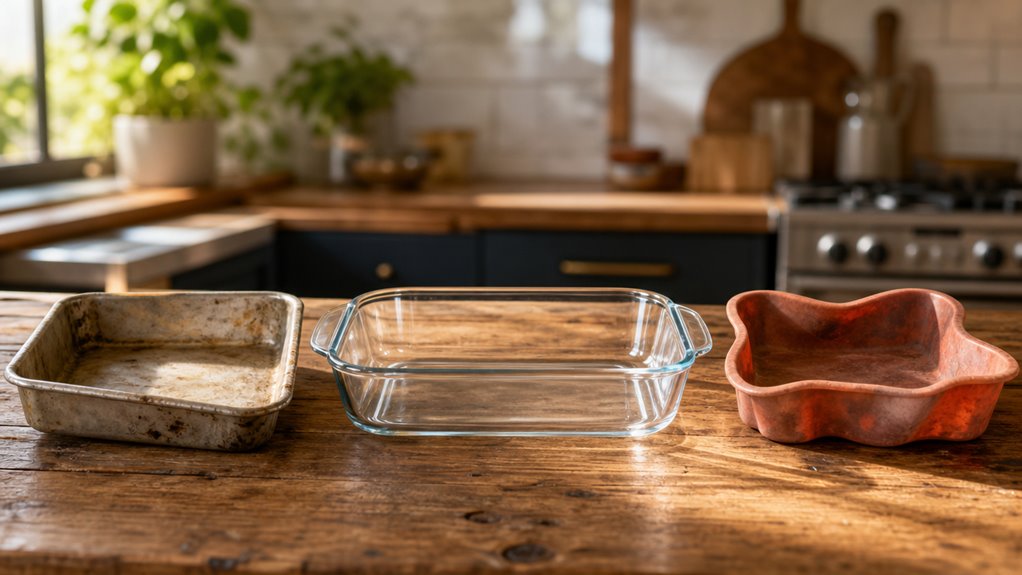
Glass bakeware outlasts metal and silicone in applications that demand even, sustained heat: casseroles, bread puddings, and wet bakes where a gradual temperature rise protects moisture and prevents the hardened edges that metal pans tend to produce.
Glass conducts heat more slowly than metal, which means reducing the oven temperature by around 25 °F and extending bake time slightly can improve results without sacrificing doneness.
That slow conductivity is also why thermal shock is a genuine concern. Moving a cold glass dish directly into a hot oven risks cracking it, so gradual heating remains a practical requirement rather than a suggestion.
Understanding these properties shapes every decision about when glass bakeware is the right choice and when it’s not.
The Dishes Where Even, Steady Heat Wins
When you bake a custard‑heavy bread pudding or a jam‑filled cobbler, the steady, even heat of a glass dish can make all the difference. Its thermal mass keeps temperature swings low, so the custard sets gently without curdling and the fruit softens gradually.
Of the three materials, glass holds heat longer, preventing dry rims while the center stays moist. You’ll see uniform bubbling in deep casseroles and lasagnas, and the top crusts brown evenly without the rapid scorching metal can cause.
Metal heats fast and browns quickly, but it also creates hot spots. Silicone, while flexible, conducts heat poorly, leaving custards pale and extending bake time. Use glass for moist, long-bake dishes where steady heat wins.
Matching the Pan Material to the Dish
If you’re baking a wet casserole or a delicate custard, the material you choose can be the difference between a smooth set and a cracked mess.
For deep, moisture‑rich dishes, glass spreads heat gently, keeping edges from over-cooking while the center stays even; it also stays nonreactive with acidic sauces, so you won’t pick up metallic flavors.
When you need a crisp top on a shallow gratin, metal pans heat fast and brown quickly, but thin steel can warp if you push them too hard.
Silicone bakeware shines for muffins and free‑standing molds because it releases easily, yet its low conductivity leaves dense, wet casseroles undercooked and it can become floppy after many cycles.
Match the pan to the dish: glass for steady, wet bakes; metal for quick browning; silicone for release‑focused treats.
The Durability and Failure Modes of Each Material
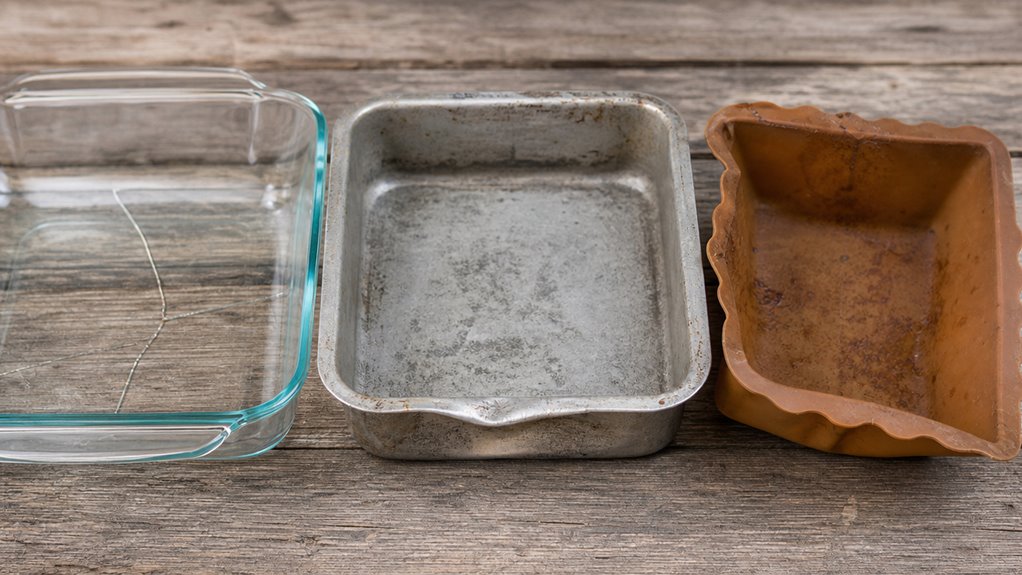
Each baking material fails in a distinct way, and understanding those failure modes helps explain why durability varies so much across glass, metal, and silicone.
Glass conducts heat evenly but is vulnerable to thermal shock, meaning a rapid shift from cold to high oven heat can cause it to crack or shatter.
Metal holds its rigid structure well under heat but can warp when thin gauge pans are exposed to uneven temperatures over repeated use.
Silicone resists sticking and releases cleanly, yet its flexible composition means it gradually loses its original shape after many baking cycles.
The way each material degrades under stress has direct consequences for both bakeware performance and long-term reliability.
Cracking Glass, Warping Metal, and Floppy Worn Silicone
Because glass expands slowly, a sudden temperature jump can shatter a glass dish in an instant. You’ll hear that cracking glass is a shock‑driven event, not a slow fatigue. Metal, on the other hand, tends to warp when thin sections heat unevenly, especially near a broiler. Silicone stays flexible, but repeated baking makes it floppy and less supportive, so it loses shape over time.
| Material | Typical Failure |
|---|---|
| Glass | Cracking glass from thermal shock |
| Metal | Warping under high, uneven heat |
| Silicone | Floppy, worn after many cycles |
| All | Surface scratches accelerate damage |
Treat each bakeware by its own limits, and match the dish to the material you trust.
Why Silicone Releases Cleanly but Metal Gives Structure and Browning
Cracking glass and warping metal showed how each material reaches its breaking point, but the next step is looking at why silicone lets you pop a cake out cleanly while metal holds shape and creates a crisp crust.
Silicone’s low‑friction surface gives effortless release, but its poor heat conduction means the batter heats slowly, so you lose browning. Metal’s high heat conduction crisps the edges, and its rigidity keeps walls straight, giving tall rise and crisp crust.
Here’s a quick breakdown:
- Heat conduction – metal fast, silicone slow.
- Release – silicone nonstick, metal needs greasing.
- Structure – metal rigid, silicone flexible.
- Failure – silicone wears floppy, metal can warp if thin.
The trade-off with silicone is release versus browning. Choose metal for crust, silicone for easy demold.
Which Bakeware Lasts and Which Fails Over Time
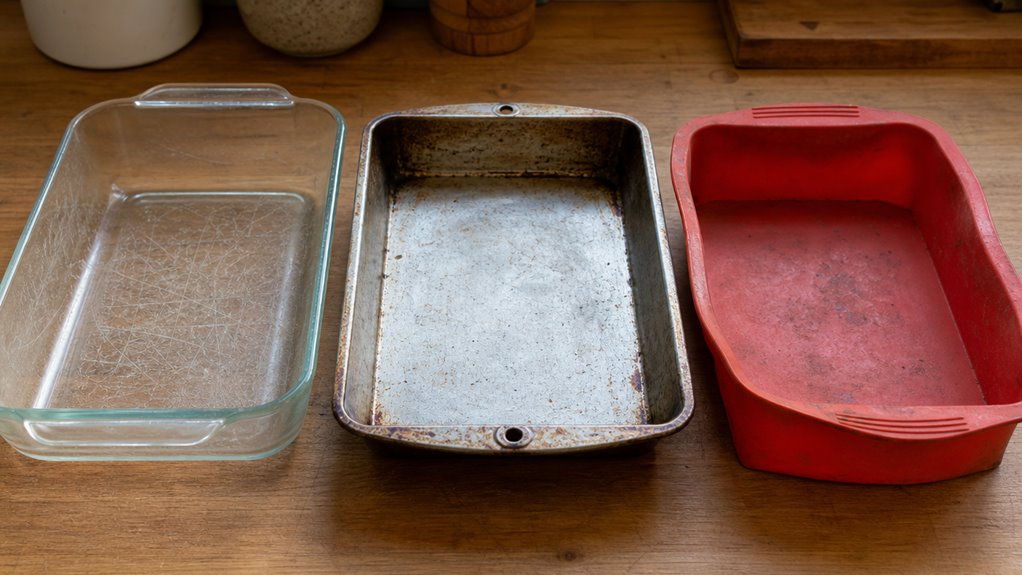
Bakeware durability depends largely on material and construction. Heavy-gauge metal pans hold their shape through repeated high-heat cycles, while thin or lightly coated alternatives often warp early, and glass dishes deliver even, gentle heat but can crack permanently if exposed to a sudden temperature shift.
Thermal shock is a consistent failure point for glass, making careful handling a practical requirement rather than a precaution.
Silicone resists cracking across years of regular use, though it can gradually lose structural firmness, particularly when used near its temperature ceiling.
Understanding how each material responds to heat, time, and handling reveals why some pans remain reliable after years of use while others degrade quickly. The details that follow clarify what separates durable bakeware from the kind that fails early.
Reading Construction and Care for Real Lifespan
When you look at a pan’s construction, the material tells you most of the story about how long it will actually last. A modern US glass dish, now tempered soda-lime, still inherits the old borosilicate reputation for even heating, but it cannot survive a sudden freezer-to-oven jump. Aluminum and stainless pans are often sold with a nonstick coating, and that coating peels after a few dozen high‑heat cycles, yet the metal underneath stays solid. Silicone stays flexible, but repeated exposure near its top temperature makes it floppy and chalky.
- Glass – slow heat, retains warmth, cracks on thermal shock.
- Metal – rapid heat, browns fast, warps if thin.
- Silicone – flexible release, soft bake, loses elasticity with age.
- Coatings – nonstick wear dictates end of life before metal fails.
Treat each material according to its strengths, and you’ll avoid premature failure.
Matching the Right Bakeware to the Under-$30 Ceiling
You’ve already seen how construction and care dictate a pan’s lifespan, so let’s line that up with a $30 budget.
If you need crisp edges on cookies or a brown crust on a loaf, metal bakeware gives you fast heat transfer and durability; a basic sheet pan stays warp‑free for years and costs well under thirty.
For casseroles, lasagna, or anything that benefits from even, gentle heat, glass bakeware works, but it’s heavier and can crack if you swing from fridge to oven.
Silicone stays cheap and non‑stick, yet it won’t brown anything and will soften after repeated use.
Match the material to the job, and you’ll avoid frequent replacements while staying within the price ceiling. The same reading of gauge and coating decides stovetop pans too, which is why our compact cookware judged piece by piece leaves boxed sets out.
Frequently Asked Questions
Can I Use a Metal Pan on a Glass Baking Sheet?
You can, but it is not a good idea. Metal on glass causes uneven heat and localized stress. For reliable results, stick to metal‑on‑metal or use glass alone, adjusting temperature and time.
Do Silicone Mats Affect Oven Temperature Accuracy?
No, silicone mats don’t alter your oven’s thermostat reading; they just insulate the food, so you may notice slower browning or slightly longer bake times, but the temperature stays accurate.
Can Cracked Glass Bakeware Ever Be Repaired Safely?
No. A crack compromises structural integrity, and any DIY fix can’t restore oven‑grade strength, so you should discard it and replace it with an undamaged dish.
How Does Altitude Change Each Material’s Performance?
At altitude, glass heats slower and risks more cracks from rapid swings; metal stays quick, browns well, and resists shock; silicone conducts poorly, browns weakly, and may warp or stay soft.
What’s the Best Way to Clean Warped Metal Bakeware?
Clean warped metal by cooling it fully, soaking in warm soapy water, scrubbing gently with a nylon pad, then drying thoroughly; avoid sudden temperature changes and harsh detergents.
Conclusion
You’ll probably keep a metal sheet for anything that needs crisp edges, a glass dish for steady, even heat, and a silicone tray for easy release. Glass can shatter if you plunge it from fridge to oven; silicone can warp after repeated high‑heat cycles; metal may warp if you overheat it. Pick the material that matches the dish, and you’ll avoid the most common failures.

Michael Haralson worked in professional kitchens from 1979 to 1992: San Diego restaurants, six years with a catering company beside an Austrian chef, and two summers as a cook on the Finland to Sweden cruise route. He then built a fifteen-year career at Nokia. It began in product marketing and product management, where technical specifications and supplier evaluation were part of the work, and grew from a few countries to a region to global roles, then into sales and corporate strategy. That took him to Beijing for three years, where he spent many weekends in a different province trying the local food and took cooking classes. He has eaten in more than 40 countries and has been shown the kitchens of restaurants in Southern Europe. At home in Finland he cooks Cantonese, Sichuan and Mediterranean food, and still uses the cast iron skillet he bought in 1992. He is the author of Buy It Once, Book One of The Researched Kitchen, and writes here about the balance between kitchen tools that cost too much and those that fail too soon.